
The International Linear Collider Project and Industrial Implications
- Slides: 47
The International Linear Collider Project and Industrial Implications. Akira Yamamoto (KEK-CERN-LCC) Japanese-Spanish industrial Forum on accelerator technologies and advanced detector instrumentation ECFA LC 2016, Industrial Session, , 1 June. , 2016 A. Yamamoto, 160601 1
Outline • Introduction • Technical Progress • Global Collaboration and Industrial Implications • Summary A. Yamamoto, 160208 2
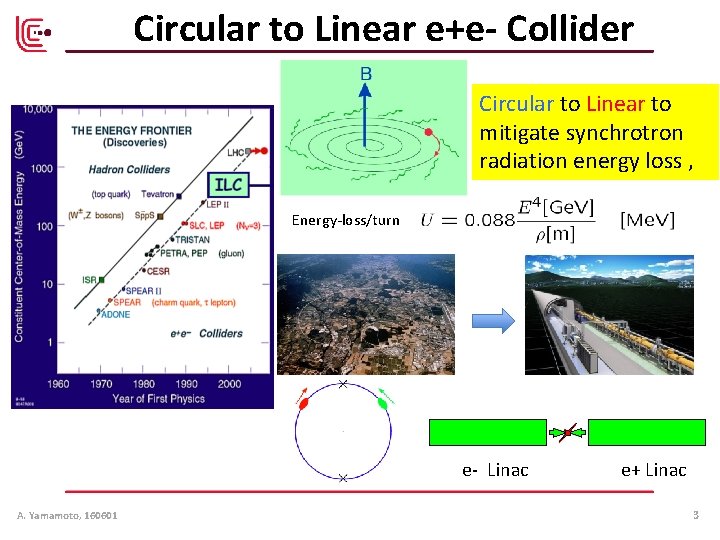
Circular to Linear e+e- Collider Circular to Linear to mitigate synchrotron radiation energy loss , Energy-loss/turn e- Linac A. Yamamoto, 160601 e+ Linac 3
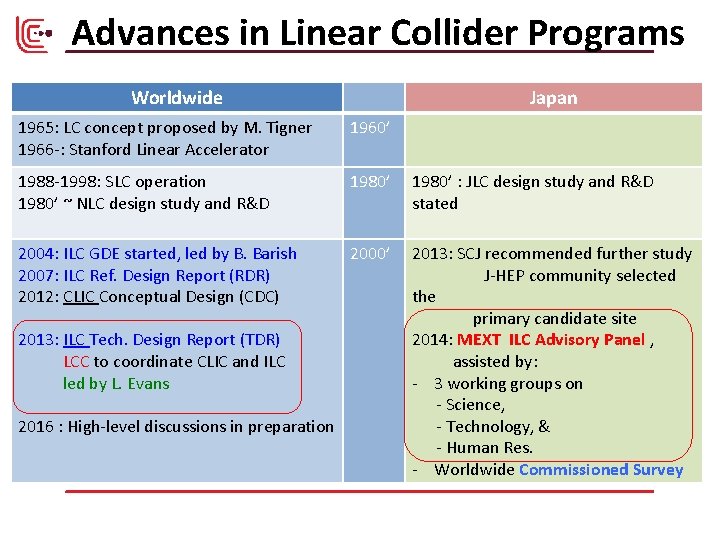
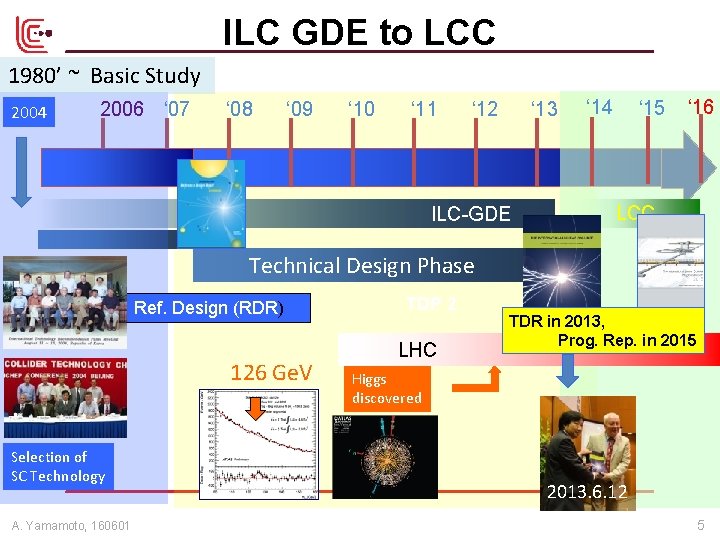
Advances in Linear Collider Programs Worldwide Japan 1965: LC concept proposed by M. Tigner 1966 -: Stanford Linear Accelerator 1960’ 1988 -1998: SLC operation 1980’ ~ NLC design study and R&D 1980’ : JLC design study and R&D stated 2004: ILC GDE started, led by B. Barish 2007: ILC Ref. Design Report (RDR) 2012: CLIC Conceptual Design (CDC) 2000’ 2013: SCJ recommended further study J-HEP community selected the primary candidate site 2014: MEXT ILC Advisory Panel , assisted by: - 3 working groups on - Science, - Technology, & - Human Res. - Worldwide Commissioned Survey 2013: ILC Tech. Design Report (TDR) LCC to coordinate CLIC and ILC led by L. Evans 2016 : High-level discussions in preparation
ILC GDE to LCC 1980’ ~ Basic Study 2004 2006 ‘ 07 ‘ 08 ‘ 09 ‘ 10 ‘ 11 ‘ 12 ‘ 13 Ref. Design (RDR) 126 Ge. V Selection of SC Technology A. Yamamoto, 160601 TDP 2 LHC ‘ 15 ‘ 16 LCC ILC-GDE Technical Design Phase ‘ 14 TDR in 2013, Prog. Rep. in 2015 Higgs discovered 2013. 6. 12 5
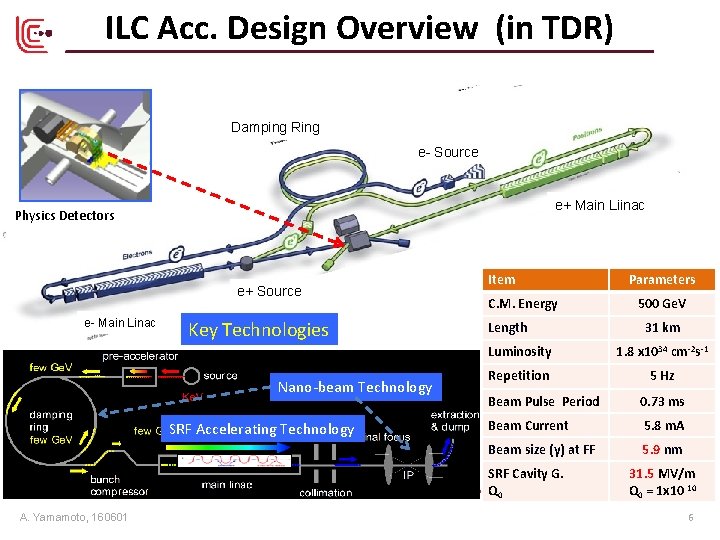
ILC Acc. Design Overview (in TDR) Damping Ring e- Source e+ Main Liinac Physics Detectors e+ Source e- Main Linac Key Technologies Nano-beam Technology SRF Accelerating Technology Item C. M. Energy Length 500 Ge. V 31 km Luminosity 1. 8 x 1034 cm-2 s-1 Repetition 5 Hz Beam Pulse Period 0. 73 ms Beam Current 5. 8 m. A Beam size (y) at FF 5. 9 nm SRF Cavity G. Q 0 A. Yamamoto, 160601 Parameters 31. 5 MV/m Q 0 = 1 x 10 10 6
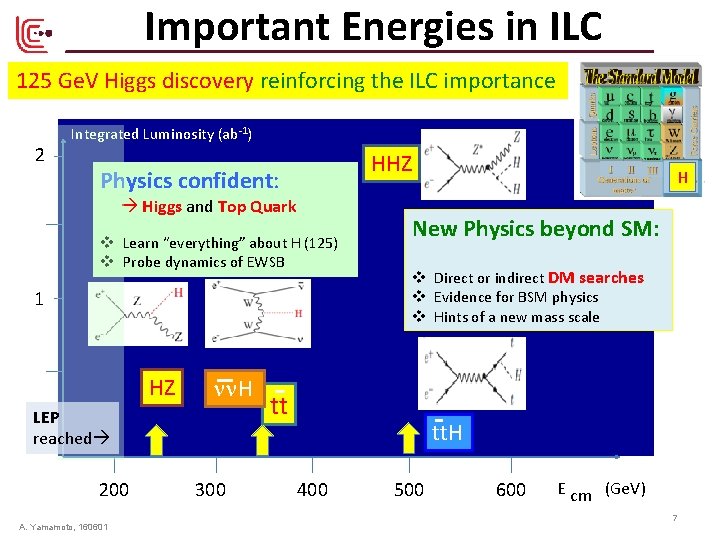
Important Energies in ILC 125 Ge. V Higgs discovery reinforcing the ILC importance 2 Integrated Luminosity (ab-1) HHZ Physics confident: Higgs and Top Quark v Learn “everything” about H (125) v Probe dynamics of EWSB 1 HZ nn. H LEP reached 200 A. Yamamoto, 160601 300 K. Kawagoe (modified) H New Physics beyond SM: v Direct or indirect DM searches v Evidence for BSM physics v Hints of a new mass scale tt tt. H 400 500 600 E cm (Ge. V) 7
Introduction Outline Technical Progress Global Collaboration and Industrial Implications Summary A. Yamamoto, 160601 8
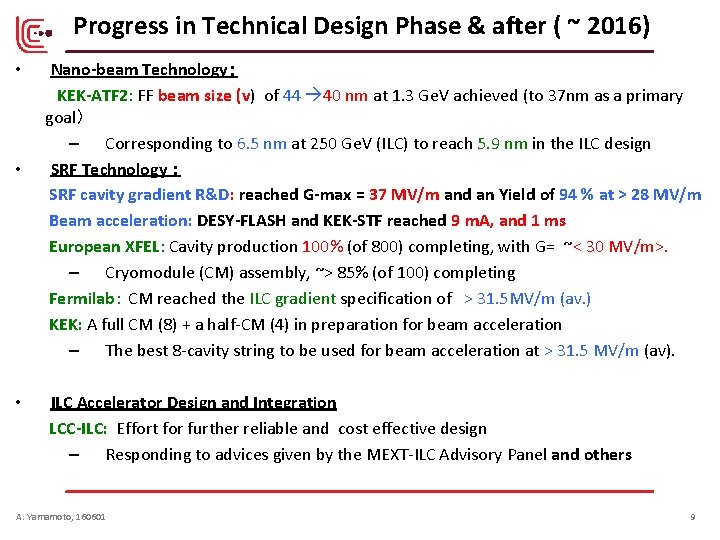
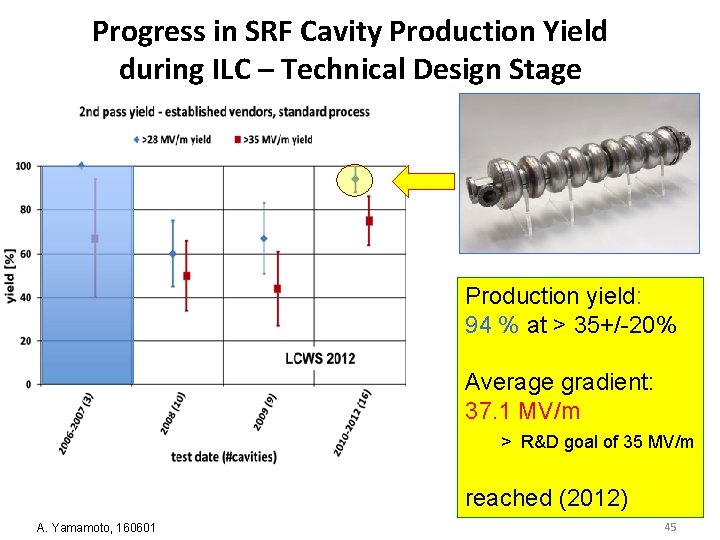
Progress in Technical Design Phase & after ( ~ 2016) • • • Nano-beam Technology: KEK-ATF 2: FF beam size (v) of 44 40 nm at 1. 3 Ge. V achieved (to 37 nm as a primary goal) ‒ Corresponding to 6. 5 nm at 250 Ge. V (ILC) to reach 5. 9 nm in the ILC design SRF Technology : SRF cavity gradient R&D: reached G-max = 37 MV/m and an Yield of 94 % at > 28 MV/m Beam acceleration: DESY-FLASH and KEK-STF reached 9 m. A, and 1 ms European XFEL: Cavity production 100% (of 800) completing, with G= ~< 30 MV/m>. ‒ Cryomodule (CM) assembly, ~> 85% (of 100) completing Fermilab: CM reached the ILC gradient specification of > 31. 5 MV/m (av. ) KEK: A full CM (8) + a half-CM (4) in preparation for beam acceleration ‒ The best 8 -cavity string to be used for beam acceleration at > 31. 5 MV/m (av). ILC Accelerator Design and Integration LCC-ILC: Effort for further reliable and cost effective design ‒ Responding to advices given by the MEXT-ILC Advisory Panel and others A. Yamamoto, 160601 9
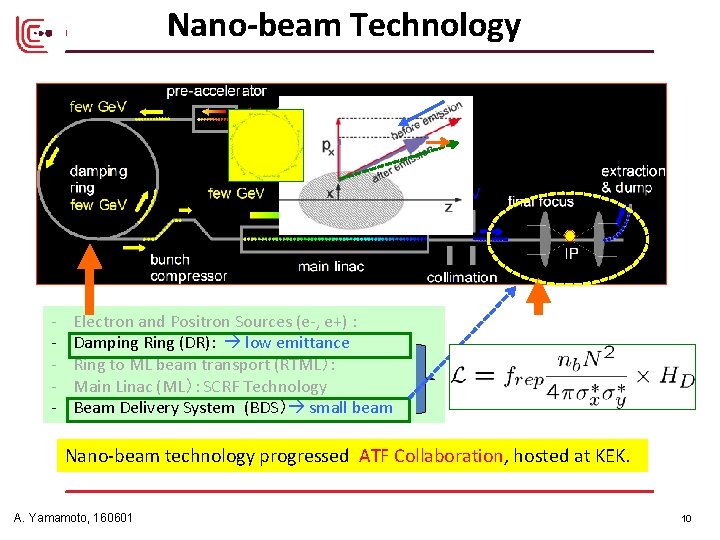
Nano-beam Technology - Electron and Positron Sources (e-, e+) : Damping Ring (DR): low emittance Ring to ML beam transport (RTML): Main Linac (ML):SCRF Technology Beam Delivery System (BDS) small beam Nano-beam technology progressed ATF Collaboration, hosted at KEK. A. Yamamoto, 160601 10
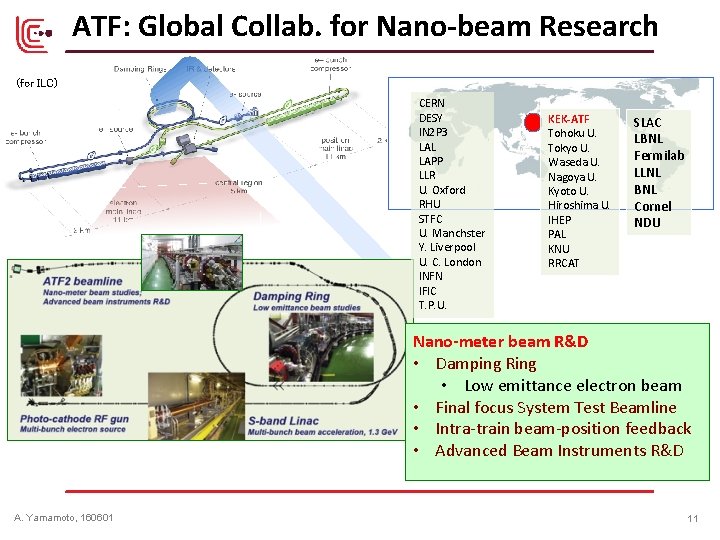
ATF: Global Collab. for Nano-beam Research (for ILC) CERN DESY IN 2 P 3 LAL LAPP LLR U. Oxford RHU STFC U. Manchster Y. Liverpool U. C. London INFN IFIC T. P. U. Cs 2 Te Photocathode RF Gun A. Yamamoto, 160601 KEK-ATF Tohoku U. Tokyo U. Waseda U. Nagoya U. Kyoto U. Hiroshima U. IHEP PAL KNU RRCAT SLAC LBNL Fermilab LLNL BNL Cornel NDU Nano-meter beam R&D • Damping Ring • Low emittance electron beam • Final focus System Test Beamline • Intra-train beam-position feedback • Advanced Beam Instruments R&D 11
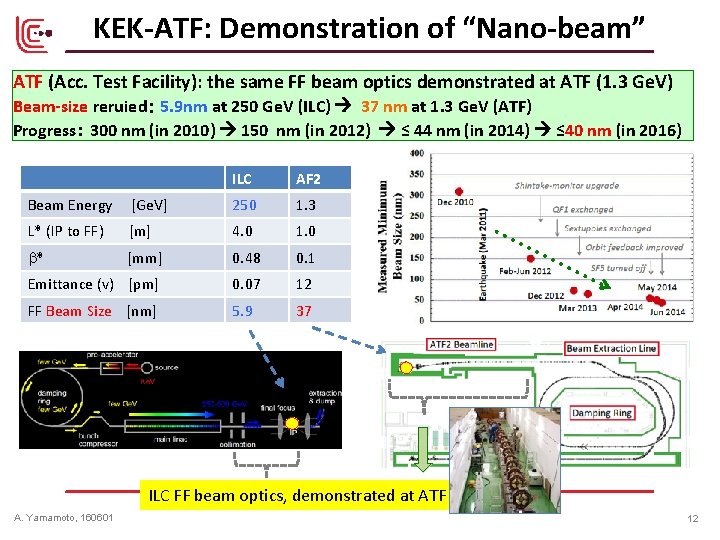
KEK-ATF: Demonstration of “Nano-beam” ATF (Acc. Test Facility): the same FF beam optics demonstrated at ATF (1. 3 Ge. V) Beam-size reruied: 5. 9 nm at 250 Ge. V (ILC) 37 nm at 1. 3 Ge. V (ATF) Progress: 300 nm (in 2010) 150 nm (in 2012) ≤ 44 nm (in 2014) ≤ 40 nm (in 2016) ILC AF 2 Beam Energy [Ge. V] 250 1. 3 L* (IP to FF) [m] 4. 0 1. 0 b* [mm] 0. 48 0. 1 Emittance (v) [pm] 0. 07 12 FF Beam Size [nm] 5. 9 37 ILC FF beam optics, demonstrated at ATF A. Yamamoto, 160601 12
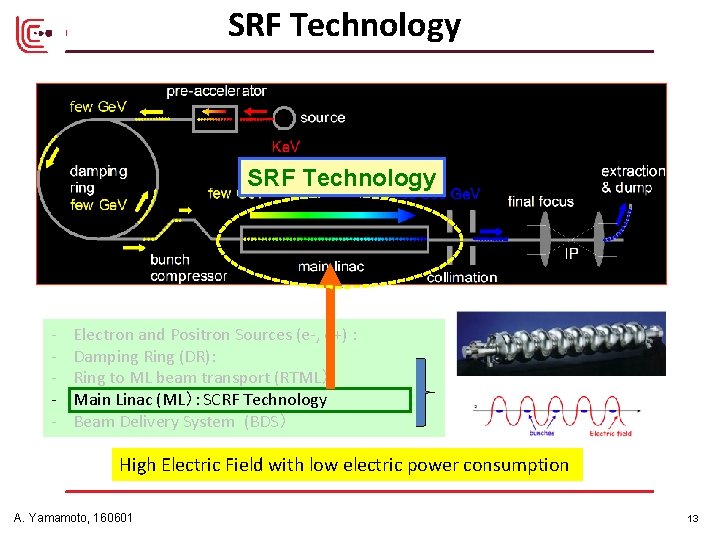
SRF Technology - Electron and Positron Sources (e-, e+) : Damping Ring (DR): Ring to ML beam transport (RTML): Main Linac (ML):SCRF Technology Beam Delivery System (BDS) High Electric Field with low electric power consumption A. Yamamoto, 160601 13
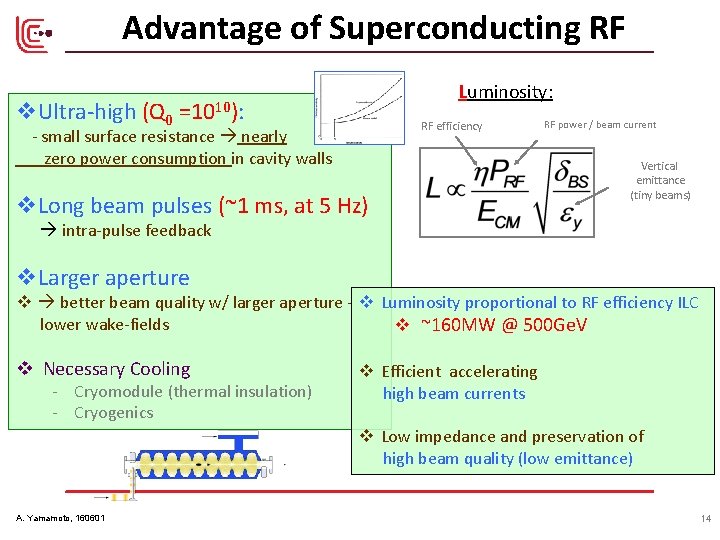
Advantage of Superconducting RF v. Ultra-high (Q 0 Luminosity: =1010): RF efficiency - small surface resistance nearly zero power consumption in cavity walls v. Long beam pulses (~1 ms, at 5 Hz) RF power / beam current Vertical emittance (tiny beams) intra-pulse feedback v. Larger aperture v better beam quality w/ larger aperture - v Luminosity proportional to RF efficiency ILC lower wake-fields v ~160 MW @ 500 Ge. V v Necessary Cooling - Cryomodule (thermal insulation) - Cryogenics v Efficient accelerating high beam currents v Low impedance and preservation of high beam quality (low emittance) A. Yamamoto, 160601 14
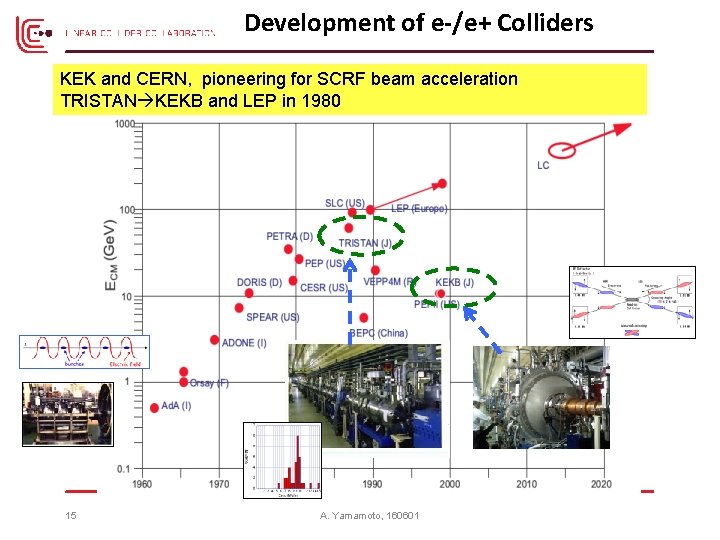
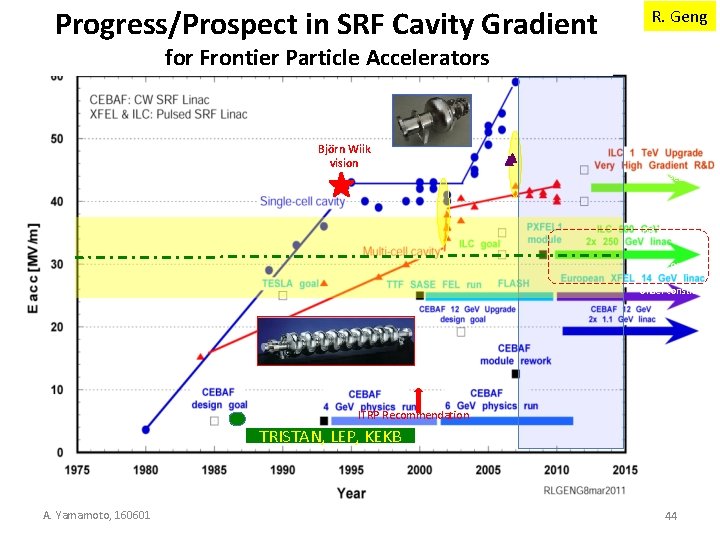
Development of e-/e+ Colliders KEK and CERN, pioneering for SCRF beam acceleration TRISTAN KEKB and LEP in 1980 15 A. Yamamoto, 160601
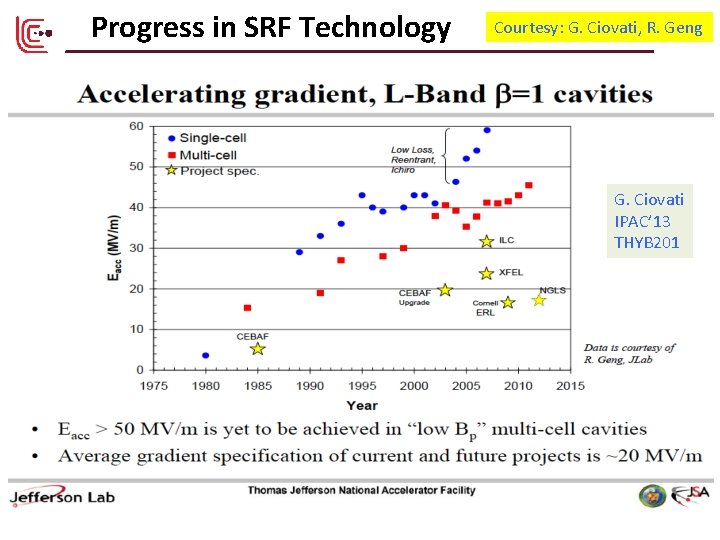
Progress in SRF Technology Courtesy: G. Ciovati, R. Geng G. Ciovati IPAC’ 13 THYB 201 A. Yamamoto, 2015/2/24 16
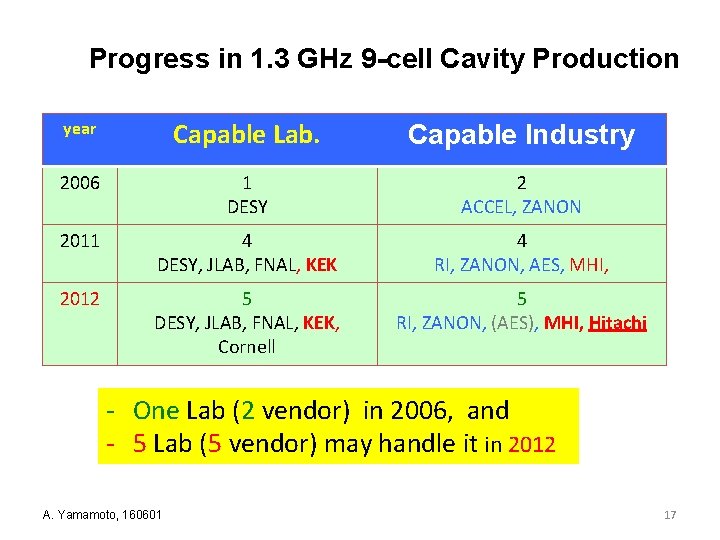
Progress in 1. 3 GHz 9 -cell Cavity Production year Capable Lab. Capable Industry 2006 1 DESY 2 ACCEL, ZANON 2011 4 DESY, JLAB, FNAL, KEK 4 RI, ZANON, AES, MHI, 2012 5 DESY, JLAB, FNAL, KEK, Cornell 5 RI, ZANON, (AES), MHI, Hitachi - One Lab (2 vendor) in 2006, and - 5 Lab (5 vendor) may handle it in 2012 A. Yamamoto, 160601 17
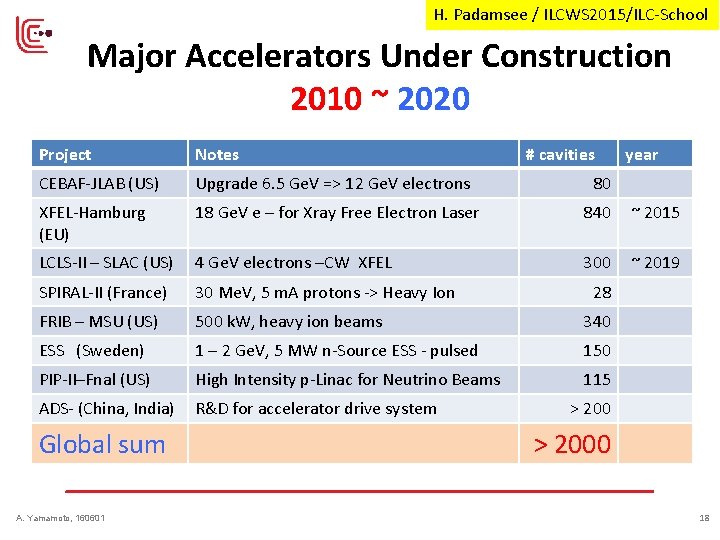
H. Padamsee / ILCWS 2015/ILC-School Major Accelerators Under Construction 2010 ~ 2020 Project Notes CEBAF-JLAB (US) Upgrade 6. 5 Ge. V => 12 Ge. V electrons 80 XFEL-Hamburg (EU) 18 Ge. V e – for Xray Free Electron Laser 840 ~ 2015 LCLS-II – SLAC (US) 4 Ge. V electrons –CW XFEL 300 ~ 2019 SPIRAL-II (France) 30 Me. V, 5 m. A protons -> Heavy Ion FRIB – MSU (US) 500 k. W, heavy ion beams 340 ESS (Sweden) 1 – 2 Ge. V, 5 MW n-Source ESS - pulsed 150 PIP-II–Fnal (US) High Intensity p-Linac for Neutrino Beams 115 ADS- (China, India) R&D for accelerator drive system Global sum A. Yamamoto, 160601 # cavities year 28 > 2000 18
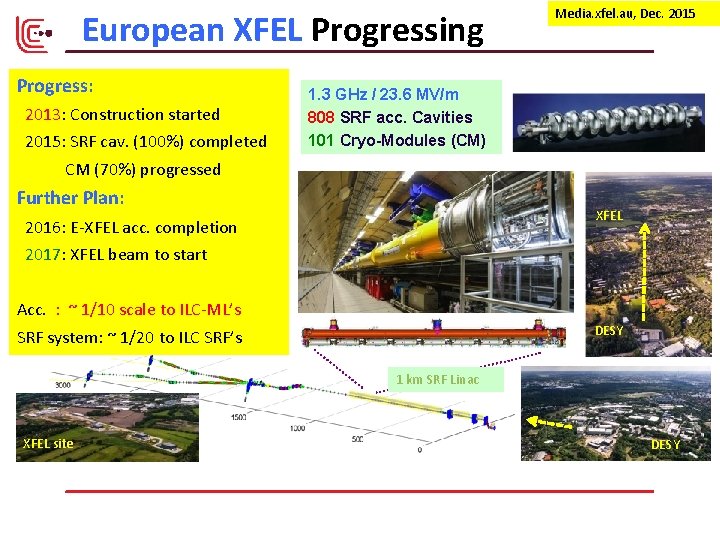
European XFEL Progressing Progress: 2013: Construction started 2015: SRF cav. (100%) completed Media. xfel. au, Dec. 2015 1. 3 GHz / 23. 6 MV/m 808 SRF acc. Cavities 101 Cryo-Modules (CM) CM (70%) progressed Further Plan: XFEL 2016: E-XFEL acc. completion 2017: XFEL beam to start Acc. : ~ 1/10 scale to ILC-ML’s DESY SRF system: ~ 1/20 to ILC SRF’s 1 km SRF Linac XFEL site DESY
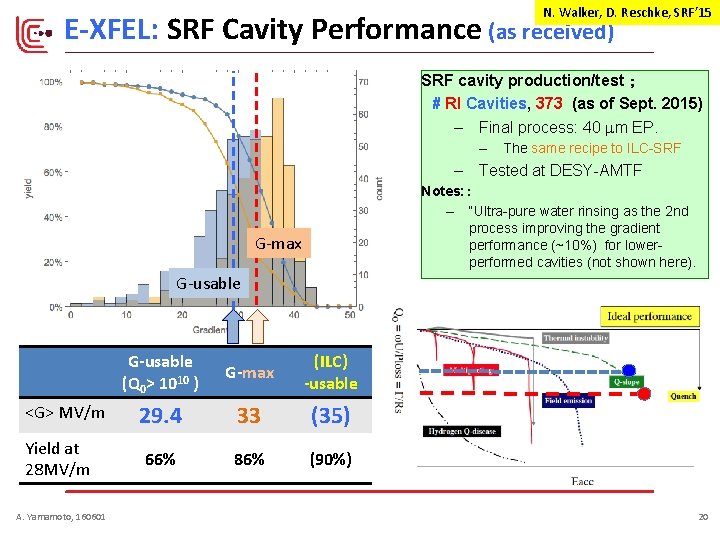
N. Walker, D. Reschke, SRF’ 15 E-XFEL: SRF Cavity Performance (as received) SRF cavity production/test ; # RI Cavities, 373 (as of Sept. 2015) ‒ Final process: 40 mm EP. ‒ The same recipe to ILC-SRF ‒ Tested at DESY-AMTF Notes: : ‒ “Ultra-pure water rinsing as the 2 nd process improving the gradient performance (~10%) for lowerperformed cavities (not shown here). G-max G-usable <G> MV/m Yield at 28 MV/m A. Yamamoto, 160601 G-usable (Q 0> 1010 ) G-max (ILC) -usable 29. 4 33 (35) 66% 86% (90%) 20
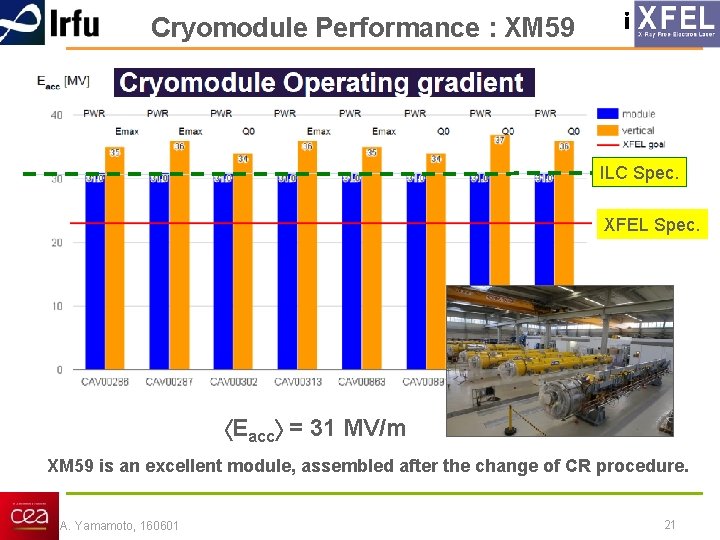
Cryomodule Performance : XM 59 i ILC Spec. XFEL Spec. Eacc = 31 MV/m XM 59 is an excellent module, assembled after the change of CR procedure. A. Yamamoto, 160601 21
Introduction Outline Technical Progress Global Collaboration and Industrial Implications Summary Yamamoto, 160208 A. A. Yamamoto, 160601 24
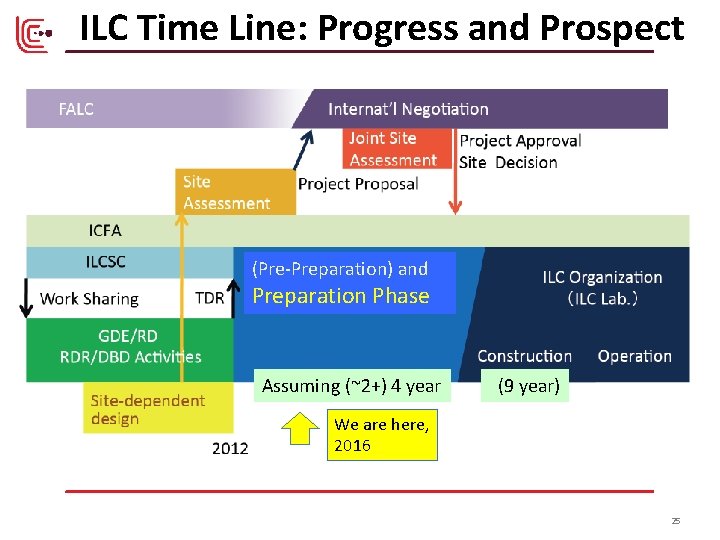
ILC Time Line: Progress and Prospect (Pre-Preparation) and Preparation Phase Assuming (~2+) 4 year (9 year) We are here, 2016 25
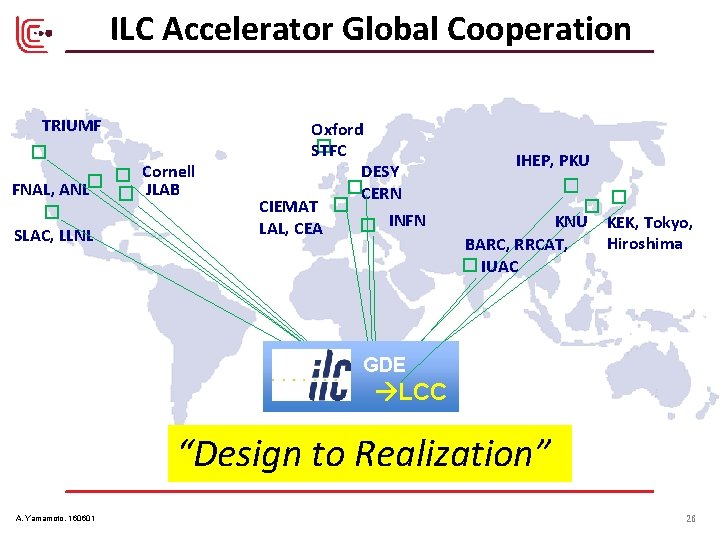
ILC Accelerator Global Cooperation TRIUMF � � Cornell � FNAL, ANL � JLAB � SLAC, LLNL Oxford � STFC DESY �CERN CIEMAT � � INFN LAL, CEA IHEP, PKU � � � KNU KEK, Tokyo, Hiroshima BARC, RRCAT, � IUAC GDE LCC “Design to Realization” A. Yamamoto, 160601 26
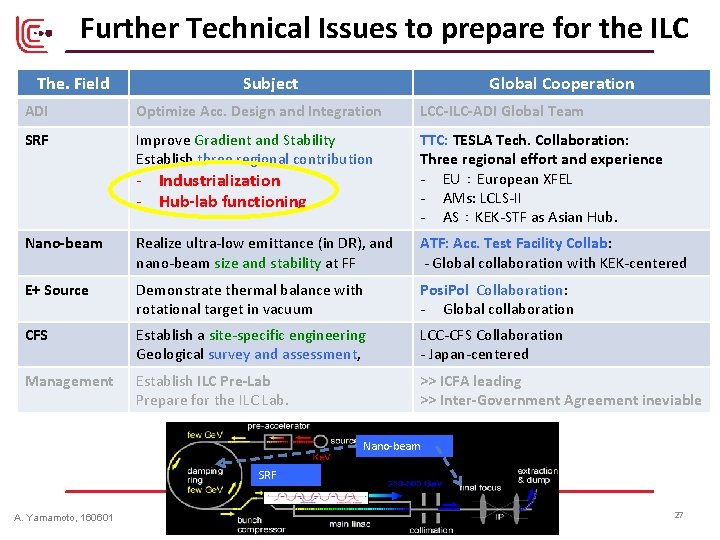
Further Technical Issues to prepare for the ILC The. Field Subject Global Cooperation ADI Optimize Acc. Design and Integration LCC-ILC-ADI Global Team SRF Improve Gradient and Stability Establish three regional contribution TTC: TESLA Tech. Collaboration: Three regional effort and experience - EU:European XFEL - AMs: LCLS-II - AS:KEK-STF as Asian Hub. Nano-beam Realize ultra-low emittance (in DR), and nano-beam size and stability at FF ATF: Acc. Test Facility Collab: - Global collaboration with KEK-centered E+ Source Demonstrate thermal balance with rotational target in vacuum Posi. Pol Collaboration: - Global collaboration CFS Establish a site-specific engineering Geological survey and assessment, LCC-CFS Collaboration - Japan-centered Management Establish ILC Pre-Lab Prepare for the ILC Lab. >> ICFA leading >> Inter-Government Agreement ineviable - Industrialization - Hub-lab functioning Nano-beam SRF A. Yamamoto, 160601 27
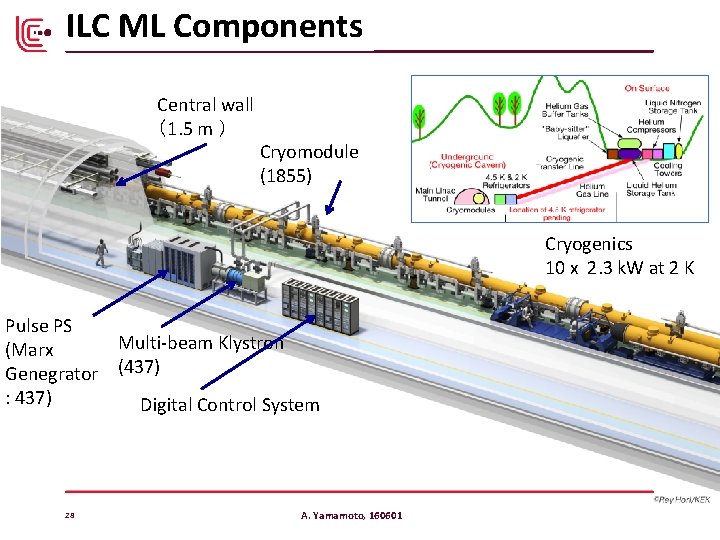
ILC ML Components Central wall (1. 5 m ) Cryomodule (1855) Cryogenics 10 x 2. 3 k. W at 2 K Pulse PS Multi-beam Klystron (Marx Genegrator (437) : 437) Digital Control System 28 A. Yamamoto, 160601
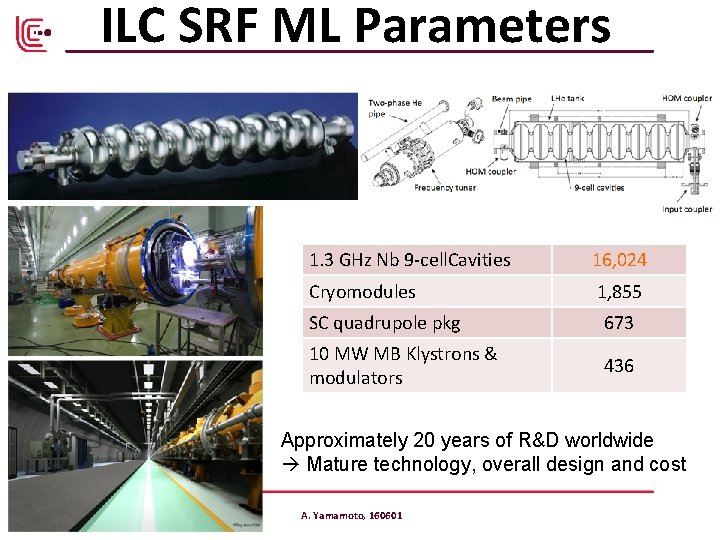
ILC SRF ML Parameters 1. 3 GHz Nb 9 -cell. Cavities 16, 024 Cryomodules 1, 855 SC quadrupole pkg 673 10 MW MB Klystrons & modulators 436 Approximately 20 years of R&D worldwide Mature technology, overall design and cost 29 A. Yamamoto, 160601
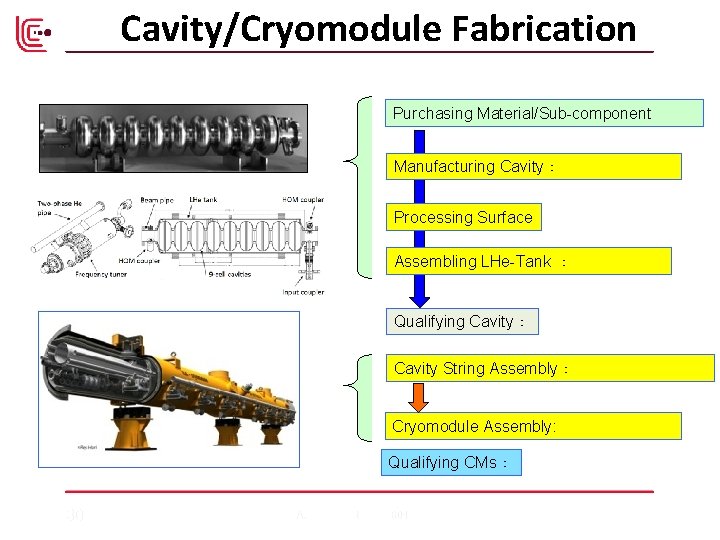
Cavity/Cryomodule Fabrication Purchasing Material/Sub-component Manufacturing Cavity: Processing Surface Assembling LHe-Tank : Qualifying Cavity: Cavity String Assembly: Cryomodule Assembly: Qualifying CMs: 30 A. Yamamoto, 160601
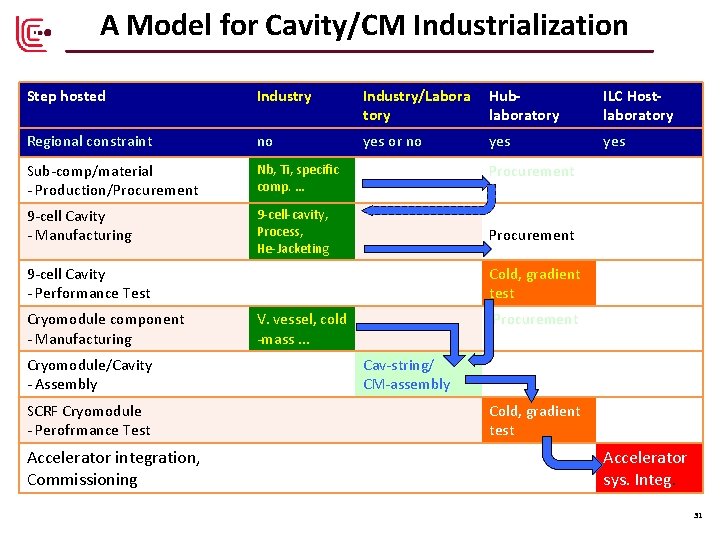
A Model for Cavity/CM Industrialization Step hosted Industry/Labora tory Hublaboratory ILC Hostlaboratory Regional constraint no yes or no yes Sub-comp/material - Production/Procurement Nb, Ti, specific comp. … 9 -cell Cavity - Manufacturing 9 -cell-cavity, Process, He-Jacketing Procurement 9 -cell Cavity - Performance Test Cryomodule component - Manufacturing Cryomodule/Cavity - Assembly SCRF Cryomodule - Perofrmance Test Accelerator integration, Commissioning Cold, gradient test V. vessel, cold -mass. . . Procurement Cav-string/ CM-assembly Cold, gradient test Accelerator sys. Integ. 31
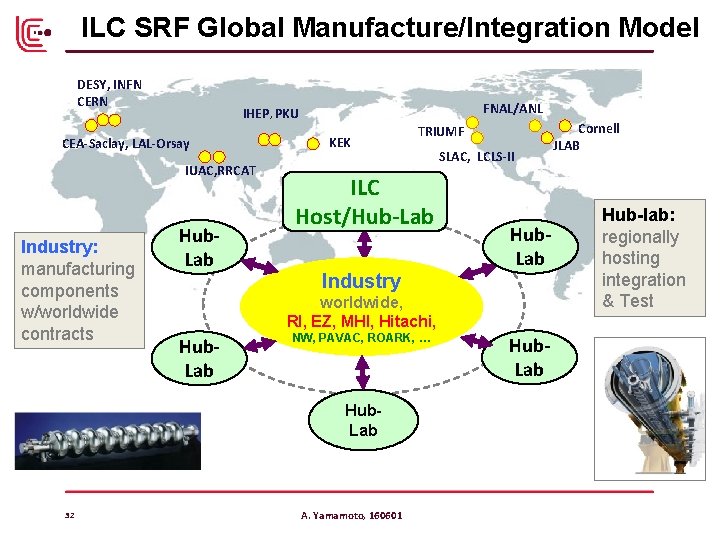
ILC SRF Global Manufacture/Integration Model DESY, INFN CERN CEA-Saclay, LAL-Orsay IUAC, RRCAT Industry: manufacturing components w/worldwide contracts FNAL/ANL IHEP, PKU Hub. Lab KEK ILC Host/Hub-Lab Industry SLAC, LCLS-II Hub. Lab worldwide, RI, EZ, MHI, Hitachi, Hub. Lab NW, PAVAC, ROARK, … Hub. Lab 32 TRIUMF A. Yamamoto, 160601 Hub. Lab Cornell JLAB Hub-lab: regionally hosting integration & Test
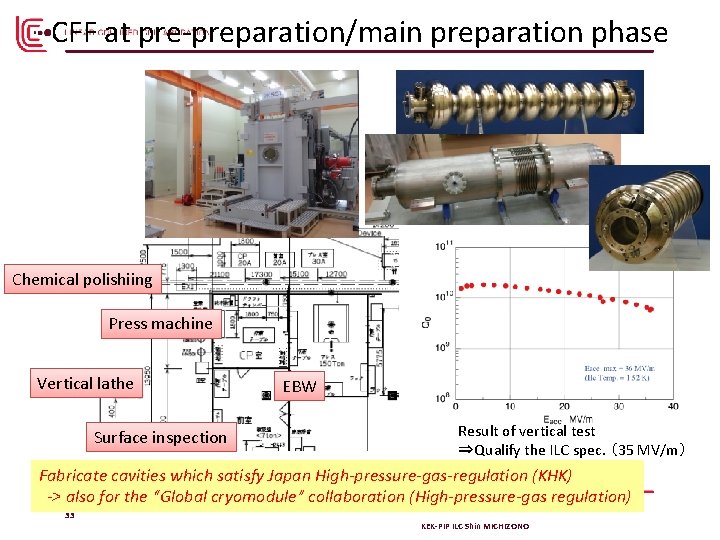
CFF at pre-preparation/main preparation phase Chemical polishiing Press machine Vertical lathe Surface inspection EBW 33 Result of vertical test ⇒Qualify the ILC spec. (35 MV/m) Fabricate cavities which satisfy Japan High-pressure-gas-regulation (KHK) -> also for the “Global cryomodule” collaboration (High-pressure-gas regulation) 33 KEK-PIP ILC Shin MICHIZONO
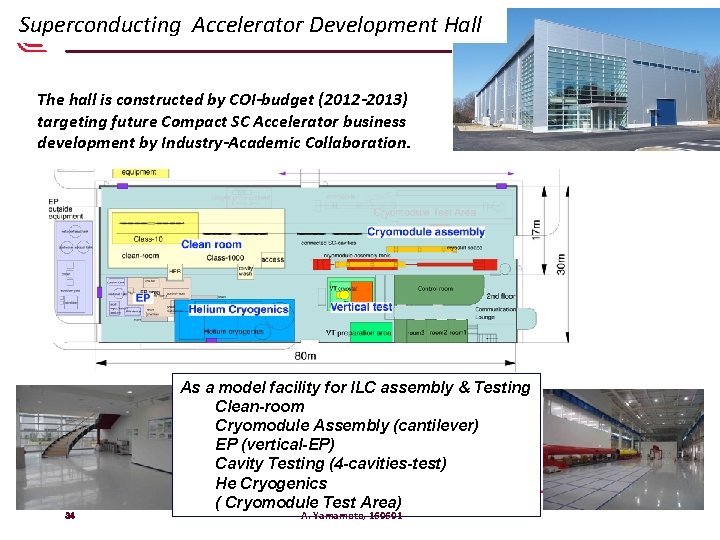
Superconducting Accelerator Development Hall The hall is constructed by COI-budget (2012 -2013) targeting future Compact SC Accelerator business development by Industry-Academic Collaboration. 34 As a model facility for ILC assembly & Testing Clean-room Cryomodule Assembly (cantilever) EP (vertical-EP) Cavity Testing (4 -cavities-test) He Cryogenics ( Cryomodule Test Area) A. Yamamoto, 160601
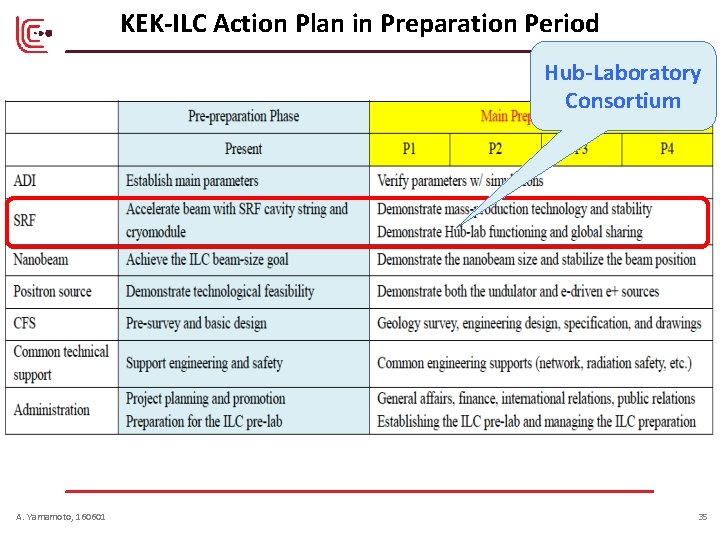
KEK-ILC Action Plan in Preparation Period Hub-Laboratory Consortium A. Yamamoto, 160601 35
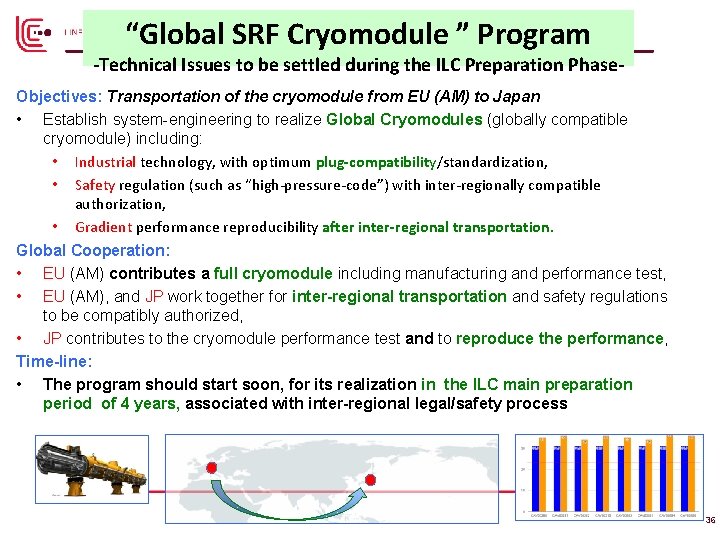
“Global SRF Cryomodule ” Program -Technical Issues to be settled during the ILC Preparation Phase. Objectives: Transportation of the cryomodule from EU (AM) to Japan • Establish system-engineering to realize Global Cryomodules (globally compatible cryomodule) including: • Industrial technology, with optimum plug-compatibility/standardization, • Safety regulation (such as “high-pressure-code”) with inter-regionally compatible authorization, • Gradient performance reproducibility after inter-regional transportation. Global Cooperation: • EU (AM) contributes a full cryomodule including manufacturing and performance test, • EU (AM), and JP work together for inter-regional transportation and safety regulations to be compatibly authorized, • JP contributes to the cryomodule performance test and to reproduce the performance, Time-line: • The program should start soon, for its realization in the ILC main preparation period of 4 years, associated with inter-regional legal/safety process 36
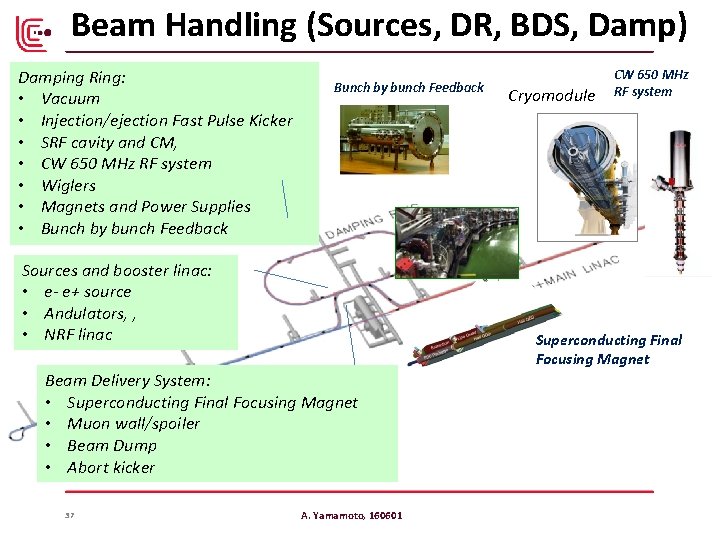
Beam Handling (Sources, DR, BDS, Damp) Damping Ring: • Vacuum • Injection/ejection Fast Pulse Kicker • SRF cavity and CM, • CW 650 MHz RF system • Wiglers • Magnets and Power Supplies • Bunch by bunch Feedback Sources and booster linac: • e- e+ source • Andulators, , • NRF linac Superconducting Final Focusing Magnet Beam Delivery System: • Superconducting Final Focusing Magnet • Muon wall/spoiler • Beam Dump • Abort kicker 37 Cryomodule CW 650 MHz RF system A. Yamamoto, 160601
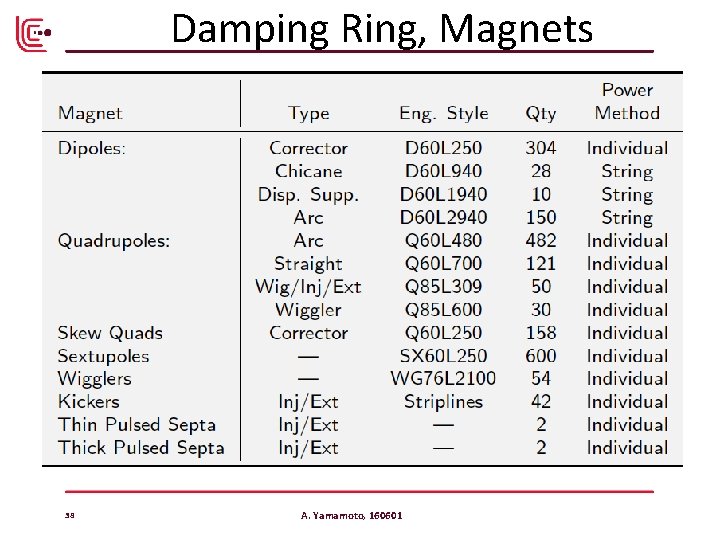
Damping Ring, Magnets 38 A. Yamamoto, 160601
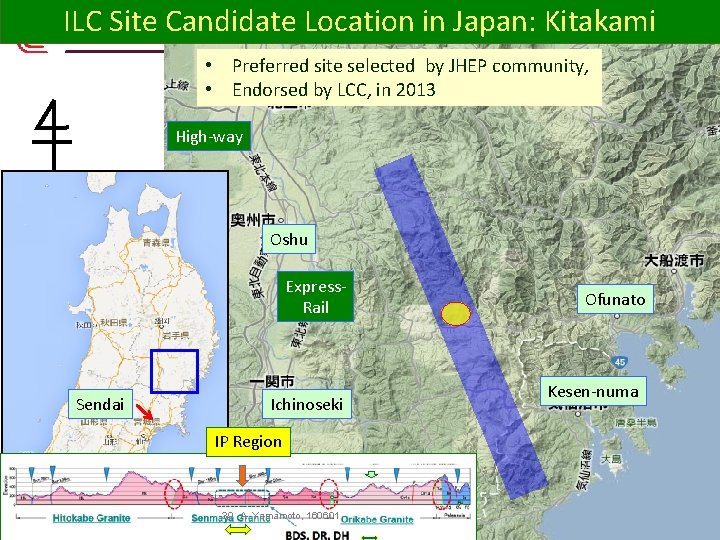
ILC Site Candidate Location in Japan: Kitakami • Preferred site selected by JHEP community, • Endorsed by LCC, in 2013 High-way Oshu Express. Rail Sendai Ichinoseki IP Region 39 A. Yamamoto, 160601 Ofunato Kesen-numa
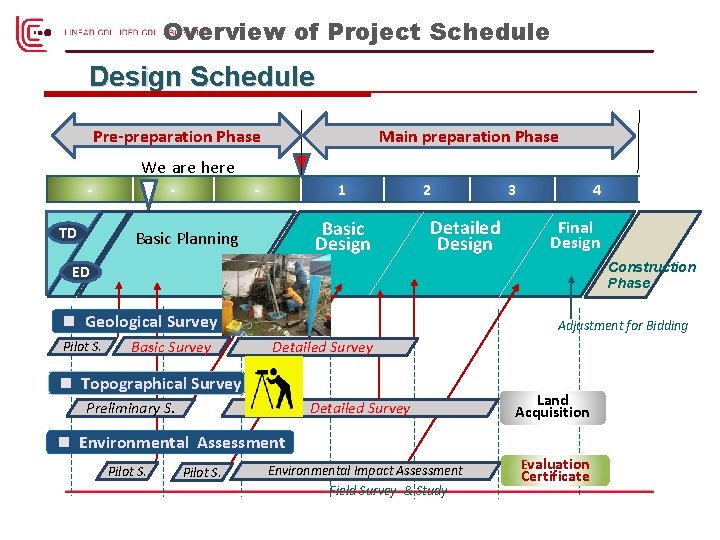
Overview of Project Schedule Design Schedule Pre-preparation Phase Main preparation Phase We are here TD - - 1 Basic Design Basic Planning 2 Detailed Design 3 4 Final Design Construction Phase ED n Geological Survey Pilot S. Basic Survey Adjustment for Bidding Detailed Survey n Topographical Survey Preliminary S. Detailed Survey Land Acquisition n Environmental Assessment Pilot S. Environmental Impact Assessment Field Survey & Study Evaluation Certificate
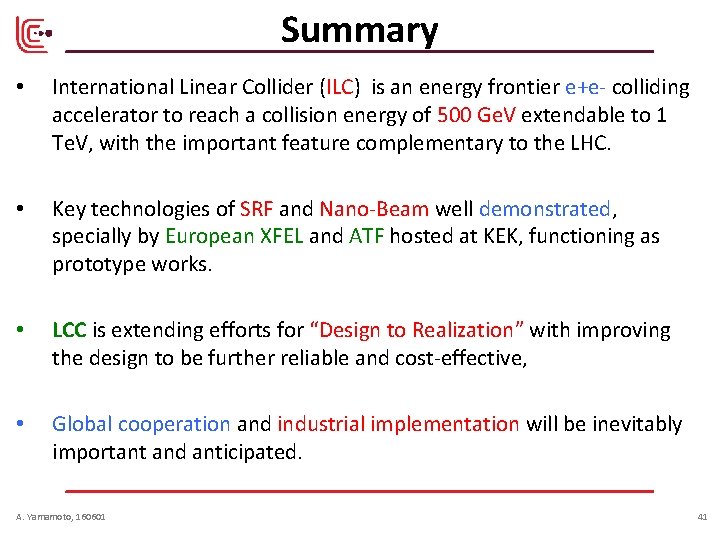
Summary • International Linear Collider (ILC) is an energy frontier e+e- colliding accelerator to reach a collision energy of 500 Ge. V extendable to 1 Te. V, with the important feature complementary to the LHC. • Key technologies of SRF and Nano-Beam well demonstrated, specially by European XFEL and ATF hosted at KEK, functioning as prototype works. • LCC is extending efforts for “Design to Realization” with improving the design to be further reliable and cost-effective, • Global cooperation and industrial implementation will be inevitably important and anticipated. A. Yamamoto, 160601 41
Backup A. Yamamoto, 160601 42
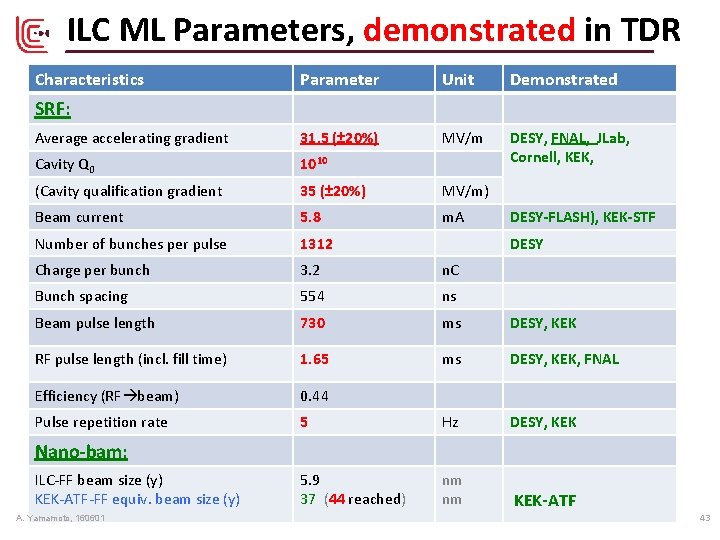
ILC ML Parameters, demonstrated in TDR Characteristics Parameter Unit Demonstrated Average accelerating gradient 31. 5 (± 20%) MV/m Cavity Q 0 1010 DESY, FNAL, JLab, Cornell, KEK, (Cavity qualification gradient 35 (± 20%) MV/m) Beam current 5. 8 m. A Number of bunches per pulse 1312 Charge per bunch 3. 2 n. C Bunch spacing 554 ns Beam pulse length 730 ms DESY, KEK RF pulse length (incl. fill time) 1. 65 ms DESY, KEK, FNAL Efficiency (RF beam) 0. 44 Pulse repetition rate 5 Hz DESY, KEK 5. 9 37 (44 reached) nm nm KEK-ATF SRF: DESY-FLASH), KEK-STF DESY Nano-bam: ILC-FF beam size (y) KEK-ATF-FF equiv. beam size (y) A. Yamamoto, 160601 43
Progress/Prospect in SRF Cavity Gradient R. Geng for Frontier Particle Accelerators Björn Wiik vision R&D needed TDR by 2012 Under construction ITRP Recommendation TRISTAN, LEP, KEKB A. Yamamoto, 160601 44
Progress in SRF Cavity Production Yield during ILC – Technical Design Stage Production yield: 94 % at > 35+/-20% Average gradient: 37. 1 MV/m > R&D goal of 35 MV/m reached (2012) A. Yamamoto, 160601 45
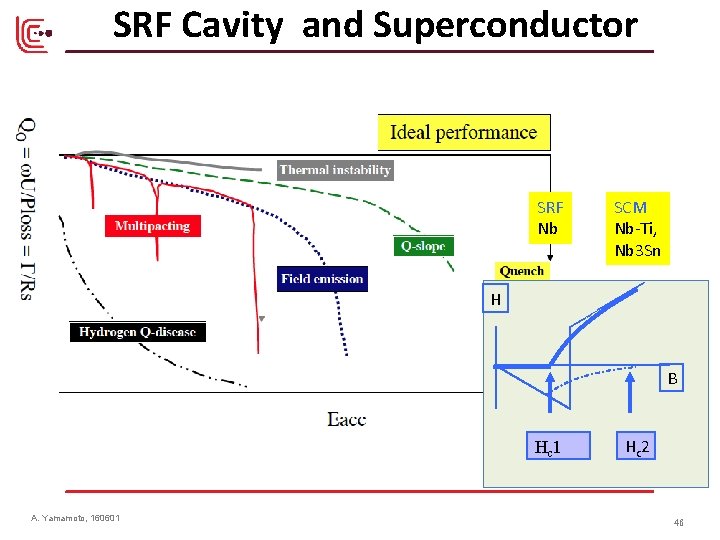
SRF Cavity and Superconductor SRF Nb SCM Nb-Ti, Nb 3 Sn H B Hc 1 A. Yamamoto, 160601 Hc 2 46
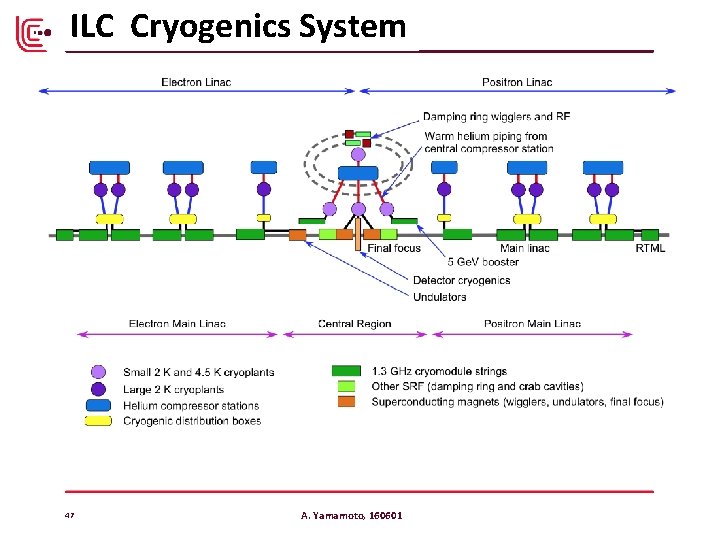
ILC Cryogenics System 47 A. Yamamoto, 160601
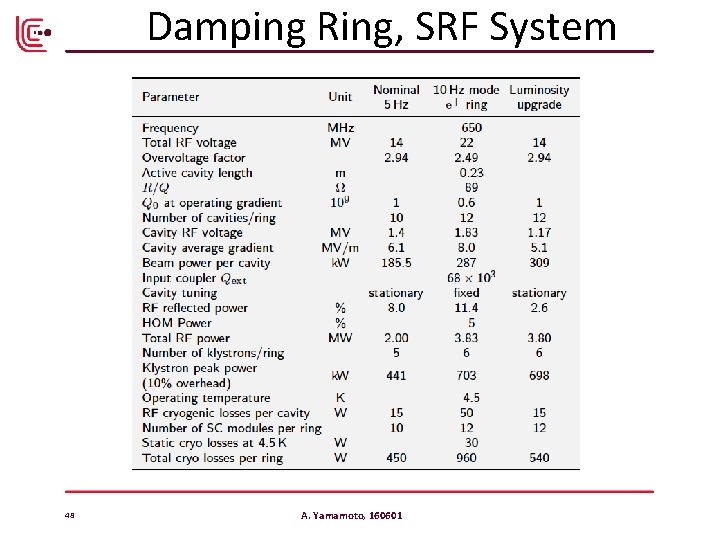
Damping Ring, SRF System 48 A. Yamamoto, 160601
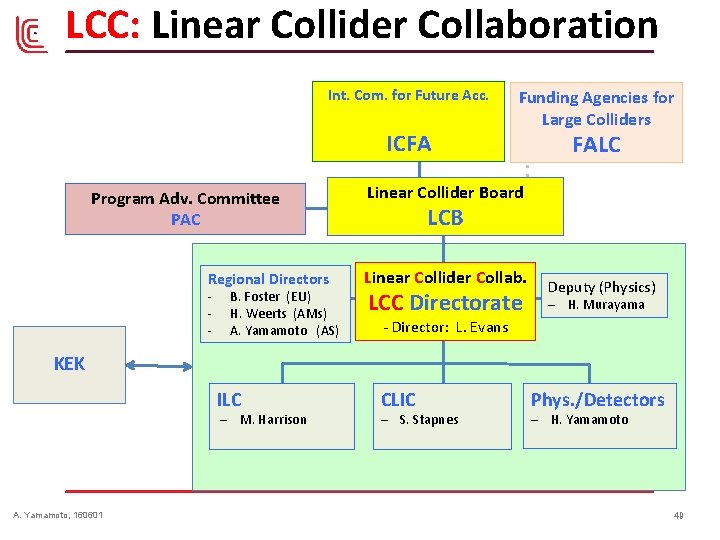
LCC: Linear Collider Collaboration Int. Com. for Future Acc. ICFA Program Adv. Committee PAC Regional Directors - B. Foster (EU) H. Weerts (AMs) A. Yamamoto (AS) Funding Agencies for Large Colliders FALC Linear Collider Board LCB Linear Collider Collab. LCC Directorate Deputy (Physics) – H. Murayama - Director: L. Evans KEK ILC – M. Harrison A. Yamamoto, 160601 CLIC – S. Stapnes Phys. /Detectors – H. Yamamoto 49