
The International Linear Collider Physics Opportunities and Experimental
- Slides: 39
The International Linear Collider Physics Opportunities and Experimental Techniques for the Next Large Scale Facility in Accelerator Particle Physics Marco Battaglia UC Berkeley and LBNL TASI, Boulder, June 2006
International e+e- Linear Collider ILC highest priority for future major facility in HEP needed to extend and complement LHC discoveries with accuracy which is crucial to understand nature of New Physics, test fundamental properties at high energy scale and establish their relation to Cosmology; Technology decision promotes ILC towards next stage in accelerator design definition, R&D and cost optimization: Matching program of Physics studies and Detector R&D needed develop new accurate and cost effective detector techniques from proof of concepts to a state of engineering readiness to be adopted in the ILC experiments.
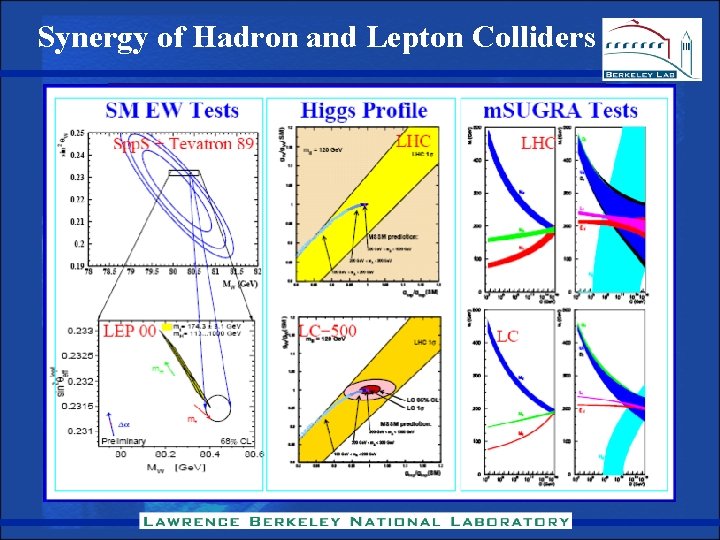
Synergy of Hadron and Lepton Colliders
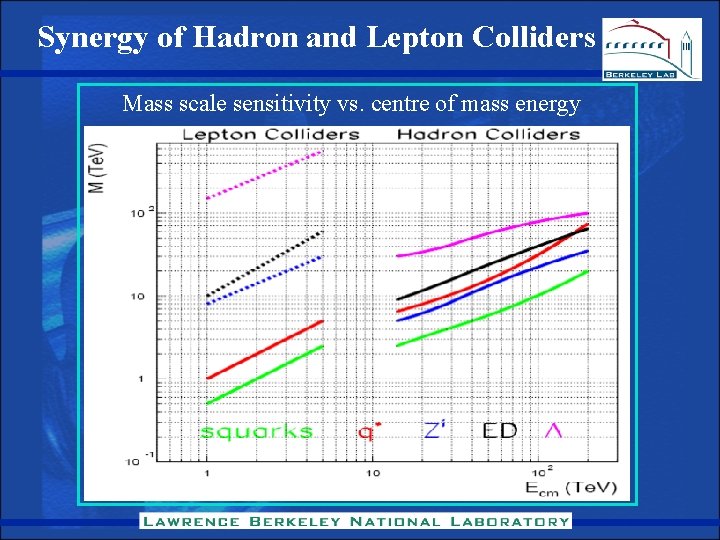
Synergy of Hadron and Lepton Colliders Mass scale sensitivity vs. centre of mass energy
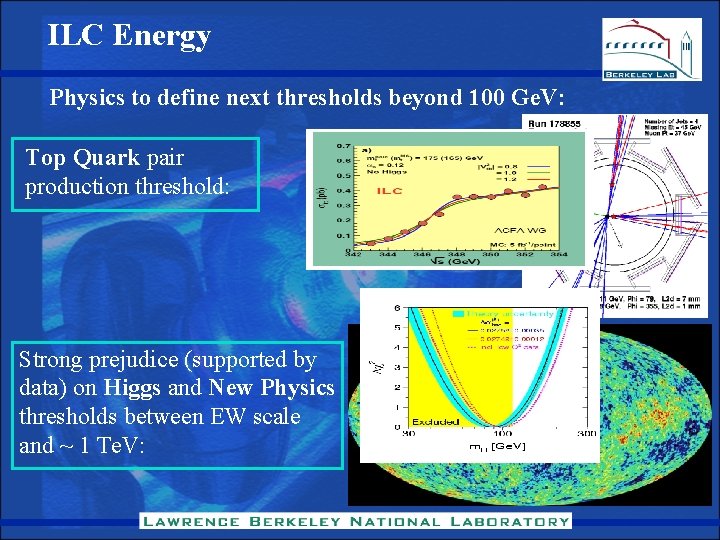
ILC Energy Physics to define next thresholds beyond 100 Ge. V: Top Quark pair production threshold: Strong prejudice (supported by data) on Higgs and New Physics thresholds between EW scale and ~ 1 Te. V:
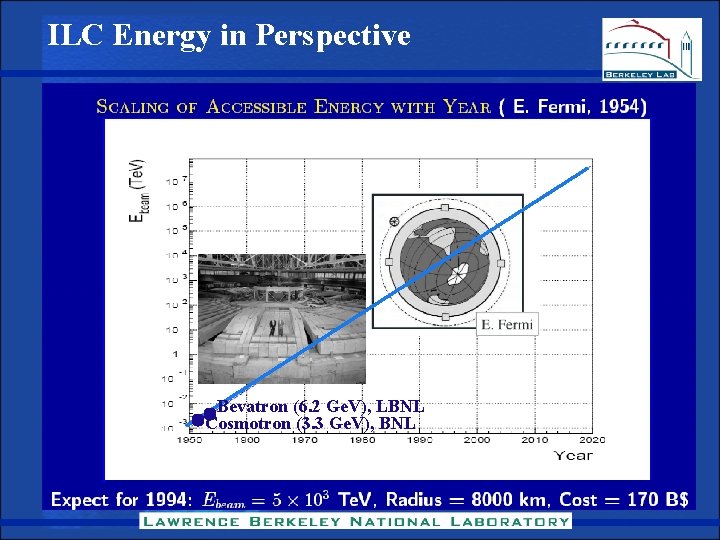
ILC Energy in Perspective Bevatron (6. 2 Ge. V), LBNL Cosmotron (3. 3 Ge. V), BNL
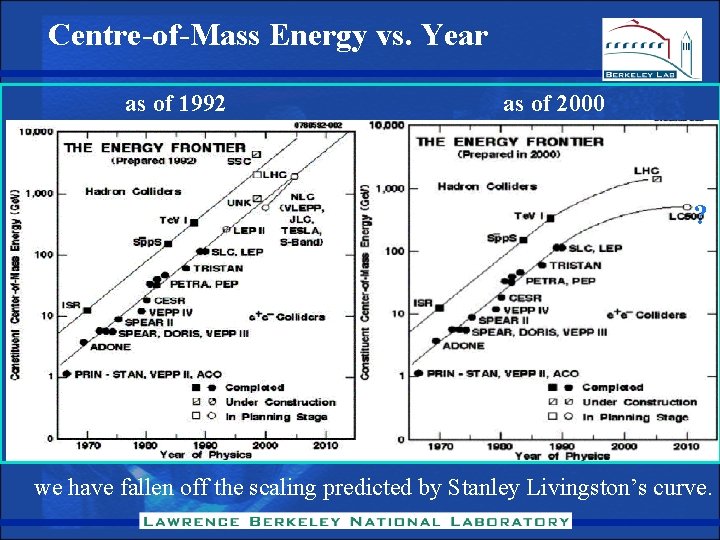
Centre-of-Mass Energy vs. Year as of 1992 as of 2000 ? we have fallen off the scaling predicted by Stanley Livingston’s curve.
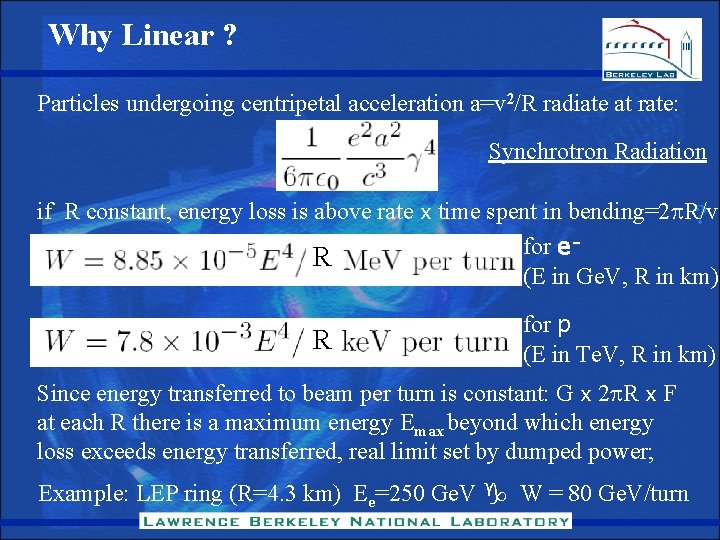
Why Linear ? Particles undergoing centripetal acceleration a=v 2/R radiate at rate: Synchrotron Radiation if R constant, energy loss is above rate x time spent in bending=2 p. R/v ? for e R (E in Ge. V, R in km) R for p (E in Te. V, R in km) Since energy transferred to beam per turn is constant: G x 2 p. R x F at each R there is a maximum energy Emax beyond which energy loss exceeds energy transferred, real limit set by dumped power; Example: LEP ring (R=4. 3 km) Ee=250 Ge. V g W = 80 Ge. V/turn
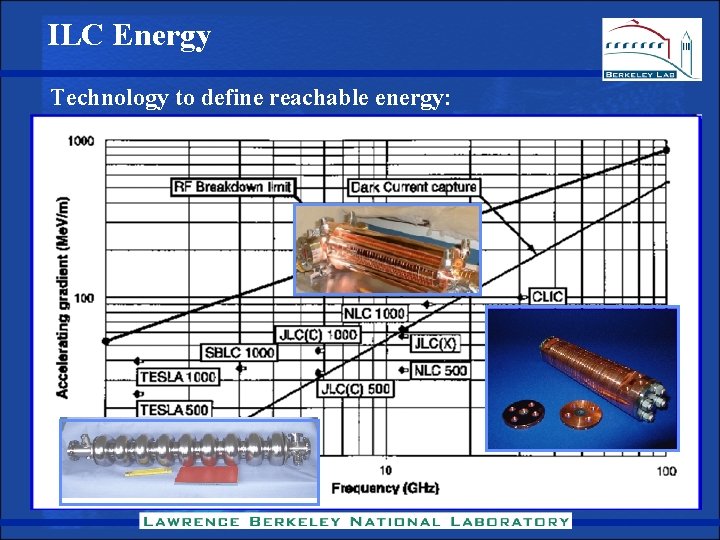
ILC Energy Technology to define reachable energy:
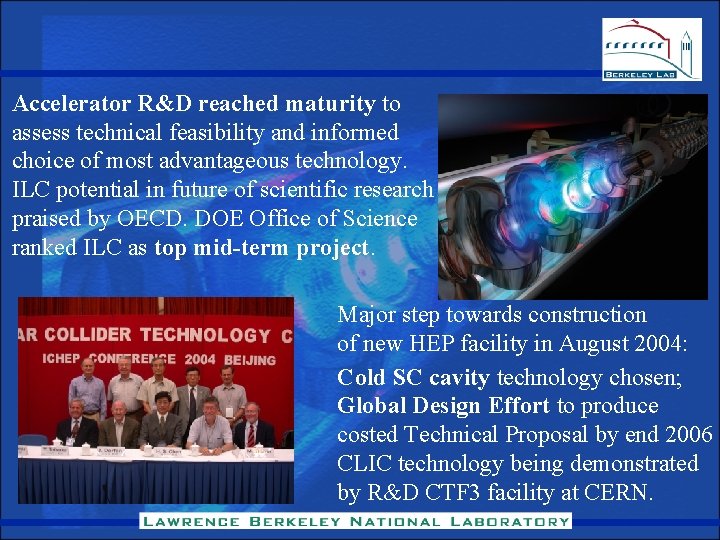
Accelerator R&D reached maturity to assess technical feasibility and informed choice of most advantageous technology. ILC potential in future of scientific research praised by OECD. DOE Office of Science ranked ILC as top mid-term project. Major step towards construction of new HEP facility in August 2004: Cold SC cavity technology chosen; Global Design Effort to produce costed Technical Proposal by end 2006 CLIC technology being demonstrated by R&D CTF 3 facility at CERN.
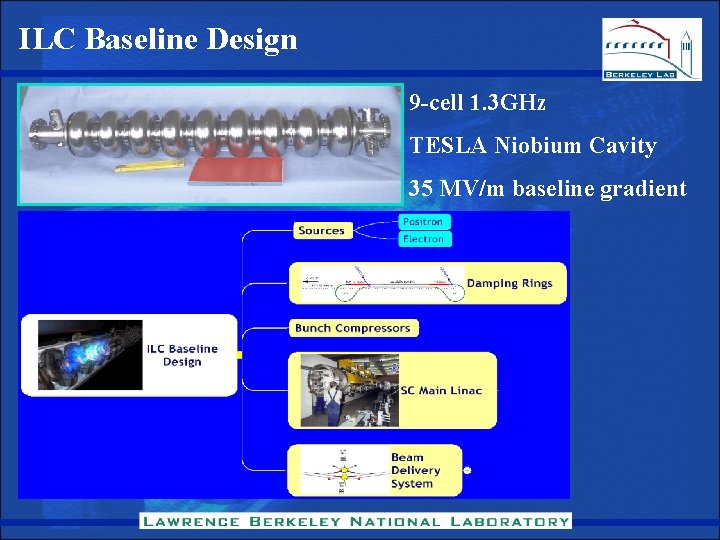
ILC Baseline Design 9 -cell 1. 3 GHz TESLA Niobium Cavity 35 MV/m baseline gradient
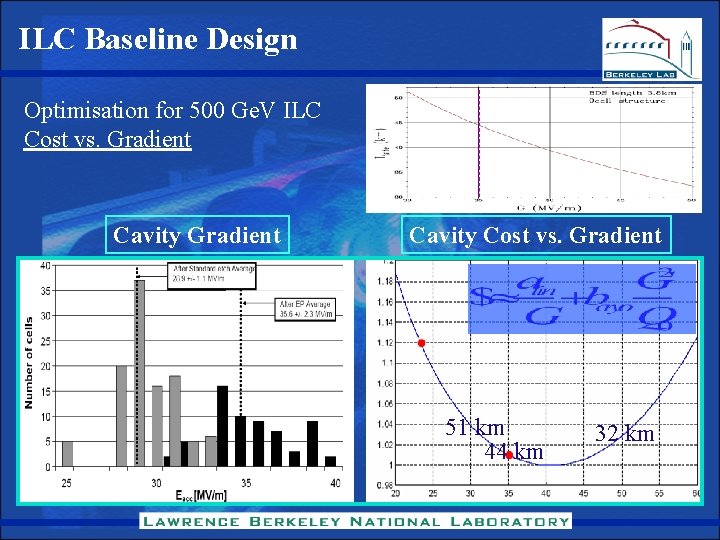
ILC Baseline Design Optimisation for 500 Ge. V ILC Cost vs. Gradient Cavity Cost vs. Gradient 51 km 44 km 32 km
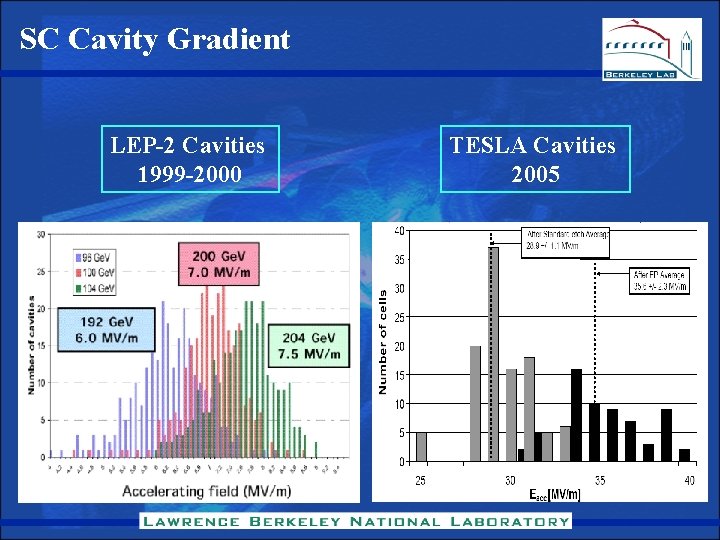
SC Cavity Gradient LEP-2 Cavities 1999 -2000 TESLA Cavities 2005
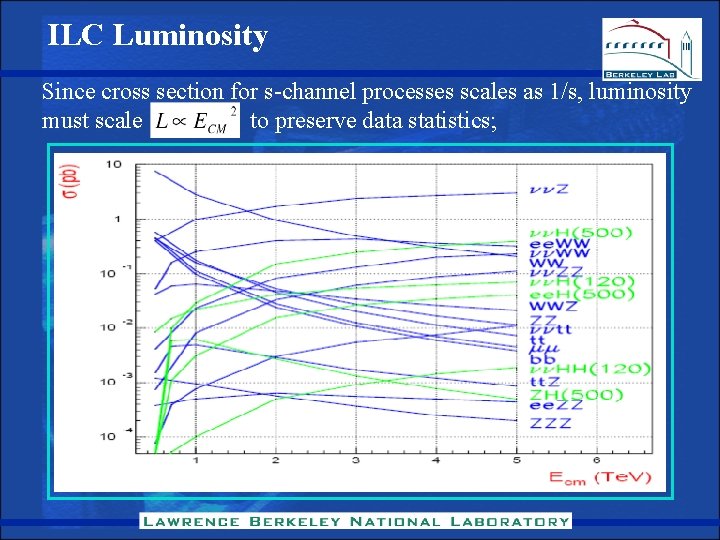
ILC Luminosity Since cross section for s-channel processes scales as 1/s, luminosity must scale to preserve data statistics;
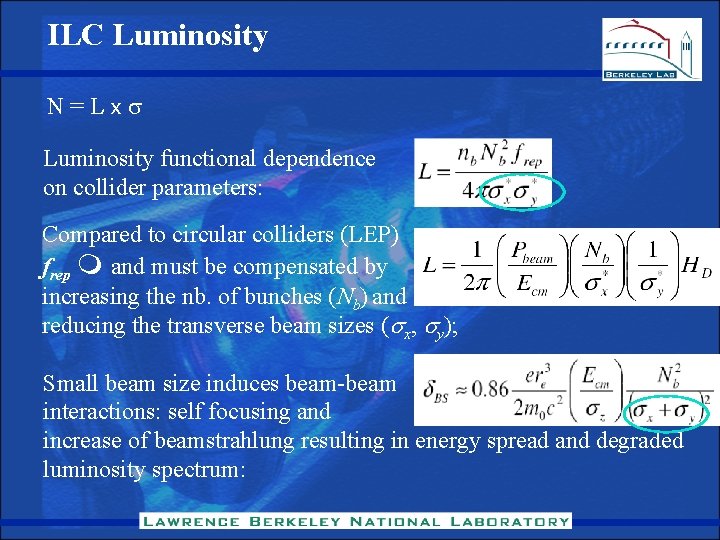
ILC Luminosity N=Lxs Luminosity functional dependence on collider parameters: Compared to circular colliders (LEP) frep m and must be compensated by increasing the nb. of bunches (Nb) and reducing the transverse beam sizes (sx, sy); Small beam size induces beam-beam interactions: self focusing and increase of beamstrahlung resulting in energy spread and degraded luminosity spectrum:
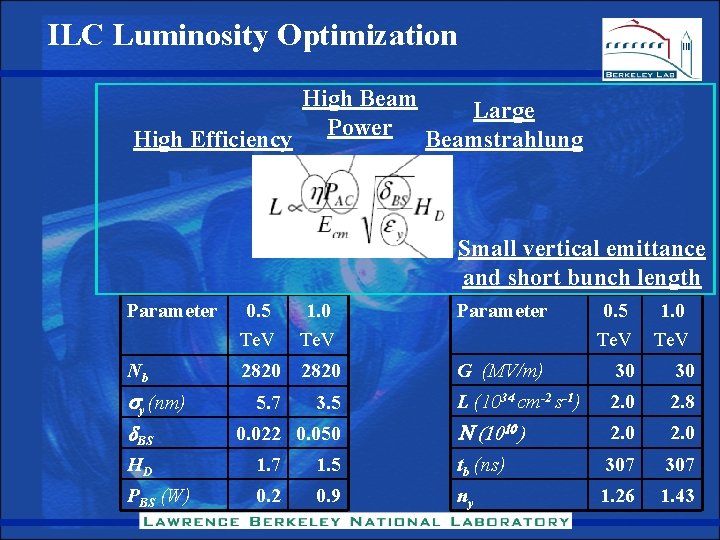
ILC Luminosity Optimization High Beam Large High Efficiency Power Beamstrahlung Small vertical emittance and short bunch length Parameter 0. 5 Te. V 1. 0 Te. V Nb 2820 G (MV/m) 30 30 L (1034 cm-2 s-1) 2. 0 2. 8 N (1010) 2. 0 sy (nm) d. BS 5. 7 3. 5 0. 022 0. 050 HD 1. 7 1. 5 tb (ns) 307 PBS (W) 0. 2 0. 9 ny 1. 26 1. 43
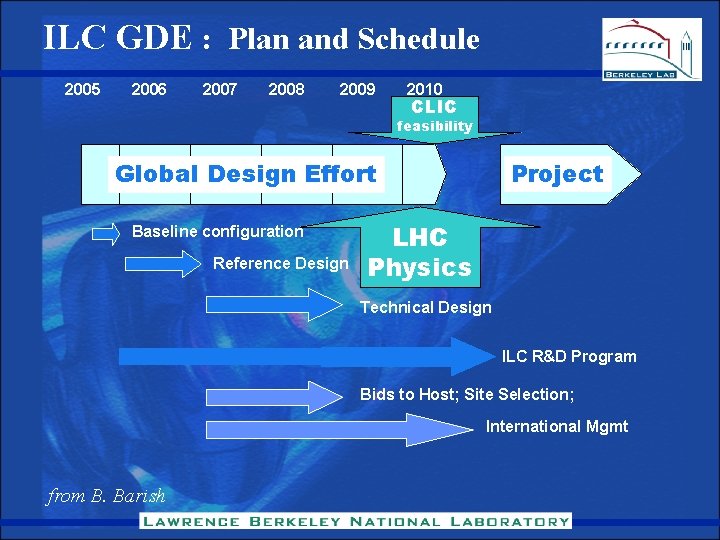
ILC GDE : Plan and Schedule 2005 2006 2007 2008 2009 2010 CLIC feasibility Project Global Design Effort Baseline configuration Reference Design LHC Physics Technical Design ILC R&D Program Bids to Host; Site Selection; International Mgmt from B. Barish
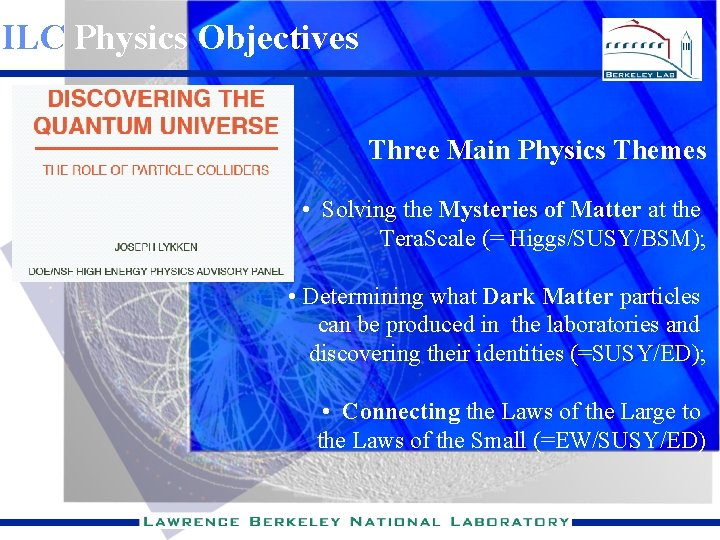
ILC Physics Objectives Three Main Physics Themes • Solving the Mysteries of Matter at the Tera. Scale (= Higgs/SUSY/BSM); • Determining what Dark Matter particles can be produced in the laboratories and discovering their identities (=SUSY/ED); • Connecting the Laws of the Large to the Laws of the Small (=EW/SUSY/ED)
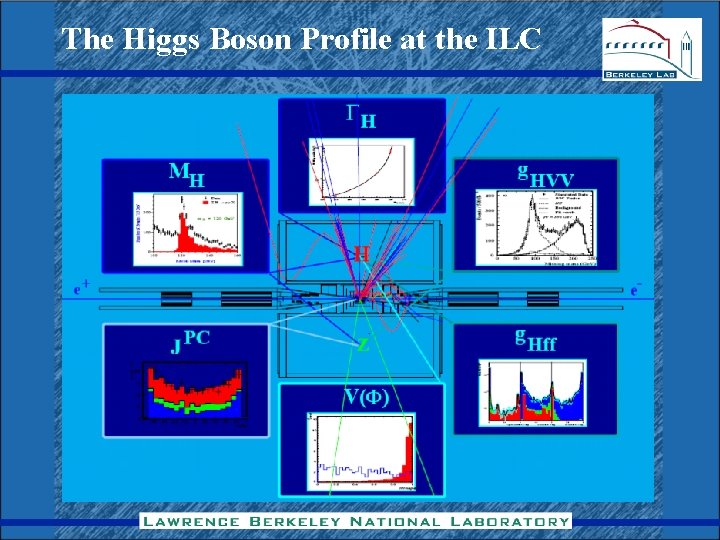
The Higgs Boson Profile at the ILC
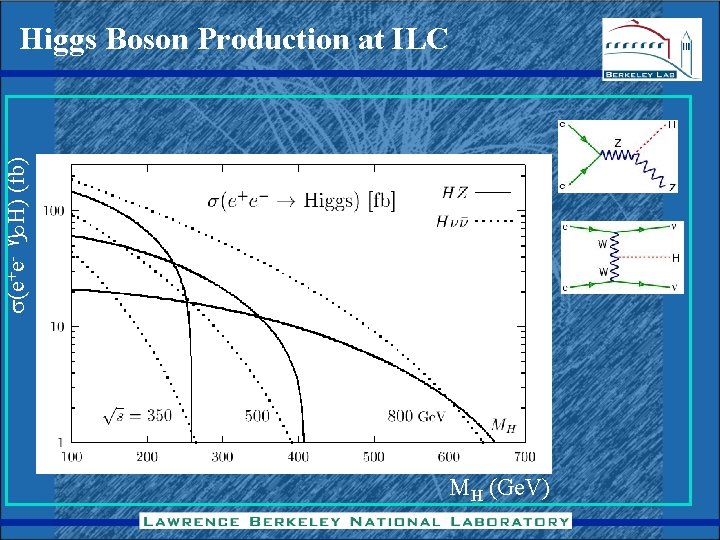
s(e+e- g. H) (fb) Higgs Boson Production at ILC MH (Ge. V)
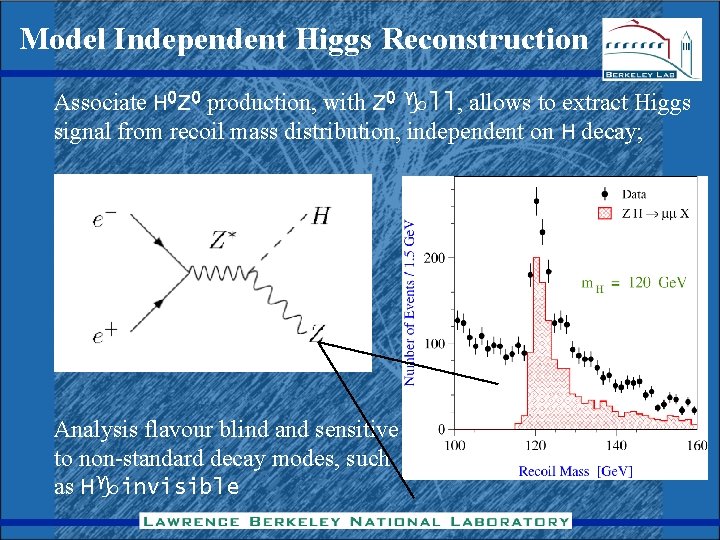
Model Independent Higgs Reconstruction Associate H 0 Z 0 production, with Z 0 gll, allows to extract Higgs signal from recoil mass distribution, independent on H decay; Analysis flavour blind and sensitive to non-standard decay modes, such as Hginvisible
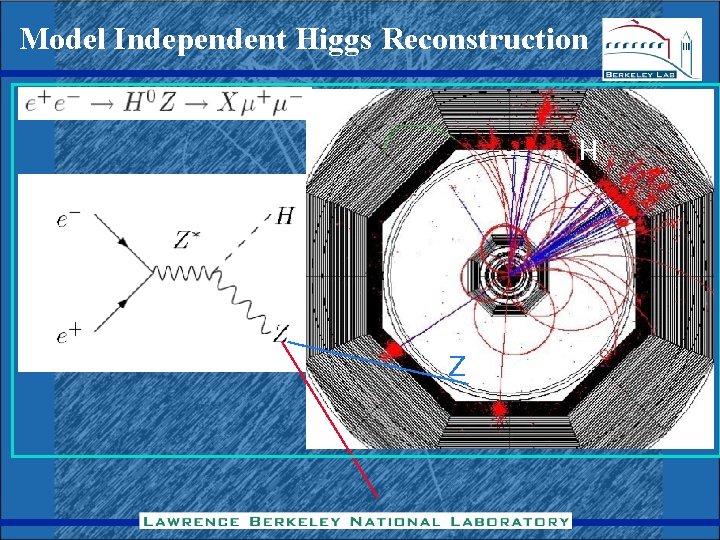
Model Independent Higgs Reconstruction H Z
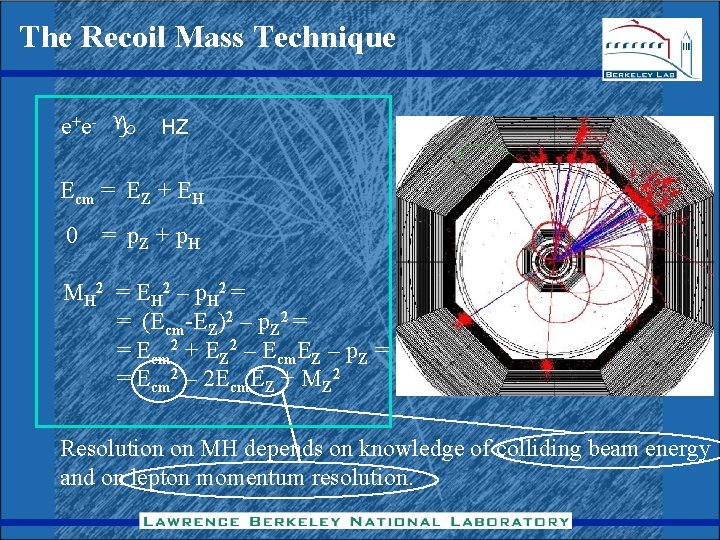
The Recoil Mass Technique e +e - g HZ Ecm = EZ + EH 0 = p. Z + p. H MH 2 = EH 2 – p. H 2 = = (Ecm-EZ)2 – p. Z 2 = = Ecm 2 + EZ 2 – Ecm. EZ – p. Z = = Ecm 2 – 2 Ecm. EZ + MZ 2 Resolution on MH depends on knowledge of colliding beam energy and on lepton momentum resolution.
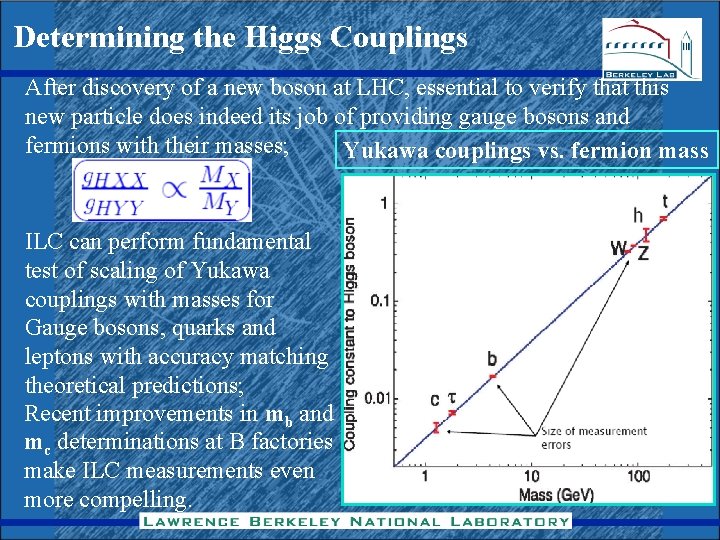
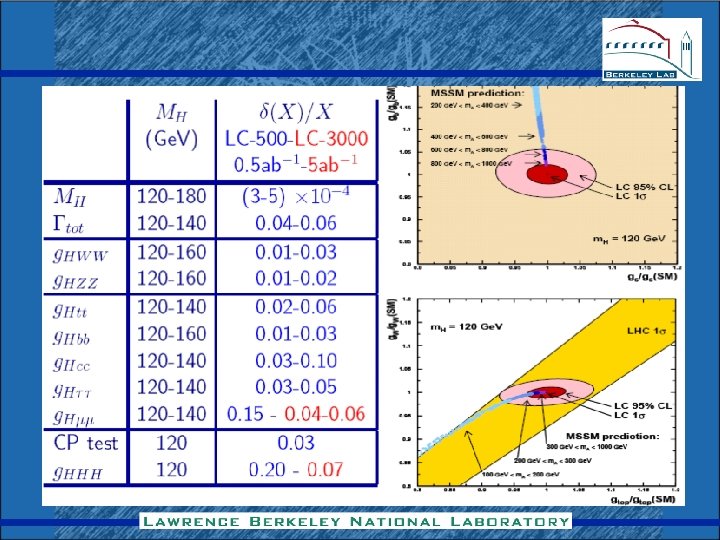
Determining the Higgs Couplings After discovery of a new boson at LHC, essential to verify that this new particle does indeed its job of providing gauge bosons and fermions with their masses; Yukawa couplings vs. fermion mass ILC can perform fundamental test of scaling of Yukawa couplings with masses for Gauge bosons, quarks and leptons with accuracy matching theoretical predictions; Recent improvements in mb and mc determinations at B factories make ILC measurements even more compelling.
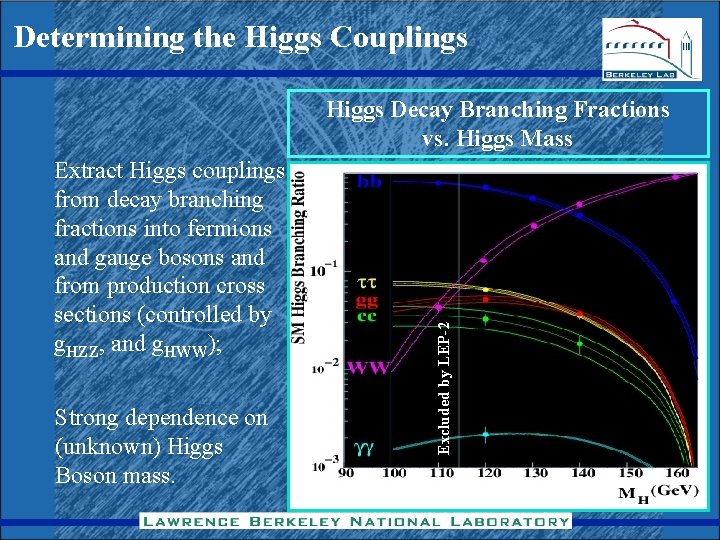
Determining the Higgs Couplings Extract Higgs couplings from decay branching fractions into fermions and gauge bosons and from production cross sections (controlled by g. HZZ, and g. HWW); Strong dependence on (unknown) Higgs Boson mass. Excluded by LEP-2 Higgs Decay Branching Fractions vs. Higgs Mass
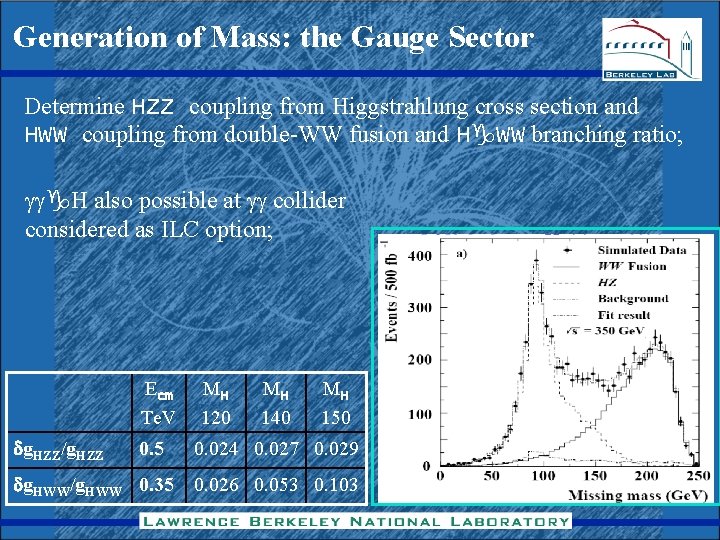
Generation of Mass: the Gauge Sector Determine HZZ coupling from Higgstrahlung cross section and HWW coupling from double-WW fusion and Hg. WW branching ratio; ggg. H also possible at gg collider considered as ILC option; Ecm Te. V dg. HZZ/g. HZZ 0. 5 MH 120 MH 140 MH 150 0. 024 0. 027 0. 029 dg. HWW/g. HWW 0. 35 0. 026 0. 053 0. 103
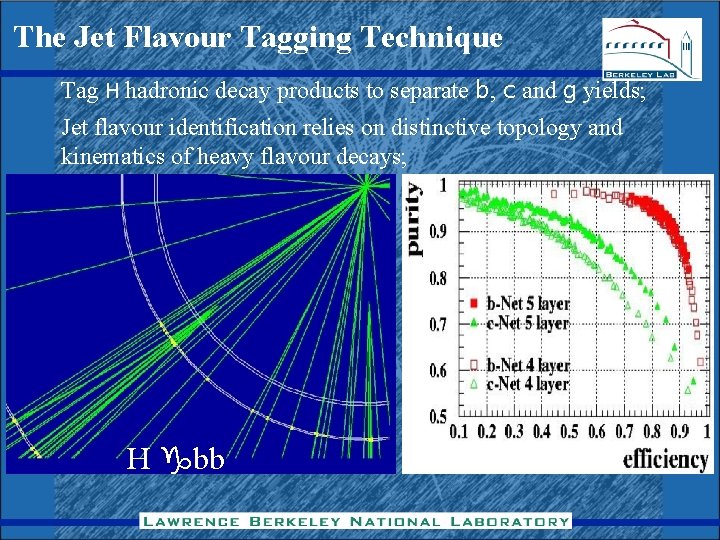
The Jet Flavour Tagging Technique Tag H hadronic decay products to separate b, c and g yields; Jet flavour identification relies on distinctive topology and kinematics of heavy flavour decays; H gbb
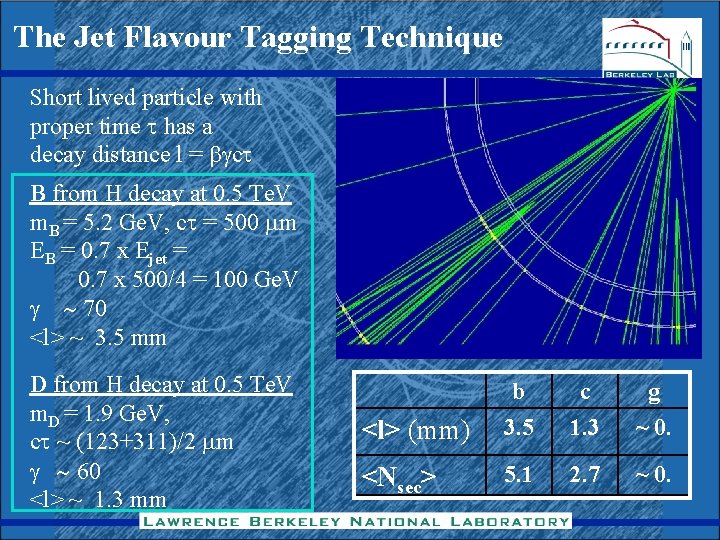
The Jet Flavour Tagging Technique Short lived particle with proper time t has a decay distance l = bgct B from H decay at 0. 5 Te. V m. B = 5. 2 Ge. V, ct = 500 mm EB = 0. 7 x Ejet = 0. 7 x 500/4 = 100 Ge. V g ~ 70 <l> ~ 3. 5 mm D from H decay at 0. 5 Te. V m. D = 1. 9 Ge. V, ct ~ (123+311)/2 mm g ~ 60 <l> ~ 1. 3 mm <l> (mm) b 3. 5 c 1. 3 g ~ 0. <Nsec> 5. 1 2. 7 ~ 0.
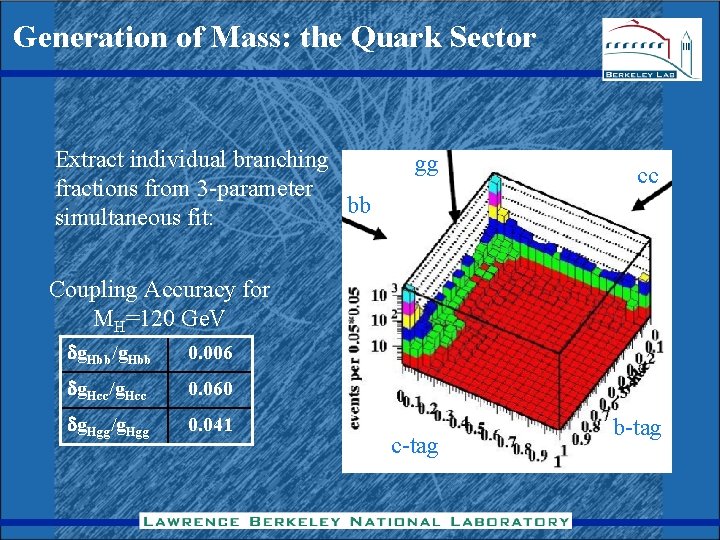
Generation of Mass: the Quark Sector Extract individual branching fractions from 3 -parameter bb simultaneous fit: gg cc Coupling Accuracy for MH=120 Ge. V dg. Hbb/g. Hbb 0. 006 dg. Hcc/g. Hcc 0. 060 dg. Hgg/g. Hgg 0. 041 c-tag b-tag
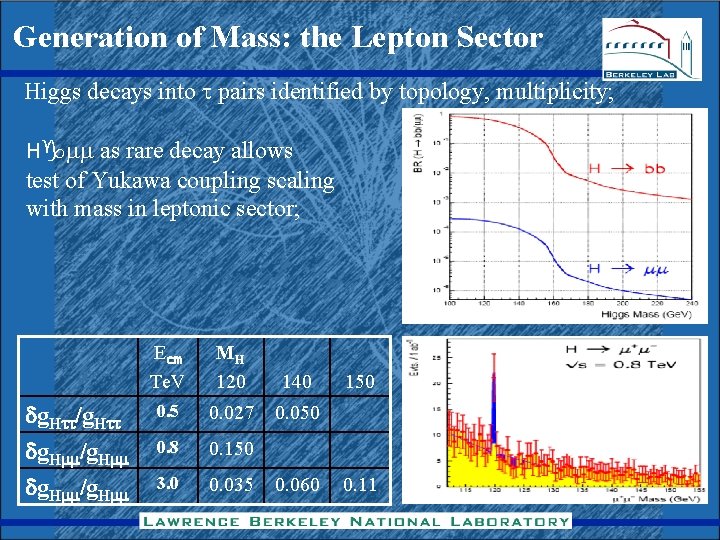
Generation of Mass: the Lepton Sector Higgs decays into t pairs identified by topology, multiplicity; Hgmm as rare decay allows test of Yukawa coupling scaling with mass in leptonic sector; Ecm Te. V MH 120 140 dg. Htt/g. Htt 0. 5 0. 027 0. 050 dg. Hmm/g. Hmm 0. 8 0. 150 dg. Hmm/g. Hmm 3. 0 0. 035 0. 060 150 0. 11
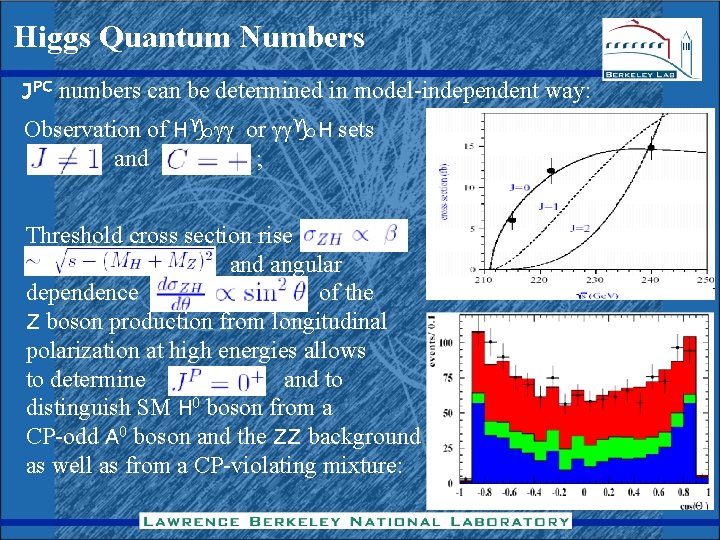
Higgs Quantum Numbers JPC numbers can be determined in model-independent way: Observation of Hggg or ggg. H sets and ; Threshold cross section rise and angular dependence of the Z boson production from longitudinal polarization at high energies allows to determine and to distinguish SM H 0 boson from a CP-odd A 0 boson and the ZZ background as well as from a CP-violating mixture:
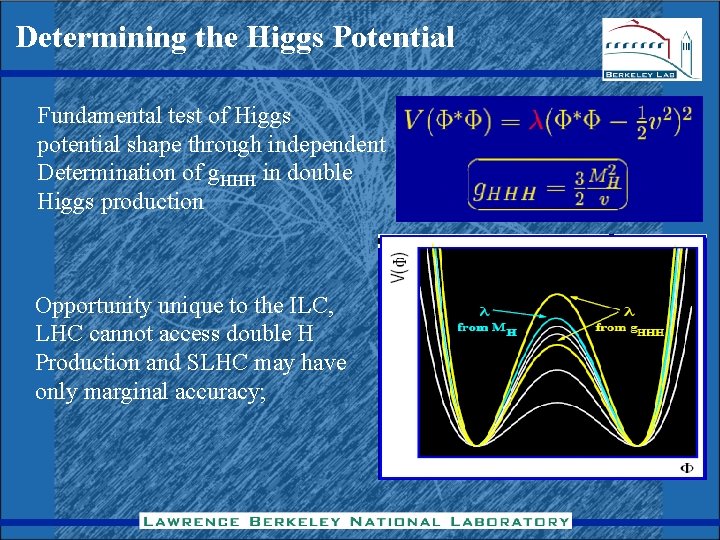
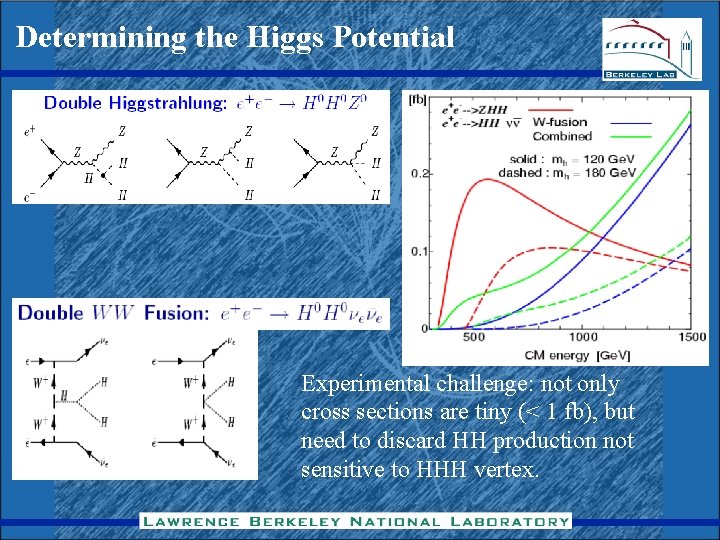
Determining the Higgs Potential Fundamental test of Higgs potential shape through independent Determination of g. HHH in double Higgs production Opportunity unique to the ILC, LHC cannot access double H Production and SLHC may have only marginal accuracy;
Determining the Higgs Potential Experimental challenge: not only cross sections are tiny (< 1 fb), but need to discard HH production not sensitive to HHH vertex.
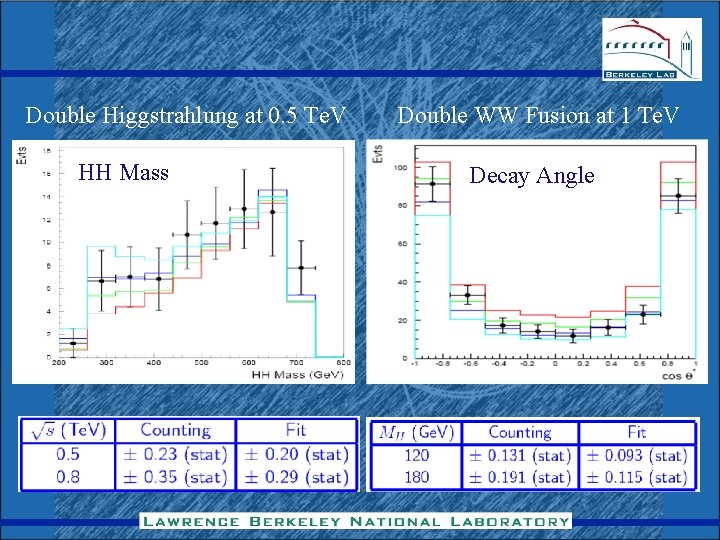
Double Higgstrahlung at 0. 5 Te. V HH Mass Double WW Fusion at 1 Te. V Decay Angle
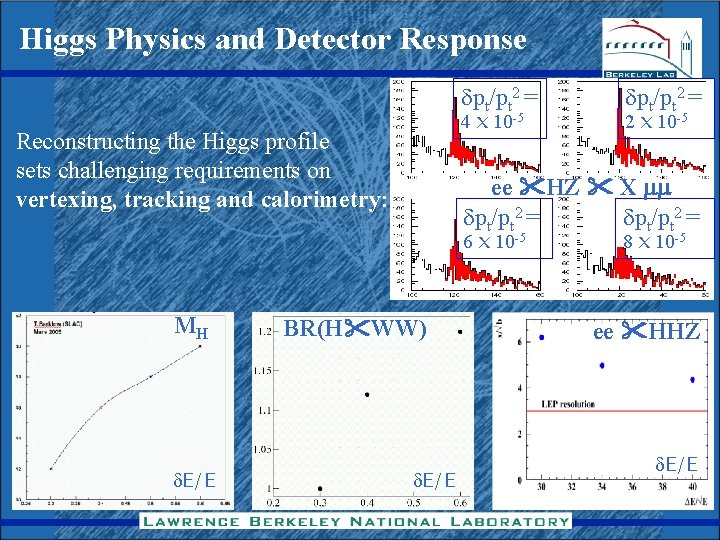
Higgs Physics and Detector Response dpt/pt 2 = 4 x 10 -5 Reconstructing the Higgs profile sets challenging requirements on vertexing, tracking and calorimetry: d. E/E 2 x 10 -5 ee "HZ " X mm dpt/pt 2 = 6 x 10 -5 MH dpt/pt 2 = BR(H"WW) d. E/E 8 x 10 -5 ee "HHZ d. E/E
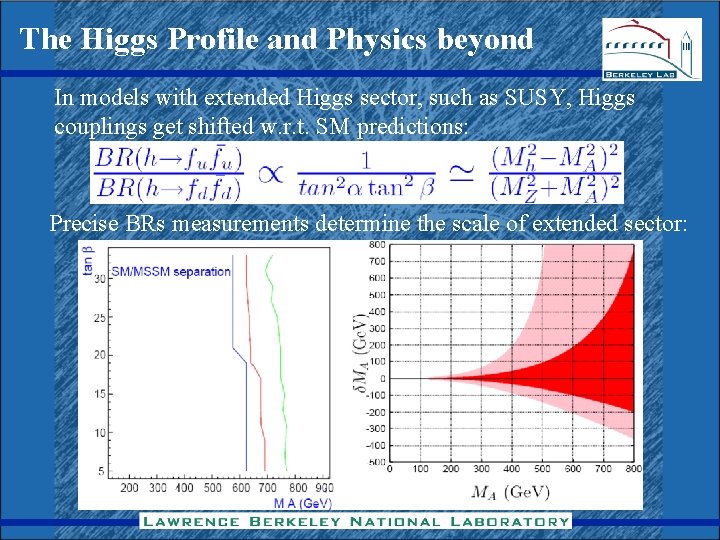
The Higgs Profile and Physics beyond In models with extended Higgs sector, such as SUSY, Higgs couplings get shifted w. r. t. SM predictions: Precise BRs measurements determine the scale of extended sector:
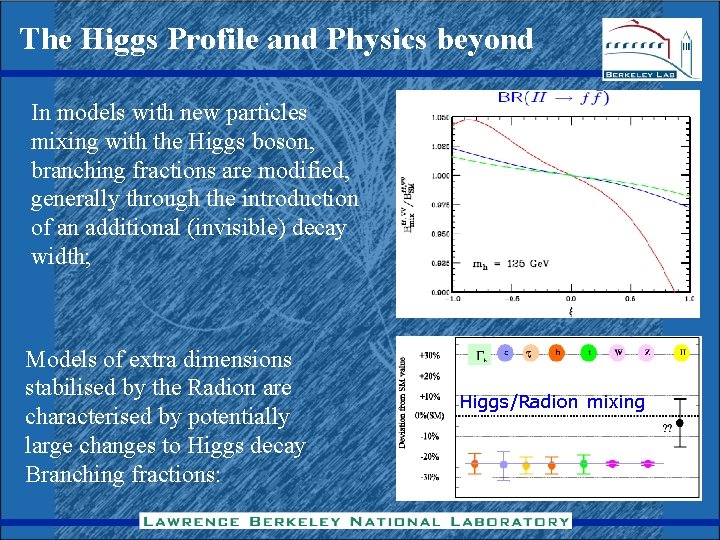
The Higgs Profile and Physics beyond In models with new particles mixing with the Higgs boson, branching fractions are modified, generally through the introduction of an additional (invisible) decay width; Models of extra dimensions stabilised by the Radion are characterised by potentially large changes to Higgs decay Branching fractions: Higgs/Radion mixing