
The International Fellowship Program Findings from a first
- Slides: 28
The International Fellowship Program Findings from a first round of evaluative information gathering and analysis Jürgen Enders, Henno Theisens & Don Westerheijden 14. 3. 05 © CHEPS
CHEPS Evaluation Project I 2 14. 3. 05 n Concept, design and instruments for a formative evaluation of the IFP n Potential to contribute to a summative evaluation n In close co-operation with the IFF/IFP Secretariat, feedback from IFP Partners, consultations with the IFF Board of Directors and the Program Advisory Committee © CHEPS
CHEPS Evaluation Project II 3 14. 3. 05 n Evaluation framework n Modular package: questionnaire instruments and interview protocols n Implementation started 2004 © CHEPS
Major Questions for Evaluation I n Is IFP able to define, reach and select its target group(s) in the context of national/regional circumstances? u n Does the Fellow’s profile, pre-academic training and placement support enable IFP to place Fellows in competitive institutions according to their strengths, needs and aspirations? u 4 14. 3. 05 Target Groups, Outreach, Selection © CHEPS Pre-Academic Training and Placement
Major Questions for Evaluation II n Does the match between the Fellow’s profile and the profile of host institutions/study programs lead to successful post-graduate experience and outcomes? u n 5 14. 3. 05 Postgraduate experience Do the Fellowship and post-graduate experience and outcomes lead Alumni into successful professional careers and help to overcome barriers due to social background? u © CHEPS Further career
Major Questions for Evaluation III n Finally, are IFP Alumni motivated and enabled to use their education and career for the betterment of their communities? u 6 14. 3. 05 © CHEPS Social engagement
Design and Method n n Questionnaires and interviews Different actors in IFP u Finalists: Selected and not selected ¨ u 2003, 2004 Fellows placed (in post-graduate study) Selected in 2003 ¨ Selected before 2003 ( ‘catch-up’ questionnaire) ¨ 25 interviews ¨ 7 14. 3. 05 © CHEPS
Design and Method u Alumni: ¨ Early career ² ¨ Fellowship ended before Oct. ’ 04 ( ‘catch-up’ questionnaire) Planned: ca. 3 years after graduation International Partner Organizations u Placement Partner Organizations u Mentors at Host Institutions u Low response to questionnaire (24%) ¨ 8 interviews ¨ 8 14. 3. 05 © CHEPS
Findings (1) Target Group Definition, Outreach, Selection n 9 14. 3. 05 IFP has set up infrastructures and networks that reflect program goals and allow for local variety within global coherence Process of consultation to discuss the nature of access to higher education and to identify target groups and communities Cultural, social, and economic indicators of ‘exclusion’ have been identified and prioritized for the purpose of the country or sub-region © CHEPS
Findings (1) Target Group Definition, Outreach and Selection n 10 14. 3. 05 Poverty, gender and coming from/living in a remote/rural area are important criteria for the overall program Frequent outreach activities as well as multiple and sometimes innovative efforts to address target groups The IFP is a highly selective program © CHEPS
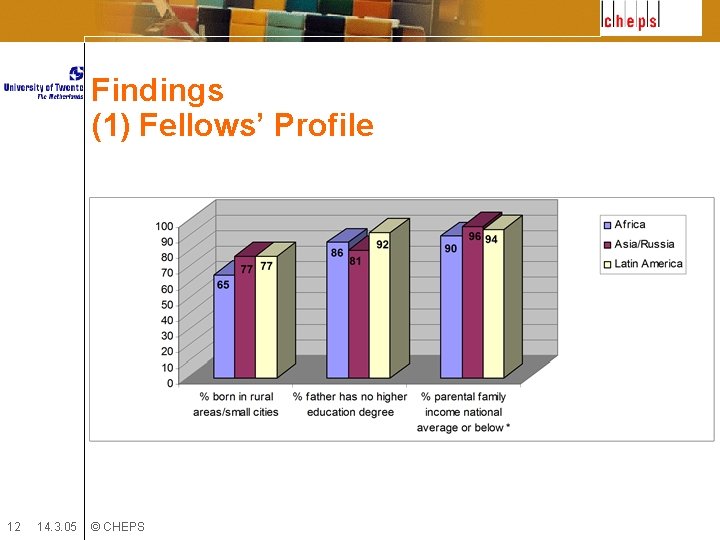
Findings (1) Target Group Definition, Outreach and Selection n 11 14. 3. 05 Selection processes with discrete steps that include as cornerstones documentary review, interviews as well as outside expert rating Target group criteria are well reflected in the final selection of IFP Fellows The program mainly (while not exclusively) recruits among people with a socio-demographic background a socio-biographic profile that fits the program goals © CHEPS
Findings (1) Fellows’ Profile 12 14. 3. 05 © CHEPS
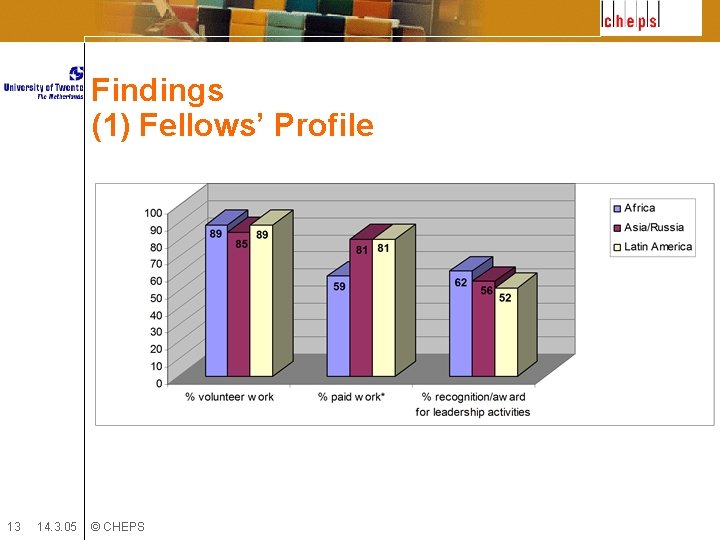
Findings (1) Fellows’ Profile 13 14. 3. 05 © CHEPS
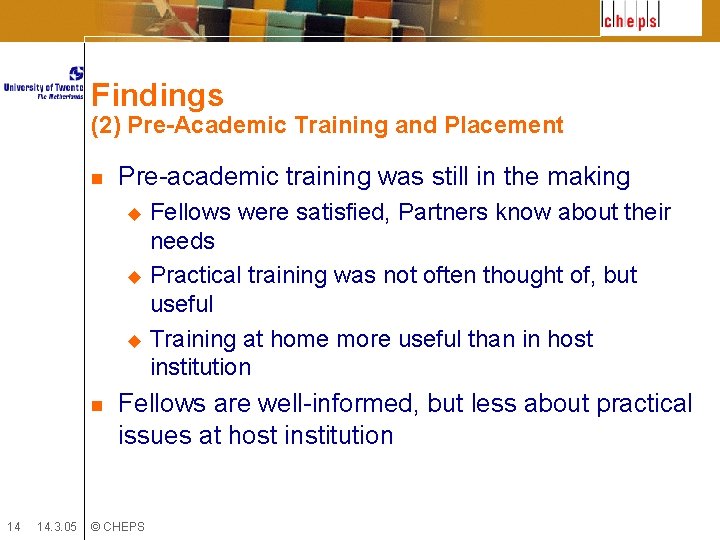
Findings (2) Pre-Academic Training and Placement n Pre-academic training was still in the making Fellows were satisfied, Partners know about their needs u Practical training was not often thought of, but useful u Training at home more useful than in host institution u n 14 14. 3. 05 Fellows are well-informed, but less about practical issues at host institution © CHEPS
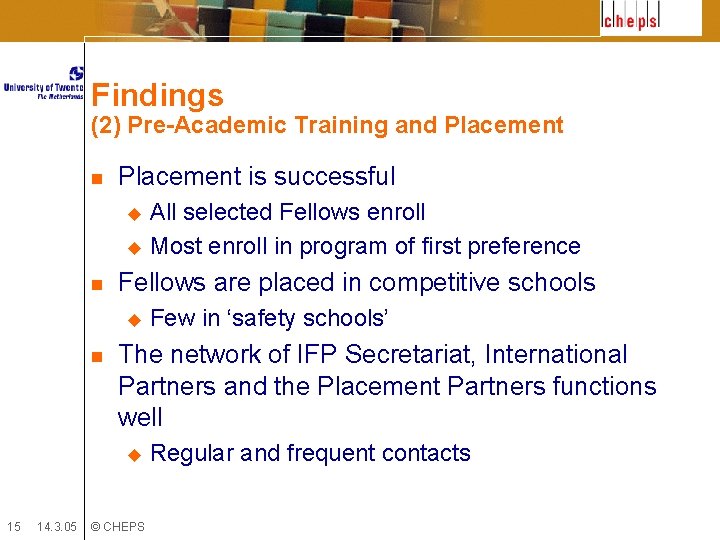
Findings (2) Pre-Academic Training and Placement n Placement is successful All selected Fellows enroll u Most enroll in program of first preference u n Fellows are placed in competitive schools u n The network of IFP Secretariat, International Partners and the Placement Partners functions well u 15 14. 3. 05 Few in ‘safety schools’ © CHEPS Regular and frequent contacts
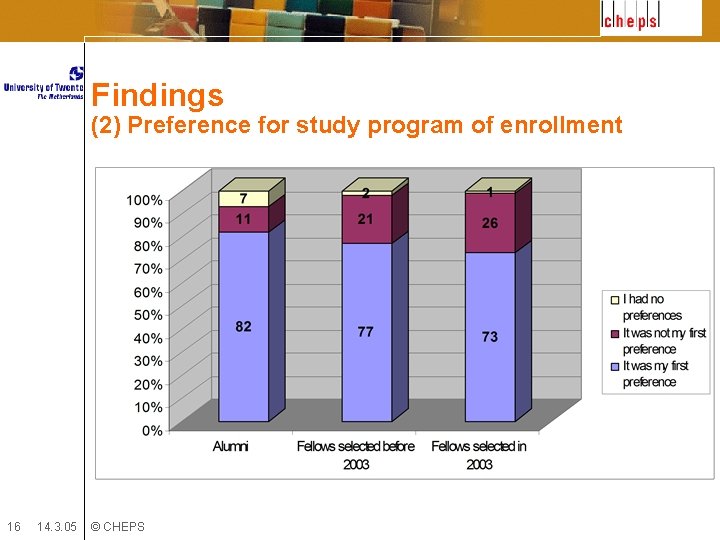
Findings (2) Preference for study program of enrollment 16 14. 3. 05 © CHEPS
Findings (3) Post-Graduate Experience n n n Fellows function well in their host institutions They feel satisfied about the study and about the academic support over 60% lived on the IFP Fellowship only, u n A better match has been achieved in recent years between the expected time to degree and the duration of the Fellowship u 17 14. 3. 05 others complemented their income from other sources, mainly private or family © CHEPS Exception: some Ph. D. -students
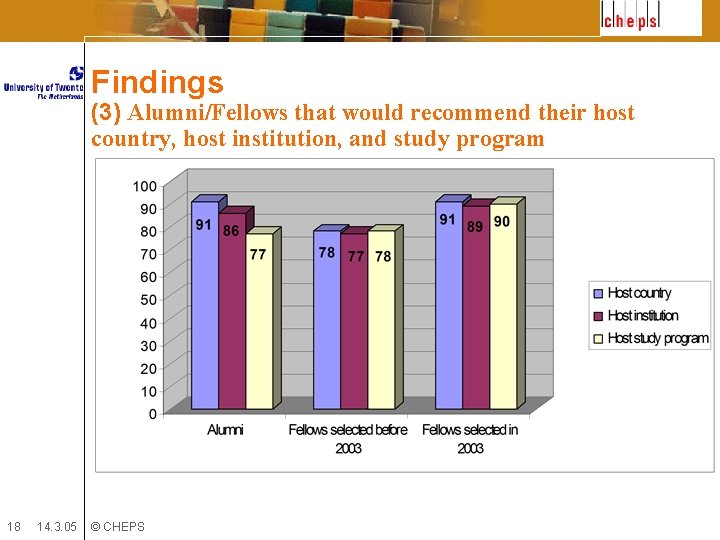
Findings (3) Alumni/Fellows that would recommend their host country, host institution, and study program 18 14. 3. 05 © CHEPS
Findings (3) Post-Graduate Experience n n 19 14. 3. 05 Most Fellows are actively involved in the social and academic life of the host institution Most Fellows have established contacts with other Fellows Almost all Fellows stay in touch with their home region, family and friends Fellows are less active in social volunteer activities than they were before, but most are still active © CHEPS
Findings (3) Post-Graduate Experience n Fellows expect the most important contribution of their postgraduate studies to be an improvement in their field of study’s knowledge u n 20 14. 3. 05 also social values and individual gains Fellows felt less positive about their training experience in terms of immediately applicable new skills and their (employment) benefits © CHEPS
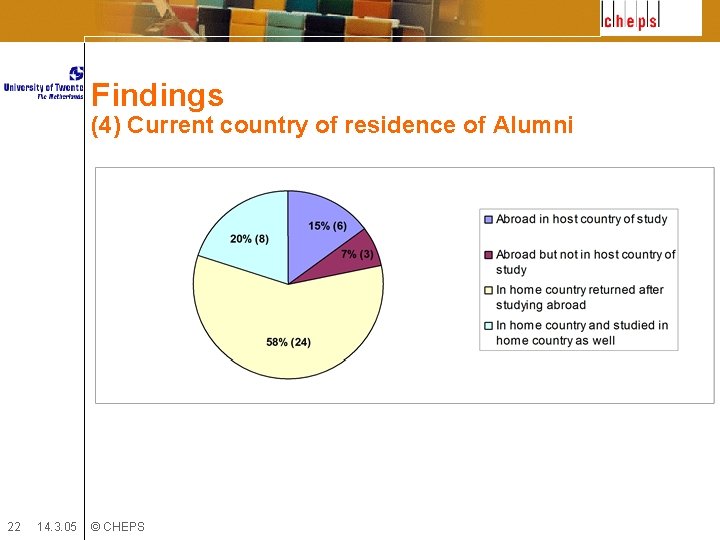
Findings (4) Postgraduate Outcomes and Early Career 21 14. 3. 05 n We can only say something about the very first steps in the further careers of (few) IFP Alumni n All IFP Alumni that responded to our survey successfully completed their studies n 78 % returned to or stayed in their home country © CHEPS
Findings (4) Current country of residence of Alumni 22 14. 3. 05 © CHEPS
Findings (4) Postgraduate Outcomes and Early Career 23 14. 3. 05 n Most of those staying abroad are pursuing further studies or receiving advanced professional training n ‘Brain drain’ might be transitional n 54% of Alumni live in their home community © CHEPS
Findings (4) Postgraduate Outcomes and Early Career n n 24 14. 3. 05 Wherever they are, IFP Alumni are actively involved in the cause of social justice The IFP program has helped Alumni to build many of the competencies they need for their work or further studies Almost all former Fellows interacted with other Fellows during their Fellowship All Alumni would appreciate Alumni activities © CHEPS
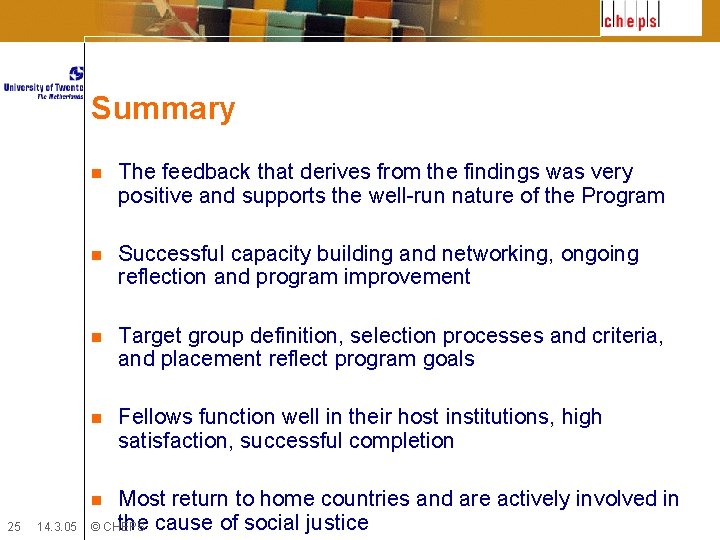
Summary n The feedback that derives from the findings was very positive and supports the well-run nature of the Program n Successful capacity building and networking, ongoing reflection and program improvement n Target group definition, selection processes and criteria, and placement reflect program goals n Fellows function well in their host institutions, high satisfaction, successful completion Most return to home countries and are actively involved in the cause of social justice © CHEPS n 25 14. 3. 05
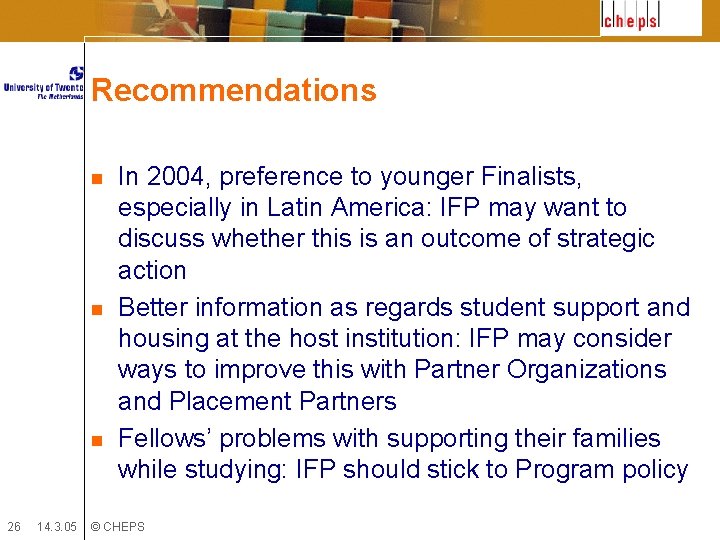
Recommendations n n n 26 14. 3. 05 In 2004, preference to younger Finalists, especially in Latin America: IFP may want to discuss whether this is an outcome of strategic action Better information as regards student support and housing at the host institution: IFP may consider ways to improve this with Partner Organizations and Placement Partners Fellows’ problems with supporting their families while studying: IFP should stick to Program policy © CHEPS
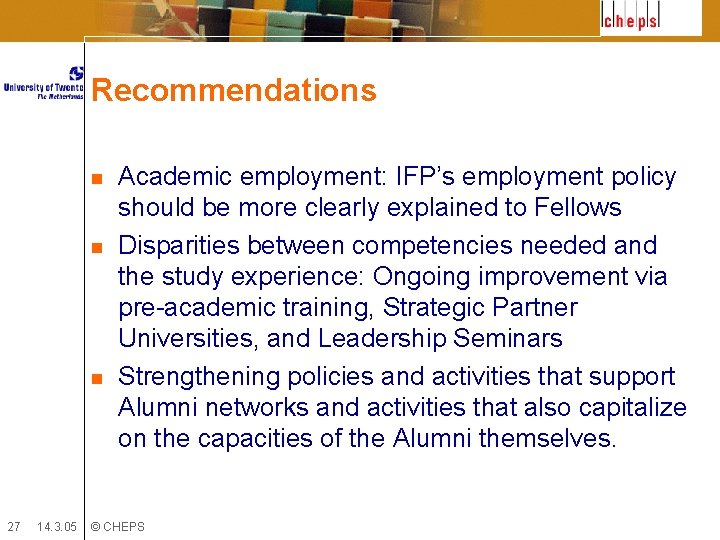
Recommendations n n n 27 14. 3. 05 Academic employment: IFP’s employment policy should be more clearly explained to Fellows Disparities between competencies needed and the study experience: Ongoing improvement via pre-academic training, Strategic Partner Universities, and Leadership Seminars Strengthening policies and activities that support Alumni networks and activities that also capitalize on the capacities of the Alumni themselves. © CHEPS
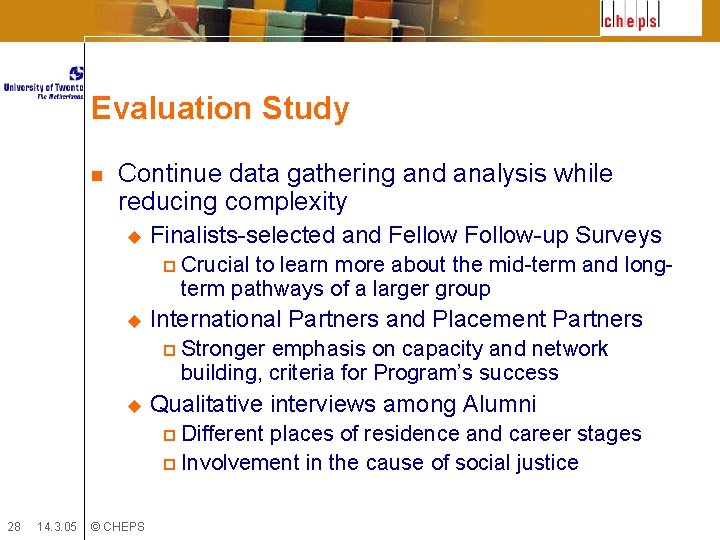
Evaluation Study n Continue data gathering and analysis while reducing complexity u Finalists-selected and Fellow Follow-up Surveys ¨ u International Partners and Placement Partners ¨ u Crucial to learn more about the mid-term and longterm pathways of a larger group Stronger emphasis on capacity and network building, criteria for Program’s success Qualitative interviews among Alumni Different places of residence and career stages ¨ Involvement in the cause of social justice ¨ 28 14. 3. 05 © CHEPS