
The International Centre for Innovation in Education ICIE
- Slides: 46
The International Centre for Innovation in Education (ICIE), 3 rd International Conference on Excellence in Education 2010: Research-Strategic Planning-Development, Harokopio university, Athens-Greece, June 8 -11, 2010. “Towards Excellence In Education: Academic Achievement and its relationship with the Dominant Representational Type, Academic Self-concept and Intelligence in Greek Primary Schools charalampostsiros@gmail. com ” 1
“Towards Excellence In Education: Academic Achievement and its relationship with the Dominant Representational Type, Academic Self-concept and Intelligence in Greek Primary Schools ” Haralampos TSIROS Ph. D. (Ph. -Phyc. -Ed. ), M. Sc. (Eng. ), B. Sc. (Soc. Sc. ), D. I. C. charalampostsiros@gmail. com 2
Outline of the presentation l l l 1. CONCEPT IDENTIFICATION 2. AIMS OF THE STUDY 3. MATERIAL AND METHOD 4. RESULTS 5. CONCLUSIONS 6. PRACTICAL IMPLICATIONS charalampostsiros@gmail. com 3
1. CONCEPT IDENTIFICATION 1 a. Dominant Representational Type charalampostsiros@gmail. com 4
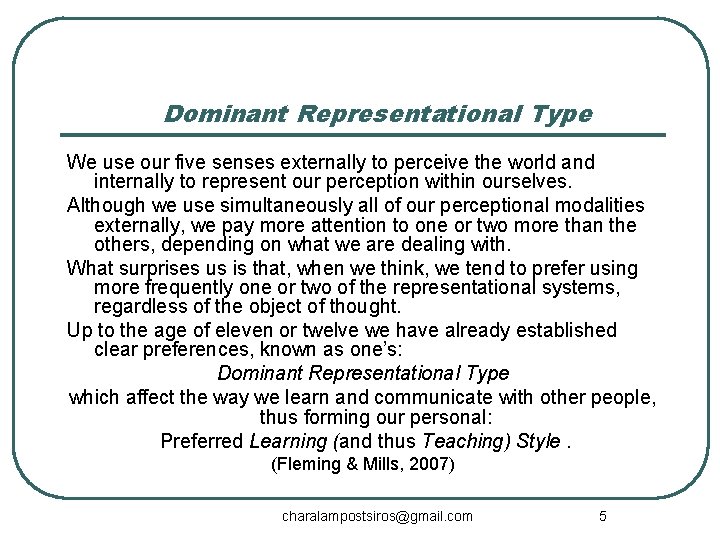
Dominant Representational Type We use our five senses externally to perceive the world and internally to represent our perception within ourselves. Although we use simultaneously all of our perceptional modalities externally, we pay more attention to one or two more than the others, depending on what we are dealing with. What surprises us is that, when we think, we tend to prefer using more frequently one or two of the representational systems, regardless of the object of thought. Up to the age of eleven or twelve we have already established clear preferences, known as one’s: Dominant Representational Type which affect the way we learn and communicate with other people, thus forming our personal: Preferred Learning (and thus Teaching) Style. (Fleming & Mills, 2007) charalampostsiros@gmail. com 5
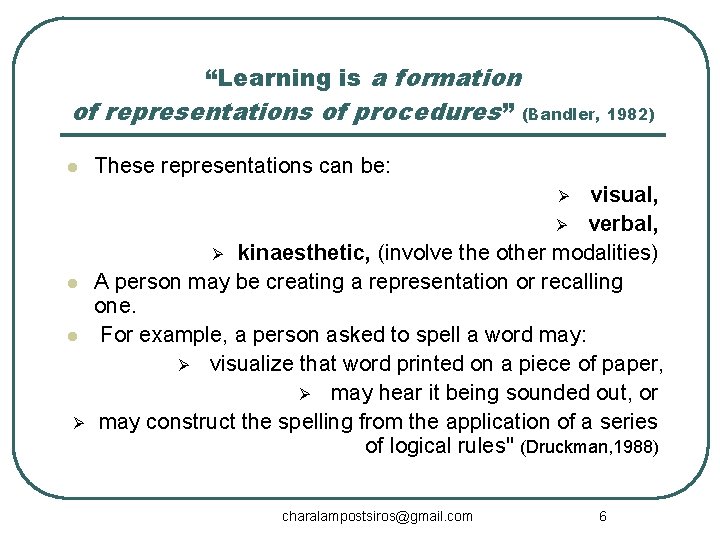
“Learning is a formation of representations of procedures” (Bandler, 1982) l These representations can be: visual, Ø verbal, Ø kinaesthetic, (involve the other modalities) A person may be creating a representation or recalling one. For example, a person asked to spell a word may: Ø visualize that word printed on a piece of paper, Ø may hear it being sounded out, or may construct the spelling from the application of a series of logical rules" (Druckman, 1988) Ø l l Ø charalampostsiros@gmail. com 6
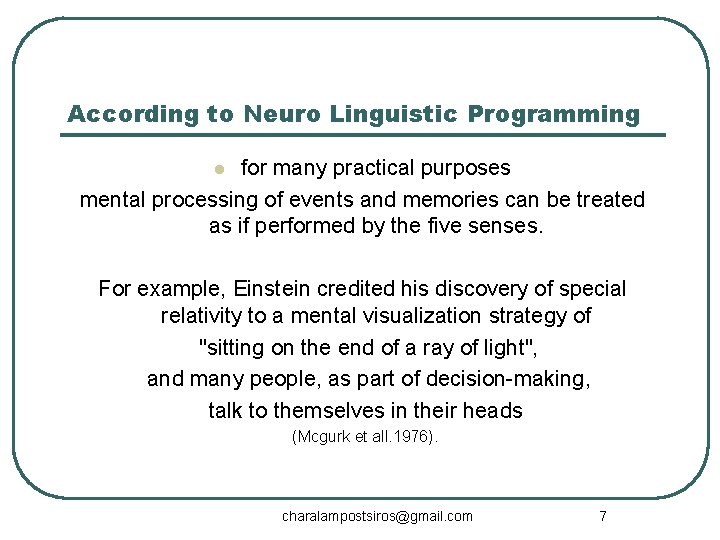
According to Neuro Linguistic Programming for many practical purposes mental processing of events and memories can be treated as if performed by the five senses. l For example, Einstein credited his discovery of special relativity to a mental visualization strategy of "sitting on the end of a ray of light", and many people, as part of decision-making, talk to themselves in their heads (Mcgurk et all. 1976). charalampostsiros@gmail. com 7
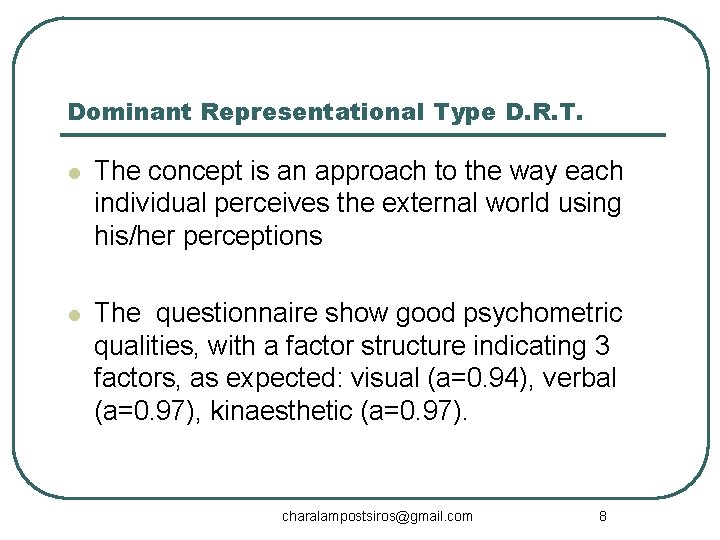
Dominant Representational Type D. R. T. l The concept is an approach to the way each individual perceives the external world using his/her perceptions l The questionnaire show good psychometric qualities, with a factor structure indicating 3 factors, as expected: visual (a=0. 94), verbal (a=0. 97), kinaesthetic (a=0. 97). charalampostsiros@gmail. com 8
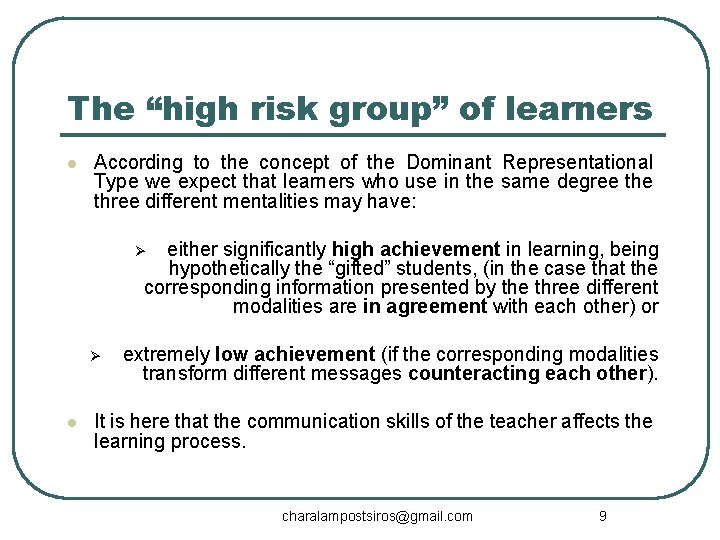
The “high risk group” of learners l According to the concept of the Dominant Representational Type we expect that learners who use in the same degree three different mentalities may have: either significantly high achievement in learning, being hypothetically the “gifted” students, (in the case that the corresponding information presented by the three different modalities are in agreement with each other) or Ø Ø l extremely low achievement (if the corresponding modalities transform different messages counteracting each other). It is here that the communication skills of the teacher affects the learning process. charalampostsiros@gmail. com 9
1. CONCEPT IDENTIFICATION (continued) 1 b. Academic Self-concept. charalampostsiros@gmail. com 10
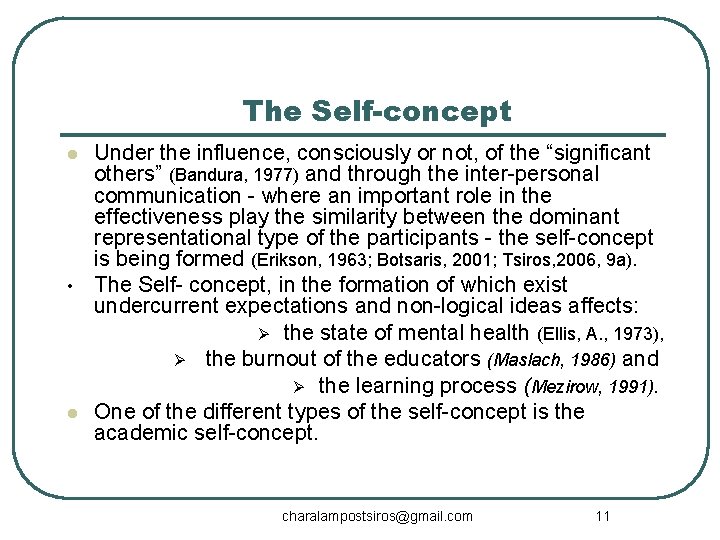
The Self-concept l • l Under the influence, consciously or not, of the “significant others” (Bandura, 1977) and through the inter-personal communication - where an important role in the effectiveness play the similarity between the dominant representational type of the participants - the self-concept is being formed (Erikson, 1963; Botsaris, 2001; Tsiros, 2006, 9 a). The Self- concept, in the formation of which exist undercurrent expectations and non-logical ideas affects: Ø the state of mental health (Ellis, A. , 1973), Ø the burnout of the educators (Maslach, 1986) and Ø the learning process (Mezirow, 1991). One of the different types of the self-concept is the academic self-concept. charalampostsiros@gmail. com 11
1. CONCEPT IDENTIFICATION (continued) 1 c. Intelligence. Raven Progressive Matrices test charalampostsiros@gmail. com 12
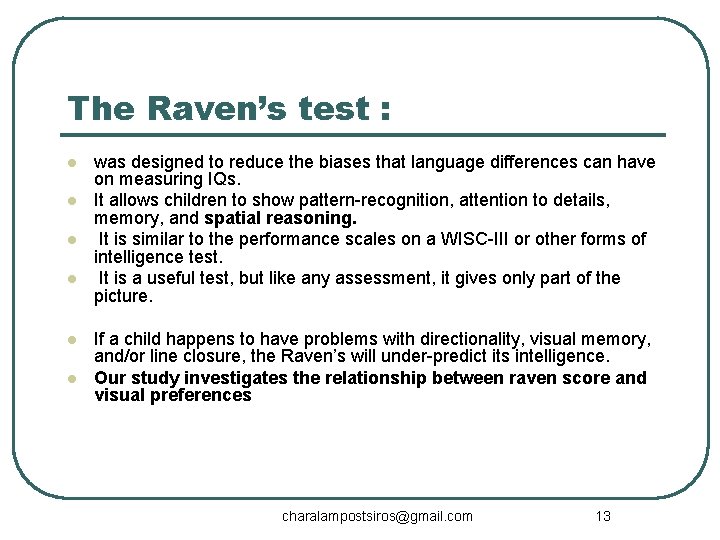
The Raven’s test : l l l was designed to reduce the biases that language differences can have on measuring IQs. It allows children to show pattern-recognition, attention to details, memory, and spatial reasoning. It is similar to the performance scales on a WISC-III or other forms of intelligence test. It is a useful test, but like any assessment, it gives only part of the picture. If a child happens to have problems with directionality, visual memory, and/or line closure, the Raven’s will under-predict its intelligence. Our study investigates the relationship between raven score and visual preferences charalampostsiros@gmail. com 13
1. CONCEPT IDENTIFICATION (continued) 1 d. Academic achievement charalampostsiros@gmail. com 14
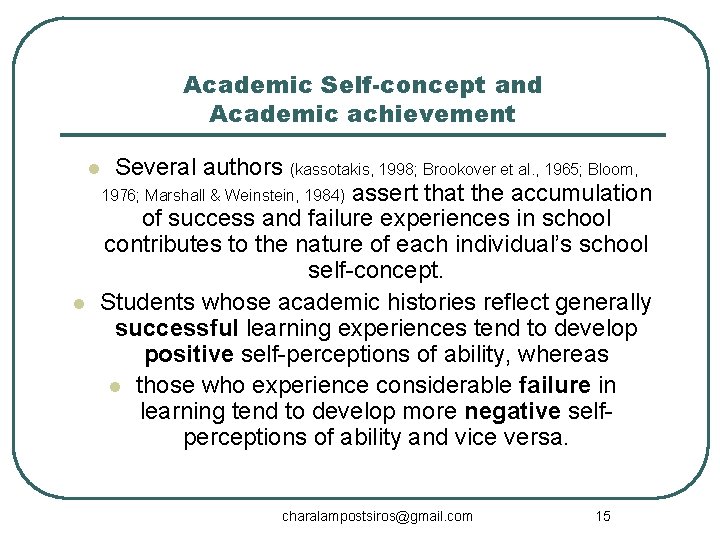
Academic Self-concept and Academic achievement Several authors (kassotakis, 1998; Brookover et al. , 1965; Bloom, 1976; Marshall & Weinstein, 1984) assert that the accumulation of success and failure experiences in school contributes to the nature of each individual’s school self-concept. Students whose academic histories reflect generally successful learning experiences tend to develop positive self-perceptions of ability, whereas l those who experience considerable failure in learning tend to develop more negative selfperceptions of ability and vice versa. l l charalampostsiros@gmail. com 15
2. AIMS OF THE STUDY charalampostsiros@gmail. com 16
2. Aims of the study… l l a. To investigate the factorial structure, validity and reliability of the Dominant Representational Type Questionnaire (D. R. T. Q. ). b. To investigate the interrelationship between the school grade in Math and Language assigned by the teacher and their Dominant Representational Type, Academic Self-concept, and Intelligence. charalampostsiros@gmail. com 17
…aims of the study… l l Also, to investigate the “influence” of the variable Dominant Representational Type on the above mentioned relationships. We did so by investigating whethere are statistically significant differences (χ2, p<0. 05), between the percentages of the students belonging in each of the subgroups of the variables under study in the “high risk group” (consisted of the students with the same degree of modality preference, that is students who showed the same degree of visual, verbal and kinaesthetic preferences), and the rest of the population. charalampostsiros@gmail. com 18
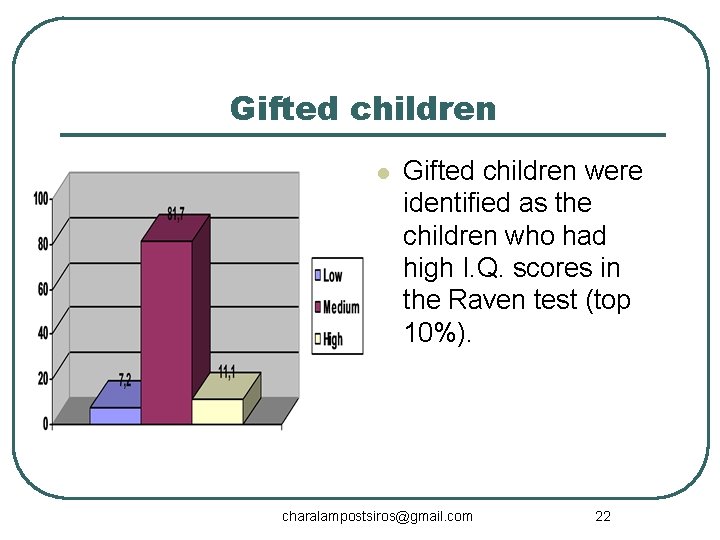
…aims of the study l l c. We also focus on the gifted students identified by a high I. Q. (top 11. 1% in Raven test). d. Finally, we were interested in investigating whether the Raven test, used so often in identifying the gifted students, really “primarily tests one's visual spatial abilities”. charalampostsiros@gmail. com 19
3. MATERIAL AND METHOD 3 a. Sample charalampostsiros@gmail. com 20
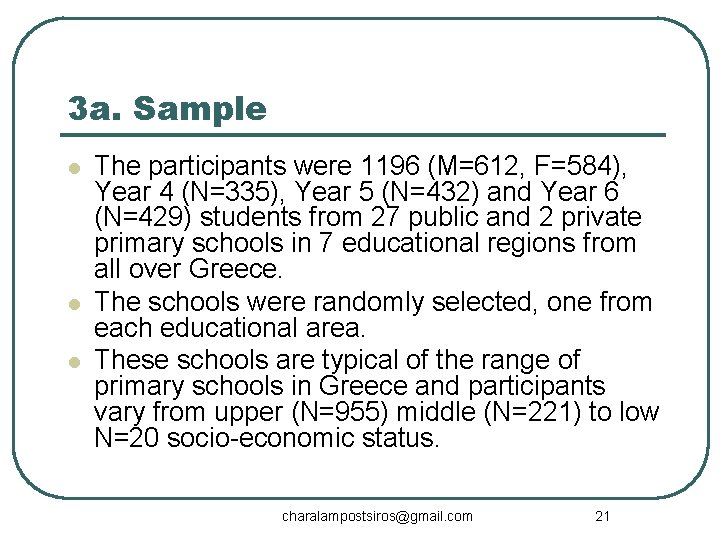
3 a. Sample l l l The participants were 1196 (M=612, F=584), Year 4 (N=335), Year 5 (N=432) and Year 6 (N=429) students from 27 public and 2 private primary schools in 7 educational regions from all over Greece. The schools were randomly selected, one from each educational area. These schools are typical of the range of primary schools in Greece and participants vary from upper (N=955) middle (N=221) to low N=20 socio-economic status. charalampostsiros@gmail. com 21
Gifted children l Gifted children were identified as the children who had high I. Q. scores in the Raven test (top 10%). charalampostsiros@gmail. com 22
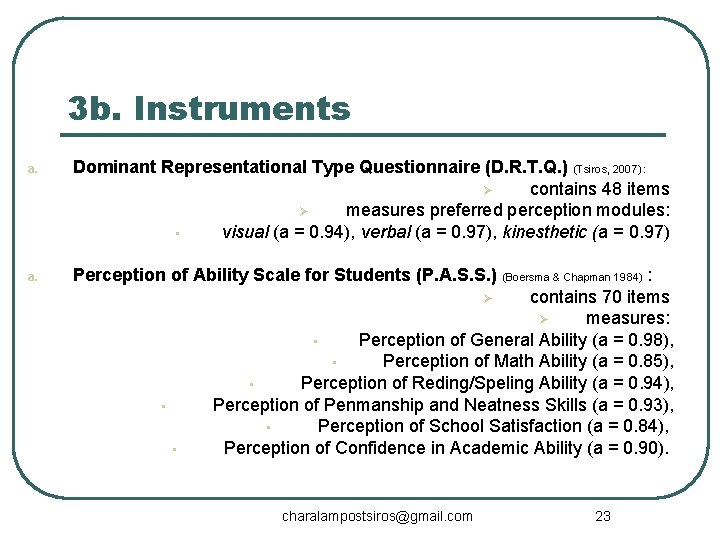
3 b. Instruments a. Dominant Representational Type Questionnaire (D. R. T. Q. ) (Tsiros, 2007) : Ø contains 48 items Ø measures preferred perception modules: • visual (a = 0. 94), verbal (a = 0. 97), kinesthetic (a = 0. 97) a. Perception of Ability Scale for Students (P. A. S. S. ) • • : Ø contains 70 items Ø measures: • Perception of General Ability (a = 0. 98), • Perception of Math Ability (a = 0. 85), • Perception of Reding/Speling Ability (a = 0. 94), Perception of Penmanship and Neatness Skills (a = 0. 93), • Perception of School Satisfaction (a = 0. 84), Perception of Confidence in Academic Ability (a = 0. 90). charalampostsiros@gmail. com (Boersma & Chapman 1984) 23
…Instruments c. Raven’s test (I. Q. ) measures : Ø Ø Ø pattern-recognition, attention to details, Ø memory, and spatial reasoning Ø c. Achievement in Maths and Language: Ø provided by their teachers. charalampostsiros@gmail. com 24
3 c. Statistical analysis l l χ2 -test (χ2, p<0. 05) F-test Pearson (r, p< 0. 01) AN. O. VA. charalampostsiros@gmail. com 25
4. RESULTS 4 investigations charalampostsiros@gmail. com 26
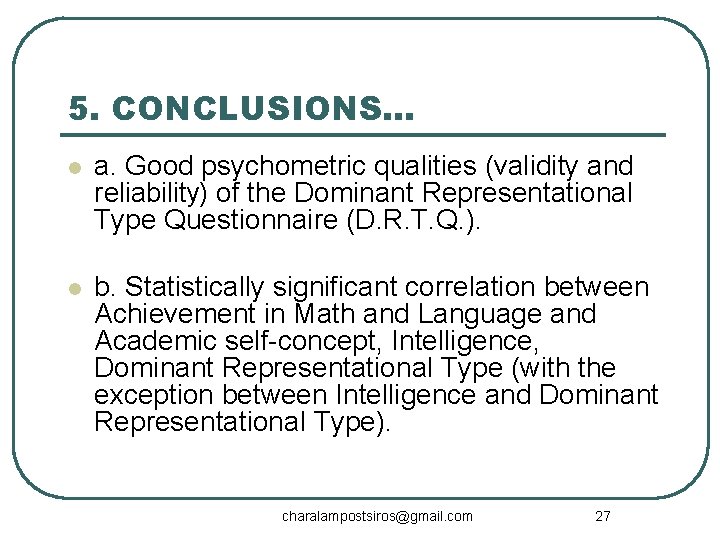
5. CONCLUSIONS… l a. Good psychometric qualities (validity and reliability) of the Dominant Representational Type Questionnaire (D. R. T. Q. ). l b. Statistically significant correlation between Achievement in Math and Language and Academic self-concept, Intelligence, Dominant Representational Type (with the exception between Intelligence and Dominant Representational Type). charalampostsiros@gmail. com 27
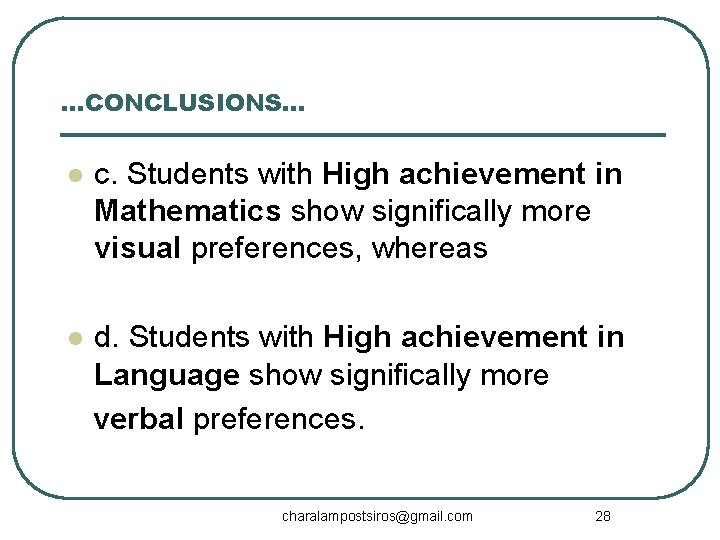
…CONCLUSIONS… l c. Students with High achievement in Mathematics show significally more visual preferences, whereas l d. Students with High achievement in Language show significally more verbal preferences. charalampostsiros@gmail. com 28
…CONCLUSIONS… e. Students in the High Risk group show significally lower : l Perception of Reding/Speling Ability l Perception of Penmanship and Neatness Skills l Perception of School Satisfaction l Total perception of Self-concept than the rest of the students. charalampostsiros@gmail. com 29
…CONCLUSIONS… • Ø f. Gifted students show significally : higher Perception of Reding/Speling Ability but • lower Perception of School Satisfaction than non-gifted. There is no evidence, though, that they have higher levels of academic achievement. charalampostsiros@gmail. com 30
…CONCLUSIONS… g. Correlation between intelligence measured by raven test and visual preferences (r=0. 07 p<0. 05) This result proves that “the Raven test primarily tests one's visual spatial abilities”. l It also adds credibility to the Dominant Representational Type Questionnaire’s criterion related validity. l charalampostsiros@gmail. com 31
6. PRACTICAL IMPLICATIONS l l Based on this research findings an educational cognitive scheme was planned which was followed in a series of in-service training seminars, conducted by the same trainer, on the same subject, in 60 groups. The seminars attended more than 2000 educational and administrative public executives (educational counsellors, district directors), both in primary and secondary education, all over Greece. charalampostsiros@gmail. com 32
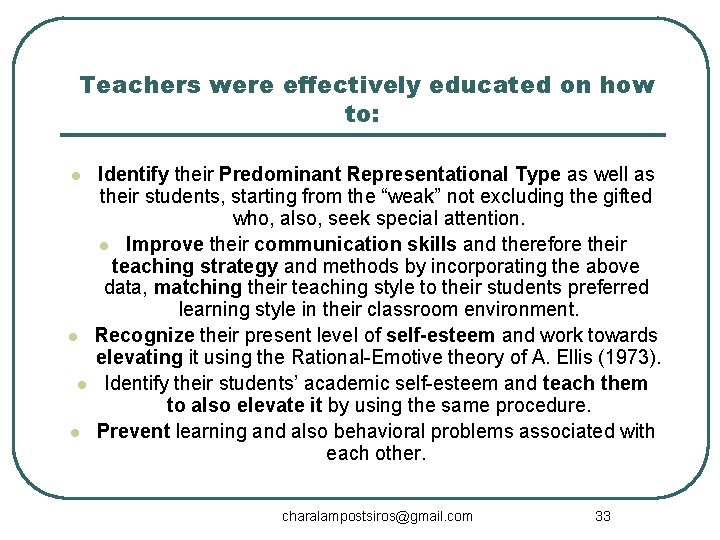
Teachers were effectively educated on how to: l l Identify their Predominant Representational Type as well as their students, starting from the “weak” not excluding the gifted who, also, seek special attention. l Improve their communication skills and therefore their teaching strategy and methods by incorporating the above data, matching their teaching style to their students preferred learning style in their classroom environment. Recognize their present level of self-esteem and work towards elevating it using the Rational-Emotive theory of A. Ellis (1973). Identify their students’ academic self-esteem and teach them to also elevate it by using the same procedure. Prevent learning and also behavioral problems associated with each other. charalampostsiros@gmail. com 33
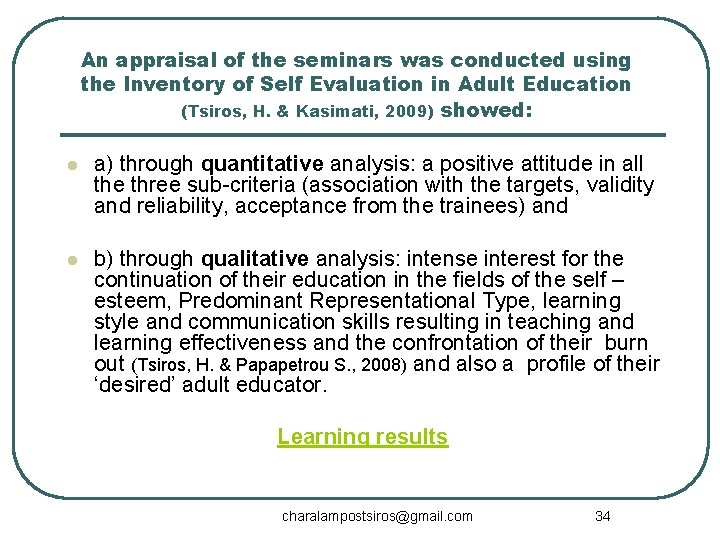
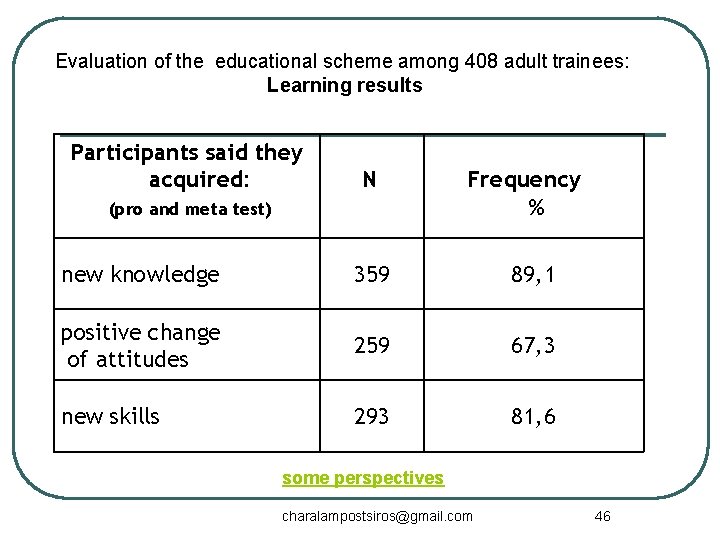
An appraisal of the seminars was conducted using the Inventory of Self Evaluation in Adult Education (Tsiros, H. & Kasimati, 2009) showed: l a) through quantitative analysis: a positive attitude in all the three sub-criteria (association with the targets, validity and reliability, acceptance from the trainees) and l b) through qualitative analysis: intense interest for the continuation of their education in the fields of the self – esteem, Predominant Representational Type, learning style and communication skills resulting in teaching and learning effectiveness and the confrontation of their burn out (Tsiros, H. & Papapetrou S. , 2008) and also a profile of their ‘desired’ adult educator. Learning results charalampostsiros@gmail. com 34
some perspectives l l Therefore the above described cognitive educational scheme, based on solid research results deserves a role in the discussion for excellence in education. The study seeks further investigation in different backgrounds and in relation with different appraisal tools. charalampostsiros@gmail. com 35
Thank You! Haralampos TSIROS charalampostsiros@gmail. com http: //www. uop-gr. acedemia. edu. CHARALAMPOSTSIROS (in English) http: //www. tsiros. tk/ (in Greek) Mobile: (+30) 6947712168 charalampostsiros@gmail. com 36
a. Dominant Representational Type Questionnaire (D. R. T. Q. ) l l Good psychometric qualities with a factor structure indicating 3 factors, as expected: visual, verbal, kinaesthetic. Reliability analysis yield satisfactory Cronbach’s alpha values for each subscale: visual 0. 94, verbal 0. 97, kinesthetic 0. 97 and total 0. 99. This indicate a strong and acceptable degree of internal consistency in each subscale. charalampostsiros@gmail. com 37
b 1. Correlation (χ2, p<0. 05; r, p< 0. 01) between Academic Self-concept (all six subscales) and Achievement both in Moths and Language, in a positive direction There are statistically significant differences among the students with high achievement in Language (AN. O. VA. : F= 22. 2, p< 0. 01) and, also, in Maths (F=28. 6, p< 0. 01) in comparison with students with medium and low achievement. l We can therefore claim that the relationship between total academic self-concept and achievement is “stronger” for the students with high achievement both in Maths and Language. l charalampostsiros@gmail. com 38
…RESULTS… gradient in students with high Perception of Reding/Speling Ability: l visual (42. 8%), l kinaesthetic (36. 2%), l verbal (21%) preferences. charalampostsiros@gmail. com 39
b 2. Correlation (χ2, p<0. 05) between Intelligence and Academic Self-concept (all six subscales) in a positive direction. l l Statistically significant differences (χ2, p<0. 05), between the percentages of the students showing high perception of self-concept in the high risk group, consisted of the students with the same degree of modality preference, that is students who showed the same degree of visual, verbal and kinaesthetic preferences, and the rest of the population in a negative direction as follows: Perception of General Ability (14. 2% versus 85. 5%) Perception of School Satisfaction (13. 0% versus 87. 0%) Perception of Confidence in Academic Ability (17. 20% versus 82. 7%) l Total perception of self-concept (11. 70% versus 88. 3%). charalampostsiros@gmail. com 40
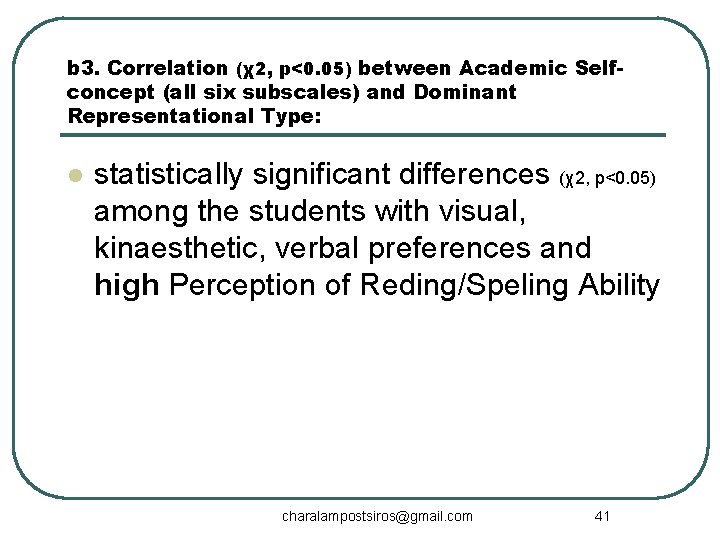
b 3. Correlation (χ2, p<0. 05) between Academic Selfconcept (all six subscales) and Dominant Representational Type: l statistically significant differences (χ2, p<0. 05) among the students with visual, kinaesthetic, verbal preferences and high Perception of Reding/Speling Ability charalampostsiros@gmail. com 41
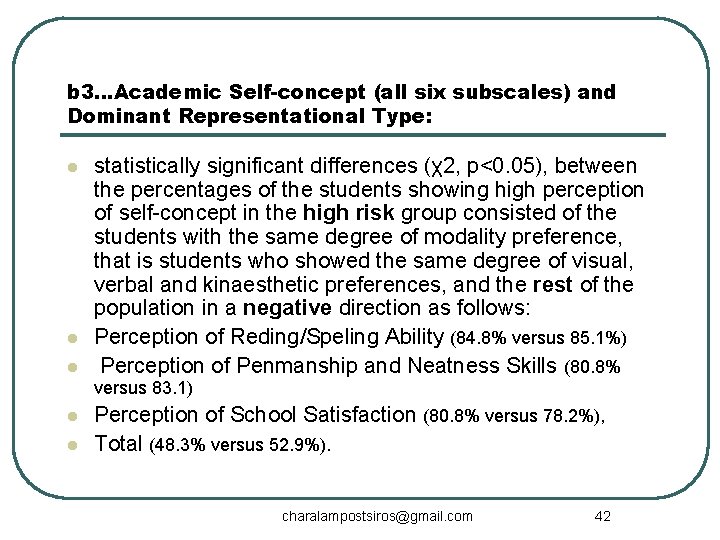
b 3…Academic Self-concept (all six subscales) and Dominant Representational Type: l l l statistically significant differences (χ2, p<0. 05), between the percentages of the students showing high perception of self-concept in the high risk group consisted of the students with the same degree of modality preference, that is students who showed the same degree of visual, verbal and kinaesthetic preferences, and the rest of the population in a negative direction as follows: Perception of Reding/Speling Ability (84. 8% versus 85. 1%) Perception of Penmanship and Neatness Skills (80. 8% versus 83. 1) l l Perception of School Satisfaction (80. 8% versus 78. 2%), Total (48. 3% versus 52. 9%). charalampostsiros@gmail. com 42
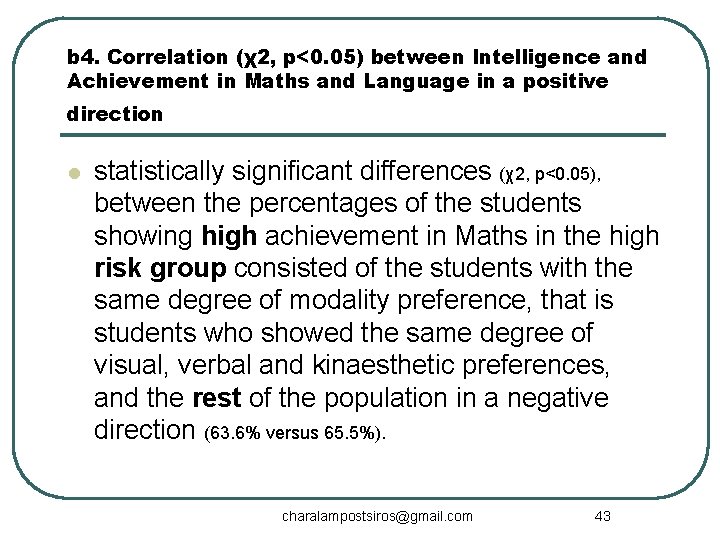
b 4. Correlation (χ2, p<0. 05) between Intelligence and Achievement in Maths and Language in a positive direction l statistically significant differences (χ2, p<0. 05), between the percentages of the students showing high achievement in Maths in the high risk group consisted of the students with the same degree of modality preference, that is students who showed the same degree of visual, verbal and kinaesthetic preferences, and the rest of the population in a negative direction (63. 6% versus 65. 5%). charalampostsiros@gmail. com 43
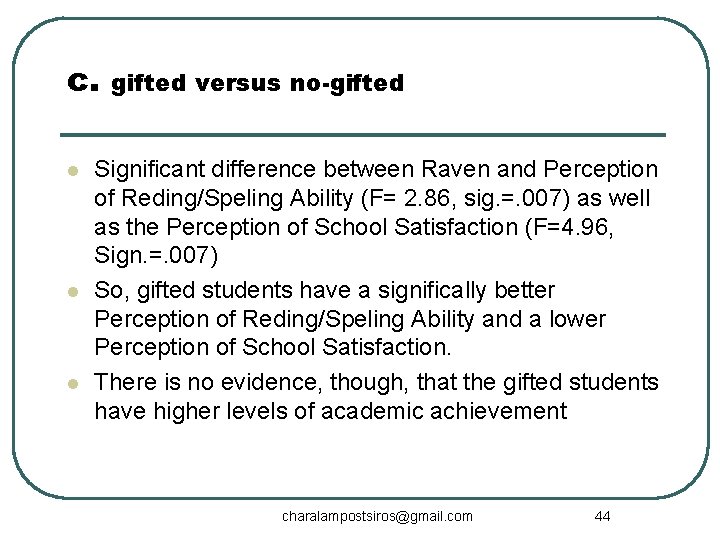
c. l l l gifted versus no-gifted Significant difference between Raven and Perception of Reding/Speling Ability (F= 2. 86, sig. =. 007) as well as the Perception of School Satisfaction (F=4. 96, Sign. =. 007) So, gifted students have a significally better Perception of Reding/Speling Ability and a lower Perception of School Satisfaction. There is no evidence, though, that the gifted students have higher levels of academic achievement charalampostsiros@gmail. com 44
d. Raven and visual preferences: l l l Correlation between intelligence measured by raven test and visual preferences (r=0. 07 p<0. 05) This result proves that “the Raven test primarily tests one's visual spatial abilities”. It also gives credibility to the Dominant Representational Type Questionnaire’s criterion related validity …CONCLUSIONS… charalampostsiros@gmail. com 45
Evaluation of the educational scheme among 408 adult trainees: Learning results Participants said they acquired: Ν (pro and meta test) Frequency % new knowledge 359 89, 1 positive change of attitudes 259 67, 3 new skills 293 81, 6 some perspectives charalampostsiros@gmail. com 46