
The International Arctic Buoy Programme Buoys on Ice
The International Arctic Buoy Programme Buoys on Ice for Science and Operations 20 plus organizations spanning 9 countries and 1 international organization Chairman’s and Coordinator’s Report for DBCP 21 th Session Tim Goos - Chairman IABP Meteorological Service of Canada, Environment Canada Ignatius Rigor - Coordinator IABP Polar Science Center, University of Washington photos copyright / courtesy Donald G. Barton Presented by Elizabeth Horton, Naval Oceanographic Office, U. S. A. Prepared by Edward Hudson, Meteorological Service of Environment Canada
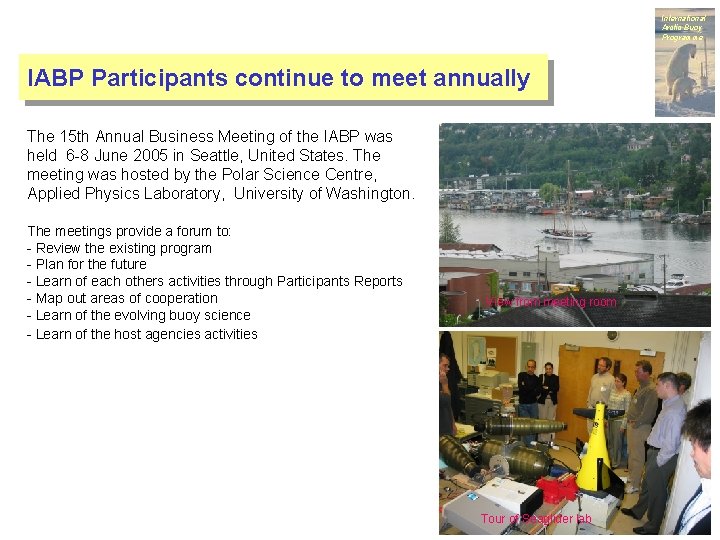
International Arctic Buoy Programme IABP Participants continue to meet annually The 15 th Annual Business Meeting of the IABP was held 6 -8 June 2005 in Seattle, United States. The meeting was hosted by the Polar Science Centre, Applied Physics Laboratory, University of Washington. The meetings provide a forum to: - Review the existing program - Plan for the future - Learn of each others activities through Participants Reports - Map out areas of cooperation - Learn of the evolving buoy science - Learn of the host agencies activities View from meeting room Tour of Seaglider lab
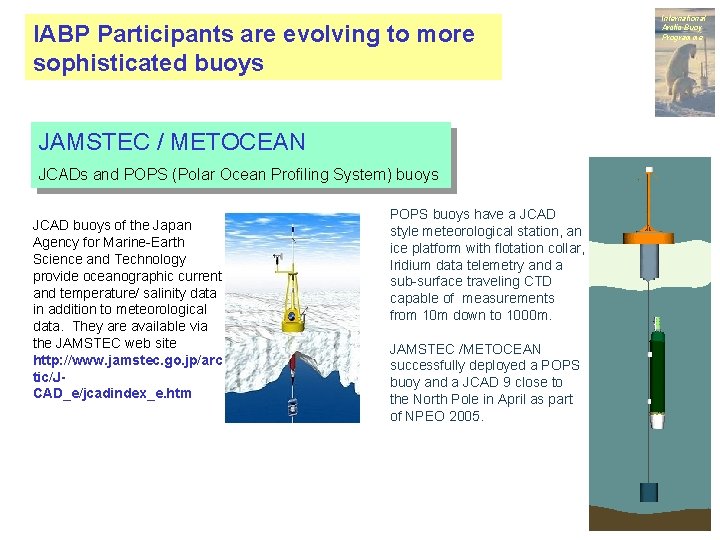
IABP Participants are evolving to more sophisticated buoys JAMSTEC / METOCEAN JCADs and POPS (Polar Ocean Profiling System) buoys JCAD buoys of the Japan Agency for Marine-Earth Science and Technology provide oceanographic current and temperature/ salinity data in addition to meteorological data. They are available via the JAMSTEC web site http: //www. jamstec. go. jp/arc tic/JCAD_e/jcadindex_e. htm POPS buoys have a JCAD style meteorological station, an ice platform with flotation collar, Iridium data telemetry and a sub-surface traveling CTD capable of measurements from 10 m down to 1000 m. JAMSTEC /METOCEAN successfully deployed a POPS buoy and a JCAD 9 close to the North Pole in April as part of NPEO 2005. International Arctic Buoy Programme
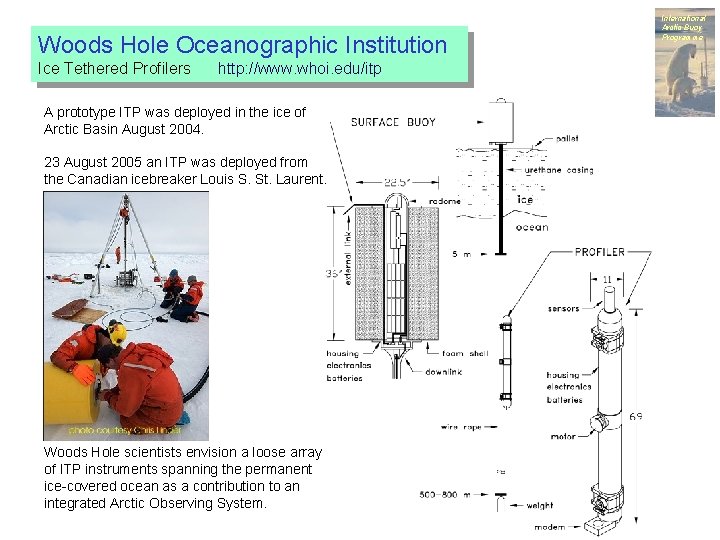
Woods Hole Oceanographic Institution Ice Tethered Profilers http: //www. whoi. edu/itp A prototype ITP was deployed in the ice of Arctic Basin August 2004. 23 August 2005 an ITP was deployed from the Canadian icebreaker Louis S. St. Laurent. Woods Hole scientists envision a loose array of ITP instruments spanning the permanent ice-covered ocean as a contribution to an integrated Arctic Observing System. International Arctic Buoy Programme
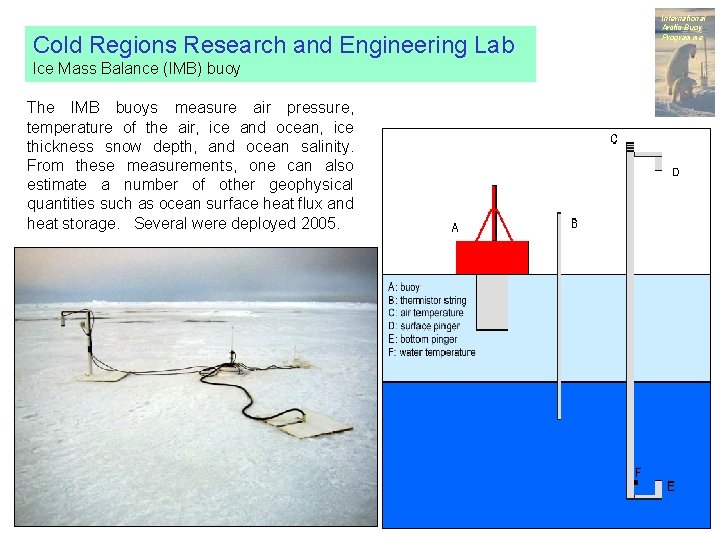
Cold Regions Research and Engineering Lab Ice Mass Balance (IMB) buoy The IMB buoys measure air pressure, temperature of the air, ice and ocean, ice thickness snow depth, and ocean salinity. From these measurements, one can also estimate a number of other geophysical quantities such as ocean surface heat flux and heat storage. Several were deployed 2005. International Arctic Buoy Programme
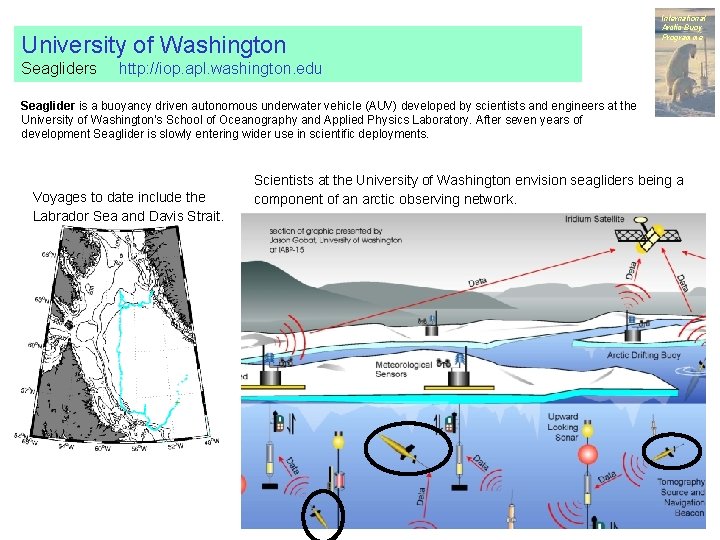
University of Washington Seagliders International Arctic Buoy Programme http: //iop. apl. washington. edu Seaglider is a buoyancy driven autonomous underwater vehicle (AUV) developed by scientists and engineers at the University of Washington's School of Oceanography and Applied Physics Laboratory. After seven years of development Seaglider is slowly entering wider use in scientific deployments. Voyages to date include the Labrador Sea and Davis Strait. Scientists at the University of Washington envision seagliders being a component of an arctic observing network.
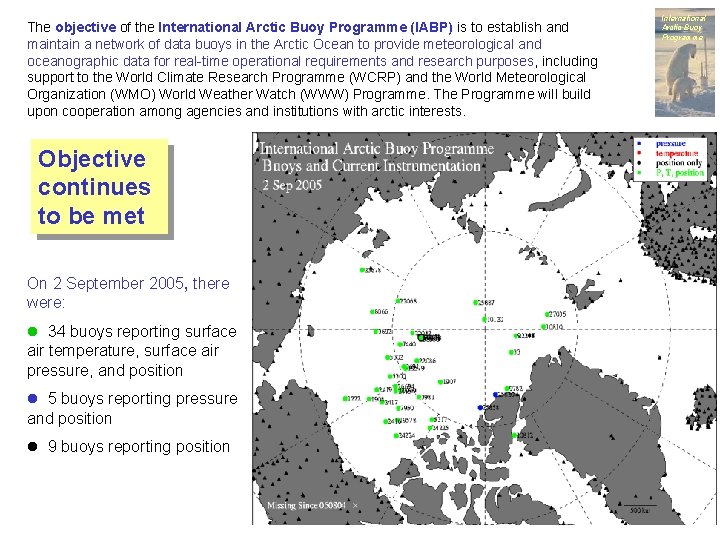
The objective of the International Arctic Buoy Programme (IABP) is to establish and maintain a network of data buoys in the Arctic Ocean to provide meteorological and oceanographic data for real-time operational requirements and research purposes, including support to the World Climate Research Programme (WCRP) and the World Meteorological Organization (WMO) World Weather Watch (WWW) Programme. The Programme will build upon cooperation among agencies and institutions with arctic interests. Objective continues to be met On 2 September 2005, there were: 34 buoys reporting surface air temperature, surface air pressure, and position 5 buoys reporting pressure and position 9 buoys reporting position International Arctic Buoy Programme
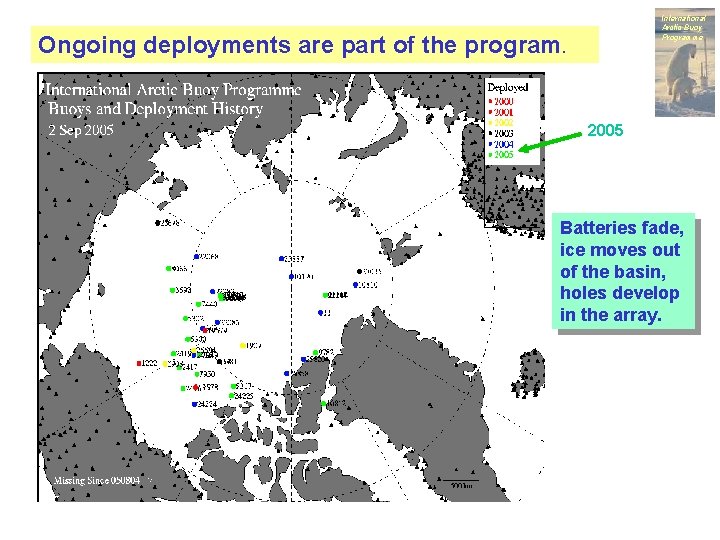
International Arctic Buoy Programme Ongoing deployments are part of the program. 2005 Batteries fade, ice moves out of the basin, holes develop in the array.
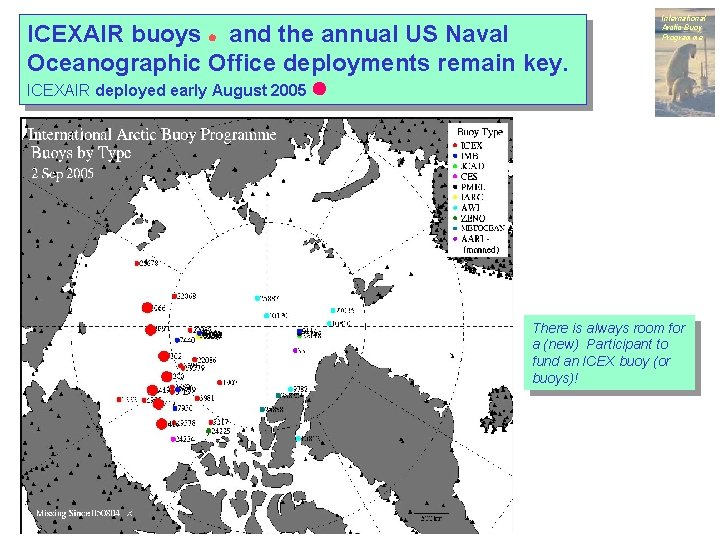
ICEXAIR buoys and the annual US Naval Oceanographic Office deployments remain key. International Arctic Buoy Programme ICEXAIR deployed early August 2005 There is always room for a (new) Participant to fund an ICEX buoy (or buoys)!
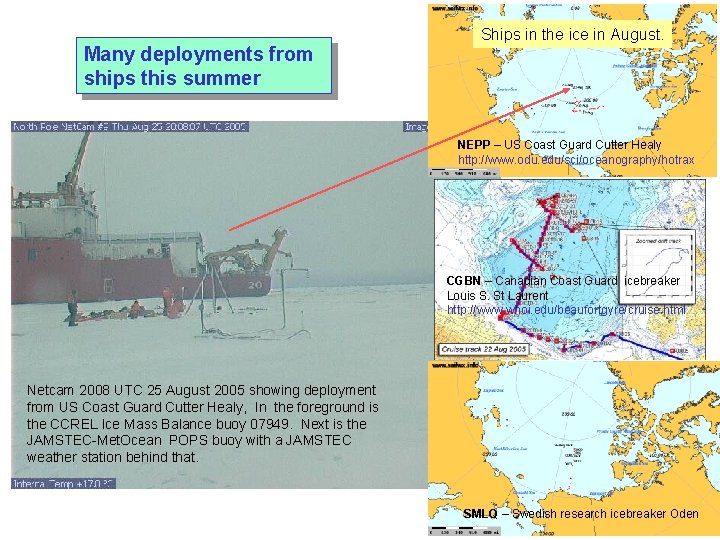
International Arctic Buoy Programme Many deployments from ships this summer Ships in the ice in August. NEPP – US Coast Guard Cutter Healy http: //www. odu. edu/sci/oceanography/hotrax CGBN – Canadian Coast Guard icebreaker Louis S. St Laurent http: //www. whoi. edu/beaufortgyre/cruise. html Netcam 2008 UTC 25 August 2005 showing deployment from US Coast Guard Cutter Healy, In the foreground is the CCREL Ice Mass Balance buoy 07949. Next is the JAMSTEC-Met. Ocean POPS buoy with a JAMSTEC weather station behind that. SMLQ – Swedish research icebreaker Oden
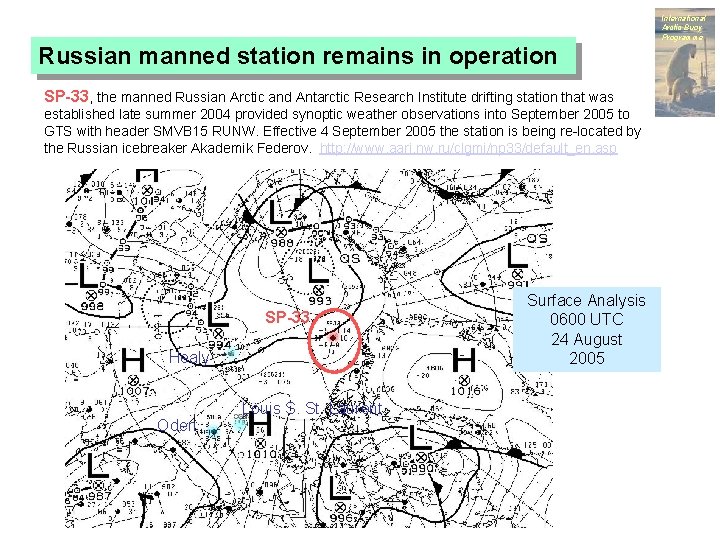
International Arctic Buoy Programme Russian manned station remains in operation SP-33, the manned Russian Arctic and Antarctic Research Institute drifting station that was established late summer 2004 provided synoptic weather observations into September 2005 to GTS with header SMVB 15 RUNW. Effective 4 September 2005 the station is being re-located by the Russian icebreaker Akademik Federov. http: //www. aari. nw. ru/clgmi/np 33/default_en. asp SP-33 Healy Oden Louis S. St. Laurent Surface Analysis 0600 UTC 24 August 2005
International Arctic Buoy Programme Challenges o Encouraging agencies who put buoys on ice the Arctic Basin to share their basic met data via GTS o Ensuring a well positioned array of buoys providing the basics of position, air temperature and sea level pressure is met as the science community moves to more sophisticated buoys deployments o Increasing the demonstrated value of IABP data to operational forecast services and hence getting more support from operational agencies IABP and the International Polar Year It is hoped that the IPY will prompt new IABP Participants and that these new Participants will remain beyond 2007.
- Slides: 12