
The Internal Radiation Hazard An Introduction to Radiation

- Slides: 29
The Internal Radiation Hazard An Introduction to Radiation Protection 6 e 2012 © 2012 Martin, Harbison, Beach, Cole/Hodder Education An Introduction to Radiation Protection 6 e © Martin, Harbison, Education
Introduction • Routes of Entry • Modelling and dose coefficients • Methods of protection – – – facility design containment area designation procedures PPE • Contamination monitoring • Personal monitoring An Introduction to Radiation Protection 6 e © 2012 Martin, Harbison, Beach, Cole/Hodder Education
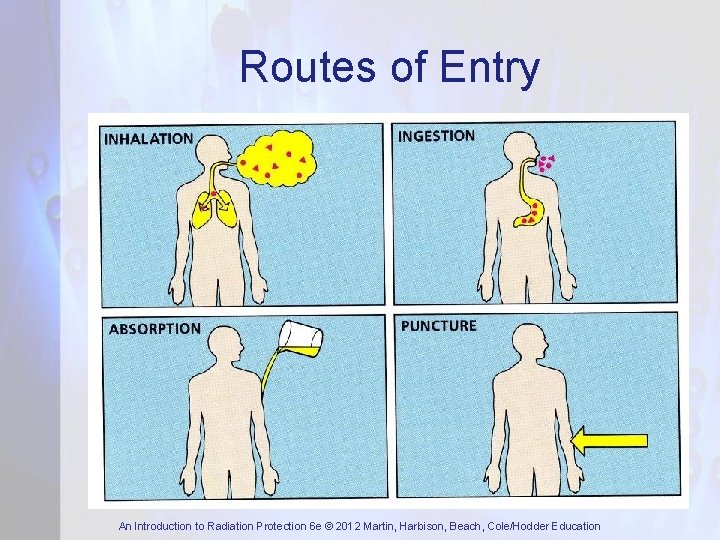
Routes of Entry An Introduction to Radiation Protection 6 e © 2012 Martin, Harbison, Beach, Cole/Hodder Education
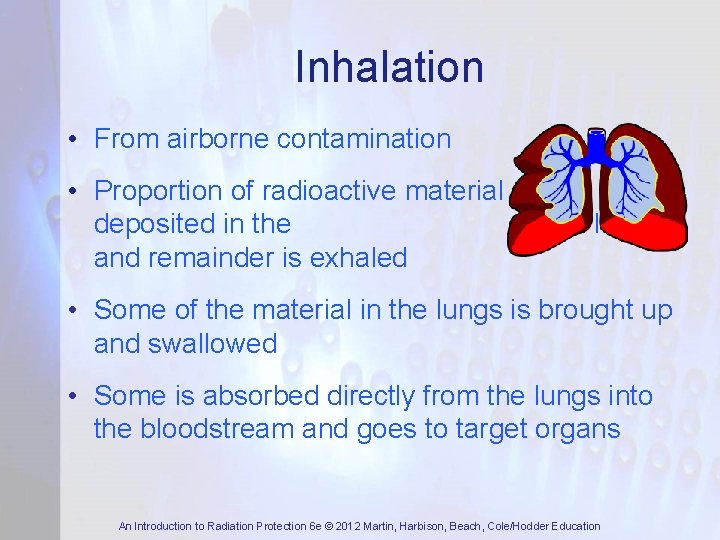
Inhalation • From airborne contamination • Proportion of radioactive material deposited in the and remainder is exhaled is lungs • Some of the material in the lungs is brought up and swallowed • Some is absorbed directly from the lungs into the bloodstream and goes to target organs An Introduction to Radiation Protection 6 e © 2012 Martin, Harbison, Beach, Cole/Hodder Education
Ingestion • From contamination on foodstuffs, hands etc • Some will be absorbed into the bloodstream and goes to target organs • Reminder will be excreted in faeces An Introduction to Radiation Protection 6 e © 2012 Martin, Harbison, Beach, Cole/Hodder Education
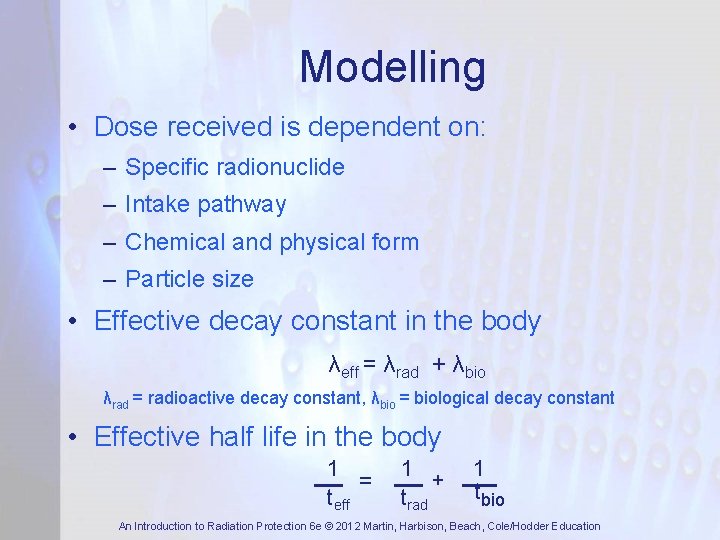
Modelling • Dose received is dependent on: – Specific radionuclide – Intake pathway – Chemical and physical form – Particle size • Effective decay constant in the body λeff = λrad + λbio λrad = radioactive decay constant, λbio = biological decay constant • Effective half life in the body 1 = teff 1 + trad 1 tbio An Introduction to Radiation Protection 6 e © 2012 Martin, Harbison, Beach, Cole/Hodder Education
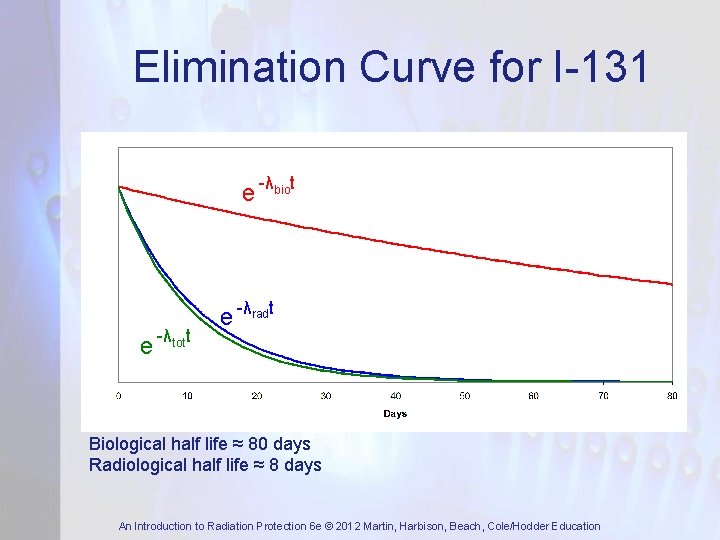
Elimination Curve for I-131 e -λbiot e -λtott e -λradt Biological half life ≈ 80 days Radiological half life ≈ 8 days An Introduction to Radiation Protection 6 e © 2012 Martin, Harbison, Beach, Cole/Hodder Education
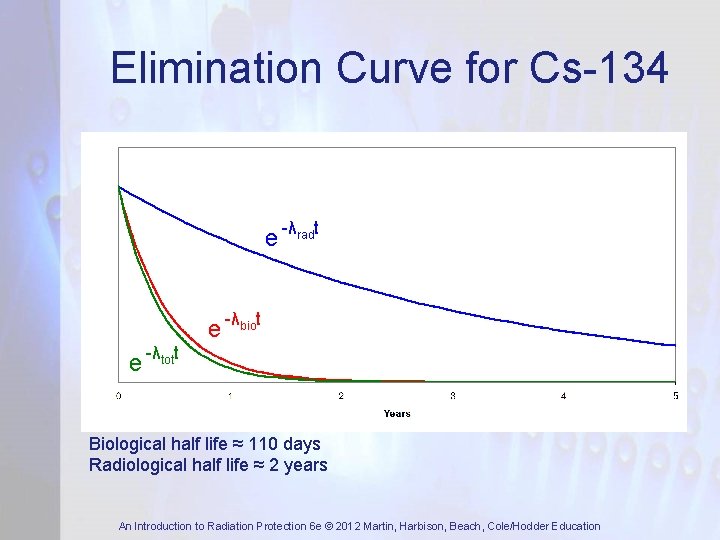
Elimination Curve for Cs-134 e -λradt e -λbiot e -λtott Biological half life ≈ 110 days Radiological half life ≈ 2 years An Introduction to Radiation Protection 6 e © 2012 Martin, Harbison, Beach, Cole/Hodder Education
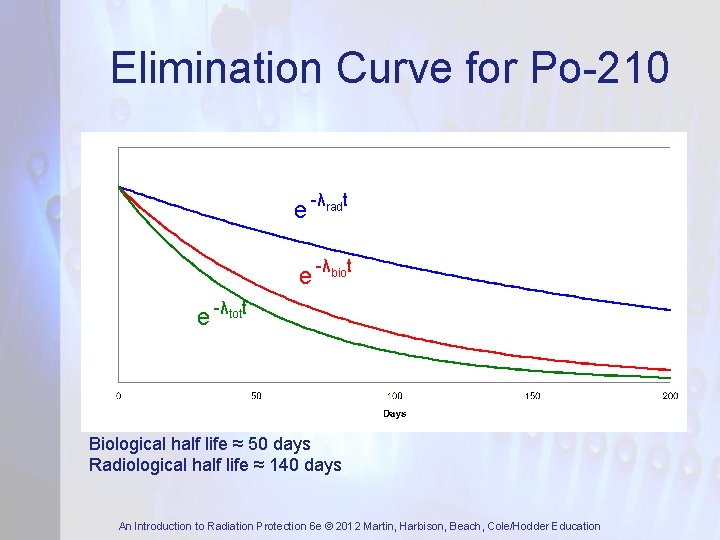
Elimination Curve for Po-210 e -λradt e -λbiot e -λtott Biological half life ≈ 50 days Radiological half life ≈ 140 days An Introduction to Radiation Protection 6 e © 2012 Martin, Harbison, Beach, Cole/Hodder Education
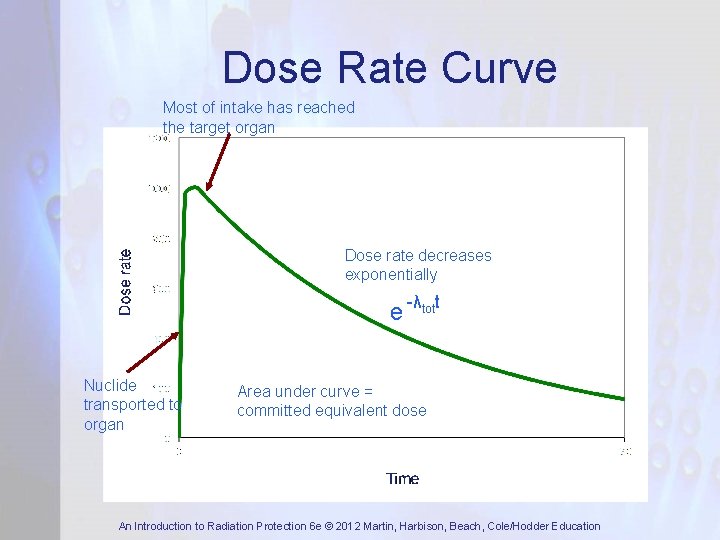
Dose Rate Curve Most of intake has reached the target organ Dose rate decreases exponentially e -λtott Nuclide transported to organ Area under curve = committed equivalent dose An Introduction to Radiation Protection 6 e © 2012 Martin, Harbison, Beach, Cole/Hodder Education
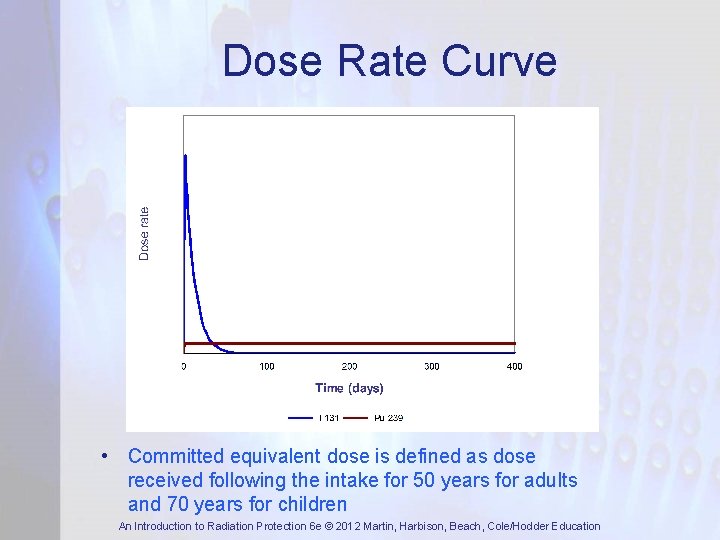
Dose Rate Curve • Committed equivalent dose is defined as dose received following the intake for 50 years for adults and 70 years for children An Introduction to Radiation Protection 6 e © 2012 Martin, Harbison, Beach, Cole/Hodder Education
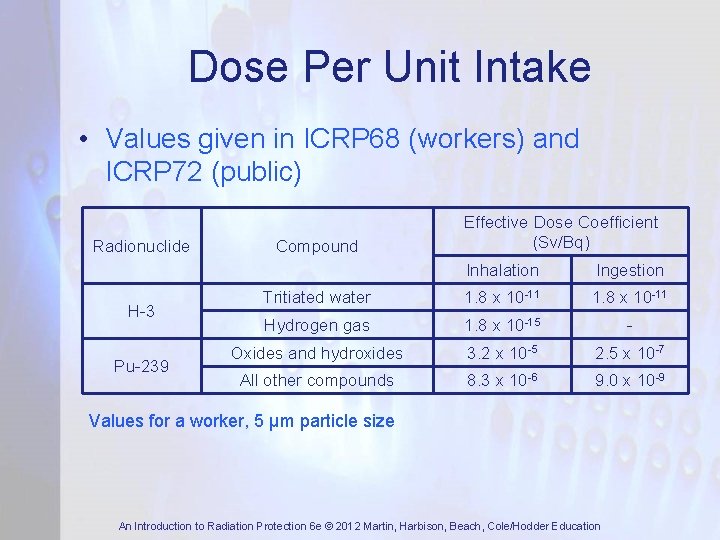
Dose Per Unit Intake • Values given in ICRP 68 (workers) and ICRP 72 (public) Radionuclide H-3 Pu-239 Compound Effective Dose Coefficient (Sv/Bq) Inhalation Ingestion Tritiated water 1. 8 x 10 -11 Hydrogen gas 1. 8 x 10 -15 - Oxides and hydroxides 3. 2 x 10 -5 2. 5 x 10 -7 All other compounds 8. 3 x 10 -6 9. 0 x 10 -9 Values for a worker, 5 μm particle size An Introduction to Radiation Protection 6 e © 2012 Martin, Harbison, Beach, Cole/Hodder Education
Methods of Protection • Eliminate use • Minimize activity • Containment • Procedures • Use of personal protective equipment (PPE) • Good housekeeping An Introduction to Radiation Protection 6 e © 2012 Martin, Harbison, Beach, Cole/Hodder Education
Facility Design • New facilities should be designed to be easily decontaminated – Good clean finish with no gaps in which contamination can accumulate – Covings at all angles to walls, ceilings to walls and floors to walls – Non porous materials – gloss paint, sheet PVC – Work surfaces made of non-porous materials e. g. melamine, PVC, stainless steel An Introduction to Radiation Protection 6 e © 2012 Martin, Harbison, Beach, Cole/Hodder Education
Facility Design • Air flow from low contamination to high contamination • Ventilation, use of HEPA filter units etc • Gaseous discharges – location of discharge • Containment • Work being done within the facility • Decommissioning An Introduction to Radiation Protection 6 e © 2012 Martin, Harbison, Beach, Cole/Hodder Education
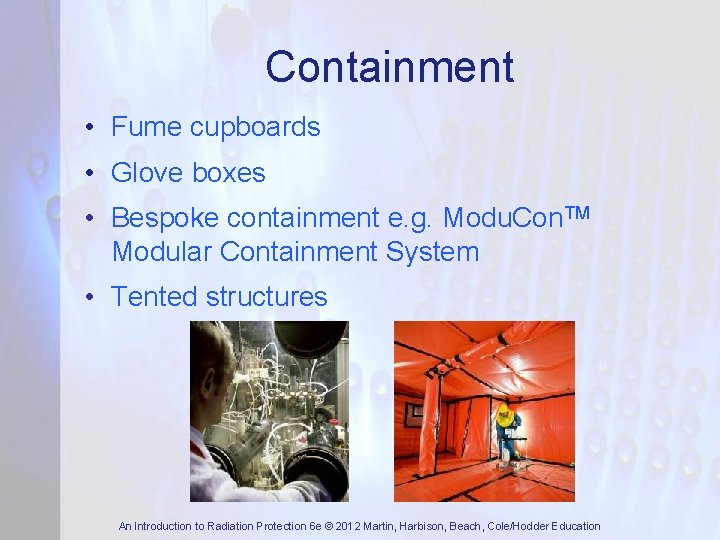
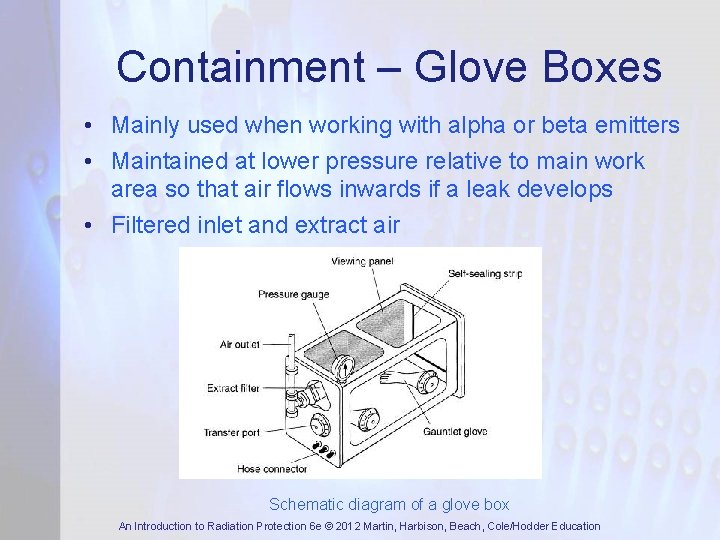
Containment • Fume cupboards • Glove boxes • Bespoke containment e. g. Modu. Con. TM Modular Containment System • Tented structures An Introduction to Radiation Protection 6 e © 2012 Martin, Harbison, Beach, Cole/Hodder Education
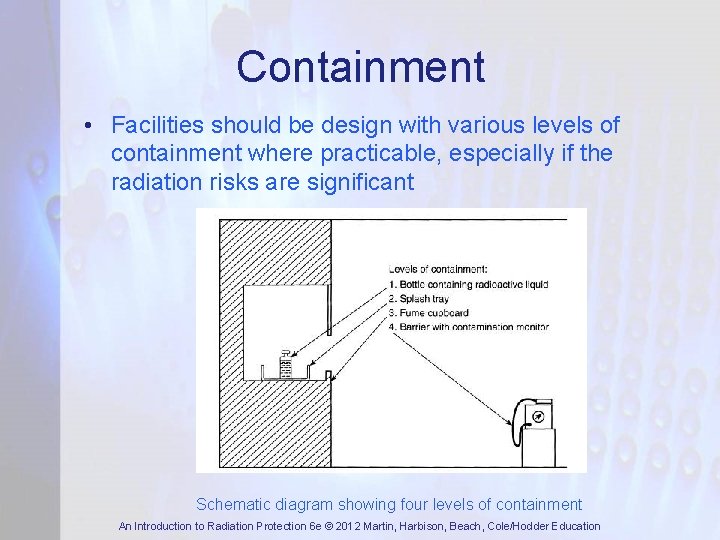
Containment • Facilities should be design with various levels of containment where practicable, especially if the radiation risks are significant Schematic diagram showing four levels of containment An Introduction to Radiation Protection 6 e © 2012 Martin, Harbison, Beach, Cole/Hodder Education
Containment – Glove Boxes • Mainly used when working with alpha or beta emitters • Maintained at lower pressure relative to main work area so that air flows inwards if a leak develops • Filtered inlet and extract air Schematic diagram of a glove box An Introduction to Radiation Protection 6 e © 2012 Martin, Harbison, Beach, Cole/Hodder Education
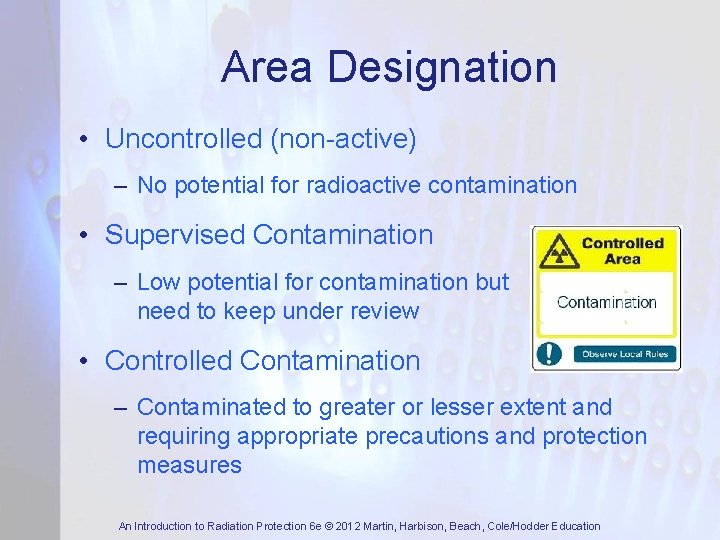
Area Designation • Uncontrolled (non-active) – No potential for radioactive contamination • Supervised Contamination – Low potential for contamination but need to keep under review • Controlled Contamination – Contaminated to greater or lesser extent and requiring appropriate precautions and protection measures An Introduction to Radiation Protection 6 e © 2012 Martin, Harbison, Beach, Cole/Hodder Education
Procedures • Radiation safety arrangements (rules) for working in contamination areas – No eating, drinking, smoking – Wounds to be covered before entering areas – Wounds sustained in area to be reported immediately and treated accordingly • Barrier procedures • Work procedures • Pre work safety talks An Introduction to Radiation Protection 6 e © 2012 Martin, Harbison, Beach, Cole/Hodder Education
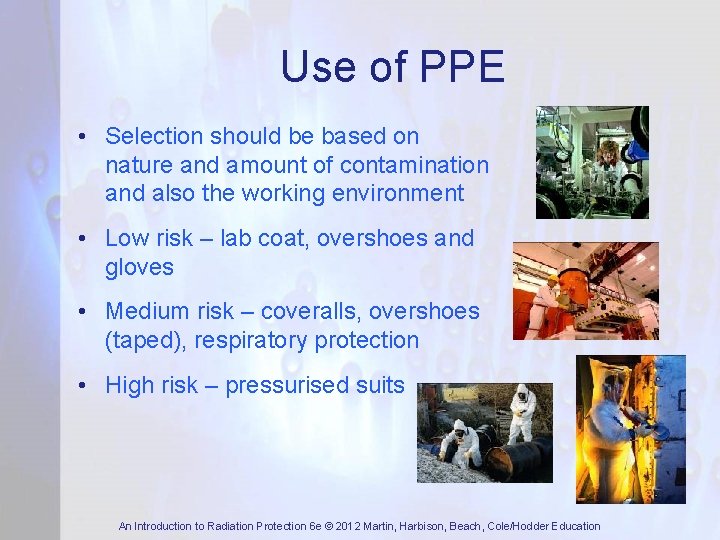
Use of PPE • Selection should be based on nature and amount of contamination and also the working environment • Low risk – lab coat, overshoes and gloves • Medium risk – coveralls, overshoes (taped), respiratory protection • High risk – pressurised suits An Introduction to Radiation Protection 6 e © 2012 Martin, Harbison, Beach, Cole/Hodder Education
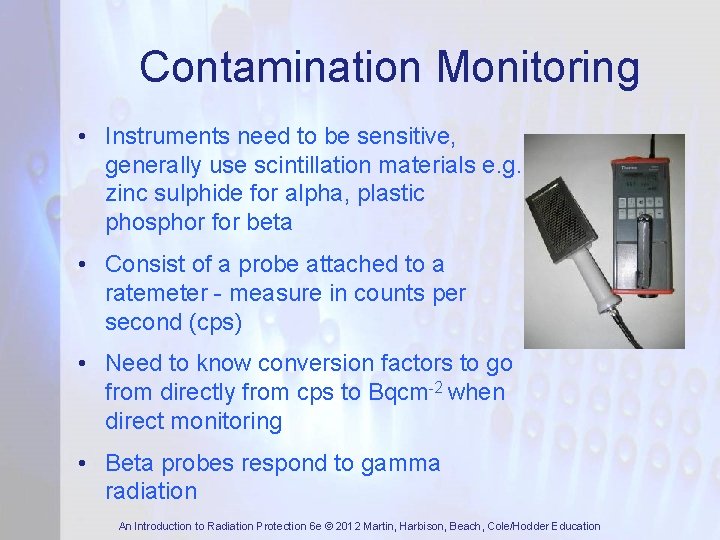
Contamination Monitoring • Instruments need to be sensitive, generally use scintillation materials e. g. zinc sulphide for alpha, plastic phosphor for beta • Consist of a probe attached to a ratemeter - measure in counts per second (cps) • Need to know conversion factors to go from directly from cps to Bqcm-2 when direct monitoring • Beta probes respond to gamma radiation An Introduction to Radiation Protection 6 e © 2012 Martin, Harbison, Beach, Cole/Hodder Education
Smear Surveys • Used to: – Detect very low levels of contamination – Monitor for contamination in an area of high radiation background – Monitor for nuclides that are difficult to detect using direct methods e. g. H-3, C-14 – Establish if contamination is loose or fixed – Monitor areas that are inaccessible with instruments An Introduction to Radiation Protection 6 e © 2012 Martin, Harbison, Beach, Cole/Hodder Education
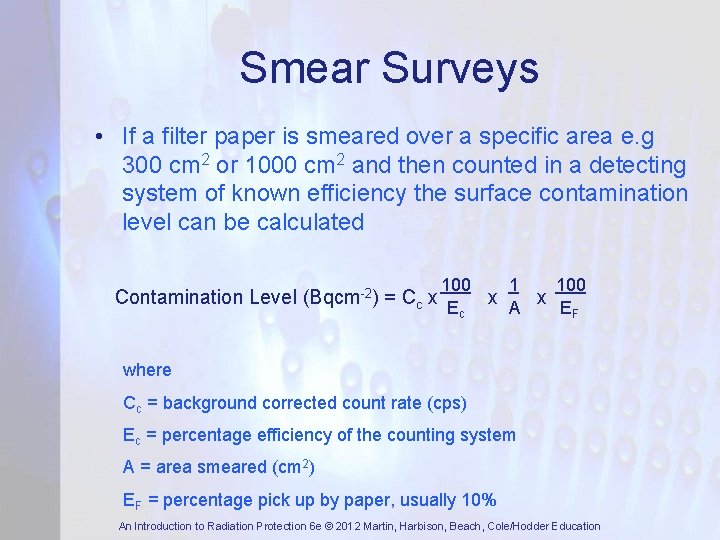
Smear Surveys • If a filter paper is smeared over a specific area e. g 300 cm 2 or 1000 cm 2 and then counted in a detecting system of known efficiency the surface contamination level can be calculated Contamination Level (Bqcm-2) 100 1 100 = Cc x E x A x E c F where Cc = background corrected count rate (cps) Ec = percentage efficiency of the counting system A = area smeared (cm 2) EF = percentage pick up by paper, usually 10% An Introduction to Radiation Protection 6 e © 2012 Martin, Harbison, Beach, Cole/Hodder Education
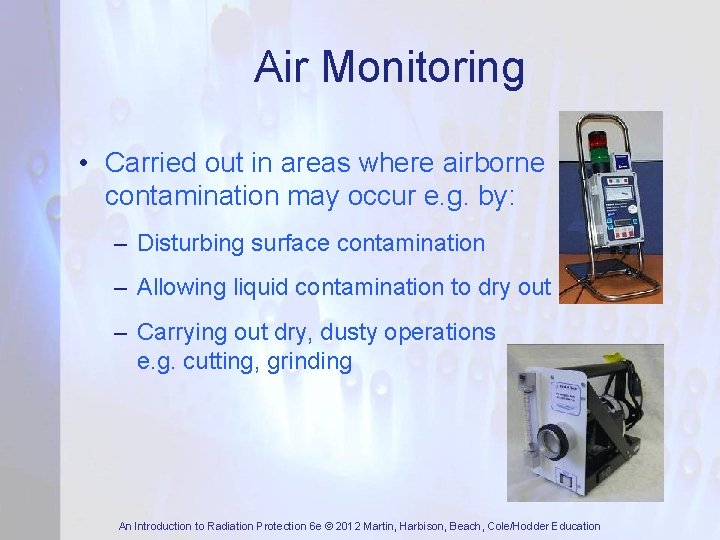
Air Monitoring • Carried out in areas where airborne contamination may occur e. g. by: – Disturbing surface contamination – Allowing liquid contamination to dry out – Carrying out dry, dusty operations e. g. cutting, grinding An Introduction to Radiation Protection 6 e © 2012 Martin, Harbison, Beach, Cole/Hodder Education
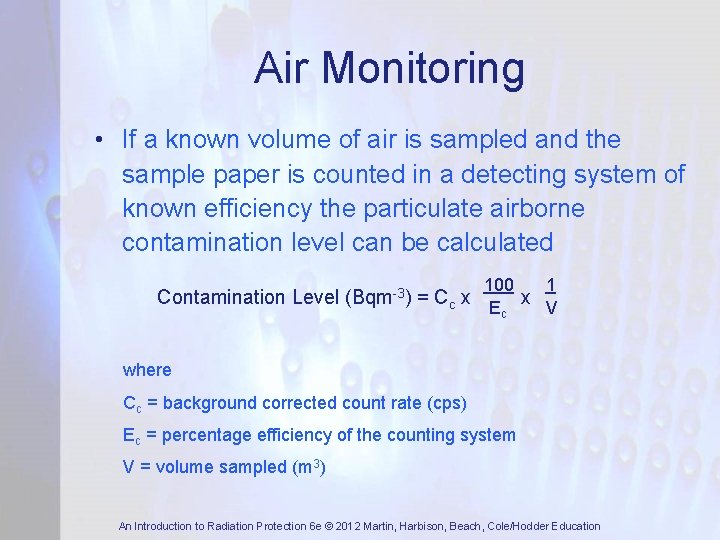
Air Monitoring • If a known volume of air is sampled and the sample paper is counted in a detecting system of known efficiency the particulate airborne contamination level can be calculated Contamination Level (Bqm-3) 100 1 = Cc x E x V c where Cc = background corrected count rate (cps) Ec = percentage efficiency of the counting system V = volume sampled (m 3) An Introduction to Radiation Protection 6 e © 2012 Martin, Harbison, Beach, Cole/Hodder Education
Personal Monitoring • May need to do in addition to area monitoring if: – the dose per unit intake is high e. g. plutonium – a nuclide is difficult to detect by monitoring – there is a significant risk that individuals could receive an intake – there has been an accident An Introduction to Radiation Protection 6 e © 2012 Martin, Harbison, Beach, Cole/Hodder Education
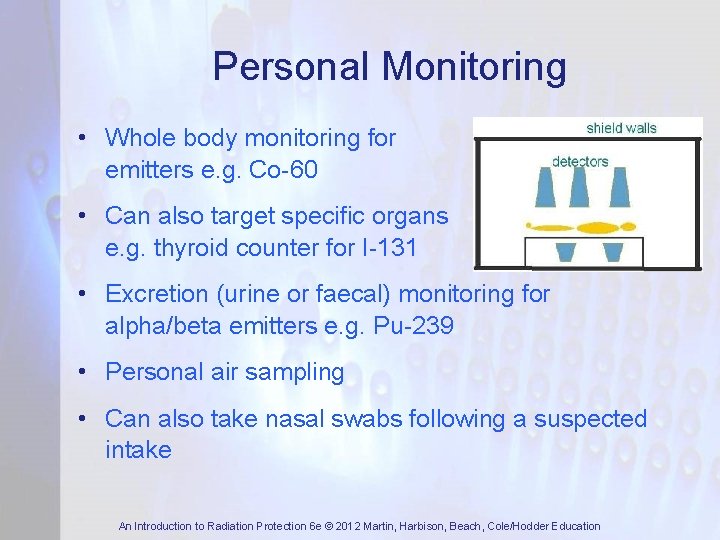
Personal Monitoring • Whole body monitoring for emitters e. g. Co-60 gamma • Can also target specific organs e. g. thyroid counter for I-131 • Excretion (urine or faecal) monitoring for alpha/beta emitters e. g. Pu-239 • Personal air sampling • Can also take nasal swabs following a suspected intake An Introduction to Radiation Protection 6 e © 2012 Martin, Harbison, Beach, Cole/Hodder Education
Summary • Routes of Entry • Modelling and dose coefficients • Methods of protection – – – facility design containment area designation procedures PPE • Contamination monitoring • Personal monitoring An Introduction to Radiation Protection 6 e © 2012 Martin, Harbison, Beach, Cole/Hodder Education