
THE INTERNAL ENVIRONMENT RESOURCES CAPABILITIES CORE COMPETENCIES EXTERNAL
THE INTERNAL ENVIRONMENT: RESOURCES, CAPABILITIES, & CORE COMPETENCIES
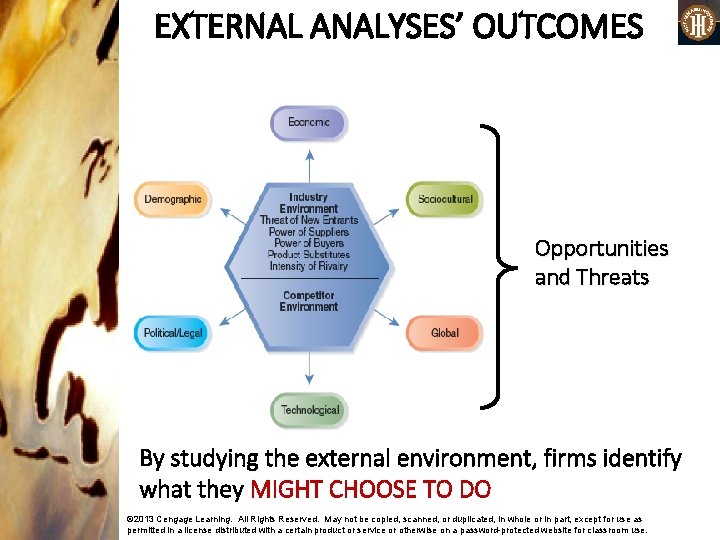
EXTERNAL ANALYSES’ OUTCOMES Opportunities and Threats By studying the external environment, firms identify what they MIGHT CHOOSE TO DO © 2013 Cengage Learning. All Rights Reserved. May not be copied, scanned, or duplicated, in whole or in part, except for use as permitted in a license distributed with a certain product or service or otherwise on a password-protected website for classroom use.
INTERNAL ANALYSES’ OUTCOMES Unique Resources, Capabilities, and Competencies (required for sustainable competitive advantage) By studying the internal environment, firms identify what they CAN DO © 2013 Cengage Learning. All Rights Reserved. May not be copied, scanned, or duplicated, in whole or in part, except for use as permitted in a license distributed with a certain product or service or otherwise on a password-protected website for classroom use.
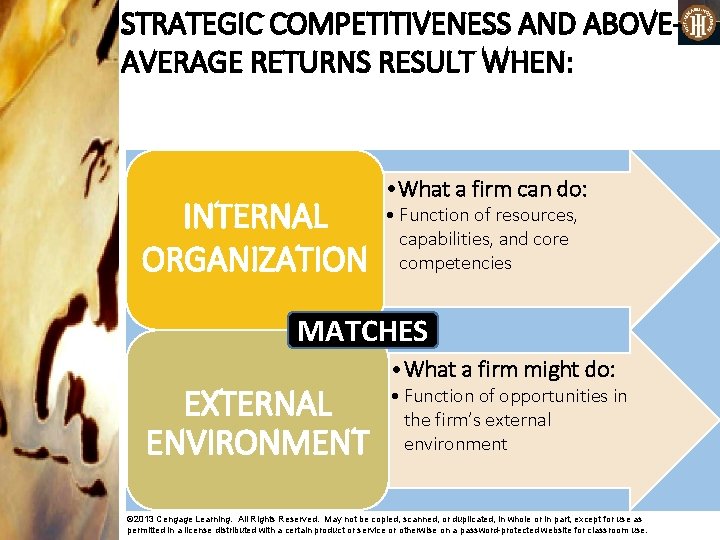
STRATEGIC COMPETITIVENESS AND ABOVEAVERAGE RETURNS RESULT WHEN: INTERNAL ORGANIZATION • What a firm can do: • Function of resources, capabilities, and core competencies MATCHES EXTERNAL ENVIRONMENT • What a firm might do: • Function of opportunities in the firm’s external environment © 2013 Cengage Learning. All Rights Reserved. May not be copied, scanned, or duplicated, in whole or in part, except for use as permitted in a license distributed with a certain product or service or otherwise on a password-protected website for classroom use.
COMPETITIVE ADVANTAGE KEY POINTS ■ NO COMPETITIVE ADVANTAGE LASTS FOREVER ■ OVER TIME, RIVALS USE THEIR OWN UNIQUE RESOURCES, CAPABILITIES, AND CORE COMPETENCIES TO DUPLICATE THE FOCAL FIRM’S ABILITY TO CREATE VALUE FOR CUSTOMERS ■ WITH GLOBALIZATION, SUSTAINABLE COMPETITIVE ADVANTAGE IS ESPECIALLY CHALLENGING © 2013 Cengage Learning. All Rights Reserved. May not be copied, scanned, or duplicated, in whole or in part, except for use as permitted in a license distributed with a certain product or service or otherwise on a password-protected website for classroom use.
COMPETITIVE ADVANTAGE SUSTAINABILITY Sustainability of a competitive advantage is a function of: • The rate of core competence obsolescence due to environmental changes • The availability of substitutes for the core competence • The imitability of the core competence © 2013 Cengage Learning. All Rights Reserved. May not be copied, scanned, or duplicated, in whole or in part, except for use as permitted in a license distributed with a certain product or service or otherwise on a password-protected website for classroom use.
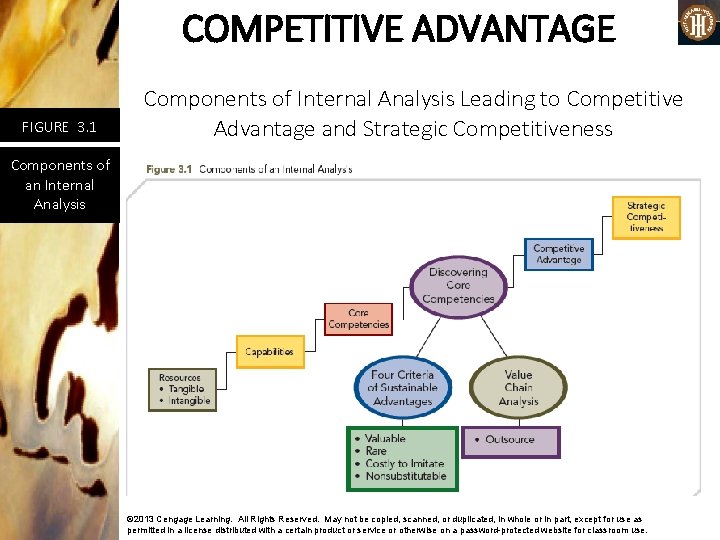
COMPETITIVE ADVANTAGE FIGURE 3. 1 Components of Internal Analysis Leading to Competitive Advantage and Strategic Competitiveness Components of an Internal Analysis © 2013 Cengage Learning. All Rights Reserved. May not be copied, scanned, or duplicated, in whole or in part, except for use as permitted in a license distributed with a certain product or service or otherwise on a password-protected website for classroom use.
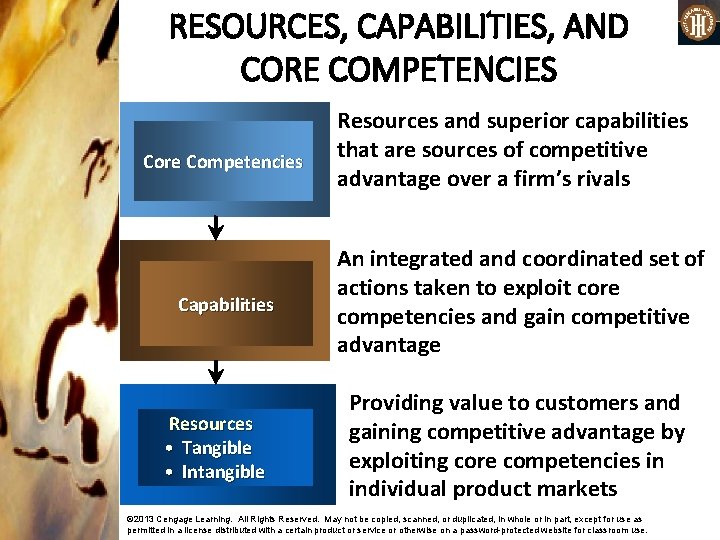
RESOURCES, CAPABILITIES, AND CORE COMPETENCIES Core Competencies Capabilities Resources • Tangible • Intangible Resources and superior capabilities that are sources of competitive advantage over a firm’s rivals An integrated and coordinated set of actions taken to exploit core competencies and gain competitive advantage Providing value to customers and gaining competitive advantage by exploiting core competencies in individual product markets © 2013 Cengage Learning. All Rights Reserved. May not be copied, scanned, or duplicated, in whole or in part, except for use as permitted in a license distributed with a certain product or service or otherwise on a password-protected website for classroom use.
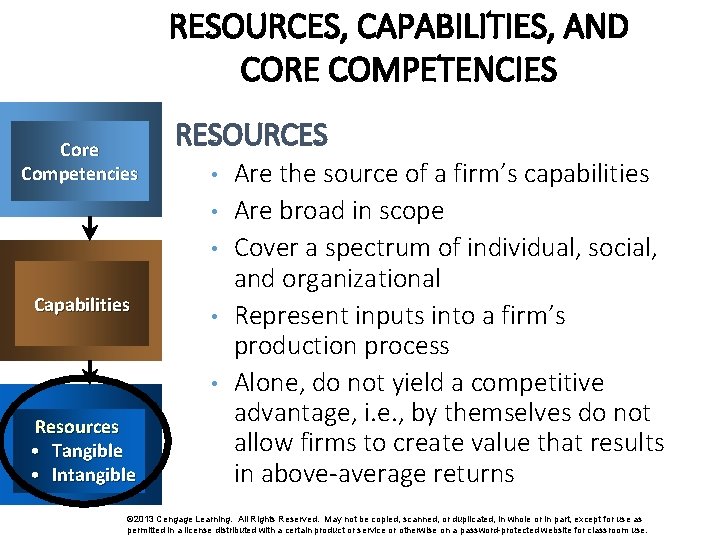
RESOURCES, CAPABILITIES, AND CORE COMPETENCIES Core Competencies RESOURCES • • • Capabilities • • Resources • Tangible • Intangible Are the source of a firm’s capabilities Are broad in scope Cover a spectrum of individual, social, and organizational Represent inputs into a firm’s production process Alone, do not yield a competitive advantage, i. e. , by themselves do not allow firms to create value that results in above-average returns © 2013 Cengage Learning. All Rights Reserved. May not be copied, scanned, or duplicated, in whole or in part, except for use as permitted in a license distributed with a certain product or service or otherwise on a password-protected website for classroom use.
RESOURCES, CAPABILITIES, AND CORE COMPETENCIES TYPES OF RESOURCES Tangible Resources • Assets that can be seen, touched, and quantified Intangible Resources • • Assets rooted deeply in the firm’s history, accumulated over time In comparison to ‘tangible’ resources, usually can’t be seen or touched Compared to tangible resources, intangible resources are a superior source of core competencies © 2013 Cengage Learning. All Rights Reserved. May not be copied, scanned, or duplicated, in whole or in part, except for use as permitted in a license distributed with a certain product or service or otherwise on a password-protected website for classroom use.
RESOURCES, CAPABILITIES AND, CORE COMPETENCIES TYPES OF RESOURCES Tangible Resources • • FINANCIAL RESOURCES - the firm’s capacity to borrow and generate internal funds ORGANIZATIONAL RESOURCES - formal reporting structures PHYSICAL RESOURCES - sophistication and location of a firm’s plant and equipment; distribution facilities; product inventory TECHNOLOGICAL RESOURCES - stock of technology, such as patents, trademarks, copyrights, and trade secrets © 2013 Cengage Learning. All Rights Reserved. May not be copied, scanned, or duplicated, in whole or in part, except for use as permitted in a license distributed with a certain product or service or otherwise on a password-protected website for classroom use.
RESOURCES, CAPABILITIES AND, CORE COMPETENCIES TYPES OF RESOURCES Intangible Resources • HUMAN RESOURCES - knowledge; trust; skills; collaborative abilities • INNOVATION RESOURCES - scientific capabilities; capacity to innovate • REPUTATIONAL RESOURCES - brand name; perceptions of product quality, durability, and reliability; positive reputation with stakeholders, e. g. , suppliers/customers © 2013 Cengage Learning. All Rights Reserved. May not be copied, scanned, or duplicated, in whole or in part, except for use as permitted in a license distributed with a certain product or service or otherwise on a password-protected website for classroom use.
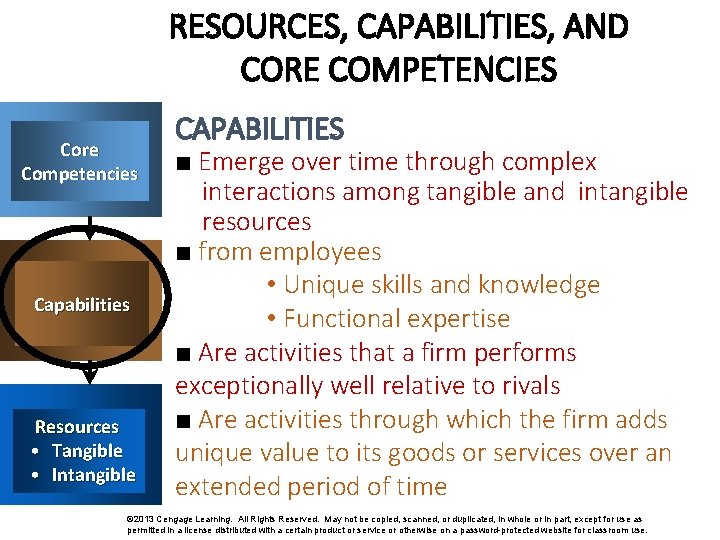
RESOURCES, CAPABILITIES, AND CORE COMPETENCIES Core Competencies Capabilities Resources • Tangible • Intangible CAPABILITIES ■ Emerge over time through complex interactions among tangible and intangible resources ■ from employees • Unique skills and knowledge • Functional expertise ■ Are activities that a firm performs exceptionally well relative to rivals ■ Are activities through which the firm adds unique value to its goods or services over an extended period of time © 2013 Cengage Learning. All Rights Reserved. May not be copied, scanned, or duplicated, in whole or in part, except for use as permitted in a license distributed with a certain product or service or otherwise on a password-protected website for classroom use.
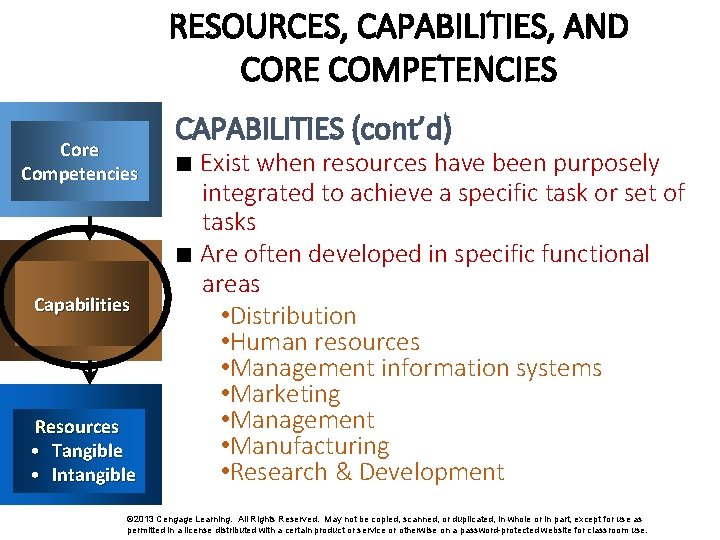
RESOURCES, CAPABILITIES, AND CORE COMPETENCIES Core Competencies Capabilities Resources • Tangible • Intangible CAPABILITIES (cont’d) ■ Exist when resources have been purposely integrated to achieve a specific task or set of tasks ■ Are often developed in specific functional areas • Distribution • Human resources • Management information systems • Marketing • Management • Manufacturing • Research & Development © 2013 Cengage Learning. All Rights Reserved. May not be copied, scanned, or duplicated, in whole or in part, except for use as permitted in a license distributed with a certain product or service or otherwise on a password-protected website for classroom use.
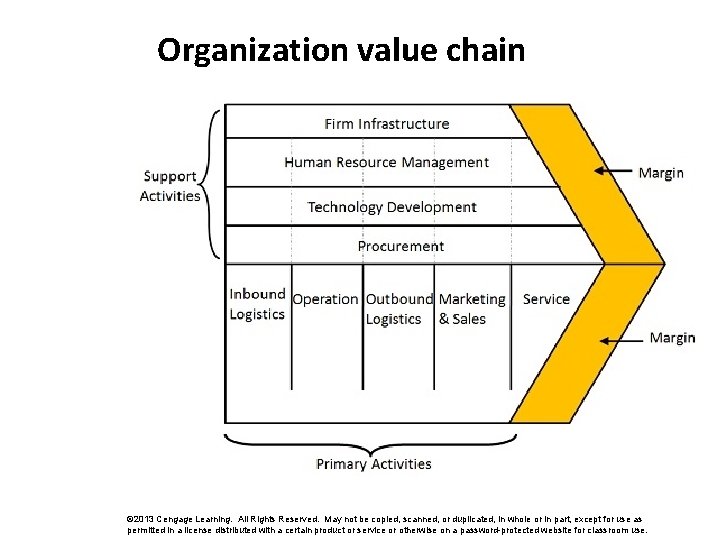
Organization value chain © 2013 Cengage Learning. All Rights Reserved. May not be copied, scanned, or duplicated, in whole or in part, except for use as permitted in a license distributed with a certain product or service or otherwise on a password-protected website for classroom use.
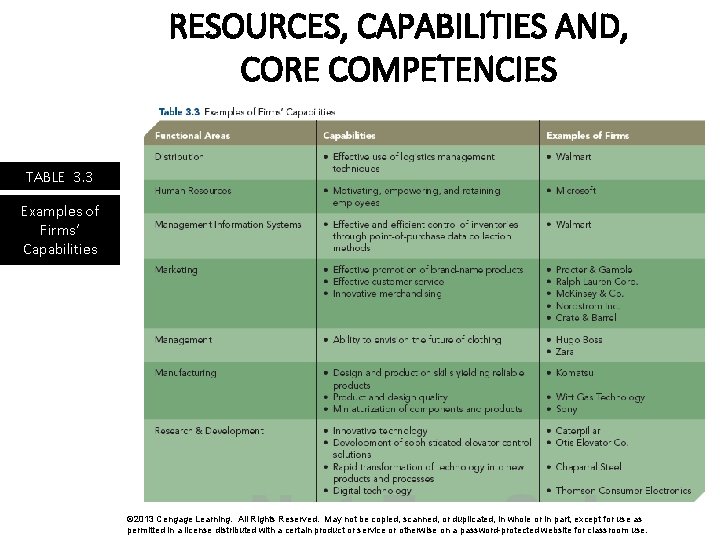
RESOURCES, CAPABILITIES AND, CORE COMPETENCIES TABLE 3. 3 Examples of Firms’ Capabilities © 2013 Cengage Learning. All Rights Reserved. May not be copied, scanned, or duplicated, in whole or in part, except for use as permitted in a license distributed with a certain product or service or otherwise on a password-protected website for classroom use.
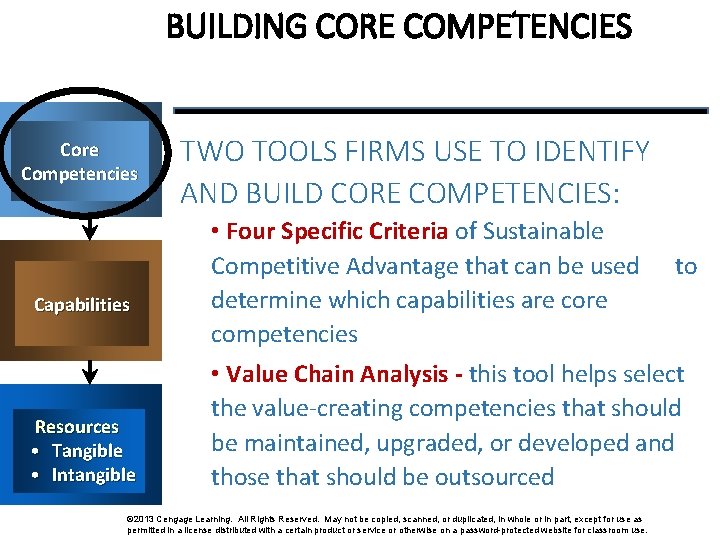
BUILDING CORE COMPETENCIES Core Competencies Capabilities Resources • Tangible • Intangible TWO TOOLS FIRMS USE TO IDENTIFY AND BUILD CORE COMPETENCIES: • Four Specific Criteria of Sustainable Competitive Advantage that can be used to determine which capabilities are competencies • Value Chain Analysis - this tool helps select the value-creating competencies that should be maintained, upgraded, or developed and those that should be outsourced © 2013 Cengage Learning. All Rights Reserved. May not be copied, scanned, or duplicated, in whole or in part, except for use as permitted in a license distributed with a certain product or service or otherwise on a password-protected website for classroom use.
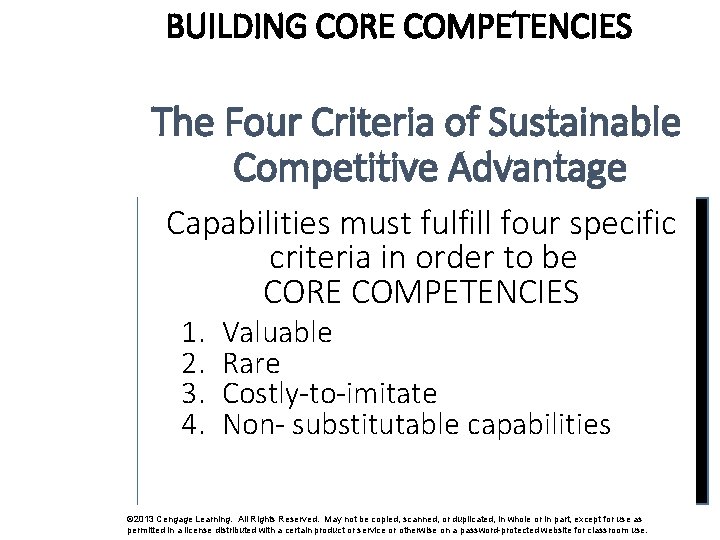
BUILDING CORE COMPETENCIES The Four Criteria of Sustainable Competitive Advantage Capabilities must fulfill four specific criteria in order to be CORE COMPETENCIES 1. 2. 3. 4. Valuable Rare Costly-to-imitate Non- substitutable capabilities © 2013 Cengage Learning. All Rights Reserved. May not be copied, scanned, or duplicated, in whole or in part, except for use as permitted in a license distributed with a certain product or service or otherwise on a password-protected website for classroom use.
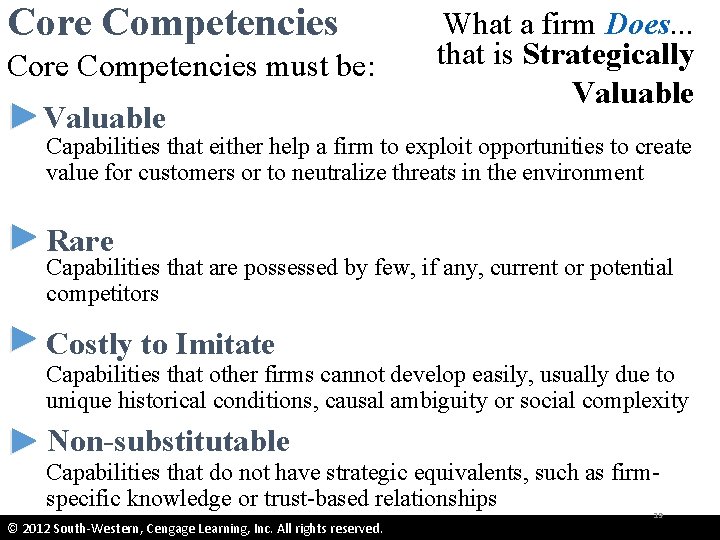
Core Competencies must be: Valuable What a firm Does. . . that is Strategically Valuable Capabilities that either help a firm to exploit opportunities to create value for customers or to neutralize threats in the environment Rare Capabilities that are possessed by few, if any, current or potential competitors Costly to Imitate Capabilities that other firms cannot develop easily, usually due to unique historical conditions, causal ambiguity or social complexity Non-substitutable Capabilities that do not have strategic equivalents, such as firmspecific knowledge or trust-based relationships © 2012 South-Western, Cengage Learning, Inc. All rights reserved. 19
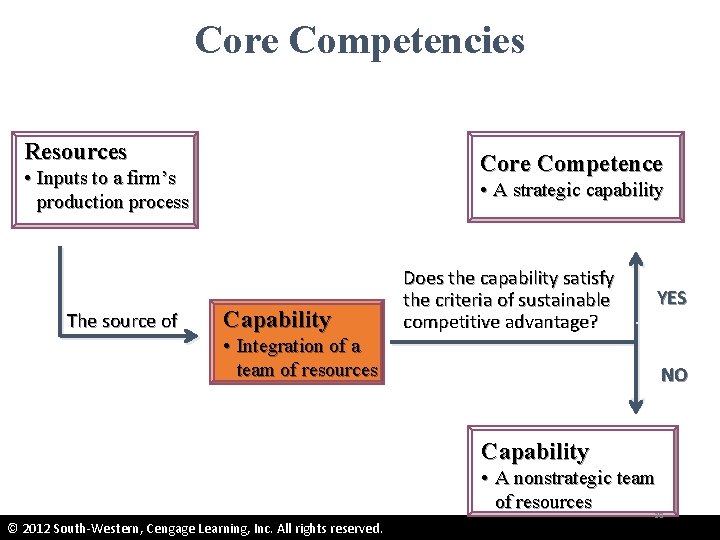
Core Competencies Resources Core Competence • Inputs to a firm’s production process The source of • A strategic capability Capability • Integration of a team of resources Does the capability satisfy the criteria of sustainable competitive advantage? YES NO Capability © 2012 South-Western, Cengage Learning, Inc. All rights reserved. • A nonstrategic team of resources 20
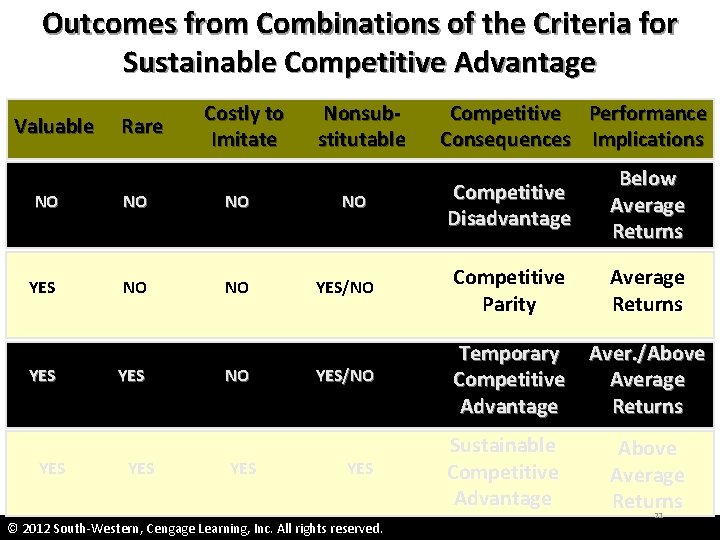
Outcomes from Combinations of the Criteria for Sustainable Competitive Advantage Valuable Rare Costly to Imitate NO NO NO YES YES YES NO YES Nonsubstitutable Competitive Performance Consequences Implications Competitive Disadvantage Below Average Returns YES/NO Competitive Parity Average Returns YES/NO Temporary Competitive Advantage Aver. /Above Average Returns Sustainable Competitive Advantage Above Average Returns 21 NO YES © 2012 South-Western, Cengage Learning, Inc. All rights reserved.
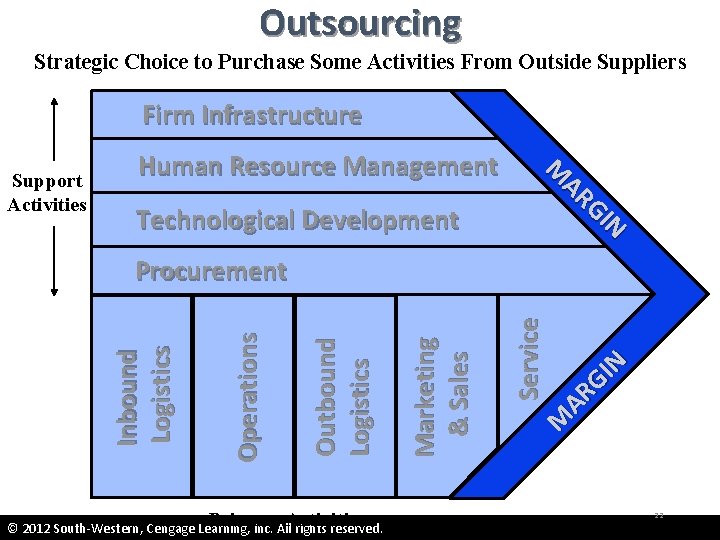
Outsourcing Strategic Choice to Purchase Some Activities From Outside Suppliers Firm Infrastructure Support Activities Human Resource Management Technological Development M AR GI N Primary © 2012 South-Western, Cengage Learning, Inc. All. Activities rights reserved. M AR GI N Service Marketing & Sales Outbound Logistics Operations Inbound Logistics Procurement 22
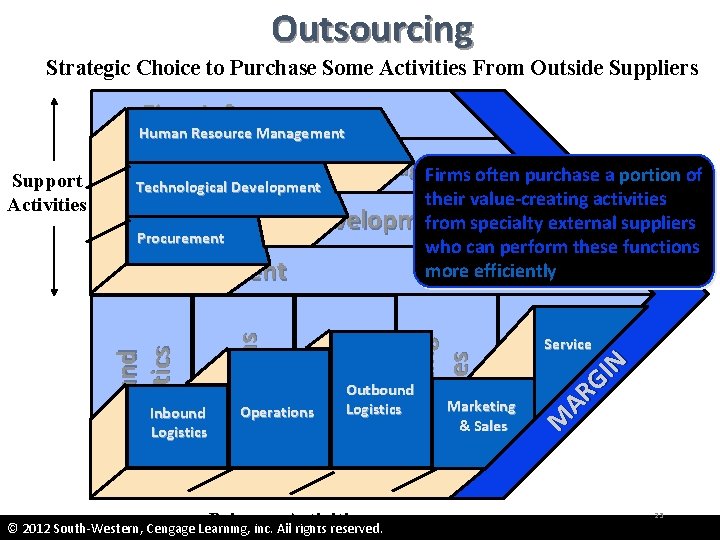
Outsourcing Strategic Choice to Purchase Some Activities From Outside Suppliers Firm Infrastructure Human Resource Management Procurement who can perform these functions more efficiently Outbound Logistics Primary © 2012 South-Western, Cengage Learning, Inc. All. Activities rights reserved. Marketing & Sales Service M AR GI N Operations Marketing & Sales Outbound Logistics Inbound Logistics Operations Inbound Logistics Procurement Service Support Activities M Human Resource Management Firms often purchase AR a portion of Technological Development their value-creating. Gactivities IN suppliers Technological Development from specialty external Procurement 23
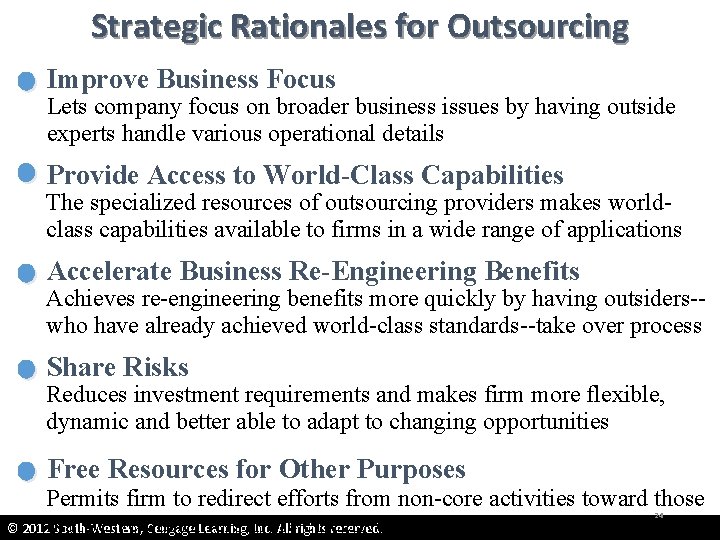
Strategic Rationales for Outsourcing Improve Business Focus Lets company focus on broader business issues by having outside experts handle various operational details Provide Access to World-Class Capabilities The specialized resources of outsourcing providers makes worldclass capabilities available to firms in a wide range of applications Accelerate Business Re-Engineering Benefits Achieves re-engineering benefits more quickly by having outsiders-who have already achieved world-class standards--take over process Share Risks Reduces investment requirements and makes firm more flexible, dynamic and better able to adapt to changing opportunities Free Resources for Other Purposes Permits firm to redirect efforts from non-core activities toward those serve customers effectively © 2012 that South-Western, Cengage Learning, more Inc. All rights reserved. 24
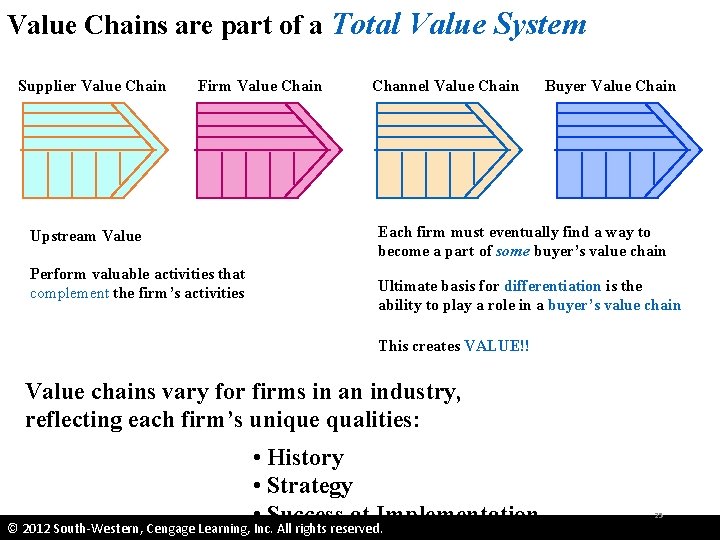
Value Chains are part of a Total Value System Supplier Value Chain Firm Value Chain Upstream Value Perform valuable activities that complement the firm’s activities Channel Value Chain Buyer Value Chain Each firm must eventually find a way to become a part of some buyer’s value chain Ultimate basis for differentiation is the ability to play a role in a buyer’s value chain This creates VALUE!! Value chains vary for firms in an industry, reflecting each firm’s unique qualities: • History • Strategy • Success at Implementation © 2012 South-Western, Cengage Learning, Inc. All rights reserved. 25
Core Competencies--Cautions and Reminders Never take for granted that core competencies will continue to provide a source of competitive advantage All core competencies have the potential to become Core Rigidities are former core competencies that sow the seeds of organizational inertia and prevent the firm from responding appropriately to changes in the external environment Strategic myopia and inflexibility can strangle the firm’s ability to grow and adapt to environmental change or competitive threats © 2012 South-Western, Cengage Learning, Inc. All rights reserved. 26
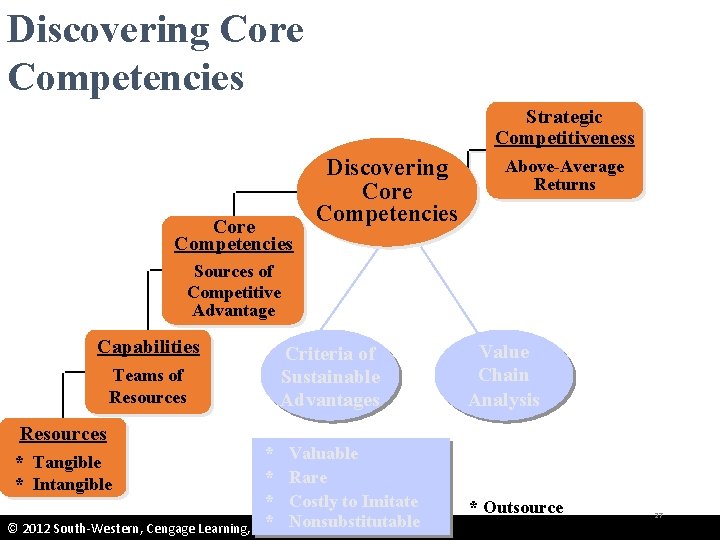
Discovering Core Competencies Strategic Competitiveness Core Competencies Discovering Core Competencies Above-Average Returns Sources of Competitive Advantage Capabilities Teams of Resources Criteria of Sustainable Advantages Value Chain Analysis Resources * Valuable * Rare * Costly to Imitate * All. Nonsubstitutable © 2012 South-Western, Cengage Learning, Inc. rights reserved. * Tangible * Intangible * Outsource 27
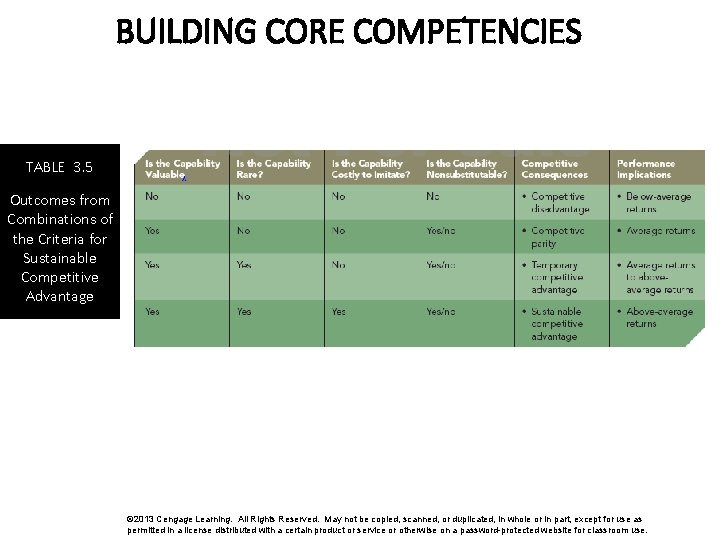
BUILDING CORE COMPETENCIES TABLE 3. 5 Outcomes from Combinations of the Criteria for Sustainable Competitive Advantage © 2013 Cengage Learning. All Rights Reserved. May not be copied, scanned, or duplicated, in whole or in part, except for use as permitted in a license distributed with a certain product or service or otherwise on a password-protected website for classroom use.
BUILDING CORE COMPETENCIES VALUE CHAIN ANALYSIS • Allows the firm to understand the parts of its operations that create value and those that do not • • A template that firms use to: • Understand their cost position • Facilitate the implementation of a chosen business-level strategy © 2013 Cengage Learning. All Rights Reserved. May not be copied, scanned, or duplicated, in whole or in part, except for use as permitted in a license distributed with a certain product or service or otherwise on a password-protected website for classroom use.
BUILDING CORE COMPETENCIES VALUE CHAIN ANALYSIS • Both value chain (primary) and support activities should be analyzed • Competitive landscape demands that value chains and supply chains be examined in a global context • Each activity should be examined relative to competitor’s abilities and rated as superior, equivalent, or inferior • © 2013 Cengage Learning. All Rights Reserved. May not be copied, scanned, or duplicated, in whole or in part, except for use as permitted in a license distributed with a certain product or service or otherwise on a password-protected website for classroom use.
BUILDING CORE COMPETENCIES VALUE CHAIN ANALYSIS To become a core competence and a source of competitive advantage, a capability must allow the firm: • 1. to perform an activity in a manner that provides superior value relative to competitors, or 2. to perform a value-creating activity that competitors cannot perform © 2013 Cengage Learning. All Rights Reserved. May not be copied, scanned, or duplicated, in whole or in part, except for use as permitted in a license distributed with a certain product or service or otherwise on a password-protected website for classroom use.
BUILDING CORE COMPETENCIES VALUE CHAIN ANALYSIS VALUE CHAIN ACTIVITIES: activities the firm completes in order to produce products and then sell, distribute, and service those products in ways that create value for customers • SUPPORT FUNCTIONS: activities the firm completes in order to support the work being done to produce, sell, distribute, and service the products the firm is producing © 2013 Cengage Learning. All Rights Reserved. May not be copied, scanned, or duplicated, in whole or in part, except for use as permitted in a license distributed with a certain product or service or otherwise on a password-protected website for classroom use.
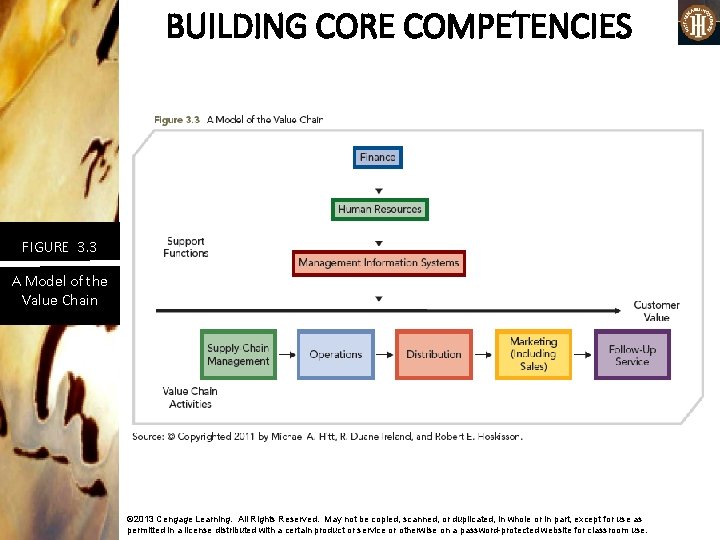
BUILDING CORE COMPETENCIES • FIGURE 3. 3 A Model of the Value Chain © 2013 Cengage Learning. All Rights Reserved. May not be copied, scanned, or duplicated, in whole or in part, except for use as permitted in a license distributed with a certain product or service or otherwise on a password-protected website for classroom use.
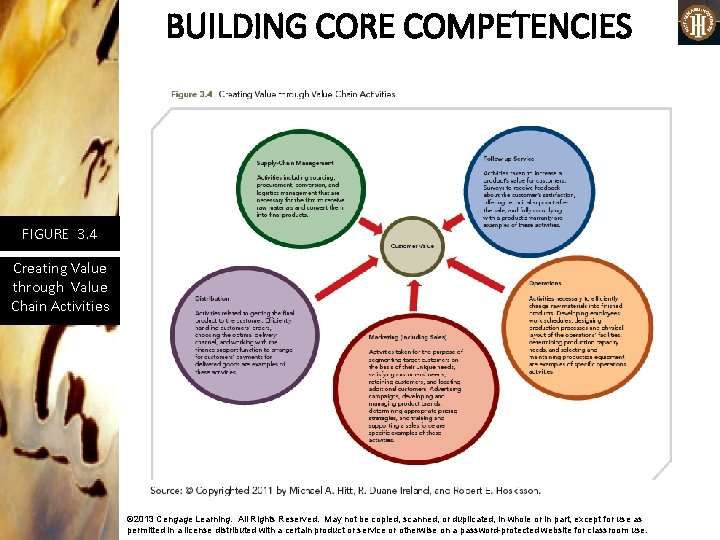
BUILDING CORE COMPETENCIES VALUE CHAIN ANALYSIS FIGURE 3. 4 • Creating Value through Value Chain Activities © 2013 Cengage Learning. All Rights Reserved. May not be copied, scanned, or duplicated, in whole or in part, except for use as permitted in a license distributed with a certain product or service or otherwise on a password-protected website for classroom use.
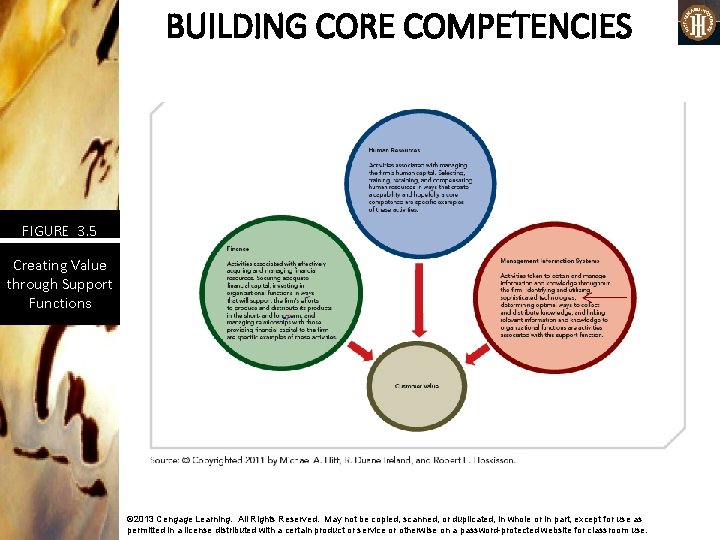
BUILDING CORE COMPETENCIES • FIGURE 3. 5 Creating Value through Support Functions © 2013 Cengage Learning. All Rights Reserved. May not be copied, scanned, or duplicated, in whole or in part, except for use as permitted in a license distributed with a certain product or service or otherwise on a password-protected website for classroom use.
BUILDING CORE COMPETENCIES VALUE CHAIN ANALYSIS • SOCIAL CAPITAL - when firms have strong positive alliances with suppliers and customers • • • TRUST - is required to build social capital whereby resources such as knowledge are transferred across organizations JUDGMENT - pivotal in evaluating a firm’s capability to execute its value chain activities and support functions © 2013 Cengage Learning. All Rights Reserved. May not be copied, scanned, or duplicated, in whole or in part, except for use as permitted in a license distributed with a certain product or service or otherwise on a password-protected website for classroom use.
OUTSOURCING • Definition: purchase of a value-creating activity or support function from an external supplier • • • Effective execution includes an increase in flexibility and risk mitigation, and a reduction in capital investment Global industries trend continues at a rapid pace Firms must outsource activities where they cannot create value or are at a substantial disadvantage compared to competitors • © 2013 Cengage Learning. All Rights Reserved. May not be copied, scanned, or duplicated, in whole or in part, except for use as permitted in a license distributed with a certain product or service or otherwise on a password-protected website for classroom use.
OUTSOURCING STRATEGIC RATIONALES ■ Few organizations are competitively superior in all value chain activities and support functions • ■ By outsourcing activities where it lacks competence, the firm can fully concentrate on those areas in which it can create value ■ Freeing resources for other purposes redirects efforts from non-core activities toward those that serve customers more effectively © 2013 Cengage Learning. All Rights Reserved. May not be copied, scanned, or duplicated, in whole or in part, except for use as permitted in a license distributed with a certain product or service or otherwise on a password-protected website for classroom use.
OUTSOURCING STRATEGIC RATIONALES ■ Specialty suppliers can perform outsourced capabilities more efficiently. • ■ Sharing risks - reduces investment requirements and makes firm more flexible, dynamic, and better able to adapt to changing opportunities ■ Providing access to world-class standards – the specialized resources of outsourcing providers makes world-class capabilities available to firms © 2013 Cengage Learning. All Rights Reserved. May not be copied, scanned, or duplicated, in whole or in part, except for use as permitted in a license distributed with a certain product or service or otherwise on a password-protected website for classroom use.
OUTSOURCING ■ Outsource those value chain activities and support functions that are NOT a source of core competence • ■ Concerns: innovation, technological uncertainty, and job loss; usually revolves around firm’s innovative ability and loss of jobs to external supplier ■ Offshoring - foreign supply source © 2013 Cengage Learning. All Rights Reserved. May not be copied, scanned, or duplicated, in whole or in part, except for use as permitted in a license distributed with a certain product or service or otherwise on a password-protected website for classroom use.
COMPETENCIES, STRENGTHS, WEAKNESSES, AND STRATEGIC DECISIONS • • Firms must identify their strengths and weaknesses Appropriate resources and capabilities are needed to develop desired strategy and create value for customers and other stakeholders • © 2013 Cengage Learning. All Rights Reserved. May not be copied, scanned, or duplicated, in whole or in part, except for use as permitted in a license distributed with a certain product or service or otherwise on a password-protected website for classroom use.
COMPETENCIES, STRENGTHS, WEAKNESSES, AND STRATEGIC DECISIONS • The “right” resources (as opposed to “many” resources) are those with the potential to be formed into core competencies as the foundation for competitive advantage • • Tools (e. g. , outsourcing) can help a firm focus on core competencies as the source for competitive advantage © 2013 Cengage Learning. All Rights Reserved. May not be copied, scanned, or duplicated, in whole or in part, except for use as permitted in a license distributed with a certain product or service or otherwise on a password-protected website for classroom use.
COMPETENCIES, STRENGTHS, WEAKNESSES, AND STRATEGIC DECISIONS • Core competencies have potential to become CORE RIGIDITIES Former core competencies that now generate inertia and stifle innovation • • • External environmental conditions and events impact a firm’s core competencies © 2013 Cengage Learning. All Rights Reserved. May not be copied, scanned, or duplicated, in whole or in part, except for use as permitted in a license distributed with a certain product or service or otherwise on a password-protected website for classroom use.
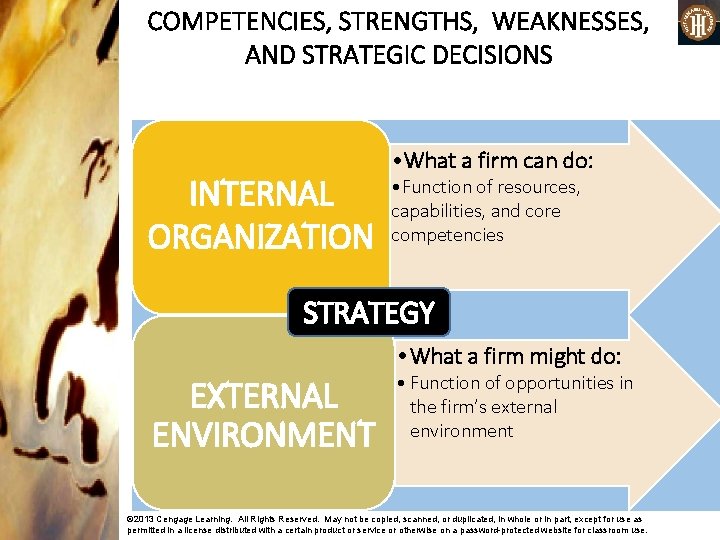
COMPETENCIES, STRENGTHS, WEAKNESSES, AND STRATEGIC DECISIONS INTERNAL ORGANIZATION • What a firm can do: • Function of resources, capabilities, and core competencies STRATEGY • What a firm might do: EXTERNAL ENVIRONMENT • Function of opportunities in the firm’s external environment © 2013 Cengage Learning. All Rights Reserved. May not be copied, scanned, or duplicated, in whole or in part, except for use as permitted in a license distributed with a certain product or service or otherwise on a password-protected website for classroom use.
- Slides: 44