
The Intercultural Development Inventory IDI Qualifying Seminar Mitchell
- Slides: 19
The Intercultural Development Inventory® (IDI® Qualifying Seminar Mitchell R. Hammer, Ph. D. Copyright, 1998 -2014, Mitchell R. Hammer, Ph. D. , IDI, NIGHT ARRIVES LLC, used with permission Copyright, 2007, 2009 Mitchell R. BETWEEN EUROPE & AFRICA Hammer, Ph. D.
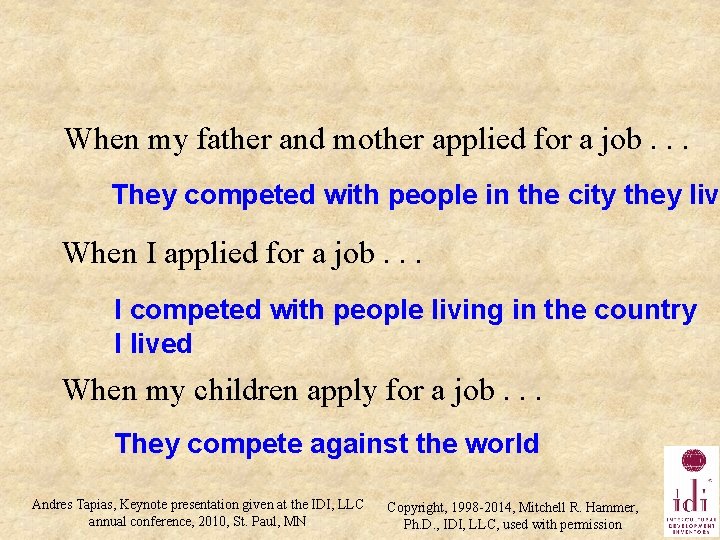
When my father and mother applied for a job. . . They competed with people in the city they liv When I applied for a job. . . I competed with people living in the country I lived When my children apply for a job. . . They compete against the world Andres Tapias, Keynote presentation given at the IDI, LLC annual conference, 2010, St. Paul, MN Copyright, 1998 -2014, Mitchell R. Hammer, Ph. D. , IDI, LLC, used with permission
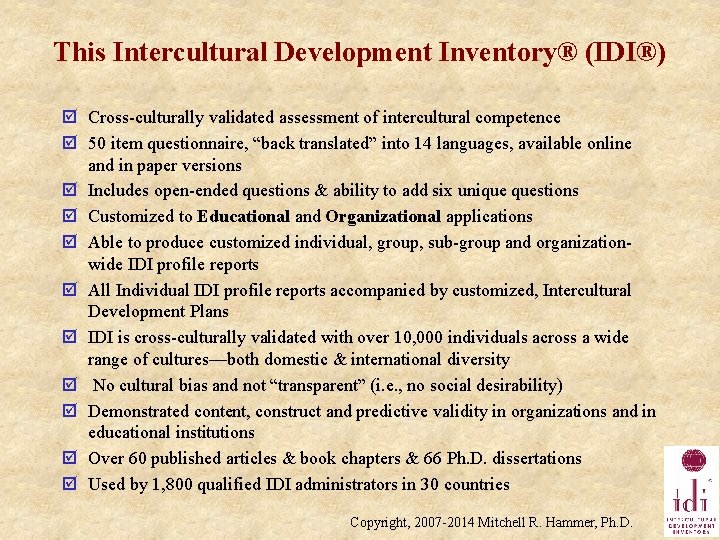
This Intercultural Development Inventory® (IDI®) Cross-culturally validated assessment of intercultural competence 50 item questionnaire, “back translated” into 14 languages, available online and in paper versions Includes open-ended questions & ability to add six unique questions Customized to Educational and Organizational applications Able to produce customized individual, group, sub-group and organizationwide IDI profile reports All Individual IDI profile reports accompanied by customized, Intercultural Development Plans IDI is cross-culturally validated with over 10, 000 individuals across a wide range of cultures—both domestic & international diversity No cultural bias and not “transparent” (i. e. , no social desirability) Demonstrated content, construct and predictive validity in organizations and in educational institutions Over 60 published articles & book chapters & 66 Ph. D. dissertations Used by 1, 800 qualified IDI administrators in 30 countries Copyright, 2007 -2014 Mitchell R. Hammer, Ph. D.
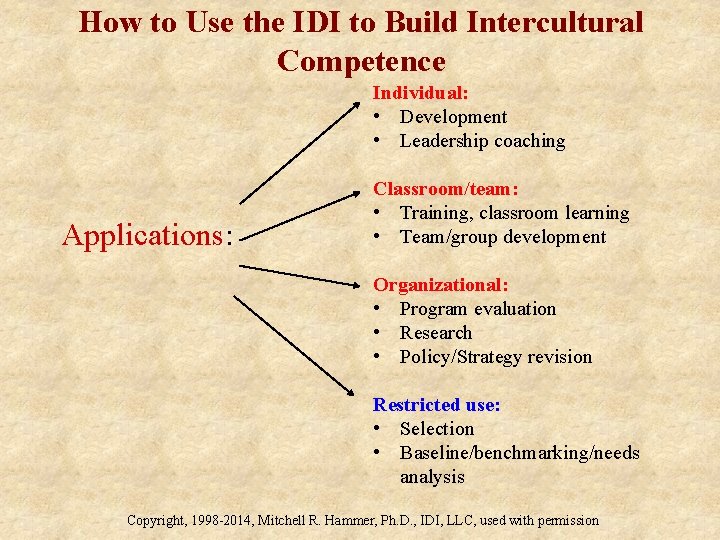
How to Use the IDI to Build Intercultural Competence Individual: • Development • Leadership coaching Applications: Classroom/team: • Training, classroom learning • Team/group development Organizational: • Program evaluation • Research • Policy/Strategy revision Restricted use: • Selection • Baseline/benchmarking/needs analysis Copyright, 1998 -2014, Mitchell R. Hammer, Ph. D. , IDI, LLC, used with permission
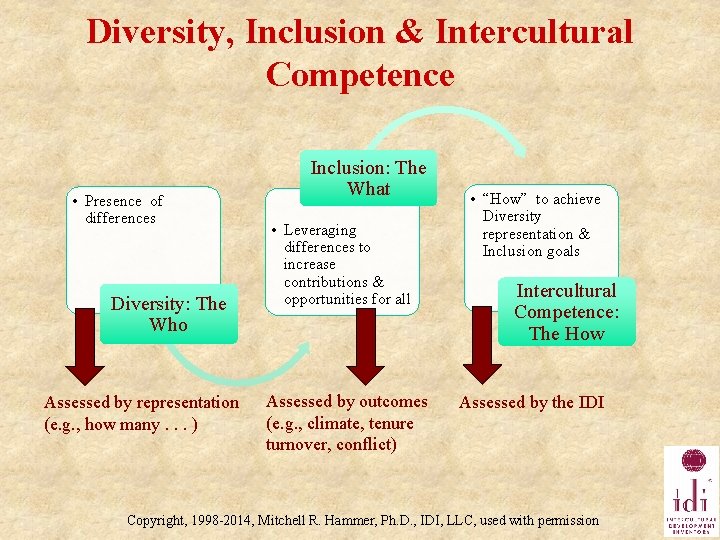
Diversity, Inclusion & Intercultural Competence • Presence of differences Diversity: The Who Assessed by representation (e. g. , how many. . . ) Inclusion: The What • Leveraging differences to increase contributions & opportunities for all Assessed by outcomes (e. g. , climate, tenure turnover, conflict) • “How” to achieve Diversity representation & Inclusion goals Intercultural Competence: The How Assessed by the IDI Copyright, 1998 -2014, Mitchell R. Hammer, Ph. D. , IDI, LLC, used with permission
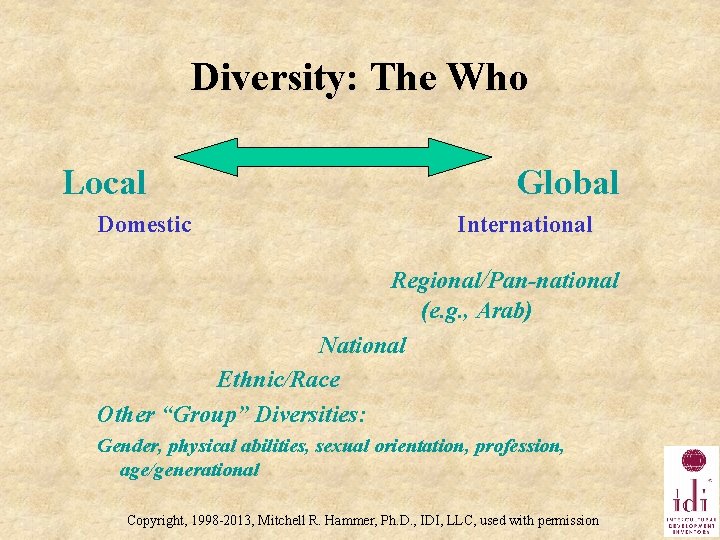
Diversity: The Who Local Domestic Global International Regional/Pan-national (e. g. , Arab) National Ethnic/Race Other “Group” Diversities: Gender, physical abilities, sexual orientation, profession, age/generational Copyright, 1998 -2013, Mitchell R. Hammer, Ph. D. , IDI, LLC, used with permission
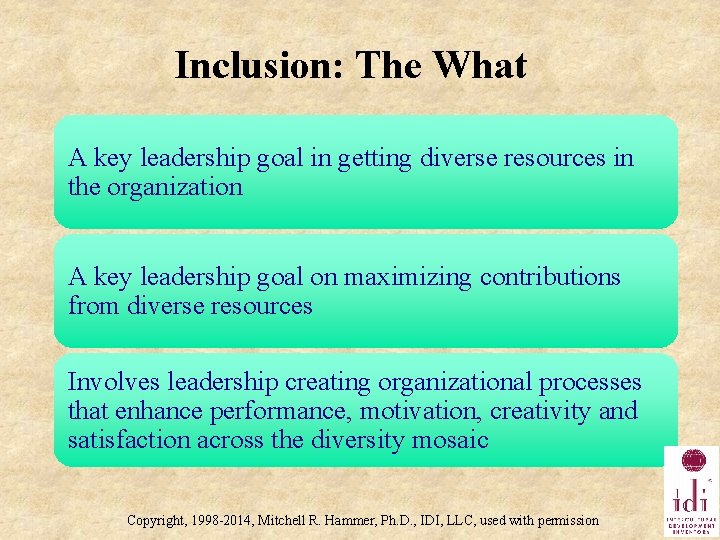
Inclusion: The What A key leadership goal in getting diverse resources in the organization A key leadership goal on maximizing contributions from diverse resources Involves leadership creating organizational processes that enhance performance, motivation, creativity and satisfaction across the diversity mosaic Copyright, 1998 -2014, Mitchell R. Hammer, Ph. D. , IDI, LLC, used with permission
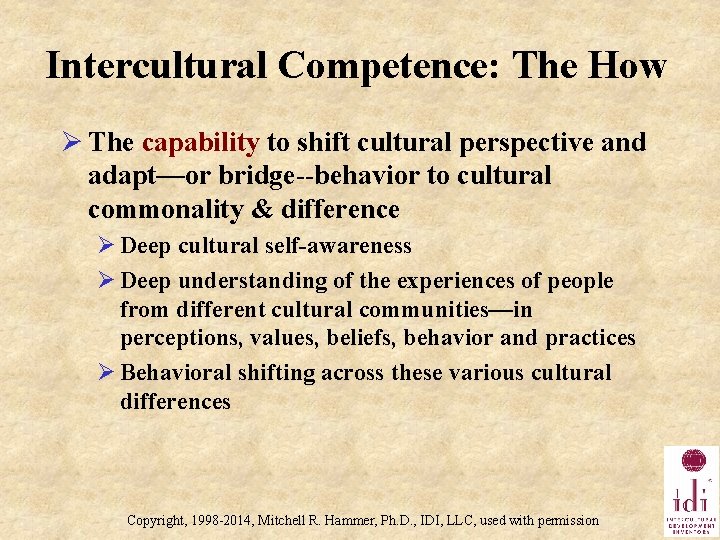
Intercultural Competence: The How Ø The capability to shift cultural perspective and adapt—or bridge--behavior to cultural commonality & difference Ø Deep cultural self-awareness Ø Deep understanding of the experiences of people from different cultural communities—in perceptions, values, beliefs, behavior and practices Ø Behavioral shifting across these various cultural differences Copyright, 1998 -2014, Mitchell R. Hammer, Ph. D. , IDI, LLC, used with permission
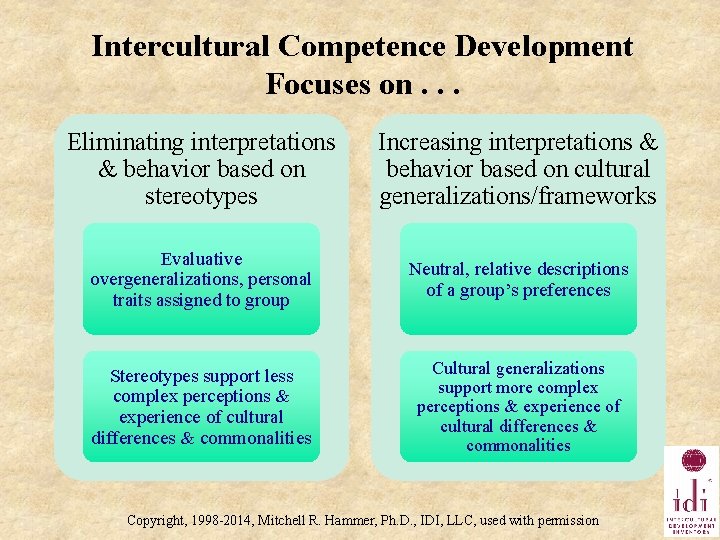
Intercultural Competence Development Focuses on. . . Eliminating interpretations & behavior based on stereotypes Increasing interpretations & behavior based on cultural generalizations/frameworks Evaluative overgeneralizations, personal traits assigned to group Neutral, relative descriptions of a group’s preferences Stereotypes support less complex perceptions & experience of cultural differences & commonalities Cultural generalizations support more complex perceptions & experience of cultural differences & commonalities Copyright, 1998 -2014, Mitchell R. Hammer, Ph. D. , IDI, LLC, used with permission
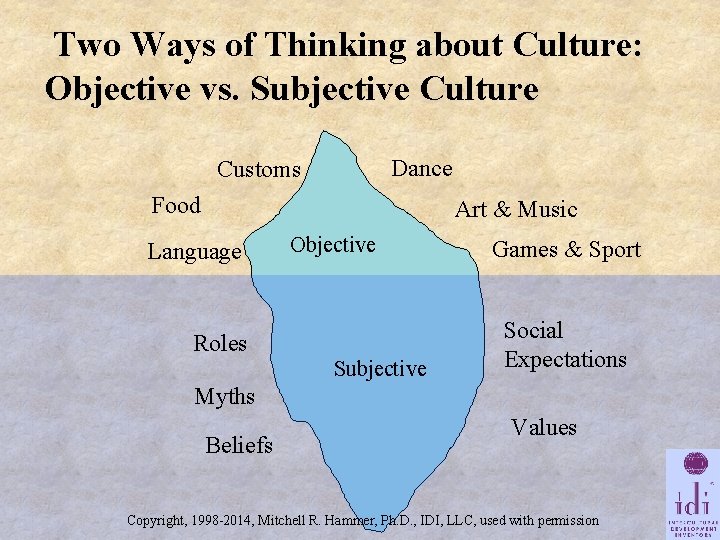
Two Ways of Thinking about Culture: Objective vs. Subjective Culture Dance Customs Food Art & Music Language Objective Roles Subjective Games & Sport Social Expectations Myths Beliefs Values Copyright, 1998 -2014, Mitchell R. Hammer, Ph. D. , IDI, LLC, used with permission
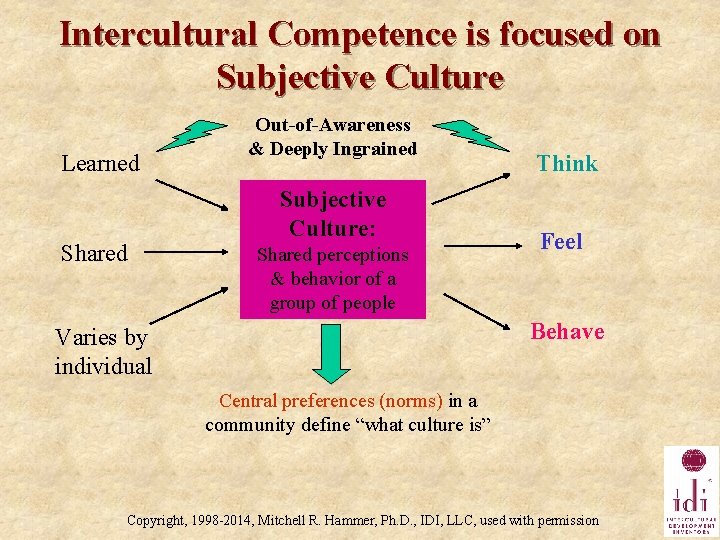
Intercultural Competence is focused on Subjective Culture Learned Shared Out-of-Awareness & Deeply Ingrained Subjective Culture: Shared perceptions & behavior of a group of people Think Feel Behave Varies by individual Central preferences (norms) in a community define “what culture is” Copyright, 1998 -2014, Mitchell R. Hammer, Ph. D. , IDI, LLC, used with permission
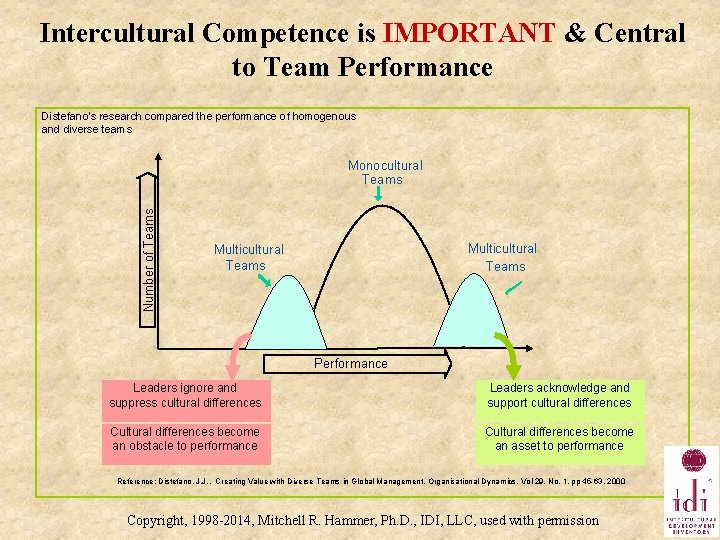
Intercultural Competence is IMPORTANT & Central to Team Performance Distefano’s research compared the performance of homogenous and diverse teams Number of Teams Monocultural Teams Multicultural Teams Performance Leaders ignore and suppress cultural differences Leaders acknowledge and support cultural differences Cultural differences become an obstacle to performance Cultural differences become an asset to performance Reference: Distefano, J. J. , Creating Value with Diverse Teams in Global Management, Organisational Dynamics, Vol 29, No. 1, pp 45 -63, 2000 Copyright, 1998 -2014, Mitchell R. Hammer, Ph. D. , IDI, LLC, used with permission
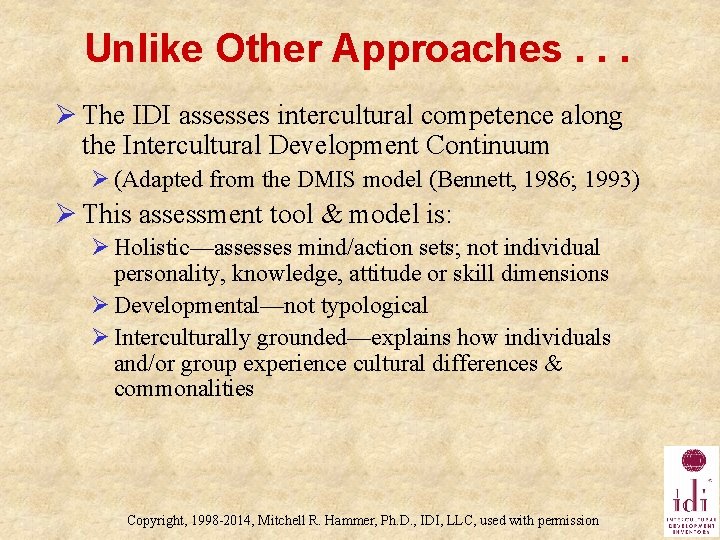
Unlike Other Approaches. . . Ø The IDI assesses intercultural competence along the Intercultural Development Continuum Ø (Adapted from the DMIS model (Bennett, 1986; 1993) Ø This assessment tool & model is: Ø Holistic—assesses mind/action sets; not individual personality, knowledge, attitude or skill dimensions Ø Developmental—not typological Ø Interculturally grounded—explains how individuals and/or group experience cultural differences & commonalities Copyright, 1998 -2014, Mitchell R. Hammer, Ph. D. , IDI, LLC, used with permission
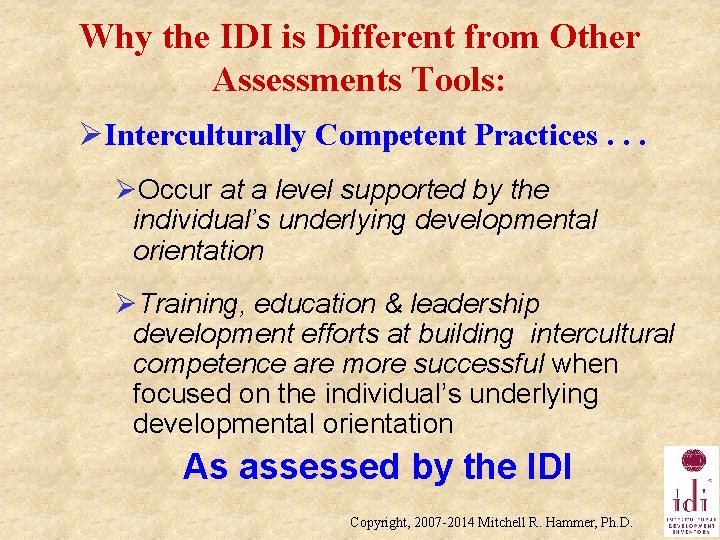
Why the IDI is Different from Other Assessments Tools: ØInterculturally Competent Practices. . . ØOccur at a level supported by the individual’s underlying developmental orientation ØTraining, education & leadership development efforts at building intercultural competence are more successful when focused on the individual’s underlying developmental orientation As assessed by the IDI Copyright, 2007 -2014 Mitchell R. Hammer, Ph. D.
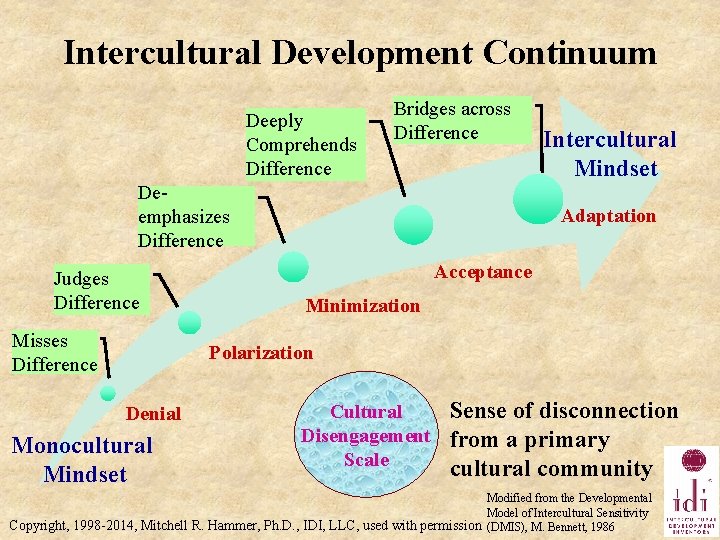
Intercultural Development Continuum Deeply Comprehends Difference Bridges across Difference Deemphasizes Difference Judges Difference Misses Difference Intercultural Mindset Adaptation Acceptance Minimization Polarization Denial Monocultural Mindset Cultural Disengagement Scale Sense of disconnection from a primary cultural community Modified from the Developmental Model of Intercultural Sensitivity Copyright, 1998 -2014, Mitchell R. Hammer, Ph. D. , IDI, LLC, used with permission (DMIS), M. Bennett, 1986
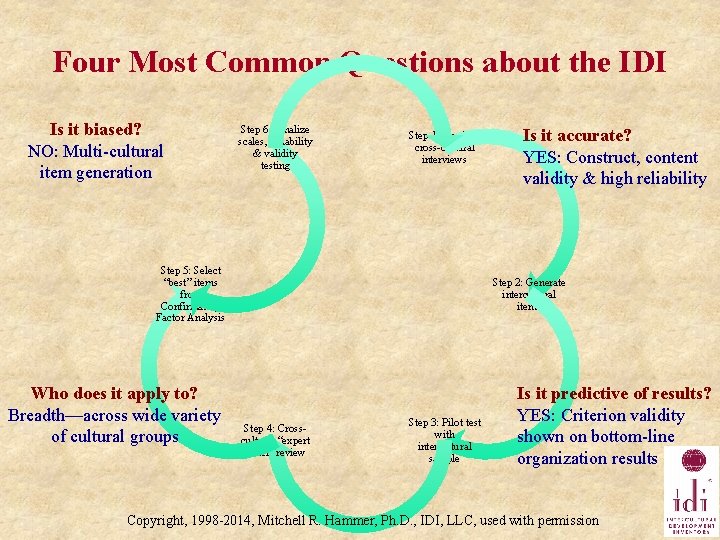
Four Most Common Questions about the IDI Is it biased? NO: Multi-cultural item generation Step 6: Finalize scales, reliability & validity testing Step 1: Conduct cross-cultural interviews Step 5: Select “best” items from Confirmatory Factor Analysis Who does it apply to? Breadth—across wide variety of cultural groups Is it accurate? YES: Construct, content validity & high reliability Step 2: Generate intercultural items Step 4: Crosscultural “expert panel” review Step 3: Pilot test with intercultural sample Is it predictive of results? YES: Criterion validity shown on bottom-line organization results Copyright, 1998 -2014, Mitchell R. Hammer, Ph. D. , IDI, LLC, used with permission
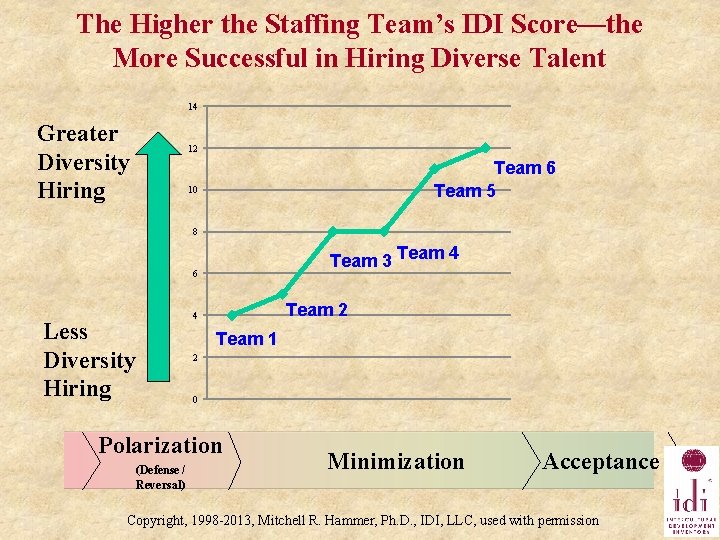
The Higher the Staffing Team’s IDI Score—the More Successful in Hiring Diverse Talent 14 Greater Diversity Hiring 12 Team 6 Team 5 10 8 Team 3 Team 4 6 Less Diversity Hiring Team 2 4 Team 1 2 0 Polarization (Defense / Reversal) Minimization Acceptance Copyright, 1998 -2013, Mitchell R. Hammer, Ph. D. , IDI, LLC, used with permission
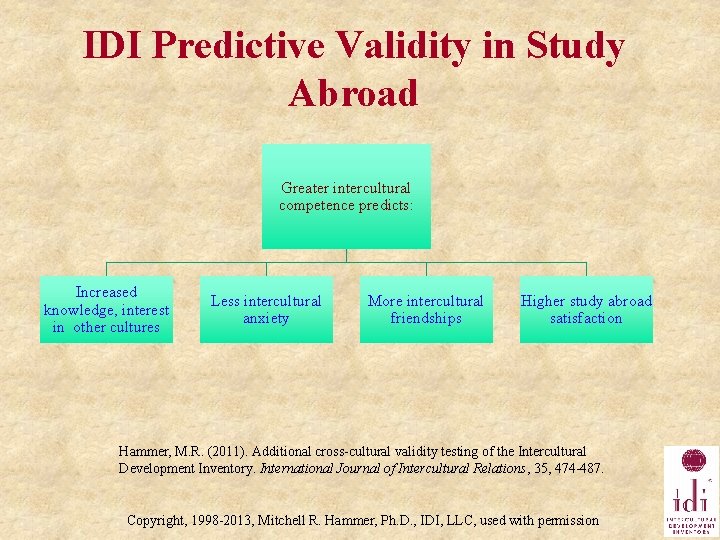
IDI Predictive Validity in Study Abroad Greater intercultural competence predicts: Increased knowledge, interest in other cultures Less intercultural anxiety More intercultural friendships Higher study abroad satisfaction Hammer, M. R. (2011). Additional cross-cultural validity testing of the Intercultural Development Inventory. International Journal of Intercultural Relations, 35, 474 -487. Copyright, 1998 -2013, Mitchell R. Hammer, Ph. D. , IDI, LLC, used with permission
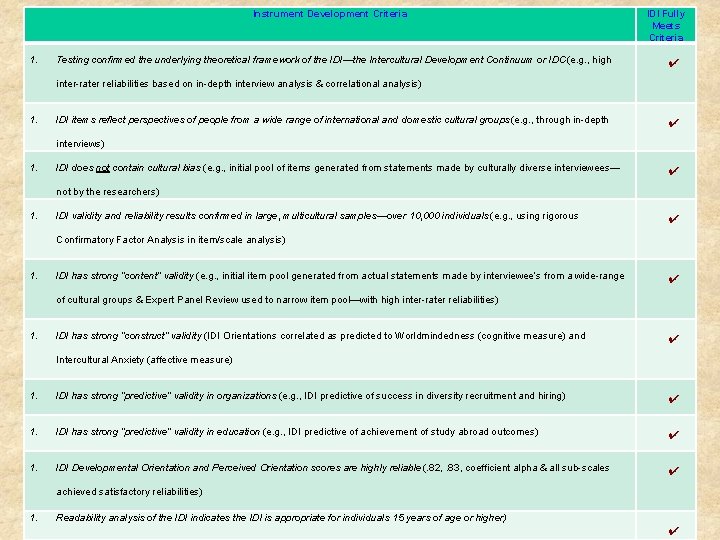
Instrument Development Criteria 1. Testing confirmed the underlying theoretical framework of the IDI—the Intercultural Development Continuum or IDC (e. g. , high IDI Fully Meets Criteria ✔ inter-rater reliabilities based on in-depth interview analysis & correlational analysis) 1. IDI items reflect perspectives of people from a wide range of international and domestic cultural groups (e. g. , through in-depth ✔ interviews) 1. IDI does not contain cultural bias (e. g. , initial pool of items generated from statements made by culturally diverse interviewees— ✔ not by the researchers) 1. IDI validity and reliability results confirmed in large, multicultural samples—over 10, 000 individuals (e. g. , using rigorous ✔ Confirmatory Factor Analysis in item/scale analysis) 1. IDI has strong “content” validity (e. g. , initial item pool generated from actual statements made by interviewee’s from a wide-range ✔ of cultural groups & Expert Panel Review used to narrow item pool—with high inter-rater reliabilities) 1. IDI has strong “construct” validity (IDI Orientations correlated as predicted to Worldmindedness (cognitive measure) and ✔ Intercultural Anxiety (affective measure) 1. IDI has strong “predictive” validity in organizations (e. g. , IDI predictive of success in diversity recruitment and hiring) ✔ 1. IDI has strong “predictive” validity in education (e. g. , IDI predictive of achievement of study abroad outcomes) ✔ 1. IDI Developmental Orientation and Perceived Orientation scores are highly reliable (. 82, . 83, coefficient alpha & all sub-scales ✔ achieved satisfactory reliabilities) 1. Readability analysis of the IDI indicates the IDI is appropriate for individuals 15 years of age or higher) ✔