
The Intercultural Classroom Communication Styles n n n


- Slides: 13
The Intercultural Classroom
Communication Styles n n n Linear vs. Circular (Contextual) Direct vs. Indirect Detached vs. attached Intellectual engagement vs. relational engagement Procedural vs. personal
Linear n Discussion is conducted in a straight line, developing causal connections among subpoints towards an end point, stated explicitly. Low reliance on context. (Cut to the chase, where the rubber meets the road!)
Circular (Contextual) n Discussion is conducted in a circular movement, developing context around the main point, which is often left unstated, high reliance on context. (Once you have the relevant information, you will just know what I mean!)
Direct n Meaning is conveyed through explicit statements made directly to the people involved, with little reliance on contextual factors such as situation and timing. (What you see is what you get!)
Indirect n Meaning is conveyed by suggestion, implication, nonverbal behavior, and other contextual cues; for instance, statements intended for one person may be made within earshot to a different person (What you get is what you manage to see!) ¡ Usually through a third party…most cultures are indirect except Americans. Direct, face to face causes loss of face and permanently damages the relationship. Other cultures no one on one. Americans go ballistic.
Detached n Issues are discussed with calmness and objectivity, conveying the speaker’s ability to weigh all the factors impersonally. (If it’s important, it shouldn’t be tainted by personal bias!)
Attached n Issues are discussed with feeling and emotion, conveying the speaker’s personal stake in the issue and the outcome. (If it’s important, it’s worth getting worked up over!)
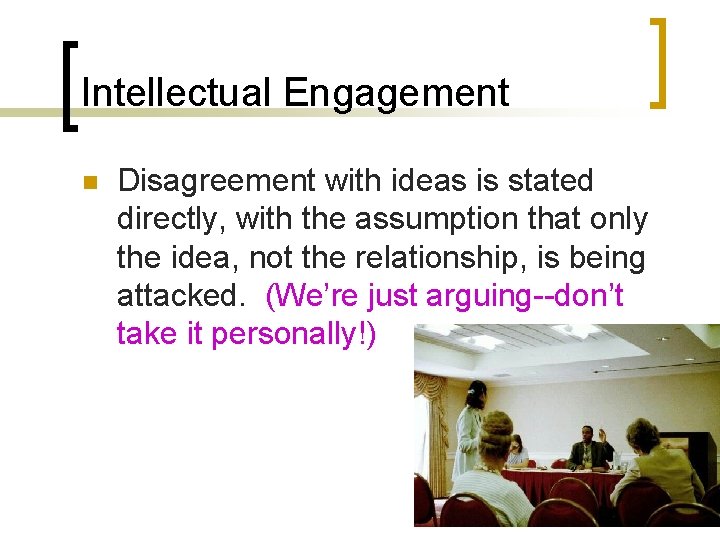
Intellectual Engagement n Disagreement with ideas is stated directly, with the assumption that only the idea, not the relationship, is being attacked. (We’re just arguing--don’t take it personally!)
Relational Engagement n Relational issues and problems are confronted directly, while intellectual disagreement is handled more subtly and indirectly. (Be authentic about your feelings and respectful of others’ ideas!)
Procedural n Questions should be resolved by adhering to policies and procedures as much as possible; following the rules helps to prevent discrimination. (Fairness is ensured by treating people similarly!)
Personal n Questions should be resolved by understanding and acting on the particular circumstances of the people involved; following the rules too much may prevent empathy. (Fairness is ensured by treating people uniquely!)