
The Integumentary System Epidermis Dermis Hair and Nails

- Slides: 53
The Integumentary System Epidermis Dermis Hair and Nails $100 $100 $200 $200 $300 $300 $400 $400 $500 $500 Glands Grab Bag FINAL ROUND
Epidermis: $100 Question The epidermis is made of this tissue: a. loose connective tissue b. stratified squamous epithelium c. dense irregular connective tissue d. adipose ANSWER BACK TO GAME
Epidermis: $100 Answer The epidermis is made of this tissue: a. loose connective tissue b. stratified squamous epithelium c. dense irregular connective tissue d. adipose BACK TO GAME
Epidermis: $200 Question These cells are responsible for the ability of the epidermis to resist abrasion and reduce water loss: a. melanocytes b. Merkel cells c. Langerhans cells d. keratinocytes ANSWER BACK TO GAME
Epidermis: $200 Answer These cells are responsible for the ability of the epidermis to resist abrasion and reduce water loss: a. melanocytes b. Merkel cells c. Langerhans cells d. keratinocytes BACK TO GAME
Epidermis: $300 Question This layer of skin replaces older cells that desquamate with newer cells by mitosis: a. stratum granulosum b. stratum basale c. stratum lucidum d. stratum corneum ANSWER BACK TO GAME
Epidermis: $300 Answer This layer of skin replaces older cells that desquamate with newer cells by mitosis: a. stratum granulosum b. stratum basale c. stratum lucidum d. stratum corneum BACK TO GAME
Epidermis: $400 Question Thin skin: a. lacks a stratum lucidum b. contains hair c. is found on the back d. all of these e. none of these ANSWER BACK TO GAME
Epidermis: $400 Answer Thin skin: a. lacks a stratum lucidum b. contains hair c. is found on the back d. all of these e. none of these BACK TO GAME
Epidermis: $500 Question Cyanosis, blue tinted skin, is caused by this: a. excess carotene b. decreased melanin production c. decreased oxygen in the blood d. increased blood flow ANSWER BACK TO GAME
Epidermis: $500 Answer Cyanosis, blue tinted skin, is caused by this: a. excess carotene b. decreased melanin production c. decreased oxygen in the blood d. increased blood flow BACK TO GAME
Dermis: $100 Question The dermis is made of this kind of tissue: a. adipose b. epithelium c. connective d. keratin ANSWER BACK TO GAME
Dermis: $100 Answer The dermis is made of this kind of tissue: a. adipose b. epithelium c. connective d. keratin BACK TO GAME
Dermis: $200 Question This is not associated with the dermis: a. melanocytes b. nerve endings c. lymphatic vessels d. hair follicles ANSWER BACK TO GAME
Dermis: $200 Answer This is not associated with the dermis: a. melanocytes b. nerve endings c. lymphatic vessels d. hair follicles BACK TO GAME
Dermis: $300 Question These lines of scar tissue are formed from excess stretching of the skin: a. fingerprints b. dermal papillae c. cleavage (tension) lines d. striae ANSWER BACK TO GAME
Dermis: $300 Answer These lines of scar tissue are formed from excess stretching of the skin: a. fingerprints b. dermal papillae c. cleavage (tension) lines d. striae BACK TO GAME
Dermis: $400 Question These folds shape the epidermis into fingerprints: a. strata b. dermal papillae c. corpuscles d. arrector pili ANSWER BACK TO GAME
Dermis: $400 Answer These folds shape the epidermis into fingerprints: a. strata b. dermal papillae c. corpuscles d. arrector pili BACK TO GAME
Dermis: $500 Question This layer contains blood vessels that nourish the epidermis, remove wastes and regulate body temperature: a. reticular layer b. hypodermis c. papillary layer d. stratum basale ANSWER BACK TO GAME
Dermis: $500 Answer This layer contains blood vessels that nourish the epidermis, remove wastes and regulate body temperature: a. reticular layer b. hypodermis c. papillary layer d. stratum basale BACK TO GAME
Hair and Nails: $100 Question Near birth, the hair on the scalp, eyelids and eyebrows are replaced with this: a. terminal hair b. lanugo c. vellus hair ANSWER BACK TO GAME
Hair and Nails: $100 Answer Near birth, the hair on the scalp, eyelids and eyebrows are replaced with this: a. terminal hair b. lanugo c. vellus hair BACK TO GAME
Hair and Nails: $200 Question This layer of cells in the hair forms the surface and contains hard keratin: a. medulla b. cortex c. cuticle d. dermal root sheath ANSWER BACK TO GAME
Hair and Nails: $200 Answer This layer of cells in the hair forms the surface and contains hard keratin: a. medulla b. cortex c. cuticle d. dermal root sheath BACK TO GAME
Hair and Nails: $300 Question These smooth muscles are attached to hair follicles and contraction of them produces “goose bumps”: a. hairbulb b. arrector pili c. dermal root sheath d. epithelial root sheath ANSWER BACK TO GAME
Hair and Nails: $300 Answer These smooth muscles are attached to hair follicles and contraction of them produces “goose bumps”: a. hairbulb b. arrector pili c. dermal root sheath d. epithelial root sheath BACK TO GAME
Hair and Nails: $400 Question The nail is produced mostly by this: a. nail bed b. nail root c. nail fold d. nail matrix ANSWER BACK TO GAME
Hair and Nails: $400 Answer The nail is produced mostly by this: a. nail bed b. nail root c. nail fold d. nail matrix BACK TO GAME
Hair and Nails: $500 Question This white crescent-shaped area is seen at the base of the nail: a. nail bed b. nail fold c. lunula d. eponychium e. hyponychium ANSWER BACK TO GAME
Hair and Nails: $500 Answer This white crescent-shaped area is seen at the base of the nail: a. nail bed b. nail fold c. lunula d. eponychium e. hyponychium BACK TO GAME
Glands: $100 Question These sweat glands are responsible for cooling the body: a. merocrine (eccrine) b. apocrine c. ceruminous d. sebaceous ANSWER BACK TO GAME
Glands: $100 Answer These sweat glands are responsible for cooling the body: a. merocrine (eccrine) b. apocrine c. ceruminous d. sebaceous BACK TO GAME
Glands: $200 Question These modified apocrine sweat glands are found in the breasts: a. ceruminous b. sebaceous c. mammary d. mucous ANSWER BACK TO GAME
Glands: $200 Answer These modified apocrine sweat glands are found in the breasts: a. ceruminous b. sebaceous c. mammary d. mucous BACK TO GAME
Glands: $300 Question Sebaceous glands produce sebum, prevent drying of the skin, protect against some bacteria, and are classified as holocrine. True/ False ANSWER BACK TO GAME
Glands: $300 Answer Sebaceous glands produce sebum, prevent drying of the skin, protect against some bacteria, and are classified as holocrine. True/ False BACK TO GAME
Glands: $400 Question This gland is involved with the production of body odor: a. merocrine b. apocrine c. cermunious d. sebaceous ANSWER BACK TO GAME
Glands: $400 Answer This gland is involved with the production of body odor: a. merocrine b. apocrine c. cermunious d. sebaceous BACK TO GAME
Glands: $500 Question These glands located in the external auditory meatus (ear canal) produce ear wax: a. apocrine b. ceruminous c. merocrine (eccrine) d. sebaceous ANSWER BACK TO GAME
Glands: $500 Answer These glands located in the external auditory meatus (ear canal) produce ear wax: a. apocrine b. ceruminous c. merocrine (eccrine) d. sebaceous BACK TO GAME
Grab Bag: $100 Question The major function of the skin is protection from this: a. abrasion b. dehydration c. ultraviolet light d. entry of microorganisms e. all of these ANSWER BACK TO GAME
Grab Bag: $100 Answer The major function of the skin is protection from this: a. abrasion b. dehydration c. ultraviolet light d. entry of microorganisms e. all of these BACK TO GAME
Grab Bag: $200 Question This layer contains about half of the body’s stored fat: a. epidermis b. dermis c. hypodermis (subcutaneous) d. stratum basale ANSWER BACK TO GAME
Grab Bag: $200 Answer This layer contains about half of the body’s stored fat: a. epidermis b. dermis c. hypodermis (subcutaneous) d. stratum basale BACK TO GAME
Grab Bag: $300 Question This substance is synthesized in the skin and increases blood calcium for normal nerve and muscle function: a. vitamin A b. vitamin B c. vitamin C d. vitamin D ANSWER BACK TO GAME
Grab Bag: $300 Answer This substance is synthesized in the skin and increases blood calcium for normal nerve and muscle function: a. vitamin A b. vitamin B c. vitamin C d. vitamin D BACK TO GAME
Grab Bag: $400 Question This best describes the function of melanin in the skin: a. reduces water loss b. protects against UV light c. helps regulate body temperature d. lubricates the skin ANSWER BACK TO GAME
Grab Bag: $400 Answer This best describes the function of melanin in the skin: a. reduces water loss b. protects against UV light c. helps regulate body temperature d. lubricates the skin BACK TO GAME
Grab Bag: $500 Question These are all effects of aging on the integumentary system except: a. decrease of elastic fibers b. loss of fat from hypodermis c. decrease of melanin production in hair d. increase of sweat gland activity ANSWER BACK TO GAME
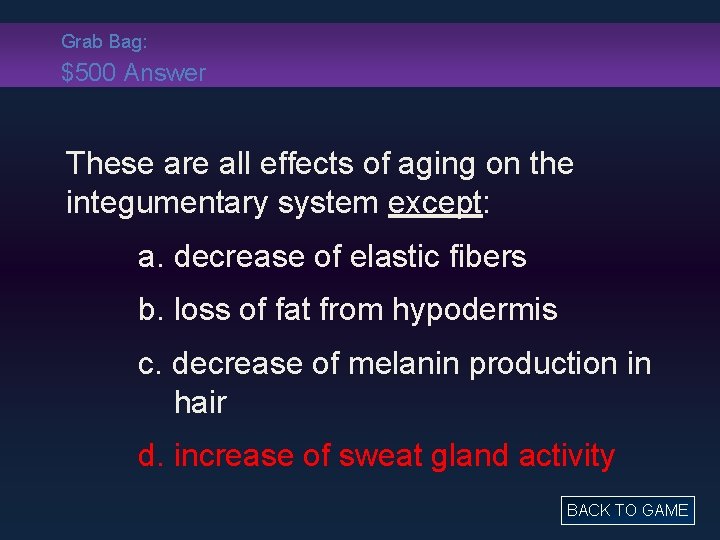
Grab Bag: $500 Answer These are all effects of aging on the integumentary system except: a. decrease of elastic fibers b. loss of fat from hypodermis c. decrease of melanin production in hair d. increase of sweat gland activity BACK TO GAME
FINAL ROUND Question After the resting stage of hair growth, the hair: a. grows more rapidly b. falls out c. shortens the hair follicle d. loses its pigmentation ANSWER BACK TO GAME
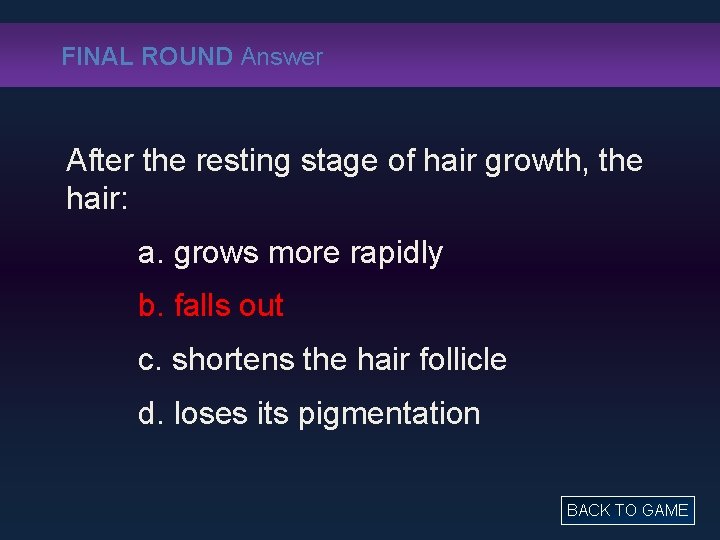
FINAL ROUND Answer After the resting stage of hair growth, the hair: a. grows more rapidly b. falls out c. shortens the hair follicle d. loses its pigmentation BACK TO GAME