
The Integumentary System Chapter 5 The Skin epithelial







- Slides: 13
The Integumentary System Chapter 5
The Skin êepithelial and connective tissues working together êthe largest organ of the body 1. 5 - 2 square meters 4 - 5 kg êvariable thickness: 0. 5 mm to 4 mm
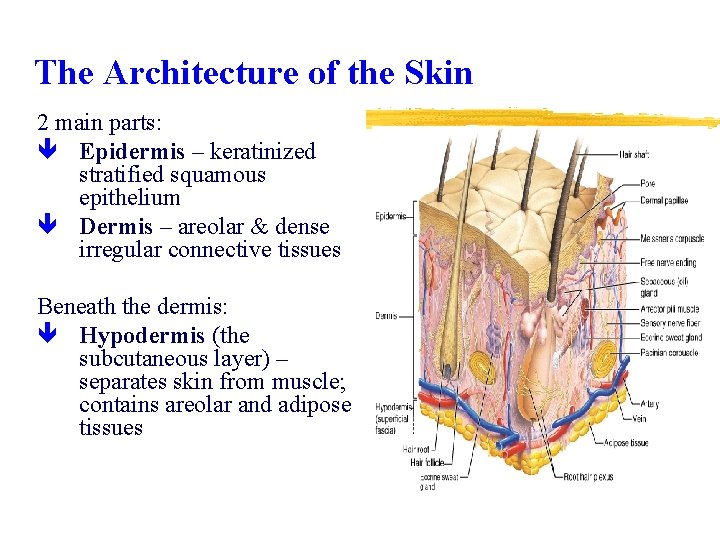
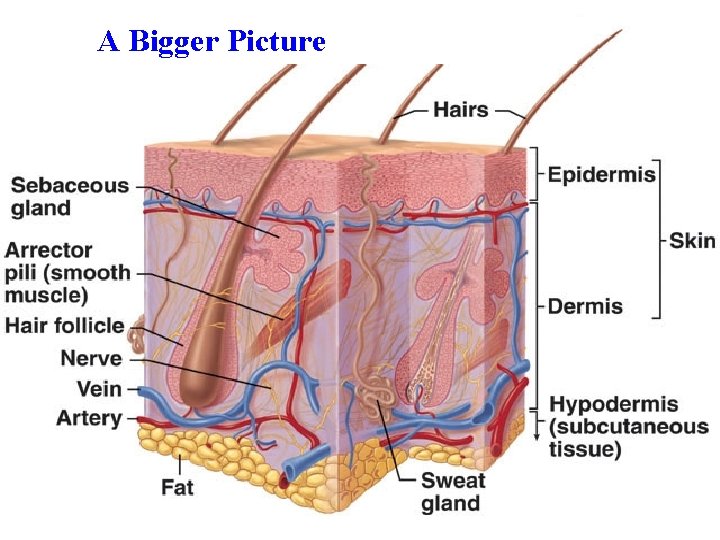
The Architecture of the Skin 2 main parts: ê Epidermis – keratinized stratified squamous epithelium ê Dermis – areolar & dense irregular connective tissues Beneath the dermis: ê Hypodermis (the subcutaneous layer) – separates skin from muscle; contains areolar and adipose tissues
A Bigger Picture
Skin’s Many Functions êregulation of body temperature êprotection – a physical barrier & water conservation êsensation – due to sensory nerve endings êexcretion – sweat êimmunity – epidermis contains phagocytes êsynthesis of vitamin D – for calcium absorption
The Epidermis 4 cell types: êKeratinocytes filled with protein keratin; waterproof barrier êMelanocytes produce pigment melanin êLangerhans cells phagocytes (function in immunity); easily damaged by UV light êMerkel cells detect touch sensations
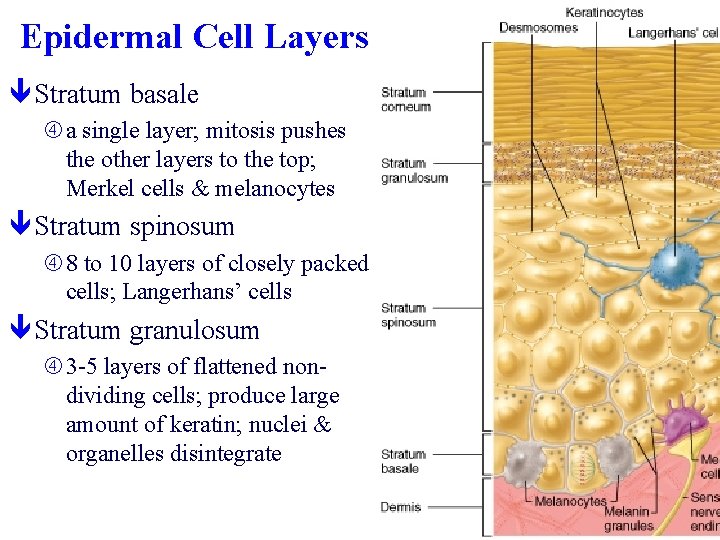
Epidermal Cell Layers ê Stratum basale a single layer; mitosis pushes the other layers to the top; Merkel cells & melanocytes ê Stratum spinosum 8 to 10 layers of closely packed cells; Langerhans’ cells ê Stratum granulosum 3 -5 layers of flattened nondividing cells; produce large amount of keratin; nuclei & organelles disintegrate
Epidermal Layers Cont. ê Stratum lucidum only in thick skin 3 -5 layers of clear, flat dead cells with keratin ê Stratum corneum 25 -30 layers of flattened, dead, keratin-filled cells continuously shed and replaced It takes 2 -4 weeks for each cell to move from the stratum basale to stratum corneum
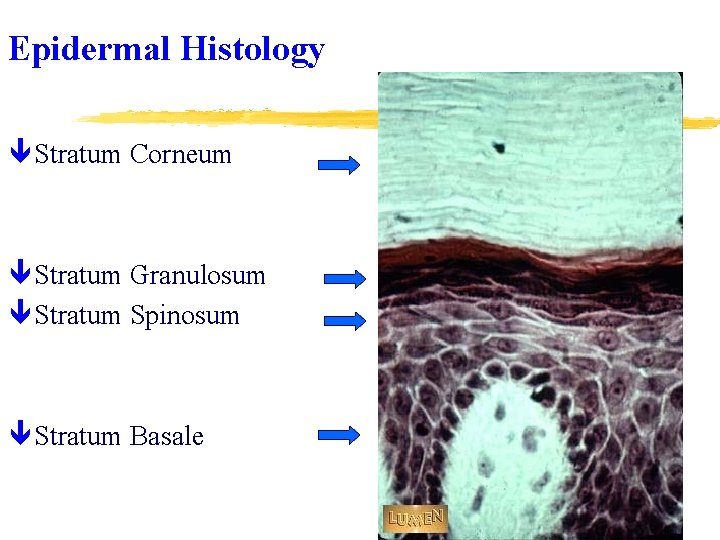
Epidermal Histology ê Stratum Corneum ê Stratum Granulosum ê Stratum Spinosum ê Stratum Basale
Skin Pigments 1. Hemoglobin – red, carries oxygen in red blood cells 2. Carotene – yellow/orange, converted to vitamin A, used in the synthesis of vision pigments 3. Melanin – yellow/red or brown/black
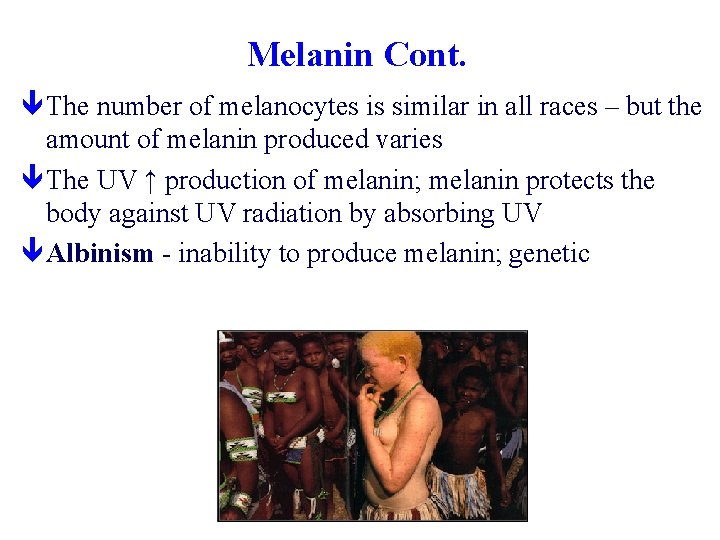
Melanin Cont. ê The number of melanocytes is similar in all races – but the amount of melanin produced varies ê The UV ↑ production of melanin; melanin protects the body against UV radiation by absorbing UV ê Albinism - inability to produce melanin; genetic
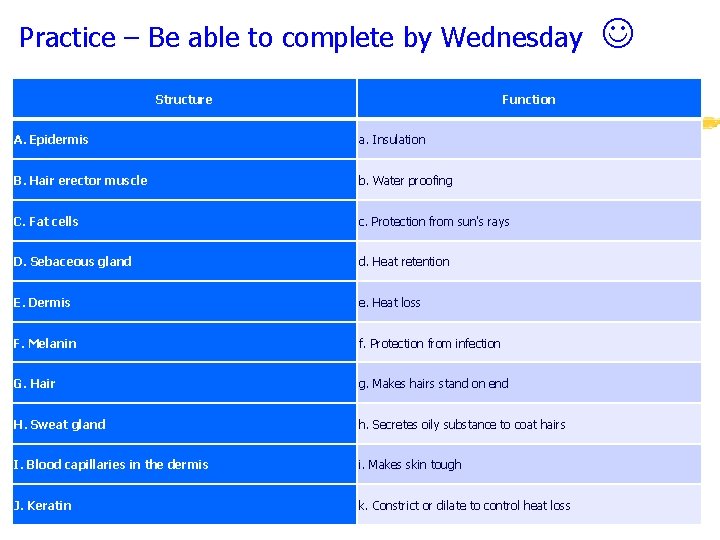
Practice – Be able to complete by Wednesday Structure Function A. Epidermis a. Insulation B. Hair erector muscle b. Water proofing C. Fat cells c. Protection from sun's rays D. Sebaceous gland d. Heat retention E. Dermis e. Heat loss F. Melanin f. Protection from infection G. Hair g. Makes hairs stand on end H. Sweat gland h. Secretes oily substance to coat hairs I. Blood capillaries in the dermis i. Makes skin tough J. Keratin k. Constrict or dilate to control heat loss