
The Integumentary System 5 1 Skin Integument Consists

- Slides: 41
The Integumentary System 5 1
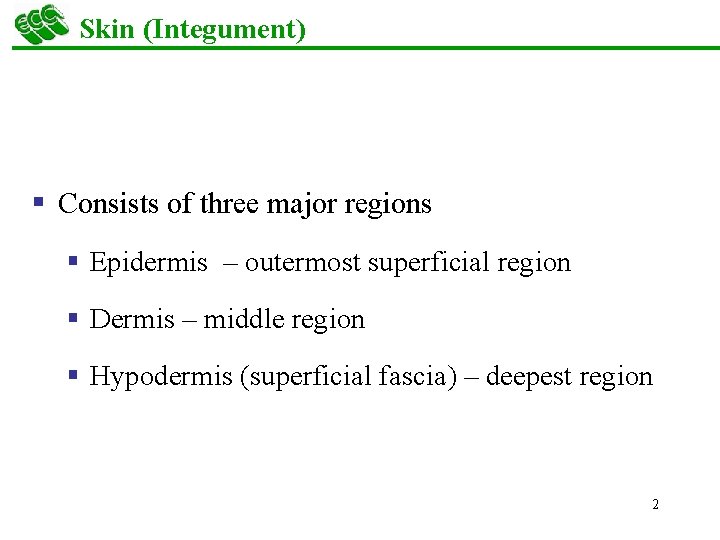
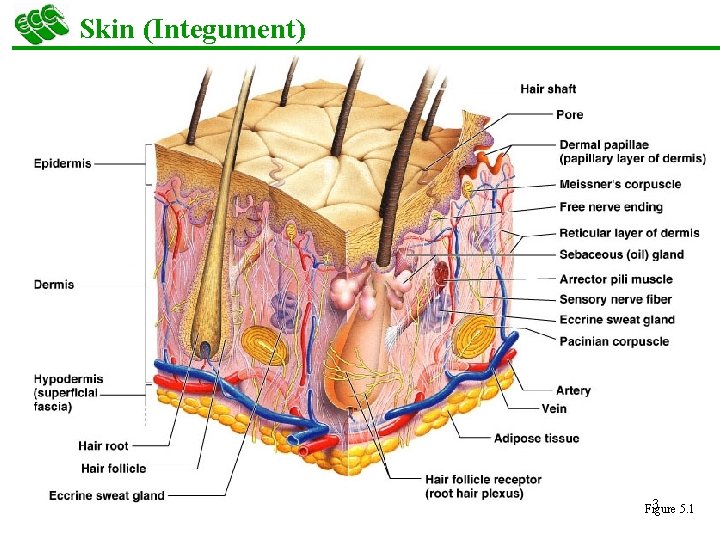
Skin (Integument) § Consists of three major regions § Epidermis – outermost superficial region § Dermis – middle region § Hypodermis (superficial fascia) – deepest region 2
Skin (Integument) 3 5. 1 Figure
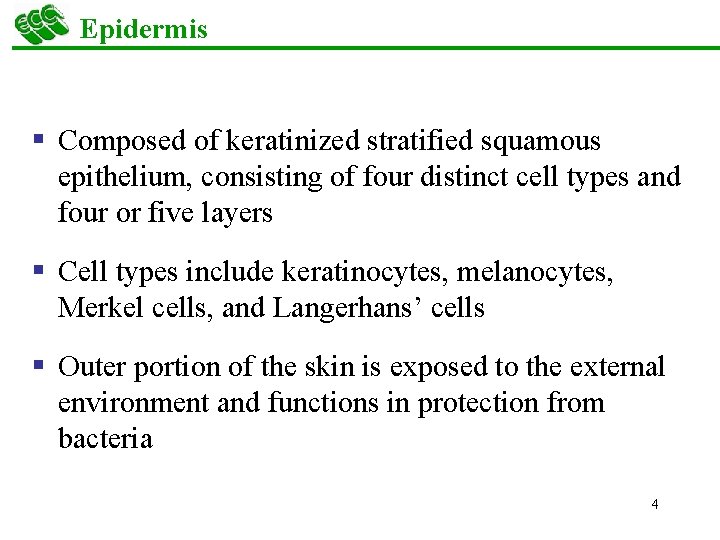
Epidermis § Composed of keratinized stratified squamous epithelium, consisting of four distinct cell types and four or five layers § Cell types include keratinocytes, melanocytes, Merkel cells, and Langerhans’ cells § Outer portion of the skin is exposed to the external environment and functions in protection from bacteria 4
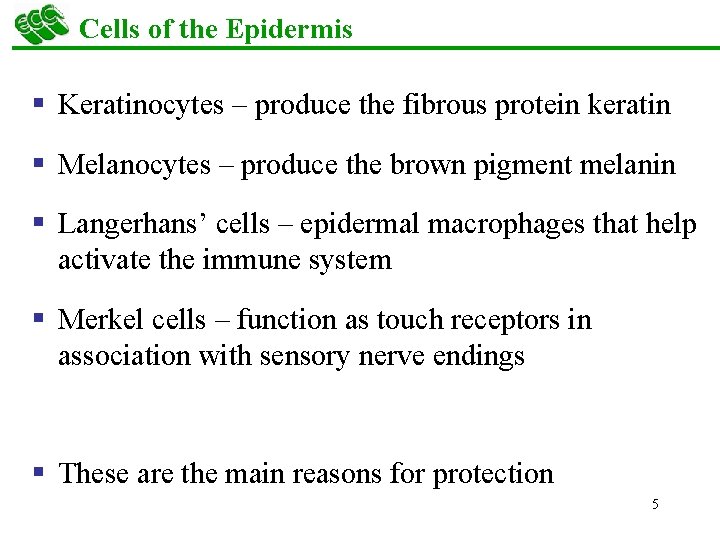
Cells of the Epidermis § Keratinocytes – produce the fibrous protein keratin § Melanocytes – produce the brown pigment melanin § Langerhans’ cells – epidermal macrophages that help activate the immune system § Merkel cells – function as touch receptors in association with sensory nerve endings § These are the main reasons for protection 5
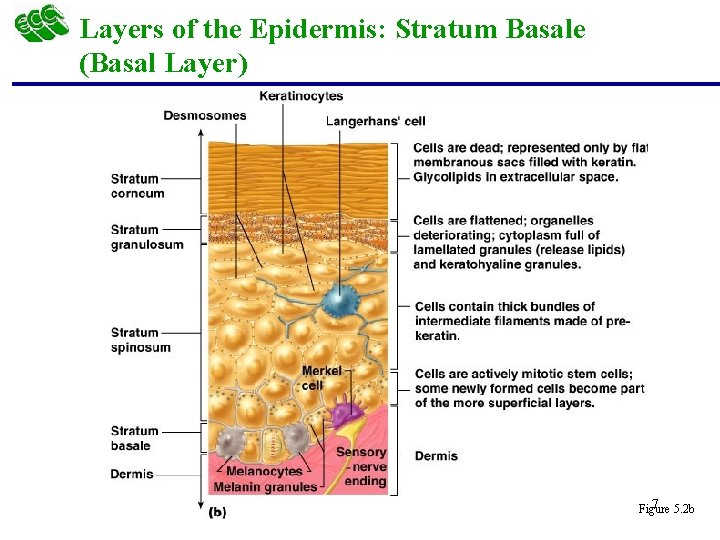
Layers of the Epidermis: Stratum Basale (Basal Layer) § Deepest epidermal layer firmly attached to the dermis § Consists of a single row of the youngest keratinocytes § Cells undergo rapid division, hence its alternate name, stratum germinativum 6
Layers of the Epidermis: Stratum Basale (Basal Layer) 7 5. 2 b Figure
Layers of the Epidermis: Stratum Spinosum (Prickly Layer) § Cells contain a weblike system of intermediate filaments attached to desmosomes § Melanin granules and Langerhans’ cells are abundant in this layer 8
Layers of the Epidermis: Stratum Granulosum (Granular Layer) § Thin; three to five cell layers in which drastic changes in keratinocyte appearance occurs § Keratohyaline and lamellated granules accumulate in the cells of this layer 9
Layers of the Epidermis: Stratum Lucidum (Clear Layer) § Thin, transparent band superficial to the stratum granulosum § Consists of a few rows of flat, dead keratinocytes § Present only in thick skin 10
Layers of the Epidermis: Stratum Corneum (Horny Layer) § Outermost layer of keratinized cells § Accounts for three quarters of the epidermal thickness § Functions include: § Waterproofing § Protection from abrasion and penetration § Rendering the body relatively insensitive to biological, chemical, and physical assaults 11
Dermis § Second major skin region containing strong, flexible connective tissue § Responsible for the dermal ridges that produce whorled ridges on the epidermal surfaces § Cell types include fibroblasts, macrophages, and occasionally mast cells and white blood cells § Composed of two layers – papillary and reticular 12
Layers of the Dermis: Papillary Layer § Papillary layer § Areolar connective tissue with collagen and elastic fibers § Its superior surface contains peglike projections called dermal papillae § Dermal papillae contain capillary loops, Meissner’s corpuscles, and free nerve endings 13
Layers of the Dermis: Reticular Layer § Reticular layer § Accounts for approximately 80% of the thickness of the skin § Collagen fibers in this layer add strength and resiliency to the skin § Elastin fibers provide stretch-recoil properties 14
Hypodermis § Subcutaneous layer deep to the skin § Composed of adipose and areolar connective tissue § Responsible for shock absorption 15
Skin Color § Three pigments contribute to skin color § Melanin – yellow to reddish-brown to black pigment, responsible for dark skin colors § Freckles and pigmented moles – result from local accumulations of melanin § Carotene – yellow to orange pigment, most obvious in the palms and soles of the feet § Hemoglobin – reddish pigment responsible for the pinkish hue of the skin 16
Sweat Glands § Different types prevent overheating of the body; secrete cerumen and milk § Eccrine sweat glands – found in palms, soles of the feet, and forehead § Sudoriferous glands serve as thermoregulators. § Apocrine sweat glands – found in axillary and anogenital areas § Ceruminous glands – modified apocrine glands in external ear canal that secrete cerumen (wax) § Mammary glands – specialized sweat glands that secrete milk 17
Sebaceous Glands § Simple alveolar glands found all over the body § Soften skin when stimulated by hormones § Secrete an oily secretion called sebum § Associated with acne 18
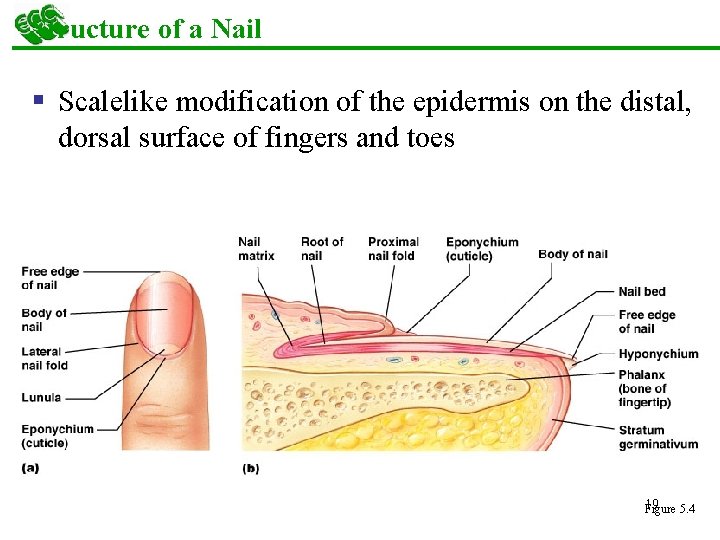
Structure of a Nail § Scalelike modification of the epidermis on the distal, dorsal surface of fingers and toes 19 Figure 5. 4
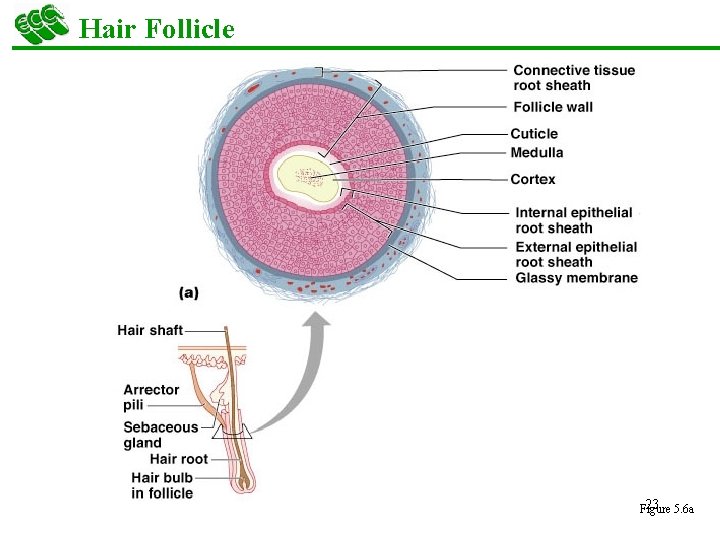
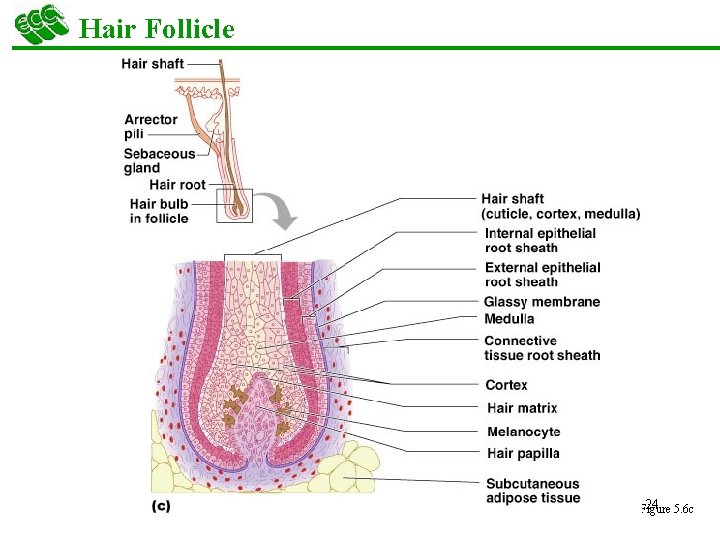
Hair § Filamentous strands of dead keratinized cells produced by hair follicles § Contains hard keratin which is tougher and more durable than soft keratin of the skin § Made up of the shaft projecting from the skin, and the root embedded in the skin § Consists of a core called the medulla, a cortex, and an outermost cuticle § Pigmented by melanocytes at the base of the hair 20
Hair Function and Distribution § Functions of hair include: § Helping to maintain warmth § Alerting the body to presence of insects on the skin § Guarding the scalp against physical trauma, heat loss, and sunlight § Hair is distributed over the entire skin surface except § Palms, soles, and lips § Nipples and portions of the external genitalia 21
Hair Follicle § Root sheath extending from the epidermal surface into the dermis § Deep end is expanded forming a hair bulb § A knot of sensory nerve endings (a root hair plexus) wraps around each hair bulb § Bending a hair stimulates these endings, hence our hairs act as sensitive touch receptors § Arrector pili muscles pulls the hair follicle into an upright position 22
Hair Follicle 23 5. 6 a Figure
Hair Follicle 24 5. 6 c Figure
Types of Hair § Vellus – pale, fine body hair found in children and the adult female § Terminal – coarse, long hair of eyebrows, scalp, axillary, and pubic regions 25
Hair Thinning and Baldness § Alopecia – hair thinning in both sexes § True, or frank, baldness § Genetically determined and sex-influenced condition § Male pattern baldness – caused by follicular response to DHT 26
Functions of the Integumentary System § Protection – chemical, physical, and mechanical barrier § Body temperature regulation is accomplished by: § Dilation (cooling) and constriction (warming) of dermal vessels § Increasing sweat gland secretions to cool the body § Cutaneous sensation – exoreceptors sense touch and pain 27
Functions of the Integumentary System § Metabolic functions – synthesis of vitamin D in dermal blood vessels § Blood reservoir – skin blood vessels store up to 5% of the body’s blood volume § Excretion – limited amounts of nitrogenous wastes are eliminated from the body in sweat 28
Skin Cancer § Most skin tumors are benign and do not metastasize § A crucial risk factor for nonmelanoma skin cancers is the disabling of the p 53 gene § Newly developed skin lotions can fix damaged DNA 29
Skin Cancer § The three major types of skin cancer are: § Basal cell carcinoma § Squamous cell carcinoma § Melanoma 30
Basal Cell Carcinoma § Least malignant and most common skin cancer § Stratum basale cells proliferate and invade the dermis and hypodermis § Slow growing and do not often metastasize § Can be cured by surgical excision in 99% of the cases 31
Squamous Cell Carcinoma § Arises from keratinocytes of stratum spinosum § Arise most often on scalp, ears, and lower lip § Grows rapidly and metastasizes if not removed § Prognosis is good if treated by radiation therapy or removed surgically 32
Melanoma § Cancer of melanocytes is the most dangerous type of skin cancer because it is: § Highly metastatic § Resistant to chemotherapy 33
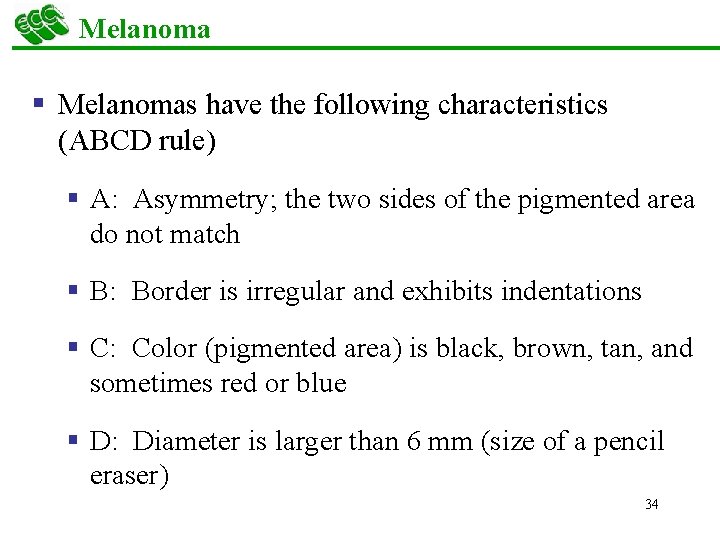
Melanoma § Melanomas have the following characteristics (ABCD rule) § A: Asymmetry; the two sides of the pigmented area do not match § B: Border is irregular and exhibits indentations § C: Color (pigmented area) is black, brown, tan, and sometimes red or blue § D: Diameter is larger than 6 mm (size of a pencil eraser) 34
Melanoma § Treated by wide surgical excision accompanied by immunotherapy § Chance of survival is poor if the lesion is over 4 mm thick 35
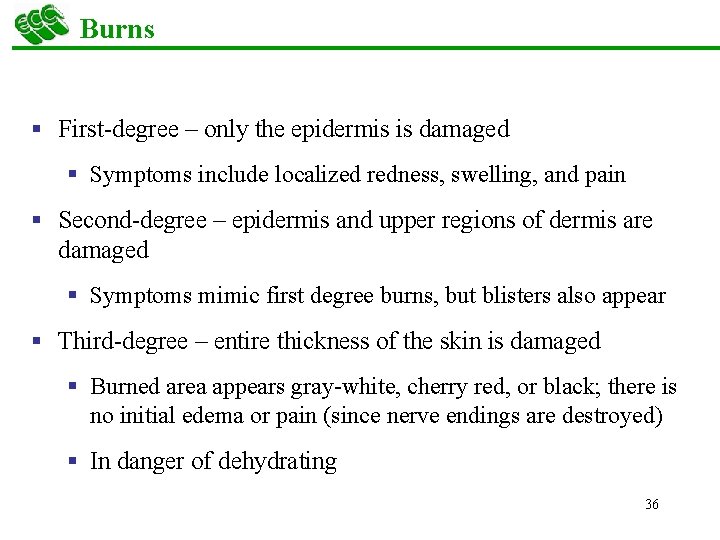
Burns § First-degree – only the epidermis is damaged § Symptoms include localized redness, swelling, and pain § Second-degree – epidermis and upper regions of dermis are damaged § Symptoms mimic first degree burns, but blisters also appear § Third-degree – entire thickness of the skin is damaged § Burned area appears gray-white, cherry red, or black; there is no initial edema or pain (since nerve endings are destroyed) § In danger of dehydrating 36
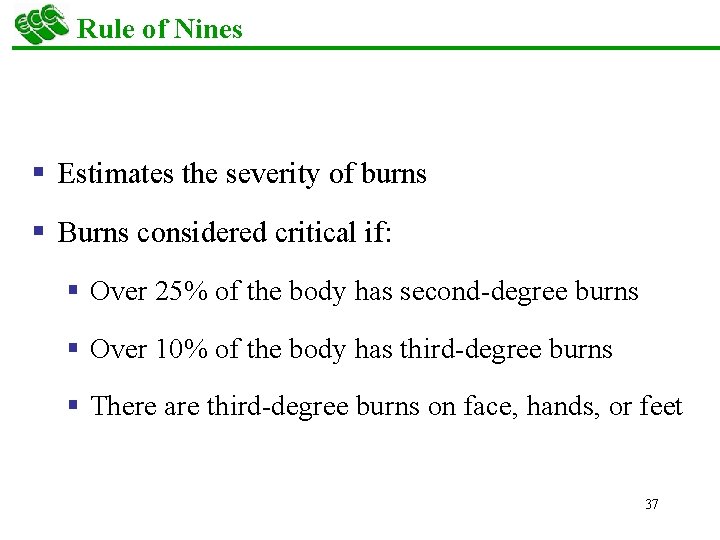
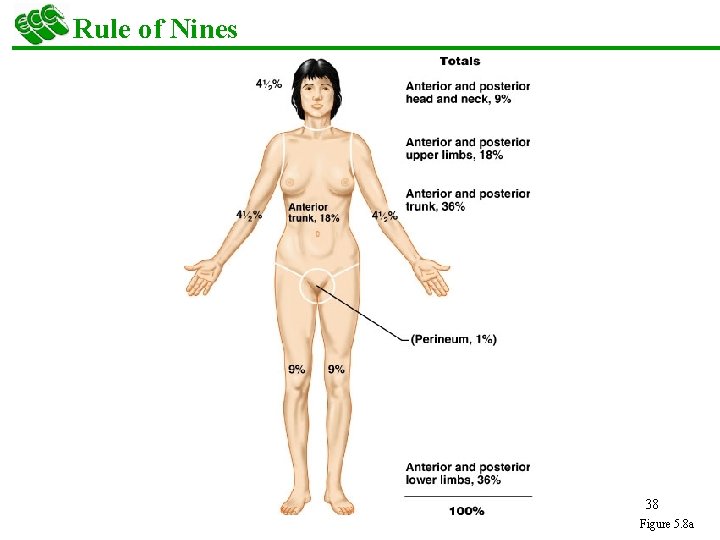
Rule of Nines § Estimates the severity of burns § Burns considered critical if: § Over 25% of the body has second-degree burns § Over 10% of the body has third-degree burns § There are third-degree burns on face, hands, or feet 37
Rule of Nines 38 Figure 5. 8 a
Developmental Aspects of the Integument: Fetal § Epidermis develops from ectoderm § Dermis and hypodermis develop from mesoderm § Lanugo – downy coat of delicate hairs covering the fetus § Vernix caseosa – substance produced by sebaceous glands that protects the skin of the fetus in the amnion 39
Developmental Aspects of the Integument: Adolescent to Adult § Skin and hair become oilier and acne may appear § Skin shows the effects of cumulative environmental assaults around age 30 § Scaling and dermatitis become more common 40
Developmental Aspects of the Integument: Old Age § Epidermal replacement of cells slows and skin becomes thinner § Skin becomes dry and itchy § Subcutaneous fat layer diminishes, leading to intolerance of cold § Decreased elasticity and loss of subcutaneous tissue leads to wrinkles § Decreased numbers of melanocytes and Langerhans’ cells increase the risk of skin cancer 41