
The Integration Algorithm A quantum computer could integrate
- Slides: 30
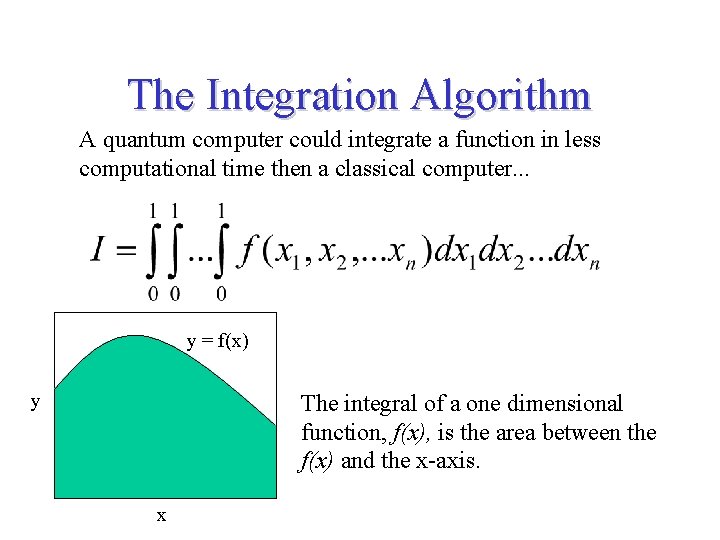
The Integration Algorithm A quantum computer could integrate a function in less computational time then a classical computer. . . y = f(x) y The integral of a one dimensional function, f(x), is the area between the f(x) and the x-axis. x
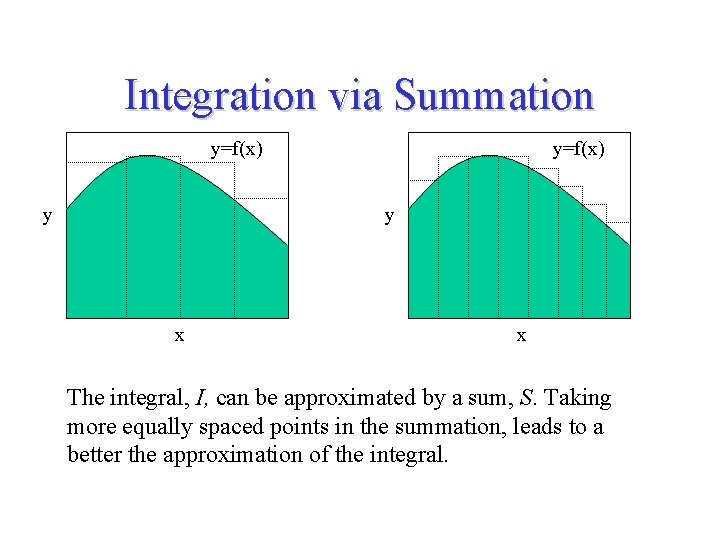
Integration via Summation y=f(x) y x x The integral, I, can be approximated by a sum, S. Taking more equally spaced points in the summation, leads to a better the approximation of the integral.
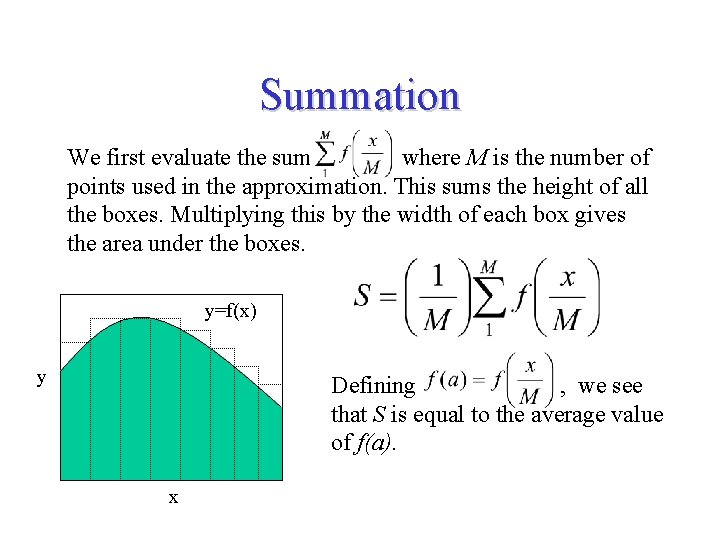
Summation We first evaluate the sum where M is the number of points used in the approximation. This sums the height of all the boxes. Multiplying this by the width of each box gives the area under the boxes. y=f(x) y Defining , we see that S is equal to the average value of f(a). x
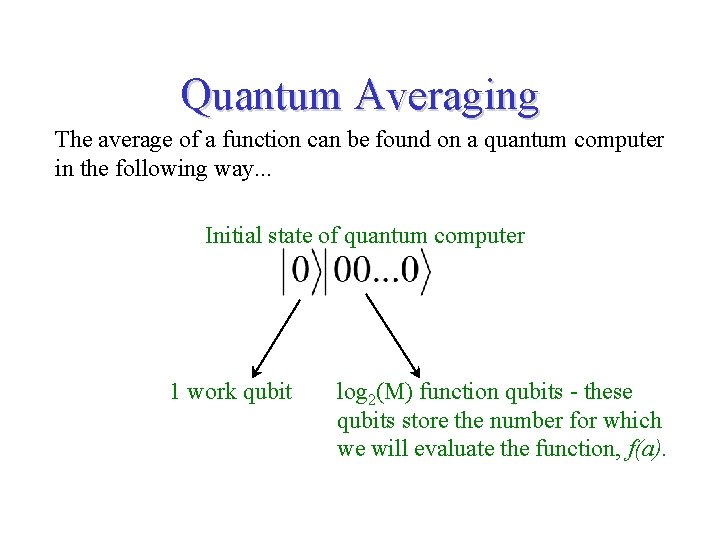
Quantum Averaging The average of a function can be found on a quantum computer in the following way. . . Initial state of quantum computer 1 work qubit log 2(M) function qubits - these qubits store the number for which we will evaluate the function, f(a).
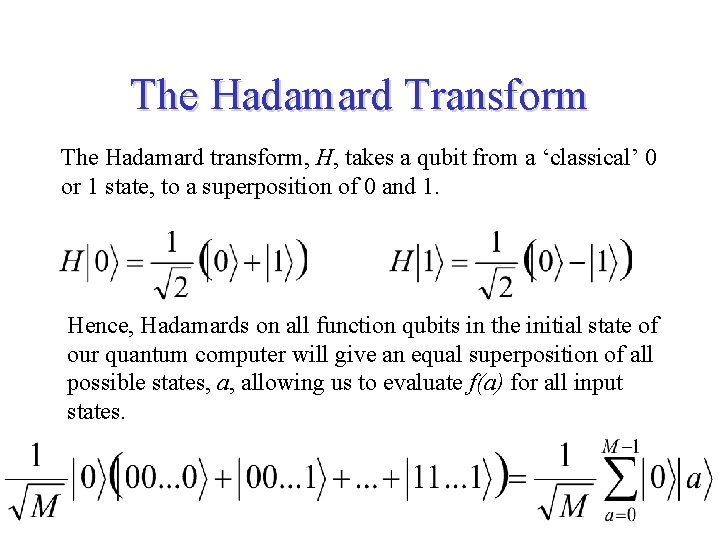
The Hadamard Transform The Hadamard transform, H, takes a qubit from a ‘classical’ 0 or 1 state, to a superposition of 0 and 1. Hence, Hadamards on all function qubits in the initial state of our quantum computer will give an equal superposition of all possible states, a, allowing us to evaluate f(a) for all input states.
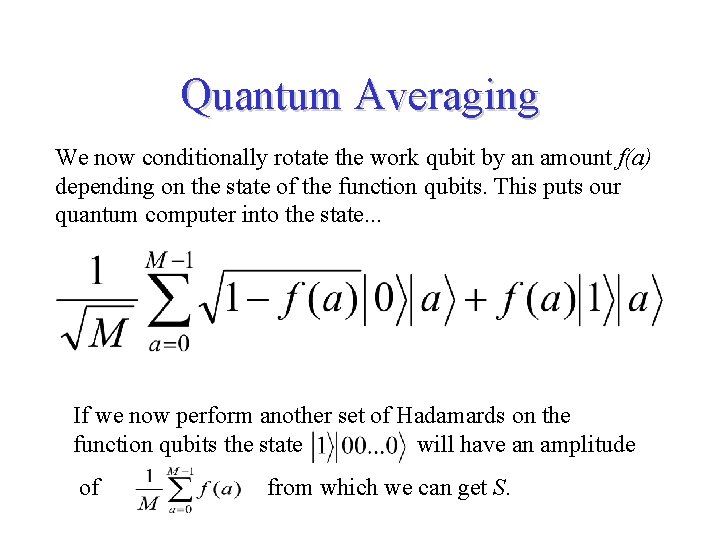
Quantum Averaging We now conditionally rotate the work qubit by an amount f(a) depending on the state of the function qubits. This puts our quantum computer into the state. . . If we now perform another set of Hadamards on the function qubits the state will have an amplitude of from which we can get S.
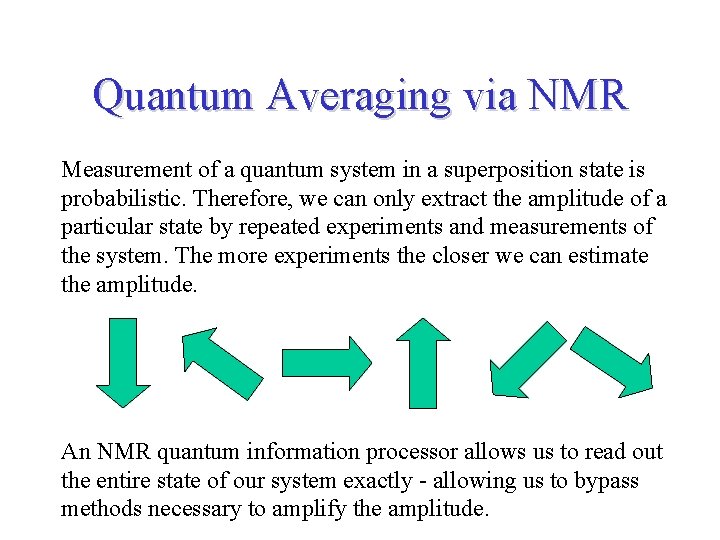
Quantum Averaging via NMR Measurement of a quantum system in a superposition state is probabilistic. Therefore, we can only extract the amplitude of a particular state by repeated experiments and measurements of the system. The more experiments the closer we can estimate the amplitude. An NMR quantum information processor allows us to read out the entire state of our system exactly - allowing us to bypass methods necessary to amplify the amplitude.
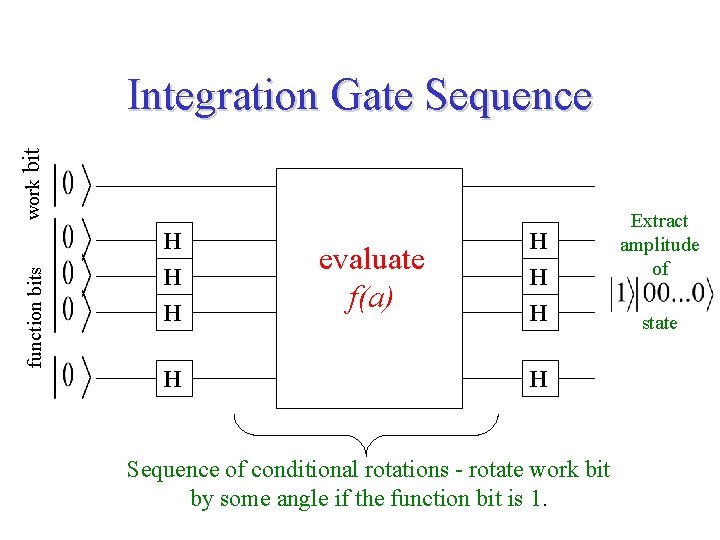
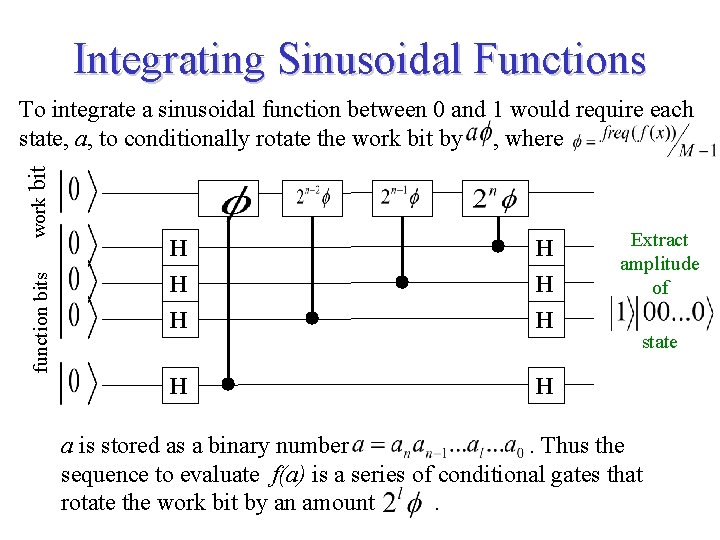
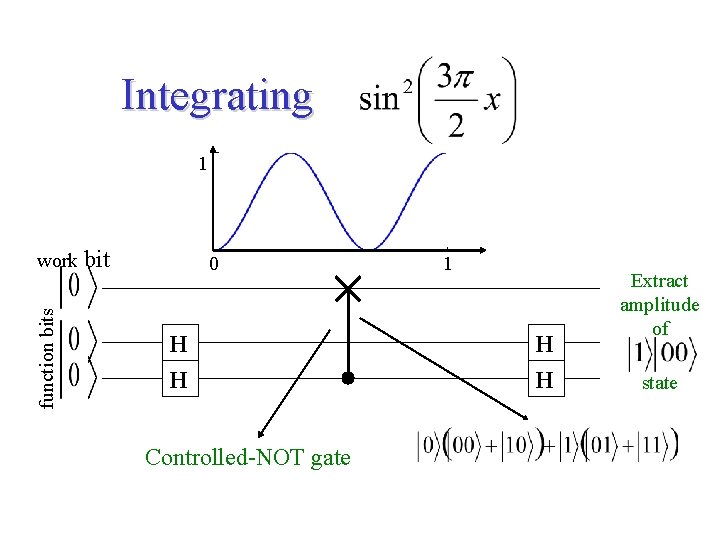
function bits work bit Integration Gate Sequence H H evaluate f(a) H H Sequence of conditional rotations - rotate work bit by some angle if the function bit is 1. Extract amplitude of state
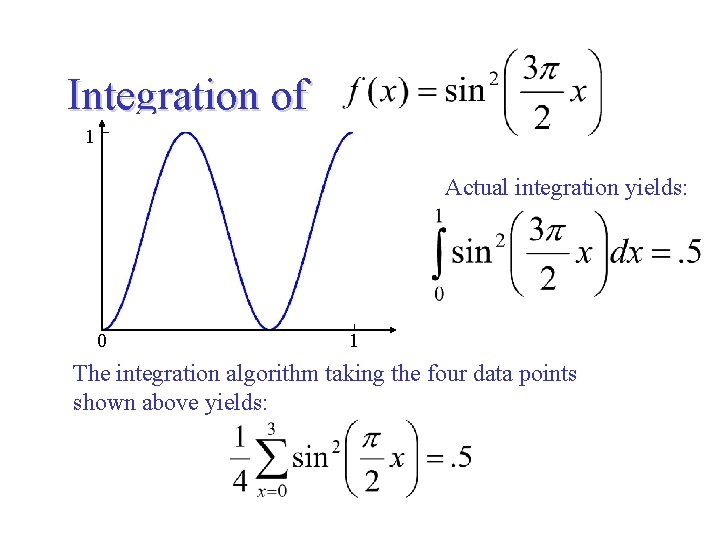
Integrating Sinusoidal Functions function bits work bit To integrate a sinusoidal function between 0 and 1 would require each state, a, to conditionally rotate the work bit by , where H H H H Extract amplitude of state a is stored as a binary number. Thus the sequence to evaluate f(a) is a series of conditional gates that rotate the work bit by an amount.
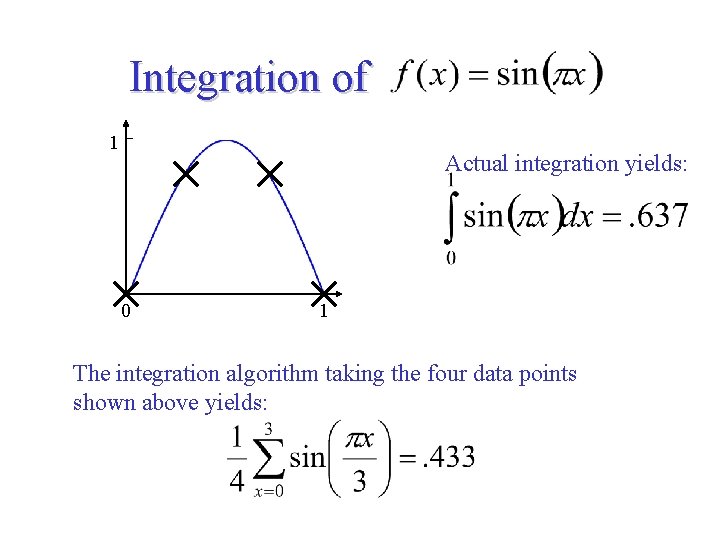
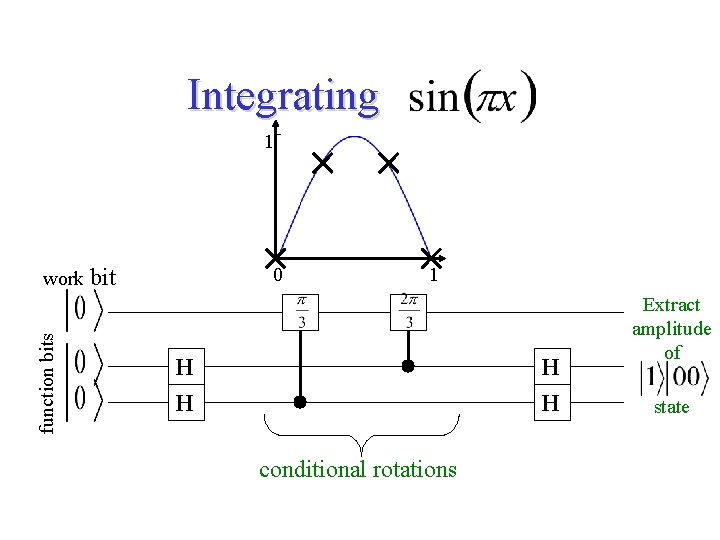
Integration of 1 Actual integration yields: 0 1 The integration algorithm taking the four data points shown above yields:
Integrating 1 function bits work bit 0 1 H H conditional rotations Extract amplitude of state
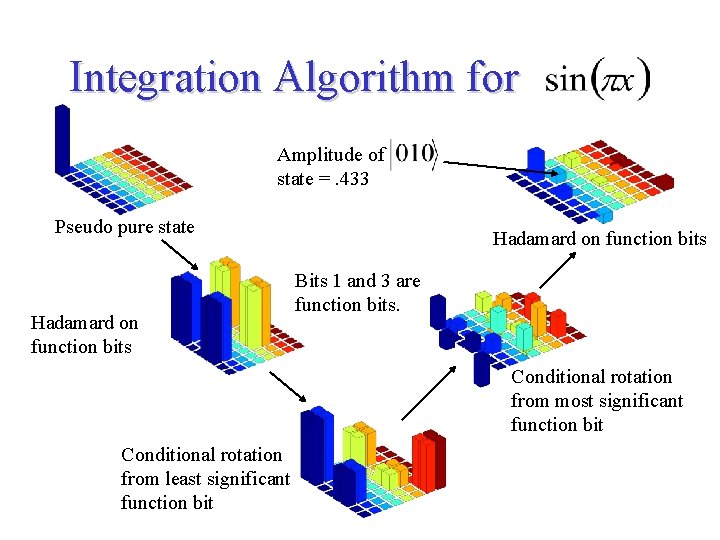
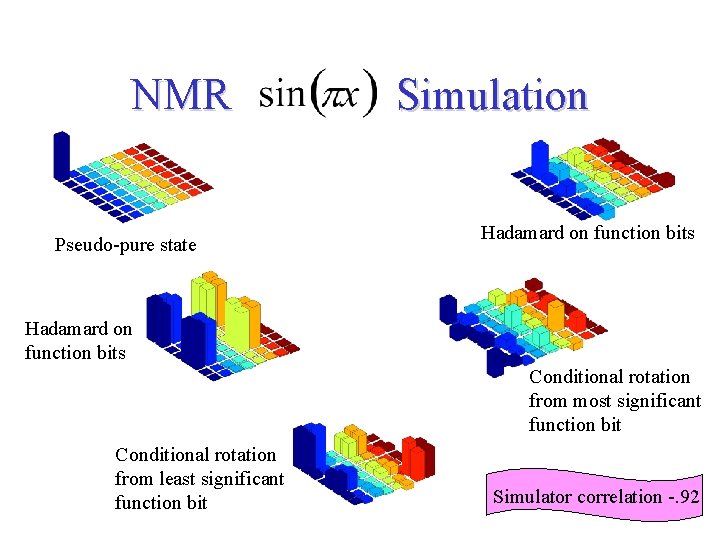
Integration Algorithm for Amplitude of state =. 433 Pseudo pure state Hadamard on function bits Bits 1 and 3 are function bits. Conditional rotation from most significant function bit Conditional rotation from least significant function bit
Integration of 1 Actual integration yields: 0 1 The integration algorithm taking the four data points shown above yields:
Integrating 1 function bits work bit 0 H H Controlled-NOT gate 1 H H Extract amplitude of state
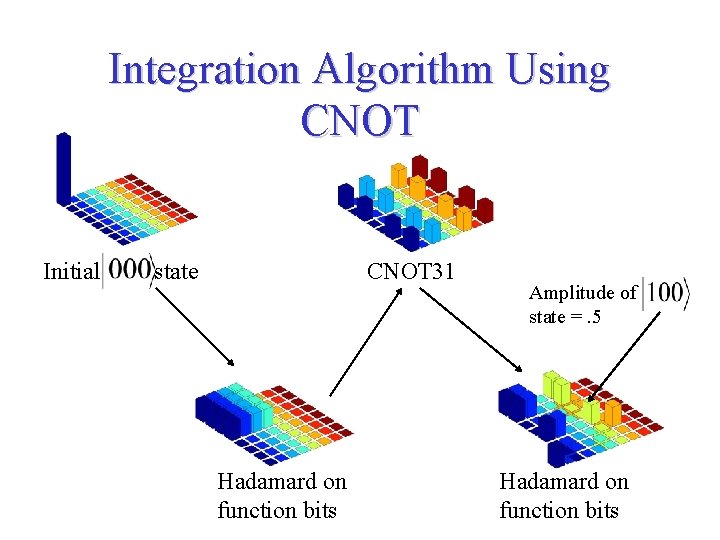
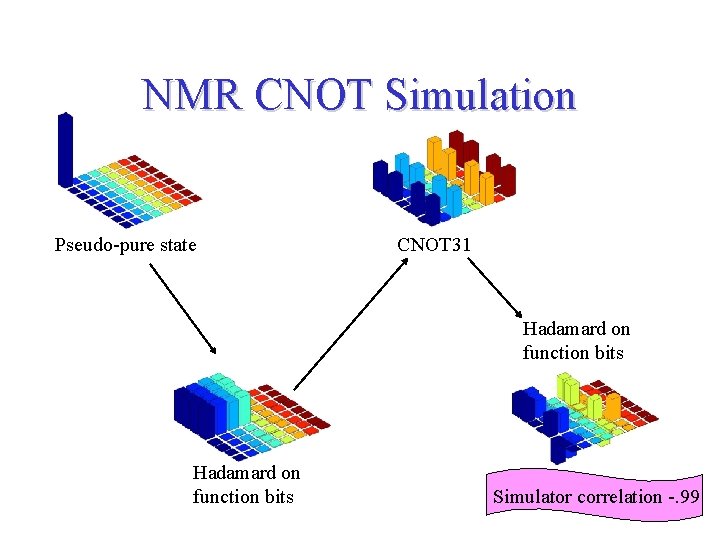
Integration Algorithm Using CNOT Initial state CNOT 31 Hadamard on function bits Amplitude of state =. 5 Hadamard on function bits
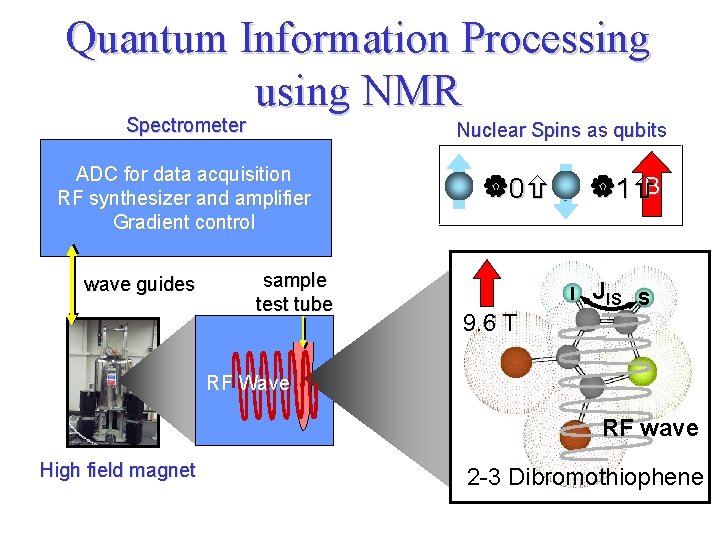
Quantum Information Processing using NMR Spectrometer Nuclear Spins as qubits ADC for data acquisition RF synthesizer and amplifier Gradient control wave guides sample test tube 0 1 B I JIS S 9. 6 T RF Wave RF wave High field magnet 2 -3 Dibromothiophene
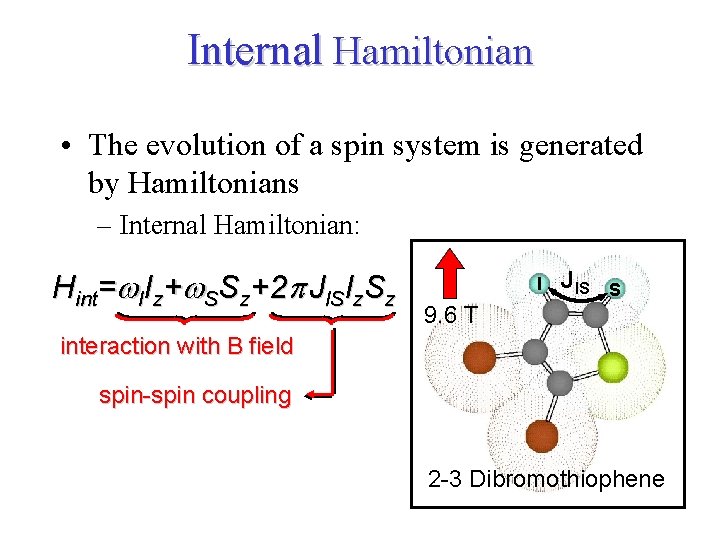
Internal Hamiltonian • The evolution of a spin system is generated by Hamiltonians – Internal Hamiltonian: Hint=w. IIz+w. SSz+2 p JISIz. Sz I JIS S 9. 6 T interaction with B field spin-spin coupling 2 -3 Dibromothiophene
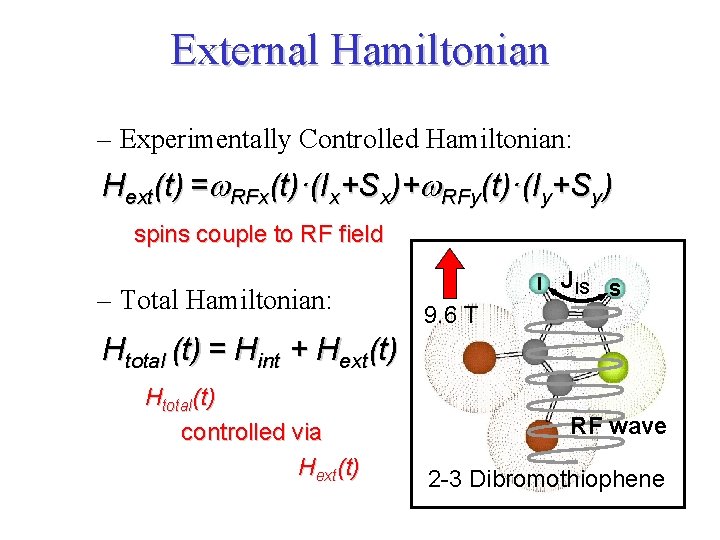
External Hamiltonian – Experimentally Controlled Hamiltonian: Hext(t) =w. RFx(t)·(Ix+Sx)+w. RFy(t)·(Iy+Sy) spins couple to RF field – Total Hamiltonian: I JIS S 9. 6 T Htotal (t) = Hint + Hext(t) Htotal(t) controlled via Hext(t) RF wave 2 -3 Dibromothiophene
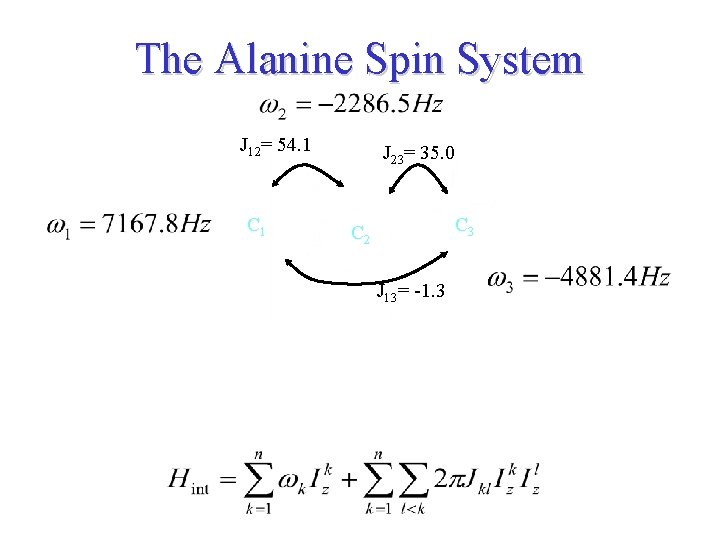
The Alanine Spin System J 12= 54. 1 C 1 J 23= 35. 0 C 3 C 2 J 13= -1. 3
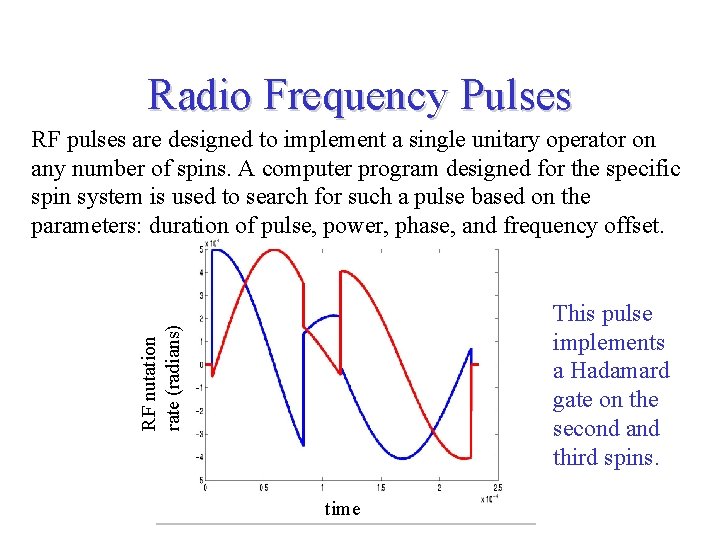
Radio Frequency Pulses RF pulses are designed to implement a single unitary operator on any number of spins. A computer program designed for the specific spin system is used to search for such a pulse based on the parameters: duration of pulse, power, phase, and frequency offset. RF nutation rate (radians) This pulse implements a Hadamard gate on the second and third spins. time
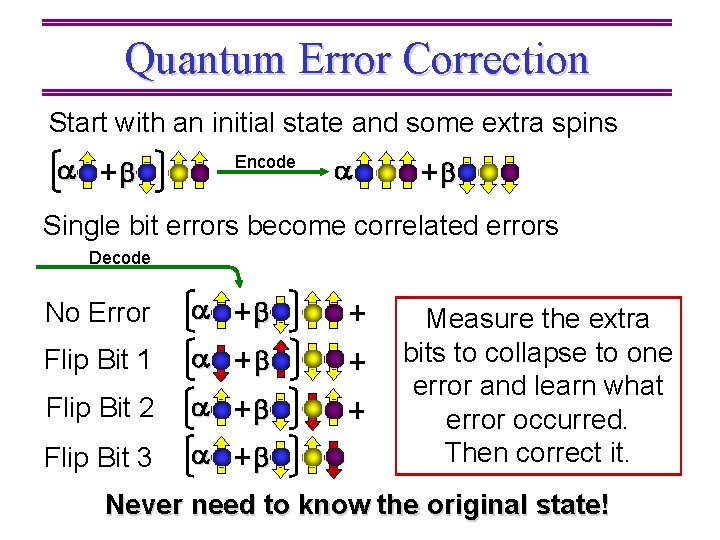
Quantum Error Correction Start with an initial state and some extra spins Encode Single bit errors become correlated errors Decode No Error Flip Bit 1 Flip Bit 2 Flip Bit 3 Measure the extra bits to collapse to one error and learn what error occurred. Then correct it. Never need to know the original state!
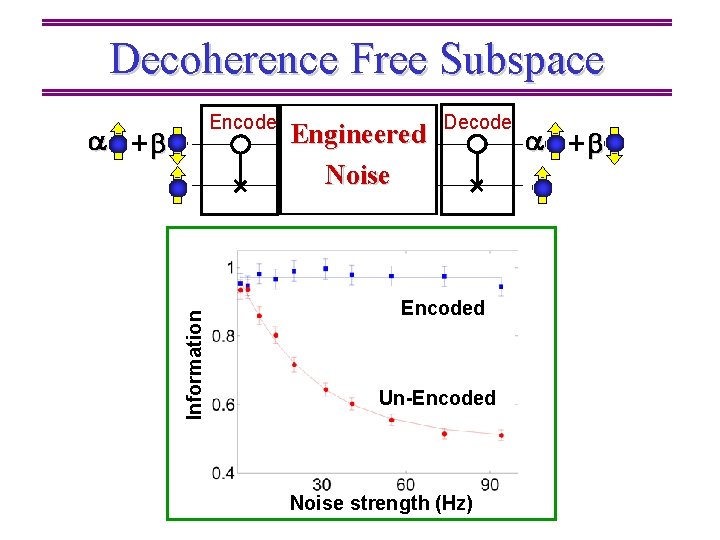
Decoherence Free Subspace Information Encode Engineered Noise Decode Encoded Un-Encoded Noise strength (Hz)
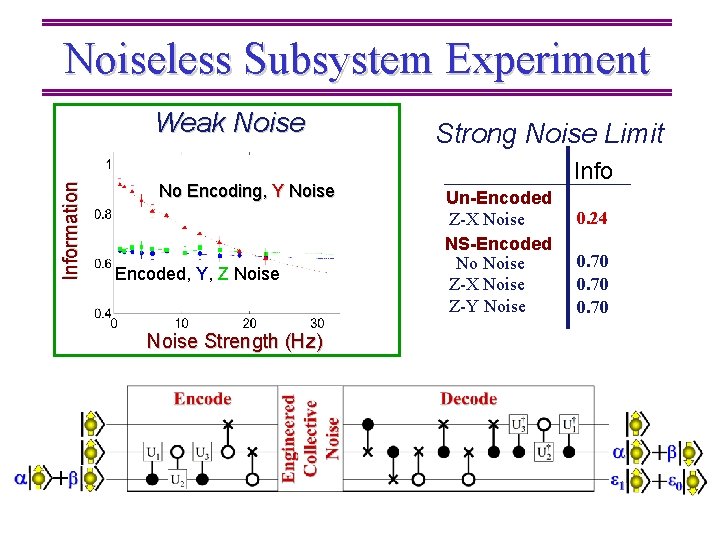
Noiseless Subsystem Experiment Information Weak Noise No Encoding, Y Noise Encoded, Y, Z Noise Strength (Hz) Strong Noise Limit Info Un-Encoded Z-X Noise NS-Encoded No Noise Z-X Noise Z-Y Noise 0. 24 0. 70
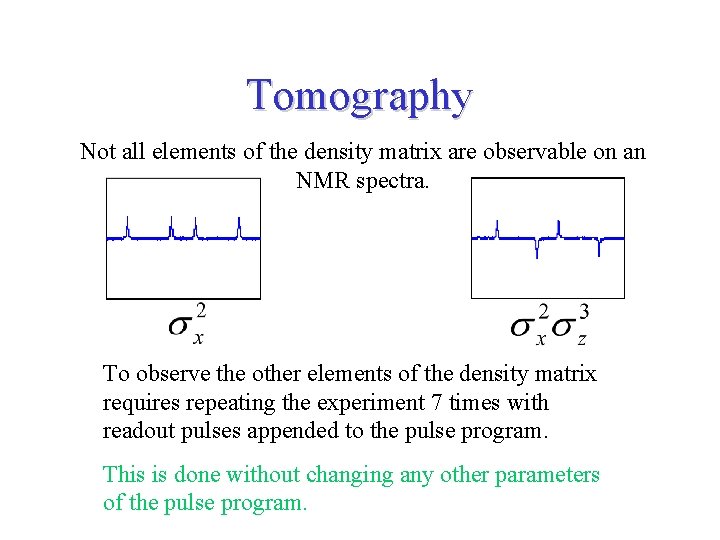
Tomography Not all elements of the density matrix are observable on an NMR spectra. To observe the other elements of the density matrix requires repeating the experiment 7 times with readout pulses appended to the pulse program. This is done without changing any other parameters of the pulse program.
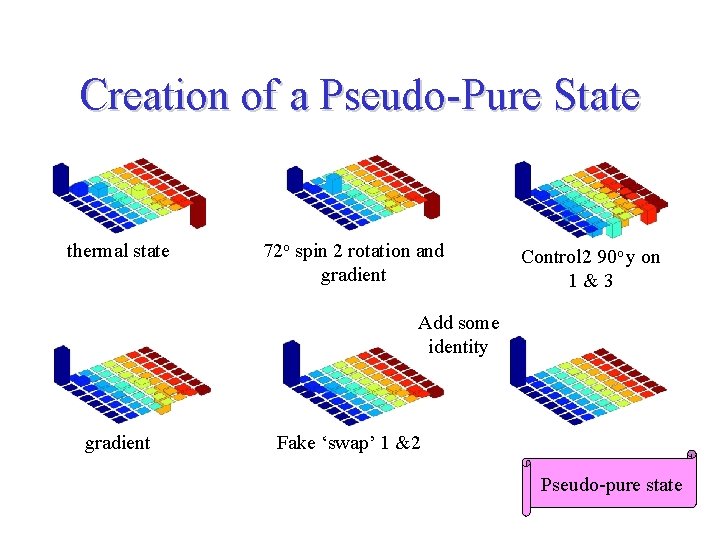
Creation of a Pseudo-Pure State thermal state 72 o spin 2 rotation and gradient Control 2 90 o y on 1&3 Add some identity gradient Fake ‘swap’ 1 &2 Pseudo-pure state
NMR Pseudo-pure state Simulation Hadamard on function bits Conditional rotation from most significant function bit Conditional rotation from least significant function bit Simulator correlation -. 92
NMR CNOT Simulation Pseudo-pure state CNOT 31 Hadamard on function bits Simulator correlation -. 99
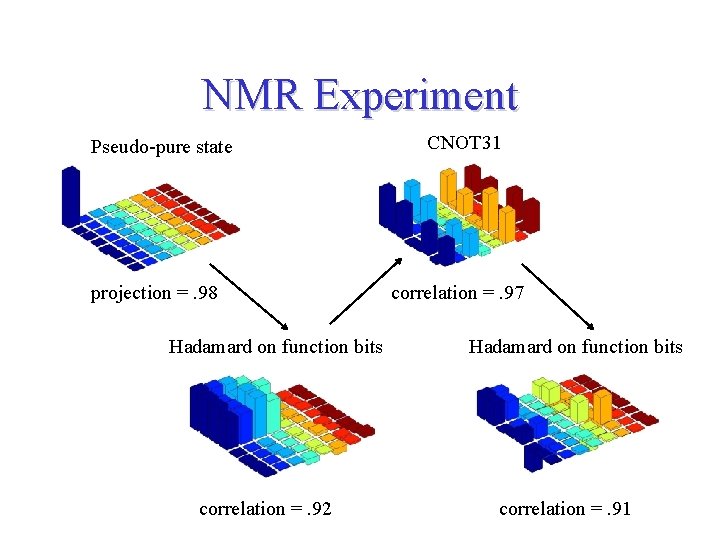
NMR Experiment Pseudo-pure state projection =. 98 Hadamard on function bits correlation =. 92 CNOT 31 correlation =. 97 Hadamard on function bits correlation =. 91
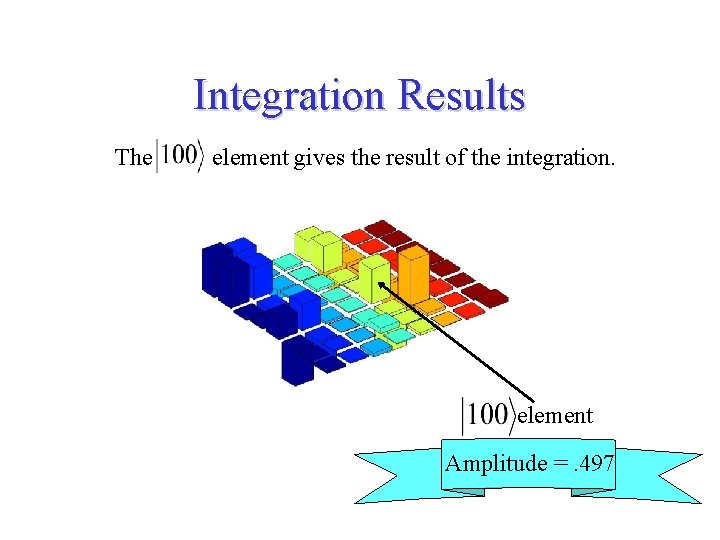
Integration Results The element gives the result of the integration. element Amplitude =. 497
Conclusions • Concrete mapping between integration algorithm and NMR QIP implementation. • Sufficient control with current NMR quantum information processors to execute integration in small Hilbert spaces. • NMR QIP version of algorithm does not require amplitude amplification. • General approach for integrating sinusoidal functions.