
THE INSURANCE BUSINESS TRANSFER A proven business model

THE INSURANCE BUSINESS TRANSFER A proven business model that can be used by the (re)insurance industry to restructure (re)insurance business Proprietary and Confidential Information
The U. S. (re)insurance run-off market In search of finality • U. S. insurance companies with run-off business are looking for effective exit solutions to facilitate operational and capital efficiencies and gain legal finality. • Existing options are limited in their scope and effect (e. g. commutations, LPTs). • State regulators recognize the need for new restructuring tools and are responding to the industry’s needs. • We have engaged with key regulators to discuss new legislative initiatives. Proprietary and Confidential Information
Recent regulatory actions Regulators are responding to the need for restructuring legislation • In 2015 Rhode Island was the first jurisdiction in the U. S. to pass legislation providing for IBTs for commercial P&C runoff liabilities. • The IL DOI is considering new legislation providing for insurance business transfers (IBT). • The OK DOI is considering new IBT legislation. • CT has recently passed a “Division” statute which is effective as of October 1, 2017. • In IL, division legislation using the CT legislation as a framework is being considered. Proprietary and Confidential Information

The Insurance Business Transfer The first option to provide economic and legal finality • The insurance business transfer (IBT) is an effective restructuring tool that can apply to all lines of business, resulting in economic and legal finality for the transferred polices and potentially increasing capital and operational efficiency. • The IBT approval process is a carefully monitored, transparent review that requires regulatory and judicial approval for the transfer of some or all of one company’s (re)insurance business to another company, including the attaching reinsurance. The transfer results in a court-sanctioned novation of the transferred policies. • Throughout the world there are many jurisdictions that have this restructuring tool to achieve this type of transfer. • The most familiar is the Part VII Transfer in the UK – a court sanctioned novation of policies from one carrier to another carrier used by insurers to rationalize portfolio and corporate restructurings and to assist in the closure of businesses in runoff. Proprietary and Confidential Information
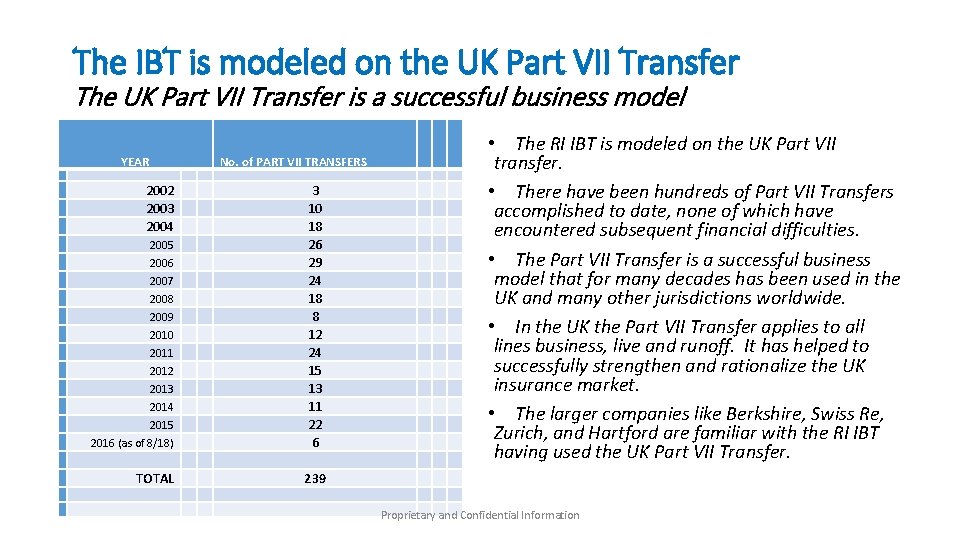
The IBT is modeled on the UK Part VII Transfer The UK Part VII Transfer is a successful business model YEAR 2002 2003 2004 No. of PART VII TRANSFERS 2005 2006 2007 2008 2009 2010 2011 2012 2013 2014 2015 2016 (as of 8/18) 3 10 18 26 29 24 18 8 12 24 15 13 11 22 6 TOTAL 239 • The RI IBT is modeled on the UK Part VII transfer. • There have been hundreds of Part VII Transfers accomplished to date, none of which have encountered subsequent financial difficulties. • The Part VII Transfer is a successful business model that for many decades has been used in the UK and many other jurisdictions worldwide. • In the UK the Part VII Transfer applies to all lines business, live and runoff. It has helped to successfully strengthen and rationalize the UK insurance market. • The larger companies like Berkshire, Swiss Re, Zurich, and Hartford are familiar with the RI IBT having used the UK Part VII Transfer. Proprietary and Confidential Information
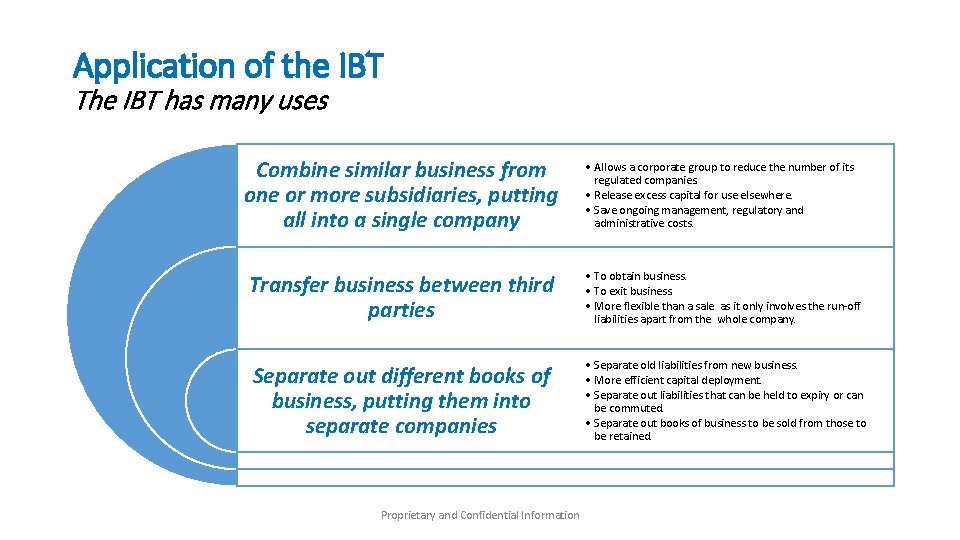
Application of the IBT The IBT has many uses Combine similar business from one or more subsidiaries, putting all into a single company • Allows a corporate group to reduce the number of its regulated companies. • Release excess capital for use elsewhere. • Save ongoing management, regulatory and administrative costs. Transfer business between third parties • To obtain business. • To exit business. • More flexible than a sale as it only involves the run-off liabilities apart from the whole company. Separate out different books of business, putting them into separate companies • Separate old liabilities from new business. • More efficient capital deployment. • Separate out liabilities that can be held to expiry or can be commuted. • Separate out books of business to be sold from those to be retained. Proprietary and Confidential Information
Policyholder Protections of the IBT Consistent with the strong policyholder protection that currently exists in U. S. law, the IBT approval process contains provisions that address policyholder concerns Extensive notice requirements Extensive financial disclosure Independent expert report that evaluates the impact on affected policyholders. Approval by regulator in transferring company’s domicile state. Independent evaluation and approval by the regulator in the assuming company’s state of domicile. • Judicial review and approval of the IBT Plan – policyholders must not be adversely affected. • Opportunity to be heard - any party who feels adversely affected by the transfer can make a representation to the court for consideration. • • • Proprietary and Confidential Information
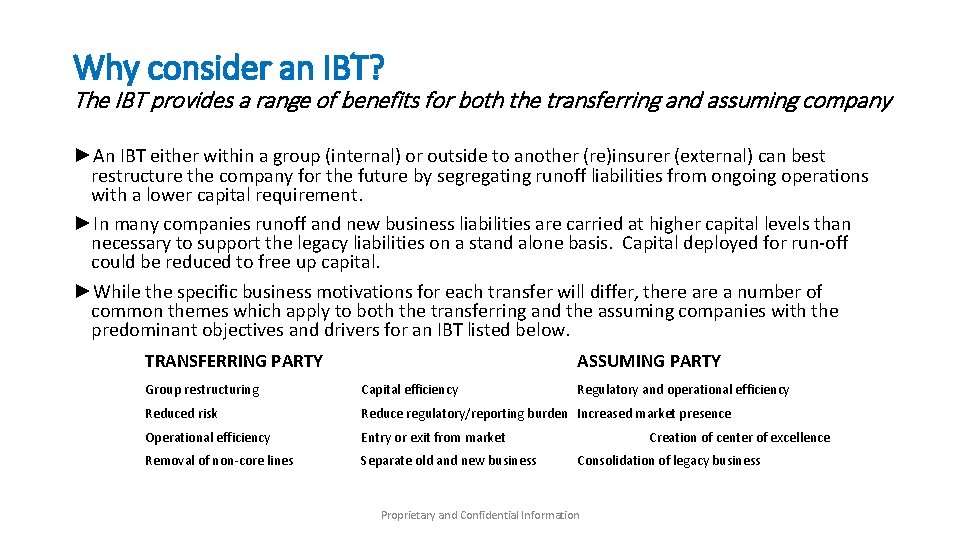
Why consider an IBT? The IBT provides a range of benefits for both the transferring and assuming company ►An IBT either within a group (internal) or outside to another (re)insurer (external) can best restructure the company for the future by segregating runoff liabilities from ongoing operations with a lower capital requirement. ►In many companies runoff and new business liabilities are carried at higher capital levels than necessary to support the legacy liabilities on a stand alone basis. Capital deployed for run-off could be reduced to free up capital. ►While the specific business motivations for each transfer will differ, there a number of common themes which apply to both the transferring and the assuming companies with the predominant objectives and drivers for an IBT listed below. TRANSFERRING PARTY ASSUMING PARTY Group restructuring Capital efficiency Regulatory and operational efficiency Reduced risk Reduce regulatory/reporting burden Increased market presence Operational efficiency Entry or exit from market Removal of non-core lines Separate old and new business Creation of center of excellence Consolidation of legacy business Proprietary and Confidential Information
Conclusion • • • The IBT has proven to be a successful restructuring tool that can result in operational and capital efficiencies for (re)insurance companies. The IBT approval process is a multi-layered regulatory and judicial review with multiple safeguards to ensure the protection of policyholder rights. The IBT will permit more efficient management of transferred books of business, and allow dedicated capital and focused solutions to be applied to run-off liabilities. State regulators are considering new insurance restructuring legislation. CT - division statute; OK - insurance business transfers; IL - Division legislation and insurance business transfers. It is expected that over time the IBT will become a widely accepted business practice in the U. S. marketplace as it has significant strategic importance to (re)insurance companies to allow them to restructure while ensuring that the interests of policyholders are protected. Proprietary and Confidential Information
Biography Richard Newton has extensive experience in run-off and is recognized as a leader in the industry. Since 1982, Mr. Newton has been involved in the direct management of run-off portfolios and since 1987 has become involved in the insurance ownership of several successful run-off insurance companies. In 1995, Mr. Newton formed International Solutions, LLC, a TPA / Consultancy company focused on run-off and serves as its CEO. He works in both the domestic and international insurance industry, primarily providing advisory and management services to troubled run-off and turn around insurance situations. His experience includes the development of corporate strategies and the execution of operational plans and has led many successful run-off projects. Rick has been involved in a wide range of transactional situations involving M&A, governmental privatizations, demutualizations, and capital raising for the development of carefully planned reinsurance programs in support of restructured run-off companies in the life, health and P&C industries. Rick spearheaded and was significantly involved with the drafting and approval of the Amendments to RI Insurance Regulation 68 providing for insurance business transfers. Proprietary and Confidential
Presentation Prepared by Richard Newton For more information, please visit www. intl-sol. net or contact me at: Richard Newton International Solutions, LLC (484) 844 -1256 rn 8652@intl-sol. com rn 8652@aol. com Proprietary and Confidential
- Slides: 11