
The Instructional Learning Cycle PRESENTED BY DAWN REZIN
The Instructional Learning Cycle PRESENTED BY: DAWN REZIN
CCSS and ILC CCSS – College and Career Readiness College and career readiness incorporates an important focus on what have been identified as 21 st century skills: critical thinking and problem solving, collaboration, communication, and creativity and innovation. The English standards require students to read multiple, sophisticated/complex sources, from informational and non-fiction text to literature, and synthesize what they read to develop criticalthinking skills. The literacy standards apply not only to English but to reading and writing expectations in history, social studies, and the sciences. ” The math standards require students to demonstrate deeper knowledge than previous state standards by asking them to perform accurate calculations and understand “apply mathematical concepts to solve real-world problems. Junior Achievement. The Role of Common Core Standards in College and Career Readiness Education. ILC Standards based education Ongoing cycle that ensures students learn all standards and associated concepts and skills to mastery Focus on data and evidence to drive instructional decisions

Plan from Standards & Teach Reflect/ S. M. A. R. T Goals Assess The Instructional Learning Cycle Analyze Data & Student Work Re-assess Adapt Instruction & Re-teach
Plan from Standards & Teach Unpack the standards Identify the content and skills students need to know and be able to do in order to show mastery of the standard Backwards Planning – Begin with the End in Mind What is the standard? What are the content and skills students need to know and be able to do? What is the learning objective and outcome? How will the learning be assessed? Criteria for Success – what does mastery of the standard look like? How do we share this with the students? High Quality Instruction Research based instructional best practices (ex. close reading) Engaging – includes Discussion Based Teaching and Cooperative Learning Differentiated to meet the needs of all learners Data driven
Assess School wide growth assessments – ex. Scantron Quarterly interim assessments Common assessments – grade level, content area Summative assessments – unit or chapter Formative classroom assessments Performance tasks or writing assessments State assessments The assessment must align to the standards (backwards planning) in order to determine if the student attained mastery and the desired outcome for the learning
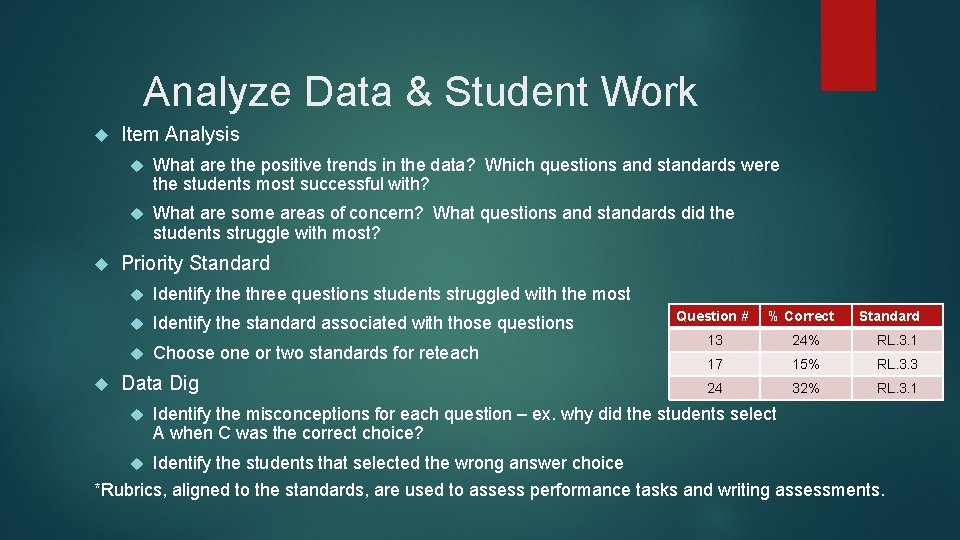
Analyze Data & Student Work Item Analysis What are the positive trends in the data? Which questions and standards were the students most successful with? What are some areas of concern? What questions and standards did the students struggle with most? Priority Standard Identify the three questions students struggled with the most Identify the standard associated with those questions Choose one or two standards for reteach Data Dig Question # % Correct Standard 13 24% RL. 3. 1 17 15% RL. 3. 3 24 32% RL. 3. 1 Identify the misconceptions for each question – ex. why did the students select A when C was the correct choice? Identify the students that selected the wrong answer choice *Rubrics, aligned to the standards, are used to assess performance tasks and writing assessments.
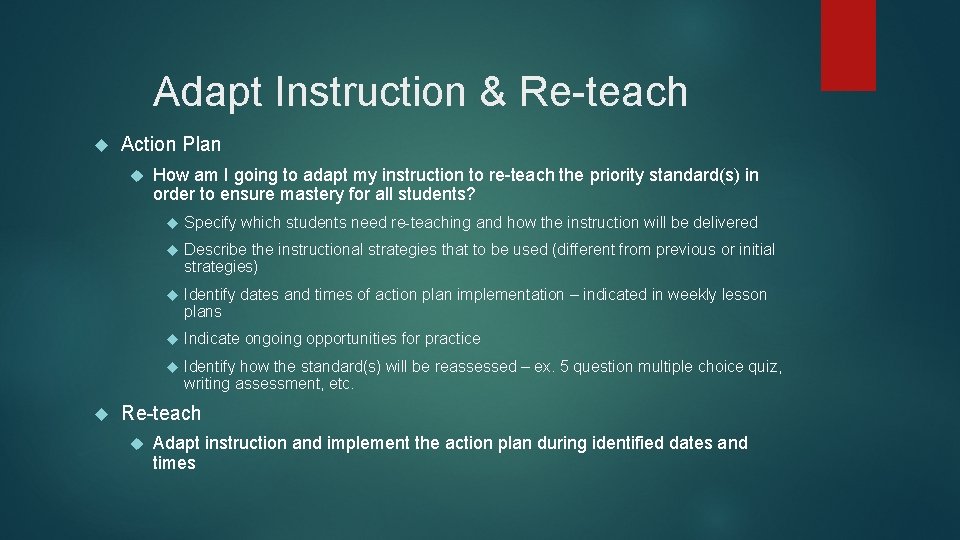
Adapt Instruction & Re-teach Action Plan How am I going to adapt my instruction to re-teach the priority standard(s) in order to ensure mastery for all students? Specify which students need re-teaching and how the instruction will be delivered Describe the instructional strategies that to be used (different from previous or initial strategies) Identify dates and times of action plan implementation – indicated in weekly lesson plans Indicate ongoing opportunities for practice Identify how the standard(s) will be reassessed – ex. 5 question multiple choice quiz, writing assessment, etc. Re-teach Adapt instruction and implement the action plan during identified dates and times

Re-assess the priority standard(s) Use the identified method on the action plan 5 question multiple choice quiz Writing assessment * Re-assessment should mirror the initial assessment and assess the standards in the same way Calculate the results Compare the initial results to the re-assessment results Identify the percentage of students that increased their understanding of the priority standard(s) through the re-teach action plan
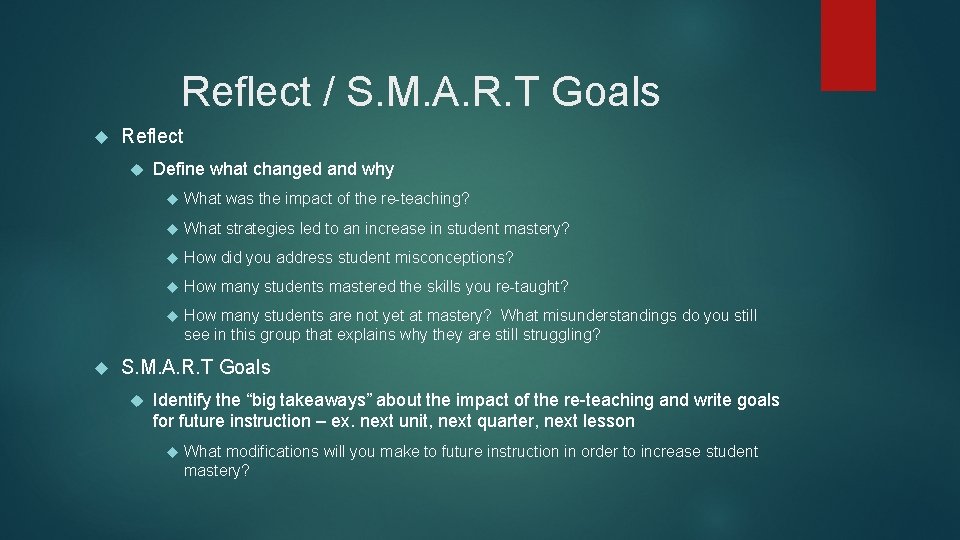
Reflect / S. M. A. R. T Goals Reflect Define what changed and why What was the impact of the re-teaching? What strategies led to an increase in student mastery? How did you address student misconceptions? How many students mastered the skills you re-taught? How many students are not yet at mastery? What misunderstandings do you still see in this group that explains why they are still struggling? S. M. A. R. T Goals Identify the “big takeaways” about the impact of the re-teaching and write goals for future instruction – ex. next unit, next quarter, next lesson What modifications will you make to future instruction in order to increase student mastery?
The Big Picture Standards aligned assessments provide timely and actionable data that drives instruction. Instruction is grounded in evidence (data) and is more targeted and differentiated to meet individual student needs. Research based best practices are used to provide high quality instruction. Ongoing cycle builds consistency in each content area and at every grade level.
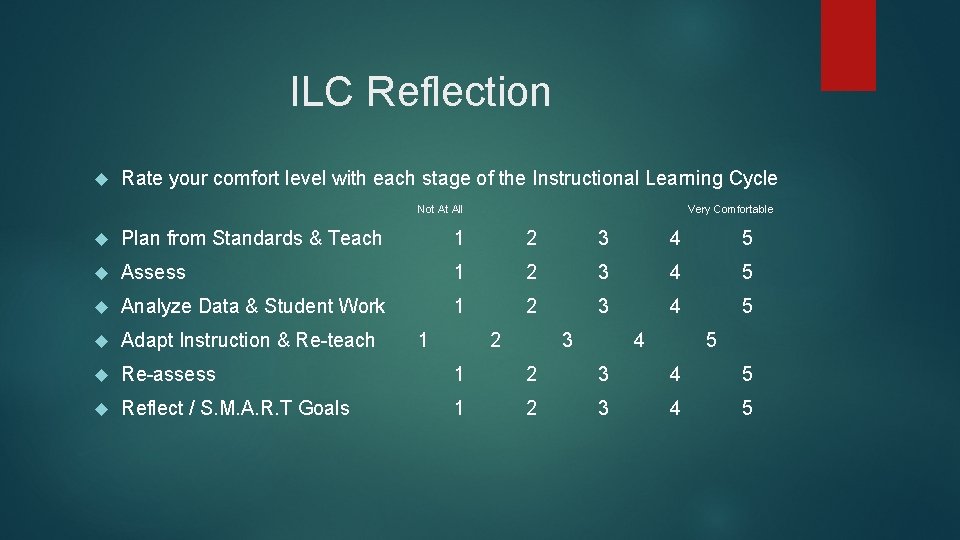
ILC Reflection Rate your comfort level with each stage of the Instructional Learning Cycle Not At All Very Comfortable Plan from Standards & Teach 1 2 3 4 5 Assess 1 2 3 4 5 Analyze Data & Student Work 1 2 3 4 5 Adapt Instruction & Re-teach Re-assess 1 2 3 4 5 Reflect / S. M. A. R. T Goals 1 2 3 4 5
- Slides: 11