
The Institutional Review Board IRB Everything You Wanted
The Institutional Review Board (IRB): Everything You Wanted to Know but Were Afraid to Ask Judy Savageau, MPH Dept of Family Medicine and Community Health; University of Massachusetts Medical School Kimberly Foley, Ph. D Dept of Family Medicine; West Virginia University Matthew Riegel, STM West Virginia University 46 th STFM Annual Spring Conference Baltimore, MD May 2, 2013
Seminar Objectives w Review basic guidelines regarding the ethical conduct of research which includes human subject participation w Review (briefly) the history of the human subject protection system w Discuss issues of informed consent w Discuss the ethics of and use of incentives for recruitment and participation of human subjects in research studies w Discuss the types of IRB applications and the review process w Audience Participation: Questions and Answers, plus completion of a brief survey
IRB Resources Available w Most institutions have a website, often through their Office of Research, which hosts numerous materials about the IRB process and materials needs to submit an application. w Additional information can be found on national websites affiliated with the Office of Human Research Protection / Department of Health and Human Services (U. S. DHHS): http: //ohrp. osophs. dhhs. gov/irb_introduction. htm. w See Select Bibliography at the end of these slides for many more resources!
Direct and Indirect Needs for Human Subjects Protection w There a number of challenges of ethical conduct in research! w Whether conducted in an academic setting or a healthcare institution/agency/organization, research involving human subjects often raises ethical concerns as study participants may experience risks and inconveniences primarily to benefit others by advancing scientific knowledge. w Ethical questions may arise at any time during the research process – from the design phase to subject recruitment to implementation of data collection methods to analyses and dissemination of study results.
Direct and Indirect Needs for Human Subjects Protection w Institutions engaged in research using human subjects are required to provide written assurance of compliance with regulations (including documentation that the IRB reviewed the research project) to funding sources. w There may be times when multiple IRBs / Human Subject Committees must approve of the study before it begins (e. g. , for multi-center trials, for collaborative projects between two agencies, etc. ). w Studies conducted at multiple sites may pose additional IRB concerns (e. g. , maintaining confidentiality of patient data held at multiple sites; insuring consistency of protocols between sites, etc; see article by Wolf).
The History of the Human Subjects Protection System w The modern story of human subjects protections began with the Nuremberg Code (of 1947), developed for the Nuremberg Military Tribunal as the standard by which to judge the human experimentation conducted by the Nazis. The Code provides the details implied by such a requirement: l capacity to consent; l freedom from coercion; and l comprehension of the risks and benefits involved. w Similar recommendations were made by the World Medical Association in its Declaration of Helsinki: Recommendations Guiding Medical Doctors in Biomedical Research Involving Human Subjects – first adopted in 1964. n
The History of the Human Subjects Protection System w The National Research Act, passed in 1974, led to the issuance of reports and recommendations identifying the basic ethical principles that should underlie the conduct of biomedical and behavioral research involving human subjects and recommending guidelines to ensure that research is conducted in accordance with those principles – known as The Belmont Report (submitted in 1978 by the National Commission for the Protection of Human Subjects of Biomedical and Behavioral Research – the commission established by the National Research Act). w The Belmont Report set forth the basic ethical principles of respect for persons, beneficence, and justice – the quintessential requirements for the ethical conduct of research involving human subjects.
Historical Consequences of Not Having IRB Oversight w Tuskegee Study of untreated syphilis in African American men, 1932 -1972 w Feres v United States, 340 U. S. 146, 1950 and United States v. Stanley, 483 U. S. 669, 1958 w Thalidomide, 1957 -1961 w Willowbrook Hepatitis Study, 1963 -1966
Institutional Review Board (IRB) w The goal of the Institutional Review Board (IRB) process is to protect the rights and welfare of those individuals who contribute to the research process by participating as subjects. In protecting the rights of subjects, the IRB also protects the institution and the researcher from the potential consequences of an inadequate consent process or the exposure of the subject to a negative risk.
Informed Consent w Informed consent requires documentation ensuring that research subjects have voluntarily accepted to participate in the research and have been properly informed of each step in the research process. w Informed consent should include: n n n n an invitation to participate in the research study; the purpose of the research; the selection criteria; the research procedures; the description of the benefits and risks; an alternative treatment if an experimental procedure is offered; the possibility to have questions answered by the research team; and an assurance of confidentiality.
Informed Consent w Issues of informed consent become particularly important among vulnerable populations (e. g. , the disabled, inmates, those with cognitive impairments or mental illness, children, pregnant women, and the elderly) where comprehending information and making voluntary choices isn’t always possible. w Research involving surveys, interviews, or observation of public behavior, and research using existing records may be exempt from the federal regulations provided that data are recorded in such a way that the human subjects cannot be identified either directly or through linked identifiers w Research that poses minimal risk but does not qualify as exempt may be eligible for review under the expedited process (more on that later).
HIPAA w The following 18 identifiers are considered Protected Health Information (PHI) and collection of this data typically prohibits IRB applications from being exempt. w Names w Vehicle identifiers and serial numbers (including license w Geographic subdivisions w w w w smaller than a state (addresses, zip codes, etc. ) w Telephone numbers w Fax numbers w Email addresses Social security numbers w Medical record numbers Health plan beneficiary w numbers w Account numbers Certificate/license numbers plate numbers) Device identifiers and serial numbers Web URLs Internet protocol (IP) address numbers Biometric identifiers (finger and voice prints) Full face photographic images Any other unique identifying number, characteristic or code
Incentives for Participation w Many research projects offer incentives to study subjects – whether they are ‘healthy’ subjects or ‘patient’ volunteers. w An internal incentive/motivation to ‘want to help’ is seen infrequently in today’s research environment. w Incentives may be monetary or other tangible/intangibles; e. g. , free medical care, free medications, gift certificates to local stores, movie tickets, raffle tickets to win a bigger prize, offers to donate money to a local charity, etc. w IRBs must consider whether paid participants in research are recruited fairly, informed adequately, and paid appropriately.
Incentives for Participation w Taking into consideration the subjects’ medical, employment, educational status, and their financial, emotional and community resources, the IRB must determine whether the incentives offered for participation in research constitute undue inducements (or undue influence) or coercion. n n Coercion = a “threat of harm” Undue inducements = a “cognitive distortion relating to assessment of risks and benefits” w Federal regulations governing research with human subjects contain no specific guidance for IRB review of payment practices.
The IRB Process w The type of IRB review that is required typically depends on the level of risk presented by the study. The primary focus of this review is on the safety and well-being of research participants. w At most institutions (if not all), being able to participate in human research requires that all ‘key personnel’ on a study be certified by taking the CITI training. w The CITI training is required for all those applications that are either ‘expedited’ or ‘full’ reviews and it may be required for ‘exempt’ applications as well.
Types of Human Subject Reviews w IRB reviews are qualified as one of three types: n Full, expedited, and exempt. w Full IRB Reviews: § Studies that include drug and device trials, vulnerable populations (children, prisoners, pregnant women), and high risk studies.
Types of Human Subject Reviews w Expedited Reviews: n n n Expedited review does not mean “fast”. It means that the study qualifies as minimal risk and does not need the approval of the entire review board. Research involving data, documents, records or specimens that have been collected or will be collected solely for nonresearch purposes (e. g. , medical record reviews, discarded tissue from surgical/pathology procedure, registry studies). Research on individual or group characteristics and behavior or research using surveys, interviews, focus groups, program evaluations, and quality assurance methodologies.
Types of Human Subject Reviews w Exempt Reviews: § § § Research involving prisoners does not qualify for exemption, nor can a project be exempt if the funding agency prohibits this. Research conducted in an established or commonly accepted educational setting, involving normal education practices such as instructional strategies, research on effectiveness, or comparison among instructional techniques, curricula or classroom management. Research involving the use of educational tests, survey procedures, interview procedures or observation of public behavior as long as the information obtained is recorded in such a manner that the human subject cannot be identified directly or through identifiers linked to the subjects.
Types of Human Subject Reviews w Exempt Reviews (continued): § § Research that involves only the collection or study of existing data, documents, records, pathological specimens, or diagnostic specimens. Existing means existing before the research is proposed or initiated; existing at the time of request. Because journals are increasingly requiring evidence of IRB approval, it would be wise to consult with the IRB about exempt status, even if the project does not require formal review.
The IRB CITI Process w Many IRB’s require the Collaborative IRB Training Initiative (CITI) program as the vehicle for ensuring comprehensive education in bioethics and human subjects protection. w The CITI program is a 13 -module program created by ‘IRB experts’ and is used by many academic health centers across the country. Certification via the CITI exam can easily be transferred to other academic institutions. w The CITI program offers many advantages, including the depth and breadth of information, its case-based application of ethical concepts and its continual attention to updating information contained in the modules. w The complete set of modules may take up to 4 hours to complete, but they do not have to be completed at one sitting. Recertification is required every three (3) years!
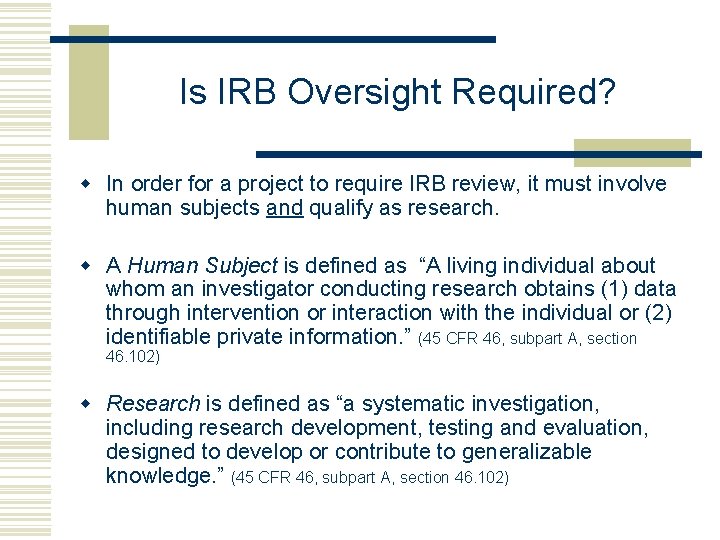
Is IRB Oversight Required? w In order for a project to require IRB review, it must involve human subjects and qualify as research. w A Human Subject is defined as “A living individual about whom an investigator conducting research obtains (1) data through intervention or interaction with the individual or (2) identifiable private information. ” (45 CFR 46, subpart A, section 46. 102) w Research is defined as “a systematic investigation, including research development, testing and evaluation, designed to develop or contribute to generalizable knowledge. ” (45 CFR 46, subpart A, section 46. 102)
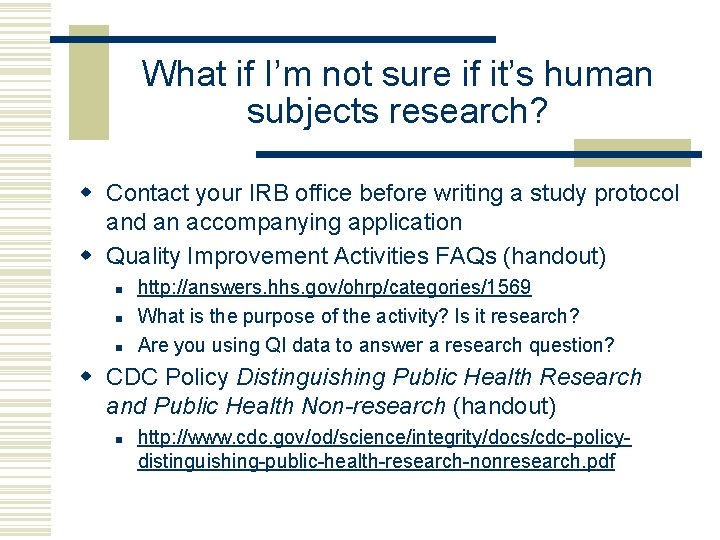
What if I’m not sure if it’s human subjects research? w Contact your IRB office before writing a study protocol and an accompanying application w Quality Improvement Activities FAQs (handout) n n n http: //answers. hhs. gov/ohrp/categories/1569 What is the purpose of the activity? Is it research? Are you using QI data to answer a research question? w CDC Policy Distinguishing Public Health Research and Public Health Non-research (handout) n http: //www. cdc. gov/od/science/integrity/docs/cdc-policydistinguishing-public-health-research-nonresearch. pdf

Thoughts / Comments / Discussion
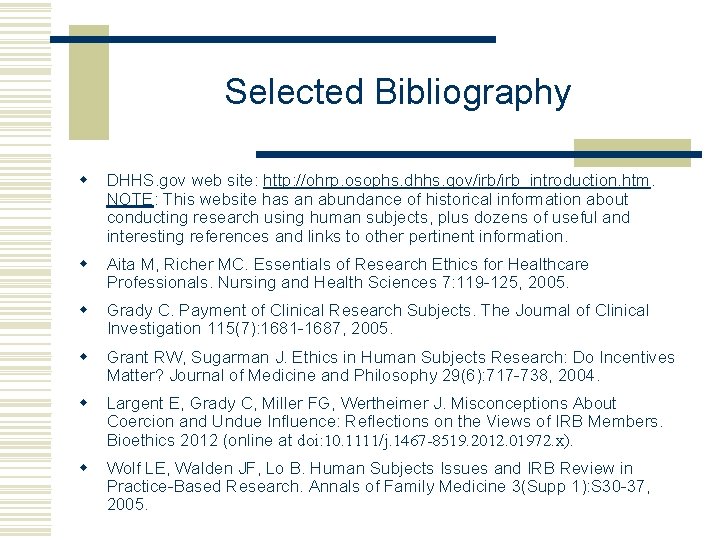
Selected Bibliography w DHHS. gov web site: http: //ohrp. osophs. dhhs. gov/irb_introduction. htm. NOTE: This website has an abundance of historical information about conducting research using human subjects, plus dozens of useful and interesting references and links to other pertinent information. w Aita M, Richer MC. Essentials of Research Ethics for Healthcare Professionals. Nursing and Health Sciences 7: 119 -125, 2005. w Grady C. Payment of Clinical Research Subjects. The Journal of Clinical Investigation 115(7): 1681 -1687, 2005. w Grant RW, Sugarman J. Ethics in Human Subjects Research: Do Incentives Matter? Journal of Medicine and Philosophy 29(6): 717 -738, 2004. w Largent E, Grady C, Miller FG, Wertheimer J. Misconceptions About Coercion and Undue Influence: Reflections on the Views of IRB Members. Bioethics 2012 (online at doi: 10. 1111/j. 1467 -8519. 2012. 01972. x). w Wolf LE, Walden JF, Lo B. Human Subjects Issues and IRB Review in Practice-Based Research. Annals of Family Medicine 3(Supp 1): S 30 -37, 2005.
- Slides: 24