
The Institutional Logics Perspective exploring the motivations and




- Slides: 15
The Institutional Logics Perspective: exploring the motivations and activities of community food organisations Katy Gordon University of Strathclyde
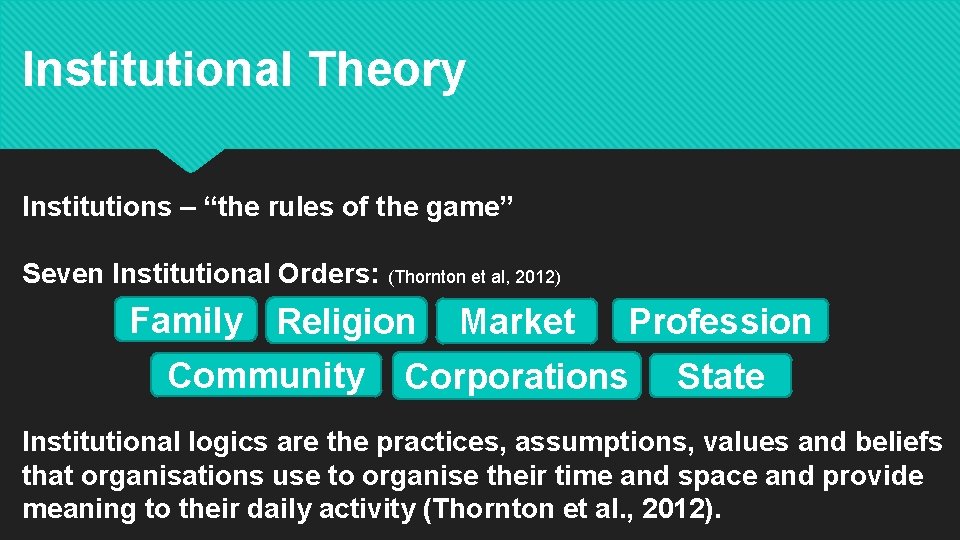
Institutional Theory Institutions – “the rules of the game” Seven Institutional Orders: (Thornton et al, 2012) Family Religion Community Market Profession Corporations State Institutional logics are the practices, assumptions, values and beliefs that organisations use to organise their time and space and provide meaning to their daily activity (Thornton et al. , 2012).
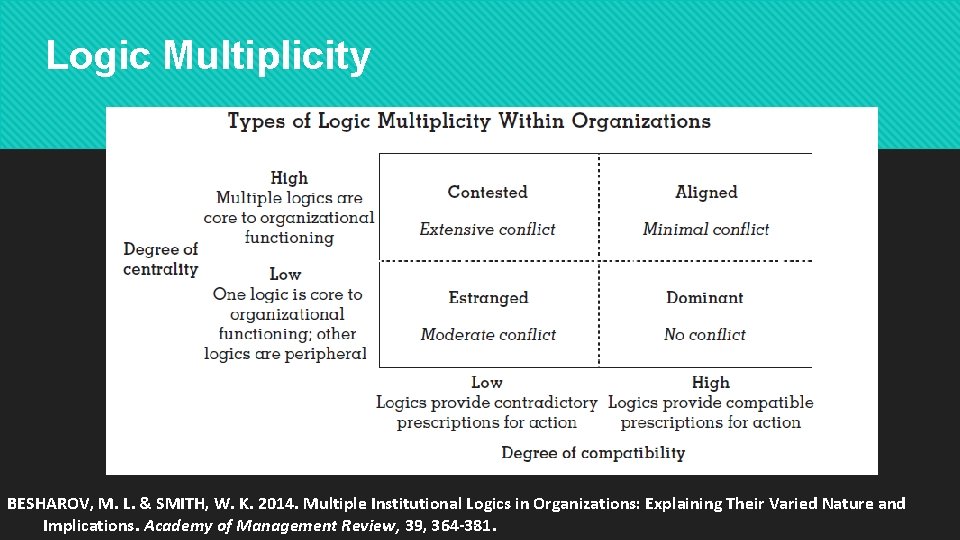
Logic Multiplicity BESHAROV, M. L. & SMITH, W. K. 2014. Multiple Institutional Logics in Organizations: Explaining Their Varied Nature and Implications. Academy of Management Review, 39, 364 -381.
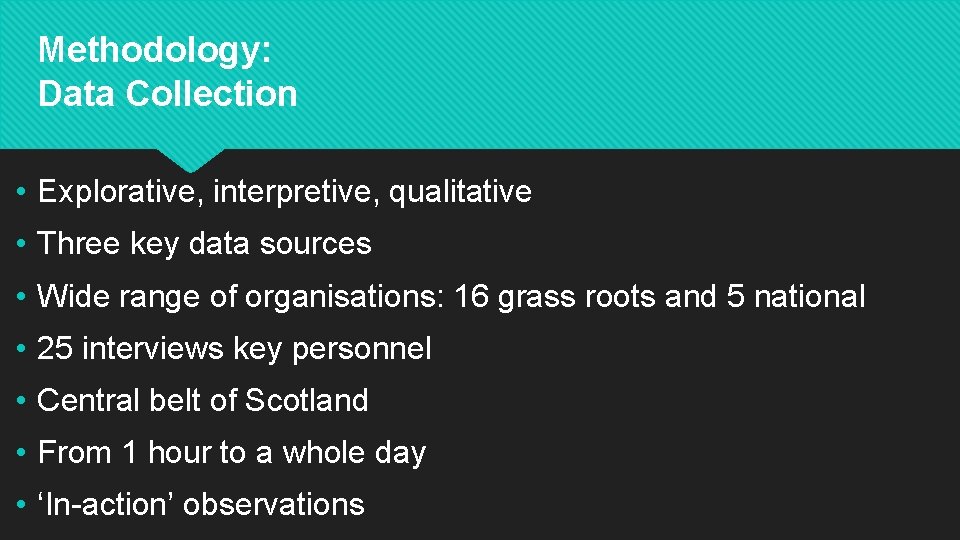
Methodology: Data Collection • Explorative, interpretive, qualitative • Three key data sources • Wide range of organisations: 16 grass roots and 5 national • 25 interviews key personnel • Central belt of Scotland • From 1 hour to a whole day • ‘In-action’ observations
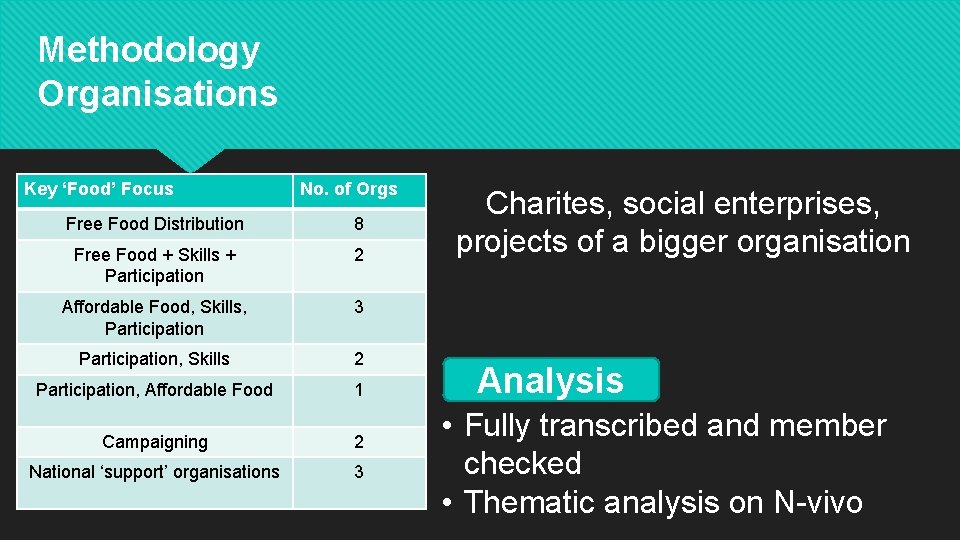
Methodology Organisations Key ‘Food’ Focus No. of Orgs Free Food Distribution 8 Free Food + Skills + Participation 2 Affordable Food, Skills, Participation 3 Participation, Skills 2 Participation, Affordable Food 1 Campaigning 2 National ‘support’ organisations 3 Charites, social enterprises, projects of a bigger organisation Analysis • Fully transcribed and member checked • Thematic analysis on N-vivo
Findings: prevailing institutional logics Market Community State
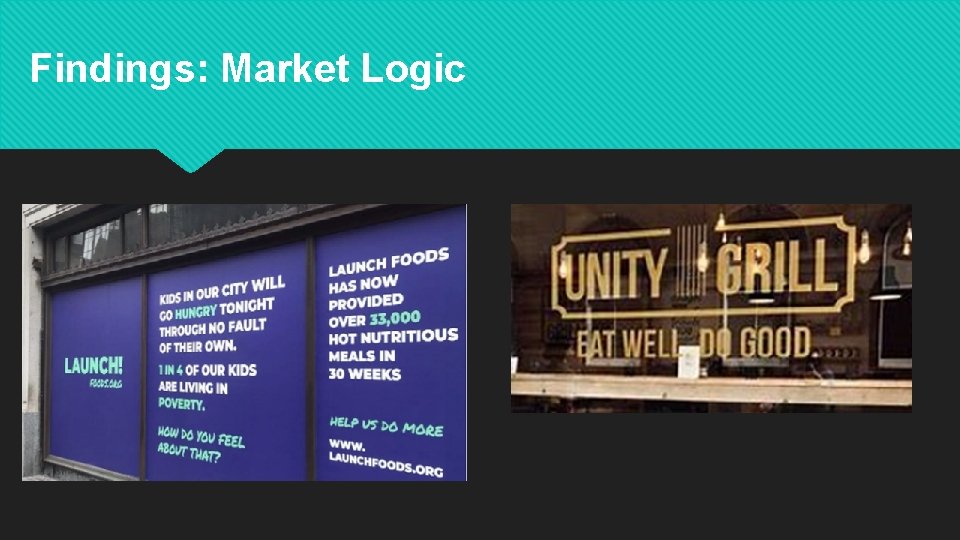
Findings: Market Logic
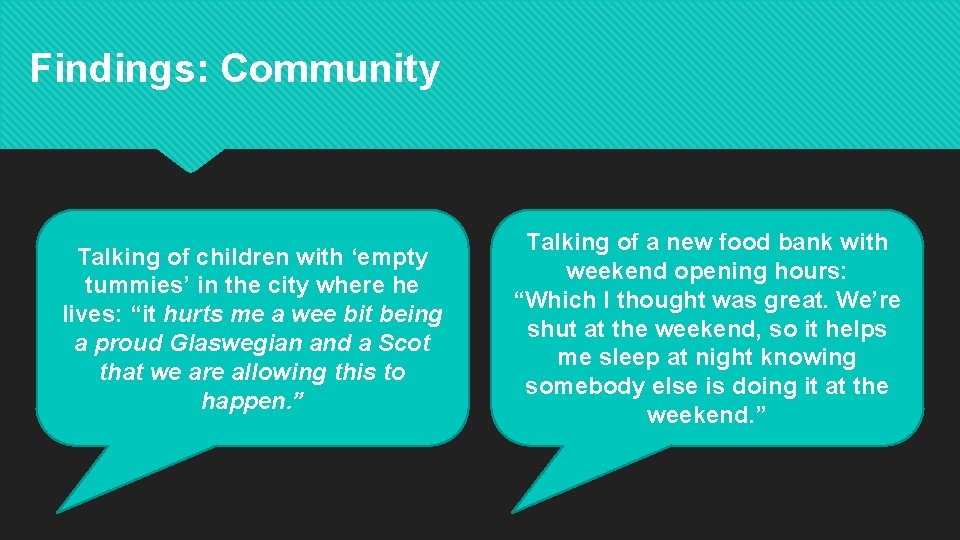
Findings: Community Talking of children with ‘empty tummies’ in the city where he lives: “it hurts me a wee bit being a proud Glaswegian and a Scot that we are allowing this to happen. ” Talking of a new food bank with weekend opening hours: “Which I thought was great. We’re shut at the weekend, so it helps me sleep at night knowing somebody else is doing it at the weekend. ”
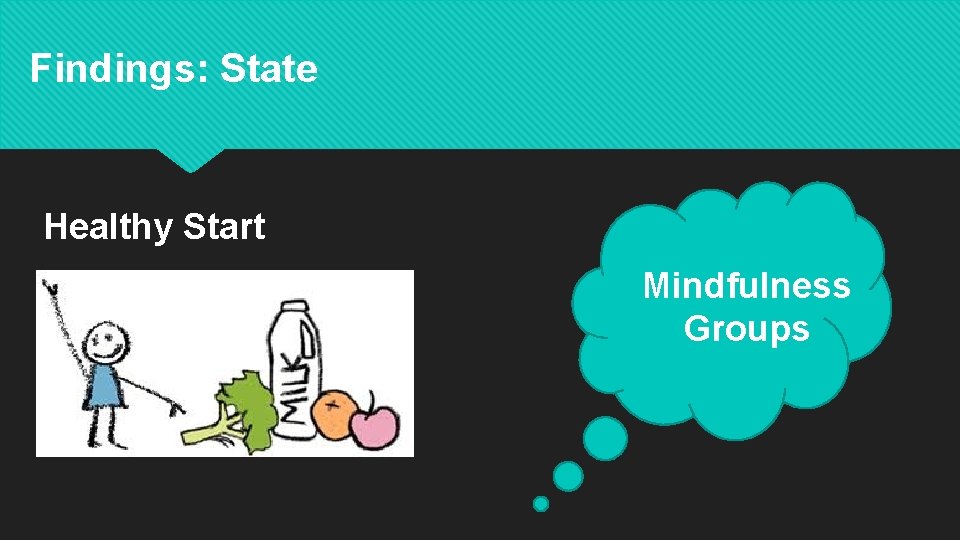
Findings: State Healthy Start Mindfulness Groups
Findings: prevailing institutional logics Market Community State
Findings: Religion and Family “The Church has learned that, for better or worse, people seek it out when they are in need and being able to help someone with that very basic need of groceries to feed their kids, they will do that. ” People aren’t used to kindness now. They’ll say, ‘what are you doing this for? ’ ‘How much do you want for this? ’ We say, ‘no this is for you, we just want to help you. ’ And people aren’t used to people wanting to help them. That’s the kindness. ”
Logic Multiplicity Centrality Compatibility Varied High • From one core, dominant logic to multiple logics • Different logics achieved similar aims • Different logics were needed to meet aims
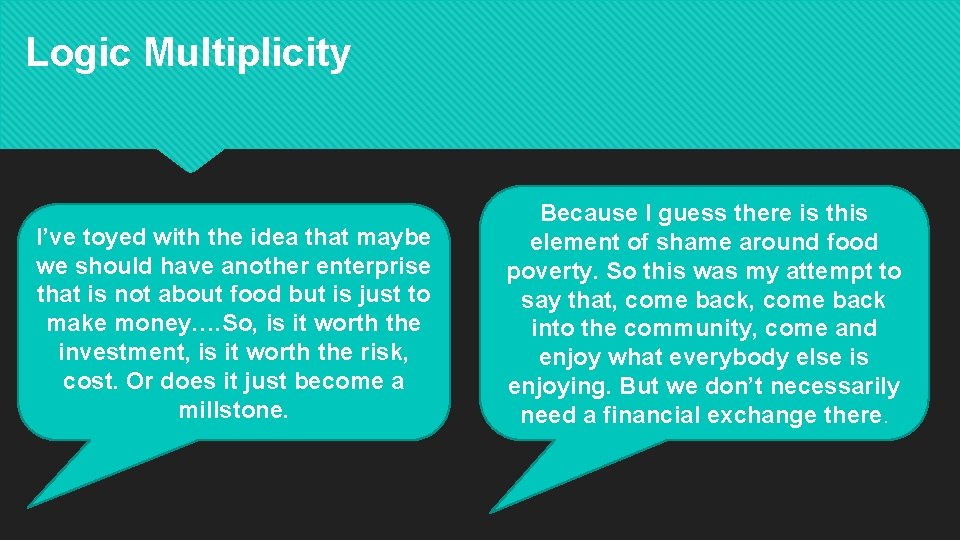
Logic Multiplicity I’ve toyed with the idea that maybe we should have another enterprise that is not about food but is just to make money…. So, is it worth the investment, is it worth the risk, cost. Or does it just become a millstone. Because I guess there is this element of shame around food poverty. So this was my attempt to say that, come back into the community, come and enjoy what everybody else is enjoying. But we don’t necessarily need a financial exchange there.
Contributions Adds further evidence to the growing body of scholarship that identities the market, the State and community as key institutional orders in the non-profit sector. Answers calls to move beyond these three dominant orders and highlights that both the religious and family order occupy a fundamental position in informing some third sector organisations. Demonstrated how logics of market and social can manifest differently but productively in organisations with a similar underlying aim.
Bibliography BESHAROV, M. L. & SMITH, W. K. 2014. Multiple Institutional Logics in Organizations: Explaining Their Varied Nature and Implicat Academy of Management Review, 39, 364 -381. GREENWOOD, R. , RAYNARD, M. , KODEIH, F. , MICELOTTA, E. R. & LOUNSBURY, M. 2011. Institutional Complexity and Organizational Responses. Academy of Management Annals, 5, 317 -371. KNUTSEN, W. L. 2012. Adapted Institutional Logics of Contemporary Nonprofit Organizations. Administration & Society, 44, 985 -10 OCASIO, W. & RADOYNOVSKA, N. 2016. Strategy and commitments to institutional logics: Organizational heterogeneity in busine models and governance. Strategic Organization, 14, 287 -309. SKELCHER, C. & SMITH, S. R. 2015. Theorizing hybridity: Institutional logics, complex organizations, and actor identities: The case nonprofits. Public Administration, 93, 433 -448. THORNTON, P. H. , OCASIO, W. & LOUNSBURY, M. 2012. The Institutional Logics Perspective: A New Approach to Culture, Struc and Process, Oxford University Press. VICKERS, I. , LYON, F. , SEPULVEDA, L. & MCMULLIN, C. 2017. Public service innovation and multiple institutional logics: The cas hybrid social enterprise providers of health and wellbeing. Research Policy, 46, 1755 -1768.