
The Insecurity of Home Digital Voice Assistants Vulnerabilities
The Insecurity of Home Digital Voice Assistants Vulnerabilities, Attacks and Countermeasures Xinyu Lei, Guan-Hua Tu, Alex X. Liu, Chi-Yu Li, Tian Xie 1
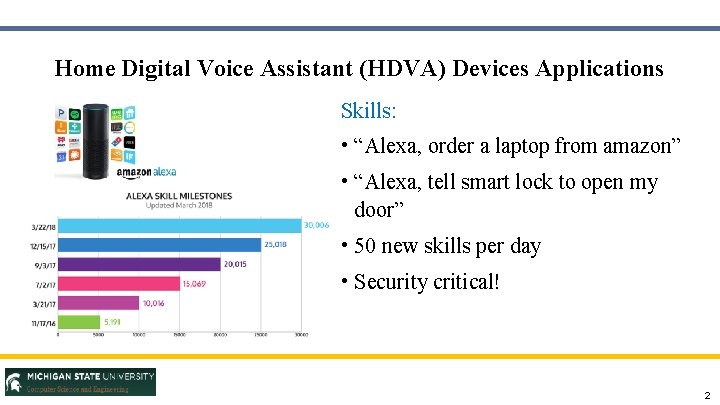
Home Digital Voice Assistant (HDVA) Devices Applications Skills: • “Alexa, order a laptop from amazon” • “Alexa, tell smart lock to open my door” • 50 new skills per day • Security critical! 2
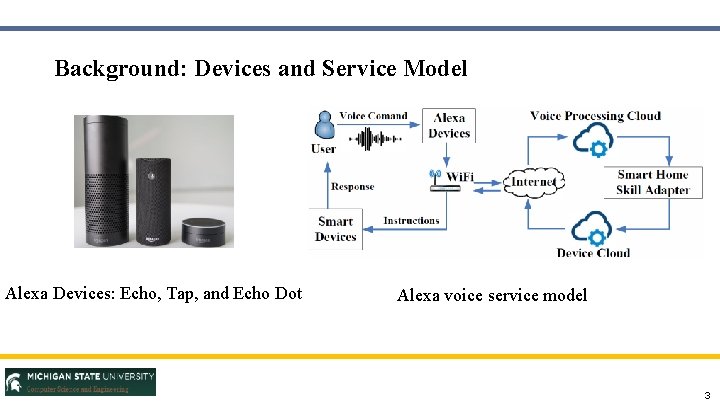
Background: Devices and Service Model Alexa Devices: Echo, Tap, and Echo Dot Alexa voice service model 3
Acoustic Attacks • Fixed location: Alexa devices need to be plugged in to have power supply. • Weak single-factor authentication: Always listen to “Alexa” to wake up and receive the following voice commands. • Consequence: More vulnerable to acoustic attacks when owners are absent from home. 4
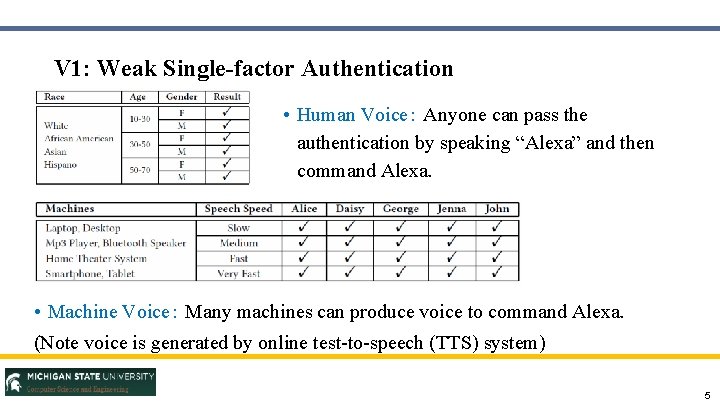
V 1: Weak Single-factor Authentication • Human Voice: Anyone can pass the authentication by speaking “Alexa” and then command Alexa. • Machine Voice: Many machines can produce voice to command Alexa. (Note voice is generated by online test-to-speech (TTS) system) 5
V 2: No Physical Presence Based Access Control • No physical presence based access control: Work by detecting the voice even if there is no surrounding users. • Validation: • Alexa can be controlled by the voice command from the Bluetooth speaker 12 meters away. • Alexa can accept voice commands larger than 60 d. B, no matter where the voice comes from. 6
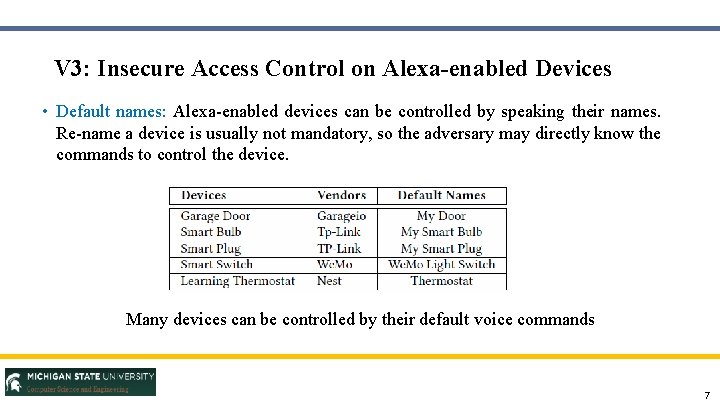
V 3: Insecure Access Control on Alexa-enabled Devices • Default names: Alexa-enabled devices can be controlled by speaking their names. Re-name a device is usually not mandatory, so the adversary may directly know the commands to control the device. Many devices can be controlled by their default voice commands 7
How To Deliver Voice to Home Digital Voice Assistant Devices The adversary can deliver voice to Alexa by many methods without being present nearby. Two examples: All devices that are capable of making • Bluetooth speakers: the adversary outside theand victim’s house can connect the sound can be abused!! his/her smartphone to the victim’s Bluetooth speaker and then play an MP 3 audio file of voice commands. • Smart TVs: the adversary can steal the victim’s home Wi-Fi password and then cast a video with voice commands to the victim’s smart TV. 8
Proof-of-concept Attacks Two real-world attack cases: • Home Burglary: Tell Alexa to open a door via smart lock. E. g. , “Alexa, tell Garageio to open my door”. • Fake Order: Tell Alexa to place a fake order on Amazon. The owner may suffer from the financial loss. 9
Possible Solutions • Learn the authentication users’ voice (V 1) • Voice may change due to health conditions • Turn off all audio devices while users leave home (V 2) • Not convenient for users • Force users to rename the default Alexa-compatible device name (V 3) • It may not be practical to ask all vendors and users to do so. 10
Solution: Physical Presence Based Access Control Idea: Virtual Security Button (VSButton): • Turn on Home Digital Voice Assistant Devices: If physical presence is detected • Turn off Home Digital Voice Assistant Devices: If no physical presence is detected Approach: Wi-Fi channel state information (CSI)-based motion detection: • Significant CSI Variation: Human motions • Nearly Stable CSI: No motions 11
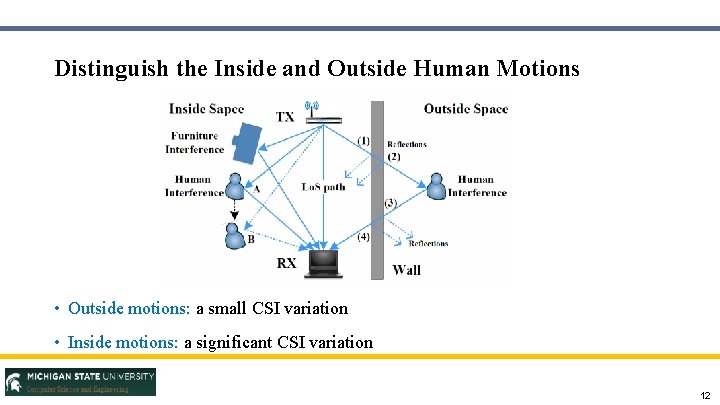
Distinguish the Inside and Outside Human Motions • Outside motions: a small CSI variation • Inside motions: a significant CSI variation 12
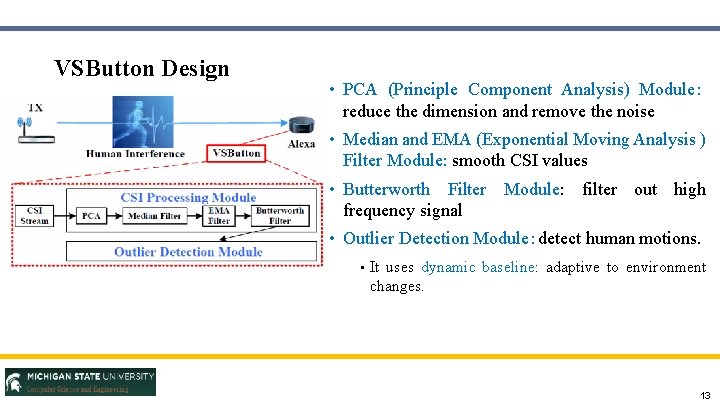
VSButton Design • PCA (Principle Component Analysis) Module: reduce the dimension and remove the noise • Median and EMA (Exponential Moving Analysis ) Filter Module: smooth CSI values • Butterworth Filter Module: filter out high frequency signal • Outlier Detection Module:detect human motions. • It uses dynamic baseline: adaptive to environment changes. 13
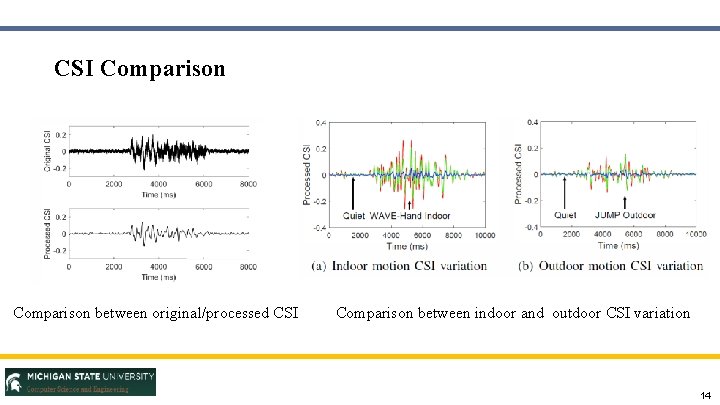
CSI Comparison between original/processed CSI Comparison between indoor and outdoor CSI variation 14
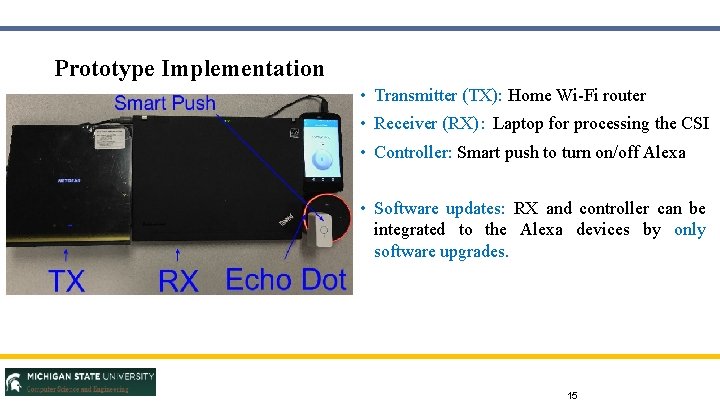
Prototype Implementation • Transmitter (TX): Home Wi-Fi router • Receiver (RX): Laptop for processing the CSI • Controller: Smart push to turn on/off Alexa • Software updates: RX and controller can be integrated to the Alexa devices by only software upgrades. 15
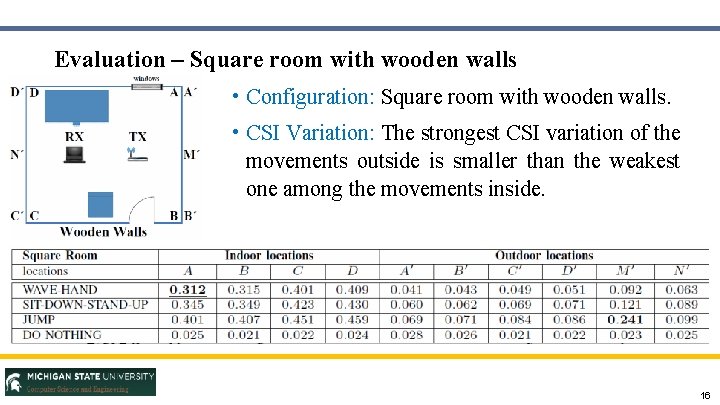
Evaluation – Square room with wooden walls • Configuration: Square room with wooden walls. • CSI Variation: The strongest CSI variation of the movements outside is smaller than the weakest one among the movements inside. 16
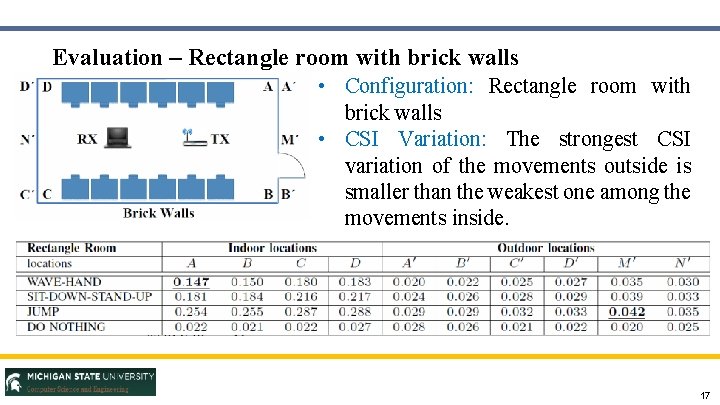
Evaluation – Rectangle room with brick walls • Configuration: Rectangle room with brick walls • CSI Variation: The strongest CSI variation of the movements outside is smaller than the weakest one among the movements inside. 17
Current Limitations of VSButton • Motions not from human: VSButton may activate HDVA service due to motions from pets. • Tradeoff between security and convenience: By increasing the motion detection threshold t, VSButton has a smaller false positive rate. • Physical invasive attack: VSButton cannot resist invasive attack (e. g, the adversary breaks the windows and enters the victim’s room). If invasive attack occurs, the adversary is able to do many things much eviler than attacking the HDVA. 18
Conclusion • HDVAs: Amazon Alexa and Google Home • Identify three vulnerabilities • Solution: VSButton based on physical presence • Accurate setting detection in both laboratory and real-world home 19
Questions & Answers 20

21

22

23
Backup 24
Related work • Indoor Human Activity/Motion Sensing. Other methods need to buy special equipment (e. g. , radar, camera). But Wi-Fi based motion detection is only based on COTS devices. • Voice Authentication for Digital Voice Assistants. Previous methods need users to wear some devices to finish voice authentication. However, our solution is device-free. 25
- Slides: 25