
The Ins Outs of ESSA Accountability Reporting July
The Ins & Outs of ESSA Accountability Reporting July 18, 2018
Meet the Presenters Manos Stefanakos Alex Jackl Chief Solutions Architect Analytic. Vue 2 Senior Data Architect Analytic. Vue
Welcome Today’s topics will include: • History of the Every Student Succeeds Act of 2015 • Basic Outcome and Reporting Requirements • Examples of what others are doing • Reporting Challenges 3
Audience and Focus We know many of you are deeply embedded in many of the issues we are going to talk about today. Indeed, many of you are experts in your own right. This presentation is designed to provide a brief overview of issues and a state of the union and THEN talk about approaches to resolving ESSA Reporting. We will also show examples of the way we at Analytic. Vue have been addressing these issues. We welcome your feedback, participation, and critical input! Thanks for participating! 4
History - ESEA • Original law was the Elementary and Secondary Education Act of 1965 • Considered a civil rights law • intended to provide all students with a “full educational opportunity” • Provided grants to agencies serving underserved students in order to close gaps between students in various subgroups, via the Title funding programs • Reauthorizations took place every 3 -5 years between 1965 -2001 5
History - NCLB, 1 of 2 • Most of the country became familiar with the passage of the No Child Left Behind law in 2001 • While essentially only the latest re-authorization of ESEA, it increased accountability standards, to a 100% proficiency rate for all students, in all subgroups, by SY 2014 • While it did not achieve its ambitious 100% goals, and attracted a great deal of sometimes deserving criticism, there were marked improvements in student outcomes as shown by NAEP results. 6
History - NCLB, 2 of 2 • Both 9 - and 13 -year-olds scored higher in reading and mathematics in 2012 than students their age in the early 1970 s. Scores were 8 to 25 points higher in 2012 than in the first assessment year. Seventeenyear-olds, however, did not show similar gains. Average reading and mathematics scores in 2012 for 17 -year-olds were not significantly different from scores in the first assessment year. – Nations Report Card, 2013 7
History - ESSA • Designed to “fix” NCLB’s emphasis on 100% proficiency by allowing states to define their own goals and timelines, that were still subject to federal approval • Goals are: – Holding all students to high academic standards – Shrinking achievement gaps and increasing graduation rates – Ensuring accountability by guaranteeing that when students fall behind, states redirect resources into what works to help – Providing more children access to high-quality preschool. 8
ESSA vs NCLB – Major Differences • State and local fixes rather than a more federaloriented solution like the No Child Left Behind Act • Reducing the often onerous burden of testing on students and teachers • New literacy funding • Focus on innovative testing, Universal Design for Learning (UDL) and personalized learning • Parent involvement in the creation of state plans 9

ESSA Framework Components 1 • Innovative Testing – NOT relying on summative annual tests or end-ofcourse assessments – Removing burden of “over testing” • Universal Design for Learning (UDL) – classroom and lesson centric, a curricular framework – focus on goals, instructional method, materials, and assessment – providing multiple means of engagements, representation, action, and expression – oriented around lessons, learning environments, lesson goals, access, and barriers 10
ESSA Framework Components 2 • Personalized Learning – Emphasis on competency-based education over seat time – Emphasis on personal plans rather than grade level based plans • Parent involvement in the creation of state plans – Although a political goal, this goal of community engagement is very important. However, it is challenging to implement in a reasonable way – We are seeing a lot of emphasis on parent portals and pushing info out to parents, less on actual engagement. 11
Challenges that ESSA is trying to address • Agreeing on what to measure • Agreeing on which schools need help • Agreeing on the best plan for improving student outcomes – Varied root causes for underperforming schools – Soft issues: leadership, community issues, and staffing – Schools and districts deals with issues differently 12
ESSA Plans and Reporting • By now, all states have submitted a plan for what they want to accomplish under ESSA. A few are awaiting final approval • While the law offers flexibility on each state’s goals, how they are defined, and the timeline for achieving them, it does define certain categories of required actions, and data to satisfy the requirements. 13
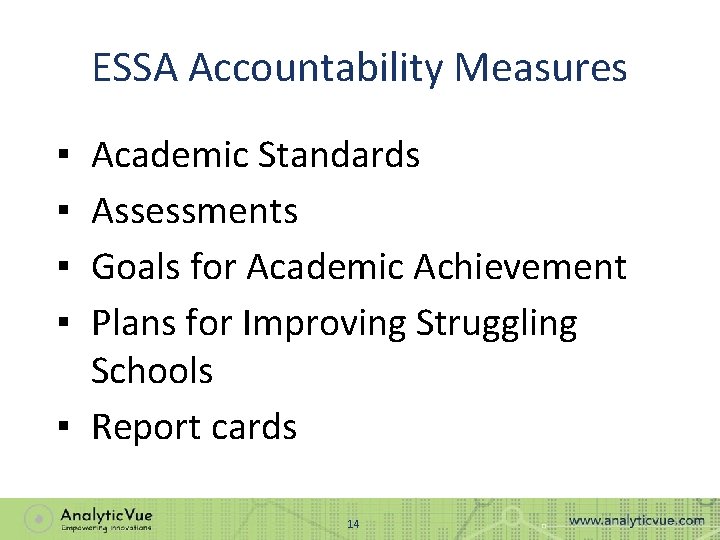
ESSA Accountability Measures Academic Standards Assessments Goals for Academic Achievement Plans for Improving Struggling Schools ▪ Report cards ▪ ▪ 14
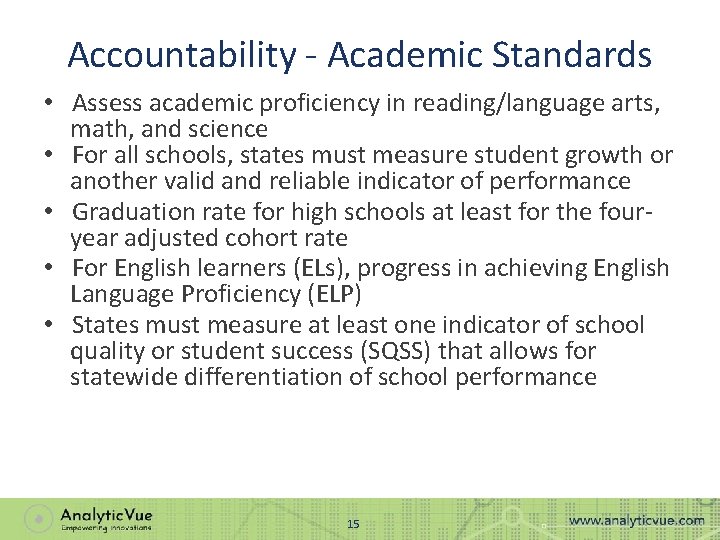
Accountability - Academic Standards • Assess academic proficiency in reading/language arts, math, and science • For all schools, states must measure student growth or another valid and reliable indicator of performance • Graduation rate for high schools at least for the fouryear adjusted cohort rate • For English learners (ELs), progress in achieving English Language Proficiency (ELP) • States must measure at least one indicator of school quality or student success (SQSS) that allows for statewide differentiation of school performance 15
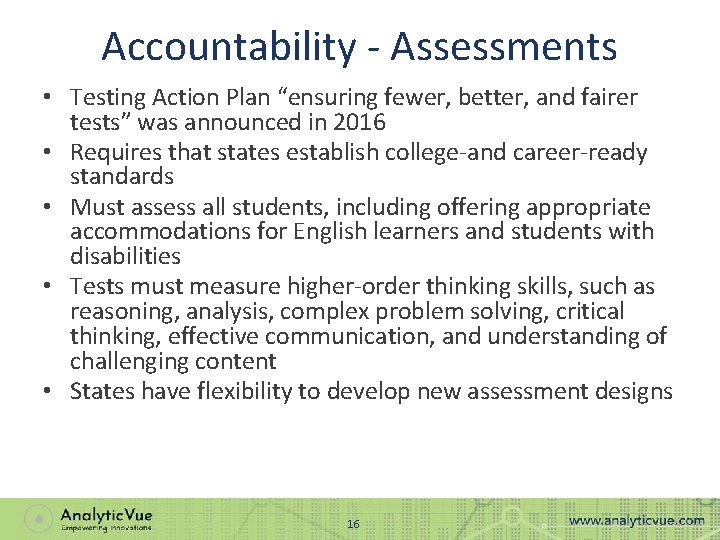
Accountability - Assessments • Testing Action Plan “ensuring fewer, better, and fairer tests” was announced in 2016 • Requires that states establish college-and career-ready standards • Must assess all students, including offering appropriate accommodations for English learners and students with disabilities • Tests must measure higher-order thinking skills, such as reasoning, analysis, complex problem solving, critical thinking, effective communication, and understanding of challenging content • States have flexibility to develop new assessment designs 16
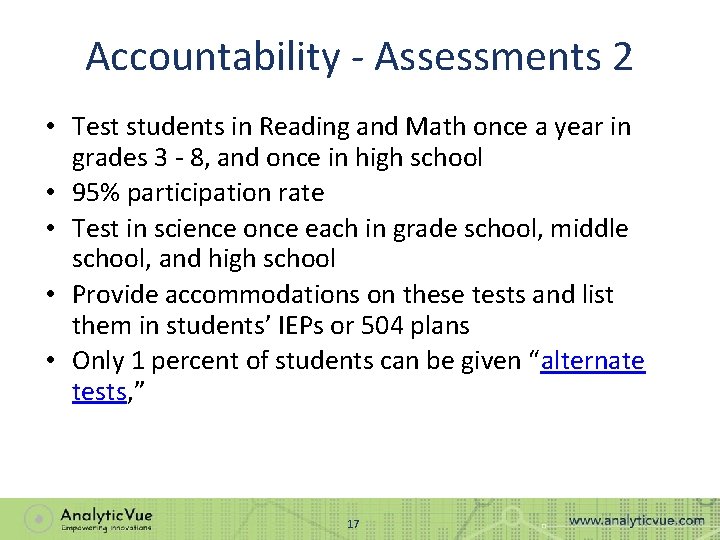
Accountability - Assessments 2 • Test students in Reading and Math once a year in grades 3 - 8, and once in high school • 95% participation rate • Test in science once each in grade school, middle school, and high school • Provide accommodations on these tests and list them in students’ IEPs or 504 plans • Only 1 percent of students can be given “alternate tests, ” 17
Accountability - Goals for Academic Achievement • This is where ESSA begins to show the flexibility that was not present in NCLB • States could choose their targets and timelines • Examples: o Alaska - By 2030, decrease percent non-proficient by 50 percent, and decrease non-graduates by 50 percent, based on the four-year cohort graduation rate o District of Columbia - By 2038 -39, 85 percent of all students and subgroups will score a level 4 or 5 on the PARCC exam; 90 percent of high school students will graduate after four years o Mississippi - 70 percent of all students and all student subgroups to be proficient by 2024 -25, in both English/language arts and math. That state wants an overall graduation rate goal of 90 percent, but this figure varies among the subgroups. 18
Accountability – Plans for Improving Struggling Schools Initial challenge is deciding what schools should be identified as “struggling” ● Identification of two categories of “struggling schools” ○ “Comprehensive Support and Improvement” schools, which are the lowest performing schools in a state ○ “Targeted Support and Improvement” schools, where certain student groups are consistently underperforming 19
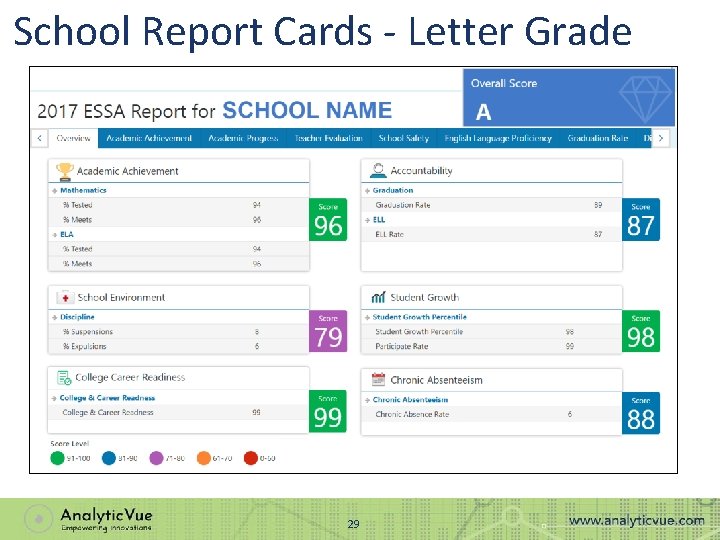
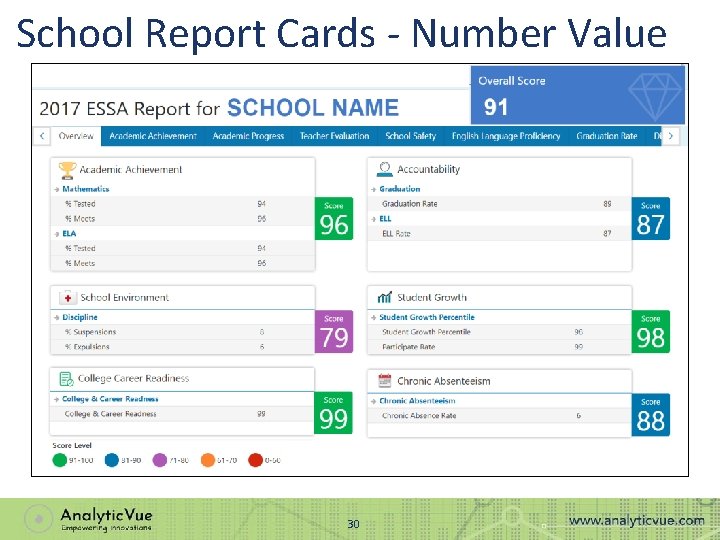
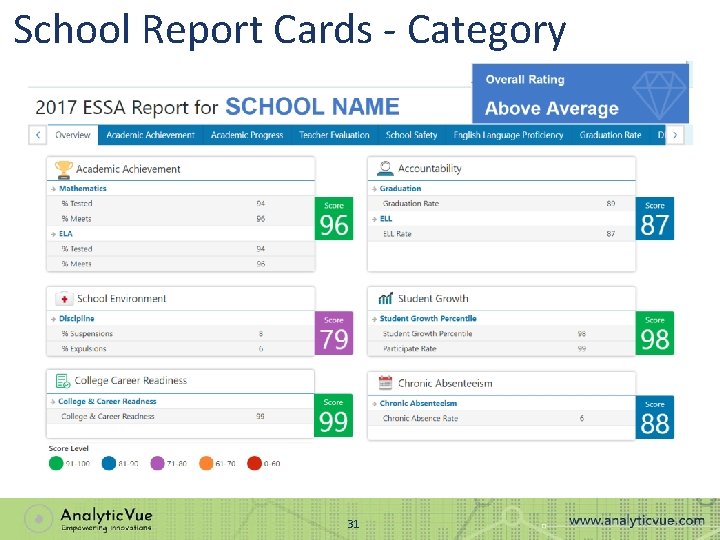
Accountability – Report Cards 1 Most states have selected one of the following: 1. 100 -point scales 2. A-F (sometimes E) grades 3. Multi-tiered ratings, o CO - Does not meet/Approaching/Meets and exceeds o WY - below average/above average Some (like OR and PA) will have no single rating for a school other than ESSA-mandated comprehensive or targeted support 20
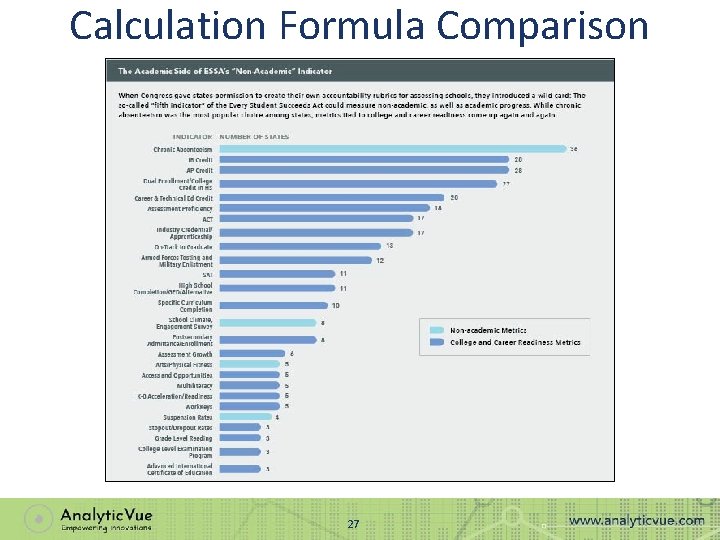
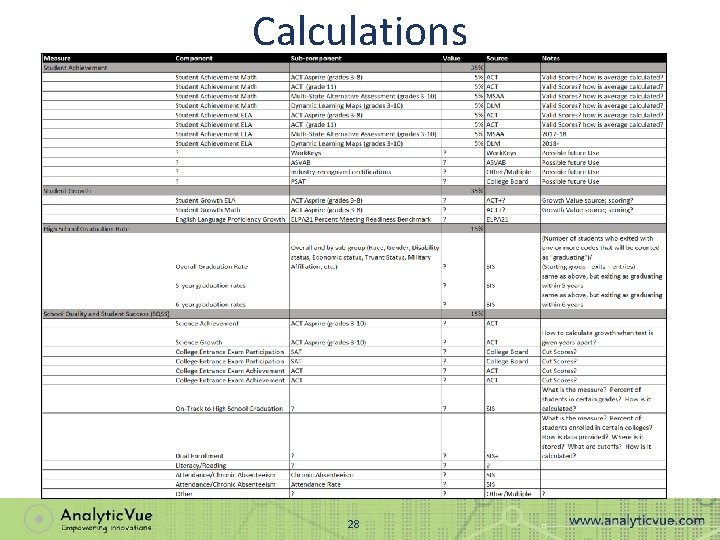
Accountability – Report Cards 2 Even for states with the same type of “grade, ” the calculation can vary in the following ways: • the particular measures used o proficiency vs. growth o chronic absenteeism vs attendance rate o graduation rate (4 - vs 5 - vs 6 -year adjusted cohort) • the weight of each measure • the cut scores for a particular rating 21
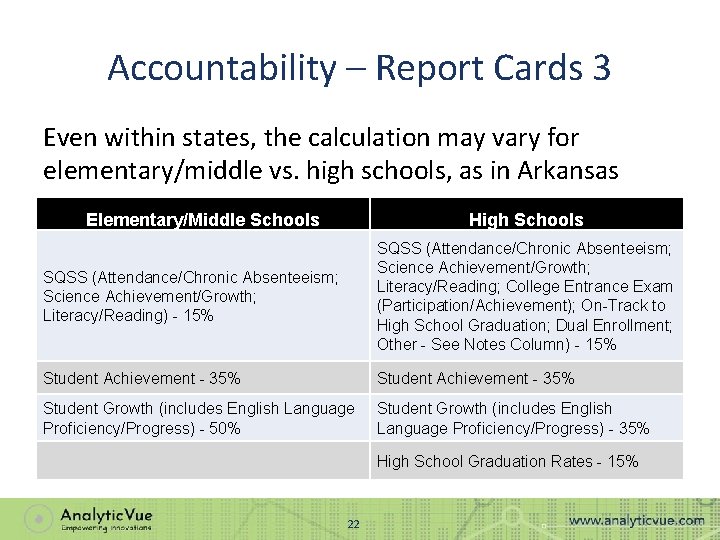
Accountability – Report Cards 3 Even within states, the calculation may vary for elementary/middle vs. high schools, as in Arkansas Elementary/Middle Schools High Schools SQSS (Attendance/Chronic Absenteeism; Science Achievement/Growth; Literacy/Reading) - 15% SQSS (Attendance/Chronic Absenteeism; Science Achievement/Growth; Literacy/Reading; College Entrance Exam (Participation/Achievement); On-Track to High School Graduation; Dual Enrollment; Other - See Notes Column) - 15% Student Achievement - 35% Student Growth (includes English Language Proficiency/Progress) - 50% Student Growth (includes English Language Proficiency/Progress) - 35% High School Graduation Rates - 15% 22
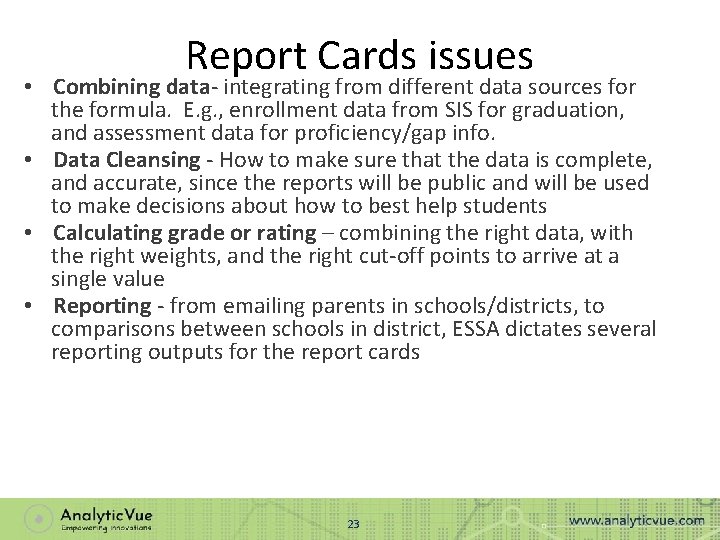
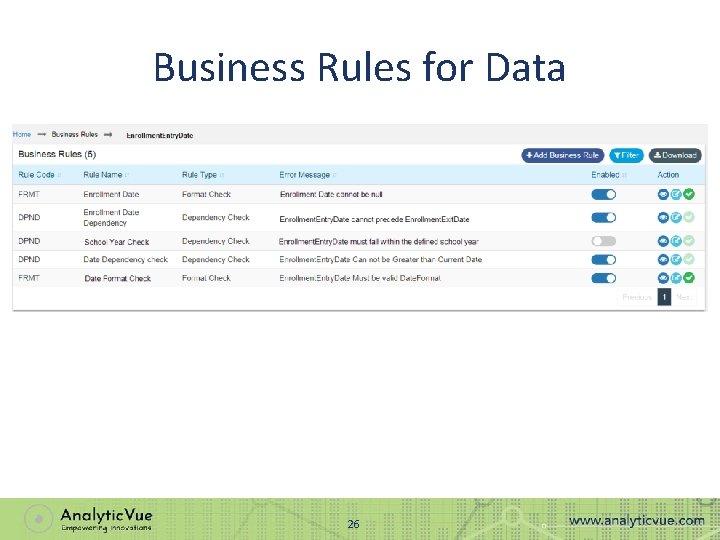
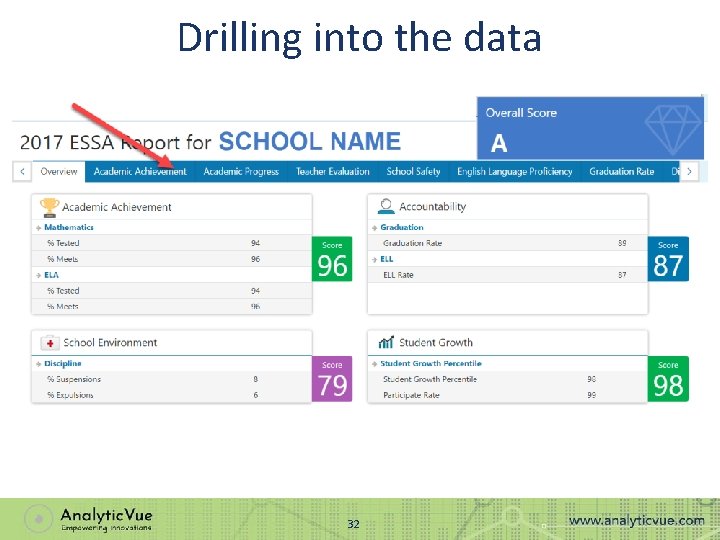
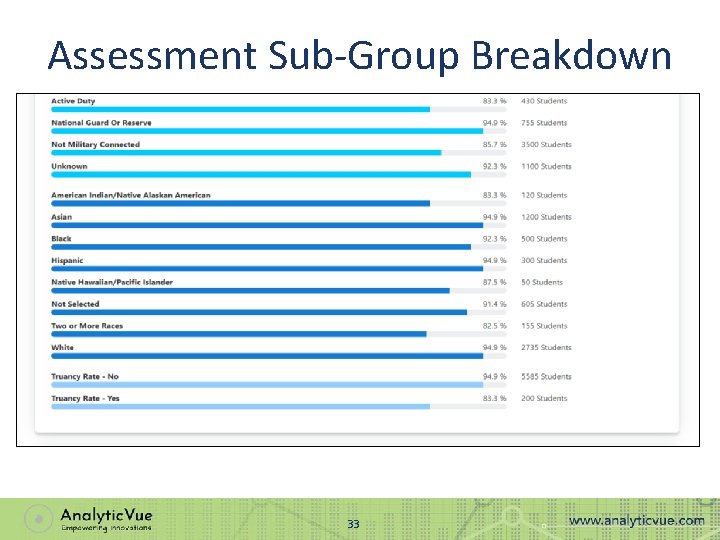
Report Cards issues • Combining data- integrating from different data sources for the formula. E. g. , enrollment data from SIS for graduation, and assessment data for proficiency/gap info. • Data Cleansing - How to make sure that the data is complete, and accurate, since the reports will be public and will be used to make decisions about how to best help students • Calculating grade or rating – combining the right data, with the right weights, and the right cut-off points to arrive at a single value • Reporting - from emailing parents in schools/districts, to comparisons between schools in district, ESSA dictates several reporting outputs for the report cards 23
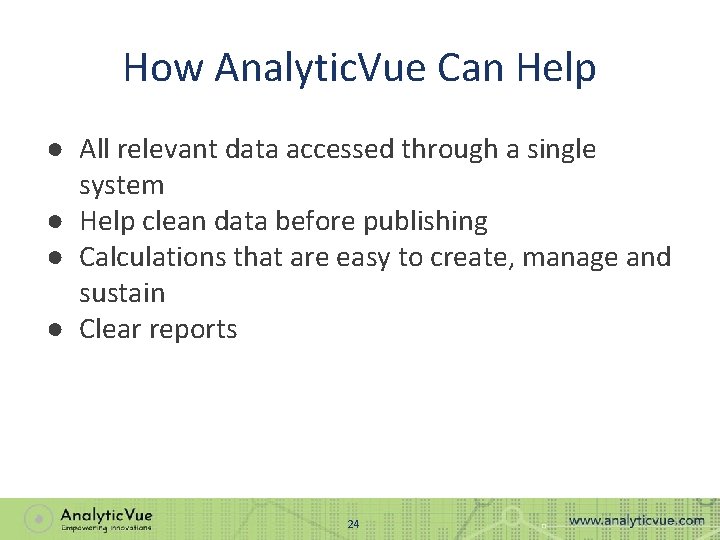
How Analytic. Vue Can Help ● All relevant data accessed through a single system ● Help clean data before publishing ● Calculations that are easy to create, manage and sustain ● Clear reports 24
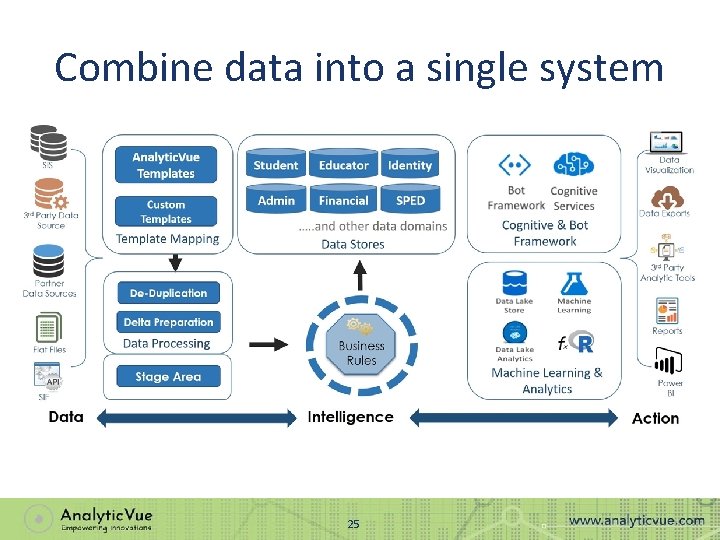
Combine data into a single system 25
Business Rules for Data 26
Calculation Formula Comparison 27
Calculations 28
School Report Cards - Letter Grade 29
School Report Cards - Number Value 30
School Report Cards - Category 31
Drilling into the data 32
Assessment Sub-Group Breakdown 33
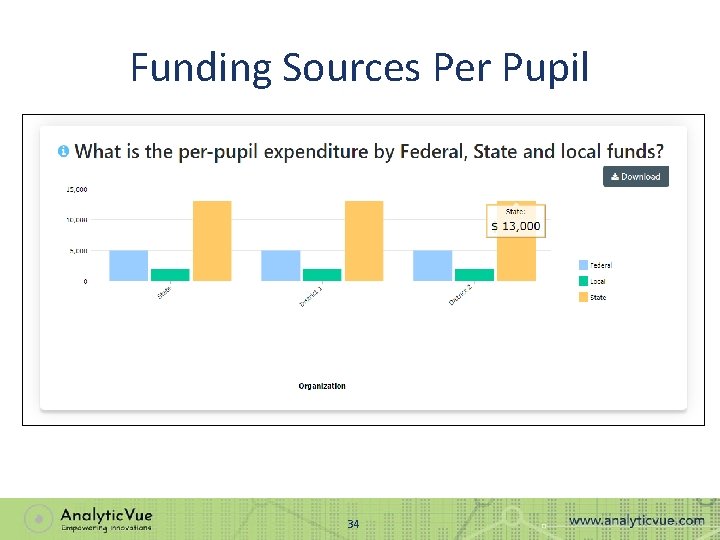
Funding Sources Per Pupil 34
Further reading The resources below provide good background on a number of the topics we discussed today, and some provide links to each state’s ESSA plan. ESSA History https: //www. ed. gov/essa? src=rn https: //www. edweek. org/ew/section/multimedia/no-child-left-behind-overviewdefinition-summary. html https: //nces. ed. gov/nationsreportcard/subject/publications/main 2012/pdf/2013456. pdf 35
Further reading Universal Design for Learning (UDL) https: //www. understood. org/en/learning-attention-issues/treatmentsapproaches/educational-strategies/universal-design-for-learning-what-it-is-and-how-it -works https: //www. understood. org/~/media/80 ec 3 f 876 a 014989 aa 8 b 6 b 395 d 8 d 7428. pdf https: //www. understood. org/en/learning-attention-issues/treatmentsapproaches/educational-strategies/the-difference-between-universal-design-forlearning-udl-and-traditional-education http: //www. udlcenter. org/aboutudl/whatisudl/3 principles 36
Further reading ESSA Plans and Measures • https: //www 2. ed. gov/admins/lead/account/stateplan 17/index. html • http: //ecs. force. com/mbdata/mb. Quest 5 E? rep=SA 172 • https: //www. nciea. org/sites/default/files/pubs-tmp/CCSSO_Growth_Resource. pdf • https: //www. ed. gov/news/press-releases/fact-sheet-testing-action-plan • https: //www. understood. org/en/school-learning/partnering-with-childs-school/tests -standards/alternate-assessments-what-they-are-and-how-they-work • https: //www. edweek. org/ew/section/multimedia/key-takeaways-state-essaplans. html http: //blogs. edweek. org/edweek/campaign-k 12/2017/06/ESSA_struggling_schools_fix_state_plans. html 37
Questions If something is not addressed today, we will create a FAQ that will be shared with participants. 38
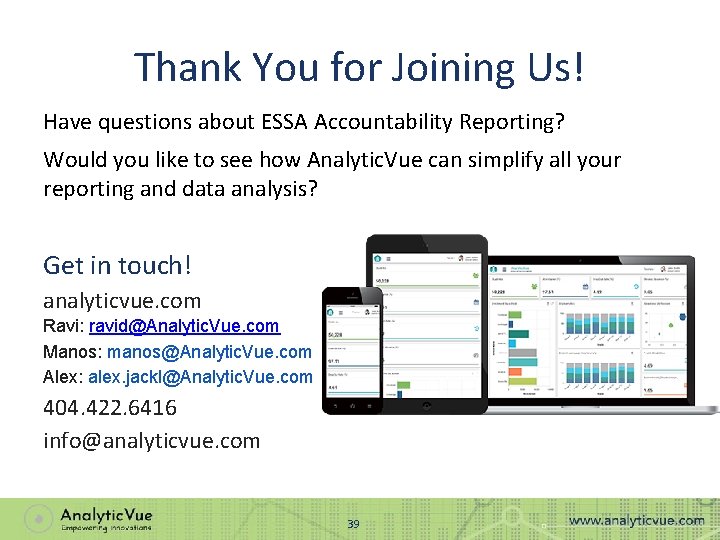
Thank You for Joining Us! Have questions about ESSA Accountability Reporting? Would you like to see how Analytic. Vue can simplify all your reporting and data analysis? Get in touch! analyticvue. com Ravi: ravid@Analytic. Vue. com Manos: manos@Analytic. Vue. com Alex: alex. jackl@Analytic. Vue. com 404. 422. 6416 info@analyticvue. com 39
- Slides: 39