
The Innovation of Computers By Elijah Bonds ENIAC
The Innovation of Computers By: Elijah Bonds
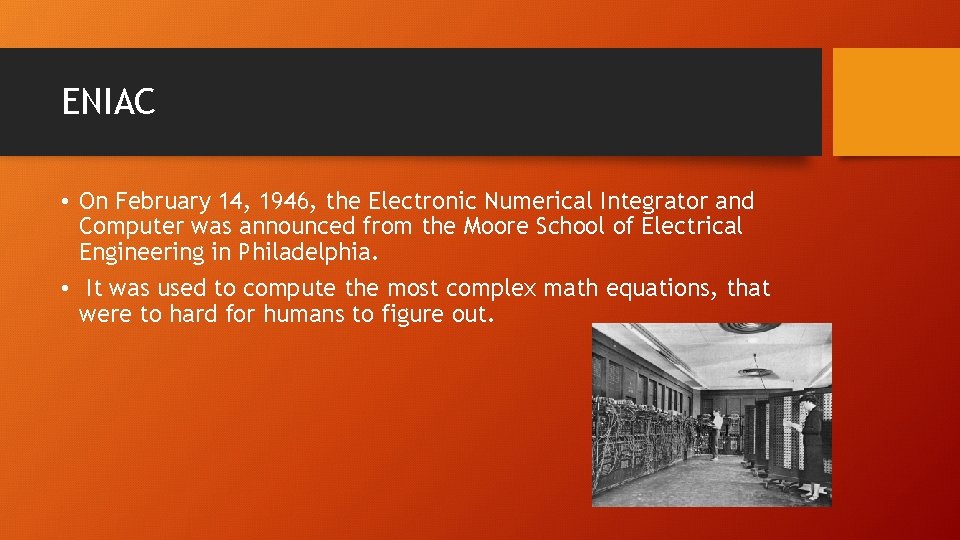
ENIAC • On February 14, 1946, the Electronic Numerical Integrator and Computer was announced from the Moore School of Electrical Engineering in Philadelphia. • It was used to compute the most complex math equations, that were to hard for humans to figure out.
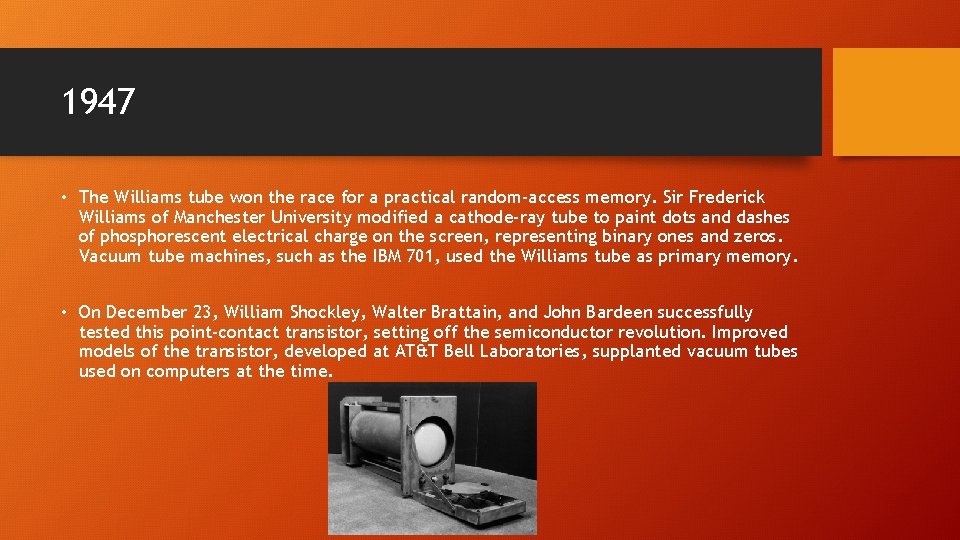
1947 • The Williams tube won the race for a practical random-access memory. Sir Frederick Williams of Manchester University modified a cathode-ray tube to paint dots and dashes of phosphorescent electrical charge on the screen, representing binary ones and zeros. Vacuum tube machines, such as the IBM 701, used the Williams tube as primary memory. • On December 23, William Shockley, Walter Brattain, and John Bardeen successfully tested this point-contact transistor, setting off the semiconductor revolution. Improved models of the transistor, developed at AT&T Bell Laboratories, supplanted vacuum tubes used on computers at the time.
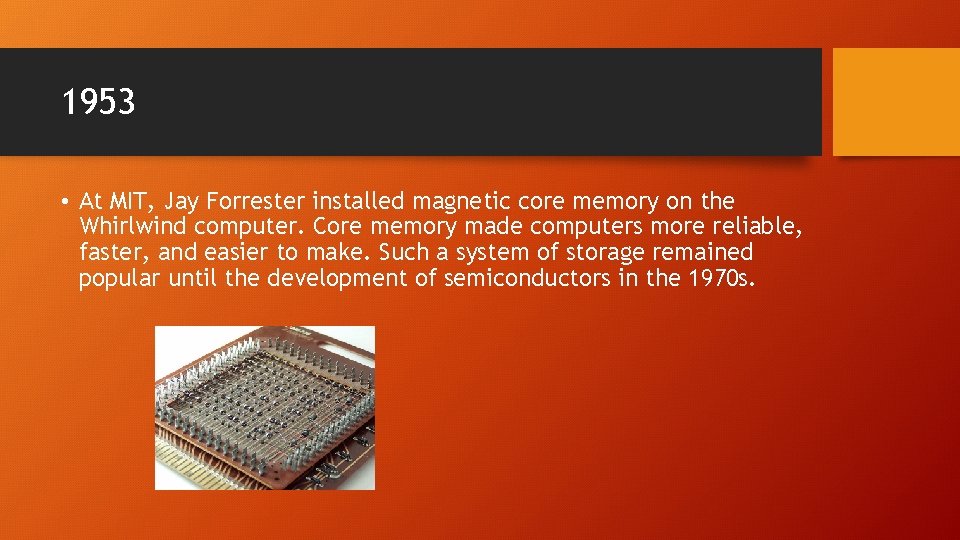
1953 • At MIT, Jay Forrester installed magnetic core memory on the Whirlwind computer. Core memory made computers more reliable, faster, and easier to make. Such a system of storage remained popular until the development of semiconductors in the 1970 s.

1954 • A silicon-based junction transistor, perfected by Gordon Teal of Texas Instruments Inc. , brought the price of this component down to $2. 50. These silicon transistors were smaller sized substitutes for vacuum tubes.
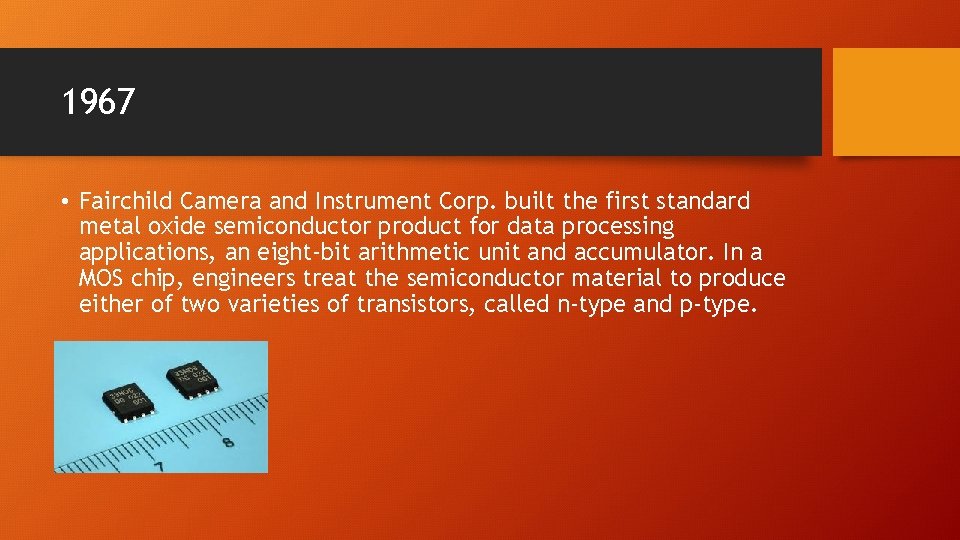
1967 • Fairchild Camera and Instrument Corp. built the first standard metal oxide semiconductor product for data processing applications, an eight-bit arithmetic unit and accumulator. In a MOS chip, engineers treat the semiconductor material to produce either of two varieties of transistors, called n-type and p-type.
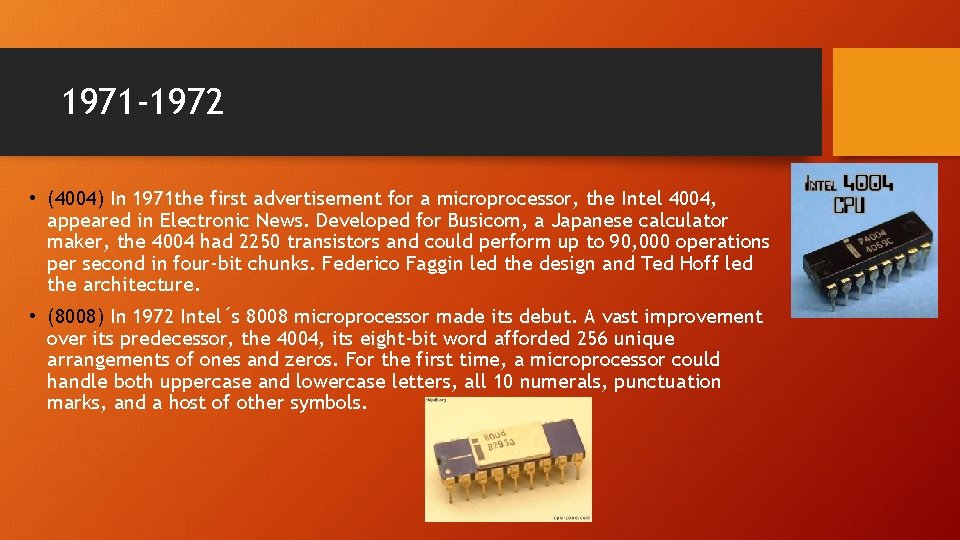
1971 -1972 • (4004) In 1971 the first advertisement for a microprocessor, the Intel 4004, appeared in Electronic News. Developed for Busicom, a Japanese calculator maker, the 4004 had 2250 transistors and could perform up to 90, 000 operations per second in four-bit chunks. Federico Faggin led the design and Ted Hoff led the architecture. • (8008) In 1972 Intel´s 8008 microprocessor made its debut. A vast improvement over its predecessor, the 4004, its eight-bit word afforded 256 unique arrangements of ones and zeros. For the first time, a microprocessor could handle both uppercase and lowercase letters, all 10 numerals, punctuation marks, and a host of other symbols.

Sites • http: //www. computerhistory. org/timeline/? category=cmpnt
- Slides: 8