
THE INNOVATION LAB NETWORK STATES SUPPORTING ASSESSMENT OF
THE INNOVATION LAB NETWORK: STATES SUPPORTING ASSESSMENT OF DEEPER LEARNING AND ORGANIZATIONAL TRANSFORMATION David T. Conley, Paul Leather, Gene Wilhoit
Overview 2 EPIC/SCOPE/SCALE Technical Assistance Project Rep: David Conley ILN Rep: Paul Leather Overview of the ILN and CCR Task Force Innovation in Context: New Hampshire Case Study Discussant: Gene Wilhoit Innovation, Lab States, and the Need to Transform the System
Who We Are 3 EPIC: Educational Policy Improvement Center Eugene/Portland, Oregon David Conley, CEO SCALE: Stanford Center for Assessment, Learning, and Equity Ray Pecheone, Director SCOPE: Stanford Center for Opportunity Policy in Education Linda Darling-Hammond, Co-Director
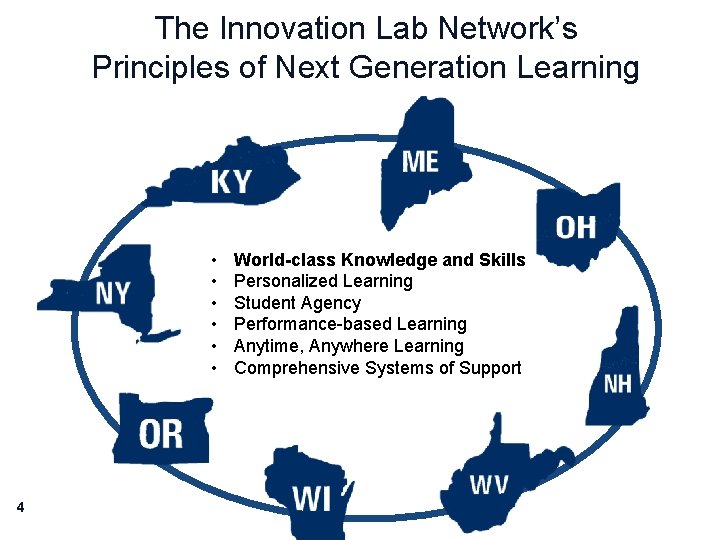
The Innovation Lab Network’s Principles of Next Generation Learning • • • 4 World-class Knowledge and Skills Personalized Learning Student Agency Performance-based Learning Anytime, Anywhere Learning Comprehensive Systems of Support
WORLD-CLASS KNOWLEDGE AND SKILLS… STUDENTS ACQUIRE, PRACTICE, AND DEMONSTRATE THE VARIOUS DIMENSIONS OF LEARNING THAT LEAD TO COLLEGE AND CAREER READINESS THROUGHOUT THE DISCIPLINES. AN IMPORTANT COMPONENT OF THIS WORK IS DEFINING, RECOGNIZING AND DEMONSTRATING A CLEAR VISION OF STUDENT SUCCESS
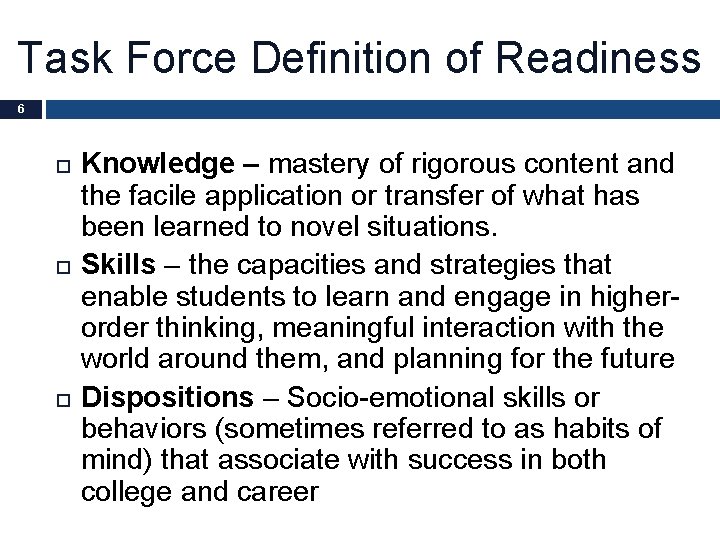
Task Force Definition of Readiness 6 Knowledge – mastery of rigorous content and the facile application or transfer of what has been learned to novel situations. Skills – the capacities and strategies that enable students to learn and engage in higherorder thinking, meaningful interaction with the world around them, and planning for the future Dispositions – Socio-emotional skills or behaviors (sometimes referred to as habits of mind) that associate with success in both college and career
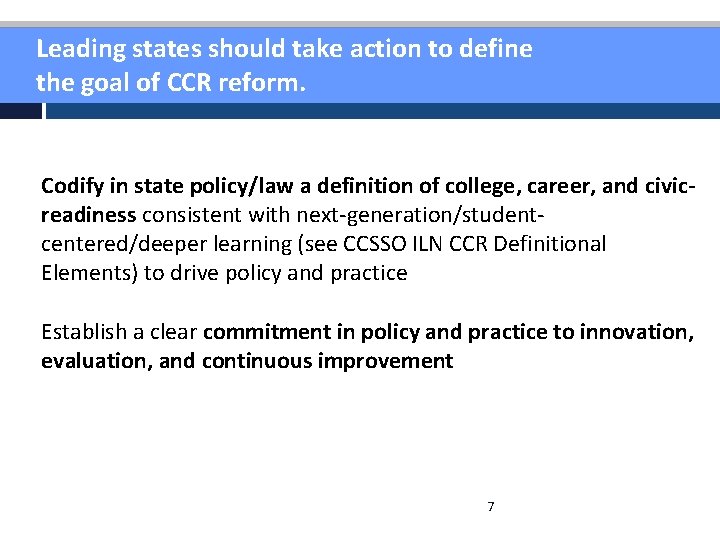
Leading states should take action to define the goal of CCR reform. Codify in state policy/law a definition of college, career, and civicreadiness consistent with next-generation/studentcentered/deeper learning (see CCSSO ILN CCR Definitional Elements) to drive policy and practice Establish a clear commitment in policy and practice to innovation, evaluation, and continuous improvement 7

Leading states create a clear “line of sight” to drive policy/ practice and continuous improvement. Realign program requirements, applications, reporting, and funding to key goals/areas; enhance funding flexibility where appropriate/ needed. 1. Learning Process – Standards, Curriculum, Instruction 2. Assessment, Accountability, Supports 3. Human Capital – Teachers and Leaders 4. Infrastructure – Time and Technology 5. System Learning – Innovation 8
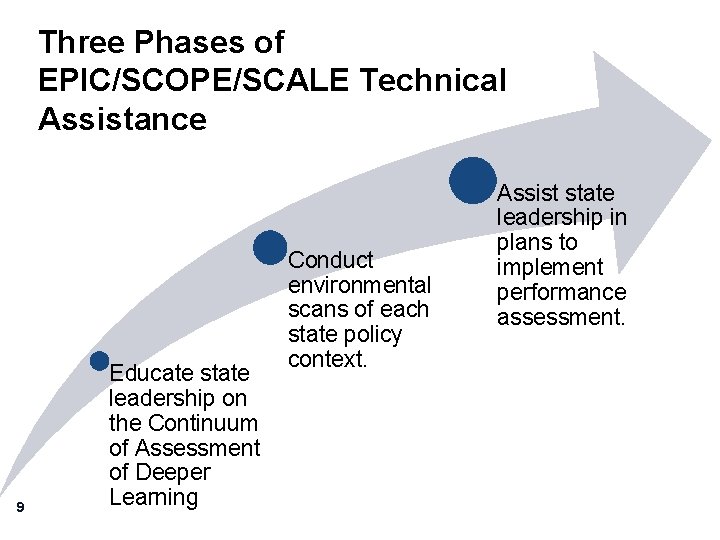
Three Phases of EPIC/SCOPE/SCALE Technical Assistance 9 Educate state leadership on the Continuum of Assessment of Deeper Learning Conduct environmental scans of each state policy context. Assist state leadership in plans to implement performance assessment.
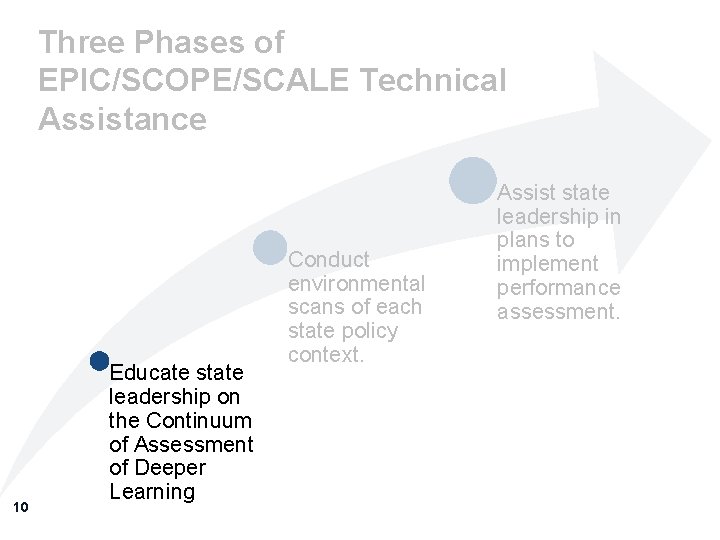
Three Phases of EPIC/SCOPE/SCALE Technical Assistance 10 Educate state leadership on the Continuum of Assessment of Deeper Learning Conduct environmental scans of each state policy context. Assist state leadership in plans to implement performance assessment.
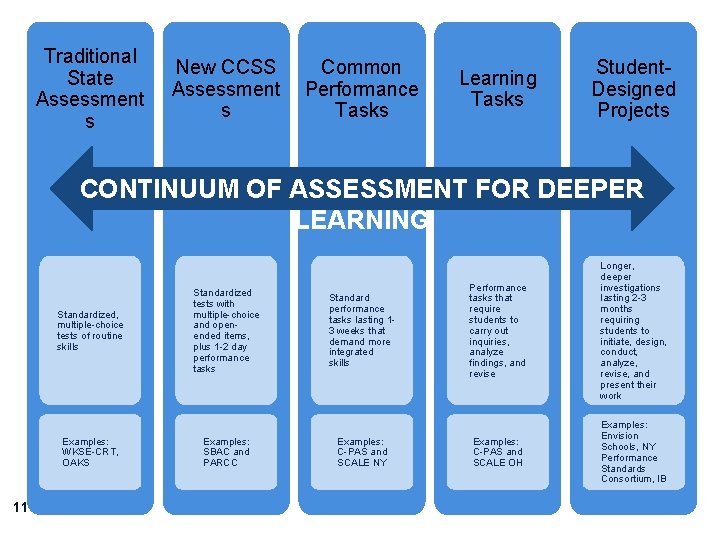
Traditional State Assessment s New CCSS Assessment s Common Performance Tasks Learning Tasks Student. Designed Projects CONTINUUM OF ASSESSMENT FOR DEEPER LEARNING Standardized, multiple-choice tests of routine skills Examples: WKSE-CRT, OAKS 11 Standardized tests with multiple-choice and openended items, plus 1 -2 day performance tasks Examples: SBAC and PARCC Standard performance tasks lasting 13 weeks that demand more integrated skills Examples: C-PAS and SCALE NY Performance tasks that require students to carry out inquiries, analyze findings, and revise Longer, deeper investigations lasting 2 -3 months requiring students to initiate, design, conduct, analyze, revise, and present their work Examples: C-PAS and SCALE OH Examples: Envision Schools, NY Performance Standards Consortium, IB
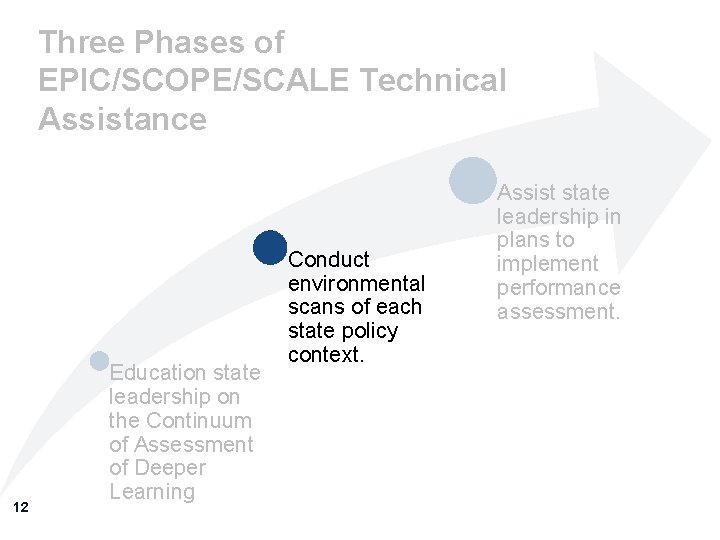
Three Phases of EPIC/SCOPE/SCALE Technical Assistance 12 Education state leadership on the Continuum of Assessment of Deeper Learning Conduct environmental scans of each state policy context. Assist state leadership in plans to implement performance assessment.
13 What We Did & Why § Interviewed state leadership § Gathered extant data from websites, waiver requests, and other public documents § Analyzed across states for trends, themes, commonalities, and nuances § Viewed the analysis as a continuing process § Learning about ILN districts, state policy plans and directions
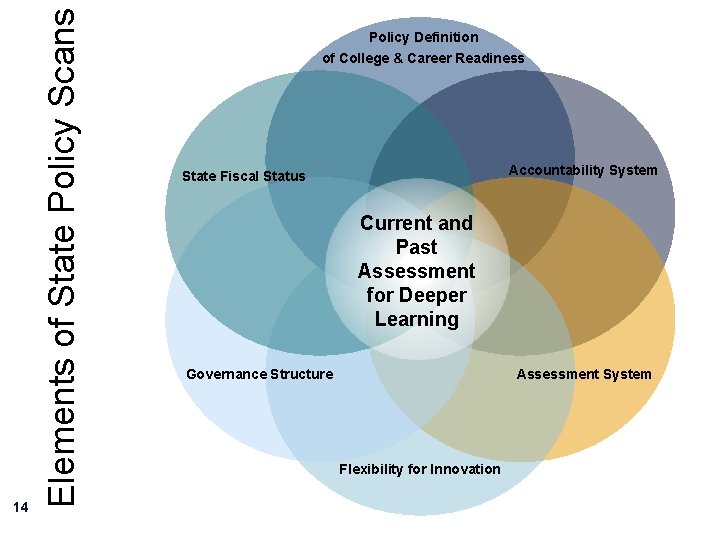
Elements of State Policy Scans 14 Policy Definition of College & Career Readiness Accountability System State Fiscal Status Current and Past Assessment for Deeper Learning Governance Structure Assessment System Flexibility for Innovation
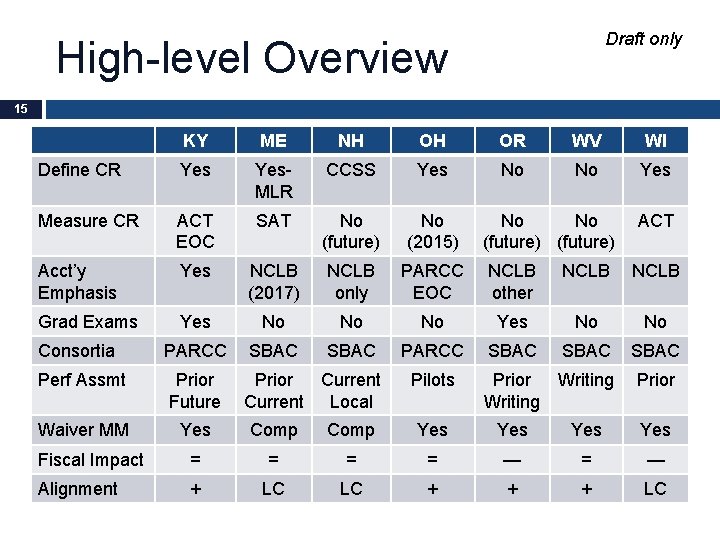
Draft only High-level Overview 15 KY ME NH OH OR WV WI Define CR Yes. MLR CCSS Yes No No Yes Measure CR ACT EOC SAT No (future) No (2015) Acct’y Emphasis Yes NCLB (2017) NCLB only PARCC EOC NCLB other NCLB Grad Exams Yes No No No Yes No No PARCC SBAC SBAC Pilots Prior Writing Prior Consortia Prior Current Local No No (future) ACT Perf Assmt Prior Future Waiver MM Yes Comp Yes Yes Fiscal Impact = = — = — Alignment + LC LC + + + LC
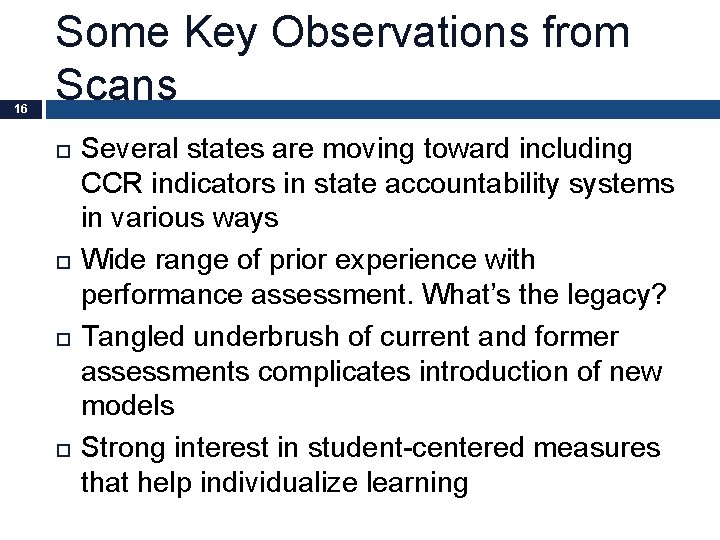
16 Some Key Observations from Scans Several states are moving toward including CCR indicators in state accountability systems in various ways Wide range of prior experience with performance assessment. What’s the legacy? Tangled underbrush of current and former assessments complicates introduction of new models Strong interest in student-centered measures that help individualize learning
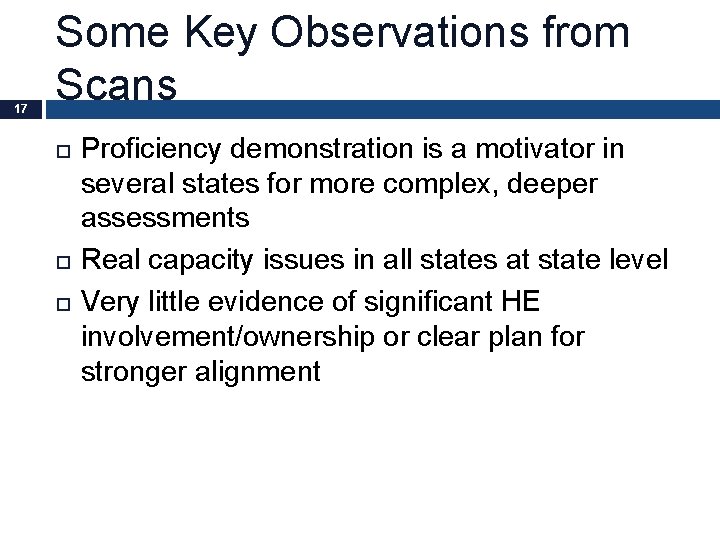
17 Some Key Observations from Scans Proficiency demonstration is a motivator in several states for more complex, deeper assessments Real capacity issues in all states at state level Very little evidence of significant HE involvement/ownership or clear plan for stronger alignment
18 Some Key Questions from Scans An Assessment System vs a System of Assessments: What measures should be collected for high-stakes decisions, and which ones inform classroom instruction, and how do they combine for a student-centered profile of readiness? “Local Control” and SEA Leadership: How do we take local innovation to scale? Where do we go from here?
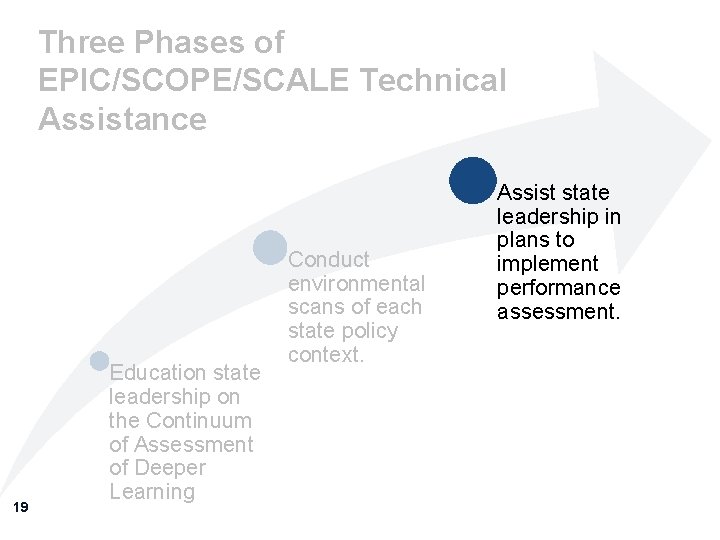
Three Phases of EPIC/SCOPE/SCALE Technical Assistance 19 Education state leadership on the Continuum of Assessment of Deeper Learning Conduct environmental scans of each state policy context. Assist state leadership in plans to implement performance assessment.
Key Strategies 20 Direct support for assessment development, piloting, and implementation Professional development / technical assistance to build educator / system capacity Facilitation of higher education involvement Treat this work as rapid prototyping exercises that are both bottom-driven and top-supported
Thumbnail State Profiles 21 Kentucky Oregon New Hampshire Case Study
EMBEDDED AND OPERATIONALIZED INTO POLICY AS A CUT SCORE. THE STATE ALSO HAS A RICH AND DIVERSE PORTFOLIO OF EXPERIENCE WITH PERFORMANCE ASSESSMENT. RECENT LEGISLATION CREATED “INNOVATION ZONES” AND OPENED NEW DOOR TO DESIGN AND PILOT NEW SYSTEMS OF DEFINING AND MEASURING A MORE COMPREHENSIVE DEFINITION OF READINESS.
PERFORMANCE ASSESSMENT THAT WAS IN PLACE IN THE 1990 S THROUGH THE CIM, CAM, AND PASS. THE STATE IS ALSO IN TRANSITION TO A NEW GOVERNANCE MODEL TO CREATE A FULLY ALIGNED P-20 SYSTEM UNDER “ 40/40/20” GOAL. THE NEW OREGON DIPLOMA INCLUDES A SET OF ESSENTIAL SKILLS FOR GRADUATION THAT DISTRICTS ARE RESPONSIBLE FOR MEASURING. MANY OF THESE SKILLS ARE COGNITIVELY COMPLEX.
PAUL LEATHER, ILN REP. NEW HAMPSHIRE CASE STUDY: ESEA WAIVER: A NEW THEORY OF ACTION FOR ACCOUNTABILITY AND A BALANCED SYSTEM OF ASSESSMENTS
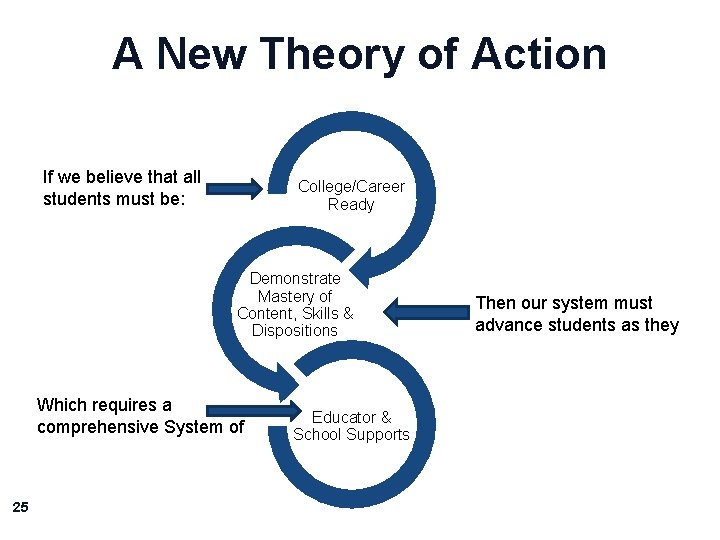
A New Theory of Action If we believe that all students must be: College/Career Ready Demonstrate Mastery of Content, Skills & Dispositions Which requires a comprehensive System of 25 Educator & School Supports Then our system must advance students as they
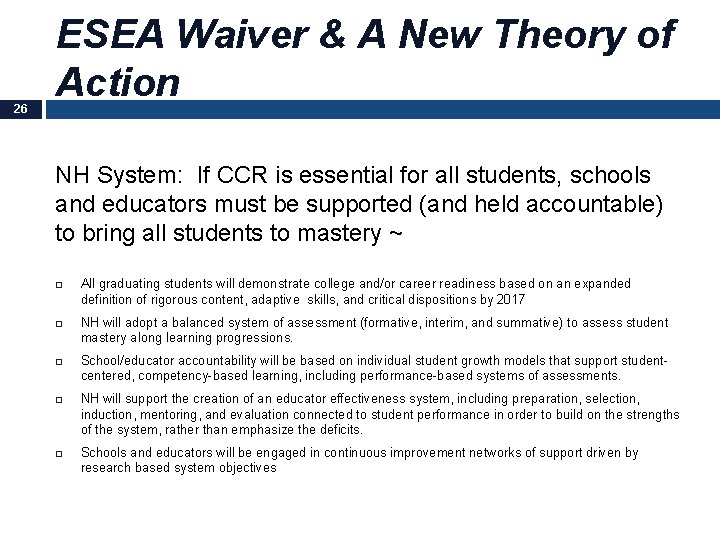
26 ESEA Waiver & A New Theory of Action NH System: If CCR is essential for all students, schools and educators must be supported (and held accountable) to bring all students to mastery ~ All graduating students will demonstrate college and/or career readiness based on an expanded definition of rigorous content, adaptive skills, and critical dispositions by 2017 NH will adopt a balanced system of assessment (formative, interim, and summative) to assess student mastery along learning progressions. School/educator accountability will be based on individual student growth models that support studentcentered, competency-based learning, including performance-based systems of assessments. NH will support the creation of an educator effectiveness system, including preparation, selection, induction, mentoring, and evaluation connected to student performance in order to build on the strengths of the system, rather than emphasize the deficits. Schools and educators will be engaged in continuous improvement networks of support driven by research based system objectives
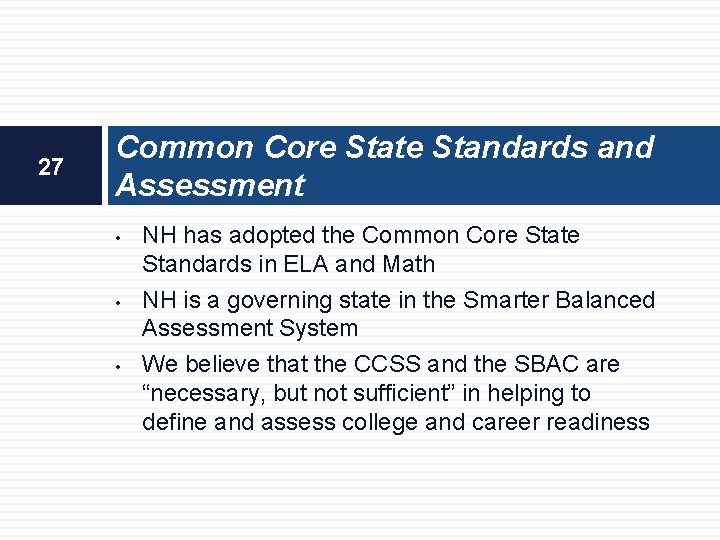
27 Common Core State Standards and Assessment • • • NH has adopted the Common Core State Standards in ELA and Math NH is a governing state in the Smarter Balanced Assessment System We believe that the CCSS and the SBAC are “necessary, but not sufficient” in helping to define and assess college and career readiness
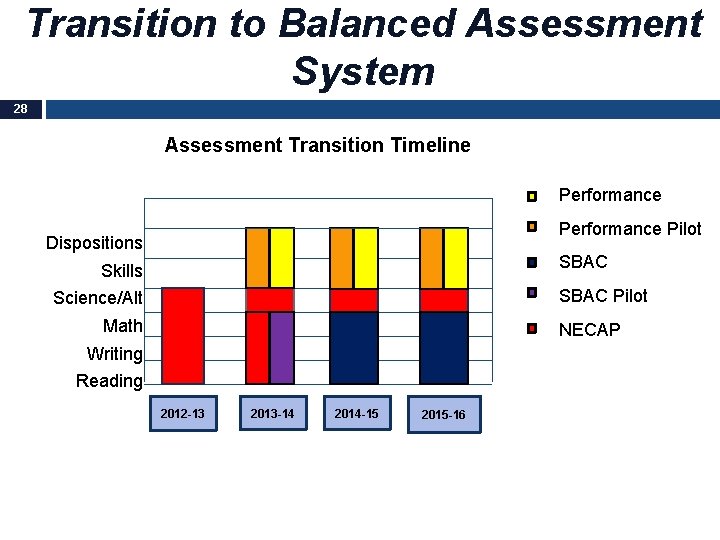
Transition to Balanced Assessment System 28 Assessment Transition Timeline Performance Pilot Dispositions SBAC Skills SBAC Pilot Science/Alt Math NECAP Writing Reading 2012 -13 2013 -14 2014 -15 2015 -16
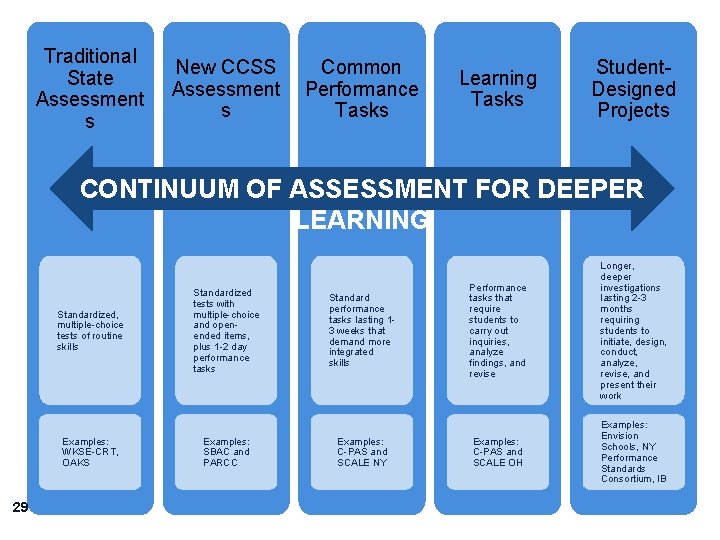
Traditional State Assessment s New CCSS Assessment s Common Performance Tasks Learning Tasks Student. Designed Projects CONTINUUM OF ASSESSMENT FOR DEEPER LEARNING Standardized, multiple-choice tests of routine skills Examples: WKSE-CRT, OAKS 29 Standardized tests with multiple-choice and openended items, plus 1 -2 day performance tasks Examples: SBAC and PARCC Standard performance tasks lasting 13 weeks that demand more integrated skills Examples: C-PAS and SCALE NY Performance tasks that require students to carry out inquiries, analyze findings, and revise Longer, deeper investigations lasting 2 -3 months requiring students to initiate, design, conduct, analyze, revise, and present their work Examples: C-PAS and SCALE OH Examples: Envision Schools, NY Performance Standards Consortium, IB
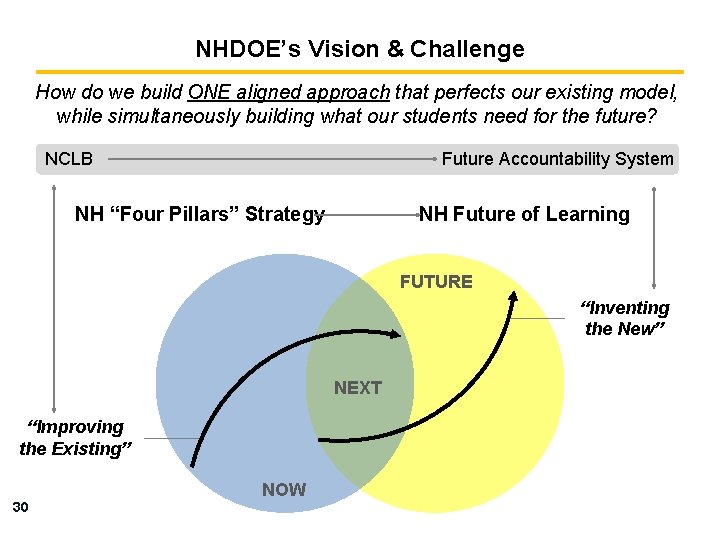
NHDOE’s Vision & Challenge How do we build ONE aligned approach that perfects our existing model, while simultaneously building what our students need for the future? NCLB Future Accountability System NH “Four Pillars” Strategy NH Future of Learning FUTURE “Inventing the New” NEXT “Improving the Existing” 30 NOW
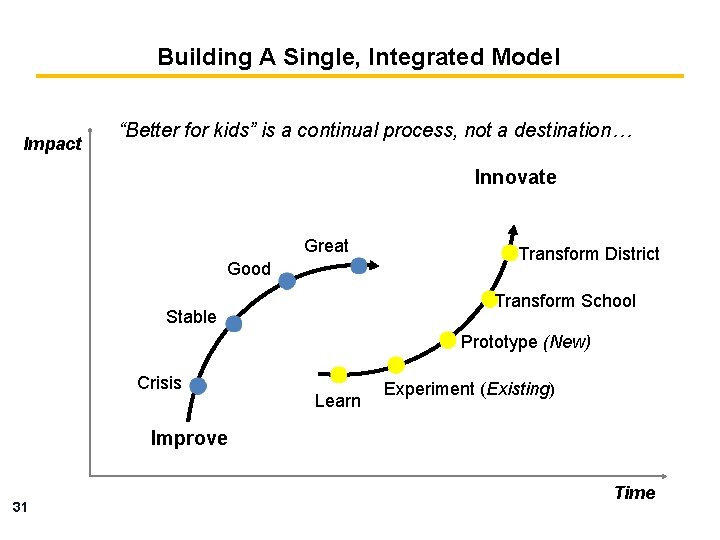
Building A Single, Integrated Model Impact “Better for kids” is a continual process, not a destination… Innovate Great Good Transform District Transform School Stable Prototype (New) Crisis Learn Experiment (Existing) Improve 31 Time

Re-thinking Networks Building on existing structures, but being clearer about a continuum of options for districts and schools based on need and interest Time-limited/ Rapid Prototype Improvement 32 Innovation Traditional, Standing Network
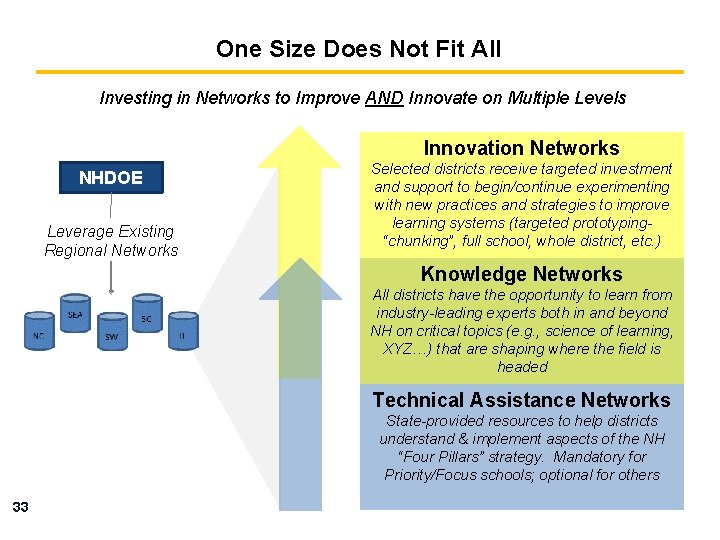
One Size Does Not Fit All Investing in Networks to Improve AND Innovate on Multiple Levels Innovation Networks NHDOE Leverage Existing Regional Networks Selected districts receive targeted investment and support to begin/continue experimenting with new practices and strategies to improve learning systems (targeted prototyping“chunking”, full school, whole district, etc. ) Knowledge Networks All districts have the opportunity to learn from industry-leading experts both in and beyond NH on critical topics (e. g. , science of learning, XYZ…) that are shaping where the field is headed Technical Assistance Networks State-provided resources to help districts understand & implement aspects of the NH “Four Pillars” strategy. Mandatory for Priority/Focus schools; optional for others 33
GENE WILHOIT, DISCUSSANT VISION FOR THE ILN IMPLICATIONS FOR STATE INNOVATION LOOKING FORWARD
QUESTIONS? Then one last thought…
“INNOVATIO N IS INVENTION MADE ACCESSIBLE. ”
- Slides: 36