
The Innovation Imperative Student Centered Learning Models sweeneynjit

- Slides: 99
The Innovation Imperative: Student Centered Learning Models sweeney@njit. edu Richard Sweeney 973 -596 -3208 Today’s Agenda Part 1 What does the research say about the research Millennial behaviors, preferences and characteristics? Part 2 What innovations, technologies and pedagogies are more likely to engage Millennials as well as improve and speed their learning?
The Innovation Imperative: Student Centered Learning Models sweeney@njit. edu Richard Sweeney 973 -596 -3208 “America's leading colleges and universities must "embrace massive experimentation" to embrace massive experimentation stay competitive as more and more educational choices become available thanks to the Internet, said Reed Hundt, former chairman of the Federal Communications Commission and a senior adviser on information industries to Mc. Kinsey & Company, during a conference late last week on the future of the Internet. ” p. 282 Young, Jeffrey R. “Colleges Must Shake Up Their Business Models to Counter New Competition Online, Former FCC Chairman Says”. The Wired Campus The Chronicle of Higher Education. May 19, 2008 Innovation
The Innovation Imperative: Student Centered Learning Models sweeney@njit. edu Richard Sweeney 973 -596 -3208 “Creative leadership is required to correct any such institutional weaknesses and to lead the process of establishing a culture of innovation. ”p. 90 “In higher education, the creative lead the creative. ” p. 90 Graves, William. “Improving Institutional Performance through ITXXXXXXXXXXXXXX Foreman, Joel. “Next-Generation Educational Technology Enabled Innovation”. EDUCAUSE Review Nov/Dec 2005: 79 -98 Versus the Lecture. ” Innovation
The Innovation Imperative: Student Centered Learning Models sweeney@njit. edu Richard Sweeney 973 -596 -3208 Is our goal to give students the best teaching? or Is our goal to engage students in learning faster and better? Powerpoint (Revised 5/20/2008) available at: http: //library 1. njit. edu/staff-folders/sweeney/
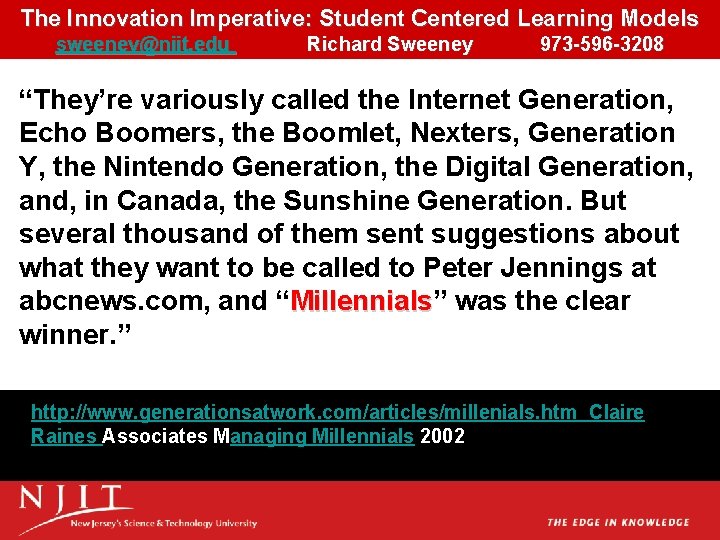
The Innovation Imperative: Student Centered Learning Models sweeney@njit. edu Richard Sweeney 973 -596 -3208 “They’re variously called the Internet Generation, Echo Boomers, the Boomlet, Nexters, Generation Y, the Nintendo Generation, the Digital Generation, and, in Canada, the Sunshine Generation. But several thousand of them sent suggestions about what they want to be called to Peter Jennings at abcnews. com, and “Millennials” was the clear Millennials winner. ” http: //www. generationsatwork. com/articles/millenials. htm Claire Raines Associates Managing Millennials 2002
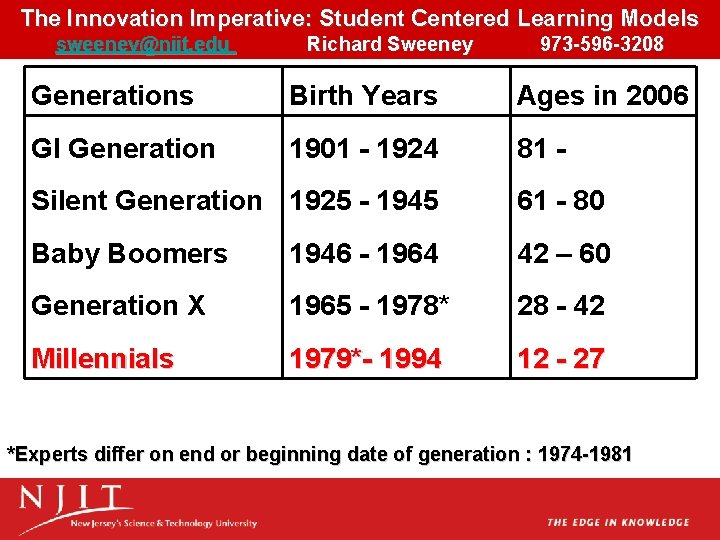
The Innovation Imperative: Student Centered Learning Models sweeney@njit. edu Richard Sweeney 973 -596 -3208 Generations Birth Years Ages in 2006 GI Generation 1901 - 1924 81 - Silent Generation 1925 - 1945 61 - 80 Baby Boomers 1946 - 1964 42 – 60 Generation X 1965 - 1978* 28 - 42 Millennials 1979*- 1994 12 - 27 *Experts differ on end or beginning date of generation : 1974 -1981
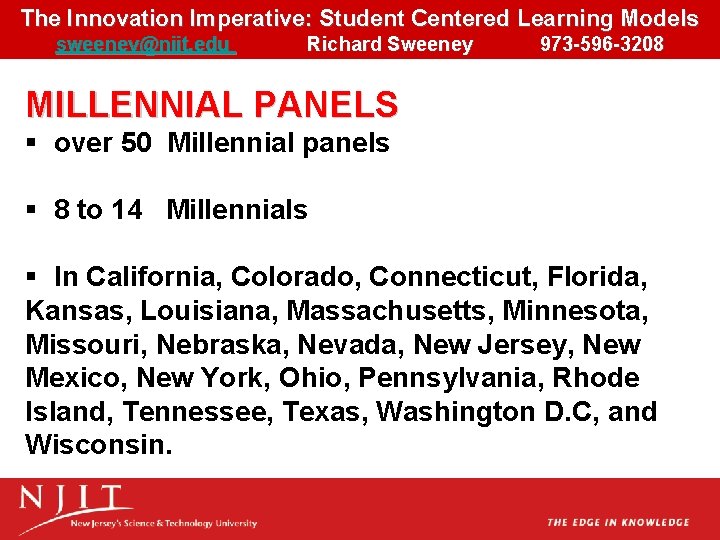
The Innovation Imperative: Student Centered Learning Models sweeney@njit. edu Richard Sweeney 973 -596 -3208 MILLENNIAL PANELS § over 50 Millennial panels § 8 to 14 Millennials § In California, Colorado, Connecticut, Florida, Kansas, Louisiana, Massachusetts, Minnesota, Missouri, Nebraska, Nevada, New Jersey, New Mexico, New York, Ohio, Pennsylvania, Rhode Island, Tennessee, Texas, Washington D. C, and Wisconsin.
The Innovation Imperative: Student Centered Learning Models sweeney@njit. edu Richard Sweeney 973 -596 -3208 The main question I studied: Are Millennials different from prior generations at the same age?
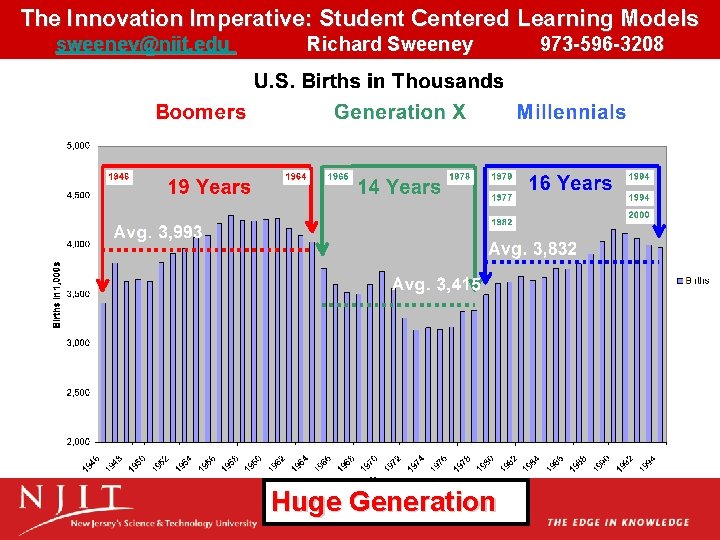
The Innovation Imperative: Student Centered Learning Models sweeney@njit. edu Richard Sweeney 973 -596 -3208 Huge Generation
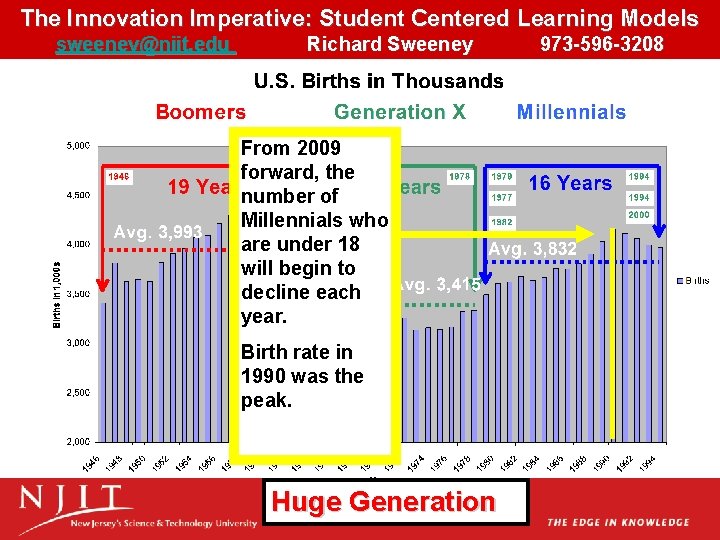
The Innovation Imperative: Student Centered Learning Models sweeney@njit. edu Richard Sweeney 973 -596 -3208 From 2009 forward, the number of Millennials who are under 18 will begin to decline each year. Birth rate in 1990 was the peak. Huge Generation
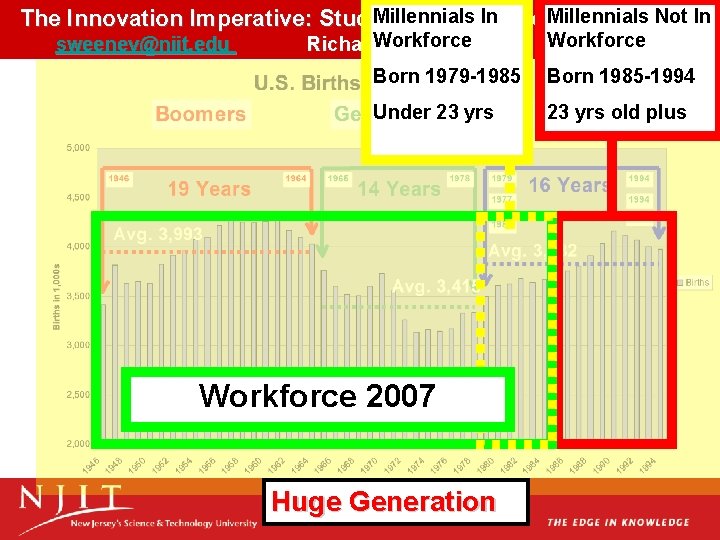
Millennials In Millennials Not In The Innovation Imperative: Student Centered Learning Models Workforce 973 -596 -3208 Workforce sweeney@njit. edu Richard Sweeney Born 1979 -1985 Born 1985 -1994 Under 23 yrs old plus Workforce 2007 Huge Generation
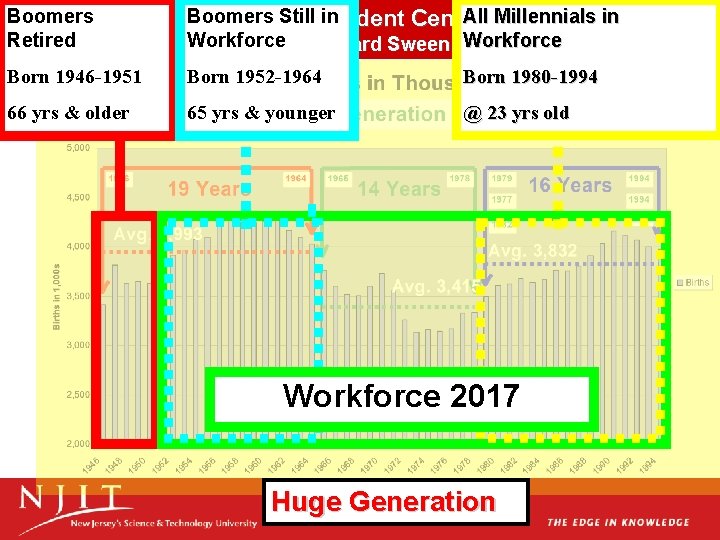
Boomers Still in All Millennials in The Innovation Imperative: Student Centered Learning Models Retired Workforce sweeney@njit. edu Richard Sweeney. Workforce 973 -596 -3208 Born 1946 -1951 Born 1952 -1964 Born 1980 -1994 66 yrs & older 65 yrs & younger @ 23 yrs old Workforce 2017 Huge Generation
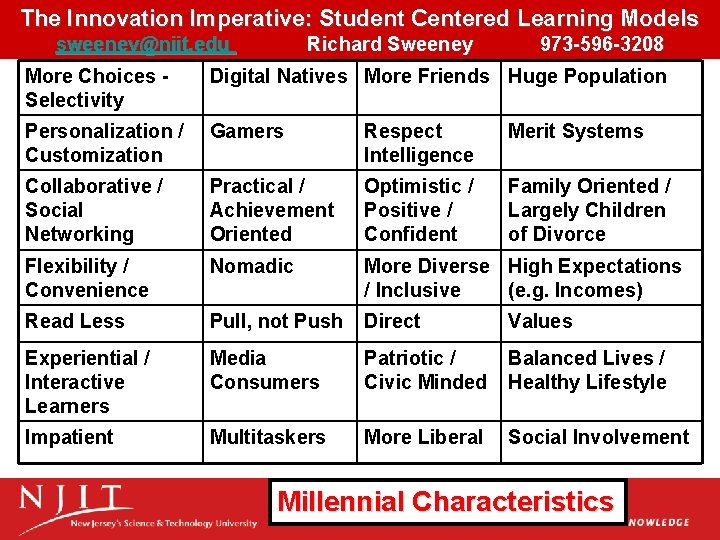
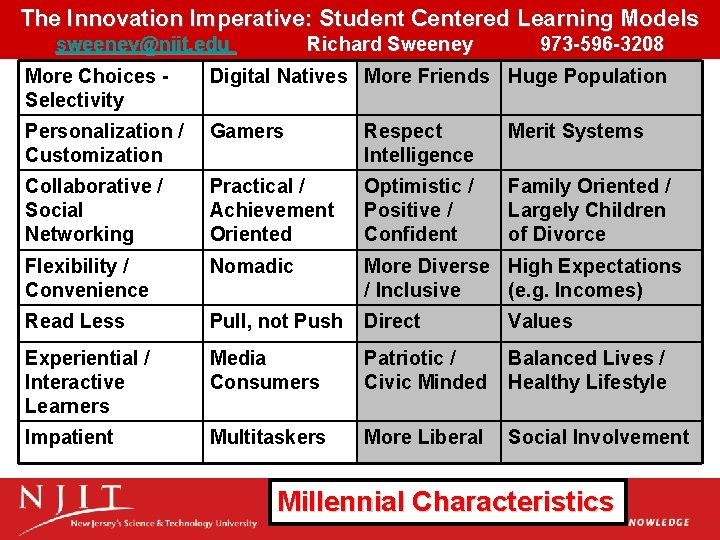
The Innovation Imperative: Student Centered Learning Models sweeney@njit. edu Richard Sweeney 973 -596 -3208 More Choices - Selectivity Digital Natives More Friends Huge Population Personalization / Customization Gamers Respect Intelligence Merit Systems Collaborative / Social Networking Practical / Achievement Oriented Optimistic / Positive / Confident Family Oriented / Largely Children of Divorce Flexibility / Convenience Nomadic More Diverse High Expectations / Inclusive (e. g. Incomes) Read Less Pull, not Push Direct Values Experiential / Interactive Learners Media Consumers Patriotic / Civic Minded Balanced Lives / Healthy Lifestyle Impatient Multitaskers More Liberal Social Involvement Millennial Characteristics
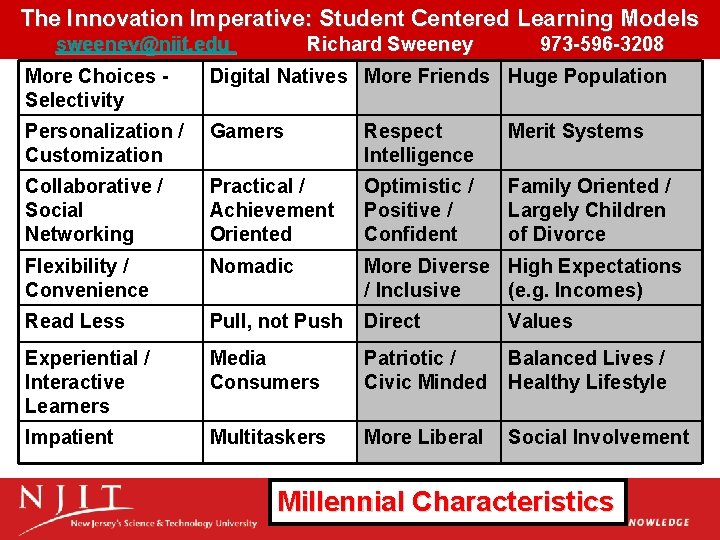
The Innovation Imperative: Student Centered Learning Models sweeney@njit. edu Richard Sweeney 973 -596 -3208 More Choices - Selectivity Digital Natives More Friends Huge Population Personalization / Customization Gamers Respect Intelligence Merit Systems Collaborative / Social Networking Practical / Achievement Oriented Optimistic / Positive / Confident Family Oriented / Largely Children of Divorce Flexibility / Convenience Nomadic More Diverse High Expectations / Inclusive (e. g. Incomes) Read Less Pull, not Push Direct Values Experiential / Interactive Learners Media Consumers Patriotic / Civic Minded Balanced Lives / Healthy Lifestyle Impatient Multitaskers More Liberal Social Involvement Millennial Characteristics
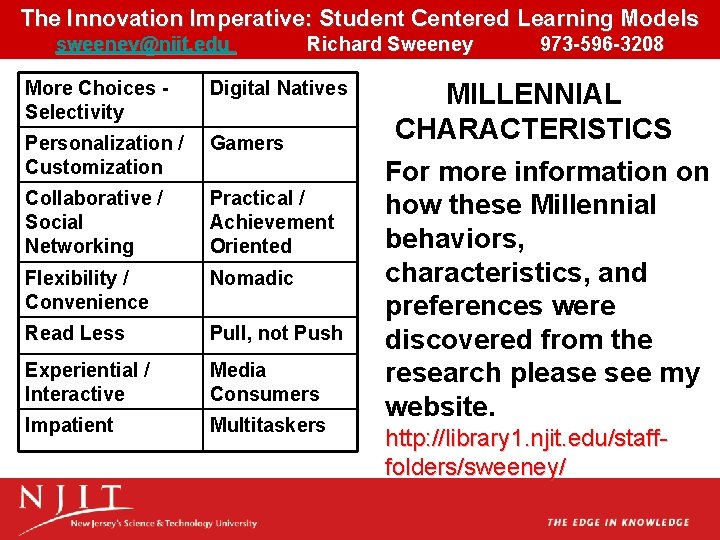
The Innovation Imperative: Student Centered Learning Models sweeney@njit. edu Richard Sweeney 973 -596 -3208 More Choices - Selectivity Digital Natives Personalization / Customization Gamers Collaborative / Social Networking Practical / Achievement Oriented Flexibility / Convenience Nomadic Read Less Pull, not Push Experiential / Interactive Media Consumers Impatient Multitaskers MILLENNIAL CHARACTERISTICS For more information on how these Millennial behaviors, characteristics, and preferences were discovered from the research please see my website. http: //library 1. njit. edu/stafffolders/sweeney/
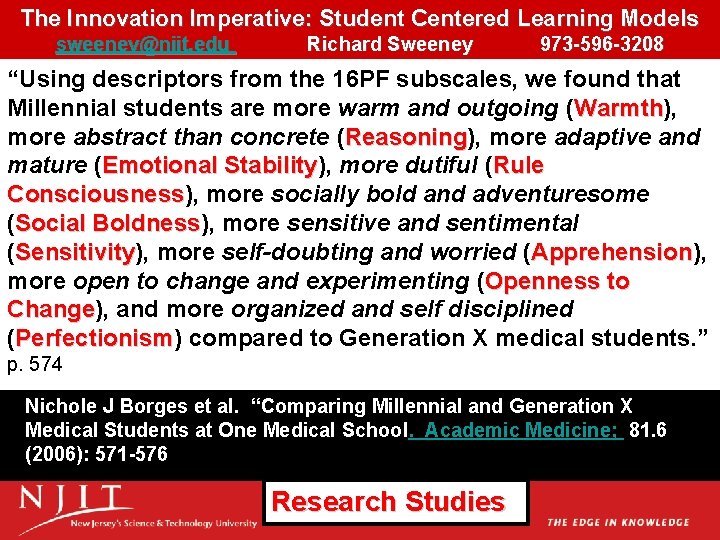
The Innovation Imperative: Student Centered Learning Models sweeney@njit. edu Richard Sweeney 973 -596 -3208 “Using descriptors from the 16 PF subscales, we found that Millennial students are more warm and outgoing (Warmth), Warmth more abstract than concrete (Reasoning), more adaptive and Reasoning mature (Emotional Stability), more dutiful (Rule Emotional Stability Consciousness), more socially bold and adventuresome Consciousness (Social Boldness), more sensitive and sentimental Social Boldness (Sensitivity), more self-doubting and worried (Apprehension), Sensitivity Apprehension more open to change and experimenting (Openness to Change), and more organized and self disciplined Change (Perfectionism) compared to Generation X medical students. ” Perfectionism p. 574 Nichole J Borges et al. “Comparing Millennial and Generation X Medical Students at One Medical School. Academic Medicine; 81. 6 (2006): 571 -576 Research Studies
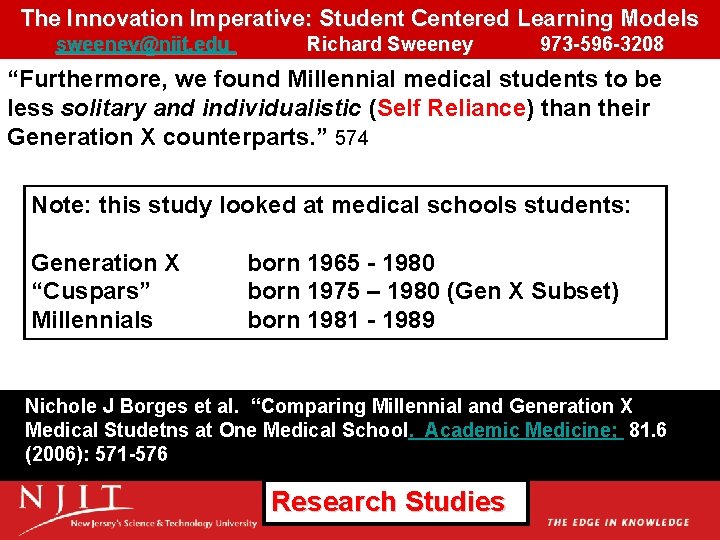
The Innovation Imperative: Student Centered Learning Models sweeney@njit. edu Richard Sweeney 973 -596 -3208 “Furthermore, we found Millennial medical students to be less solitary and individualistic (Self Reliance) than their Generation X counterparts. ” 574 Note: this study looked at medical schools students: Generation X “Cuspars” Millennials born 1965 - 1980 born 1975 – 1980 (Gen X Subset) born 1981 - 1989 Nichole J Borges et al. “Comparing Millennial and Generation X Medical Studetns at One Medical School. Academic Medicine; 81. 6 (2006): 571 -576 Research Studies
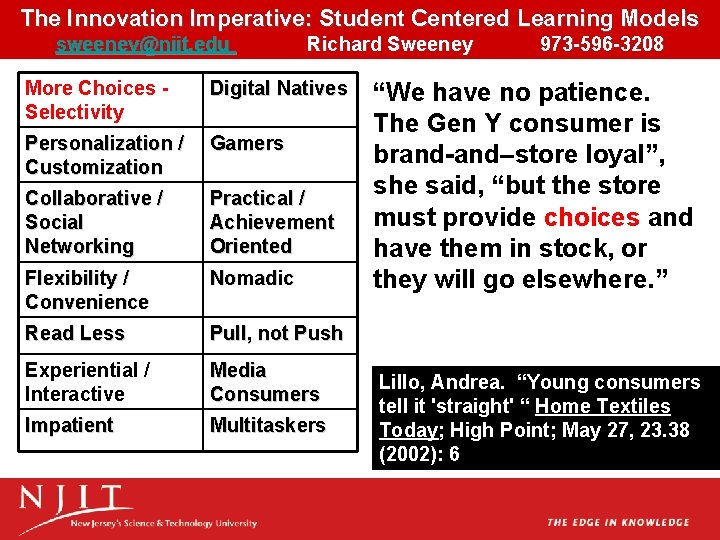
The Innovation Imperative: Student Centered Learning Models sweeney@njit. edu Richard Sweeney 973 -596 -3208 More Choices - Selectivity Digital Natives Personalization / Gamers Customization Collaborative / Social Networking Practical / Achievement Oriented Flexibility / Convenience Nomadic Read Less Pull, not Push Experiential / Interactive Media Consumers Impatient Multitaskers “We have no patience. The Gen Y consumer is brand-and–store loyal”, she said, “but the store must provide choices and have them in stock, or they will go elsewhere. ” Lillo, Andrea. “Young consumers tell it 'straight' “ Home Textiles Today; High Point; May 27, 23. 38 (2002): 6
The Innovation Imperative: Student Centered Learning Models sweeney@njit. edu Richard Sweeney 973 -596 -3208 “Trouble is, the world is full of too many choices [even the cereal aisle can "turn into a painful decision process"]…. And as Healy describes, they also have a lot more choices. This generation has the luxury of living with their parents until they get on their feet, can start their own company, and can take time to travel, notes Penelope Trunk, columnist, blogger, and author of Brazen Careerist [Warner Business Books, 2007]. ” p. 6 Mc. Cormack, Karyn. “Careers: The Goods on Generation Y”. Business Week Online, 25 June 2007: 6 More Choices
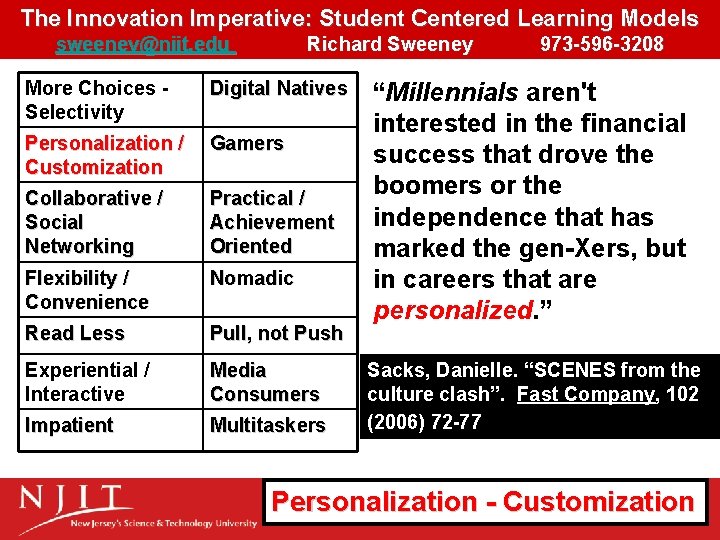
The Innovation Imperative: Student Centered Learning Models sweeney@njit. edu Richard Sweeney 973 -596 -3208 More Choices - Selectivity Digital Natives Personalization / Gamers Customization Collaborative / Social Networking Practical / Achievement Oriented Flexibility / Convenience Nomadic Read Less Pull, not Push Experiential / Interactive Media Consumers Impatient Multitaskers “Millennials aren't interested in the financial success that drove the boomers or the independence that has marked the gen-Xers, but in careers that are personalized. ” Sacks, Danielle. “SCENES from the culture clash”. Fast Company, 102 (2006) 72 -77 Personalization - Customization
The Innovation Imperative: Student Centered Learning Models sweeney@njit. edu Richard Sweeney 973 -596 -3208 “Millions of millennials are logging onto social networks like imeem and i. Like, which allow visitors to discover new music and recommend it to their friends. Millions more are flocking to online radio stations such as Pandora Radio, where you can create your own personalized stations. " Burrows, Peter. “Stars Are Aligning for Subscription Music”. Business Week; 12/17/2007 Issue 4063, p 066 -067, 2 p, 2 c Personalization - Customization
The Innovation Imperative: Student Centered Learning Models sweeney@njit. edu Richard Sweeney 973 -596 -3208 “Research shows that customized and personalized rings are hugely popular among Millennials. " Heebner, Jennifer. “Millennials Get Married”. JCK; Jan 2005, Vol. 176 Issue 1, p 70 -73, 4 p Personalization - Customization
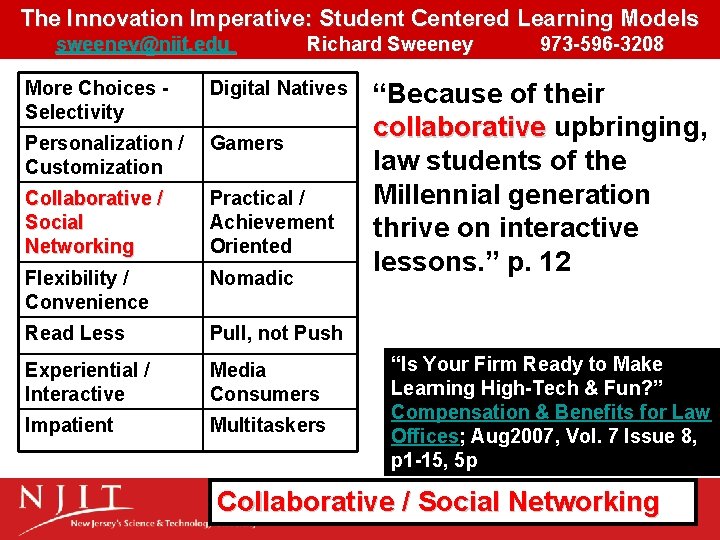
The Innovation Imperative: Student Centered Learning Models sweeney@njit. edu Richard Sweeney 973 -596 -3208 More Choices - Selectivity Digital Natives Personalization / Customization Gamers Collaborative / Social Networking Practical / Achievement Oriented Flexibility / Convenience Nomadic Read Less Pull, not Push Experiential / Interactive Media Consumers Impatient Multitaskers “Because of their collaborative upbringing, collaborative law students of the Millennial generation thrive on interactive lessons. ” p. 12 “Is Your Firm Ready to Make Learning High-Tech & Fun? ” Compensation & Benefits for Law Offices; Aug 2007, Vol. 7 Issue 8, p 1 -15, 5 p Collaborative / Social Networking
The Innovation Imperative: Student Centered Learning Models sweeney@njit. edu Richard Sweeney 973 -596 -3208 “Lyons believes that there is an increasing need for a collaborative business model which focuses on collaborative geographically dispersed teams. She feels that Generation Yer's fondness of collaborative environments will increase collaborative productivity in companies who embrace these environments. ” p. 4 Lyons, Martha. “Career Watch”. Computerworld; 1/22/2007, Vol. 41 Issue 4, p 39 -39, 3/4 p Collaborative / Social Networking
The Innovation Imperative: Student Centered Learning Models sweeney@njit. edu Richard Sweeney 973 -596 -3208 “First, it's where Gen Y is, and the overwhelming feedback from RBC research last year was "they said you have to be where we are, which is online. " Second, Facebook provides a mechanism for youngsters to circulate Royal Bank information to their group. Social networking is the key distinction between Gen Y Social networking and other generations, including the relatively techie Gen X, says Barkwell. ” O'Sullivan, Orla. “Getting real with Gen Wired”. ABA Banking Journal, Nov 2007, Vol. 99 Issue 11, p 48 -50, Collaborative / Social Networking
The Innovation Imperative: Student Centered Learning Models sweeney@njit. edu Richard Sweeney 973 -596 -3208 “Along with differences in attitudes, millennials exhibit distinct learning styles. For example, their learning preferences tend toward teamwork, experiential activities, structure and the use of technology. Their strengths include multitasking, multitasking goal orientation, positive attitudes, and a collaborative style. ” Oblinger, Diana. “Understanding the New Student. ” Educause Review, 38. 3 (2003): 36 -42. Collaborative / Social Networking
The Innovation Imperative: Student Centered Learning Models sweeney@njit. edu Richard Sweeney 973 -596 -3208 “Today Millennials demonstrate a renewed sense of interest in contributing to the collective good and are volunteering for community service and joining organizations in record numbers. Described as sociable, confident, optimistic, talented, well-educated, collaborative, open-minded, and achievement-oriented, collaborative members of the Millennial Generation are being welcomed into the workplace as shortages exist in numerous settings (Raines, 2003). ” Oblinger, Diana. “Understanding the New Student. ” Educause Review, 38. 3 (2003): 36 -42. Collaborative / Social Networking
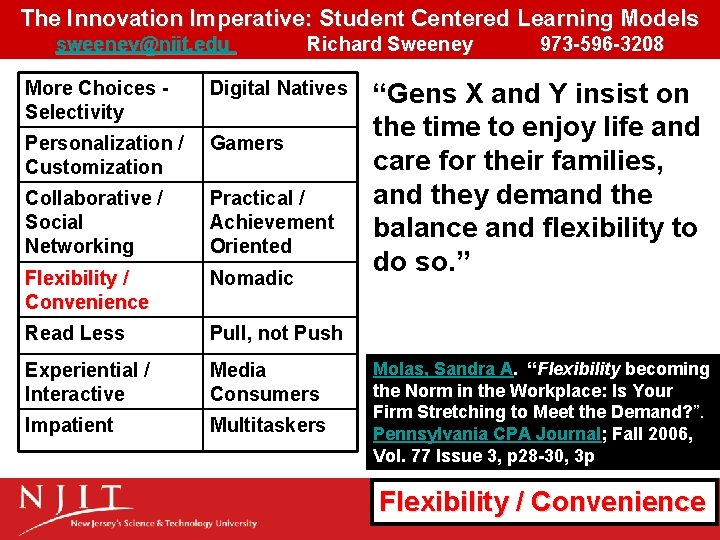
The Innovation Imperative: Student Centered Learning Models sweeney@njit. edu Richard Sweeney 973 -596 -3208 More Choices - Selectivity Digital Natives Personalization / Customization Gamers Collaborative / Social Networking Practical / Achievement Oriented Flexibility / Convenience Nomadic Read Less Pull, not Push Experiential / Interactive Media Consumers Impatient Multitaskers “Gens X and Y insist on the time to enjoy life and care for their families, and they demand the balance and flexibility to do so. ” Molas, Sandra A. “Flexibility becoming the Norm in the Workplace: Is Your Firm Stretching to Meet the Demand? ”. Pennsylvania CPA Journal; Fall 2006, Vol. 77 Issue 3, p 28 -30, 3 p Flexibility / Convenience
The Innovation Imperative: Student Centered Learning Models sweeney@njit. edu Richard Sweeney 973 -596 -3208 “They want a great deal of flexibility without flexibility commitment. They like to switch. ” p. 12 Cameron, Alan. “Maxing with the Millennials” GPS World; December 2007, Vol. 18 Issue 12, p 10 -12 Richard Sweeney Flexibility / Convenience
The Innovation Imperative: Student Centered Learning Models sweeney@njit. edu Richard Sweeney 973 -596 -3208 “ 50% say having flexibility in planning a career flexibility around major life events is the most important element for achieving a good balance between a career and personal life. ” p. 4 Ernst and Young, Canada. “Sixty-five Per Cent of College Students Think They Will Become Millionaires. ” 2001. Press Information Worldwide. 3/14/05. http: //www. pressi. com/us/release/35870. html Flexibility / Convenience
The Innovation Imperative: Student Centered Learning Models sweeney@njit. edu Richard Sweeney 973 -596 -3208 “When you look at the generation coming up now, I think the thing that generation will value more than anything is flexibility, " Friedman said. flexibility "People want to have a more balanced life. ” p. 15 Rulison, Larry. “Gen Y in search of flexibility”. Philadelphia Business Journal. 22. 31 Sep 19, (2003). 15 Flexibility / Convenience
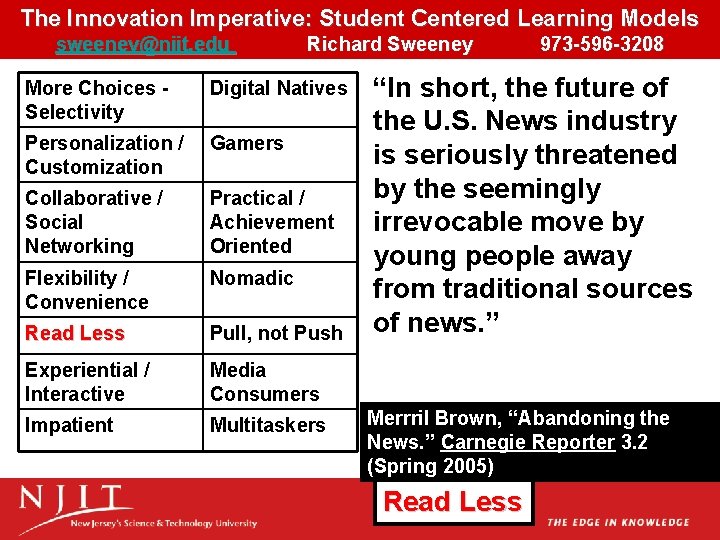
The Innovation Imperative: Student Centered Learning Models sweeney@njit. edu Richard Sweeney 973 -596 -3208 More Choices - Selectivity Digital Natives Personalization / Customization Gamers Collaborative / Social Networking Practical / Achievement Oriented Flexibility / Convenience Nomadic Read Less Pull, not Push Experiential / Interactive Media Consumers Impatient Multitaskers “In short, the future of the U. S. News industry is seriously threatened by the seemingly irrevocable move by young people away from traditional sources of news. ” Merrril Brown, “Abandoning the News. ” Carnegie Reporter 3. 2 (Spring 2005) Read Less
The Innovation Imperative: Student Centered Learning Models sweeney@njit. edu Richard Sweeney 973 -596 -3208 “Over the past 20 years, young adults (18 -34) have declined from being those most likely to read literature to those least likely (with the exception of those 65 and older. The rate of decline for the youngest adults, aged 18 to 24 was 55 percent greater than the total adult population. ” Hill, Kelly. “Reading at Risk; A Survey of Literary Reading in America” XXXXXXXXXXXXXX Foreman, Joel. “Next-Generation Educational Technology National Endowment for the Arts Research Division Report , 46 (June 2004) Versus the Lecture. ” Reading Less
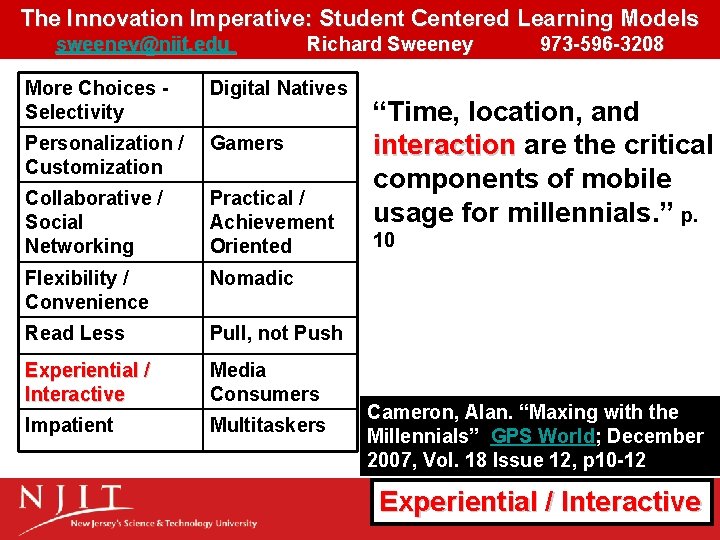
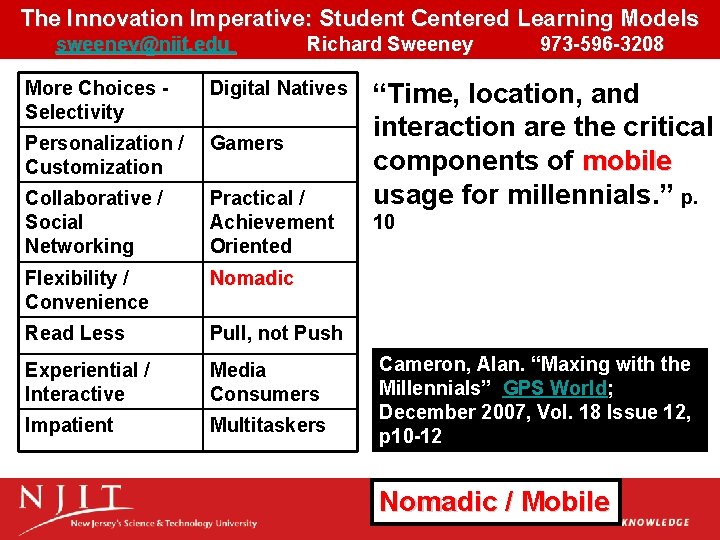
The Innovation Imperative: Student Centered Learning Models sweeney@njit. edu Richard Sweeney 973 -596 -3208 More Choices - Selectivity Digital Natives Personalization / Customization Gamers Collaborative / Social Networking Practical / Achievement Oriented Flexibility / Convenience Nomadic Read Less Pull, not Push Experiential / Interactive Media Consumers Impatient Multitaskers “Time, location, and interaction are the critical interaction components of mobile usage for millennials. ” p. 10 Cameron, Alan. “Maxing with the Millennials” GPS World; December 2007, Vol. 18 Issue 12, p 10 -12 Experiential / Interactive
The Innovation Imperative: Student Centered Learning Models sweeney@njit. edu Richard Sweeney 973 -596 -3208 “We are a generation of learners by exploration. My exploration “first Web site, for example, was constructed before I p. X had any concept of HTML or Java. I simply experimented with the commands until the pieces experimented fit together. ” Note: this article published by a Millennial Windam, Carrie “Father Google and Mother IM: Confessions of a Net XXXXXXXXXXXXXX Gen Learner”. EDUCAUSE Review, 40. 5 (2005): 42– 59. Experiential / Interactive
The Innovation Imperative: Student Centered Learning Models sweeney@njit. edu Richard Sweeney 973 -596 -3208 “Even if the lecturer is charismatic, holding the attention of several hundred students for an entire lecture of fifty minutes or longer is impossible. ” lecture is impossible p. 15 XXXXXXXXXXXXXX Foreman, Joel. “Next-Generation Educational Technology Versus the Lecture. ” Educause Review. 38. 4 (2003) 12 -22 Experiential / Interactive
The Innovation Imperative: Student Centered Learning Models sweeney@njit. edu Richard Sweeney 973 -596 -3208 “The average college class has minimal interaction; estimates are that students ask 0. 1 question per hour and that faculty ask 0. 3. By contrast, students in tutored sessions ask 20 -30 questions, and tutors ask more than 100. In computer based instruction, the number of questions posed to students per hour ranges from 160 to 800. ” p. 70 Diana Oblinger VP, Educause Diana G. Oblinger, “Learners, Learning and Technology”, Educause XXXXXXXXXXXXXX Foreman, Joel. “Next-Generation Educational Technology Review 40. 5 September/October 2005 66 -75 Versus the Lecture. ” Experiential / Interactive
The Innovation Imperative: Student Centered Learning Models sweeney@njit. edu Richard Sweeney 973 -596 -3208 More Choices - Selectivity Digital Natives Personalization / Customization Gamers Collaborative / Social Networking Practical / Achievement Oriented Flexibility / Convenience Nomadic Read Less Pull, not Push Experiential / Interactive Media Consumers Impatient Multitaskers “For these new 20 something workers, the line between work and home doesn't really exist. They just want to spend their time in meaningful and useful ways, no matter where they are. ” p 57 Trunk, Penelope. “What Gen Y Really Wants. ” Time South Pacific (Australia/New Zealand edition); 7/16/2007 Issue 27, p 57 -57, 1 p Richard Sweeney Impatience
The Innovation Imperative: Student Centered Learning Models sweeney@njit. edu Richard Sweeney 973 -596 -3208 “Busy Around the Clock Busy “Millennial teens may be America’s busiest people. Long gone are the days of Boomer kids being shooed outside to invent their own games – or of Gen. Xer Kids being left “home alone” with a “selfcare” guide. " p. 45 Howe, Neil and William Strauss. Millennials Go To College. Washington, DC: American Association of Collegiate Registrars, 2003. Impatience
The Innovation Imperative: Student Centered Learning Models sweeney@njit. edu Richard Sweeney 973 -596 -3208 “ ‘Nothing infuriates us more than busywork, ’ says busywork 24 -year-old Katie Day, an assistant editor at Berkley Publishing, a division of Penguin Group USA. Fearlessness ? "I don't have time to be intimidated, " says Anna Stassen, a 26 -year-old copywriter at the advertising agency Fallon Worldwide who treats her bosses like ‘the guys’. " Sacks, Danielle. “SCENES from the culture clash”. Fast Company, 102 (2006) 72 -77 Impatience
The Innovation Imperative: Student Centered Learning Models sweeney@njit. edu Richard Sweeney 973 -596 -3208 “We want everything to be easy, and we want it easy now, " said Katie Smith, a student at the University of Florida. "We have no patience. ” no patience p. 6 Lillo, Andrea. “Young consumers tell it 'straight' “ Home Textiles Today; High Point; May 27, 23. 38 (2002): 6 Impatience; Easy
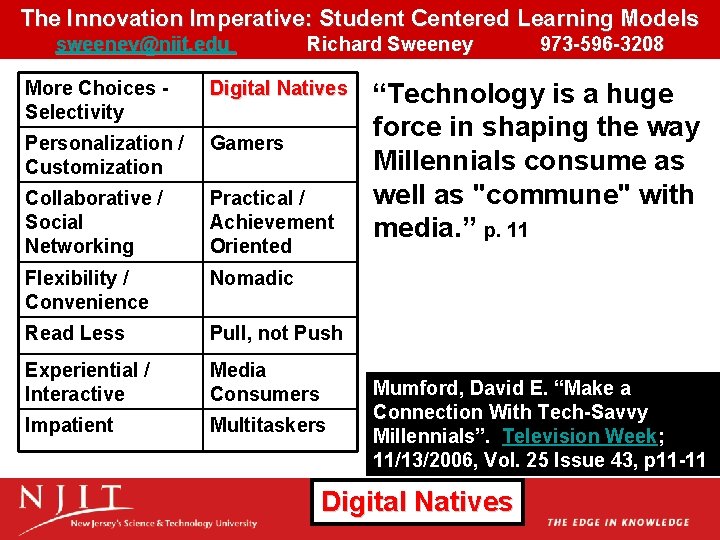
The Innovation Imperative: Student Centered Learning Models sweeney@njit. edu Richard Sweeney 973 -596 -3208 More Choices - Selectivity Digital Natives Personalization / Customization Gamers Collaborative / Social Networking Practical / Achievement Oriented Flexibility / Convenience Nomadic Read Less Pull, not Push Experiential / Interactive Media Consumers Impatient Multitaskers “Technology is a huge force in shaping the way Millennials consume as well as "commune" with media. ” p. 11 Mumford, David E. “Make a Connection With Tech-Savvy Millennials”. Television Week; 11/13/2006, Vol. 25 Issue 43, p 11 -11 Digital Natives
The Innovation Imperative: Student Centered Learning Models sweeney@njit. edu Richard Sweeney 973 -596 -3208 “And we will never understand or use the technology in precisely the same way as the Natives do. ” This distinction is critical in education, because we are currently in a time where all our students are DIGITAL NATIVES, yet the bulk of our DIGITAL NATIVES educators, teachers, administrators and curriculum developers are Digital Immigrants. ” p. 3 Prensky, Marc. “Use Their Tools! Speak Their Language!” Marc XXXXXXXXXXXXXX Prensky. March 2004. http: //www. marcprensky. com/writing/Prensky. Use_Their_Tools_Speak_Their_Language. pdf Digital Natives
The Innovation Imperative: Student Centered Learning Models sweeney@njit. edu Richard Sweeney 973 -596 -3208 “Gen Y was socialized in a digital world. It is more than technically literate; it is continually wired, plugged in, and connected to digitally streaming information, entertainment, and contracts. ” p. 6 XXXXXXXXXXXXXX Eisner, Susan P. “Managing Generation Y”. SAM Advanced Management Journal Autumn 2005 70: 4 p 4 -15 Digital Natives
The Innovation Imperative: Student Centered Learning Models sweeney@njit. edu Richard Sweeney 973 -596 -3208 “While most respondents are enthusiastic IT users and use it to support many aspects of their academic lives, most prefer only a ‘moderate’ amount of IT in their courses (59. 3 percent)”. p. 13 Salaway, Gail et al. ECAR Study of Undergraduate Students and XXXXXXXXXXXXXX Foreman, Joel. “Next-Generation Educational Technology Information Technology, 2007 Boulder, Colorado: EDUCAUSE Center Versus the Lecture. ” for Applied Research, 2007 (www. educause. edu/ecar) Digital Natives
The Innovation Imperative: Student Centered Learning Models sweeney@njit. edu Richard Sweeney 973 -596 -3208 “Within the instant messaging Gen Y (18 -27 years) age group, 46% report using IM more frequently than email. ” than email p. iii Shiu, Eulynn and Amanda Lenhart. “How Americans use instant XXXXXXXXXXXXXX Foreman, Joel. “Next-Generation Educational Technology messaging”. Pew Internet and American Life Project 9/1/2004 Versus the Lecture. ” http: //www. pewinternet. org/PPF/r/133/report_display. asp Digital Natives
The Innovation Imperative: Student Centered Learning Models sweeney@njit. edu Richard Sweeney 973 -596 -3208 “ 35% or the largest portion of those who IM for about an hour are Gen Y-ers. In contrast, the greatest percentage of instant messengers who IM for less than 15 minutes consist of Trailing Boomers (26%). ” p. iii Shiu, Eulynn and Amanda Lenhart. “How Americans use instant XXXXXXXXXXXXXX Foreman, Joel. “Next-Generation Educational Technology messaging”. Pew Internet and American Life Project 9/1/2004 Versus the Lecture. ” http: //www. pewinternet. org/PPF/r/133/report_display. asp Digital Natives Gamers
The Innovation Imperative: Student Centered Learning Models sweeney@njit. edu Richard Sweeney 973 -596 -3208 “Again this year, they overwhelming (85. 1 percent) favor e-mail for official college and university communications”. p. 12 -13` Salaway, Gail et al. ECAR Study of Undergraduate Students and XXXXXXXXXXXXXX Foreman, Joel. “Next-Generation Educational Technology Information Technology, 2007 Boulder, Colorado: EDUCAUSE Center Versus the Lecture. ” for Applied Research, 2007 (www. educause. edu/ecar) Digital Natives
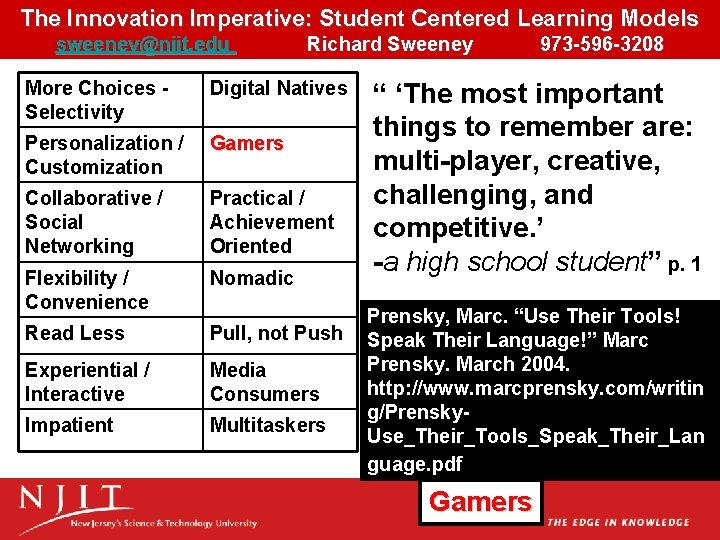
The Innovation Imperative: Student Centered Learning Models sweeney@njit. edu Richard Sweeney 973 -596 -3208 More Choices - Selectivity Digital Natives Personalization / Customization Gamers Collaborative / Social Networking Practical / Achievement Oriented Flexibility / Convenience Nomadic Read Less Pull, not Push Experiential / Interactive Media Consumers Impatient Multitaskers “ ‘The most important things to remember are: multi-player, creative, challenging, and competitive. ’ -a high school student” p. 1 Prensky, Marc. “Use Their Tools! Speak Their Language!” Marc Prensky. March 2004. http: //www. marcprensky. com/writin g/Prensky. Use_Their_Tools_Speak_Their_Lan guage. pdf Gamers
The Innovation Imperative: Student Centered Learning Models sweeney@njit. edu Richard Sweeney 973 -596 -3208 “So we now have a generation of students that is better at taking in information and making decisions quickly, better at multitasking and parallel processing; a generation that thinks graphically rather than textually, assumes connectivity, and is accustomed to seeing the world through a lens of games and play. ” p. 3 Prensky, Marc. “Use Their Tools! Speak Their Language!” Marc XXXXXXXXXXXXXX Prensky. March 2004. http: //www. marcprensky. com/writing/Prensky. Use_Their_Tools_Speak_Their_Language. pdf Gamers
The Innovation Imperative: Student Centered Learning Models sweeney@njit. edu Richard Sweeney 973 -596 -3208 “The real question is: Does the behavior of this new group [gamers] change the world in any way that really matters? If you’re in business today, the answer is clearly yes. ” p. 1 Beck, John C. , and Mitchell Wade. Got Game: How the Gamer Generation is Reshaping Business Forever. Boston: Harvard Business School Press, 2004. Gamers
The Innovation Imperative: Student Centered Learning Models sweeney@njit. edu Richard Sweeney 973 -596 -3208 “How hard this new cohort works, how they try to compete, how they fit into teams. How they take risks – all are different in statistically verifiable ways. And those differences are driven by one central factor: growing up with video games. ” p. 2 Beck, John C. , and Mitchell Wade. Got Game: How the Gamer Generation is Reshaping Business Forever. Boston: Harvard Business School Press, 2004. Gamers
The Innovation Imperative: Student Centered Learning Models sweeney@njit. edu Richard Sweeney 973 -596 -3208 “The important thing for business professionals to know about games isn’t whether someone plays them now, but whether he or she grew up playing them. ” them p. 25 Beck, John C. , and Mitchell Wade. Got Game: How the Gamer XXXXXXXXXXXXXX Generation is Reshaping Business Forever. Boston: Harvard Business School Press, 2004. Gamers
The Innovation Imperative: Student Centered Learning Models sweeney@njit. edu Richard Sweeney 973 -596 -3208 “So we now have a generation of students that is better at taking in information and making decisions quickly, better at MULTITASKING and MULTITASKING PARALLEL PROCESSING; a generation that PARALLEL PROCESSING THINKS GRAPHICALLY rather than textually, THINKS GRAPHICALLY assumes connectivity, and is accustomed to seeing the world through a lens of games and play. ” p. 3 Prensky, Marc. “Use Their Tools! Speak Their Language!” Marc XXXXXXXXXXXXXX Prensky. March 2004. http: //www. marcprensky. com/writing/Prensky. Use_Their_Tools_Speak_Their_Language. pdf Gamers
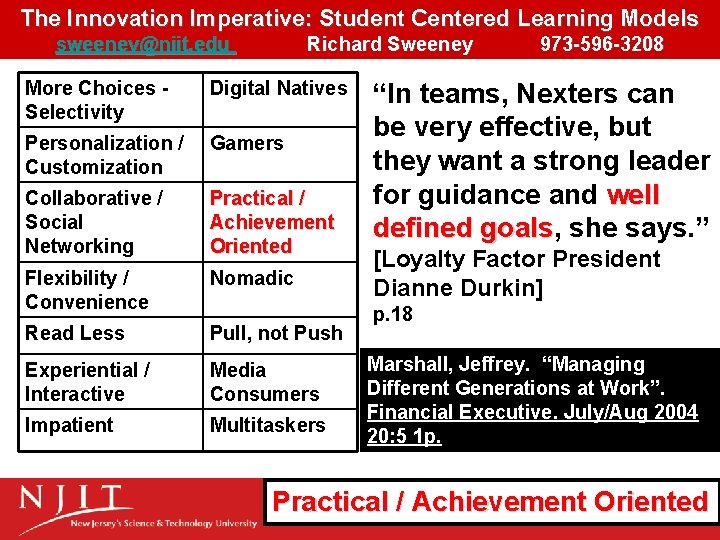
The Innovation Imperative: Student Centered Learning Models sweeney@njit. edu Richard Sweeney 973 -596 -3208 More Choices - Selectivity Digital Natives Personalization / Customization Gamers Collaborative / Social Networking Practical / Achievement Oriented Flexibility / Convenience Nomadic Read Less Pull, not Push Experiential / Interactive Media Consumers Impatient Multitaskers “In teams, Nexters can be very effective, but they want a strong leader for guidance and well defined goals, she says. ” defined goals [Loyalty Factor President Dianne Durkin] p. 18 Marshall, Jeffrey. “Managing Different Generations at Work”. Financial Executive. July/Aug 2004 20: 5 1 p. Practical / Achievement Oriented
The Innovation Imperative: Student Centered Learning Models sweeney@njit. edu Richard Sweeney 973 -596 -3208 “Gen Y employees are goal-oriented and have goal-oriented high expectations of themselves. They’re highperformers, competitive, and seek tasks with tight deadlines that reward and acknowledge their efforts. They take ownership of their work, value individualized goal setting, and seek new skills. ” p. 1 Understand Gen Y Employees”. Credit Union Magazine; April 2006 72: 6 p. 70 Practical / Achievement Oriented
The Innovation Imperative: Student Centered Learning Models sweeney@njit. edu Richard Sweeney 973 -596 -3208 More Choices - Selectivity Digital Natives Personalization / Customization Gamers Collaborative / Social Networking Practical / Achievement Oriented Flexibility / Convenience Nomadic Read Less Pull, not Push Experiential / Interactive Media Consumers Impatient Multitaskers “Time, location, and interaction are the critical components of mobile usage for millennials. ” p. 10 Cameron, Alan. “Maxing with the Millennials” GPS World; December 2007, Vol. 18 Issue 12, p 10 -12 Nomadic / Mobile
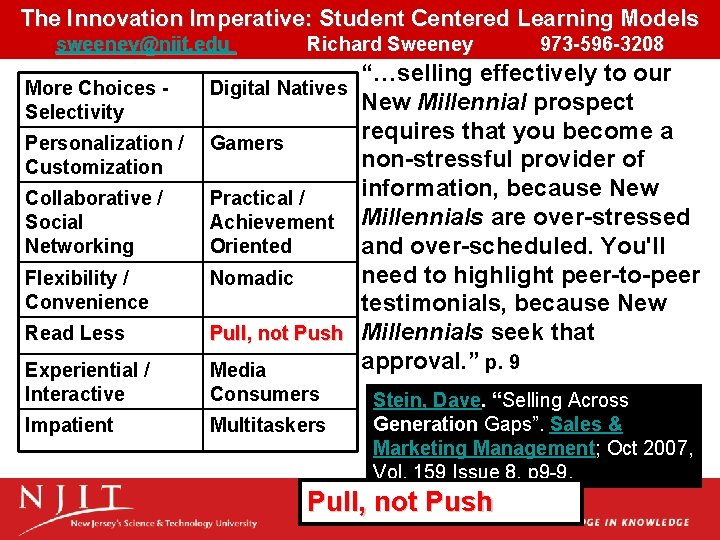
The Innovation Imperative: Student Centered Learning Models sweeney@njit. edu Richard Sweeney 973 -596 -3208 “…selling effectively to our New Millennial prospect requires that you become a Personalization / Gamers non-stressful provider of Customization information, because New Collaborative / Practical / Social Achievement Millennials are over-stressed Networking Oriented and over-scheduled. You'll need to highlight peer-to-peer Flexibility / Nomadic Convenience testimonials, because New Read Less Pull, not Push Millennials seek that approval. ” p. 9 Experiential / Media More Choices - Selectivity Digital Natives Interactive Consumers Impatient Multitaskers Stein, Dave. “Selling Across Generation Gaps”. Sales & Marketing Management; Oct 2007, Vol. 159 Issue 8, p 9 -9, Pull, not Push
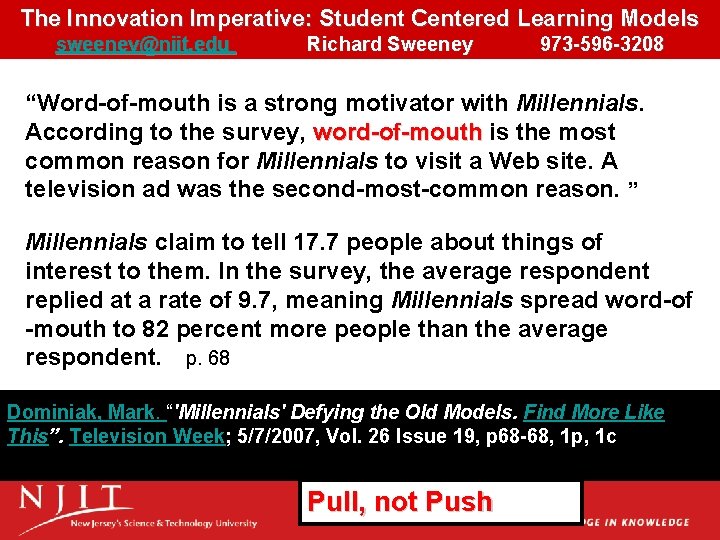
The Innovation Imperative: Student Centered Learning Models sweeney@njit. edu Richard Sweeney 973 -596 -3208 “Word-of-mouth is a strong motivator with Millennials. According to the survey, word-of-mouth is the most word-of-mouth common reason for Millennials to visit a Web site. A television ad was the second-most-common reason. ” Millennials claim to tell 17. 7 people about things of interest to them. In the survey, the average respondent replied at a rate of 9. 7, meaning Millennials spread word-of -mouth to 82 percent more people than the average respondent. p. 68 Dominiak, Mark. “'Millennials' Defying the Old Models. Find More Like This”. Television Week; 5/7/2007, Vol. 26 Issue 19, p 68 -68, 1 p, 1 c Pull, not Push
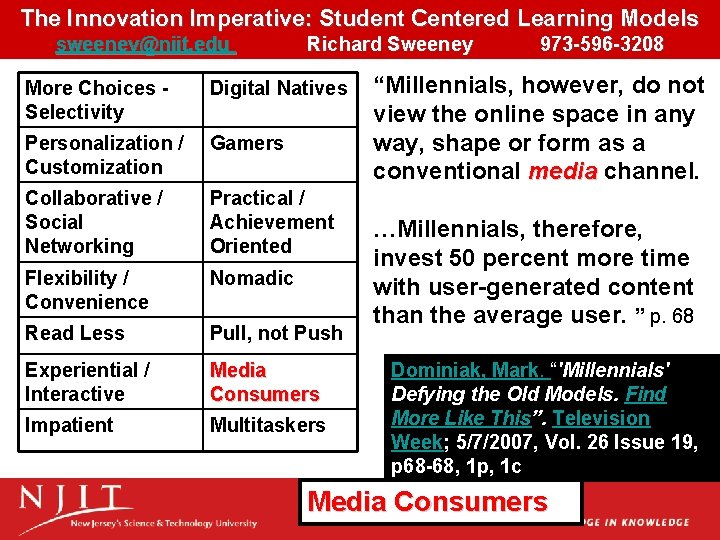
The Innovation Imperative: Student Centered Learning Models sweeney@njit. edu Richard Sweeney 973 -596 -3208 More Choices - Selectivity Digital Natives Personalization / Customization Gamers Collaborative / Social Networking Practical / Achievement Oriented Flexibility / Convenience Nomadic Read Less Pull, not Push Experiential / Interactive Media Consumers Impatient Multitaskers “Millennials, however, do not view the online space in any way, shape or form as a conventional media channel. media …Millennials, therefore, invest 50 percent more time with user-generated content than the average user. ” p. 68 Dominiak, Mark. “'Millennials' Defying the Old Models. Find More Like This”. Television Week; 5/7/2007, Vol. 26 Issue 19, p 68 -68, 1 p, 1 c Media Consumers
The Innovation Imperative: Student Centered Learning Models sweeney@njit. edu Richard Sweeney 973 -596 -3208 “. . A recent Kaiser Family Foundation report, "Generation M: Media in the Lives of 8 - to 18 -Year. Olds, " found that students who use media the most also spend more time with family, friends, most also spend more time with family, friends and other activities. That may explain the need to do many things at once. ” p. 33 Mc. Hale, Tom. “Portrait of a Digital Native” Technology & Learning, 26. 2 (2005) 33 -34 Media Consumers
The Innovation Imperative: Student Centered Learning Models sweeney@njit. edu Richard Sweeney 973 -596 -3208 “Because they are all about media, and boy, do media they consume it. They use media differently than consume you or I, to paraphrase F. Scott Fitzgerald. They consume content in their own way. ” in their own way p. 10 Cameron, Alan. “Maxing with the Millennials” GPS World; December 2007, Vol. 18 Issue 12, p 10 -12 Media Consumers
The Innovation Imperative: Student Centered Learning Models sweeney@njit. edu Richard Sweeney 973 -596 -3208 “Media influences: Baby Boomers rely on Media traditional media such as television (50 percent boomers, 27 percent Generation Y) and newspapers (19 percent versus 6 percent), while Generation Y business owners rely on the Internet for news (31 percent versus 9 percent of Boomers). ” p. 15 “Boomers vs. Gen Y”. Community Banker; Sep 2007, Vol. 16 Issue 9, p 15 Richard Sweeney Media Consumers
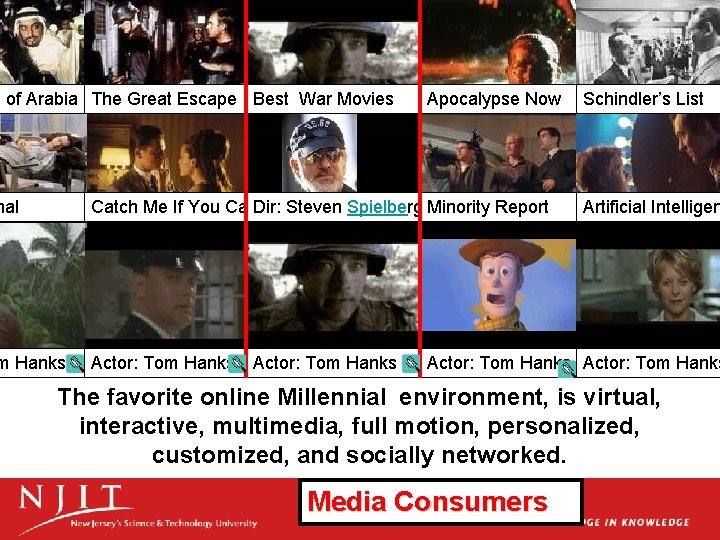
The Innovation Imperative: Student Centered Learning Models sweeney@njit. edu Richard Sweeney 973 -596 -3208 e of Arabia The Great Escape Best War Movies nal Apocalypse Now Schindler’s List Catch Me If You Can. Dir: Frank Darabont Dir: Steven Spielberg Minority Report m Hanks Actor: Tom Hanks Artificial Intelligen Actor: Tom Hanks You’ve Got Mail Away The favorite online Millennial environment, is virtual, The Green Mile Saving Private Toy Story 2 (1998) ) (1999) Ryan (1998) (1999) interactive, multimedia, full motion, personalized, Rich, this is one Dir: Nora Ephron obert Zemeckis Dir: Frank Darabont Dir: Steven Dir: Lee Unkrich of my Starring: customized, and socially networked. Spielberg Starring: favorites. Janet Tom Hanks, Starring: Tom Hanks Meg Ryan, n Hunt, Michael Clarke Duncan, Tom Hanks, Tim Allen Media Consumers Parker Posey, e Wildman, David Morse, Tom Sizemore, Don Rickles
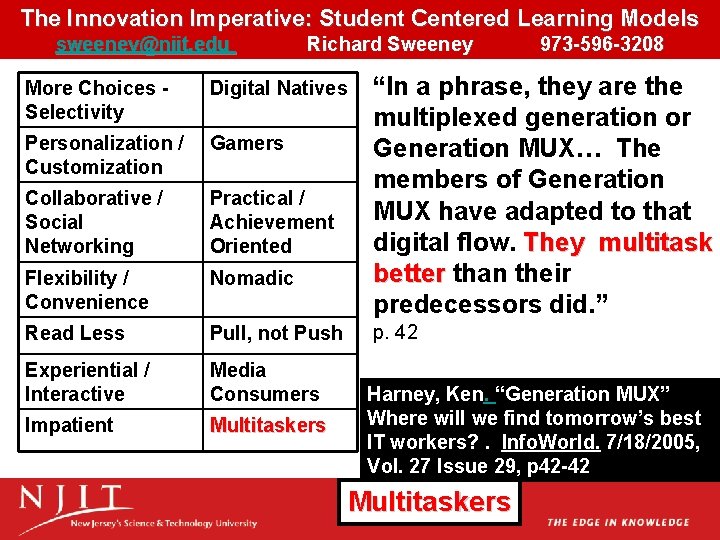
The Innovation Imperative: Student Centered Learning Models sweeney@njit. edu Richard Sweeney 973 -596 -3208 More Choices - Selectivity Digital Natives Personalization / Customization Gamers Collaborative / Social Networking Practical / Achievement Oriented Flexibility / Convenience Nomadic Read Less Pull, not Push Experiential / Interactive Media Consumers Impatient Multitaskers “In a phrase, they are the multiplexed generation or Generation MUX… The members of Generation MUX have adapted to that digital flow. They multitask better than their better predecessors did. ” p. 42 Harney, Ken. “Generation MUX” Where will we find tomorrow’s best IT workers? . Info. World. 7/18/2005, Vol. 27 Issue 29, p 42 -42 Multitaskers
The Innovation Imperative: Student Centered Learning Models sweeney@njit. edu Richard Sweeney 973 -596 -3208 “IM-ers are multi-taskers 32% of IM users say they do other things on their computer such as browsing the web or playing games virtually every time they are instant messaging and another 29% are doing something messaging else some of the time they are IM-ing. p. iv Shiu, Eulynn and Amanda Lenhart. “How Americans use instant XXXXXXXXXXXXXX Foreman, Joel. “Next-Generation Educational Technology messaging”. Pew Internet and American Life Project 9/1/2004 Versus the Lecture. ” http: //www. pewinternet. org/PPF/r/133/report_display. asp Multitaskers
The Innovation Imperative: Student Centered Learning Models sweeney@njit. edu Richard Sweeney 973 -596 -3208 "It's the way we've all come to be raised, " says Fear, a senior at Hunterdon Central Regional High School in Flemington, New Jersey. She is a member of the National Honor Society, student leader of the local Amnesty International chapter, and president of the school's International Thespian Society. "There's a lot of work we're expected to do. You have to multitask to get everything done. ” everything done. Mc. Hale, Tom. “Portrait of a Digital Native” Technology & Learning, 26. 2 (2005) 33 -34 Multitaskers
The Innovation Imperative: Student Centered Learning Models sweeney@njit. edu Richard Sweeney 973 -596 -3208 More Choices - Selectivity Digital Natives More Friends Huge Population Personalization / Customization Gamers Respect Intelligence Merit Systems Collaborative / Social Networking Practical / Achievement Oriented Optimistic / Positive / Confident Family Oriented / Largely Children of Divorce Flexibility / Convenience Nomadic More Diverse High Expectations / Inclusive (e. g. Incomes) Read Less Pull, not Push Direct Values Experiential / Interactive Learners Media Consumers Patriotic / Civic Minded Balanced Lives / Healthy Lifestyle Impatient Multitaskers More Liberal Social Involvement Millennial Characteristics
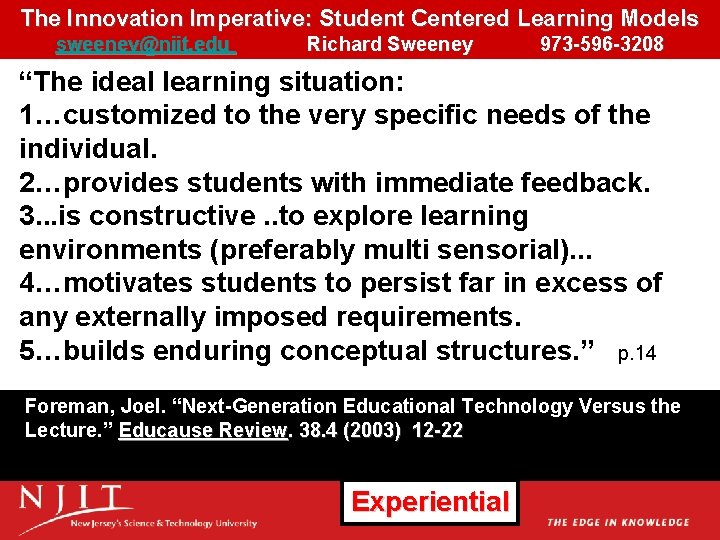
The Innovation Imperative: Student Centered Learning Models sweeney@njit. edu Richard Sweeney 973 -596 -3208 “The ideal learning situation: “ 1…customized to the very specific needs of the p. X individual. 2…provides students with immediate feedback. 3. . . is constructive. . to explore learning environments (preferably multi sensorial). . . 4…motivates students to persist far in excess of any externally imposed requirements. Experiential 5…builds enduring conceptual structures. ” p. 14 Foreman, Joel. “Next-Generation Educational Technology Versus the XXXXXXXXXXXXXX Lecture. ” Educause Review. 38. 4 (2003) 12 -22 Experiential
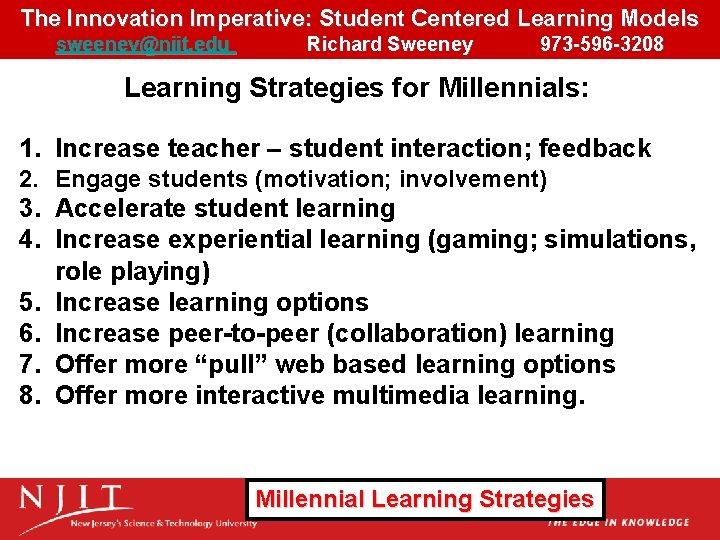
The Innovation Imperative: Student Centered Learning Models sweeney@njit. edu Richard Sweeney 973 -596 -3208 Learning Strategies for Millennials: 1. Increase teacher – student interaction; feedback 2. Engage students (motivation; involvement) 3. Accelerate student learning 4. Increase experiential learning (gaming; simulations, role playing) 5. Increase learning options 6. Increase peer-to-peer (collaboration) learning 7. Offer more “pull” web based learning options 8. Offer more interactive multimedia learning. Millennial Learning Strategies
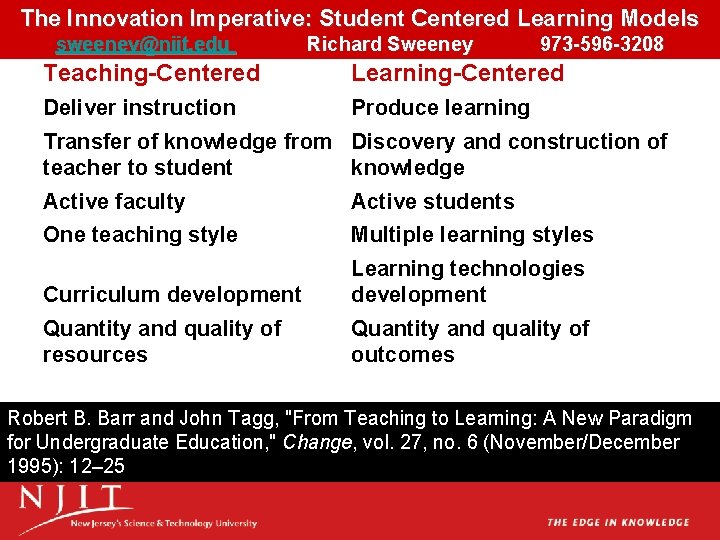
The Innovation Imperative: Student Centered Learning Models sweeney@njit. edu Richard Sweeney 973 -596 -3208 Teaching-Centered Learning-Centered Deliver instruction Produce learning Transfer of knowledge from Discovery and construction of teacher to student knowledge Active faculty Active students One teaching style Multiple learning styles Curriculum development Learning technologies development Quantity and quality of resources Quantity and quality of outcomes Robert B. Barr and John Tagg, "From Teaching to Learning: A New Paradigm for Undergraduate Education, " Change, vol. 27, no. 6 (November/December 1995): 12– 25.
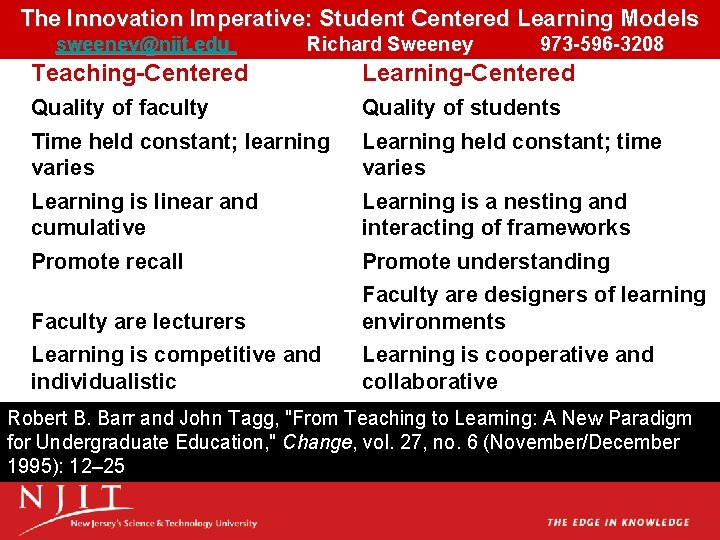
The Innovation Imperative: Student Centered Learning Models sweeney@njit. edu Richard Sweeney 973 -596 -3208 Teaching-Centered Learning-Centered Quality of faculty Quality of students Time held constant; learning varies Learning held constant; time varies Learning is linear and cumulative Learning is a nesting and interacting of frameworks Promote recall Promote understanding Faculty are lecturers Faculty are designers of learning environments Learning is competitive and individualistic Learning is cooperative and collaborative Robert B. Barr and John Tagg, "From Teaching to Learning: A New Paradigm for Undergraduate Education, " Change, vol. 27, no. 6 (November/December 1995): 12– 25.
The Innovation Imperative: Student Centered Learning Models sweeney@njit. edu Richard Sweeney 973 -596 -3208 “Two proven innovation strategies are the common-course redesign strategy and the flex program and service redesign strategy. These strategies use IT innovatively to improve accountability-that is, to improve and account for institutional performance-whenever measurably improved academic results and reduced unit costs are simultaneous goals. ” are simultaneous goals p. 79 Graves, William. “Improving Institutional Performance through ITXXXXXXXXXXXXXX Foreman, Joel. “Next-Generation Educational Technology Enabled Innovation”. EDUCAUSE Review Nov/Dec 2005: 79 -98 Versus the Lecture. ” Engagement & Productivity
The Innovation Imperative: Student Centered Learning Models sweeney@njit. edu Richard Sweeney 973 -596 -3208 “With a few important [ IT ] exceptions, these investments did not directly seek to reduce longterm unit costs and/or dampen spiraling tuition increases and, not surprisingly, did not do so whether or not they used technology to enable innovation. As a result, these “innovations” did not increase productivity but instead either added not increase productivity to long-term operating expenditures or proved unsustainable after the loss of special funding. p. 84 Graves, William. “Improving Institutional Performance through ITXXXXXXXXXXXXXX Foreman, Joel. “Next-Generation Educational Technology Enabled Innovation”. EDUCAUSE Review Nov/Dec 2005: 79 -98 Versus the Lecture. ” Engagement & Productivity
The Innovation Imperative: Student Centered Learning Models sweeney@njit. edu Richard Sweeney 973 -596 -3208 “To one degree or another, all thirty projects share the following six characteristics: 1. Whole course redesign 2. Active learning (learner centered) 3. Computer-based learning resources 4. Master learning (scheduled milestones for completion) 5. On-demand help 6. Alternative staffing (sometimes grad and undergrads)” p. 30 Twigg, Carol A. “Improving Learning and Reducing Costs: New Models XXXXXXXXXXXXXX Foreman, Joel. “Next-Generation Educational Technology for Online Learning”. EDUCAUSE Review Sep/Oct 2003: 28 -38 Versus the Lecture. ” Engagement, Assessment & Productivity
The Innovation Imperative: Student Centered Learning Models sweeney@njit. edu Richard Sweeney 973 -596 -3208 “At UMass, attendance in the traditional format averaged 67 percent; in the redesigned course, attendance averaged 90 percent, which correlated significantly to performance on exams. In addition exams no longer emphasize recall of factual material or definitions of terms; 67 percent of the questions now require reasoning or problem-solving skills, compared with 21 percent previously” p. 32 Twigg, Carol A. “Improving Learning and Reducing Costs: New Models XXXXXXXXXXXXXX Foreman, Joel. “Next-Generation Educational Technology for Online Learning”. EDUCAUSE Review Sep/Oct 2003: 28 -38 Versus the Lecture. ” Engagement, Assessment & Productivity
The Innovation Imperative: Student Centered Learning Models sweeney@njit. edu Richard Sweeney 973 -596 -3208 “Preliminary results show that all thirty institutions reduced costs by about 40 percent on average, with a range of 20 to 84 percent. ” p. 86 Twigg, Carol A. “Improving Learning and Reducing Costs: New Models XXXXXXXXXXXXXX Foreman, Joel. “Next-Generation Educational Technology for Online Learning”. EDUCAUSE Review Sep/Oct 2003: 28 -38 Versus the Lecture. ” Engagement, Assessment & Productivity
The Innovation Imperative: Student Centered Learning Models sweeney@njit. edu Richard Sweeney 973 -596 -3208 “Currently in higher education, both on campus and online, we individualize faculty practice (that is, we allow individual faculty members great latitude in course development and delivery) and standardize the student learning experience (that, is we treat all students in a course as if their learning needs, interests, and abilities were the same). Instead we need to do just the opposite: individualize student learning and standardize faculty practice. ” practice. p. 38 Twigg, Carol A. “Improving Learning and Reducing Costs: New Models XXXXXXXXXXXXXX Foreman, Joel. “Next-Generation Educational Technology for Online Learning”. EDUCAUSE Review Sep/Oct 2003: 28 -38 Versus the Lecture. ” Engagement, Assessment & Productivity
The Innovation Imperative: Student Centered Learning Models sweeney@njit. edu Richard Sweeney 973 -596 -3208 Examples: • Managing the Digital Enterprise (Rappa-North Carolina State) • Solar System Collaboratory (Colorado) • Virtual chemistry experiments (Davidson) • U. S. History Videos (History Channel) • Boiler. Cast (Purdue - podcasts, vcasts) • Game Based Learning Sites (Marc Prensky) • Math Emporium (Virginia Tech) • Building bridges (Civil Engineering-Nova) • Physics Tutorial Modules Andersen Center (RPI) • Collaborative Learning Table (RPI) • Immediate stock market quotes (Yahoo Finance) • Search. Path information literacy tutorial (Rutgers) Examples
The Innovation Imperative: Student Centered Learning Models sweeney@njit. edu Richard Sweeney 973 -596 -3208 “Now that professors are putting course lectures online and new for-profit colleges are emerging, he said, students may soon ask themselves why they students have to do things the old way ” p. 282 Young, Jeffrey R. “Colleges Must Shake Up Their Business Models to Counter New Competition Online, Former FCC Chairman Says”. The Wired Campus The Chronicle of Higher Education. May 19, 2008
The Innovation Imperative: Student Centered Learning Models sweeney@njit. edu Richard Sweeney 973 -596 -3208 “And they say it [ recorded lectures] actually improves learning and retention, especially in rigorous technical courses. At the same time, it is forcing professors to rethink how to use classroom time when basic information can easily be relayed online. ” p. 282 Young, Jeffrey R. “The Lectures Are Recorded, So Why Go to Class? ”. The Wired Campus The Chronicle of Higher Education. May 16, 2008
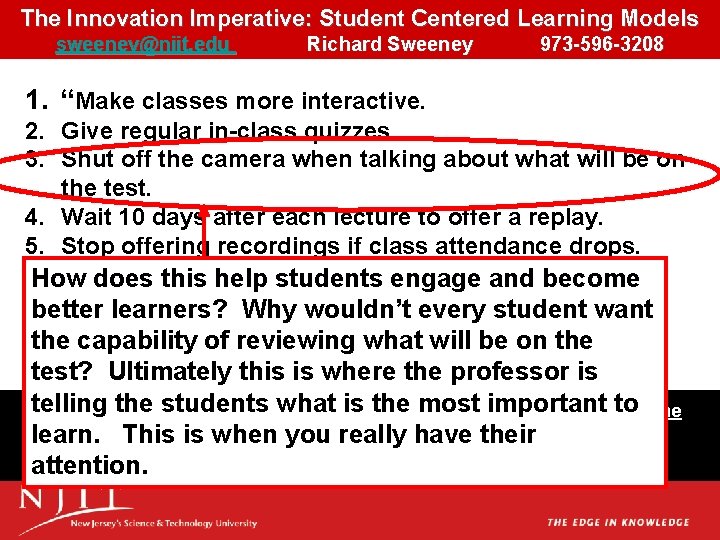
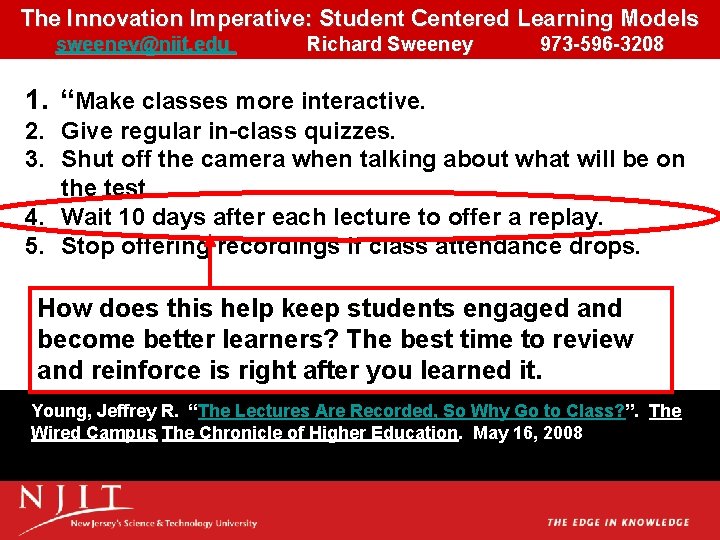
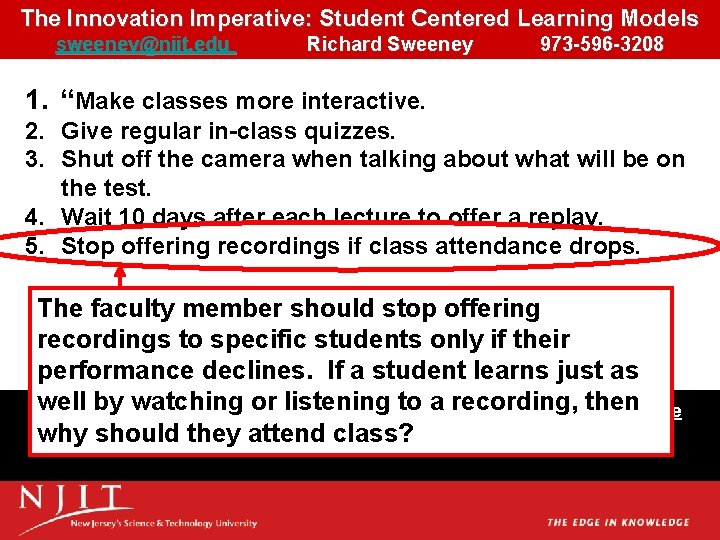
The Innovation Imperative: Student Centered Learning Models sweeney@njit. edu Richard Sweeney 973 -596 -3208 HOW PROFESSORS WHO RECORD LECTURES KEEP STUDENTS IN CLASS 1. “Make classes more interactive. 2. Give regular in-class quizzes. 3. Shut off the camera when talking about what will be on the test. 4. Wait 10 days after each lecture to offer a replay. 5. Stop offering recordings if class attendance drops. Young, Jeffrey R. “The Lectures Are Recorded, So Why Go to Class? ”. The Wired Campus The Chronicle of Higher Education. May 16, 2008
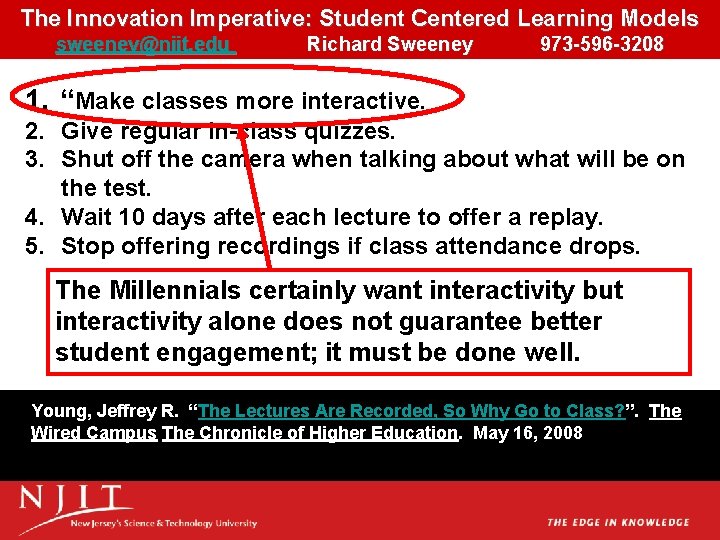
The Innovation Imperative: Student Centered Learning Models sweeney@njit. edu Richard Sweeney 973 -596 -3208 1. “Make classes more interactive. 2. Give regular in-class quizzes. 3. Shut off the camera when talking about what will be on the test. 4. Wait 10 days after each lecture to offer a replay. 5. Stop offering recordings if class attendance drops. The Millennials certainly want interactivity but interactivity alone does not guarantee better student engagement; it must be done well. Young, Jeffrey R. “The Lectures Are Recorded, So Why Go to Class? ”. The Wired Campus The Chronicle of Higher Education. May 16, 2008
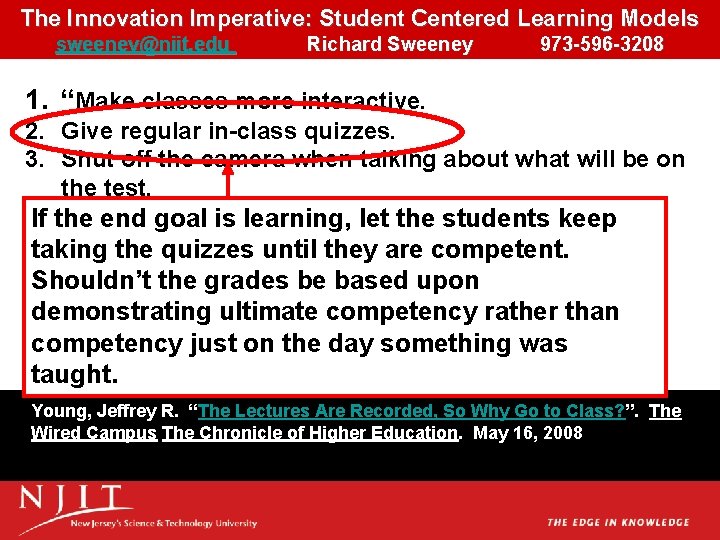
The Innovation Imperative: Student Centered Learning Models sweeney@njit. edu Richard Sweeney 973 -596 -3208 1. “Make classes more interactive. 2. Give regular in-class quizzes. 3. Shut off the camera when talking about what will be on the test. 4. Wait 10 days after each lecture to offer a replay. If the end goal is learning, let the students keep 5. Stop offering recordings if class attendance drops. taking the quizzes until they are competent. Shouldn’t the grades be based upon demonstrating ultimate competency rather than competency just on the day something was taught. Young, Jeffrey R. “The Lectures Are Recorded, So Why Go to Class? ”. The Wired Campus The Chronicle of Higher Education. May 16, 2008
The Innovation Imperative: Student Centered Learning Models sweeney@njit. edu Richard Sweeney 973 -596 -3208 1. “Make classes more interactive. 2. Give regular in-class quizzes. 3. Shut off the camera when talking about what will be on the test. 4. Wait 10 days after each lecture to offer a replay. 5. Stop offering recordings if class attendance drops. How does this help students engage and become better learners? Why wouldn’t every student want the capability of reviewing what will be on the test? Ultimately this is where the professor is telling the students what is the most important to Young, Jeffrey R. “The Lectures Are Recorded, So Why Go to Class? ”. The Wired Campus The Chronicle of Higher Education. May 16, 2008 learn. This is when you really have their attention.
The Innovation Imperative: Student Centered Learning Models sweeney@njit. edu Richard Sweeney 973 -596 -3208 1. “Make classes more interactive. 2. Give regular in-class quizzes. 3. Shut off the camera when talking about what will be on the test. 4. Wait 10 days after each lecture to offer a replay. 5. Stop offering recordings if class attendance drops. How does this help keep students engaged and become better learners? The best time to review and reinforce is right after you learned it. Young, Jeffrey R. “The Lectures Are Recorded, So Why Go to Class? ”. The Wired Campus The Chronicle of Higher Education. May 16, 2008
The Innovation Imperative: Student Centered Learning Models sweeney@njit. edu Richard Sweeney 973 -596 -3208 1. “Make classes more interactive. 2. Give regular in-class quizzes. 3. Shut off the camera when talking about what will be on the test. 4. Wait 10 days after each lecture to offer a replay. 5. Stop offering recordings if class attendance drops. The faculty member should stop offering recordings to specific students only if their performance declines. If a student learns just as well by watching or listening to a recording, then Young, Jeffrey R. “The Lectures Are Recorded, So Why Go to Class? ”. The Wired Campus The Chronicle of Higher Education. May 16, 2008 why should they attend class?
The Innovation Imperative: Student Centered Learning Models sweeney@njit. edu Richard Sweeney 973 -596 -3208 What is the role of the faculty member? The Sage on the Stage? Or the Guide on the Side? Or Both?
The Innovation Imperative: Student Centered Learning Models sweeney@njit. edu Richard Sweeney 973 -596 -3208 “Self-service: moving to self-sufficiency Banking, shopping, entertainment, research, travel, job seeking, chatting—pick a category and one theme will ring clear—self-service. People of all age groups are spending more time online doing things for themselves. ” “Users DO know what they’re doing!” —Industry Pundit. ” p. 4 OCLC Environmental Scan: Pattern Recognition (2003) http: //www. oclc. org/reports/escan/ Self Sufficiency
The Innovation Imperative: Student Centered Learning Models sweeney@njit. edu Richard Sweeney 973 -596 -3208 “ Bankers don’t market “distance banking” or label customers as ‘traditional’ of ‘nontraditional’. They realize that different customers have different needs and preferences for obtaining services. Banks also know that time-shifted online self-service can reduce costs while increasing customer satisfaction, which is why they frequently offer incentives for self-service. ” p. 86 Graves, William. “Improving Institutional Performance through ITXXXXXXXXXXXXXX Foreman, Joel. “Next-Generation Educational Technology Enabled Innovation”. EDUCAUSE Review Nov/Dec 2005: 79 -98 Versus the Lecture. ” Self Sufficiency
The Innovation Imperative: Student Centered Learning Models sweeney@njit. edu Richard Sweeney 973 -596 -3208 “Satisfaction Surveys confirm that information consumers are pleased with the results of their online activities…Librarians worry that information found using search engines does not have the credibility and authority of information found in libraries, and that people will not learn basic information seeking skills, and so leave much valuable material undiscovered. ” P. 4 OCLC Environmental Scan: Pattern Recognition (2003) http: //www. oclc. org/reports/escan/ Satisfaction
The Innovation Imperative: Student Centered Learning Models sweeney@njit. edu Richard Sweeney 973 -596 -3208 “Seamlessness The traditional separation of academic, leisure and work time is fusing into a seamless world aided by nomadic computing devices that support multiple activities. This phenomenon is most marked among young adults. Their world is a seamless “infosphere” where the boundaries of work, play and study are gone, a marked contrast to the compartmentalized lifestyles of their parents. OCLC Environmental Scan: Pattern Recognition (2003) http: //www. oclc. org/reports/escan/ Seamlessness
The Innovation Imperative: Student Centered Learning Models sweeney@njit. edu Richard Sweeney 973 -596 -3208 “Research and Learning Landscape Major trends • Reduced funding • Proliferation of e-learning • Lifelong learning in the community • The changing pattern of research and learning in higher education • Institutional repositories, scholarly communication and open access • New flows of scholarly materials” p. 14 OCLC Environmental Scan: Pattern Recognition (2003) http: //www. oclc. org/reports/escan/ Proliferation of E-learning
The Innovation Imperative: Student Centered Learning Models sweeney@njit. edu Richard Sweeney 973 -596 -3208 Proliferation of e-learning E-learning has a presence in most large corporations and in an ever increasing number of college and university courses. Course management systems such as Web. CT and Blackboard allow for the creation of a virtual classroom where faculty and students can interact and post curriculum related material. p. 14 OCLC Environmental Scan: Pattern Recognition (2003) http: //www. oclc. org/reports/escan/ Proliferation of E-learning
The Innovation Imperative: Student Centered Learning Models sweeney@njit. edu Richard Sweeney 973 -596 -3208 Proliferation of e-learning “E-learning is also the term used to describe corporate or work-based e-learning. Companies purchase elearning for workers for many of the same reasons that individuals take university courses online: travel time is reduced, infrastructure costs are low, delivery is platform-independent and learning anywhere and anytime is enabled. And e-learning is big business. Elearning companies are earning millions of dollars annually. ” p. 14 OCLC Environmental Scan: Pattern Recognition (2003) http: //www. oclc. org/reports/escan/ Proliferation of E-learning
The Innovation Imperative: Student Centered Learning Models sweeney@njit. edu Richard Sweeney 973 -596 -3208 “New standards There are two main areas of standards development. Repository and content standards are emerging to manage digital objects. Of note are OAIS (Open Archival Information System), preservation metadata, content packaging, content exchange and metadata that support operations on objects. Secondly, applications standards are being developed in the areas of cross-searching, harvesting, resolution and specialized library transaction applications such as NCIP and ISO ILL. p. 11 OCLC Environmental Scan: Pattern Recognition (2003) http: //www. oclc. org/reports/escan/
The Innovation Imperative: Student Centered Learning Models sweeney@njit. edu Richard Sweeney 973 -596 -3208 The changing patterns of research and learning in higher education The underlying challenges and opportunities involve the social and institutional changes necessary to effect the transition from traditional support for scholarship to the digital, distributed, seamless environments that will be necessary in the future. Consequently, coordinated management and disclosure of digital assets of institutions—learning objects, data sets, e-prints, theses, dissertations and so on—will be necessary. p. 11 OCLC Environmental Scan: Pattern Recognition (2003) http: //www. oclc. org/reports/escan/
The Innovation Imperative: Student Centered Learning Models sweeney@njit. edu Richard Sweeney 973 -596 -3208 The changing patterns of research and learning in higher education Currently, there are no settled patterns or standards. As well, the outputs of digital scholarship are often in complex and nonstandard forms. The academic community will need to develop a better understanding of ways in which scholarship and learning activities are created, used, reused and preserved in the digital environment. p. 11 OCLC Environmental Scan: Pattern Recognition (2003) http: //www. oclc. org/reports/escan/
The Innovation Imperative: Student Centered Learning Models Future PASSHE Academic Libraries & Collaboration sweeney@njit. edu Richard Sweeney 973 -596 -3208 Thanks for your kind attention. • Powerpoint (available at: • http: //library 1. njit. edu/staff-folders/sweeney/ •