
The Information School of the University of Washington
- Slides: 23
The Information School of the University of Washington Java. Script Context INFO/CSE 100, Spring 2006 Fluency in Information Technology http: //www. cs. washington. edu/100 12/25/2021 fit 100 -17 -context © 2006 University of Washington 1
The Information School of the University of Washington Readings and References • References » Wikipedia articles on HTML, XHTML and scripting languages http: //en. wikipedia. org/wiki/HTML http: //en. wikipedia. org/wiki/XHTML http: //en. wikipedia. org/wiki/Scripting_language » IBM Home Page Reader 3. 0 http: //www-3. ibm. com/able/solution_offerings/hpr. html 12/25/2021 fit 100 -17 -context © 2006 University of Washington 2
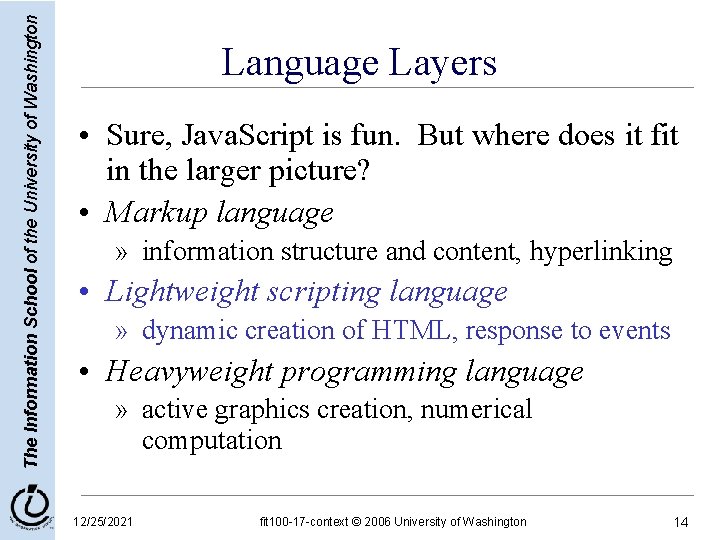
The Information School of the University of Washington Language Layers • Sure, Java. Script is fun. But where does it fit in the larger picture? • Markup language » information structure and content, hyperlinking • Lightweight scripting language » dynamic creation of HTML, response to events • Heavyweight programming language » active graphics creation, numerical computation 12/25/2021 fit 100 -17 -context © 2006 University of Washington 3
The Information School of the University of Washington Markup Language - HTML • Hyper. Text Markup Language » a language for describing the content and presentation of a web page • content: The meaning and structure of the web page • presentation: How the page is to be presented » HTML pages have a basic hierarchical structure defined by the tags • <html>, <head>, <body>, and so on » Basic HTML describes a static page • once parsed and rendered, the page doesn’t change • hyperlinking was the big step forward in basic HTML 12/25/2021 fit 100 -17 -context © 2006 University of Washington 4
The Information School of the University of Washington Content vs. Presentation • Early versions of HTML mixed these two ideas » For example: <p align=“left”> » The <p> tag identifies the basic structure of the page content » The align=“left” attribute guides the presentation • Newer versions are separating content and presentation » All "presentation attributes" of HTML elements were deprecated in HTML 4. 01. » All "presentation attributes" of HTML elements are not supported in XHTML 1. 0 Strict DTD. • This separation is a very useful distinction to make » “what is the meaning? ” vs “what is the format of the display? ” 12/25/2021 fit 100 -17 -context © 2006 University of Washington 5
The Information School of the University of Washington Why is this distinction useful? • Once you have easy access to the structure and meaning, there are many useful ways to manage and present the information that is available • Manage the information » extract a travel map from a directions page » filter an inventory list to select only certain attributes • Present the information » graphical browser on a full-size screen » cell-phone browser display 12/25/2021 fit 100 -17 -context © 2006 University of Washington 6
The Information School of the University of Washington Manage the information • Information that is well structured can be » filtered, reorganized, used as program input, presented in a variety of reports, . . . • This is what a database program is used for » If we can separate the content from the presentation in web pages, we can use the web as a giant database » Not a single database, but we can use it like one • Web scraping, screen scraping » extract the content and discard the presentation 12/25/2021 fit 100 -17 -context © 2006 University of Washington 7
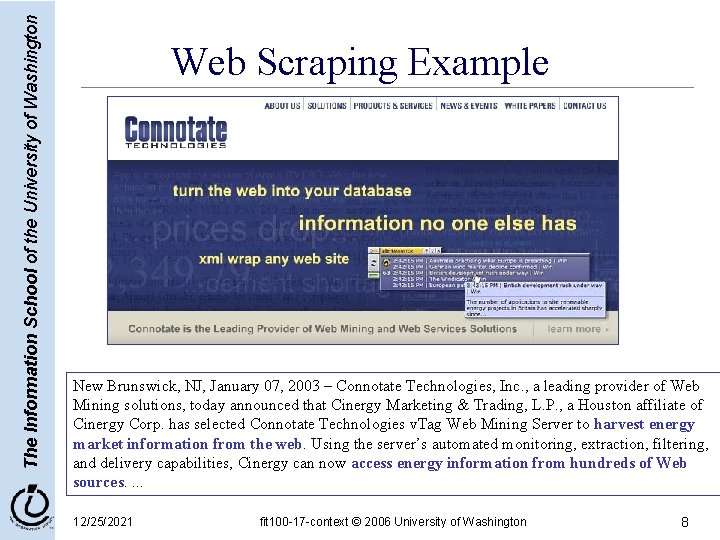
The Information School of the University of Washington Web Scraping Example New Brunswick, NJ, January 07, 2003 – Connotate Technologies, Inc. , a leading provider of Web Mining solutions, today announced that Cinergy Marketing & Trading, L. P. , a Houston affiliate of Cinergy Corp. has selected Connotate Technologies v. Tag Web Mining Server to harvest energy market information from the web. Using the server’s automated monitoring, extraction, filtering, and delivery capabilities, Cinergy can now access energy information from hundreds of Web sources. . 12/25/2021 fit 100 -17 -context © 2006 University of Washington 8
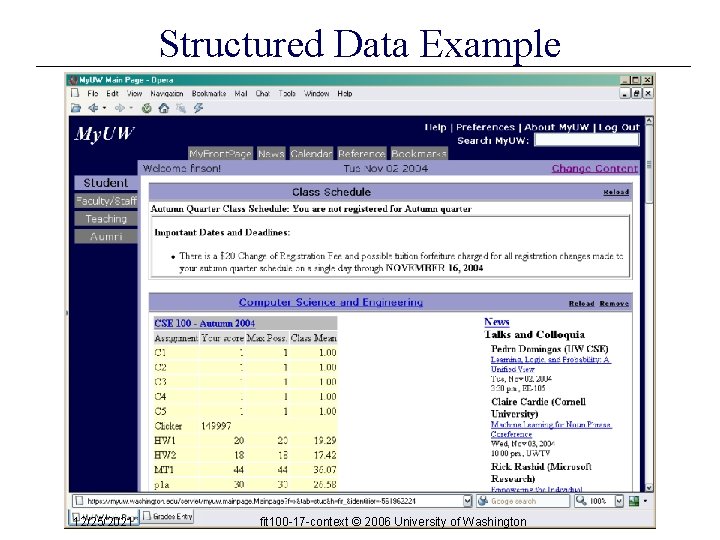
Structured Data Example 12/25/2021 fit 100 -17 -context © 2006 University of Washington
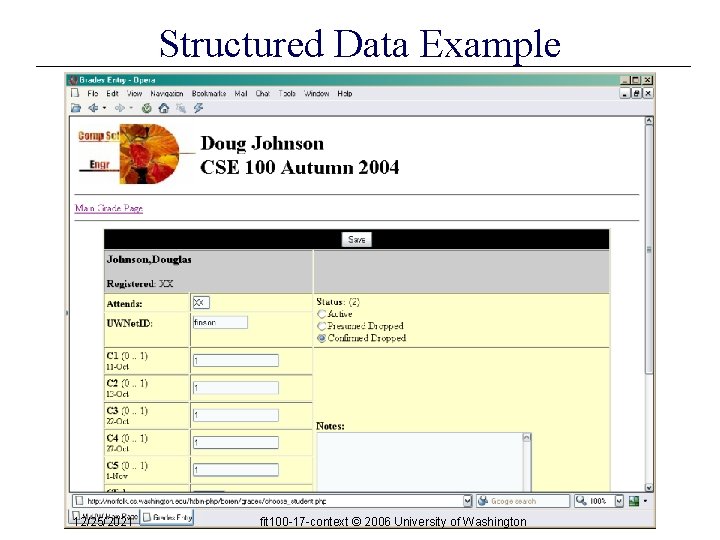
Structured Data Example 12/25/2021 fit 100 -17 -context © 2006 University of Washington
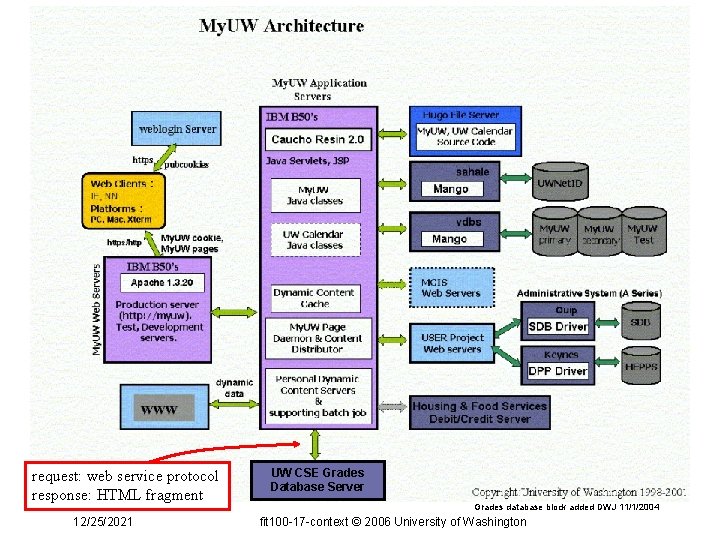
request: web service protocol response: HTML fragment 12/25/2021 UW CSE Grades Database Server Grades database block added DWJ 11/1/2004 fit 100 -17 -context © 2006 University of Washington
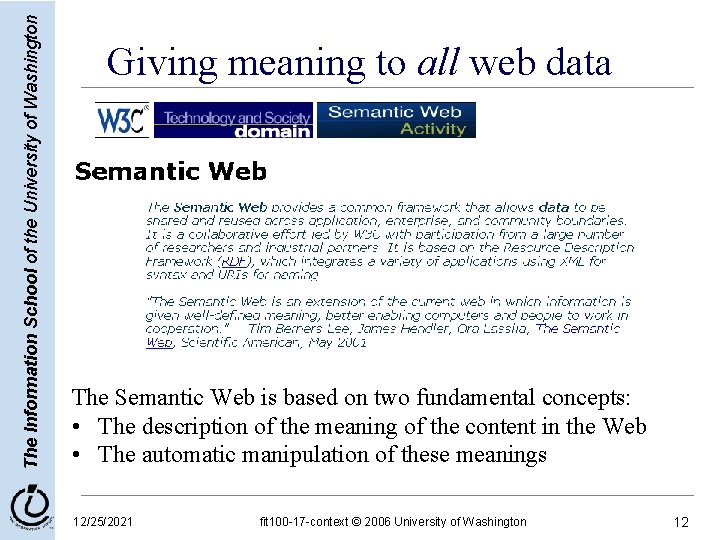
The Information School of the University of Washington Giving meaning to all web data The Semantic Web is based on two fundamental concepts: • The description of the meaning of the content in the Web • The automatic manipulation of these meanings 12/25/2021 fit 100 -17 -context © 2006 University of Washington 12
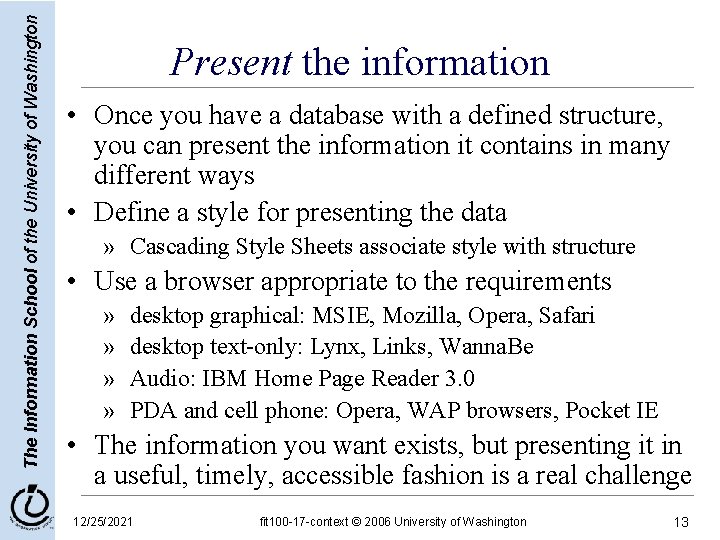
The Information School of the University of Washington Present the information • Once you have a database with a defined structure, you can present the information it contains in many different ways • Define a style for presenting the data » Cascading Style Sheets associate style with structure • Use a browser appropriate to the requirements » » desktop graphical: MSIE, Mozilla, Opera, Safari desktop text-only: Lynx, Links, Wanna. Be Audio: IBM Home Page Reader 3. 0 PDA and cell phone: Opera, WAP browsers, Pocket IE • The information you want exists, but presenting it in a useful, timely, accessible fashion is a real challenge 12/25/2021 fit 100 -17 -context © 2006 University of Washington 13
The Information School of the University of Washington Language Layers • Sure, Java. Script is fun. But where does it fit in the larger picture? • Markup language » information structure and content, hyperlinking • Lightweight scripting language » dynamic creation of HTML, response to events • Heavyweight programming language » active graphics creation, numerical computation 12/25/2021 fit 100 -17 -context © 2006 University of Washington 14
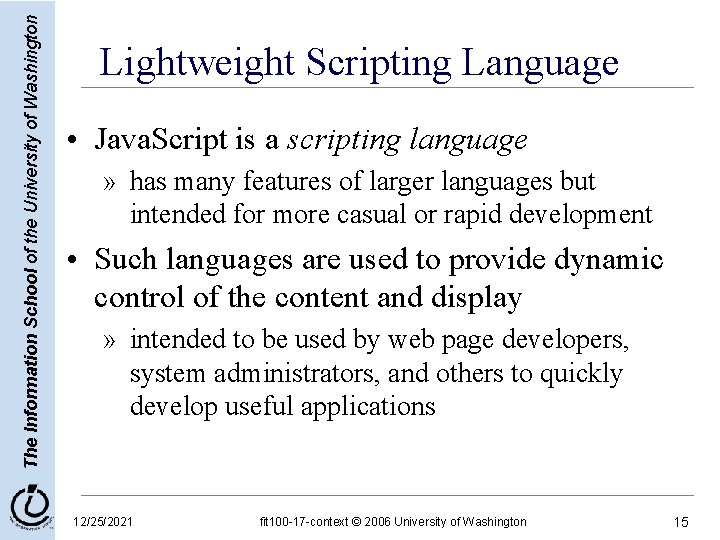
The Information School of the University of Washington Lightweight Scripting Language • Java. Script is a scripting language » has many features of larger languages but intended for more casual or rapid development • Such languages are used to provide dynamic control of the content and display » intended to be used by web page developers, system administrators, and others to quickly develop useful applications 12/25/2021 fit 100 -17 -context © 2006 University of Washington 15
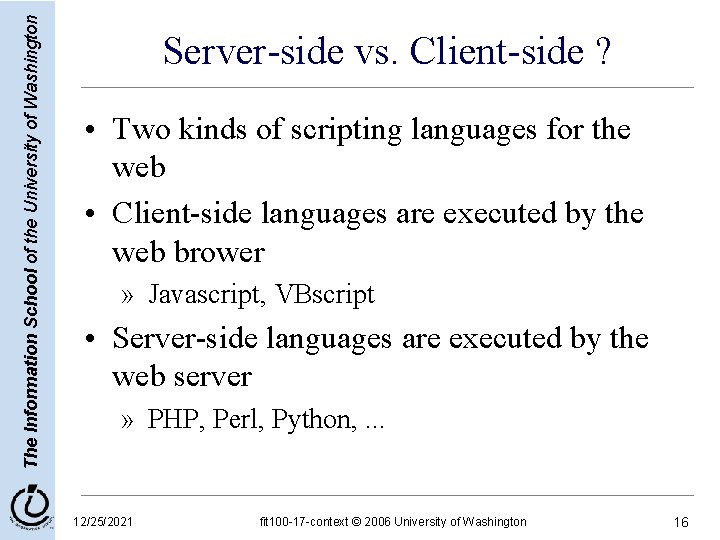
The Information School of the University of Washington Server-side vs. Client-side ? • Two kinds of scripting languages for the web • Client-side languages are executed by the web brower » Javascript, VBscript • Server-side languages are executed by the web server » PHP, Perl, Python, . . . 12/25/2021 fit 100 -17 -context © 2006 University of Washington 16
The Information School of the University of Washington Other Scripting Languages • • PHP is an HTML-embedded scripting language. Much of its syntax is borrowed from C, Java and Perl with a couple of unique PHP-specific features thrown in. The goal of the language is to allow web developers to write dynamically generated pages quickly. Python is an interpreted, interactive, object-oriented programming language. It is often compared to Tcl, Perl, Scheme or Java. Python is also usable as an extension language for applications that need a programmable interface. Perl is a language optimized for scanning arbitrary text files, extracting information from those text files, and printing reports based on that information. It's also a good language for many system management tasks. The language is intended to be practical (easy to use, efficient, complete) rather than beautiful (tiny, elegant, minimal). VBScript. Microsoft Visual Basic Scripting Edition brings active scripting to a wide variety of environments, including Web client scripting in Microsoft Internet Explorer and Web server scripting in Microsoft Internet Information Service. 12/25/2021 fit 100 -17 -context © 2006 University of Washington 17
The Information School of the University of Washington Dynamic HTML • Dynamic HTML is a technique of creating interactive web sites by using a combination of » the static markup language HTML » the style definition language Cascading Style Sheets » a client-side scripting language • A client-side scripting language provides » Adaptivity … the page can be customized » Interactivity … get user input and display results » Applications … build a general purpose program 12/25/2021 fit 100 -17 -context © 2006 University of Washington 18
The Information School of the University of Washington Language Layers • Sure, Java. Script is fun. But where does it fit in the larger picture? • Markup language » information structure and content, hyperlinking • Lightweight scripting language » dynamic creation of HTML, response to events • Heavyweight programming language » active graphics creation, numerical computation 12/25/2021 fit 100 -17 -context © 2006 University of Washington 19
The Information School of the University of Washington Larger Programming Languages • Web browsers are handy, but many applications are large and need specialized capabilities • Large applications are generally written in full featured programming languages like » Java, C++, C#, Fortran » These languages come with extensive function libraries to support extended networking, graphics, data structures, etc. • Many new languages straddle the line and are appropriate for both scripting and large-scale development 12/25/2021 fit 100 -17 -context © 2006 University of Washington 20
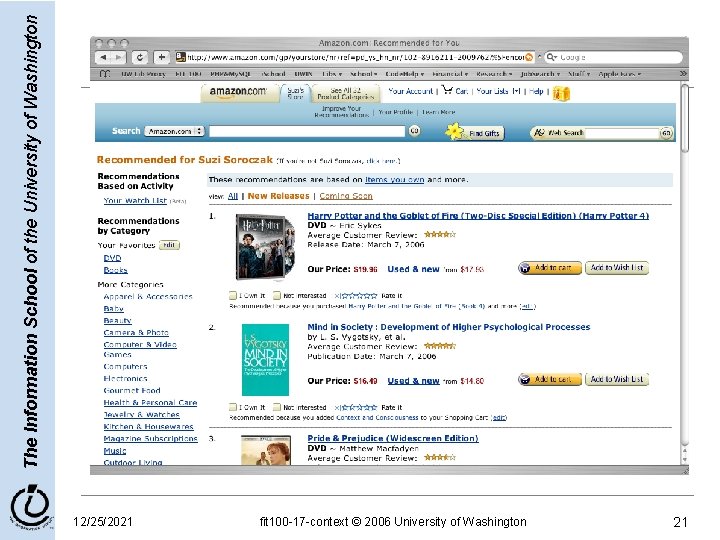
The Information School of the University of Washington 12/25/2021 fit 100 -17 -context © 2006 University of Washington 21
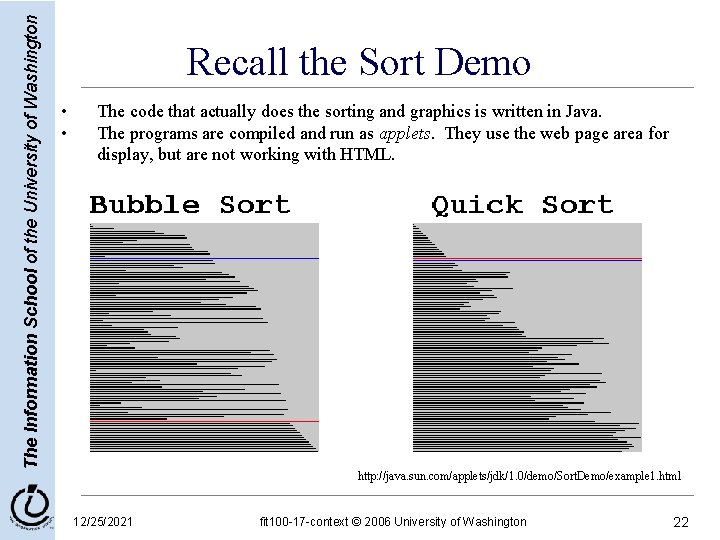
The Information School of the University of Washington Recall the Sort Demo • • The code that actually does the sorting and graphics is written in Java. The programs are compiled and run as applets. They use the web page area for display, but are not working with HTML. http: //java. sun. com/applets/jdk/1. 0/demo/Sort. Demo/example 1. html 12/25/2021 fit 100 -17 -context © 2006 University of Washington 22
The Information School of the University of Washington Summary • HTML forms the basic structure for web pages » Modern trends are to separate • the structural description of the data • the presentation of the data to the user » process the information according to the content » display the information as appropriate to the user • Programming languages make information management and display dynamic » languages come in many flavors but they share many basic concepts and much of their basic syntax 12/25/2021 fit 100 -17 -context © 2006 University of Washington 23