
The Information School of the University of Washington
- Slides: 43
The Information School of the University of Washington Basic Concepts in HIB Acquiring new lenses to see HIB and a new language to analyze it
The Information School of the University of Washington Information Need— Definition • Information needs arise whenever individuals find themselves in a situation, and require information to deal with the situation as they see fit.
Information Need— Definition The Information School of the University of Washington The difference between: • Information want • Information demand • Information need
The Information School of the University of Washington Information Want • The information a person thinks she or he wants to have to solve an information problem Or: • The information a person believes will solve his or her information problem
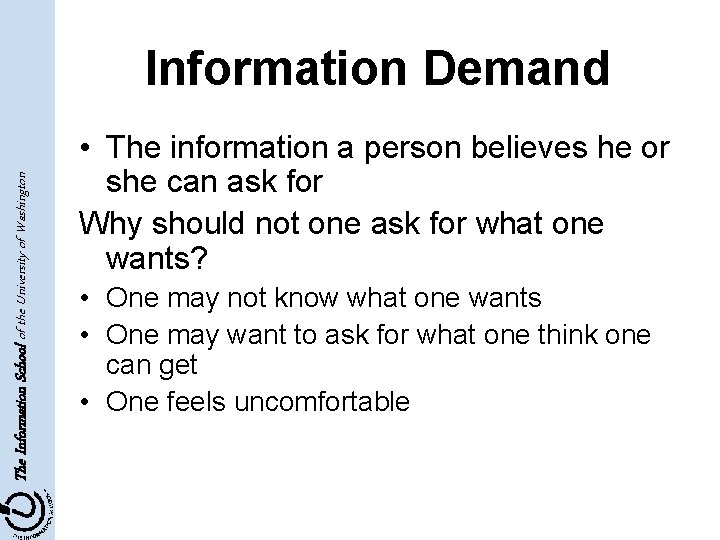
The Information School of the University of Washington Information Demand • The information a person believes he or she can ask for Why should not one ask for what one wants? • One may not know what one wants • One may want to ask for what one think one can get • One feels uncomfortable
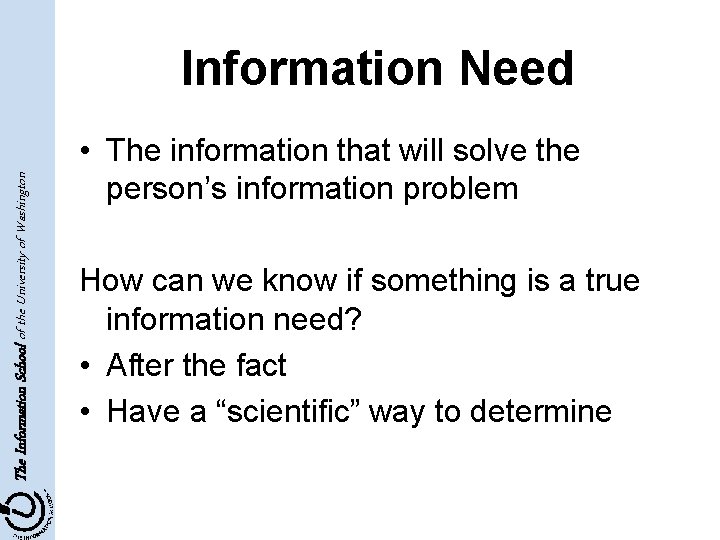
The Information School of the University of Washington Information Need • The information that will solve the person’s information problem How can we know if something is a true information need? • After the fact • Have a “scientific” way to determine
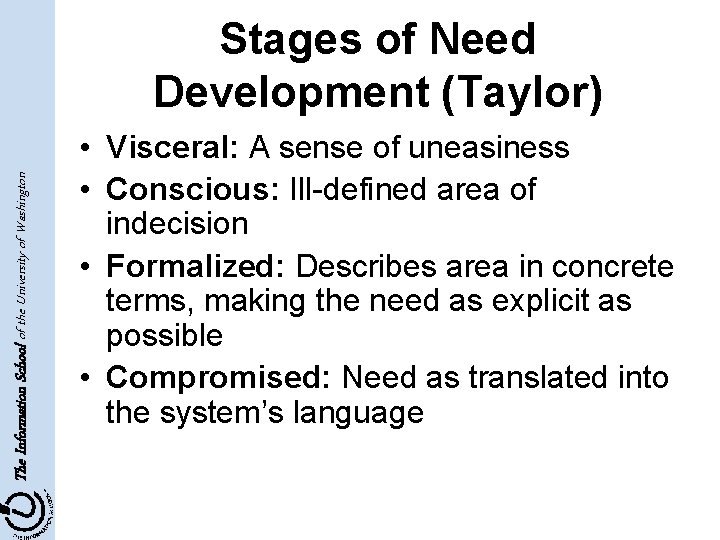
The Information School of the University of Washington Stages of Need Development (Taylor) • Visceral: A sense of uneasiness • Conscious: Ill-defined area of indecision • Formalized: Describes area in concrete terms, making the need as explicit as possible • Compromised: Need as translated into the system’s language
The Information School of the University of Washington Stages of Need Development Exercise Please identify the stages of the information need in each of the following quotations on the handout. Time: 5 minutes
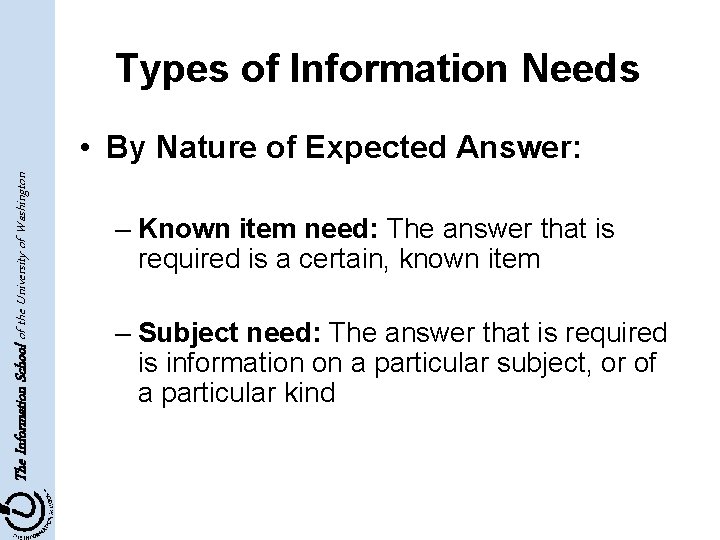
Types of Information Needs The Information School of the University of Washington • By Nature of Expected Answer: – Known item need: The answer that is required is a certain, known item – Subject need: The answer that is required is information on a particular subject, or of a particular kind
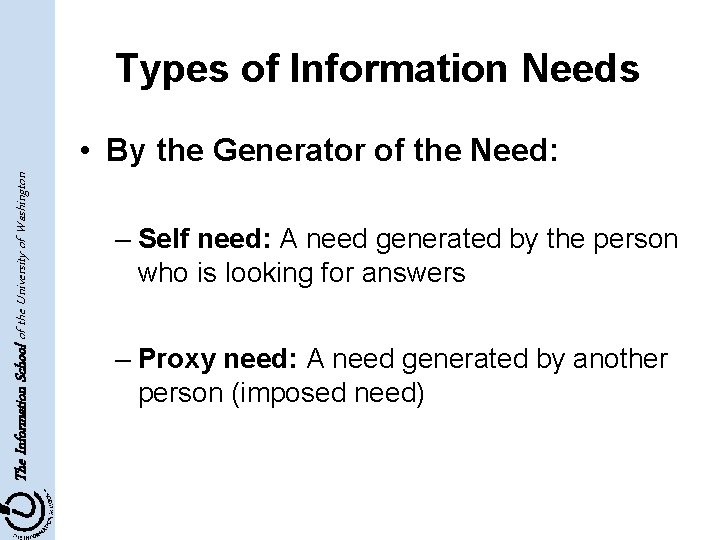
Types of Information Needs The Information School of the University of Washington • By the Generator of the Need: – Self need: A need generated by the person who is looking for answers – Proxy need: A need generated by another person (imposed need)
The Information School of the University of Washington My Information Need Exercise • Turn to your neighbor and exchange a copy of the completed assignment • Read your neighbor’s assignment and analyze the need described in terms of the characteristics just covered • Discuss with your neighbor what your analysis revealed Time: 5 minutes
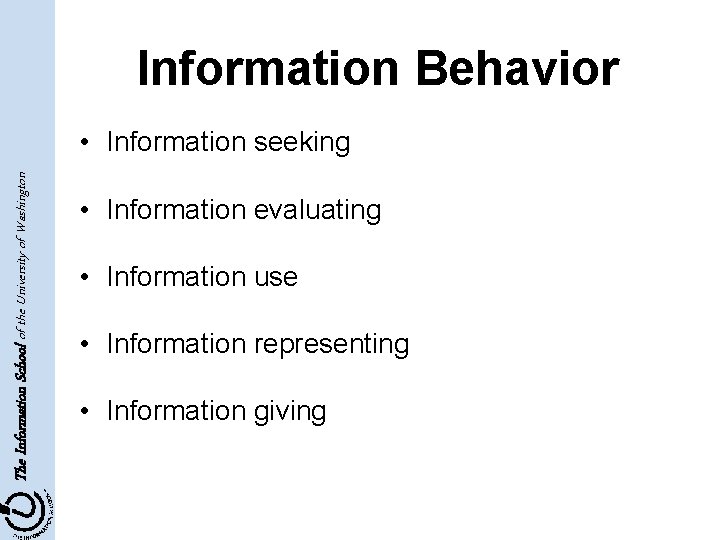
Information Behavior The Information School of the University of Washington • Information seeking • Information evaluating • Information use • Information representing • Information giving
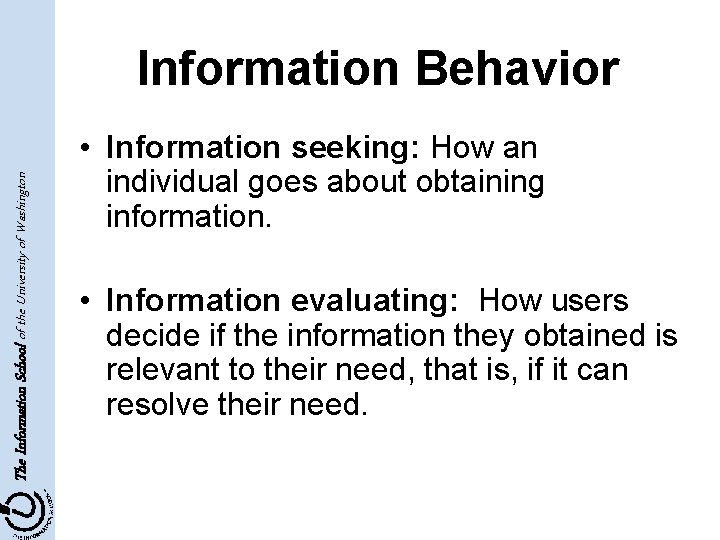
The Information School of the University of Washington Information Behavior • Information seeking: How an individual goes about obtaining information. • Information evaluating: How users decide if the information they obtained is relevant to their need, that is, if it can resolve their need.
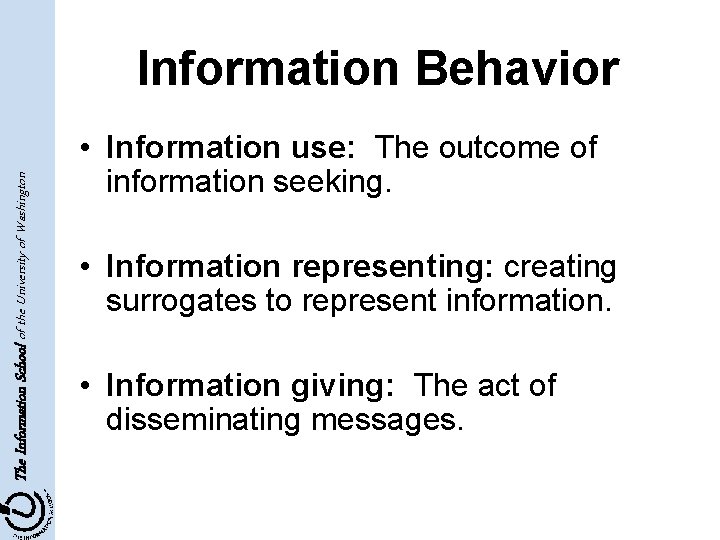
The Information School of the University of Washington Information Behavior • Information use: The outcome of information seeking. • Information representing: creating surrogates to represent information. • Information giving: The act of disseminating messages.
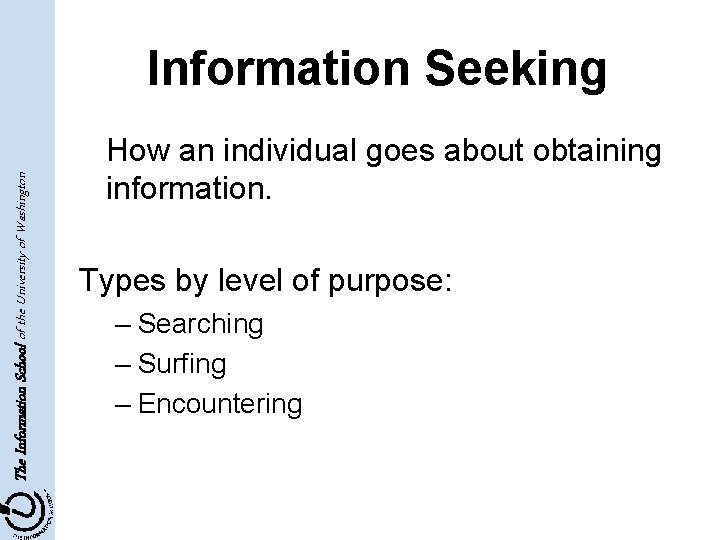
The Information School of the University of Washington Information Seeking How an individual goes about obtaining information. Types by level of purpose: – Searching – Surfing – Encountering
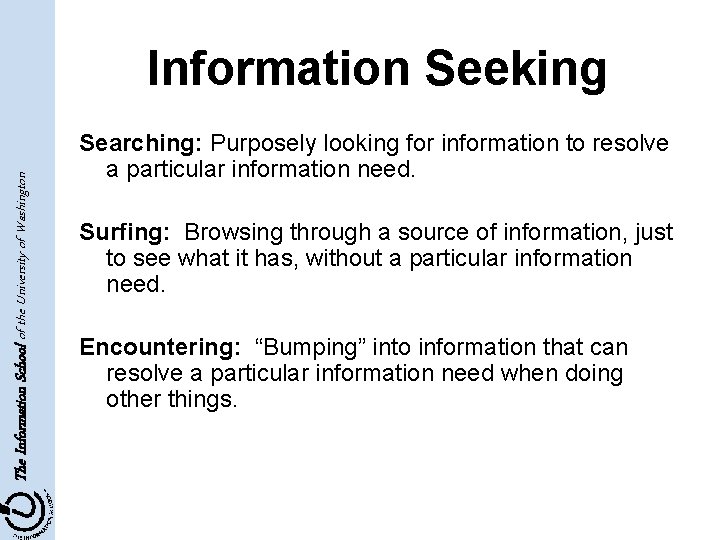
The Information School of the University of Washington Information Seeking Searching: Purposely looking for information to resolve a particular information need. Surfing: Browsing through a source of information, just to see what it has, without a particular information need. Encountering: “Bumping” into information that can resolve a particular information need when doing other things.
The Information School of the University of Washington Information Seeking— Class Workout • Revisit your neighbor’s assignment and indicate: – What behavior is described (seeking, evaluating, use, giving)? – If seeking, what type (searching, surfing, encountering)? • Discuss with your neighbor what your analysis revealed Time: 3 minutes
Search Strategies The Information School of the University of Washington Where are we now? • Information behavior – Information seeking • Searching – Search strategies
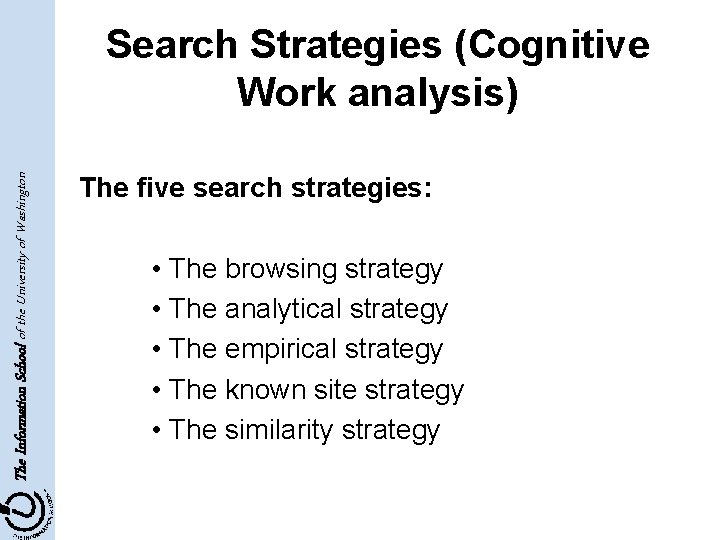
The Information School of the University of Washington Search Strategies (Cognitive Work analysis) The five search strategies: • The browsing strategy • The analytical strategy • The empirical strategy • The known site strategy • The similarity strategy
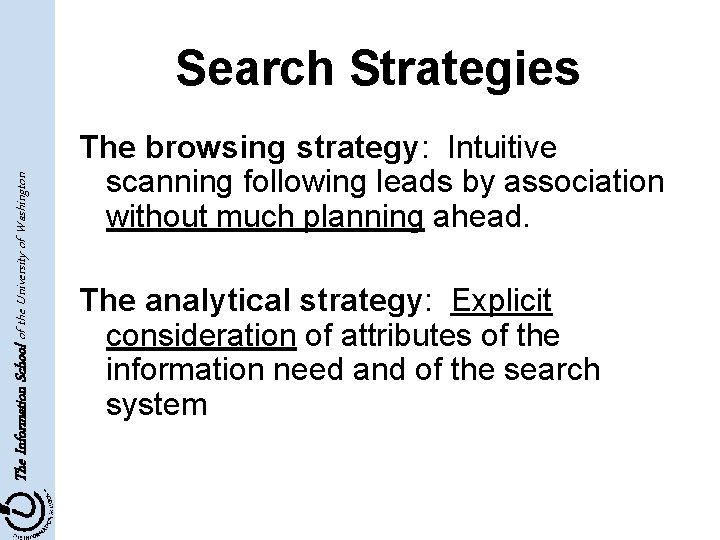
The Information School of the University of Washington Search Strategies The browsing strategy: Intuitive scanning following leads by association without much planning ahead. The analytical strategy: Explicit consideration of attributes of the information need and of the search system
The Information School of the University of Washington Search Strategies The empirical strategy: Based on previous experience, using rules and tactics that were successful in the past The known site strategy: Going directly to the place where the information is located
The Information School of the University of Washington Search Strategies The similarity strategy: Find information based on a previous successful example that is similar to the current need.
The Information School of the University of Washington Search Strategies Exercise • Revisit your neighbor’s assignment and indicate: – What search strategies were used? • Discuss with your neighbor what your analysis revealed Time: 3 minutes
The Information School of the University of Washington Searching Methods (Ellis) Where are we now? • Information behavior – Information seeking • Searching – Search strategies – Searching methods
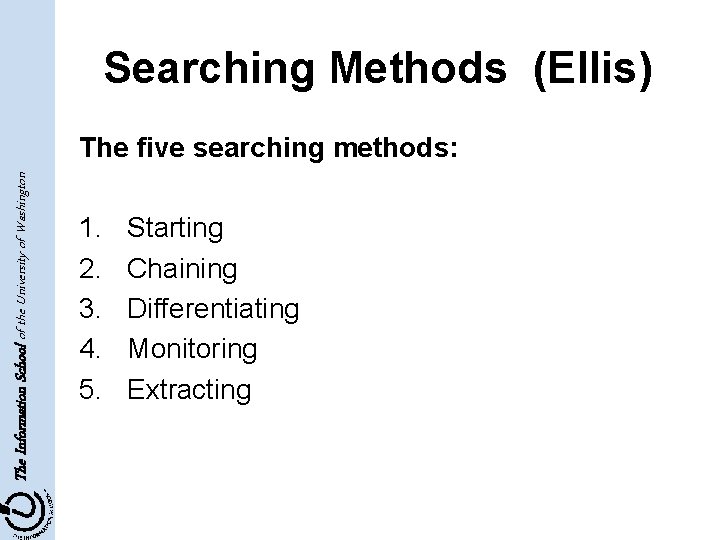
Searching Methods (Ellis) The Information School of the University of Washington The five searching methods: 1. 2. 3. 4. 5. Starting Chaining Differentiating Monitoring Extracting
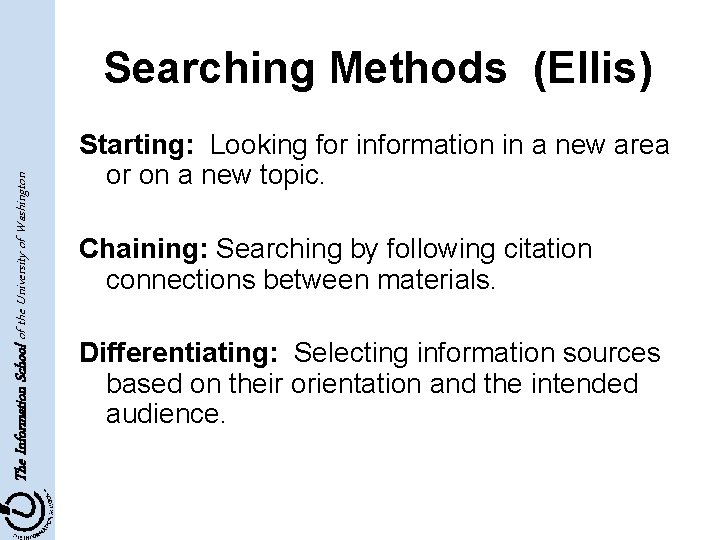
The Information School of the University of Washington Searching Methods (Ellis) Starting: Looking for information in a new area or on a new topic. Chaining: Searching by following citation connections between materials. Differentiating: Selecting information sources based on their orientation and the intended audience.
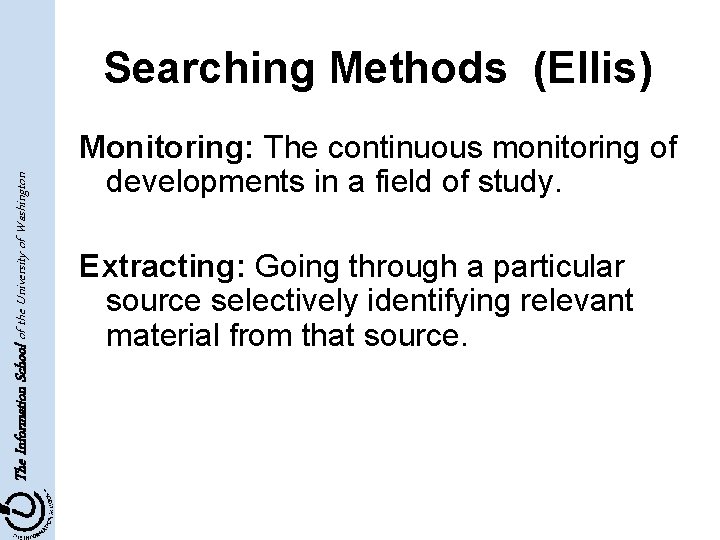
The Information School of the University of Washington Searching Methods (Ellis) Monitoring: The continuous monitoring of developments in a field of study. Extracting: Going through a particular source selectively identifying relevant material from that source.
The Information School of the University of Washington Searching Methods Exercise • Revisit your neighbor’s assignment and indicate: – What searching methods were used? – Discuss with your neighbor what your analysis revealed Time: 3 minutes
The Information School of the University of Washington Surfing Where are we now? • Information behavior – Information seeking • Searching • Surfing • Encountering
The Information School of the University of Washington Surfing: Browsing through a source of information, just to see what it has, with no particular information need in mind. Examples: – – Reading the daily newspaper Watching programs on TV Visiting a bookstore Surfing the Web Other examples?
The Information School of the University of Washington Encountering: “Bumping” into information that can resolve past or future information need. Also called: – Accidental discovery of information – Incidental information acquisition
Encountering The Information School of the University of Washington Can happen when: • Searching for information to resolve another need • Surfing • Any other activity
Information Evaluating The Information School of the University of Washington Where are we now? • Information behavior – Information seeking – Information evaluating – Information use – Information giving
Information Evaluating The Information School of the University of Washington Information Evaluating: Users evaluate information when they decide if it is relevant to their need; that is, if it can resolve their need Also called: Compare/match
Information Evaluating The Information School of the University of Washington The major issues: • The subjective nature of relevance judgment • The levels of relevance • Factors affecting relevance
The Information School of the University of Washington Information Surfing, Encountering and Evaluating Exercise • Revisit your neighbor’s assignment and indicate: – Was any surfing or encountering done? – What criteria was used to evaluate the information? • Discuss with your neighbor what your analysis revealed Time: 3 minutes
Information Use The Information School of the University of Washington • The outcome of information seeking May take various forms: – Acting on information – Changing state of knowledge (making new sense) – Confirming what one already knows
The Information School of the University of Washington Information Use Exercise • Revisit your neighbor’s assignment and indicate: – How did your neighbor used the information obtained? – How did it help (or not help) her or him? – Did another information need emerge as a result? • Discuss with your neighbor what your analysis revealed Time: 3 minutes
Information giving The Information School of the University of Washington Where are we now? • Information behavior – Information seeking – Information evaluating – Information use – Information giving
The Information School of the University of Washington Information giving: The act of disseminating messages Triggers for giving: • A user asks for information directly • A user raises a topic about which the giver has information
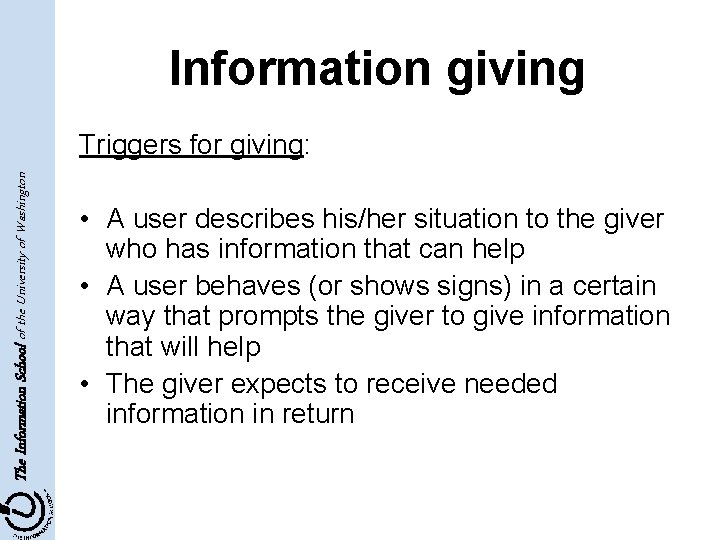
Information giving The Information School of the University of Washington Triggers for giving: • A user describes his/her situation to the giver who has information that can help • A user behaves (or shows signs) in a certain way that prompts the giver to give information that will help • The giver expects to receive needed information in return
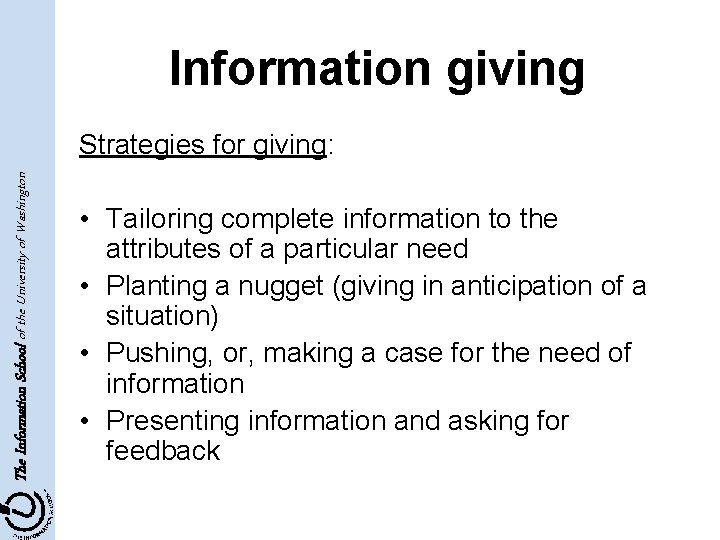
Information giving The Information School of the University of Washington Strategies for giving: • Tailoring complete information to the attributes of a particular need • Planting a nugget (giving in anticipation of a situation) • Pushing, or, making a case for the need of information • Presenting information and asking for feedback
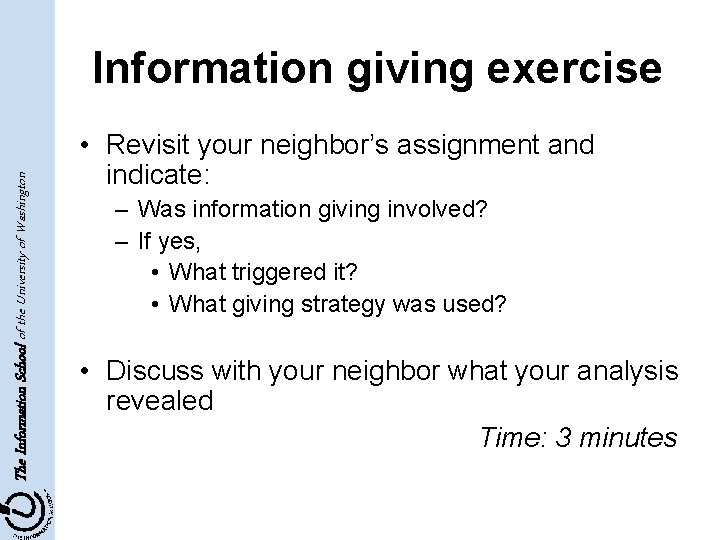
The Information School of the University of Washington Information giving exercise • Revisit your neighbor’s assignment and indicate: – Was information giving involved? – If yes, • What triggered it? • What giving strategy was used? • Discuss with your neighbor what your analysis revealed Time: 3 minutes