
The Informal Economy and Corruption Ira Lieberman September
The Informal Economy and Corruption Ira Lieberman September 5, 2005 1
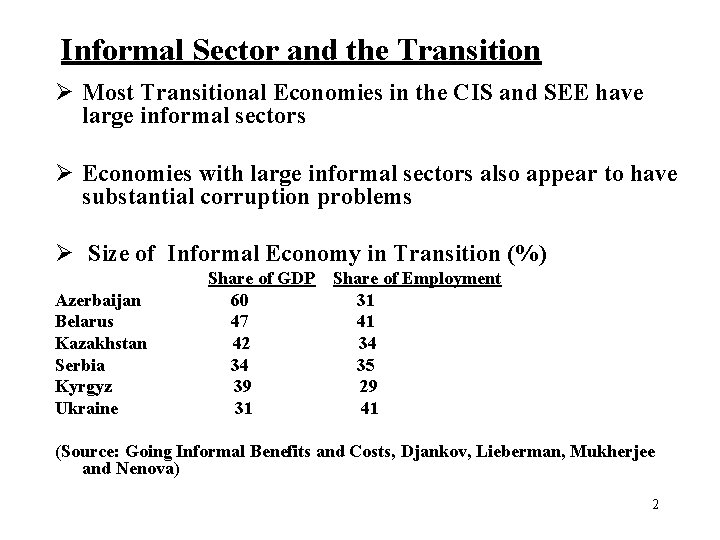
Informal Sector and the Transition Ø Most Transitional Economies in the CIS and SEE have large informal sectors Ø Economies with large informal sectors also appear to have substantial corruption problems Ø Size of Informal Economy in Transition (%) Azerbaijan Belarus Kazakhstan Serbia Kyrgyz Ukraine Share of GDP 60 47 42 34 39 31 Share of Employment 31 41 34 35 29 41 (Source: Going Informal Benefits and Costs, Djankov, Lieberman, Mukherjee and Nenova) 2
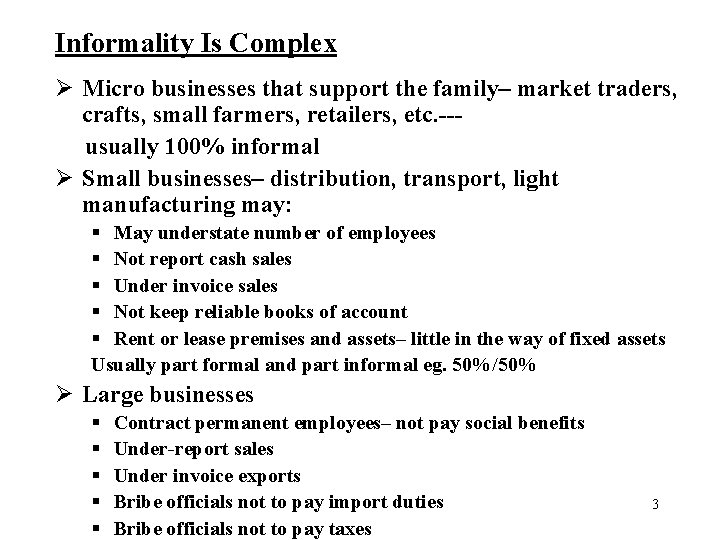
Informality Is Complex Ø Micro businesses that support the family– market traders, crafts, small farmers, retailers, etc. --usually 100% informal Ø Small businesses– distribution, transport, light manufacturing may: § May understate number of employees § Not report cash sales § Under invoice sales § Not keep reliable books of account § Rent or lease premises and assets– little in the way of fixed assets Usually part formal and part informal eg. 50%/50% Ø Large businesses § § § Contract permanent employees– not pay social benefits Under-report sales Under invoice exports Bribe officials not to pay import duties Bribe officials not to pay taxes 3
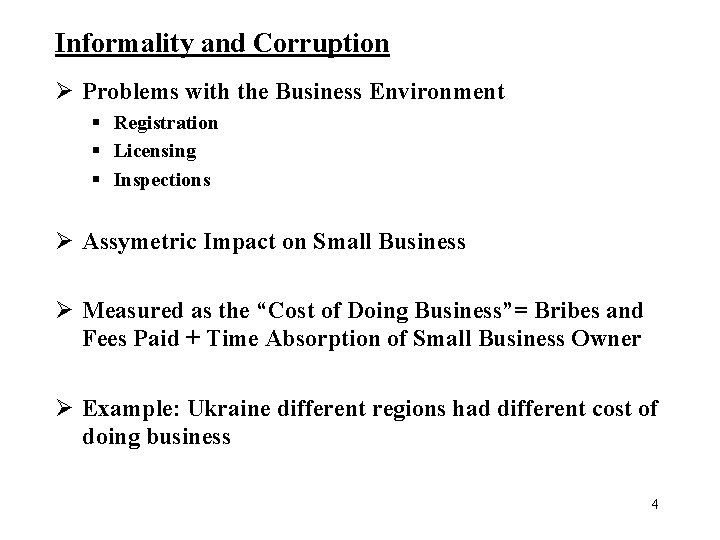
Informality and Corruption Ø Problems with the Business Environment § Registration § Licensing § Inspections Ø Assymetric Impact on Small Business Ø Measured as the “Cost of Doing Business”= Bribes and Fees Paid + Time Absorption of Small Business Owner Ø Example: Ukraine different regions had different cost of doing business 4
Informality and Corruption (continued) Ø Large Industrial Groups maintain ghost workers, e. g. Serbia § Receive full or partial salary, health and pension benefits § Show up for work infrequently or not at all § Workers employed in the informal economy Ø Cost to the economy: Groups receive subsidies to pay wages, do not pay taxes, do not pay utility bills, and accumulate substantial debt to the state and others 5

Incentives to Reduce Informality and Corruption Ø Will not be reduced to zero, all economies have an informal sector– § § § Czechs 18% of GDP, 12% employment Hungary 24% GDP, 21% employment Slovakia 18% GDP and 16% of employment Ø Can be reduced by simplifying rules governing registration and licensing and by limiting inspection– rule should be not to license at all if the business does not affect public safety Ø Establishing overall low tax levels eg. Hungary Ø Creating a unitary tax for small business Ø Providing access to finance for micro and small business– commercially provided microfinance Ø Reforming public administration= professional adequately paid bureuacracy 6
- Slides: 6