
The Influence of Personality on Presidential Leadership Style
![6. Ingroup Bias & 7. Distrust of Others • “[Trump] came to office with](https://slidetodoc.com/presentation_image_h2/27f1b0e68594ce56544a4021ddb9f502/image-19.jpg "6. Ingroup Bias & 7. Distrust of Others • “[Trump] came to office with")
- Slides: 24
The Influence of Personality on Presidential Leadership Style (with a Case Study of Donald J. Trump, 45 th President of the United States) Annie Griebie April 2021
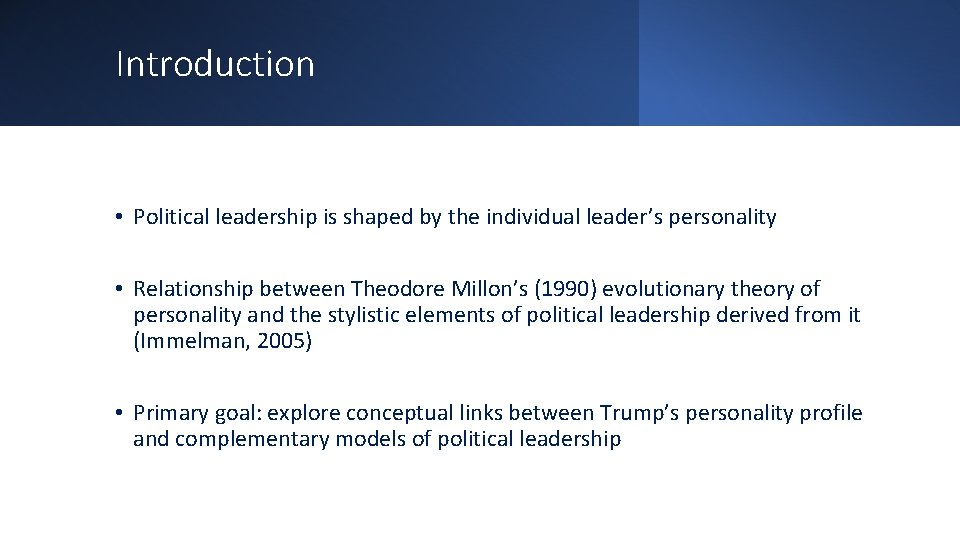
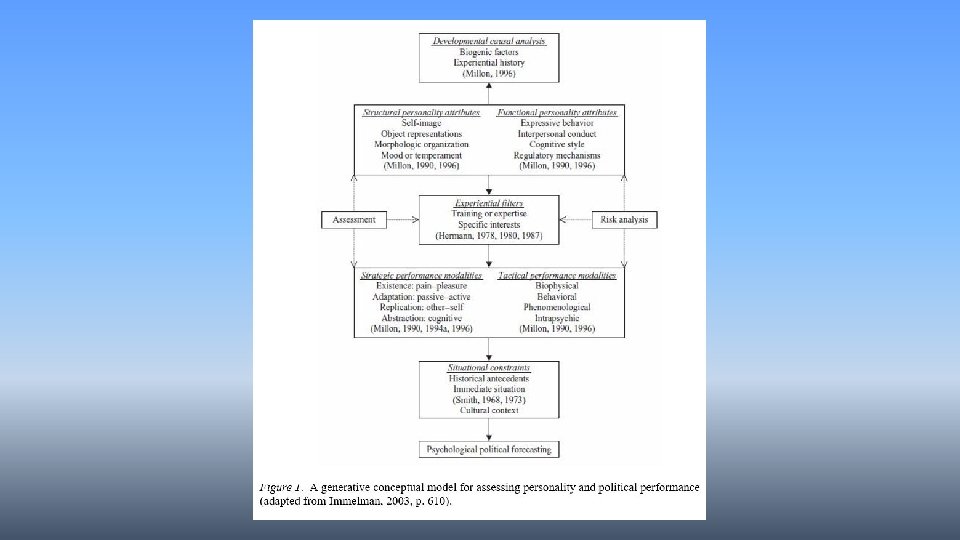
Introduction • Political leadership is shaped by the individual leader’s personality • Relationship between Theodore Millon’s (1990) evolutionary theory of personality and the stylistic elements of political leadership derived from it (Immelman, 2005) • Primary goal: explore conceptual links between Trump’s personality profile and complementary models of political leadership
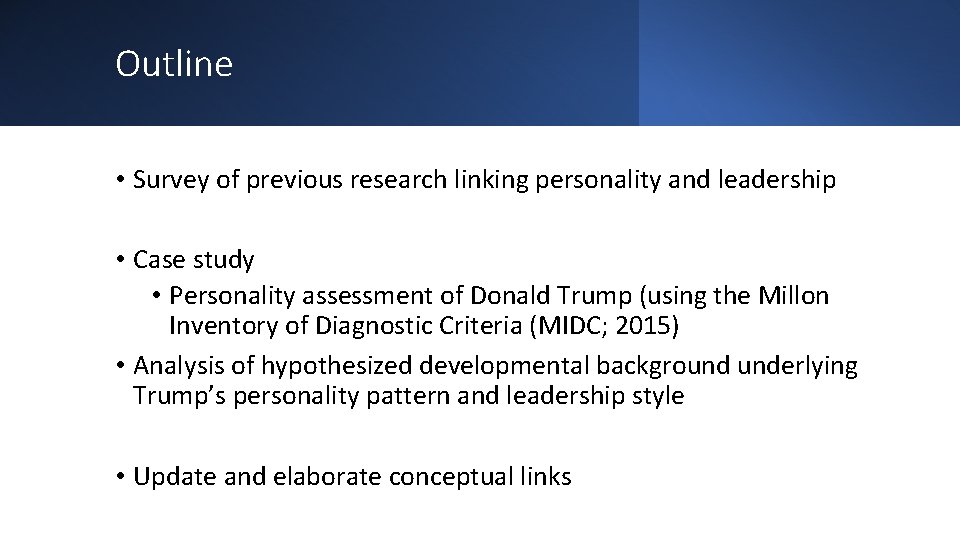
Outline • Survey of previous research linking personality and leadership • Case study • Personality assessment of Donald Trump (using the Millon Inventory of Diagnostic Criteria (MIDC; 2015) • Analysis of hypothesized developmental background underlying Trump’s personality pattern and leadership style • Update and elaborate conceptual links
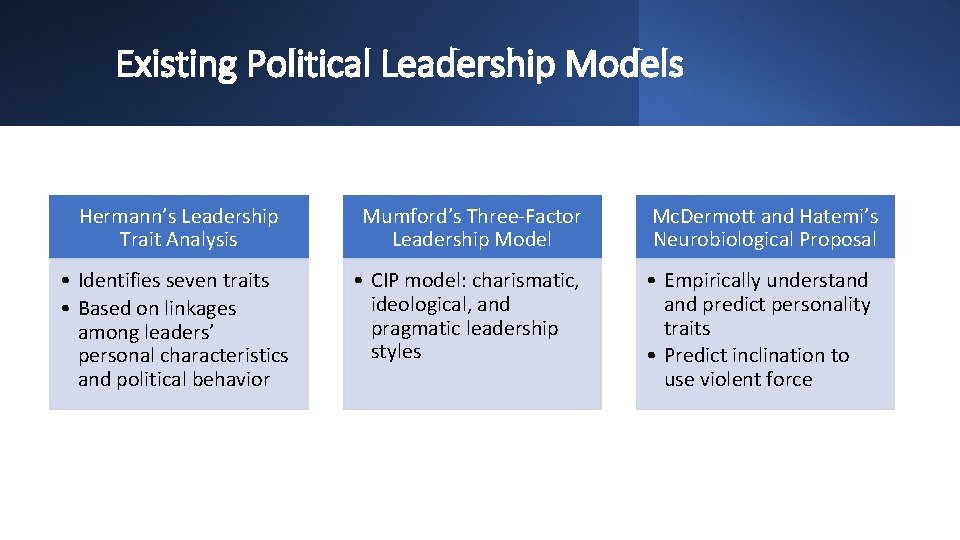
Existing Political Leadership Models Hermann’s Leadership Trait Analysis Mumford’s Three-Factor Leadership Model • Identifies seven traits • Based on linkages among leaders’ personal characteristics and political behavior • CIP model: charismatic, ideological, and pragmatic leadership styles Mc. Dermott and Hatemi’s Neurobiological Proposal • Empirically understand predict personality traits • Predict inclination to use violent force
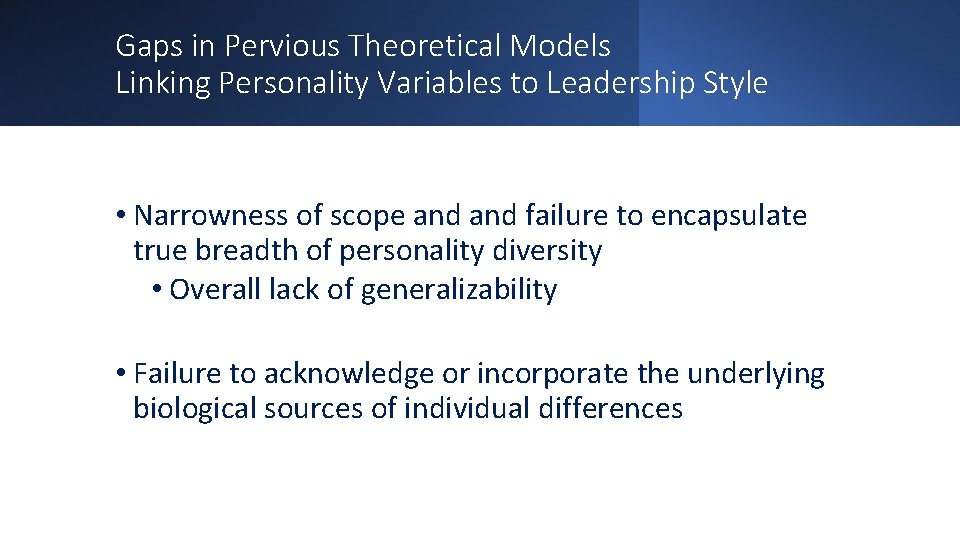
Gaps in Pervious Theoretical Models Linking Personality Variables to Leadership Style • Narrowness of scope and failure to encapsulate true breadth of personality diversity • Overall lack of generalizability • Failure to acknowledge or incorporate the underlying biological sources of individual differences
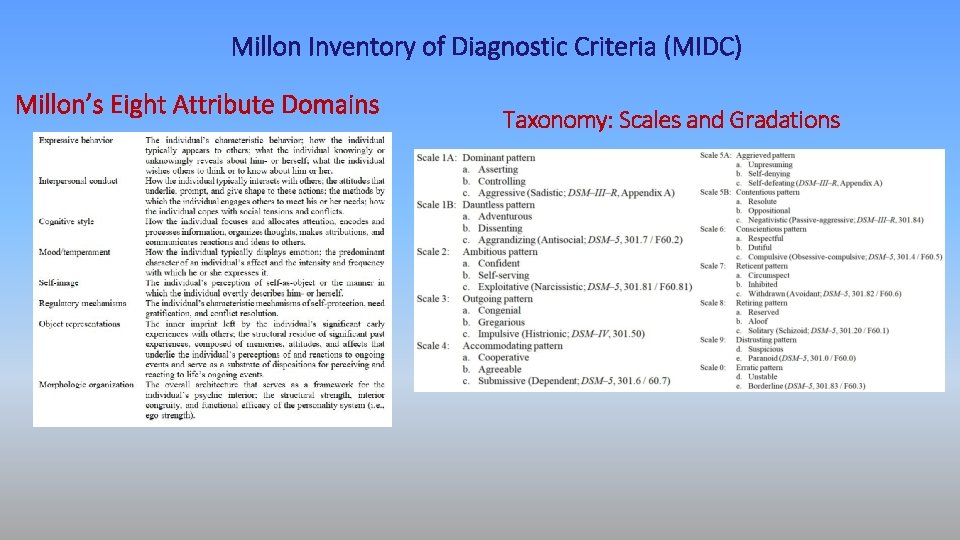
Millon Inventory of Diagnostic Criteria (MIDC) Millon’s Eight Attribute Domains Taxonomy: Scales and Gradations
Current Issues in Political Psychology • How do leadership style dynamics change within an individual over time? • How do constituents or other followers influence an individual’s leadership style?
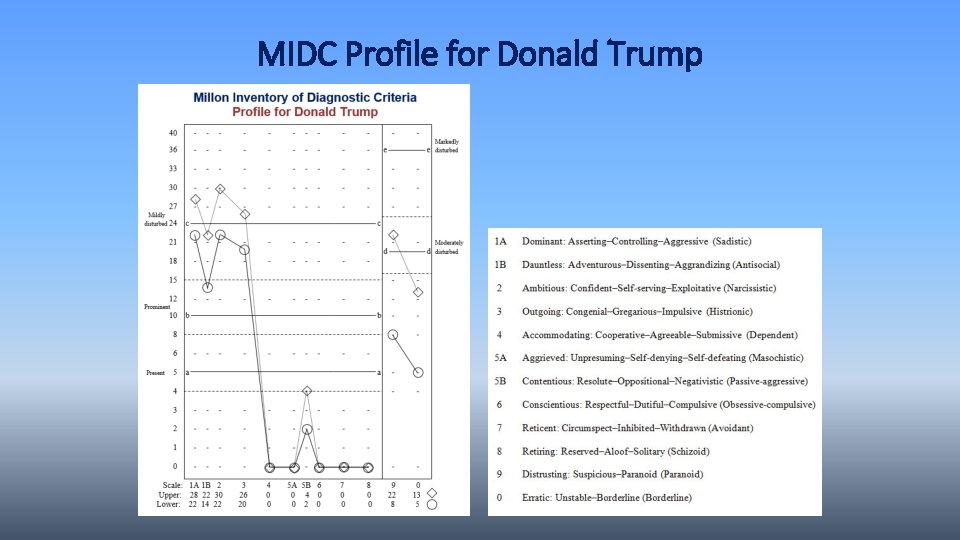
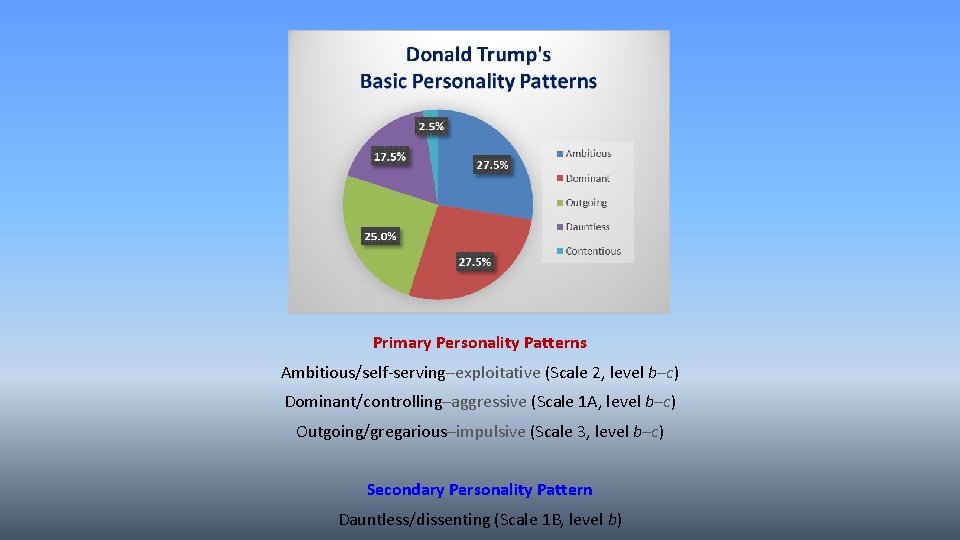
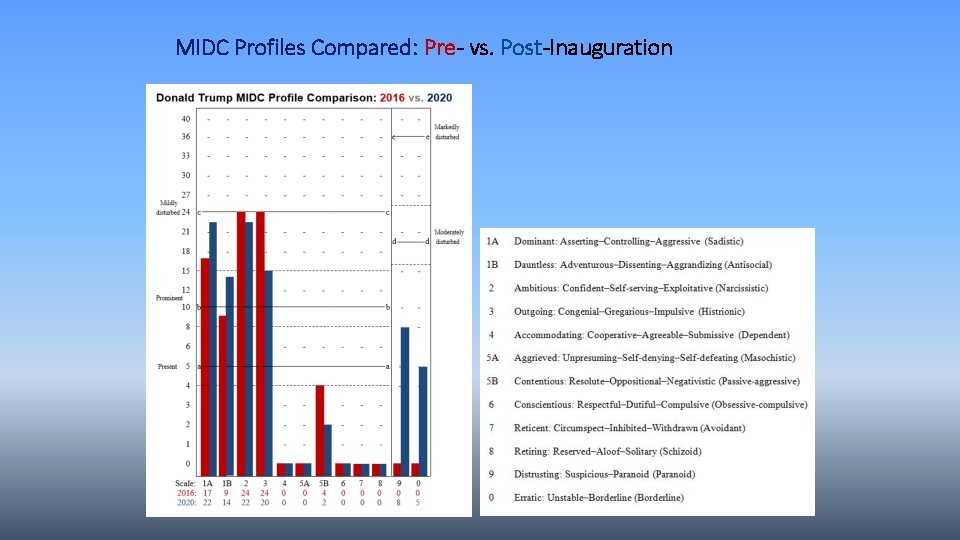
MIDC Profile for Donald Trump
Primary Personality Patterns Ambitious/self-serving–exploitative (Scale 2, level b–c) Dominant/controlling–aggressive (Scale 1 A, level b–c) Outgoing/gregarious–impulsive (Scale 3, level b–c) Secondary Personality Pattern Dauntless/dissenting (Scale 1 B, level b)
Developmental Causal Analysis • Summaries of the developmental background of personality patterns relevant to Trump, supplemented by documentation from Mary Trump’s biography of Donald Trump, Too Much and Never Enough (2020) • Experiential history sets the stage for self-perpetuation processes • Analysis served as a validity check on theoretical coherence of Trump’s MIDC-derived profile
Outgoing Pattern: Characteristic Experiential History Stimulus Enrichment and Diversity in the Sensory-Attachment Stage • Highly outgoing individuals are likely to “have been exposed to a number of different sources that provide brief, highly charged, and irregular stimulus reinforcements. … Thus, the persistent yet erratic dependency behaviors of the histrionic personality may reflect a pathological form of intense stimulus seeking that can be traced to highly charged, varied and irregular stimulus reinforcements associated with early attachment learning. The shifting from one source of gratification to another so characteristic of histrionics, their search for new stimulus adventures, their penchant for creating excitement and their inability to tolerate boredom and routine, all may represent the consequences of these unusual early experiences” (Millon, 2011, pp. 364– 365). • “All behavior exhibited by infants and toddlers is a form of attachment behavior, which seeks a positive, comforting, response from a caregiver—a smile to elicit a smile, tears to prompt a hug. Even under normal circumstances, Fred [Trump] would have considered any expression of that kind an annoyance, but Donald and Robert were likely even needier because they missed their mother and were actively distressed by her absence. The greater their distress, however, the more Fred rebuffed them (Trump, 2020, p. 25). • “Donald’s needs, which had been met inconsistently before his mother’s illness, were barely met at all by his father” (Trump, 2020, p. 25).
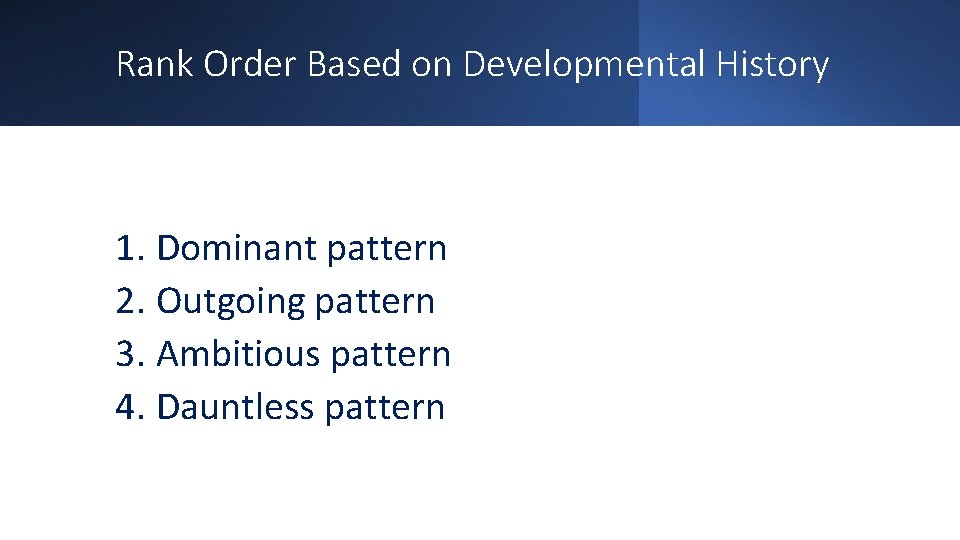
Rank Order Based on Developmental History 1. Dominant pattern 2. Outgoing pattern 3. Ambitious pattern 4. Dauntless pattern
Hermann’s Leadership Trait Analysis • Hermann (2003) identified seven traits that are useful for assessing leadership style on the basis of linkages among leaders’ personal characteristics and their political behavior: • (1) the belief that one can influence or control what happens, (2) the need for power and influence, (3) conceptual complexity (the ability to differentiate things and people in one’s environment), (4) selfconfidence, (5) the tendency to focus on problem solving and accomplishing something versus maintenance of the group and dealing with others’ ideas and sensitivities, (6) an individual’s general distrust or suspiciousness of others, and (7) the intensity with which a person holds an ingroup bias (p. 10).
1. Belief in the Ability to Control Events • Trump’s seeming naïveté about the severity of “this Russia thing” and his confidence that any repercussions would be absorbed by his underlings isn’t merely evidence of his willful ignorance and stunted capacity for critical thinking (Cauterucci, 2019). • Trump is effectively being constrained, a novel and uncomfortable position for a businessman, a reality star and an unlikely politician who resists all kinds of control. All his life, Trump has called the shots and he’s always forced others to respond to his impulses. It’s not surprising he’s frustrated when the shoe is on the other foot (Collinson, 2019).
2. Need for Power and Influence • “His obsession with domination and power have prompted Trump to tell lies more promiscuously than ever since he became President, and to engage in ever more unfounded and aggressive responses aimed at anyone he perceives stands in his way, ” Schwartz wrote (Glasser, 2020). • In Trump, we have a frightening Venn diagram consisting of three circles: The first is extreme present hedonism; the second, narcissism; and the third, bullying behavior. These three circles overlap in the middle to create an impulsive, immature, incompetent person who, when in the position of ultimate power, easily slides into the role of tyrant, complete with family members sitting at his proverbial “ruling table” (Dodes, Gilligan, Sheehy, Sword, & Zimbardo, 2017).
• “You know, people don’t understand. I went to an Ivy League college. I was a nice student. I did very well. I’m a very intelligent person (Borchers, 2017). 3. Self-Confidence • Mr. Trump has hit back against Mr. Wolff’s account, claiming on Twitter to be a “very stable genius” whose “two greatest assets have been mental stability and being, like, really smart” (Trump’s mental health, 2018).
4. Conceptual Complexity • That Trump comes to this view instinctively rather than intellectually, that his personal diplomacy is bumbling and naïve, that other U. S. actors are ramping up hostility to Russia that Trump would like to dampen, merely cloud the strategic arguments (Watson, 2018). • They stem from Trump’s unwillingness to ponder the consequences of his actions in countries that he doesn’t understand (Kaplan, 2018). • And he [Trump] is so narcissistic and unreflective that he is completely incapable of learning from his mistakes (Wehner, 2020).
5. Task vs. Relationship Focus • Trump doesn’t appear to make heartfelt connections with anyone, nor to value relationships beyond the extent to which they serve his immediate self-interest. Turnover in his administration — 85% in the first 32 months — dwarfs that of his five most recent predecessors for their entire first terms. Trump treats even his relationships with family members as transactional (Schwartz, 2020). • From the start of his ascension to power, Mr. Trump has presented himself as someone who seeks conflict, not conciliation, a fighter, not a peacemaker (Baker, 2020).
6. Ingroup Bias & 7. Distrust of Others • “[Trump] came to office with an almost pathological distrust of others and an irresistible impulse to attack any perceived threat, ” said Jonathan Turley, a law professor at George Washington University who testified against impeachment last year before the House Judiciary Committee (Baker & Haberman, 2020 a). • [Barbara Res, Trump’s top construction executive in the 1980 s, was quoted as saying] “He doesn’t trust anybody, except his family. That’s why [Trump’s ex-wife] Ivana was involved in everything and why now his children are too” (Fischer, 2018).
Composite Profile: Trump’s Leadership Style as a Function of Responsiveness to Constraints, Openness to Information, and Motivation • High in the belief he can control events and in the need for power • Low in conceptual complexity and high in self-confidence • High in task focus • High in ingroup bias
Expansionistic Leadership Style (Hermann, 1987) • View of the world: • “divided into ‘us’ and ‘them’” • “conflict is inherent to functioning in the international system” • Personal political style: • “directive and manipulative in dealing with others” • “keep one step ahead of those considered the enemy” • Foreign policy • “focused on issues of security and status” • “favor low-commitment actions”
MIDC Profiles Compared: Pre- vs. Post-Inauguration
Future Directions • Construct a taxonomy of political presidential leadership styles congruent with, and embedded in, Theodore Millon’s evolutionary theory of personality