
The infinitives of most French verbs end in
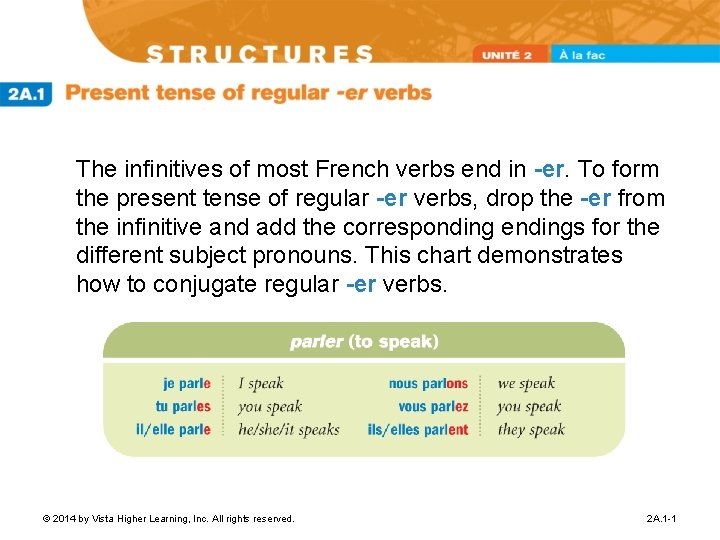
The infinitives of most French verbs end in -er. To form the present tense of regular -er verbs, drop the -er from the infinitive and add the corresponding endings for the different subject pronouns. This chart demonstrates how to conjugate regular -er verbs. © 2014 by Vista Higher Learning, Inc. All rights reserved. 2 A. 1 -1
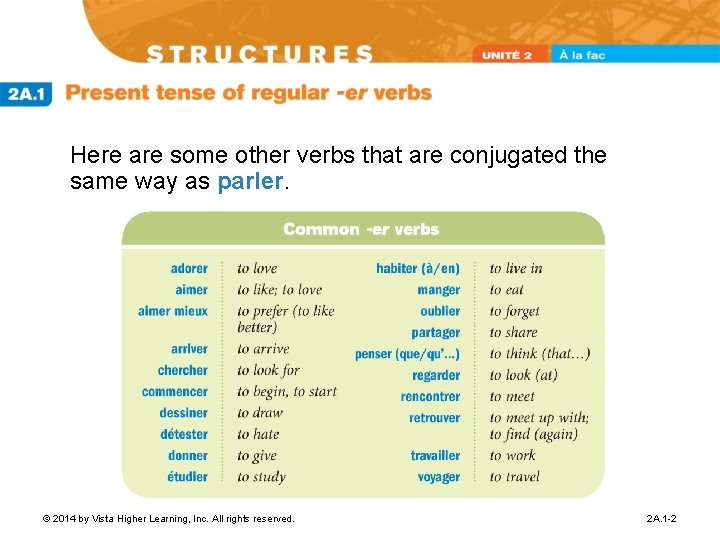
Here are some other verbs that are conjugated the same way as parler. © 2014 by Vista Higher Learning, Inc. All rights reserved. 2 A. 1 -2
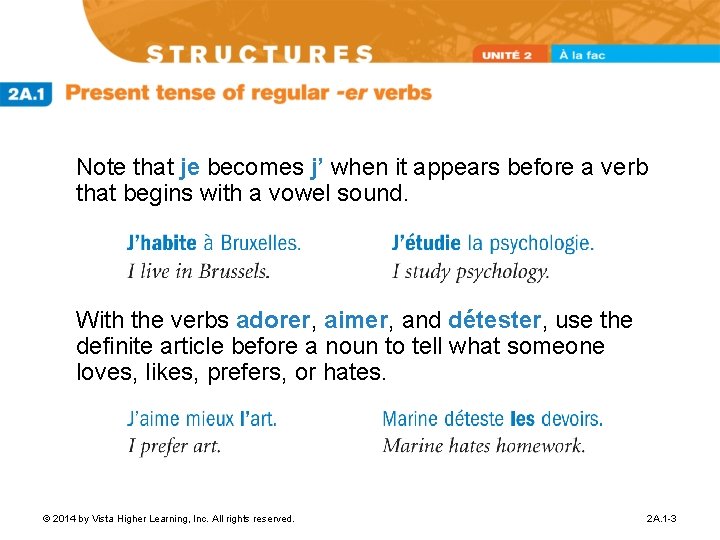
Note that je becomes j’ when it appears before a verb that begins with a vowel sound. With the verbs adorer, aimer, and détester, use the definite article before a noun to tell what someone loves, likes, prefers, or hates. © 2014 by Vista Higher Learning, Inc. All rights reserved. 2 A. 1 -3
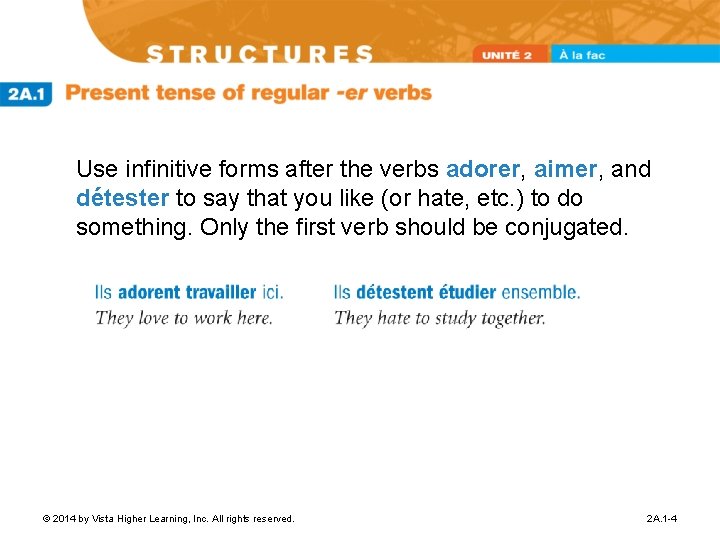
Use infinitive forms after the verbs adorer, aimer, and détester to say that you like (or hate, etc. ) to do something. Only the first verb should be conjugated. © 2014 by Vista Higher Learning, Inc. All rights reserved. 2 A. 1 -4
Boîte à outils To express yourself with greater accuracy, use these adverbs: assez (enough), d’habitude (usually), de temps en temps (from time to time), parfois (sometimes), quelquefois (sometimes), rarement (rarely), souvent (often), toujours (always). © 2014 by Vista Higher Learning, Inc. All rights reserved. 2 A. 1 -5
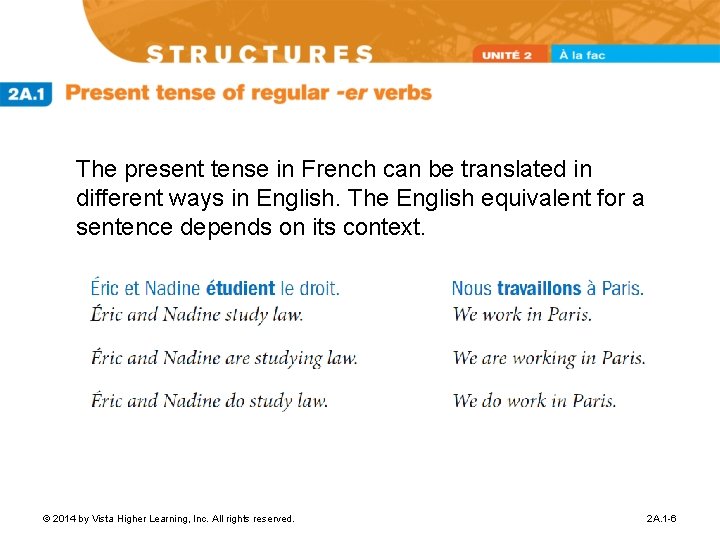
The present tense in French can be translated in different ways in English. The English equivalent for a sentence depends on its context. © 2014 by Vista Higher Learning, Inc. All rights reserved. 2 A. 1 -6
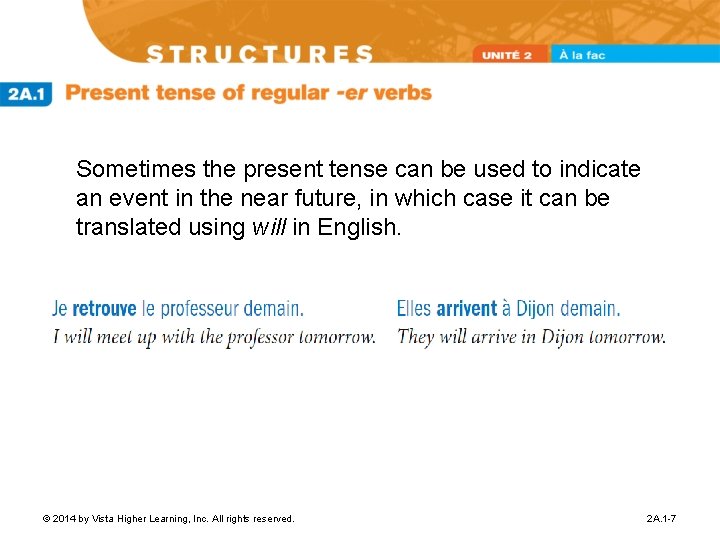
Sometimes the present tense can be used to indicate an event in the near future, in which case it can be translated using will in English. © 2014 by Vista Higher Learning, Inc. All rights reserved. 2 A. 1 -7
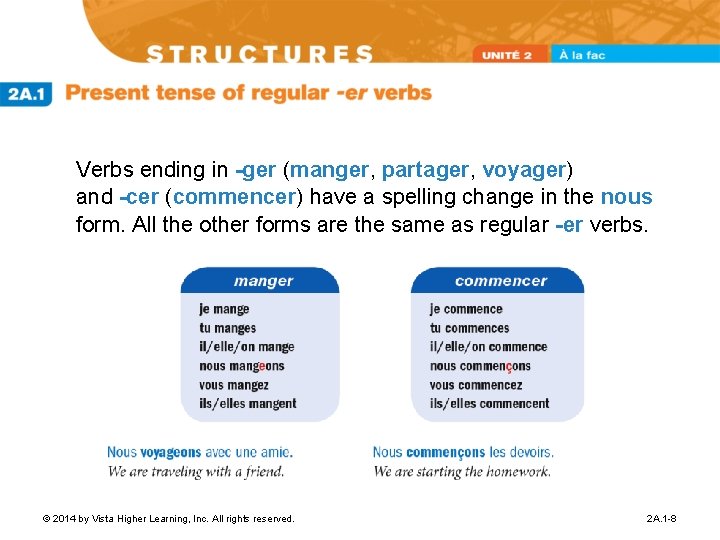
Verbs ending in -ger (manger, partager, voyager) and -cer (commencer) have a spelling change in the nous form. All the other forms are the same as regular -er verbs. © 2014 by Vista Higher Learning, Inc. All rights reserved. 2 A. 1 -8
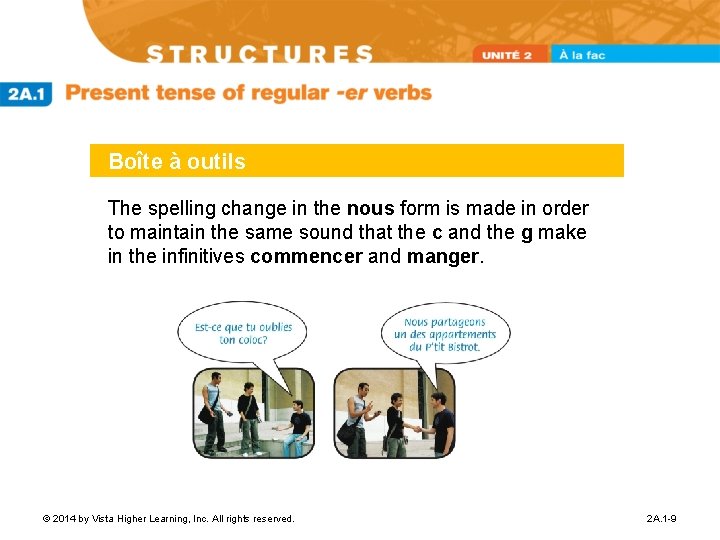
Boîte à outils The spelling change in the nous form is made in order to maintain the same sound that the c and the g make in the infinitives commencer and manger. © 2014 by Vista Higher Learning, Inc. All rights reserved. 2 A. 1 -9
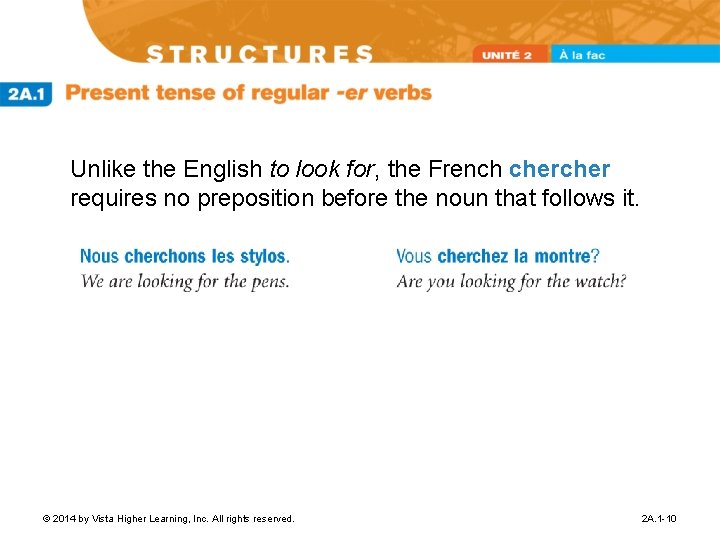
Unlike the English to look for, the French cher requires no preposition before the noun that follows it. © 2014 by Vista Higher Learning, Inc. All rights reserved. 2 A. 1 -10
- Slides: 10