
The Industrial Revolution The Industrial Revolution was a


- Slides: 23
The Industrial Revolution
■ The Industrial Revolution was a period from the 18 th to the 19 th century where major changes in agriculture, manufacturing, mining, transportation, and technology. ■ Industrialization: a shift from an agricultural (farming) economy to one based on industry (manufacturing)
Key Terms ■ ■ ■ ■ ■ Industrialization – a shift from an agricultural economy (farming) to one based on industry (manufacturing) Manufacturing – the use of machines, tools, and labor to make things for use or sale Rural – farming or country life; villages (sparsely populated) Urban – city life (densely populated) Urbanization – the movement of people to cities Tenement – a substandard, multi-family dwelling; usually old and occupied by the poor Free market – a market in which there is no economic intervention and regulation by the state (govt) Capitalism – private ownership of means of production Socialism – society (not the individual) owns and operates the means of production
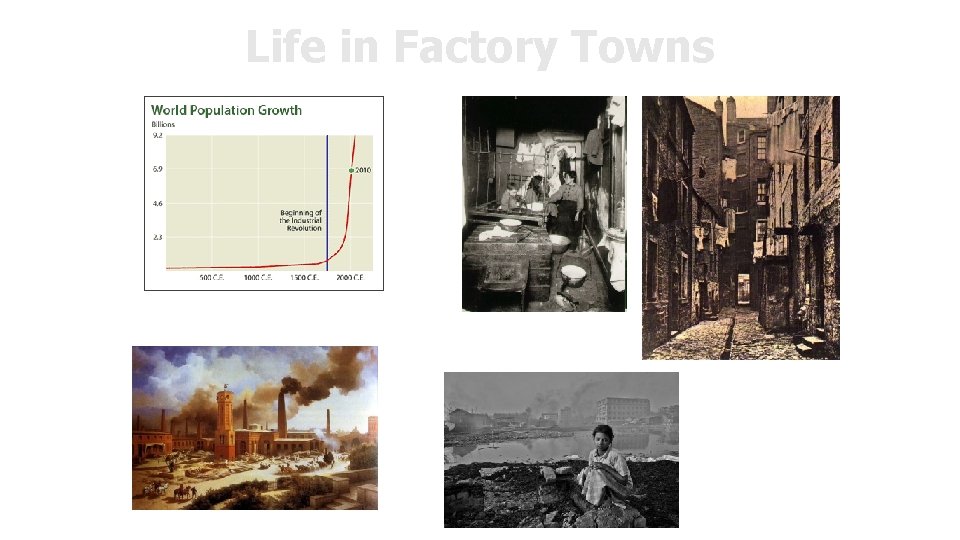
Causes of the Industrial Revolution ■ Agricultural Revolution – improved the quality and quantity of food – Farmers mixed different kinds of soil or tried new crop rotation to get higher yields – This led to a surplus of food = fewer people died from hunger = rapid growth in population ■ New technologies and new sources of energy and materials (e. g. , James Watt’s steam engine became a key source of power)
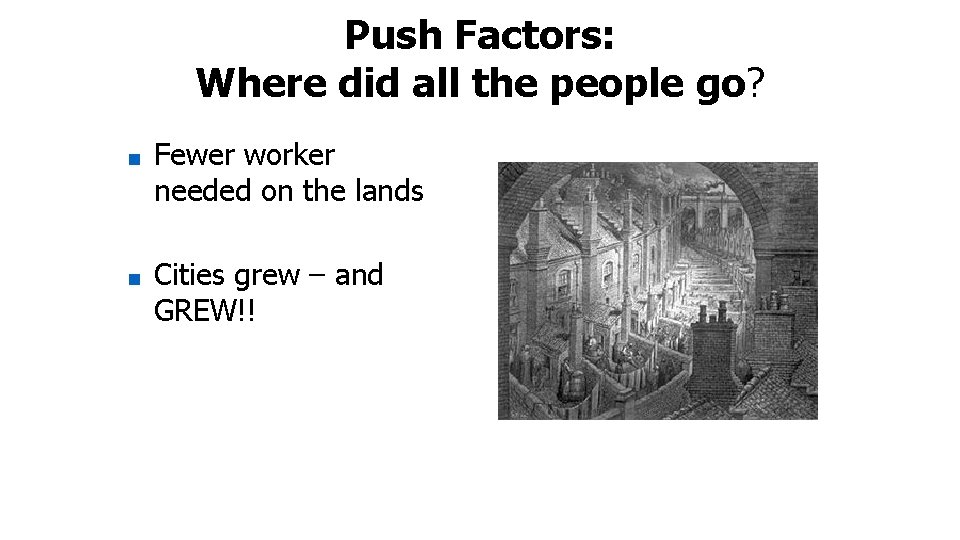
Push Factors: Where did all the people go? ■ Fewer worker needed on the lands ■ Cities grew – and GREW!! Over London by Rail Gustave Doré c. 1870. Shows the densely populated and polluted environments created in the new industrial cities
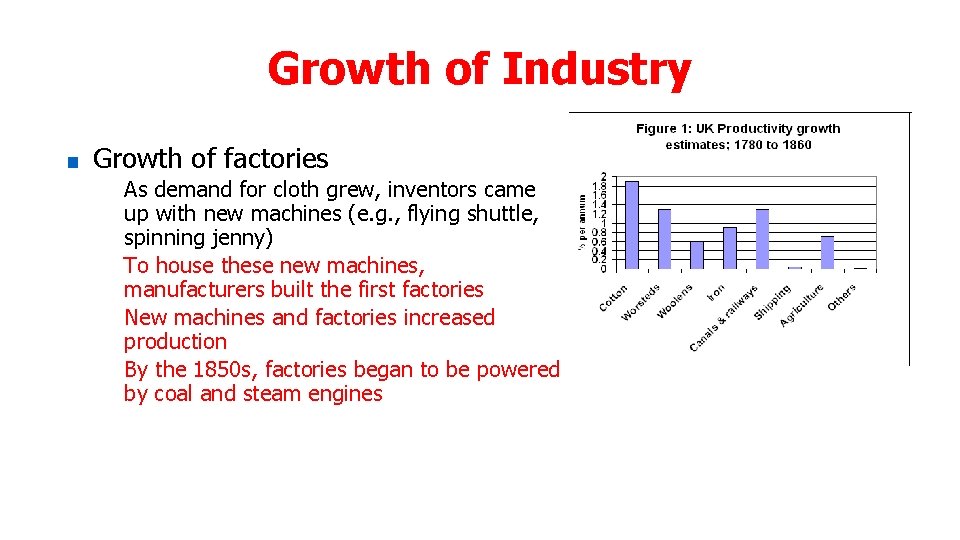
Growth of Industry ■ Growth of factories – As demand for cloth grew, inventors came up with new machines (e. g. , flying shuttle, spinning jenny) – To house these new machines, manufacturers built the first factories – New machines and factories increased production – By the 1850 s, factories began to be powered by coal and steam engines
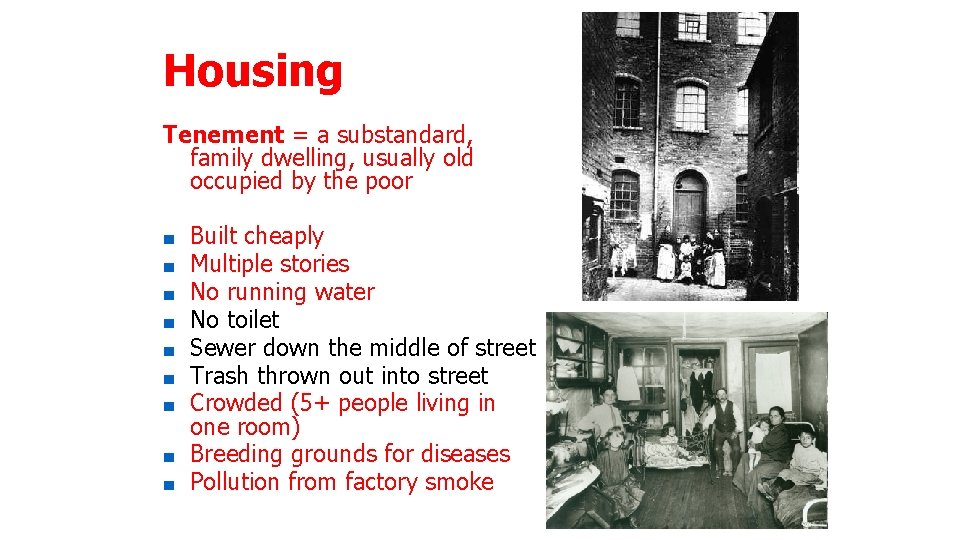
Factories and Factory Towns Where employees worked ■ ■ Major change from cottage industry Had to leave home to work (travel to cities) Working in a factory ■ ■ ■ ■ No safety codes = dangerous work for all Poor factory conditions (e. g. , no heat or a/c, dirty, smelly, cramped) Long workdays (12 -14 hours) Little pay (men compete with women and children for wages) Child labor = kept costs of production low and profits high Mind-numbing monotony (doing the same thing all day every day) Owners of mines and factories exercised control over lives of laborers Life in factory towns ■ ■ Towns grew up around factories and coal mines Pollution, poor sanitation, no health codes = sickness Rapid population growth Poor lived in crowded tiny rooms in tenements (multistory buildings divided into apartments)
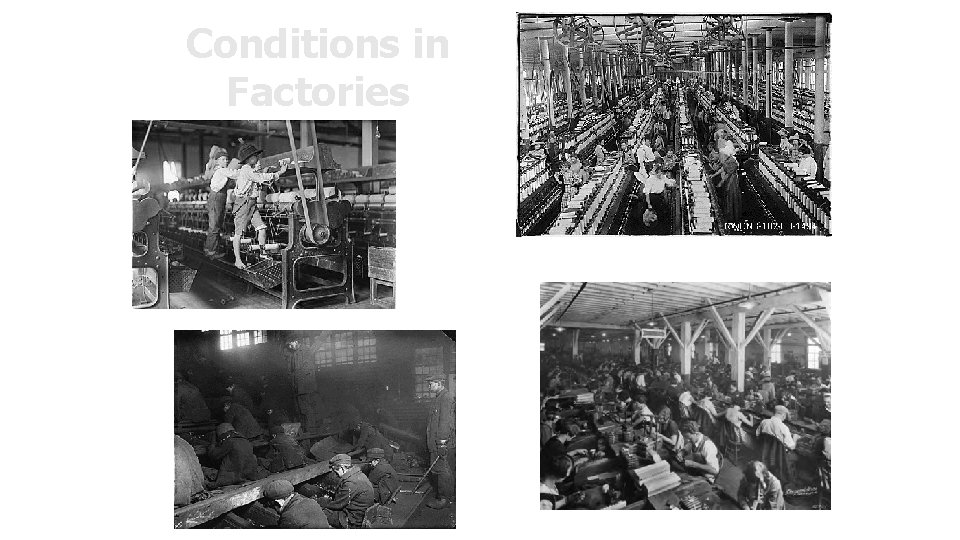
Conditions in Factories Dangerous Machinery Monotony Dirty Cramped spaces
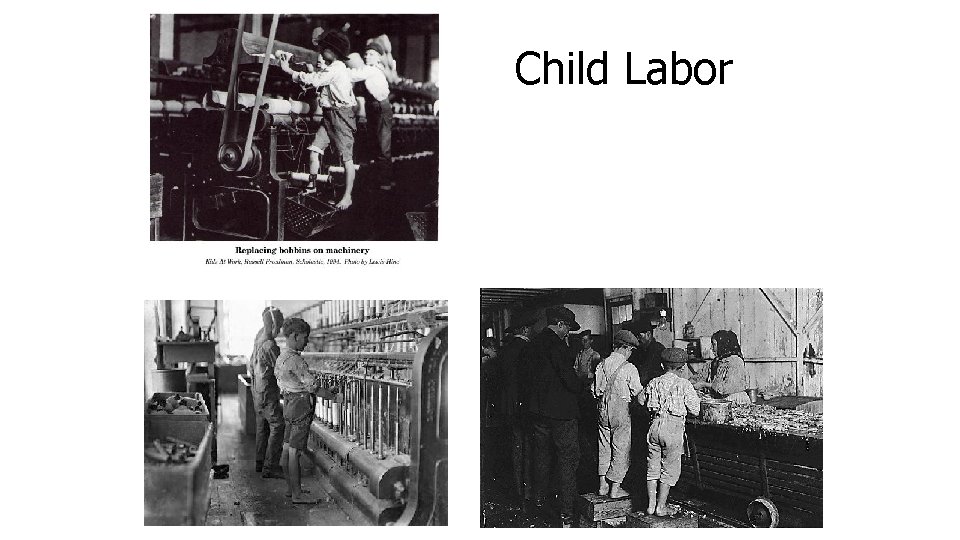
Child Labor • Young children • Long hours • Poor treatment • Dangerous conditions
Life in Factory Towns Rapid Population Growth Cramped Tenements Poor Sanitation Pollution
Housing Tenement = a substandard, family dwelling, usually old occupied by the poor Built cheaply Multiple stories No running water No toilet Sewer down the middle of street Trash thrown out into street Crowded (5+ people living in one room) ■ Breeding grounds for diseases ■ Pollution from factory smoke ■ ■ ■ ■ multiand
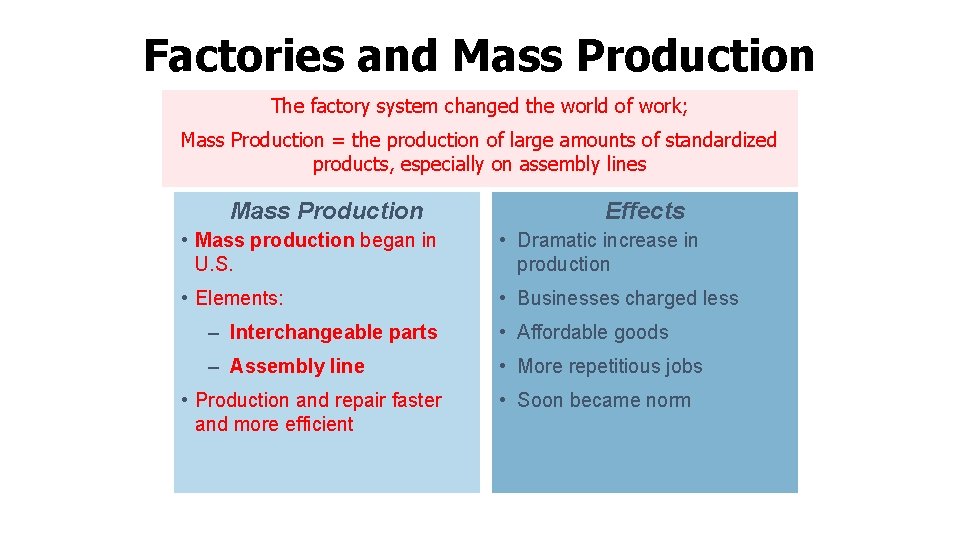
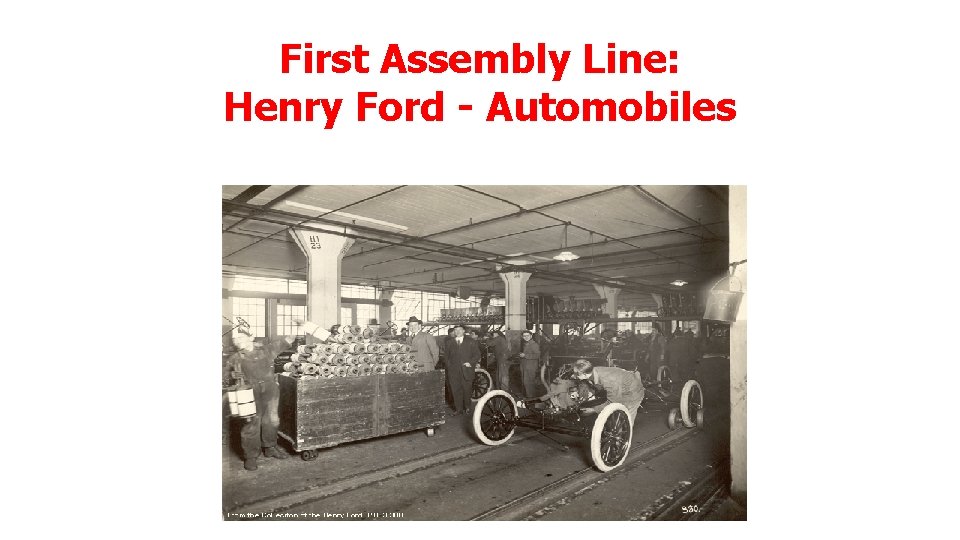
Factories and Mass Production The factory system changed the world of work; Mass Production = the production of large amounts of standardized products, especially on assembly lines Mass Production Effects • Mass production began in U. S. • Dramatic increase in production • Elements: • Businesses charged less – Interchangeable parts • Affordable goods – Assembly line • More repetitious jobs • Production and repair faster and more efficient • Soon became norm
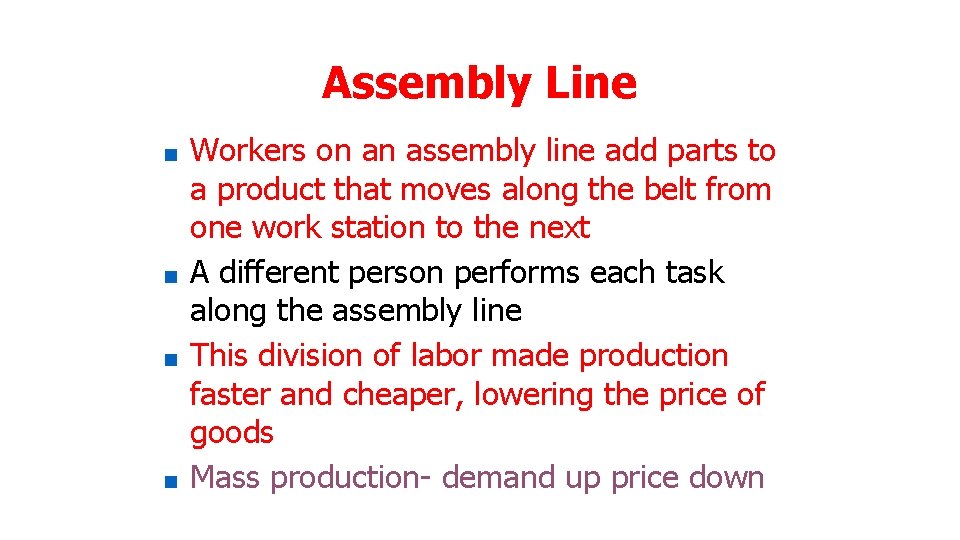
Assembly Line Workers on an assembly line add parts to a product that moves along the belt from one work station to the next ■ A different person performs each task along the assembly line ■ This division of labor made production faster and cheaper, lowering the price of goods ■ Mass production- demand up price down ■
First Assembly Line: Henry Ford - Automobiles
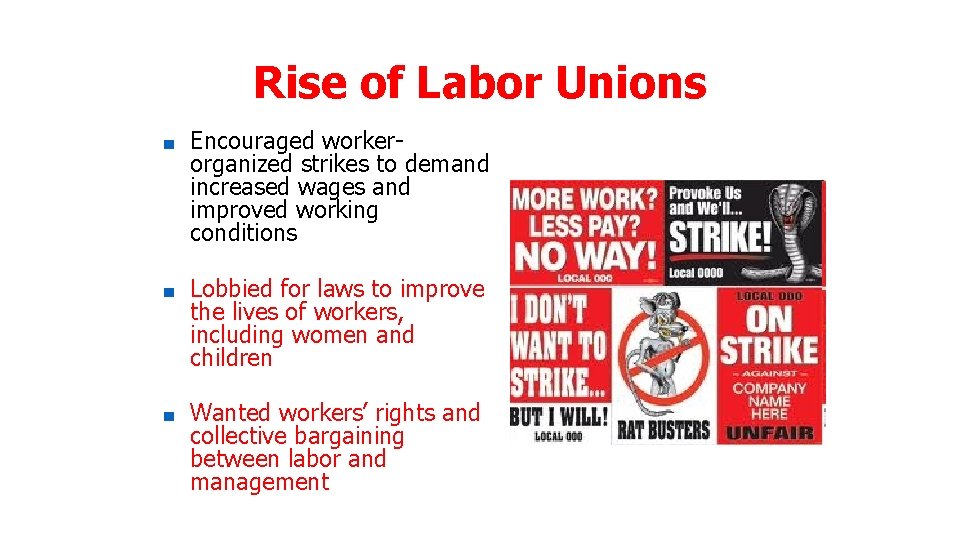
Rise of Labor Unions ■ Encouraged workerorganized strikes to demand increased wages and improved working conditions ■ Lobbied for laws to improve the lives of workers, including women and children ■ Wanted workers’ rights and collective bargaining between labor and management
New Ways of Thinking: Economic Patterns Capitalism vs. Socialism
Capitalism ■ Free-market economy: prices are determined by supply and demand ■ Profit goes to owners who invest in the business ■ Wages are paid to workers employed by companies and businesses
Effects of the Industrial Revolution
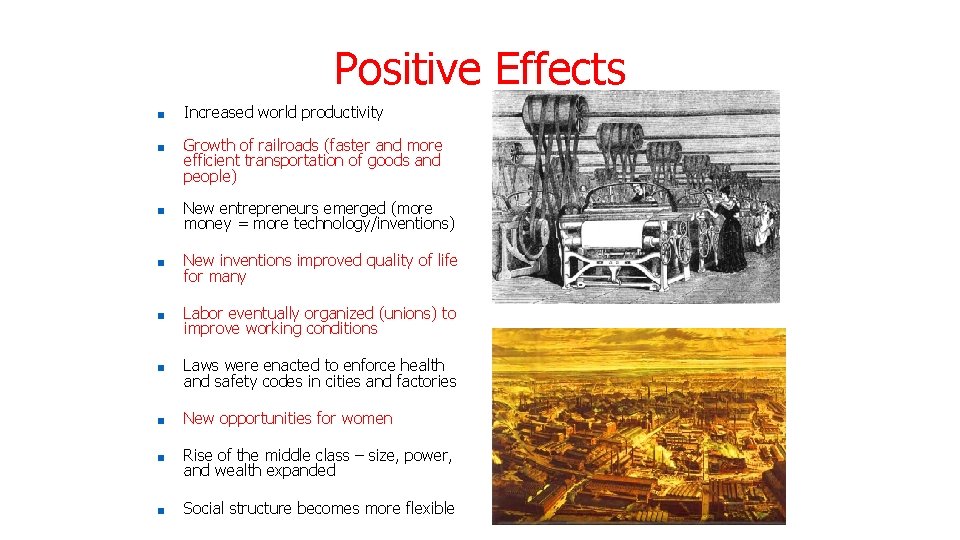
Positive Effects ■ Increased world productivity ■ Growth of railroads (faster and more efficient transportation of goods and people) ■ New entrepreneurs emerged (more money = more technology/inventions) ■ New inventions improved quality of life for many ■ Labor eventually organized (unions) to improve working conditions ■ Laws were enacted to enforce health and safety codes in cities and factories ■ New opportunities for women ■ Rise of the middle class – size, power, and wealth expanded ■ Social structure becomes more flexible
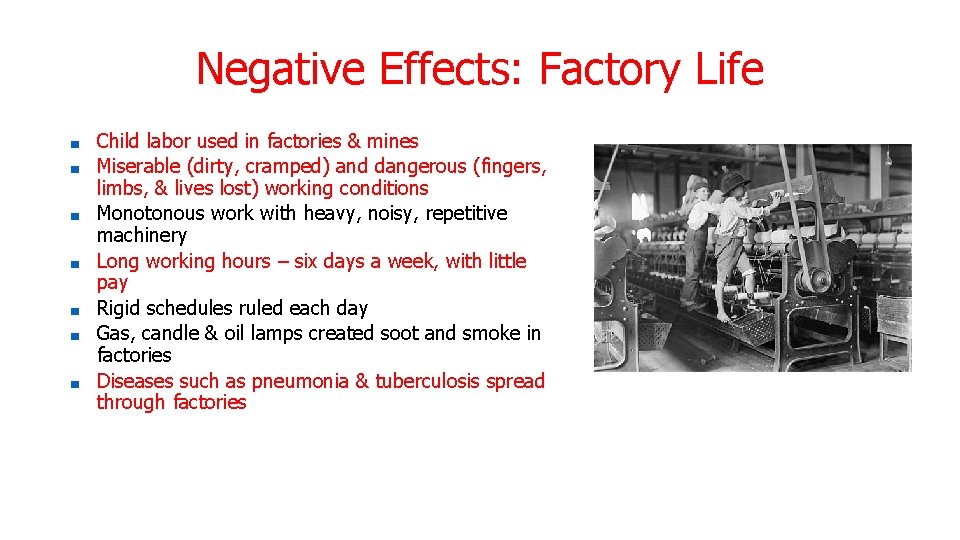
Negative Effects: Factory Life ■ ■ ■ ■ Child labor used in factories & mines Miserable (dirty, cramped) and dangerous (fingers, limbs, & lives lost) working conditions Monotonous work with heavy, noisy, repetitive machinery Long working hours – six days a week, with little pay Rigid schedules ruled each day Gas, candle & oil lamps created soot and smoke in factories Diseases such as pneumonia & tuberculosis spread through factories
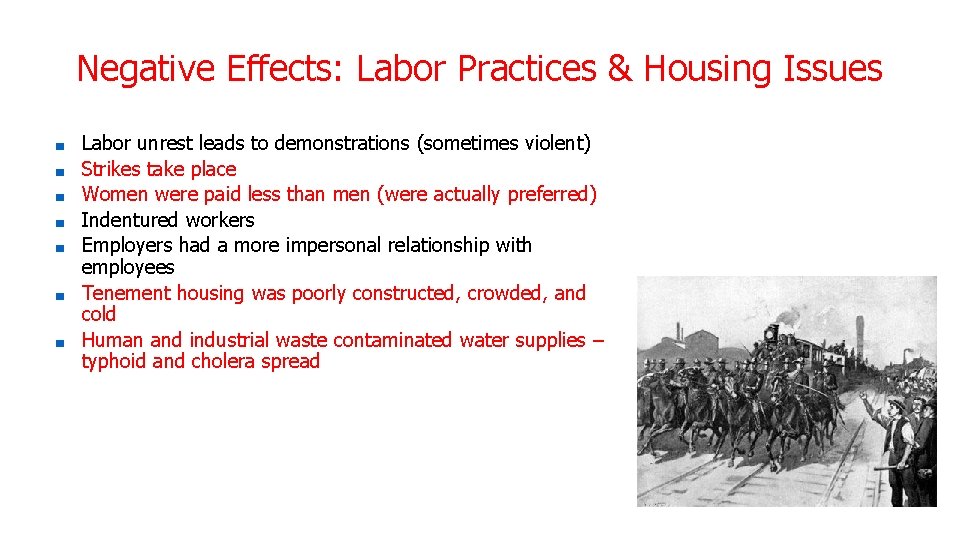
Negative Effects: Labor Practices & Housing Issues ■ ■ ■ ■ Labor unrest leads to demonstrations (sometimes violent) Strikes take place Women were paid less than men (were actually preferred) Indentured workers Employers had a more impersonal relationship with employees Tenement housing was poorly constructed, crowded, and cold Human and industrial waste contaminated water supplies – typhoid and cholera spread
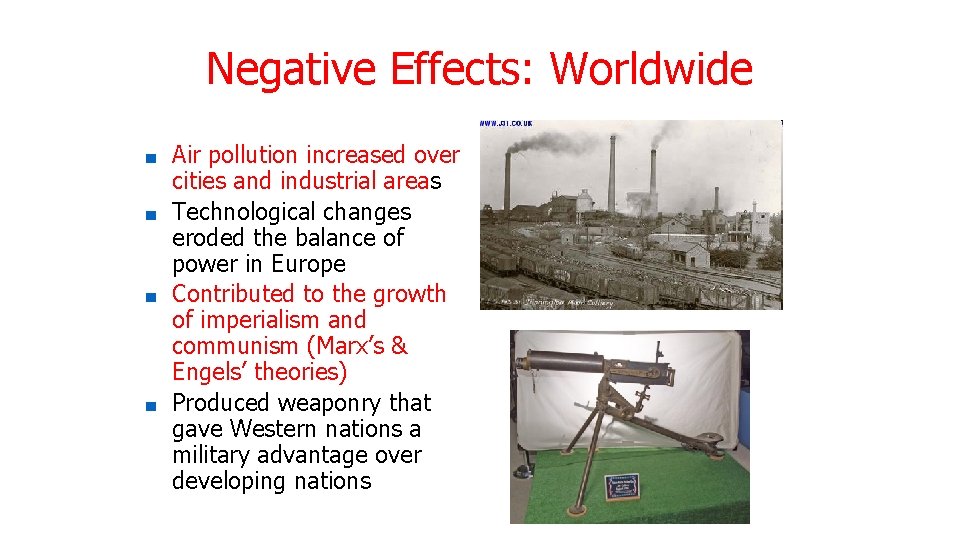
Negative Effects: Worldwide Air pollution increased over cities and industrial areas ■ Technological changes eroded the balance of power in Europe ■ Contributed to the growth of imperialism and communism (Marx’s & Engels’ theories) ■ Produced weaponry that gave Western nations a military advantage over developing nations ■
Summary: Social Effects ■ ■ Increase in population of cities Women and children enter the workplace as cheap labor Rise of labor unions Introduction of reforms – Laws to protect children in the workplace – Minimum wage and maximum hour laws – Federal safety and health standards ■ ■ Growth of the middle class Increased production and higher demand for raw materials = growth of worldwide trade Expansion of education Women’s increased demands for suffrage