
THE INDUSTRIAL REVOLUTION In Europe England during the














- Slides: 121
THE INDUSTRIAL REVOLUTION In Europe
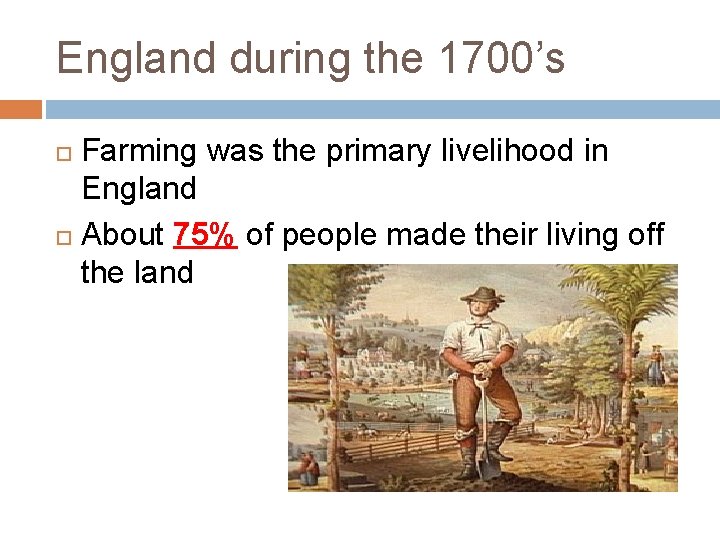
England during the 1700’s Farming was the primary livelihood in England About 75% of people made their living off the land
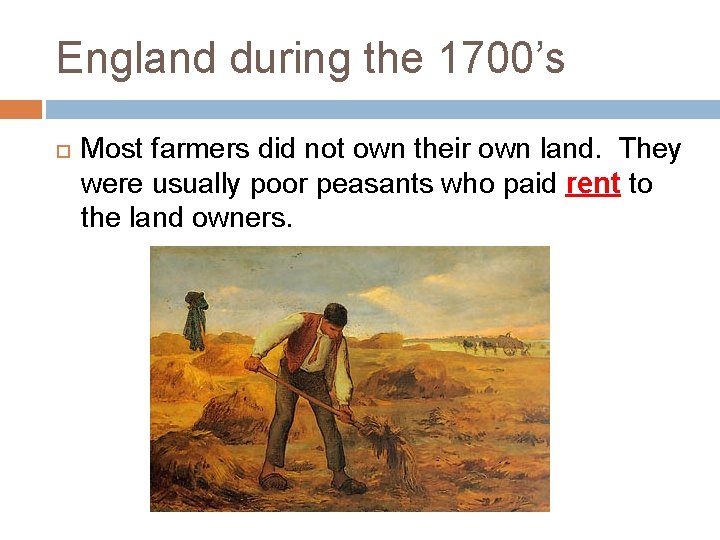
England during the 1700’s Most farmers did not own their own land. They were usually poor peasants who paid rent to the land owners.
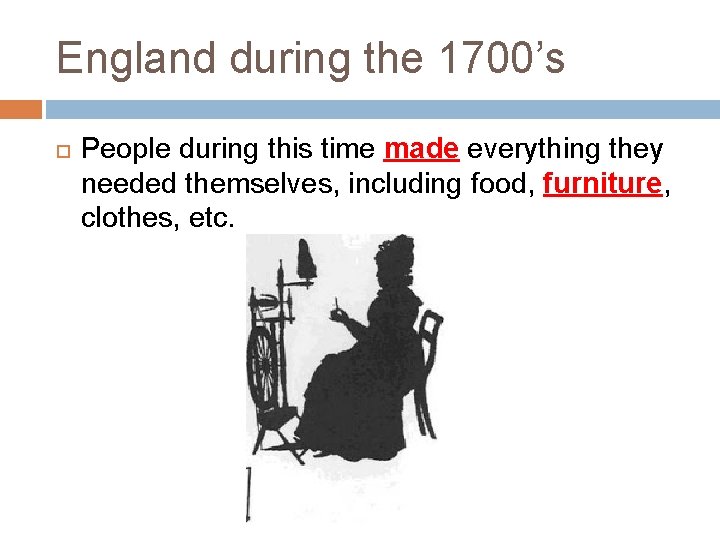
England during the 1700’s People during this time made everything they needed themselves, including food, furniture, clothes, etc.
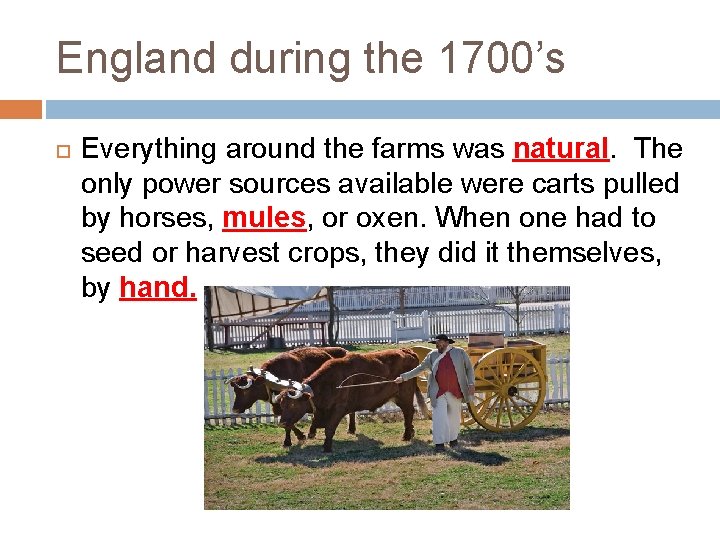
England during the 1700’s Everything around the farms was natural. The only power sources available were carts pulled by horses, mules, or oxen. When one had to seed or harvest crops, they did it themselves, by hand.
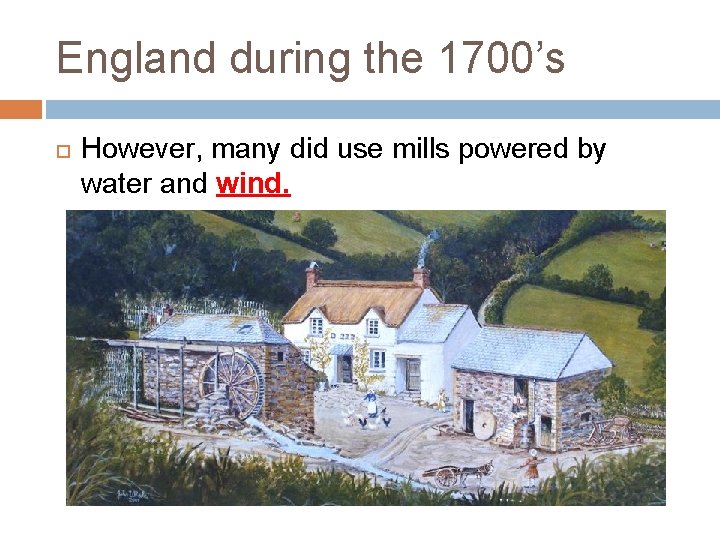
England during the 1700’s However, many did use mills powered by water and wind.
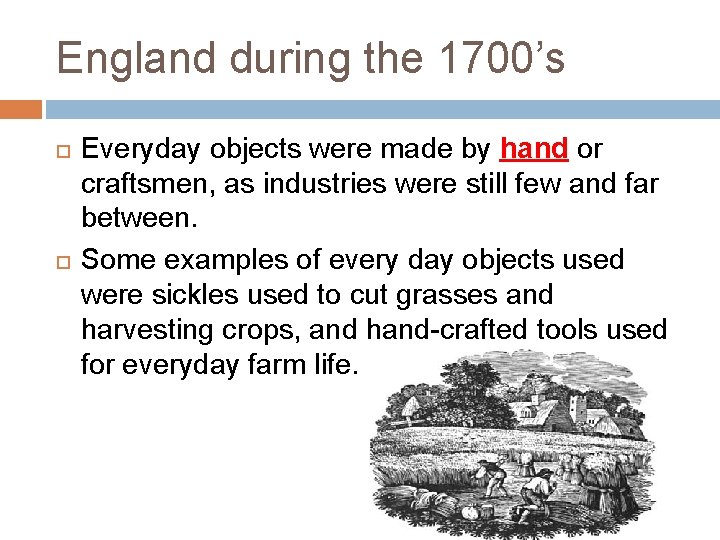
England during the 1700’s Everyday objects were made by hand or craftsmen, as industries were still few and far between. Some examples of every day objects used were sickles used to cut grasses and harvesting crops, and hand-crafted tools used for everyday farm life.
What do you think were some of the positives and negatives of this lifestyle? Positives Negatives
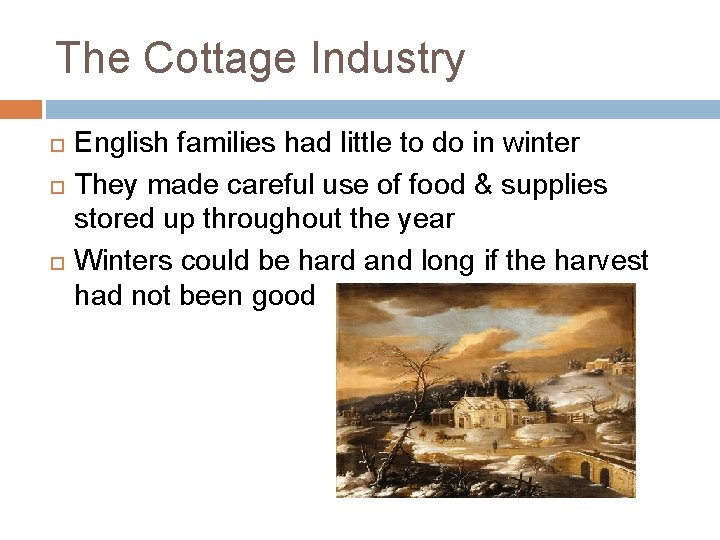
The Cottage Industry English families had little to do in winter They made careful use of food & supplies stored up throughout the year Winters could be hard and long if the harvest had not been good
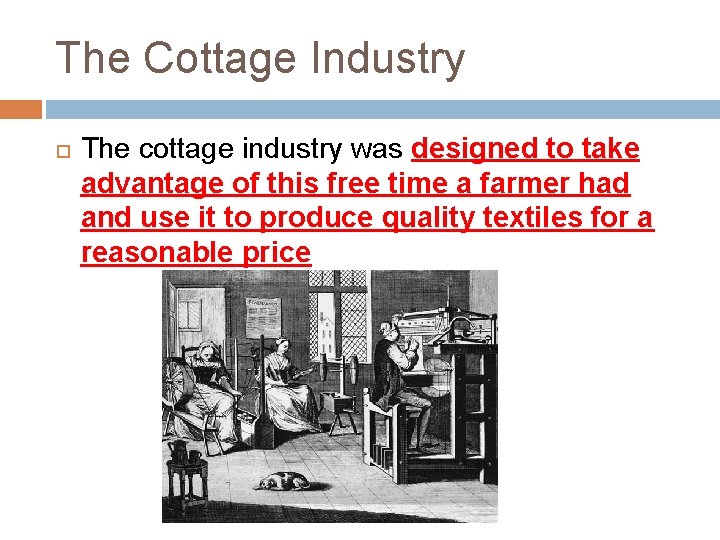
The Cottage Industry The cottage industry was designed to take advantage of this free time a farmer had and use it to produce quality textiles for a reasonable price
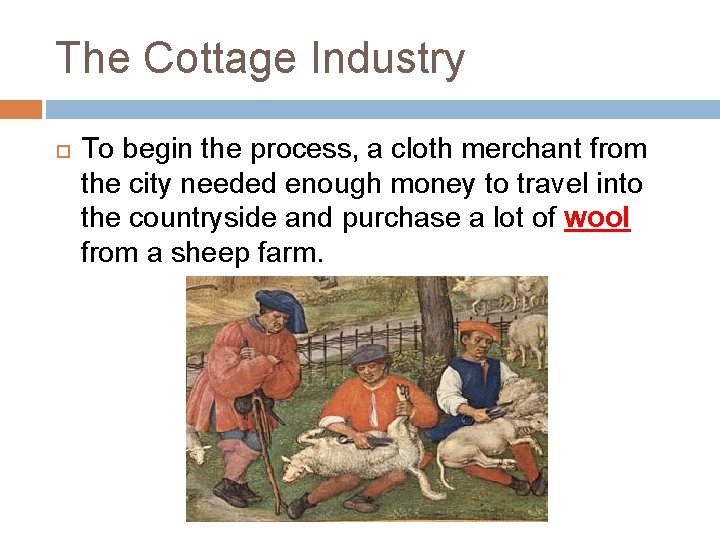
The Cottage Industry To begin the process, a cloth merchant from the city needed enough money to travel into the countryside and purchase a lot of wool from a sheep farm.
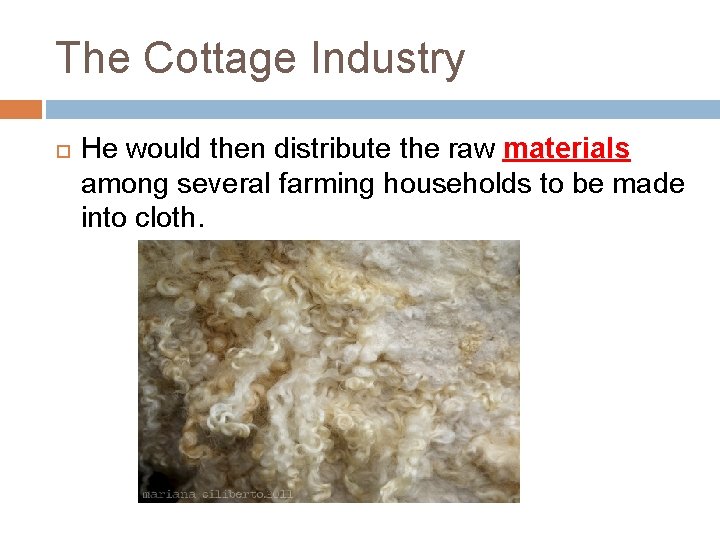
The Cottage Industry He would then distribute the raw materials among several farming households to be made into cloth.
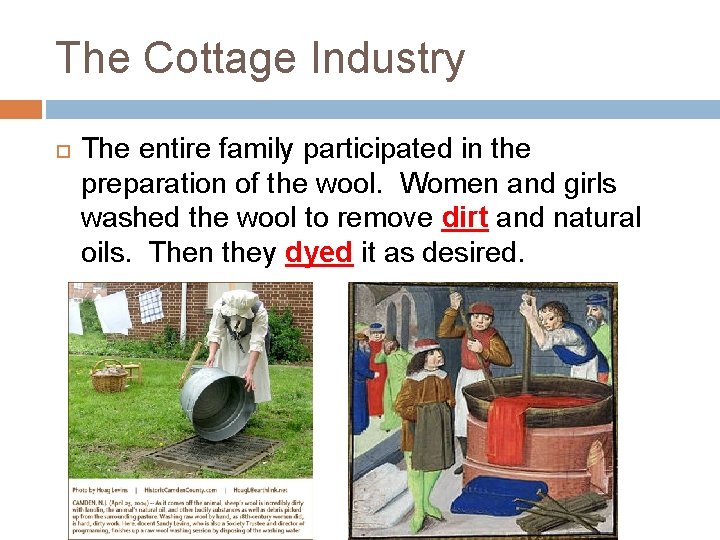
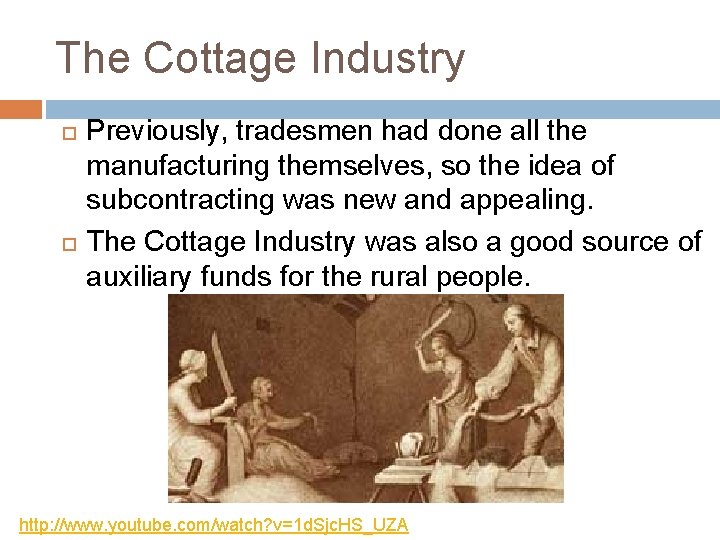
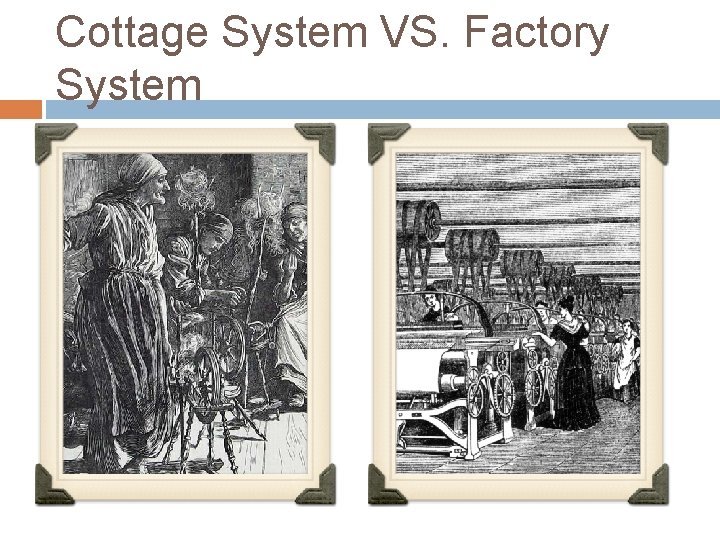
The Cottage Industry The entire family participated in the preparation of the wool. Women and girls washed the wool to remove dirt and natural oils. Then they dyed it as desired.
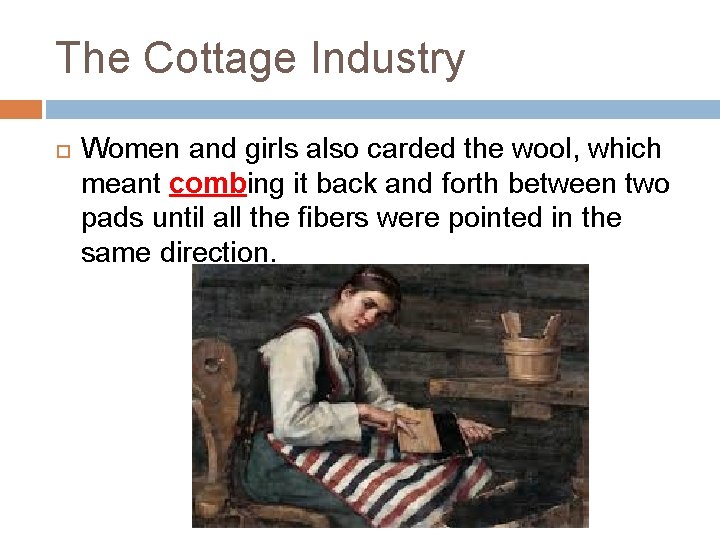
The Cottage Industry Women and girls also carded the wool, which meant combing it back and forth between two pads until all the fibers were pointed in the same direction.
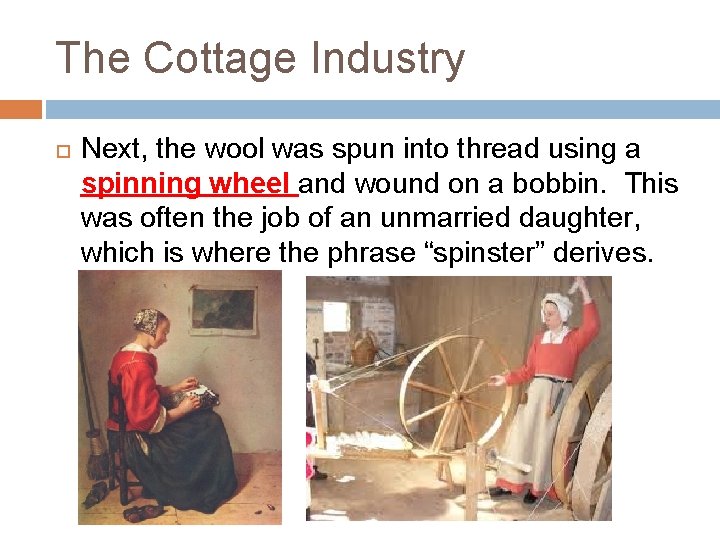
The Cottage Industry Next, the wool was spun into thread using a spinning wheel and wound on a bobbin. This was often the job of an unmarried daughter, which is where the phrase “spinster” derives.
The Cottage Industry The actual weaving of the thread into cloth was done on a loom operated by hand foot. This was physically demanding, which is why men did this job.
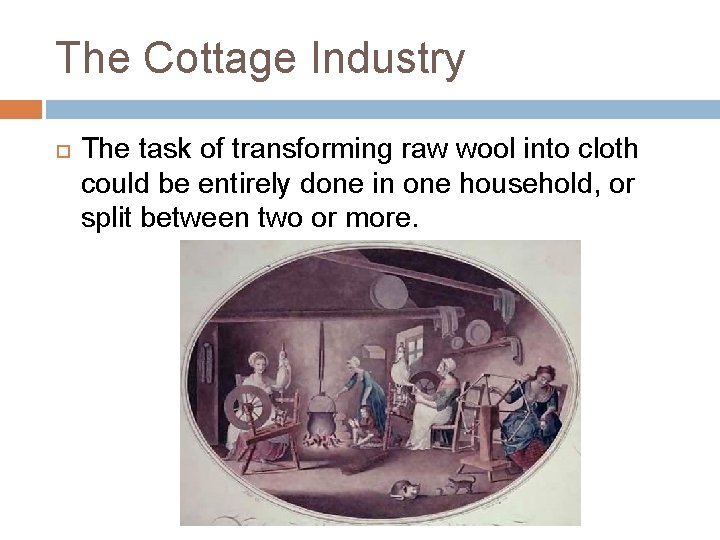
The Cottage Industry The task of transforming raw wool into cloth could be entirely done in one household, or split between two or more.
The Cottage Industry The merchant would return at regular intervals over the season to pick up the finished cloth. He took it back to the city to sell or export.
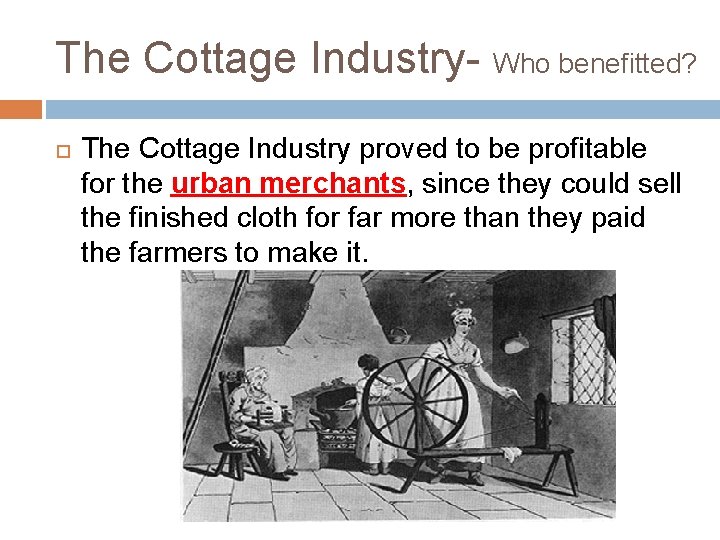
The Cottage Industry- Who benefitted? The Cottage Industry proved to be profitable for the urban merchants, since they could sell the finished cloth for far more than they paid the farmers to make it.
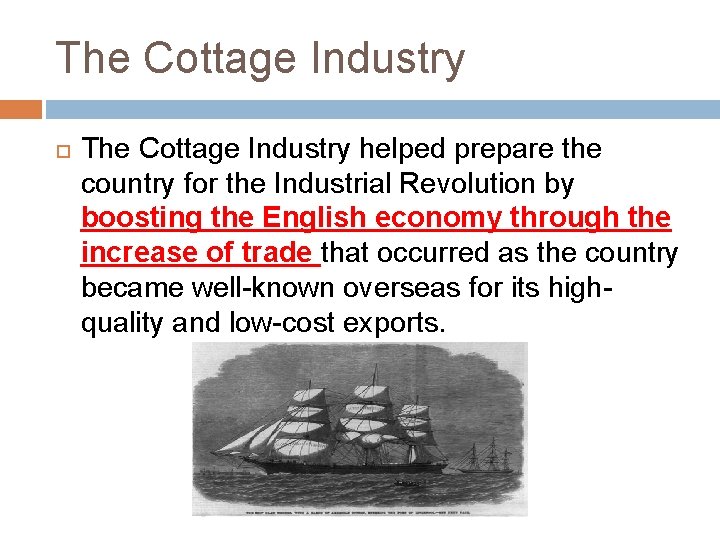
The Cottage Industry helped prepare the country for the Industrial Revolution by boosting the English economy through the increase of trade that occurred as the country became well-known overseas for its highquality and low-cost exports.
The Cottage Industry Previously, tradesmen had done all the manufacturing themselves, so the idea of subcontracting was new and appealing. The Cottage Industry was also a good source of auxiliary funds for the rural people. http: //www. youtube. com/watch? v=1 d. Sjc. HS_UZA
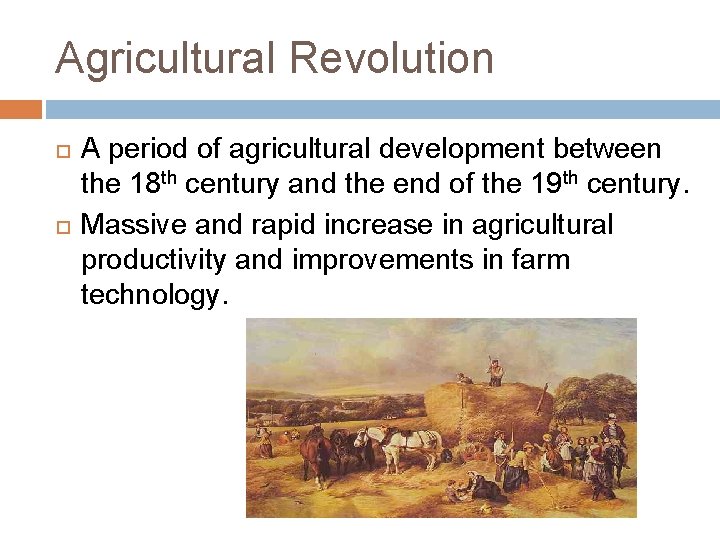
Agricultural Revolution A period of agricultural development between the 18 th century and the end of the 19 th century. Massive and rapid increase in agricultural productivity and improvements in farm technology.
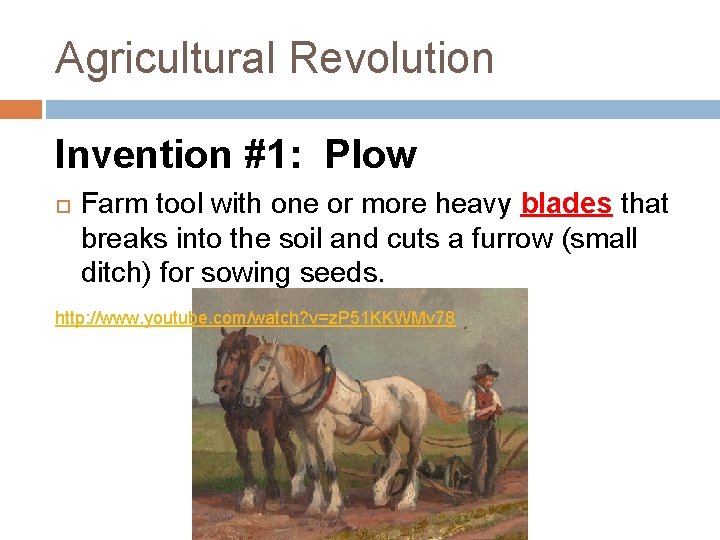
Agricultural Revolution Invention #1: Plow Farm tool with one or more heavy blades that breaks into the soil and cuts a furrow (small ditch) for sowing seeds. http: //www. youtube. com/watch? v=z. P 51 KKWMv 78
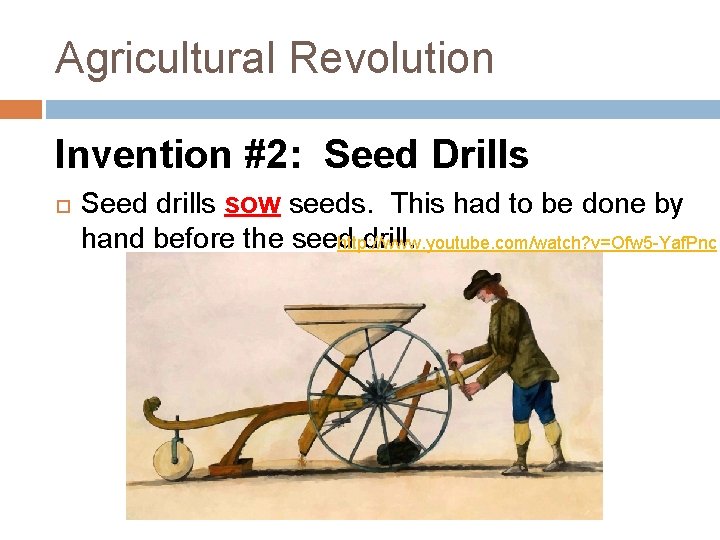
Agricultural Revolution Invention #2: Seed Drills Seed drills sow seeds. This had to be done by hand before the seed drill. http: //www. youtube. com/watch? v=Ofw 5 -Yaf. Pnc
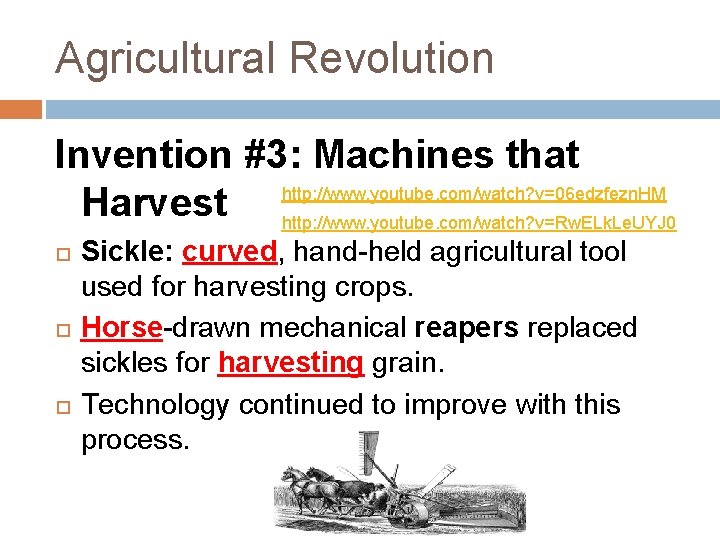
Agricultural Revolution Invention #3: Machines that http: //www. youtube. com/watch? v=06 edzfezn. HM Harvest http: //www. youtube. com/watch? v=Rw. ELk. Le. UYJ 0 Sickle: curved, hand-held agricultural tool used for harvesting crops. Horse-drawn mechanical reapers replaced sickles for harvesting grain. Technology continued to improve with this process.
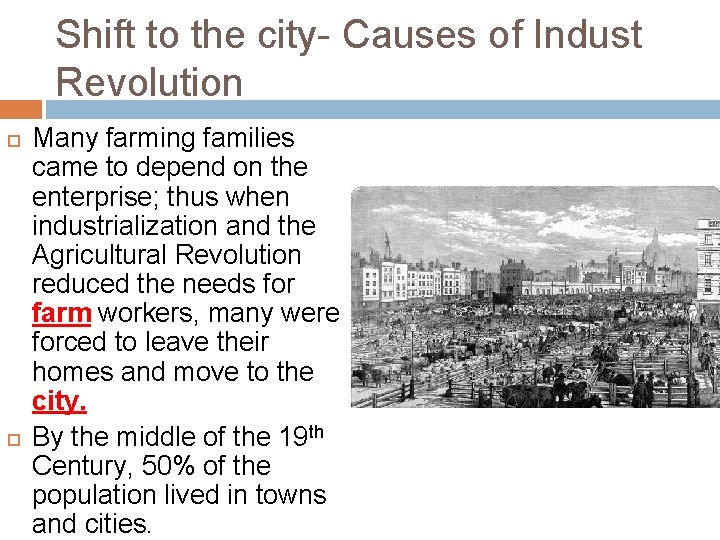
Shift to the city- Causes of Indust Revolution Many farming families came to depend on the enterprise; thus when industrialization and the Agricultural Revolution reduced the needs for farm workers, many were forced to leave their homes and move to the city. By the middle of the 19 th Century, 50% of the population lived in towns and cities.
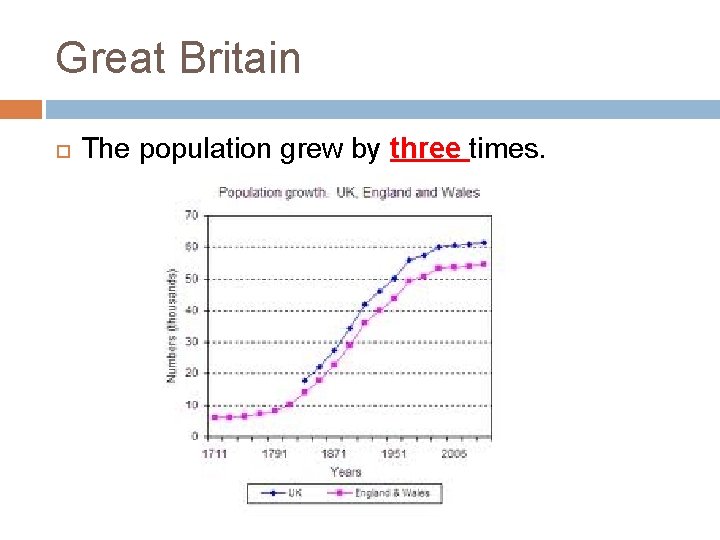
Great Britain The population grew by three times.
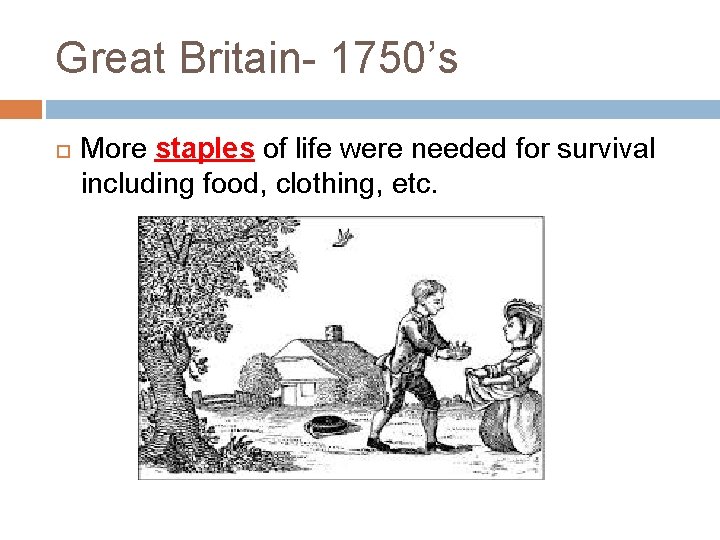
Great Britain- 1750’s More staples of life were needed for survival including food, clothing, etc.
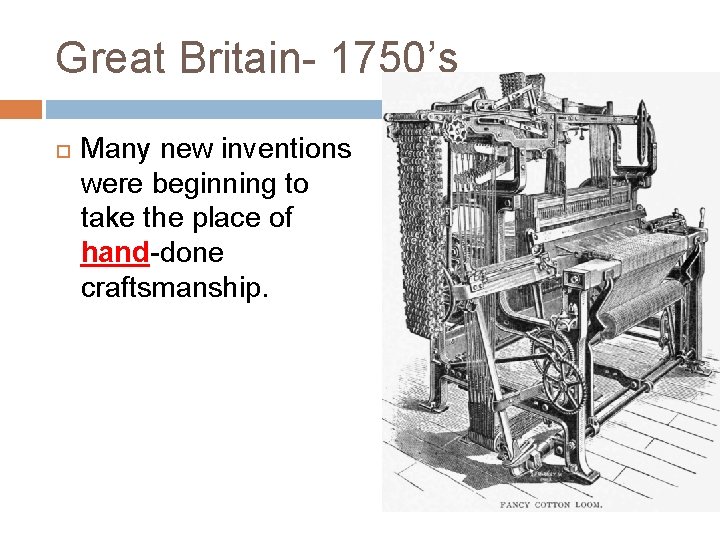
Great Britain- 1750’s Many new inventions were beginning to take the place of hand-done craftsmanship.
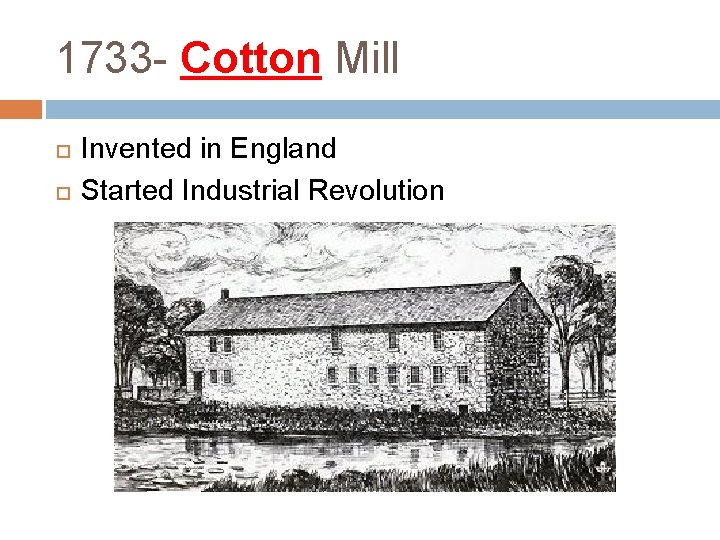
1733 - Cotton Mill Invented in England Started Industrial Revolution
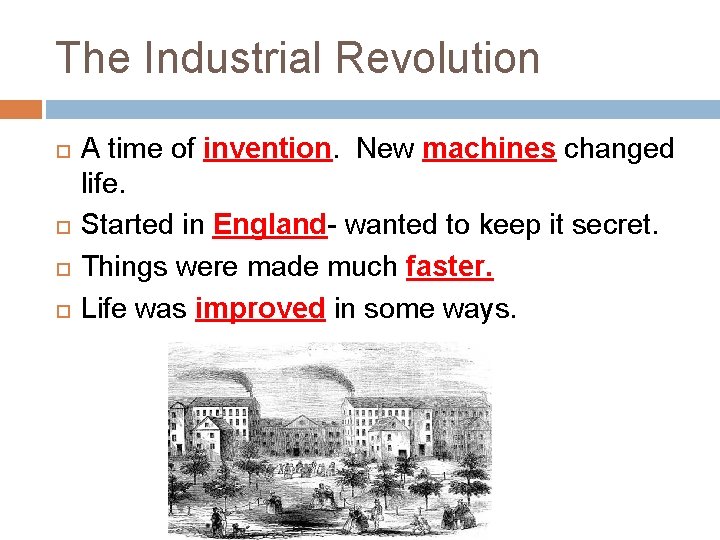
The Industrial Revolution A time of invention. New machines changed life. Started in England- wanted to keep it secret. Things were made much faster. Life was improved in some ways.
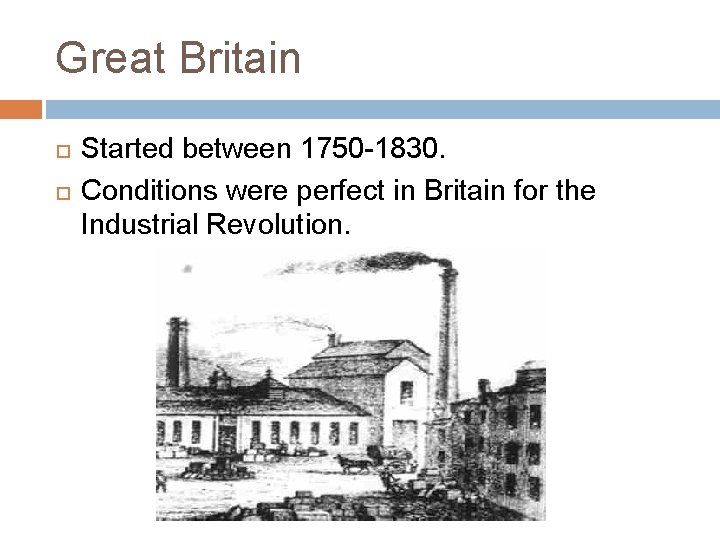
Great Britain Started between 1750 -1830. Conditions were perfect in Britain for the Industrial Revolution.
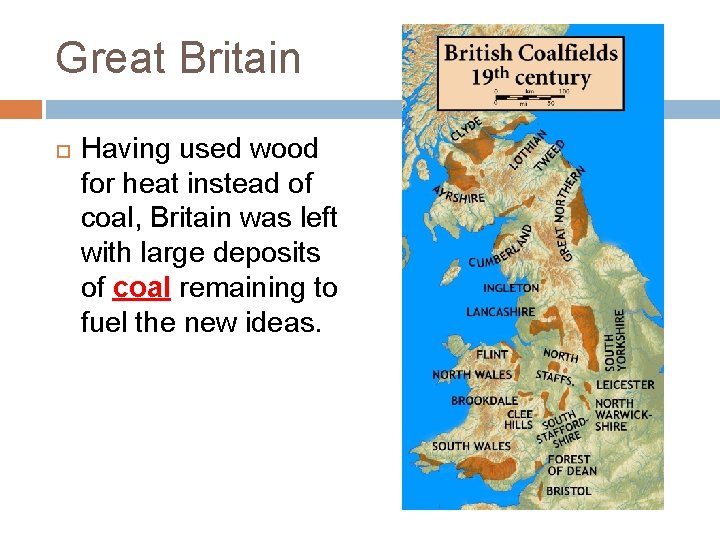
Great Britain Having used wood for heat instead of coal, Britain was left with large deposits of coal remaining to fuel the new ideas.
Great Britain Any raw supplies Britain itself did not have could be provided by its many colonies.
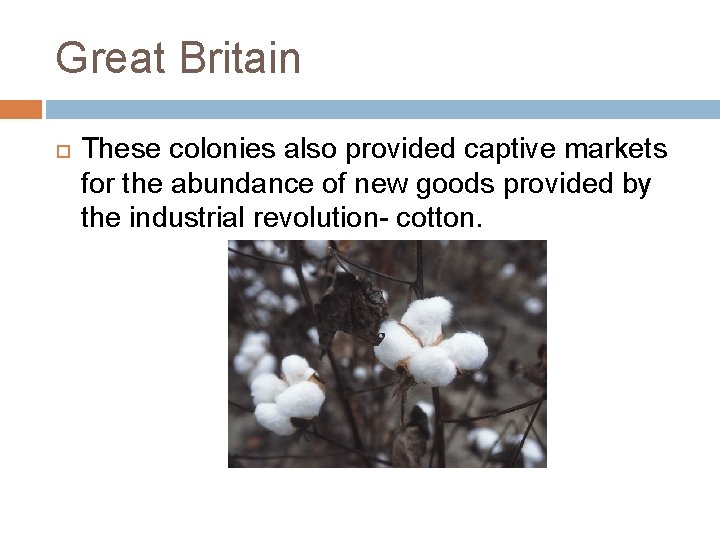
Great Britain These colonies also provided captive markets for the abundance of new goods provided by the industrial revolution- cotton.
Great Britain Cotton was a simple, cheap, and easily made product that everyone could use. So, between 1796 and 1830 cotton production tripled.
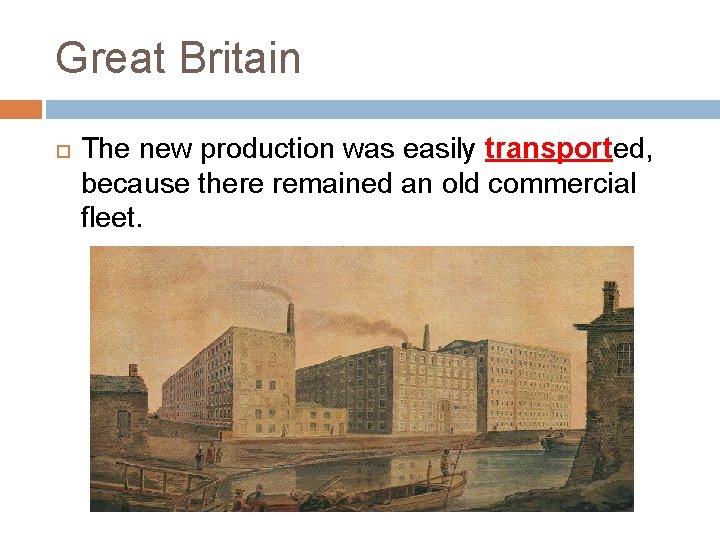
Great Britain The new production was easily transported, because there remained an old commercial fleet.
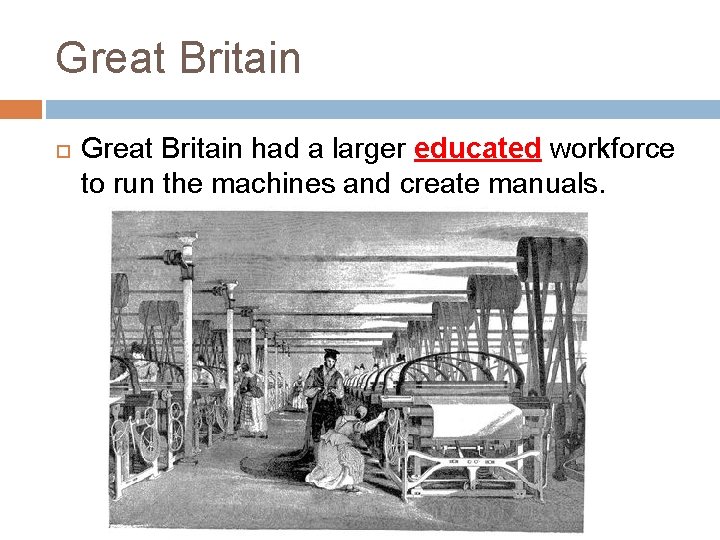
Great Britain had a larger educated workforce to run the machines and create manuals.
Great Britain The Enlightenment not only meant a larger educated population but also more modern views on work.
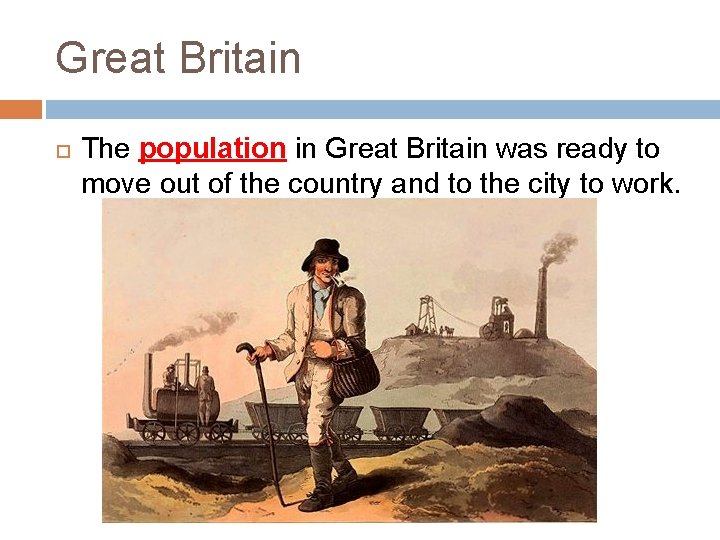
Great Britain The population in Great Britain was ready to move out of the country and to the city to work.
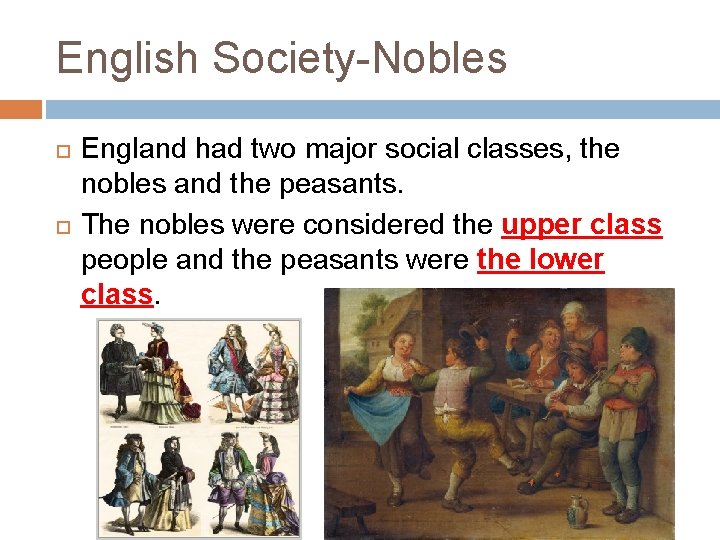
English Society-Nobles England had two major social classes, the nobles and the peasants. The nobles were considered the upper class people and the peasants were the lower class.
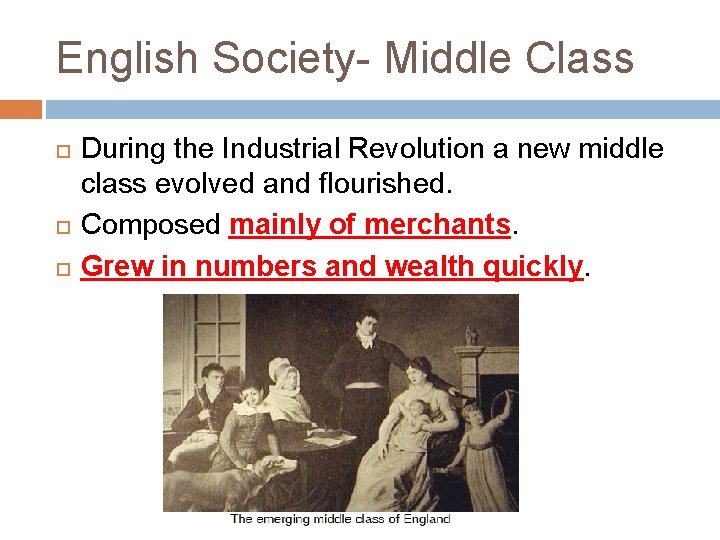
English Society- Middle Class During the Industrial Revolution a new middle class evolved and flourished. Composed mainly of merchants. Grew in numbers and wealth quickly.
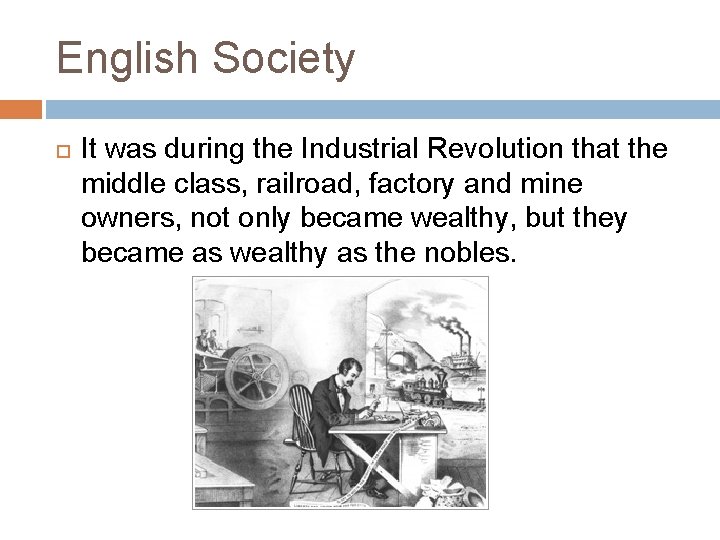
English Society It was during the Industrial Revolution that the middle class, railroad, factory and mine owners, not only became wealthy, but they became as wealthy as the nobles.
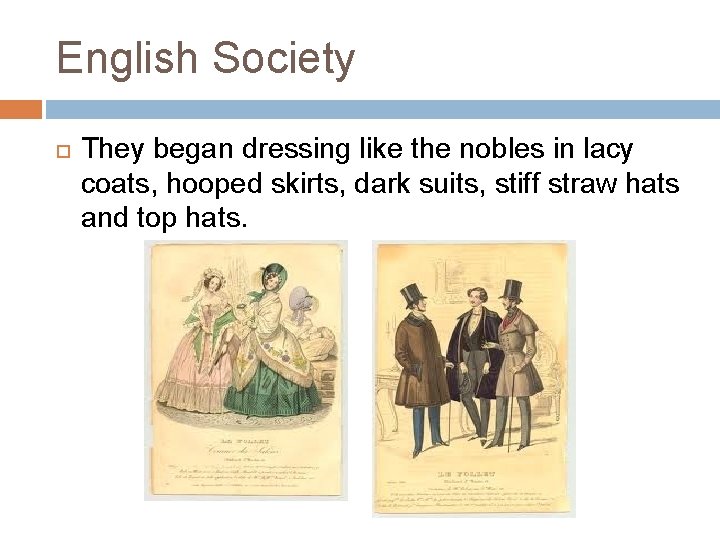
English Society They began dressing like the nobles in lacy coats, hooped skirts, dark suits, stiff straw hats and top hats.
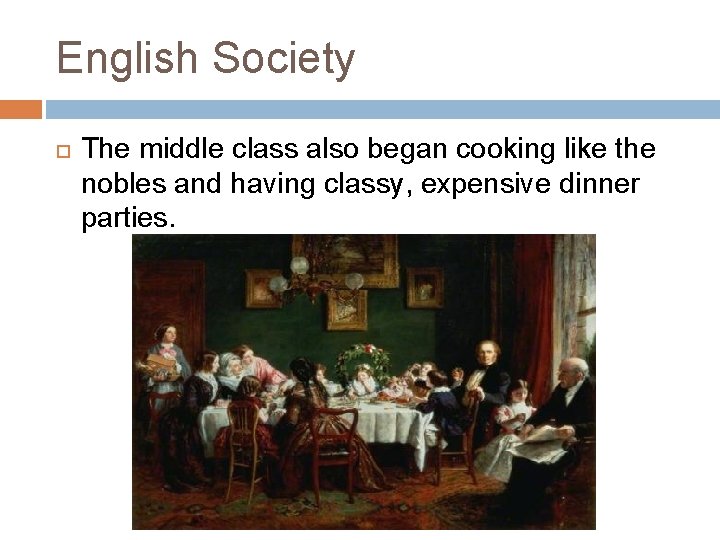
English Society The middle class also began cooking like the nobles and having classy, expensive dinner parties.
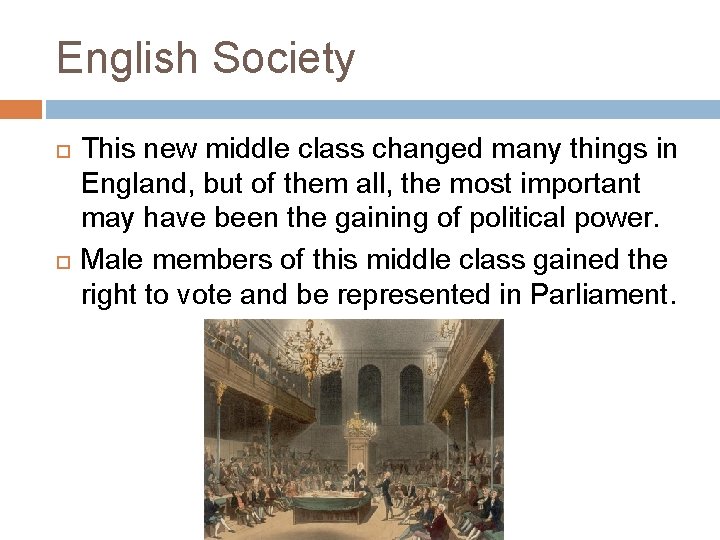
English Society This new middle class changed many things in England, but of them all, the most important may have been the gaining of political power. Male members of this middle class gained the right to vote and be represented in Parliament.
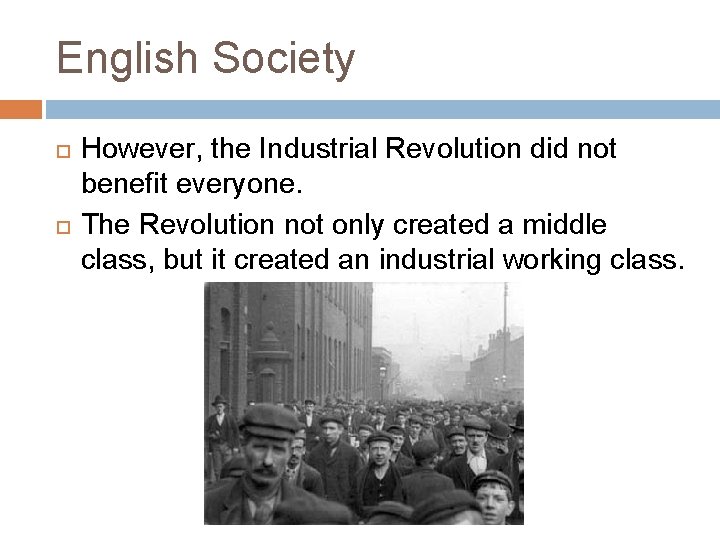
English Society However, the Industrial Revolution did not benefit everyone. The Revolution not only created a middle class, but it created an industrial working class.
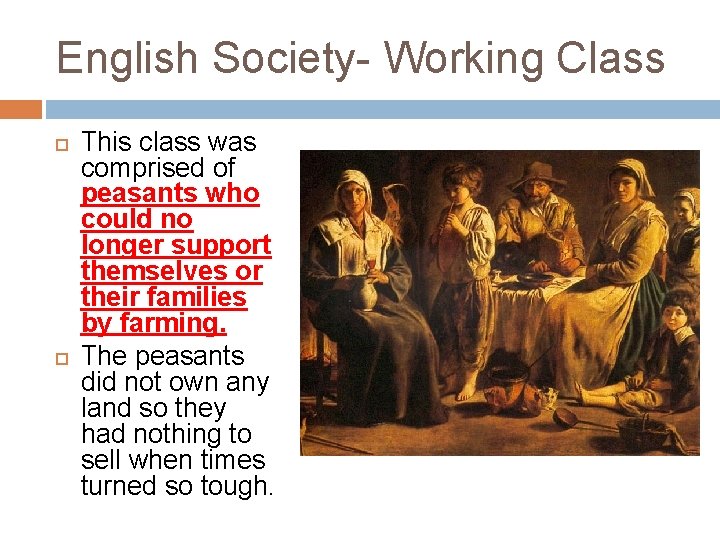
English Society- Working Class This class was comprised of peasants who could no longer support themselves or their families by farming. The peasants did not own any land so they had nothing to sell when times turned so tough.
English Society This, in turn, evolved into the peasants selling their labor in order to live. The Industrial Revolution was a nightmare for these people. They had to work up to sixteen hours a day, six days a week, for low wages.
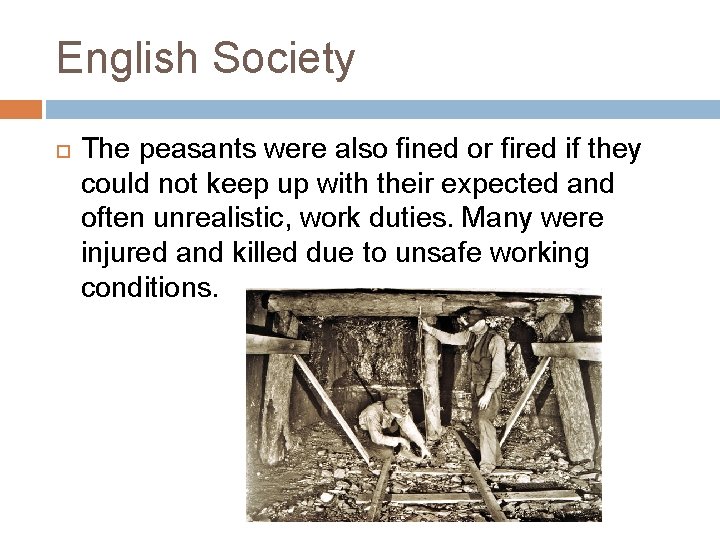
English Society The peasants were also fined or fired if they could not keep up with their expected and often unrealistic, work duties. Many were injured and killed due to unsafe working conditions.
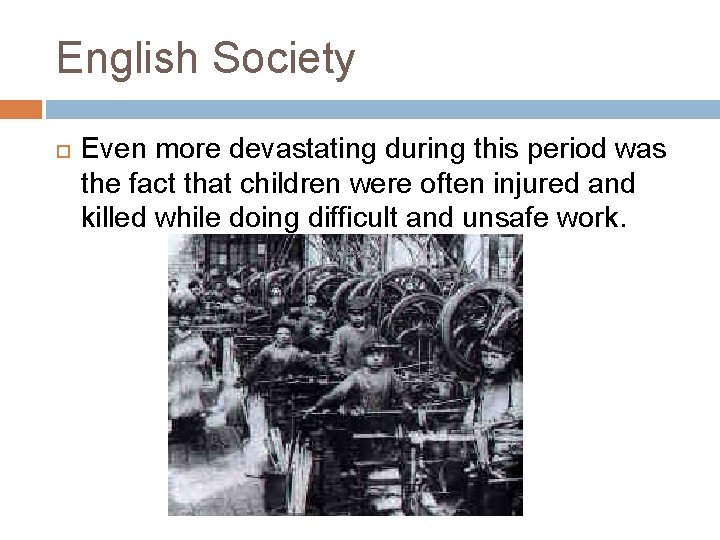
English Society Even more devastating during this period was the fact that children were often injured and killed while doing difficult and unsafe work.
Railroad and Transportation Products were being produced faster than people could get them delivered. They needed the finished products to be moved quicker and cheaper.
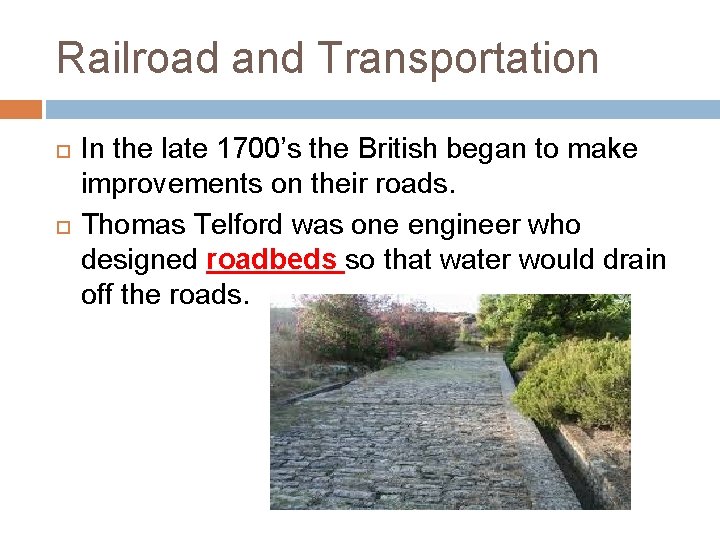
Railroad and Transportation In the late 1700’s the British began to make improvements on their roads. Thomas Telford was one engineer who designed roadbeds so that water would drain off the roads.
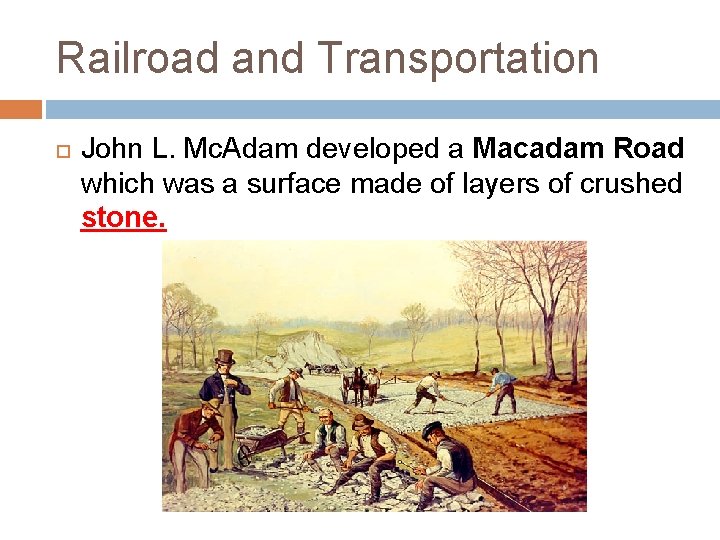
Railroad and Transportation John L. Mc. Adam developed a Macadam Road which was a surface made of layers of crushed stone.
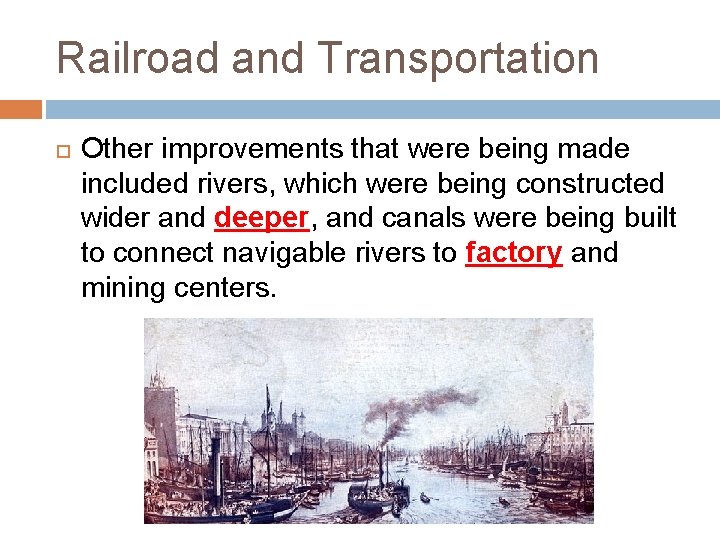
Railroad and Transportation Other improvements that were being made included rivers, which were being constructed wider and deeper, and canals were being built to connect navigable rivers to factory and mining centers.
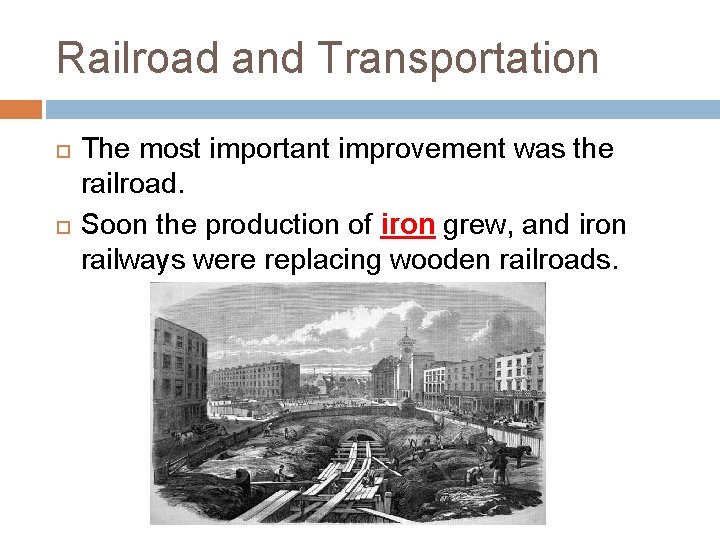
Railroad and Transportation The most important improvement was the railroad. Soon the production of iron grew, and iron railways were replacing wooden railroads.
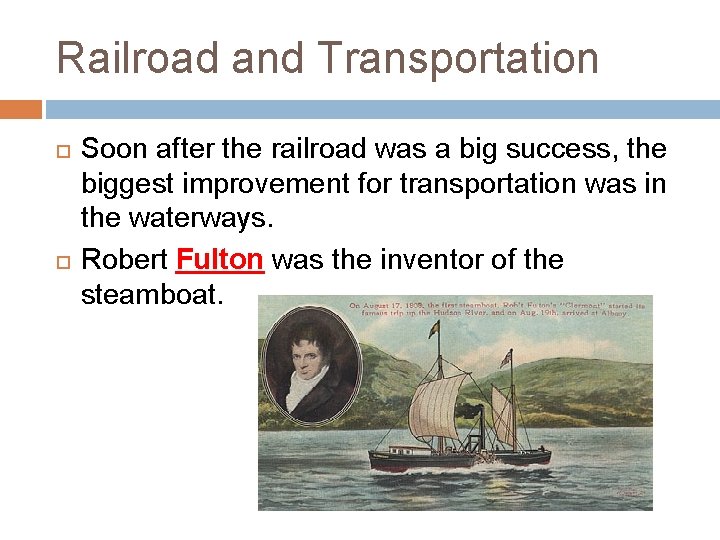
Railroad and Transportation Soon after the railroad was a big success, the biggest improvement for transportation was in the waterways. Robert Fulton was the inventor of the steamboat.
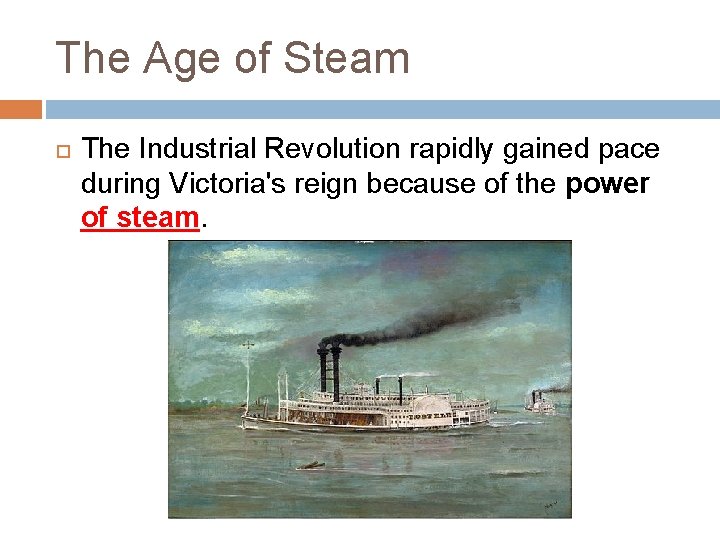
The Age of Steam The Industrial Revolution rapidly gained pace during Victoria's reign because of the power of steam.
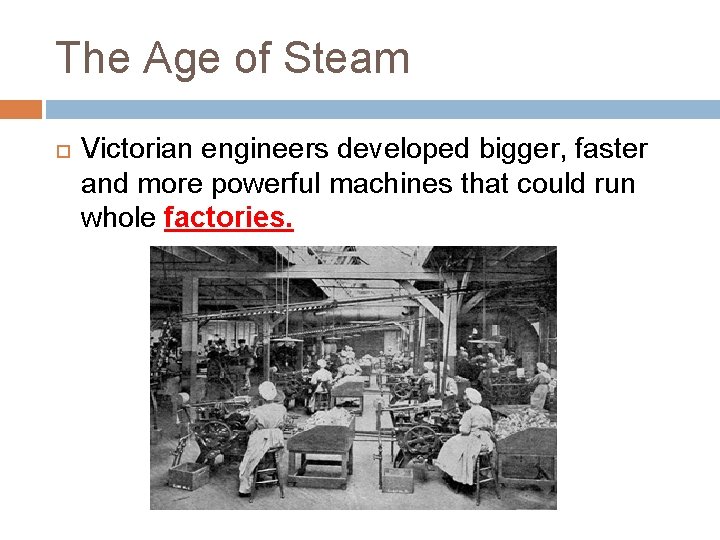
The Age of Steam Victorian engineers developed bigger, faster and more powerful machines that could run whole factories.
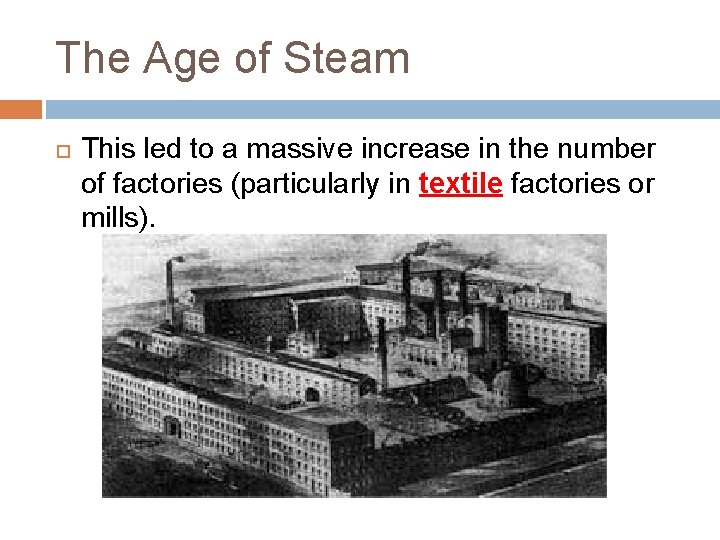
The Age of Steam This led to a massive increase in the number of factories (particularly in textile factories or mills).
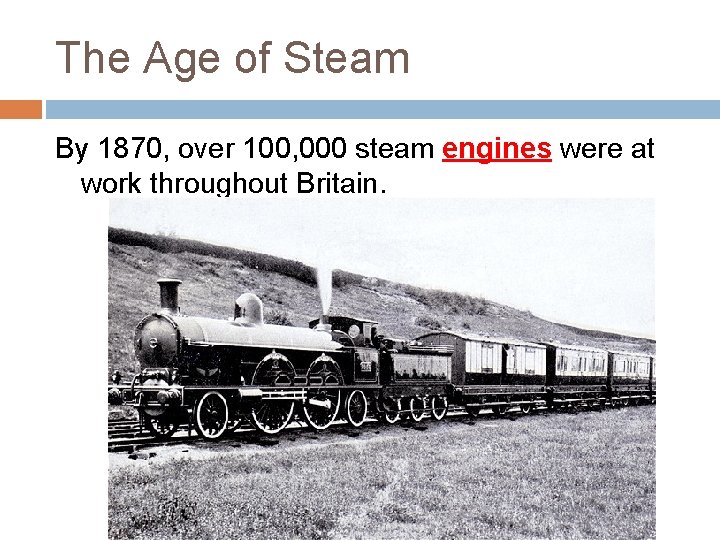
The Age of Steam By 1870, over 100, 000 steam engines were at work throughout Britain.
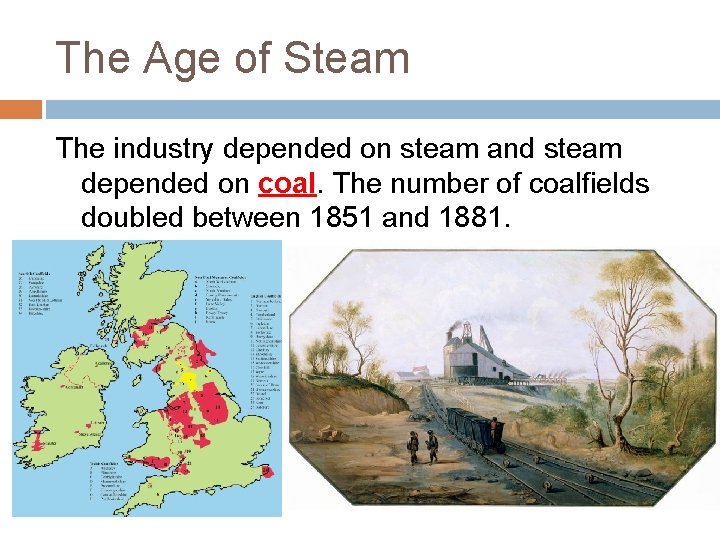
The Age of Steam The industry depended on steam and steam depended on coal. The number of coalfields doubled between 1851 and 1881.
The Age of Steel 1856 - Henry Bessemer invented a method for converting iron into steel quickly. Ships, bridges and buildings could now be bigger. http: //www. youtube. com/watch? v=dypdo. Lm 4 Rn 8
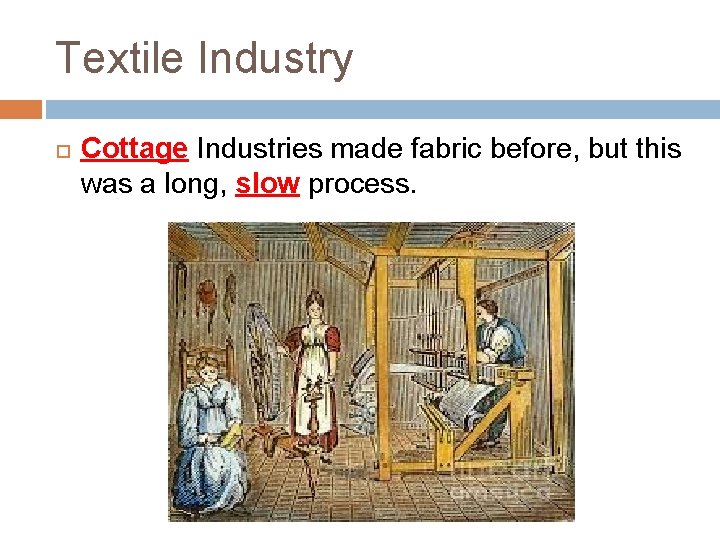
Textile Industry Cottage Industries made fabric before, but this was a long, slow process.
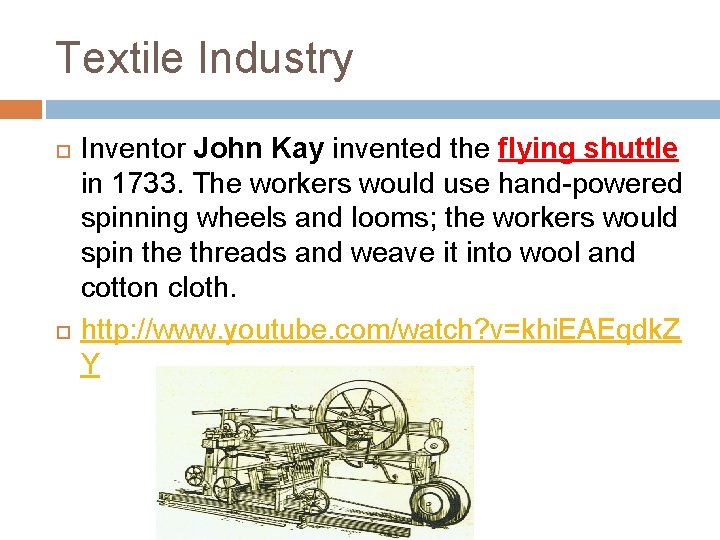
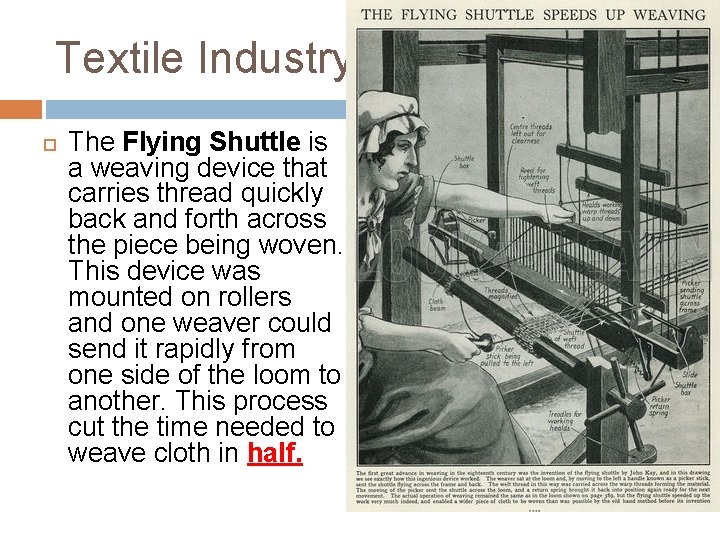
Textile Industry Inventor John Kay invented the flying shuttle in 1733. The workers would use hand-powered spinning wheels and looms; the workers would spin the threads and weave it into wool and cotton cloth. http: //www. youtube. com/watch? v=khi. EAEqdk. Z Y
Textile Industry The Flying Shuttle is a weaving device that carries thread quickly back and forth across the piece being woven. This device was mounted on rollers and one weaver could send it rapidly from one side of the loom to another. This process cut the time needed to weave cloth in half.
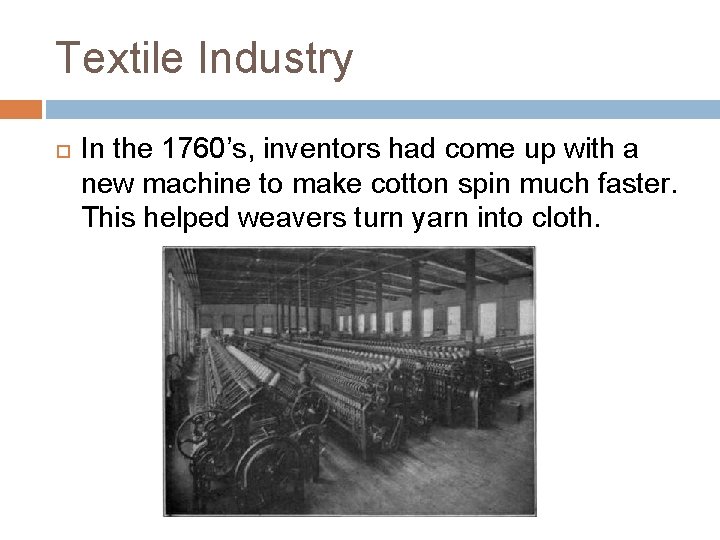
Textile Industry In the 1760’s, inventors had come up with a new machine to make cotton spin much faster. This helped weavers turn yarn into cloth.
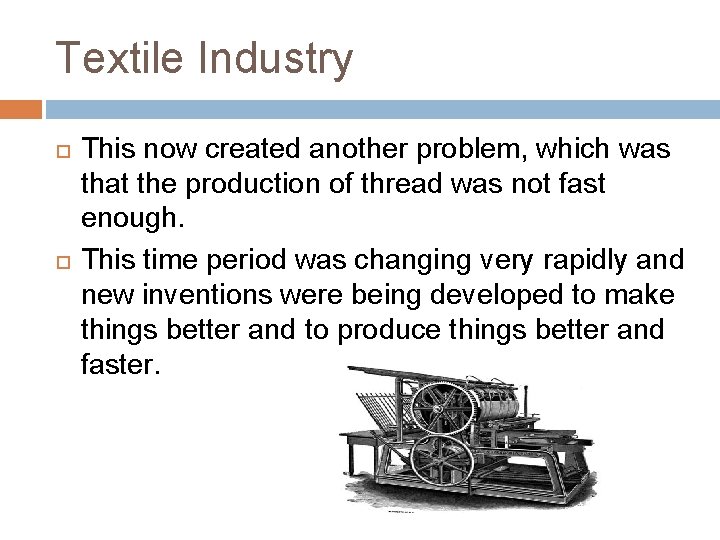
Textile Industry This now created another problem, which was that the production of thread was not fast enough. This time period was changing very rapidly and new inventions were being developed to make things better and to produce things better and faster.
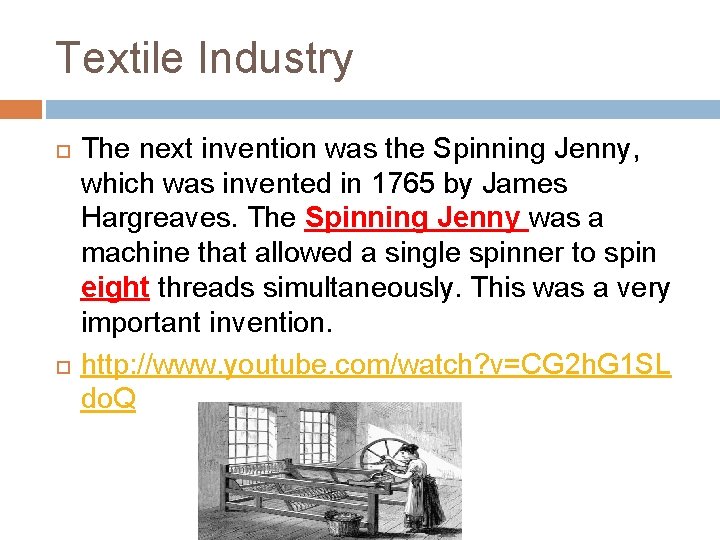
Textile Industry The next invention was the Spinning Jenny, which was invented in 1765 by James Hargreaves. The Spinning Jenny was a machine that allowed a single spinner to spin eight threads simultaneously. This was a very important invention. http: //www. youtube. com/watch? v=CG 2 h. G 1 SL do. Q
Cottage System VS. Factory System
Inventions of the Indust Rev Reading passage and DBQ
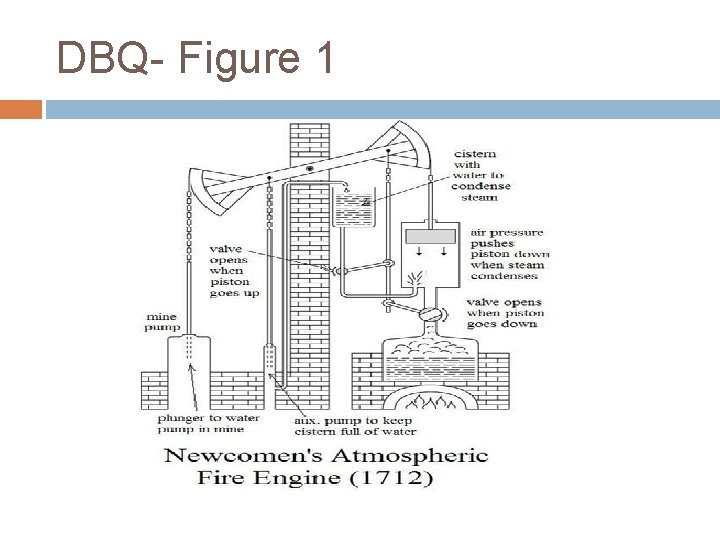
DBQ- Figure 1
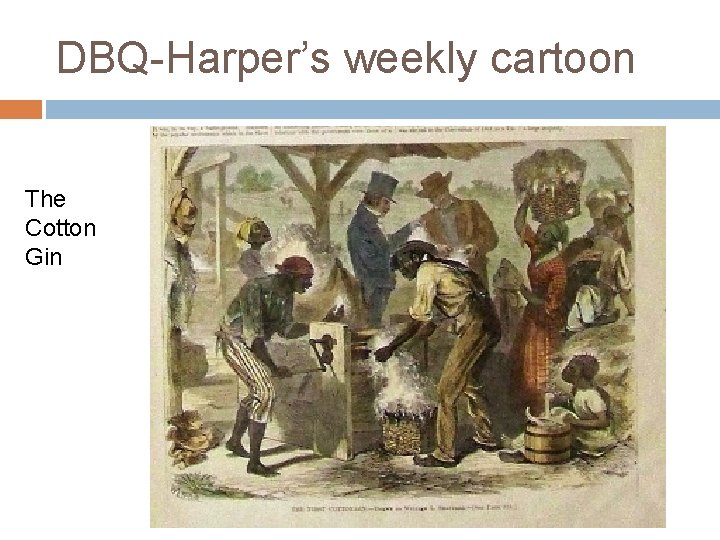
DBQ-Harper’s weekly cartoon The Cotton Gin
Resources during the Indus Revol
Industrial Revolution http: //www. youtube. com/watch? v=3 Efq-a. NBkvc POSITIVES NEGATIVES
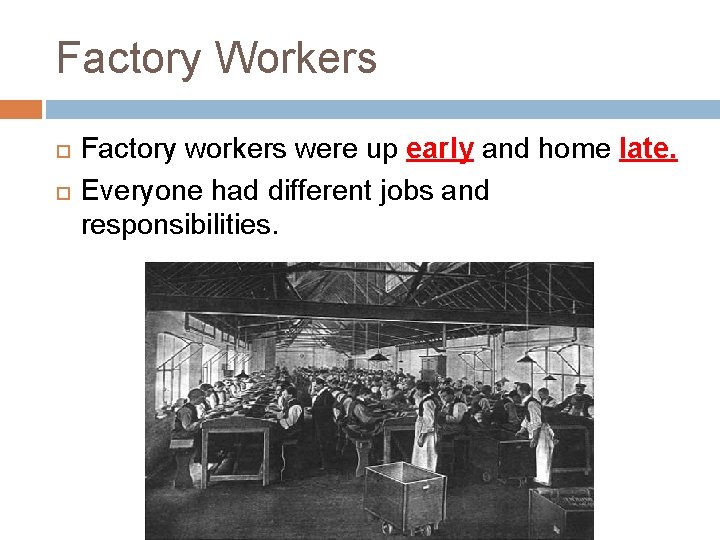
Factory Workers Factory workers were up early and home late. Everyone had different jobs and responsibilities.
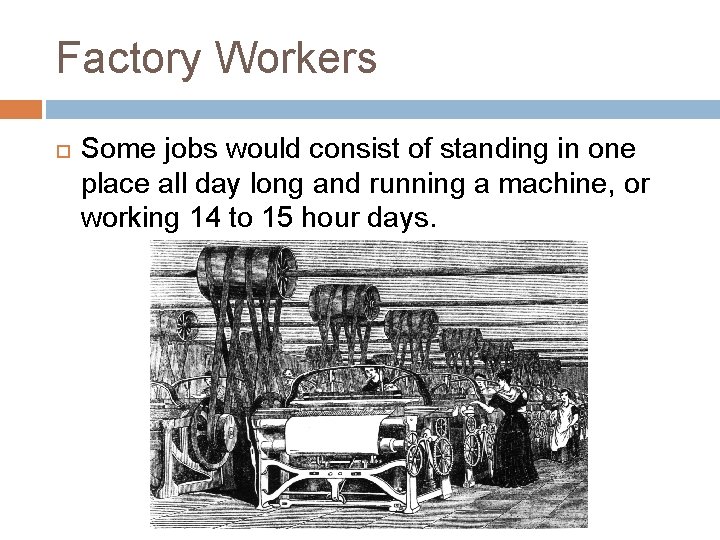
Factory Workers Some jobs would consist of standing in one place all day long and running a machine, or working 14 to 15 hour days.
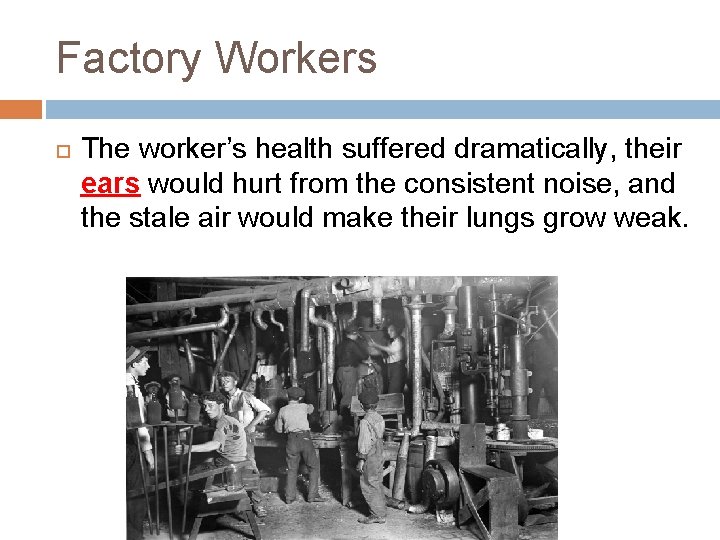
Factory Workers The worker’s health suffered dramatically, their ears would hurt from the consistent noise, and the stale air would make their lungs grow weak.
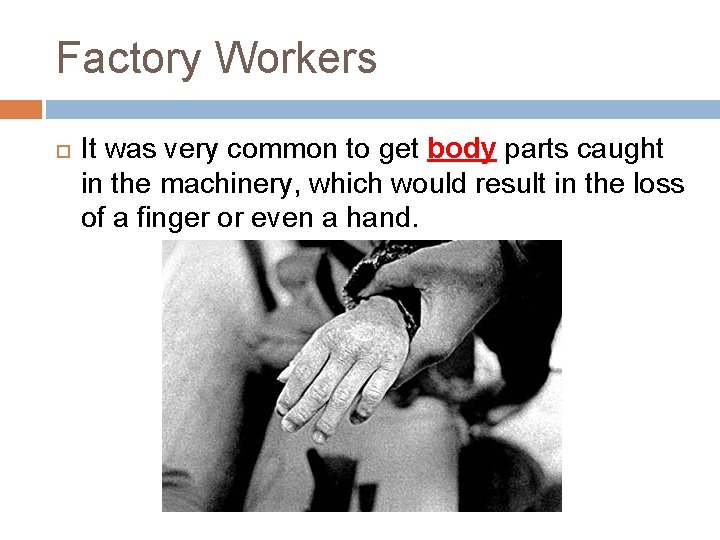
Factory Workers It was very common to get body parts caught in the machinery, which would result in the loss of a finger or even a hand.
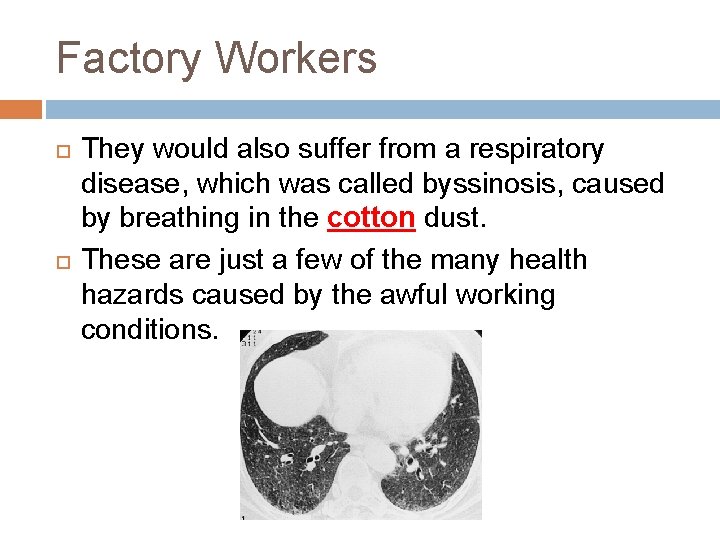
Factory Workers They would also suffer from a respiratory disease, which was called byssinosis, caused by breathing in the cotton dust. These are just a few of the many health hazards caused by the awful working conditions.
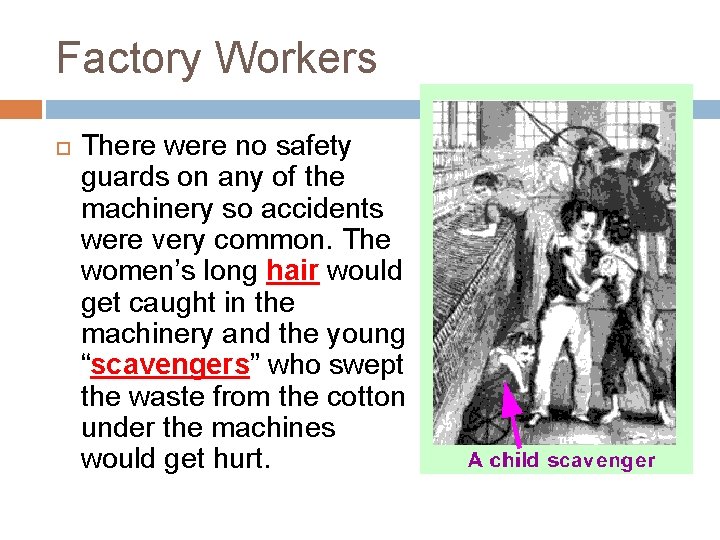
Factory Workers There were no safety guards on any of the machinery so accidents were very common. The women’s long hair would get caught in the machinery and the young “scavengers” who swept the waste from the cotton under the machines would get hurt.
Child Labor Children did not have it easy during the Industrial Revolution. Children worked in dangerous factories, coal mines and other hard labor jobs.
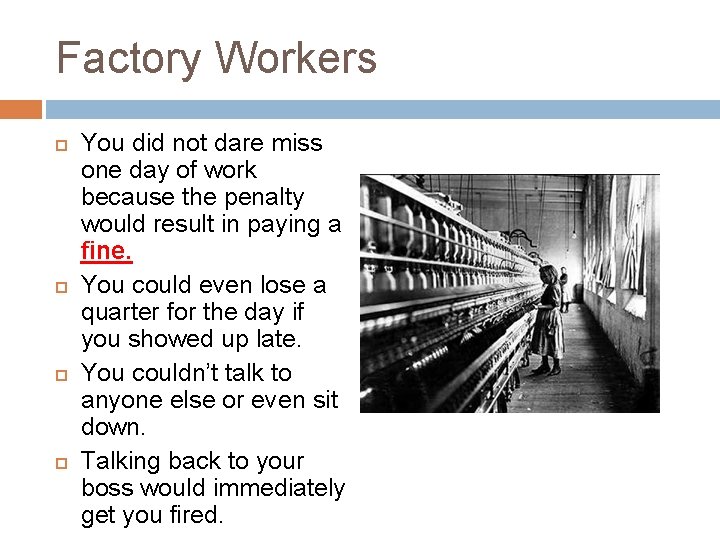
Factory Workers You did not dare miss one day of work because the penalty would result in paying a fine. You could even lose a quarter for the day if you showed up late. You couldn’t talk to anyone else or even sit down. Talking back to your boss would immediately get you fired.
Child Labor Children would start working as young as five years old and some times even younger.
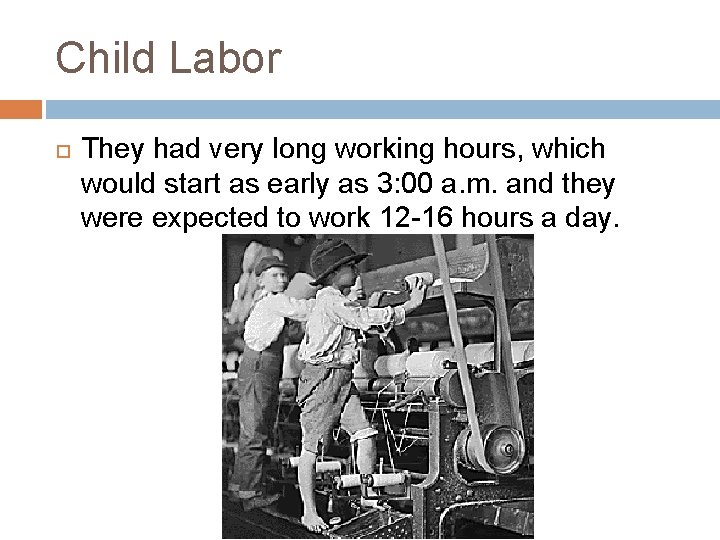
Child Labor They had very long working hours, which would start as early as 3: 00 a. m. and they were expected to work 12 -16 hours a day.
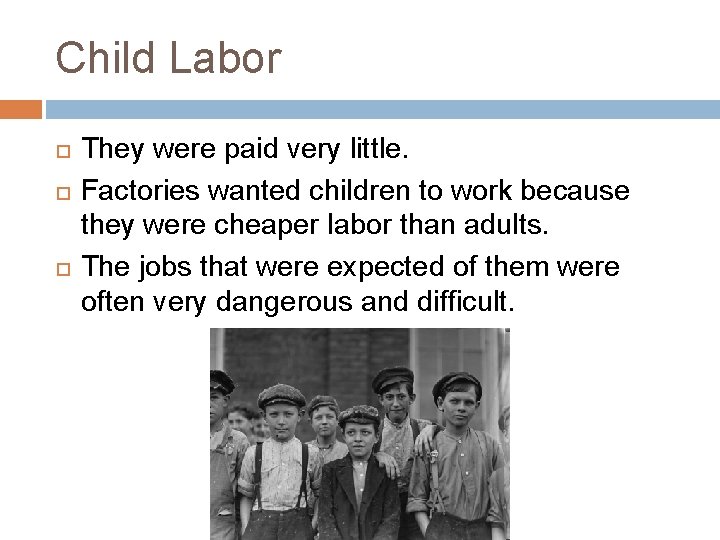
Child Labor They were paid very little. Factories wanted children to work because they were cheaper labor than adults. The jobs that were expected of them were often very dangerous and difficult.
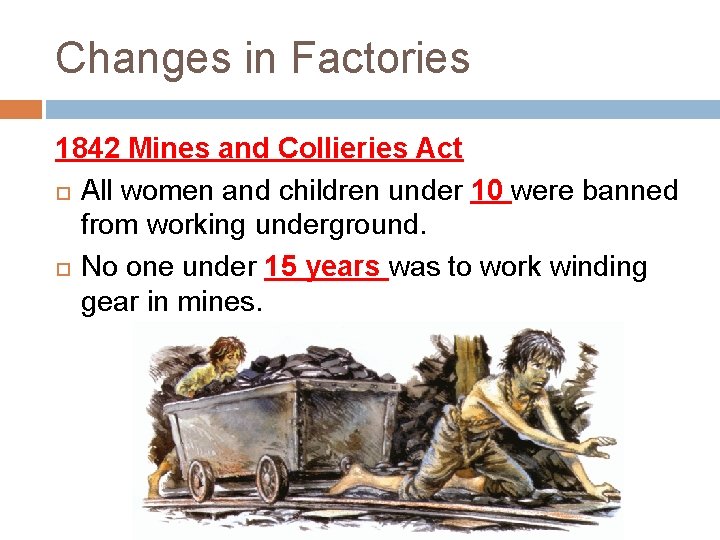
Child Labor Many boys had to guide ponies and donkeys through the mines. There were many dangers involved in working in the mine, such as explosions, floods, caveins and black lung. Black lung was a respiratory disease caused by breathing coal dust.
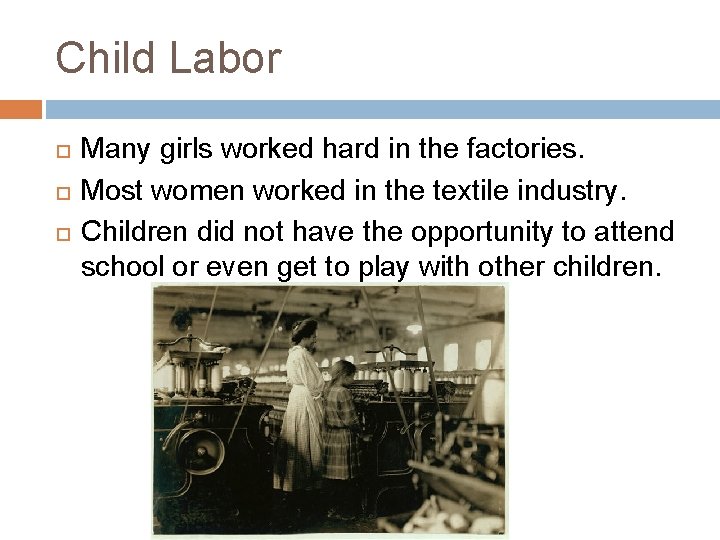
Child Labor Many girls worked hard in the factories. Most women worked in the textile industry. Children did not have the opportunity to attend school or even get to play with other children.
Child Labor Stations Examine Primary Sources https: //www. youtube. com/watch? v=t. Gb. U 5 T 25 t. PE
Life in the Factory "Two children I know got employment in a factory when they were five years old…………. the spinning men or women employ children if they can get a child to do their business……. . the child is paid one shilling or one shilling and six pence, and they will take that (five year old) child before they take an older one who will cost more. " George Gould, a Manchester merchant, written in 1816.
Life in the Factory "The smallest child in the factories were scavengers……they go under the machine, while it is going………. it is very dangerous when they first come, but they become used to it. " Charles Aberdeen worked in a Manchester cotton factory, written in 1832.
Life in the Factory "The task first allotted to Robert Blincoe was to pick up the loose cotton, that fell upon the floor. Apparently nothing could be easier……. . although he was much terrified by the whirling motion and noise of the machinery and the dust with which he was half suffocated………he soon felt sick and was constantly stooping; his back ached. Blincoe took the liberty to sit down. But this he soon found was strictly forbidden in cotton mills. His overlooker, Mr. Smith, told him he must keep on his legs. This he did for six and a half hours without a break. " John Brown, a reporter for "The Lion". Written in 1828.
Life in the Factory "We went to the mill at five in the morning. We worked until dinner time and then to nine or ten at night; on Saturday it could be till eleven and often till twelve at night. We were sent to clean the machinery on the Sunday. " Man interviewed in 1849 who had worked in a mill as a child.
Life in the Factory "In the evening I walked to Cromford and saw the children coming from their work. These children had been at work from 6 o’clock in the morning and it was now 7 o’clock in the evening. " Joseph Farington, 22 nd August 1801 (diary entry)
Life in the Factory "I began work at the mill in Bradford when I was nine years old……we began at six in the morning and worked until nine at night. When business was brisk, we began at five and worked until ten in the evening. " Hannah Brown, interviewed in 1832.
Life in the Factory "Very often the children are woken at four in the morning. The children are carried on the backs of the older children asleep to the mill, and they see no more of their parents till they go home at night and are sent to bed. " Richard Oastler, interviewed in 1832.
Life in the Factory "Woodward and other overlookers used to beat me with pieces of thick leather straps made supple by oil, and having an iron buckle at the end, drew blood almost every time it was applied. " John Brown quoted in the "Lion" newspaper in 1828.
Life in the Factory "Sarah Golding was poorly and so she stopped her machine. James Birch, the overlooker, knocked her to the floor. She got up as well as she could. He knocked her down again. Then she was carried to her house. . . . she was found dead in her bed. There was another girl called Mary. . . she knocked her food can to the floor. The master, Mr. Newton, kicked her and caused her to wear away till she died. There was another, Caroline Thompson, who was beaten till she went out of her mind. The overlookers used to cut off the hair of any girl caught talking to a lad. This head shaving was a dreadful punishment. We were more afraid of it than any other punishment for girls are proud of their hair. " An interview in 1849 with an unknown woman who worked in a cotton factory as a child.
Life in the Factory "When I was seven years old I went to work at Mr Marshall’s factory at Shrewsbury. If a child became sleepy, the overlooker touches the child on the shoulder and says "come here". In the corner of the room there is an iron cistern filled with water. He takes the boy by the legs and dips him in the cistern, and then sends him back to work. “ Jonathan Downe interviewed in June 1832.
Life in the Factory "I have seen my master, Luke Taylor, with a horse whip standing outside the mill when the children have come too late. . he lashed them all the way to the mill. " John Fairbrother, an overlooker, interviewed in 1819
Life in the Factory "I work at the silk mill. I am an overlooker and I have to superintend the children at the mill. Their strength goes towards the evening and they get tired. I have been compelled to urge them to work when I knew they could not bear it. I have been disgusted with myself. I felt myself degraded and reduced to the level of a slave-driver. William Rastrick, interviewed in 1832.
Factory Life Examine Primary sources Read like a Historian
Child Labor Video (3 parts) http: //www. youtube. com/watch? v=87 e. VOpbco Vo&list=PLq. J 67 kccct. Jj 6 ZSZAw. DA 5 Mdy. Al 4 Xy Xt. DN&index=19 Accompanying questions
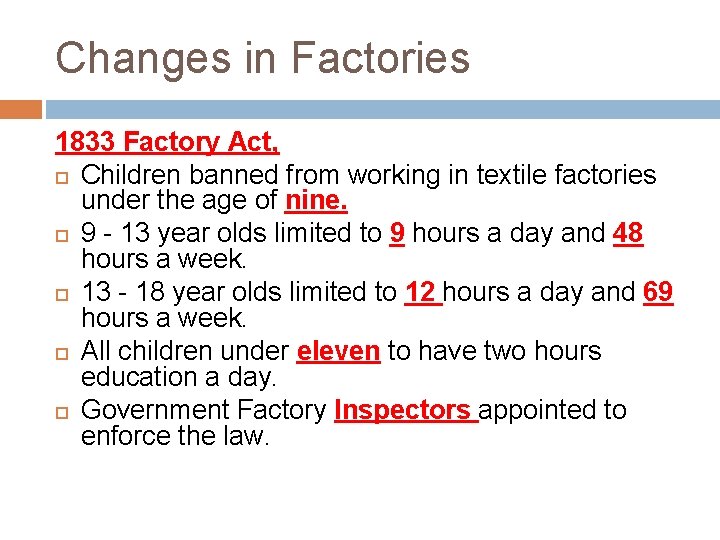
Changes in Factories 1833 Factory Act, Children banned from working in textile factories under the age of nine. 9 - 13 year olds limited to 9 hours a day and 48 hours a week. 13 - 18 year olds limited to 12 hours a day and 69 hours a week. All children under eleven to have two hours education a day. Government Factory Inspectors appointed to enforce the law.
Changes in Factories 1842 Mines and Collieries Act All women and children under 10 were banned from working underground. No one under 15 years was to work winding gear in mines.
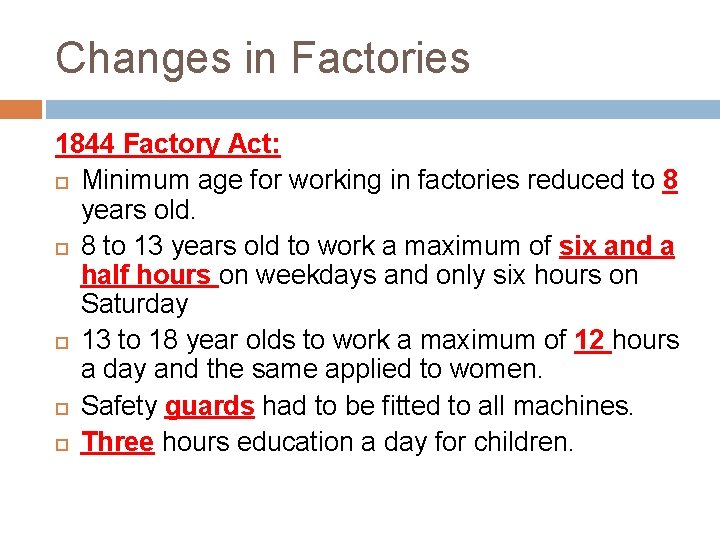
Changes in Factories 1844 Factory Act: Minimum age for working in factories reduced to 8 years old. 8 to 13 years old to work a maximum of six and a half hours on weekdays and only six hours on Saturday 13 to 18 year olds to work a maximum of 12 hours a day and the same applied to women. Safety guards had to be fitted to all machines. Three hours education a day for children.
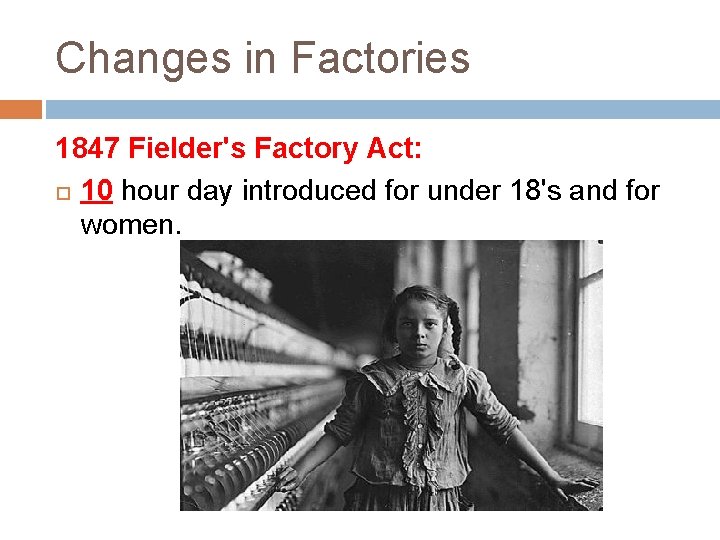
Changes in Factories 1847 Fielder's Factory Act: 10 hour day introduced for under 18's and for women.
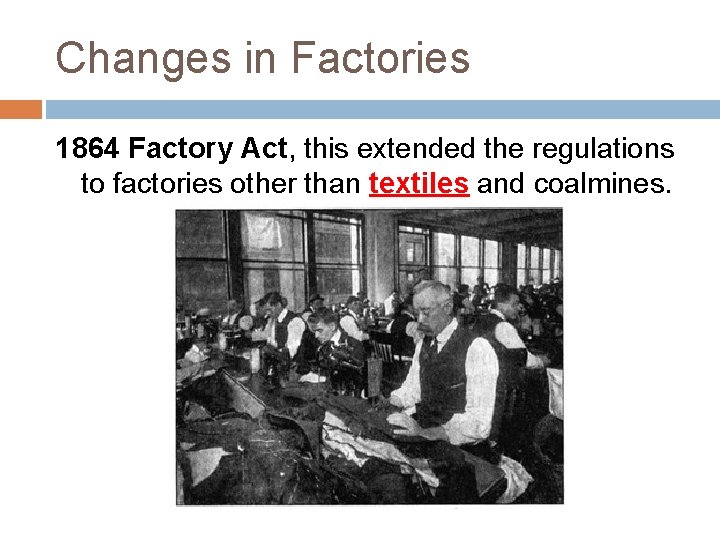
Changes in Factories 1864 Factory Act, this extended the regulations to factories other than textiles and coalmines.
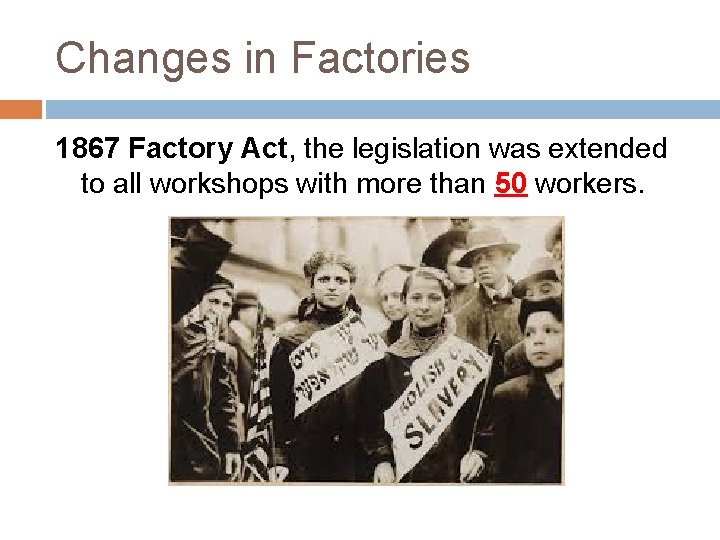
Changes in Factories 1867 Factory Act, the legislation was extended to all workshops with more than 50 workers.
Housing during the Industrial Revolution Most cities and towns were not prepared for the great increase of people looking for accommodation to live near their work place. youtube- housing
Housing during the Industrial Revolution There was a shortage of houses, so many people had to share a room in other peoples houses. Rooms were rented to whole families or perhaps several families. Often or twelve people shared one room. If there was no rooms to rent, people stayed in lodging houses.
Housing during the Industrial Revolution Many factory owners built houses for their workers near their factories. The houses were built close together really quickly and cheaply.
Housing during the Industrial Revolution These houses often had two rooms downstairs and two rooms upstairs. They were not really big enough for the large families people tended to have during the Victorian time.
Housing during the Industrial Revolution The houses also did not have running water and toilets. Up to 100 houses had to share an outdoor pump to get their water and share an outside toilet. To make things worse, the water from the pump was often polluted.
Housing during the Industrial Revolution The household rubbish was thrown out into the narrow streets and the air was filled with black smoke from the factories chimneys.
Housing during the Industrial Revolution Dirty streets and cramped living was a perfect breeding ground for diseases. More than 31, 000 people died during an outbreak of cholera in 1832 and lots more were killed by typhus, smallpox and dysentery.
Housing during the Industrial Revolution Public Health Act of 1875 banned open sewers, thanks to Joseph Bazalgette’s sewage system. The cities became much more sanitary.
Housing during the Industrial Revolution Houses were made further apart, rubbish collection was introduced and public health inspectors had to be provided by the local council. They basically had to go round whatever town or city they were employed in and check that sanitation and health of the people was alright.
Housing during the Industrial Revolution In 1853, the tax on soap was taken off, meaning poor people could buy it and become more hygienic by washing with it.
Great Britain- 1750’s For the most part, this change was positive and accepted by the people of the land. A few of the major negative changes were that the smaller farmers could no longer survive in a world expanding so fast and factories becoming so powerful.
The Industrial Revolution Crash Course http: //www. youtube. com/watch? v=zh. L 5 DCizj 5 c 1) 2) 3) 4) 5) Name two things made possible by the Industrial Revolution (IR). What did Thomas Newcomen invent? Name one reason the IR began in Britain. Why was coal vital to the IR? Why did India not need to industrialize?