
The Industrial Revolution in England World History Student

- Slides: 53
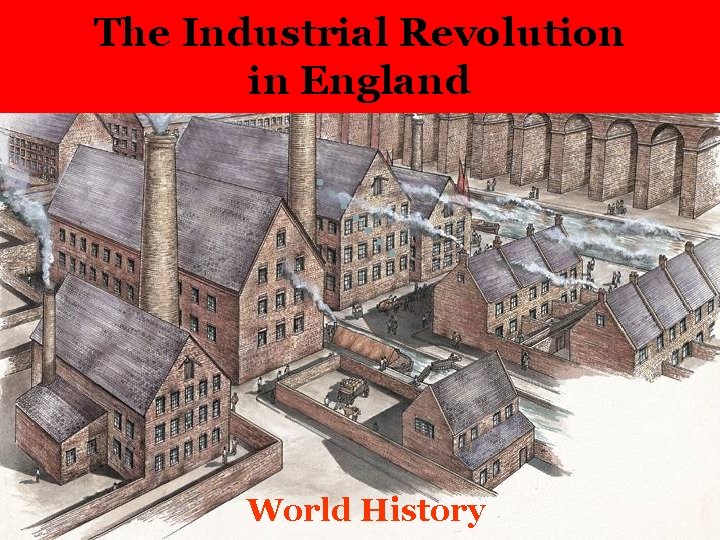
The Industrial Revolution in England World History
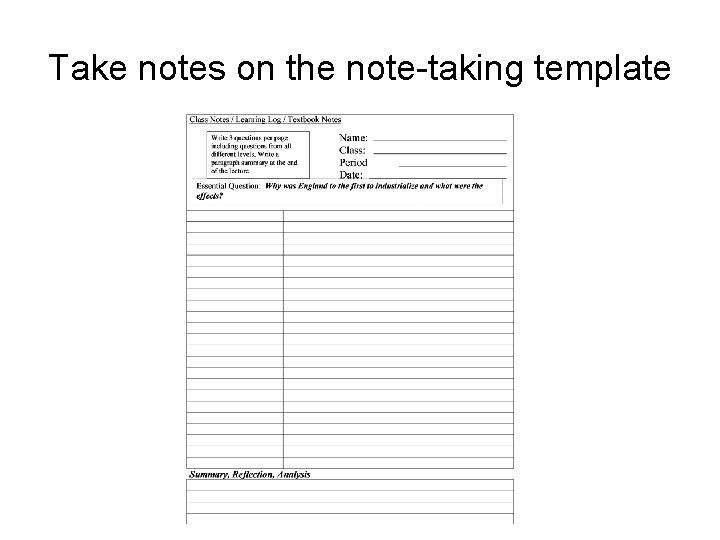
Student Instructions • As you listen to the lecture take notes on your Cornell Note Template. Only take notes when you see the outline. • For homework, create 3 questions per page choosing one level per question (see Costa’s Questions Handout). Also, write a paragraph summary answering the essential question.
Take notes on the note-taking template
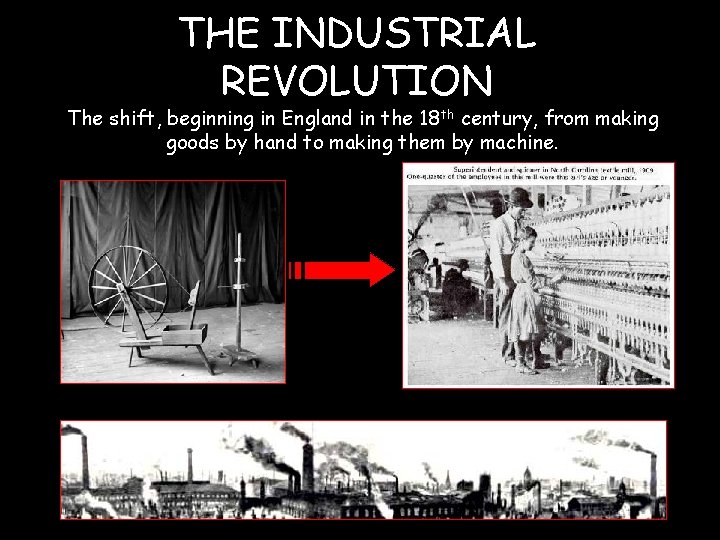
THE INDUSTRIAL REVOLUTION The shift, beginning in England in the 18 th century, from making goods by hand to making them by machine.
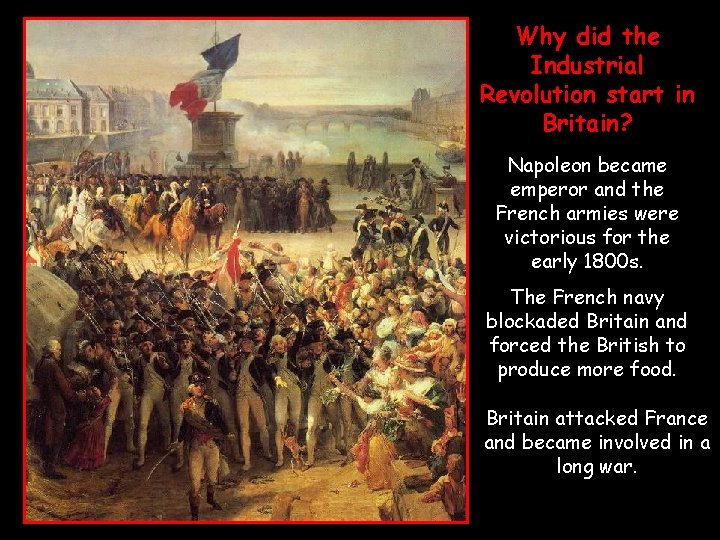
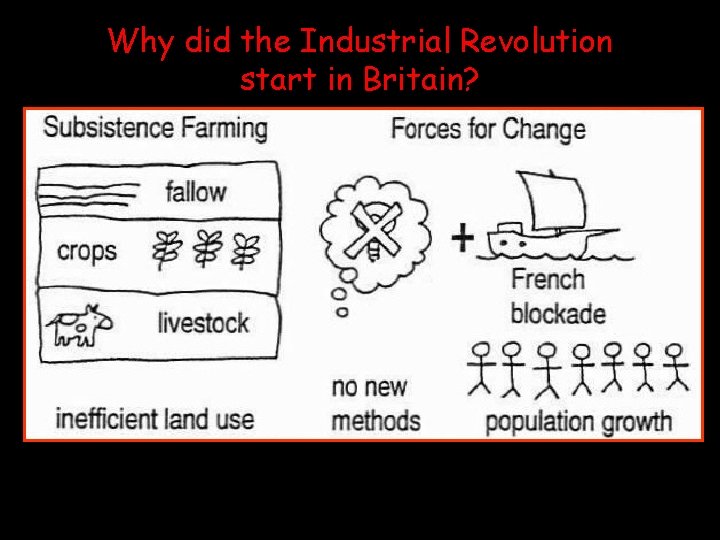
Why did the Industrial Revolution start in Britain? Napoleon became emperor and the French armies were victorious for the early 1800 s. The French navy blockaded Britain and forced the British to produce more food. Britain attacked France and became involved in a long war.
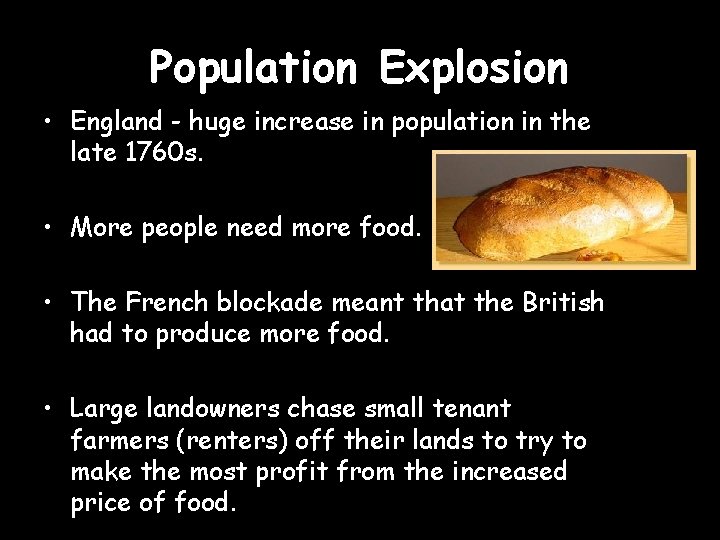
Population Explosion • England - huge increase in population in the late 1760 s. • More people need more food. • The French blockade meant that the British had to produce more food. • Large landowners chase small tenant farmers (renters) off their lands to try to make the most profit from the increased price of food.
Why did the Industrial Revolution start in Britain?
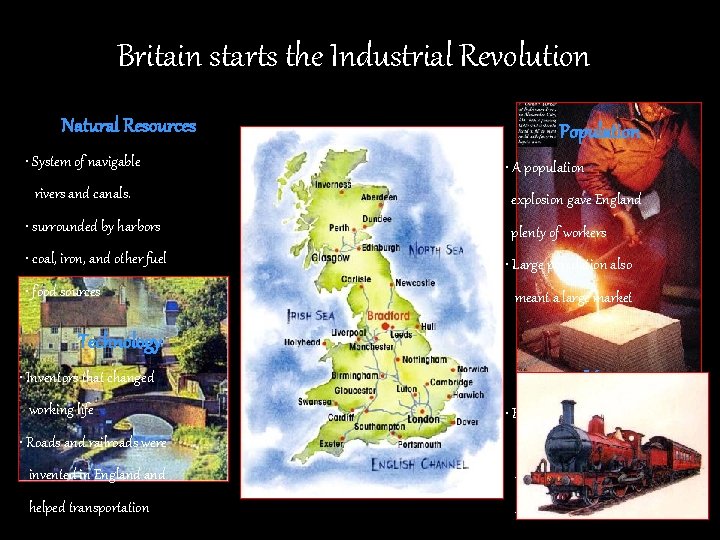
Britain starts the Industrial Revolution Natural Resources • System of navigable rivers and canals. • surrounded by harbors • coal, iron, and other fuel • food sources Population • A population explosion gave England plenty of workers • Large population also meant a large market Technology Money • Inventors that changed working life • Roads and railroads were • England had a bank that loaned entrepreneurs invented in England money to start helped transportation companies.
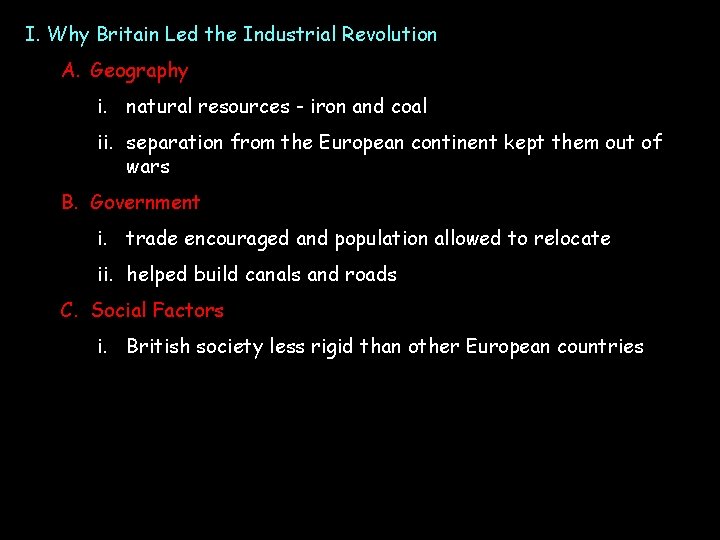
I. Why Britain Led the Industrial Revolution A. Geography i. natural resources - iron and coal ii. separation from the European continent kept them out of wars B. Government i. trade encouraged and population allowed to relocate ii. helped build canals and roads C. Social Factors i. British society less rigid than other European countries
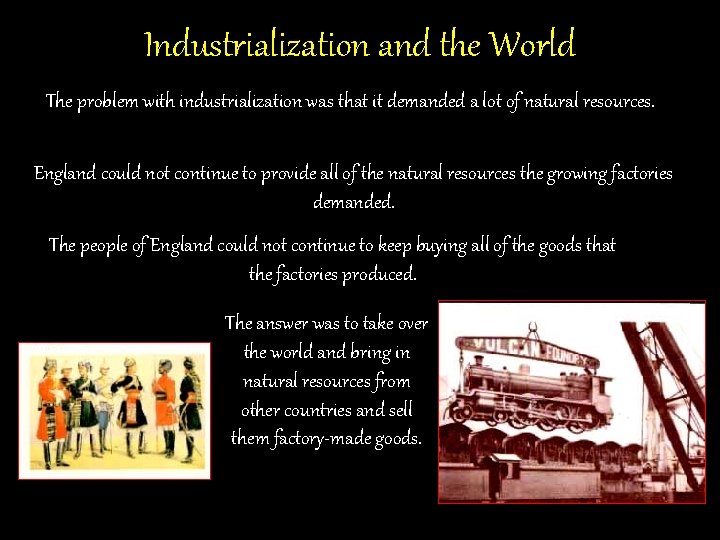
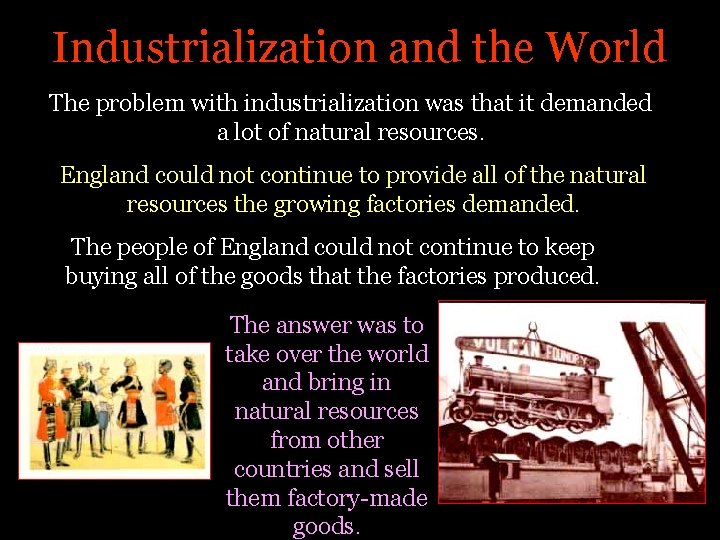
Industrialization and the World The problem with industrialization was that it demanded a lot of natural resources. England could not continue to provide all of the natural resources the growing factories demanded. The people of England could not continue to keep buying all of the goods that the factories produced. The answer was to take over the world and bring in natural resources from other countries and sell them factory-made goods.
I. Why Britain Led the Industrial Revolution A. Geography i. natural resources - iron and coal ii. separation from the European continent kept them out of wars B. Government i. trade encouraged and population allowed to relocate ii. helped build canals and roads C. Social Factors i. British society less rigid than other European countries D. Colonial Empire i. supplied raw material and provided market for goods E. Advantages of Industrializing First i. no other competition for manufactured goods monopoly on technology
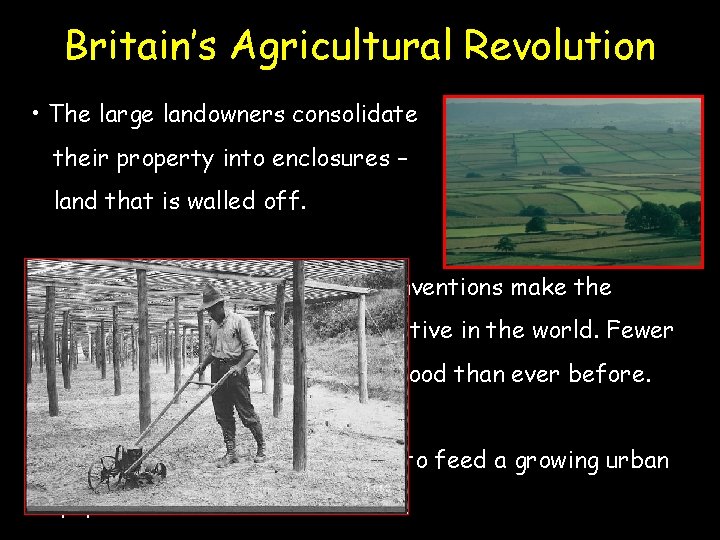
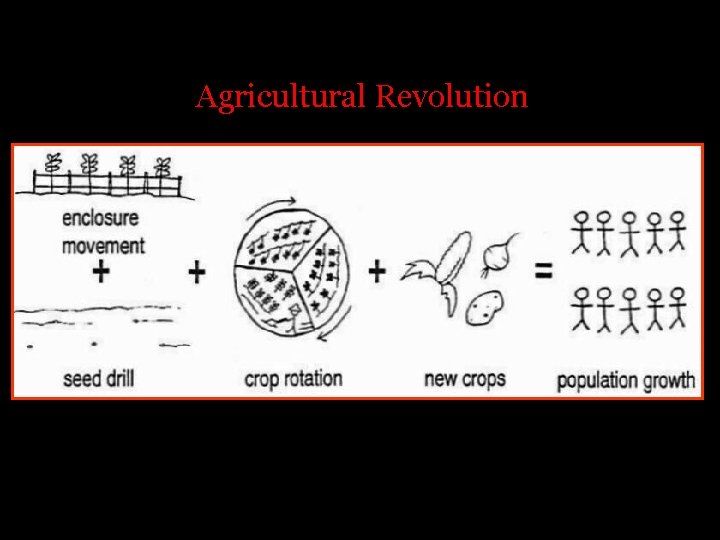
Britain’s Agricultural Revolution • The large landowners consolidate their property into enclosures – land that is walled off. • Increased technology and new inventions make the British farmers the most productive in the world. Fewer farmers can now produce more food than ever before. • This allows the rural population to feed a growing urban population.
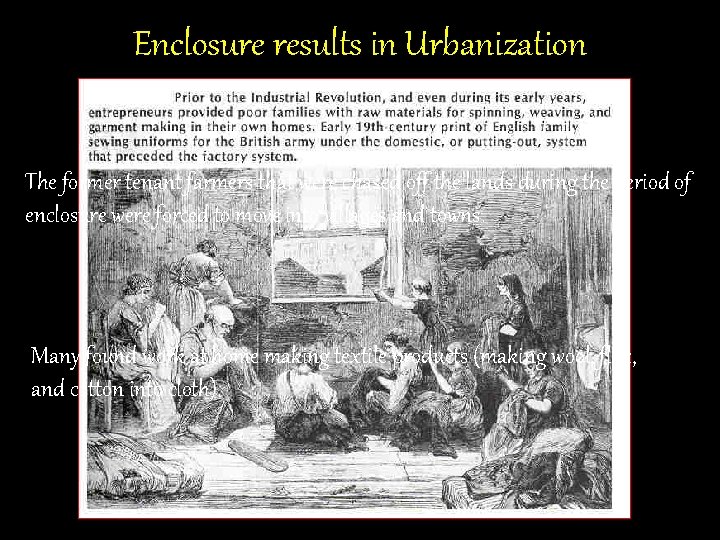
Enclosure results in Urbanization The former tenant farmers that were chased off the lands during the period of enclosure were forced to move into villages and towns. Many found work at home making textile products (making wool, flax, and cotton into cloth).
THE INDUSTRIAL REVOLUTION 2. The Agricultural Revolution A. Enclosure Movement i. landlords fenced in common land used new farming technology ii. peasants became poorer
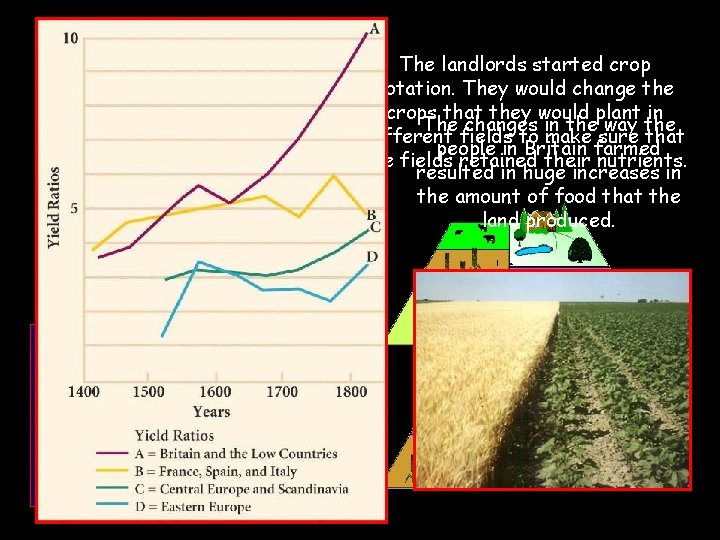
The landlords started crop rotation. They would change the crops that they would plant in The changes in the way the different fields to make sure that people in Britain farmed the fields retained their nutrients. resulted in huge increases in the amount of food that the land produced. New crops such as corn and potatoes were introduced that increased the amount of food that Britain produced.
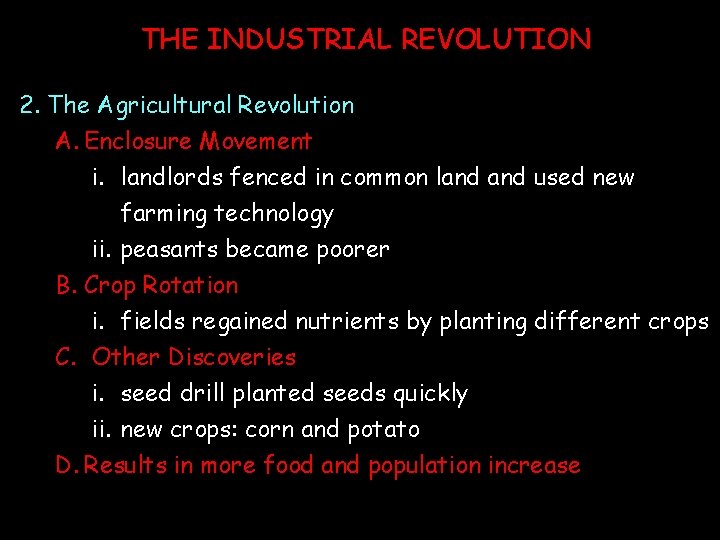
THE INDUSTRIAL REVOLUTION 2. The Agricultural Revolution A. Enclosure Movement i. landlords fenced in common land used new farming technology ii. peasants became poorer B. Crop Rotation i. fields regained nutrients by planting different crops C. Other Discoveries i. seed drill planted seeds quickly ii. new crops: corn and potato D. Results in more food and population increase
Agricultural Revolution
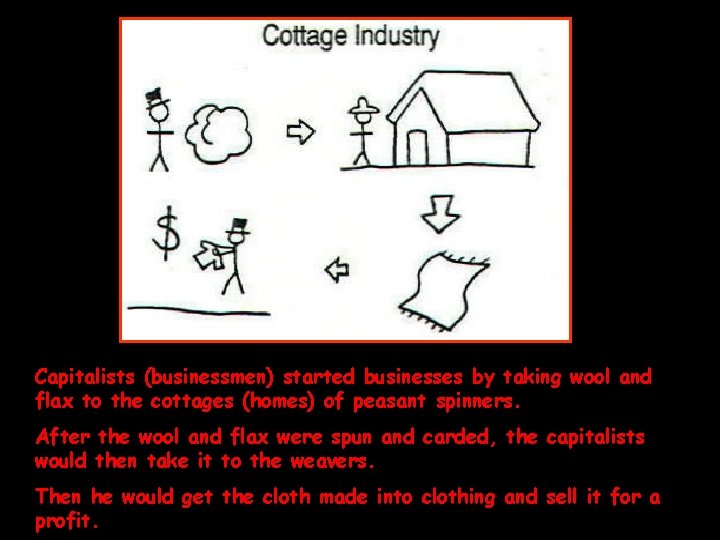
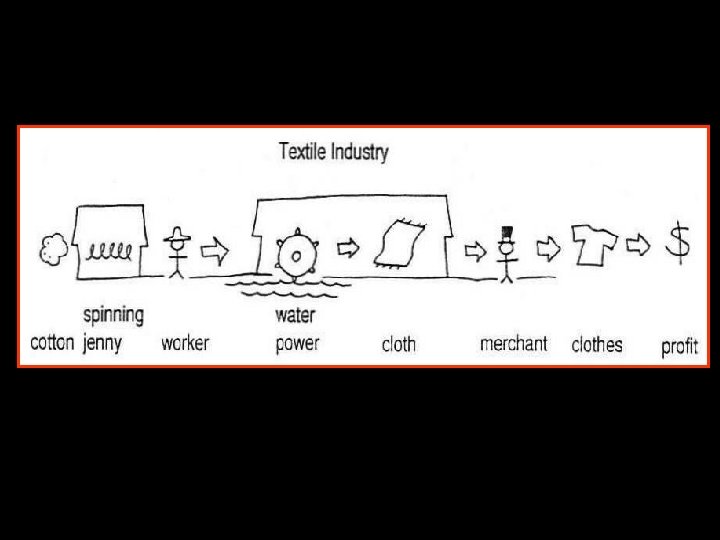
Capitalists (businessmen) started businesses by taking wool and flax to the cottages (homes) of peasant spinners. After the wool and flax were spun and carded, the capitalists would then take it to the weavers. Then he would get the cloth made into clothing and sell it for a profit.
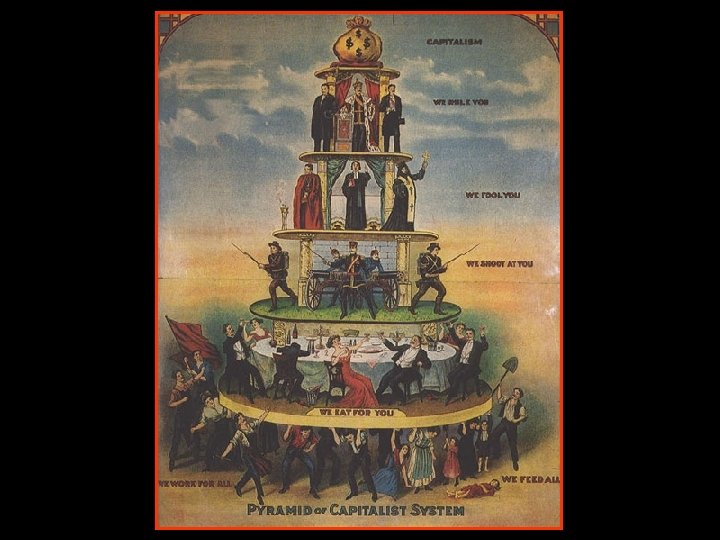
3. Cottage Industry and Early Capitalism A. Merchants Role i. supplied materials – wool and cotton ii. transported supplies iii. merchants make profits B. Capitalism i. private ownership, free competition, and profit ii. cottage industry early example of capitalism C. Effects of the Cottage Industry i. big profits for new class of merchants ii. alternative source of income for peasants
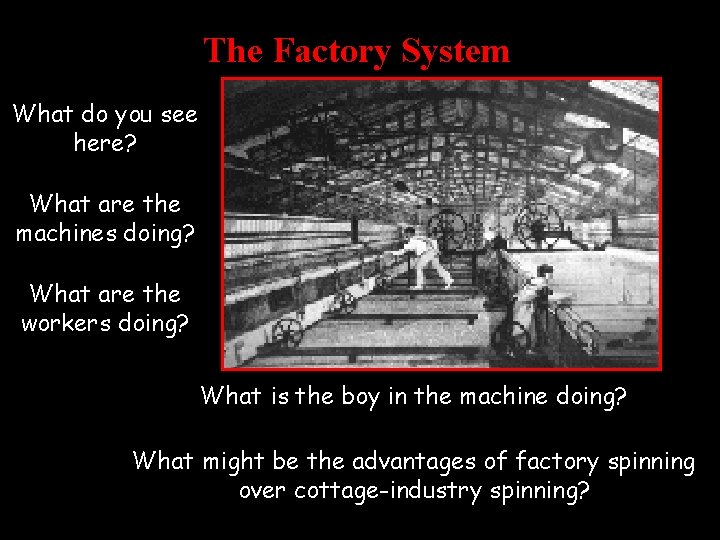
The Factory System What do you see here? What are the machines doing? What are the workers doing? What is the boy in the machine doing? What might be the advantages of factory spinning over cottage-industry spinning?
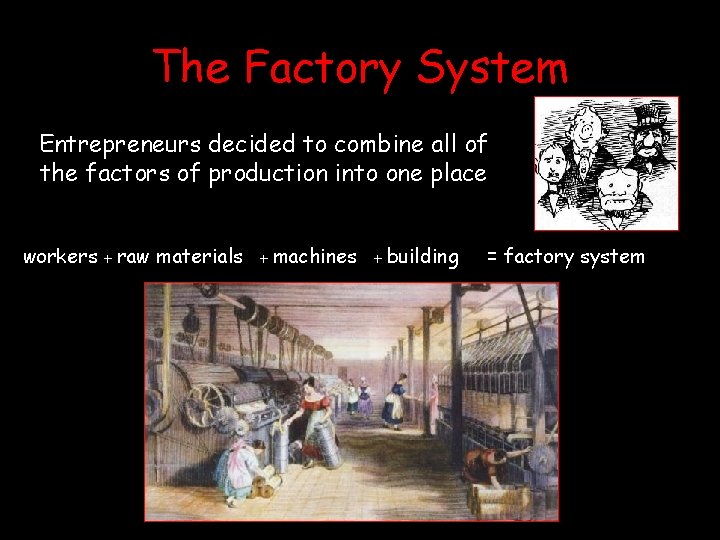
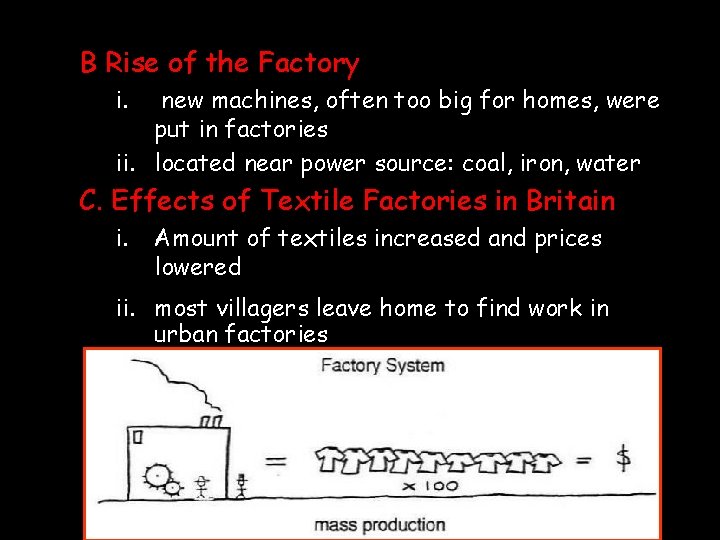
The Factory System Entrepreneurs decided to combine all of the factors of production into one place workers + raw materials + machines + building = factory system
The start of the industrial revolution was helped by many brilliant people making key inventions…
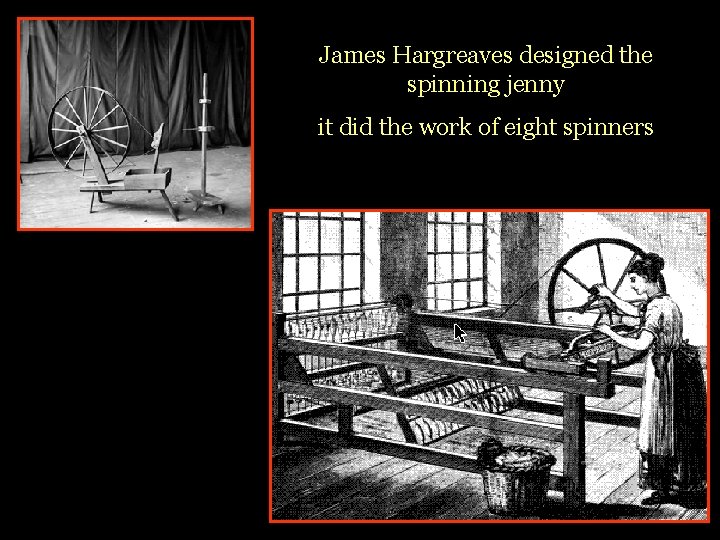
James Hargreaves designed the spinning jenny it did the work of eight spinners
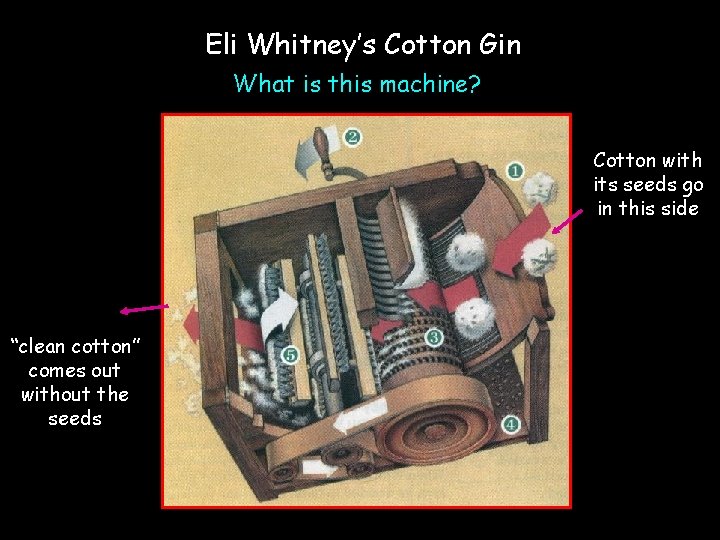
Eli Whitney’s Cotton Gin What is this machine? Cotton with its seeds go in this side “clean cotton” comes out without the seeds
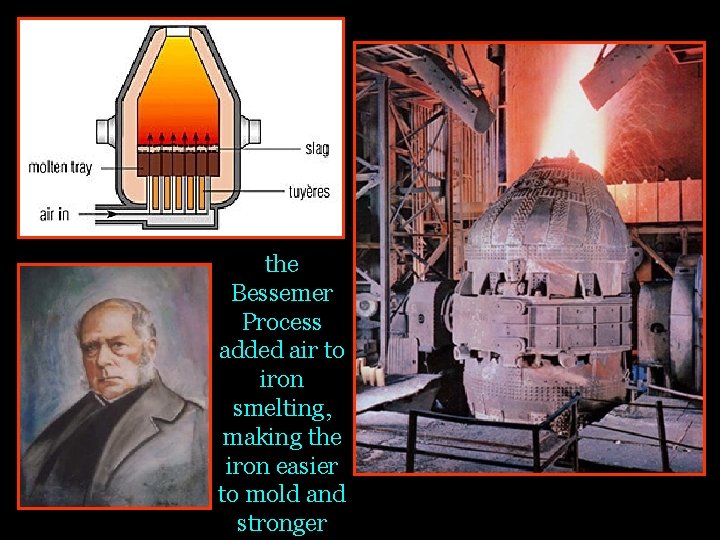
4. Textile Industry and Factory System A. Textile Industry Invented i. cottages couldn’t keep up with demand for textiles ii. new machines make textiles quicker a. James Hargreaves – spinning jenny allowed one worker to do the work of 8 spinners b. James Watt – steam engine that used less energy c. Eli Whitney – cotton gin and interchangeable parts d. Henry Bessemer – added air to making iron, which made the iron goods stronger and easier to shape e. Louis Pasteur – pasteurized goods (took out bacteria) f. Thomas Edison – many inventions, including electric bulb and phonograph
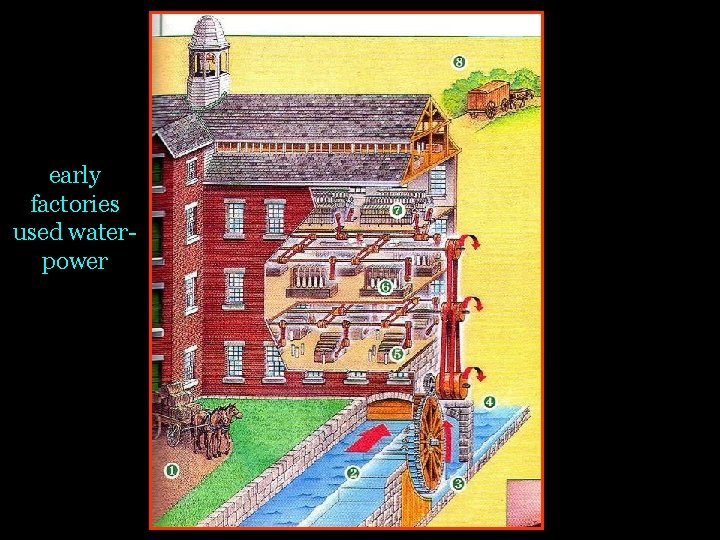
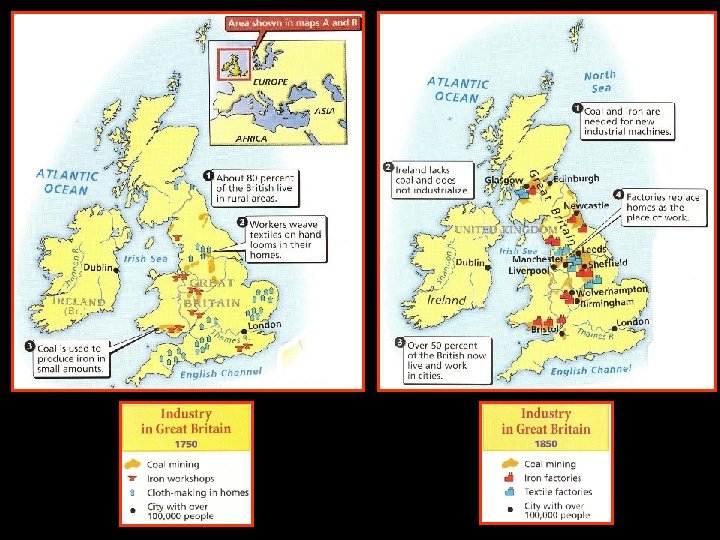
B Rise of the Factory i. new machines, often too big for homes, were put in factories ii. located near power source: coal, iron, water C. Effects of Textile Factories in Britain i. Amount of textiles increased and prices lowered ii. most villagers leave home to find work in urban factories
early factories used waterpower
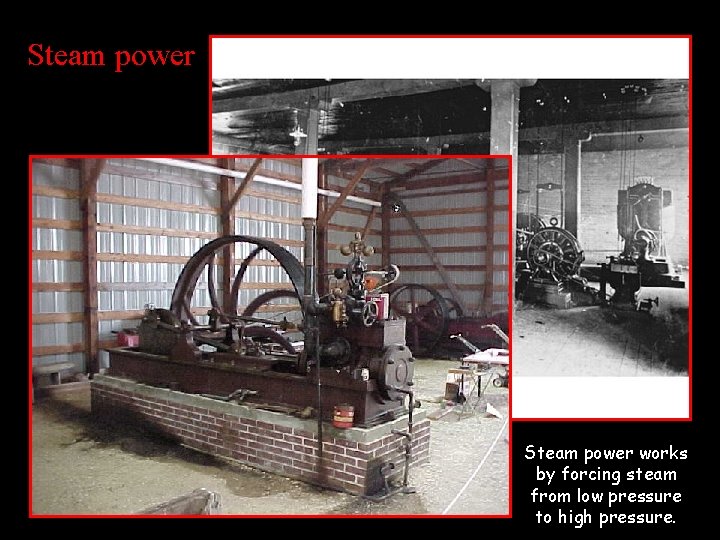
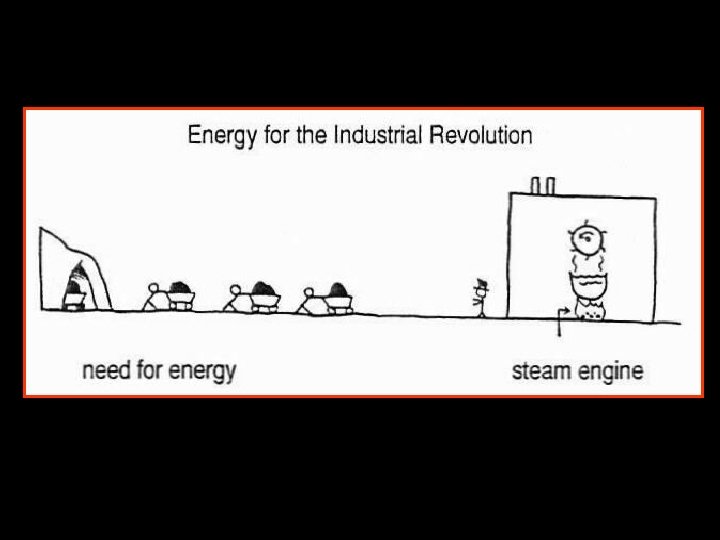
5. Steam Engine: Energy for the Industrial Revolution A. Steam Engine built for increasing need for power B. Steam forced from high to low pressure produces power C. Steam Engine improved mining which increased metals
Steam power works by forcing steam from low pressure to high pressure.
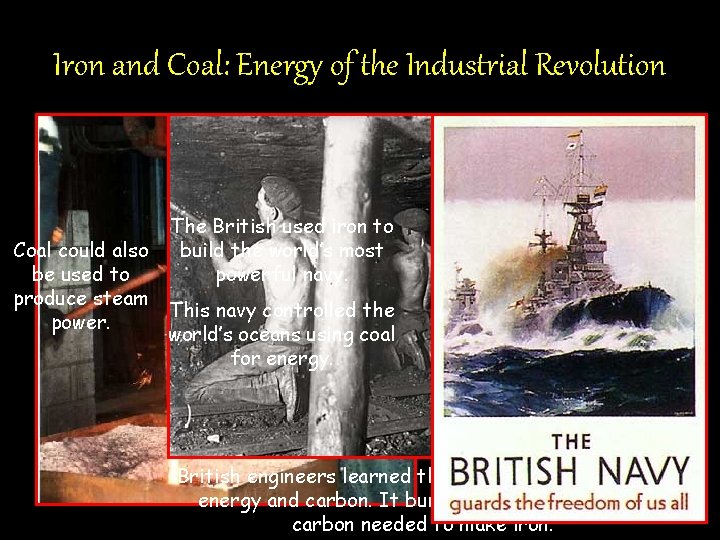
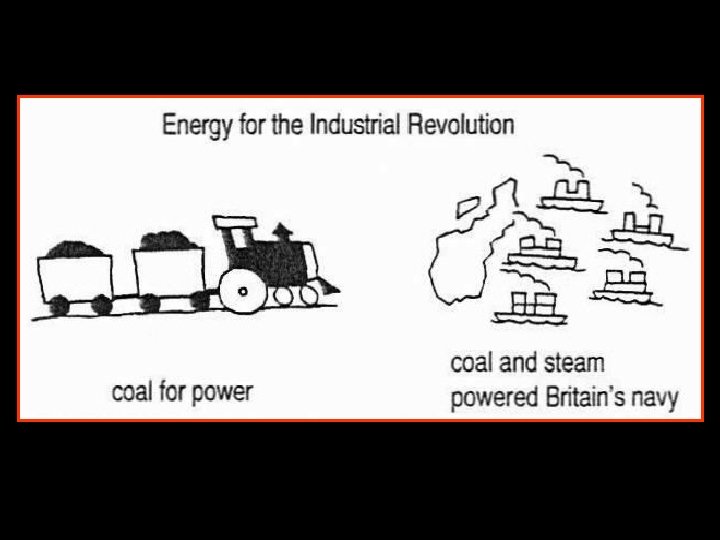
Iron and Coal: Energy of the Industrial Revolution Coal could also be used to produce steam power. The British used iron to build the world’s most powerful navy. The use of iron was essential in the industrial revolution. Iron was a very hard metal that could be used to make strong machines. This navy controlled the world’s oceans using coal for energy. The problem was that iron needed carbon added to it to be flexible and durable. many workers die because of dangerous British engineers learned that coal could be used for machinery energy and carbon. It burned slowly and had the carbon needed to make iron.
6. Iron and Coal: Energy for the Industrial Revolution A. The Need for Iron i. farming tools, new factory machinery, railways B. The Need for Coal i. steam engines powered by coal C. Effect of Iron and Coal i. Britain produced more iron than rest of the world ii. coal powered Britain’s enormous navy
the Bessemer Process added air to iron smelting, making the iron easier to mold and stronger
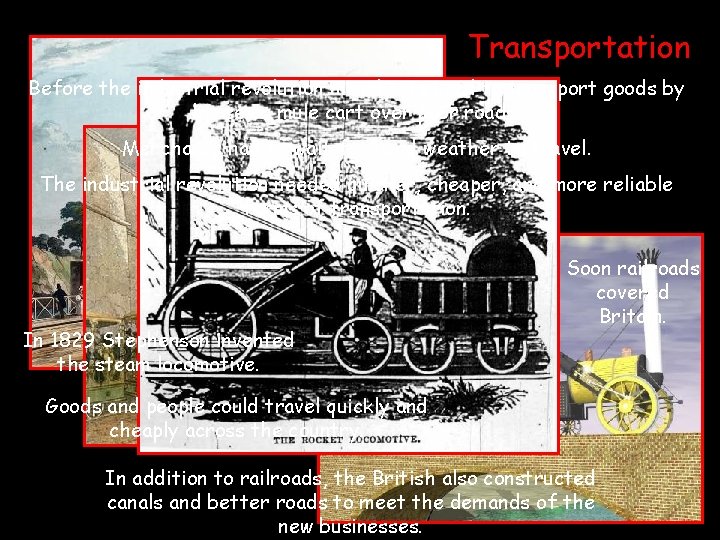
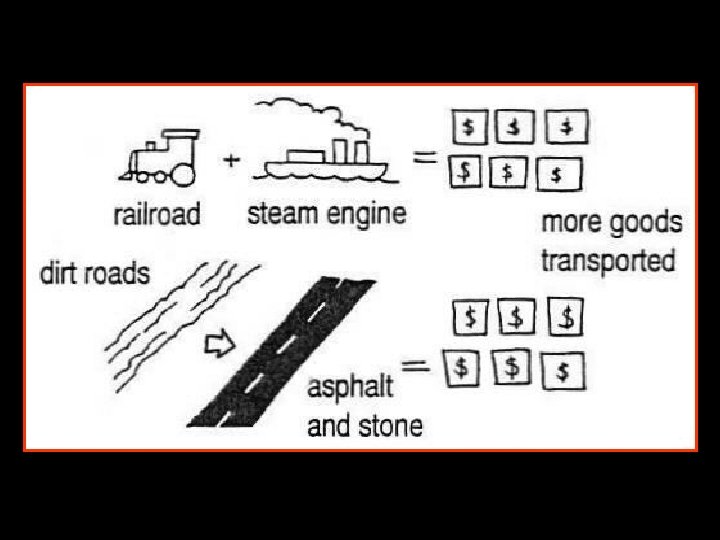
Transportation Before the industrial revolution merchants used to transport goods by horse or mule cart over poor roads. Merchants had to wait for good weather to travel. The industrial revolution needed quicker, cheaper, and more reliable forms of transportation. In 1829 Stephenson invented the steam locomotive. Soon railroads covered Britain. Goods and people could travel quickly and cheaply across the country. In addition to railroads, the British also constructed canals and better roads to meet the demands of the new businesses.
7. Transportation A. Need for Better Transportation i. increased production needed quick and cheap transportation B. Inventions i. roads, canals, railroad C. Effects of Railroads i. cheaper transportation increased production and profits ii. helped other industries
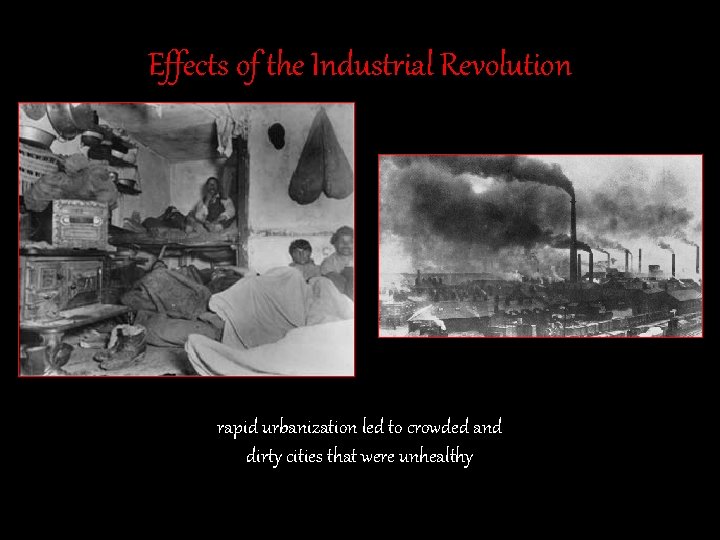
Effects of the Industrial Revolution rapid urbanization led to crowded and dirty cities that were unhealthy
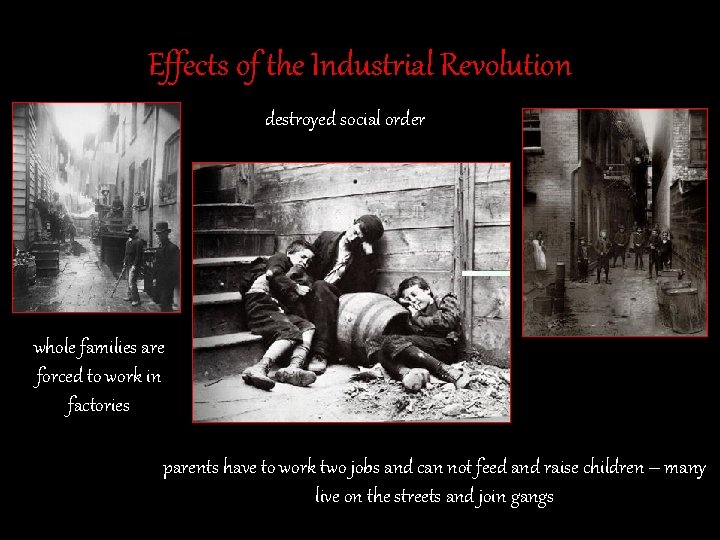
Effects of the Industrial Revolution destroyed social order whole families are forced to work in factories parents have to work two jobs and can not feed and raise children – many live on the streets and join gangs
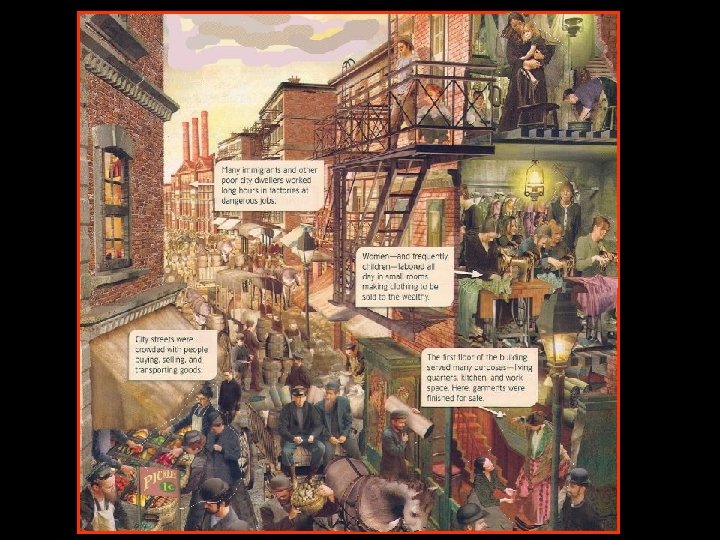
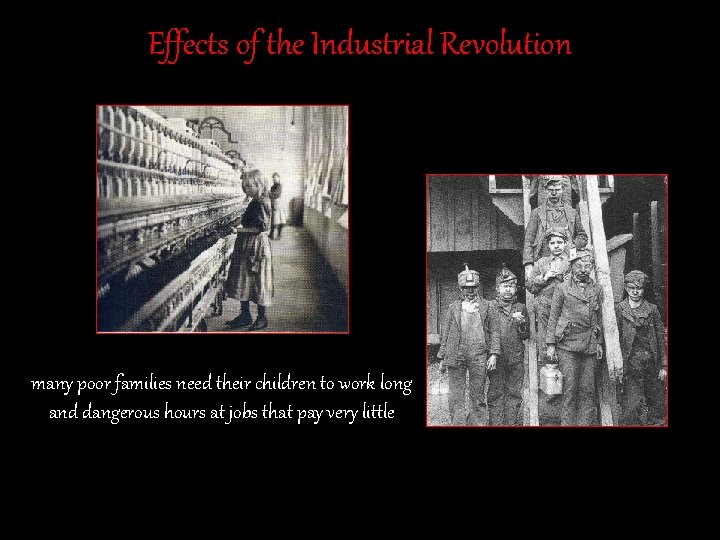
Effects of the Industrial Revolution many poor families need their children to work long and dangerous hours at jobs that pay very little
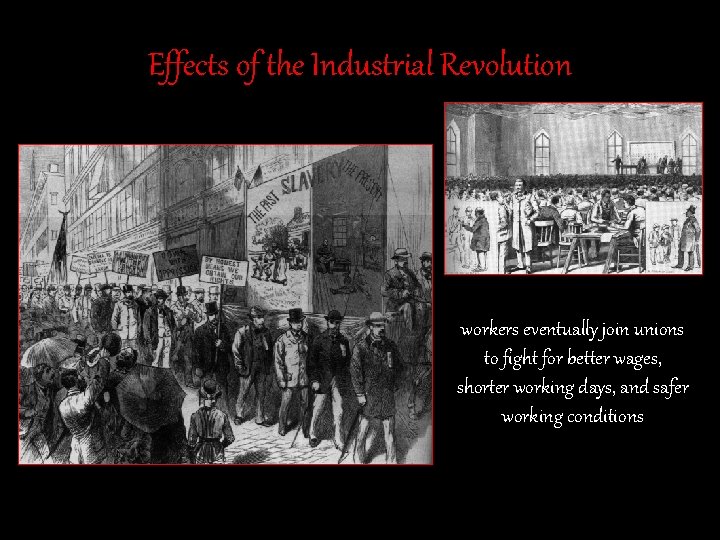
Effects of the Industrial Revolution workers eventually join unions to fight for better wages, shorter working days, and safer working conditions
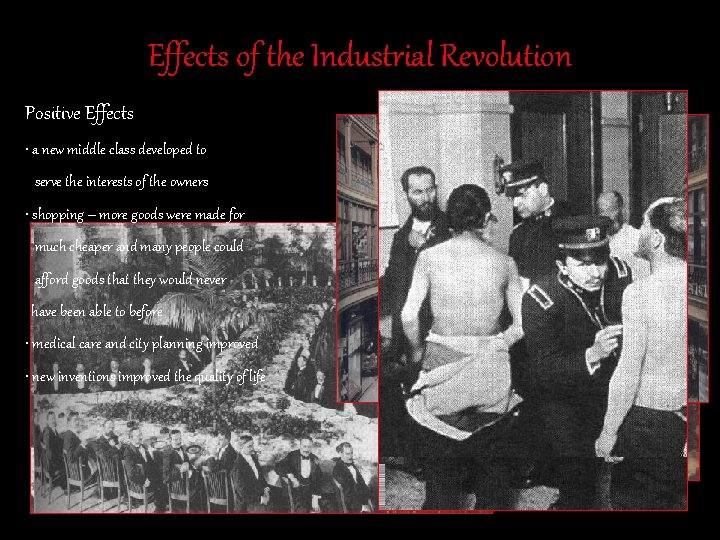
Effects of the Industrial Revolution Positive Effects • a new middle class developed to serve the interests of the owners • shopping – more goods were made for much cheaper and many people could afford goods that they would never have been able to before • medical care and city planning improved • new inventions improved the quality of life
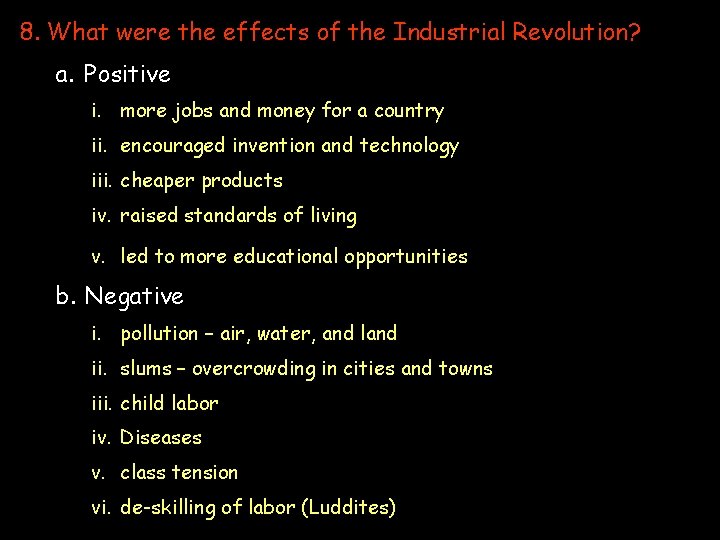
8. What were the effects of the Industrial Revolution? a. Positive i. more jobs and money for a country ii. encouraged invention and technology iii. cheaper products iv. raised standards of living v. led to more educational opportunities b. Negative i. pollution – air, water, and land ii. slums – overcrowding in cities and towns iii. child labor iv. Diseases v. class tension vi. de-skilling of labor (Luddites)
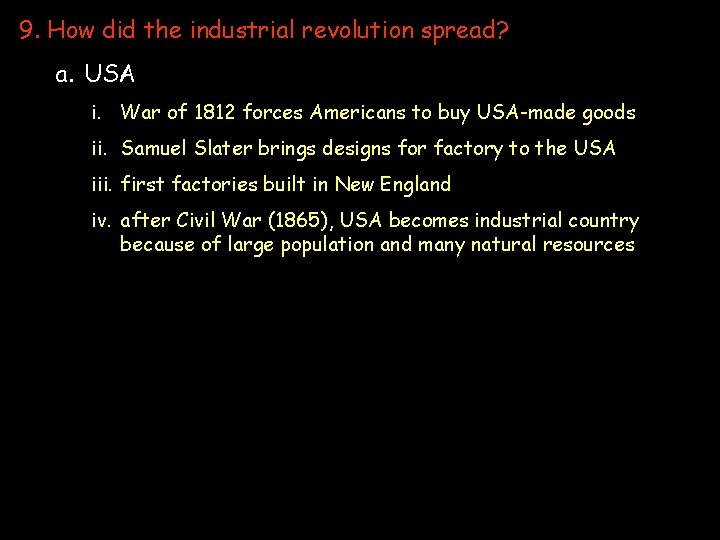
9. How did the industrial revolution spread? a. USA i. War of 1812 forces Americans to buy USA-made goods ii. Samuel Slater brings designs for factory to the USA iii. first factories built in New England iv. after Civil War (1865), USA becomes industrial country because of large population and many natural resources
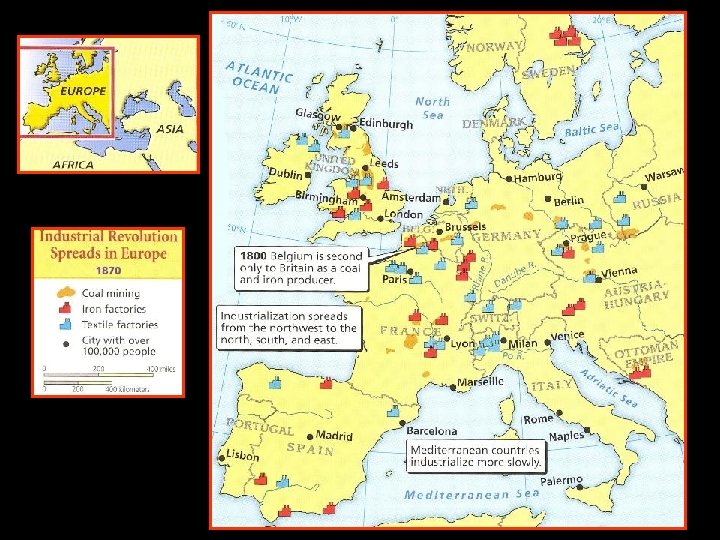
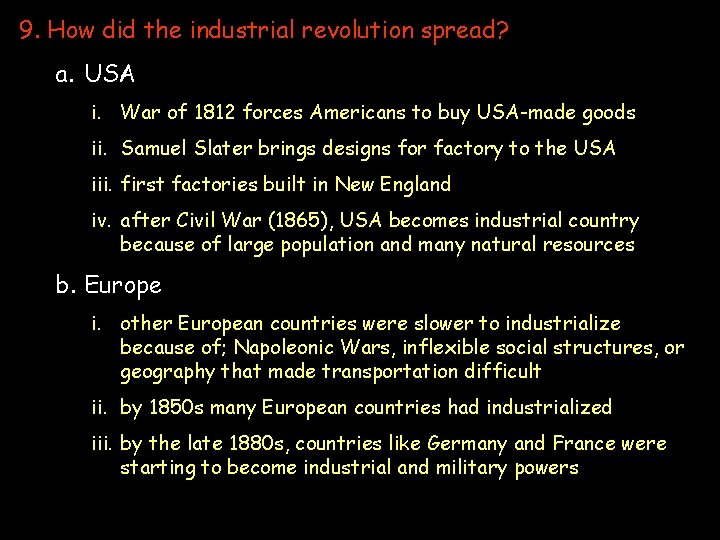
9. How did the industrial revolution spread? a. USA i. War of 1812 forces Americans to buy USA-made goods ii. Samuel Slater brings designs for factory to the USA iii. first factories built in New England iv. after Civil War (1865), USA becomes industrial country because of large population and many natural resources b. Europe i. other European countries were slower to industrialize because of; Napoleonic Wars, inflexible social structures, or geography that made transportation difficult ii. by 1850 s many European countries had industrialized iii. by the late 1880 s, countries like Germany and France were starting to become industrial and military powers
Industrialization and the World The problem with industrialization was that it demanded a lot of natural resources. England could not continue to provide all of the natural resources the growing factories demanded. The people of England could not continue to keep buying all of the goods that the factories produced. The answer was to take over the world and bring in natural resources from other countries and sell them factory-made goods.
10. How did people react to the new society? a. Philosophers try to explain changes i. capitalism – private ownership and profits for owners ii. utilitarianism – best interests of society iii. utopianism – ideal communities iv. socialism – public ownership and operation for general good v. communism – no private ownership, everything shared b. The Arts reflect changes i. Neoclassical – before industrial revolution, focused on order and harmony in society ii. Romantic – turned away from society’s order and focused on nature and individual’s emotions iii. Realistic – turned away from the escapism of the Romantics and tried to reflect the reality of life in industrial society
10. How did people react to the new society? a. Philosophers try to explain changes i. capitalism – private ownership and profits for owners ii. utilitarianism – best interests of society iii. utopianism – ideal communities iv. socialism – public ownership and operation for general good v. communism – no private ownership, everything shared b. The Arts reflect changes i. Neoclassical – before industrial revolution, focused on order and harmony in society ii. Romantic – turned away from society’s order and focused on nature and individual’s emotions iii. Realistic – turned away from the escapism of the Romantics and tried to reflect the reality of life in industrial society