
The Industrial Revolution Chapter 25 Overview n When
- Slides: 31
The Industrial Revolution Chapter 25
Overview n When? n n Where? n n n 1700’s & 1800’s (18 th & 19 th centuries) Started in Great Britain Spread around Europe, to the Americans, and eventually around the world What? n Development of many industries that changed the way people lived
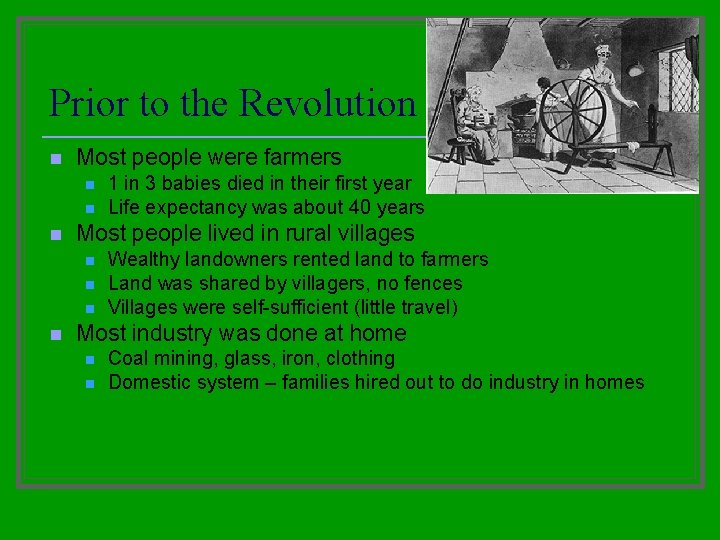
Prior to the Revolution n Most people were farmers n n n Most people lived in rural villages n n 1 in 3 babies died in their first year Life expectancy was about 40 years Wealthy landowners rented land to farmers Land was shared by villagers, no fences Villages were self-sufficient (little travel) Most industry was done at home n n Coal mining, glass, iron, clothing Domestic system – families hired out to do industry in homes
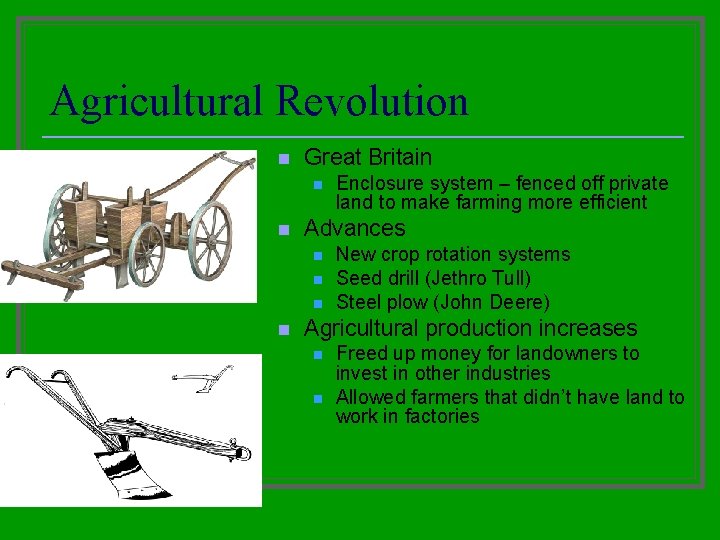
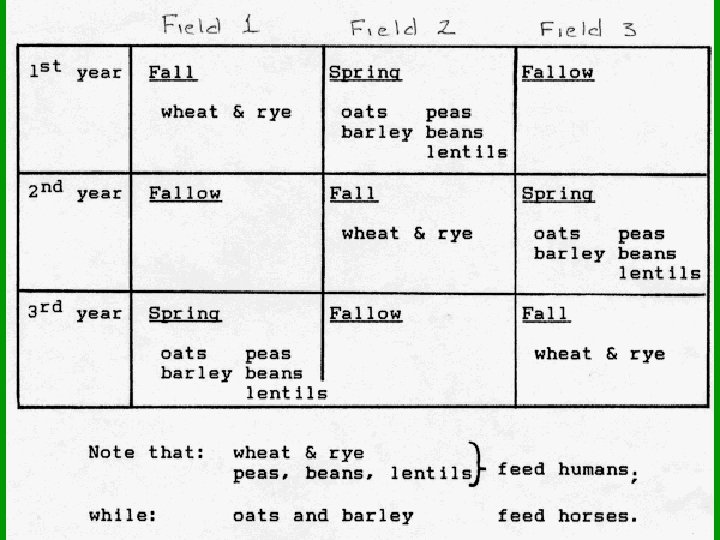
Agricultural Revolution n Great Britain n n Advances n n Enclosure system – fenced off private land to make farming more efficient New crop rotation systems Seed drill (Jethro Tull) Steel plow (John Deere) Agricultural production increases n n Freed up money for landowners to invest in other industries Allowed farmers that didn’t have land to work in factories
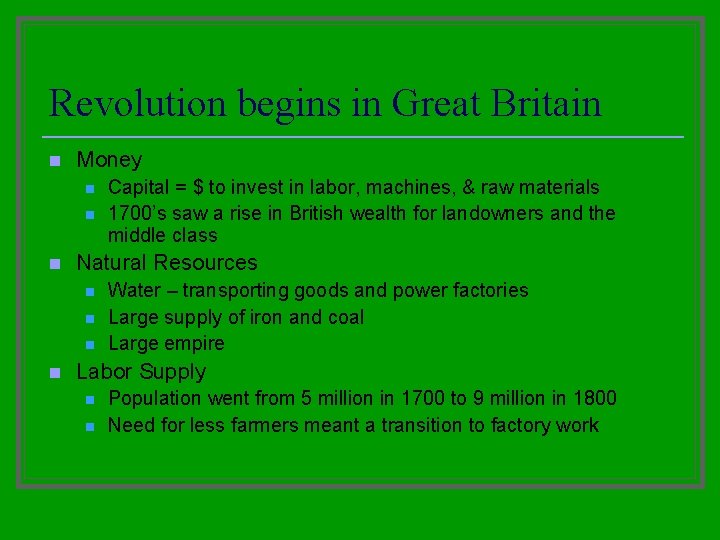
Revolution begins in Great Britain n Money n n n Natural Resources n n Capital = $ to invest in labor, machines, & raw materials 1700’s saw a rise in British wealth for landowners and the middle class Water – transporting goods and power factories Large supply of iron and coal Large empire Labor Supply n n Population went from 5 million in 1700 to 9 million in 1800 Need for less farmers meant a transition to factory work
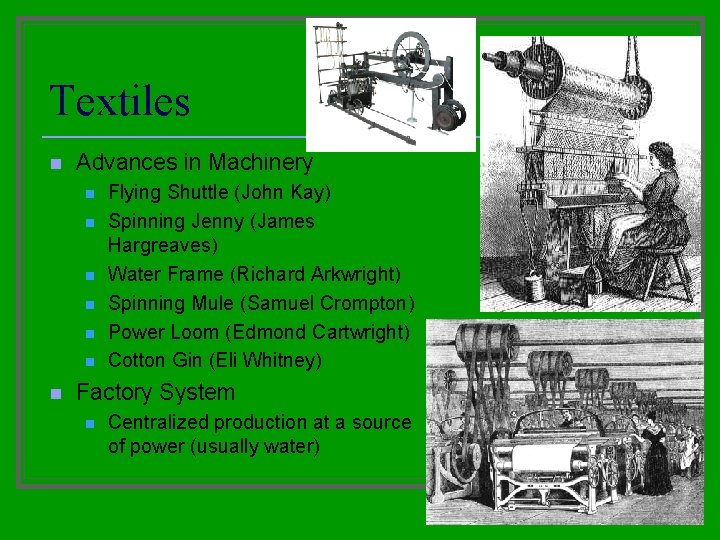
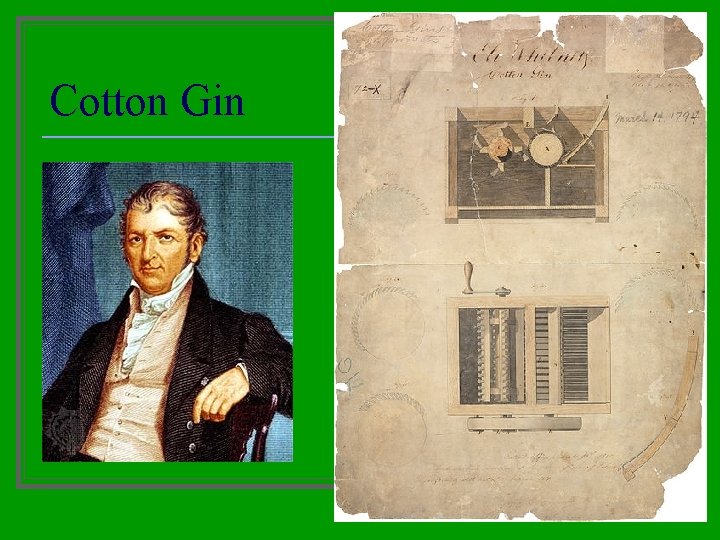
Textiles n Advances in Machinery n n n n Flying Shuttle (John Kay) Spinning Jenny (James Hargreaves) Water Frame (Richard Arkwright) Spinning Mule (Samuel Crompton) Power Loom (Edmond Cartwright) Cotton Gin (Eli Whitney) Factory System n Centralized production at a source of power (usually water)
Cotton Gin
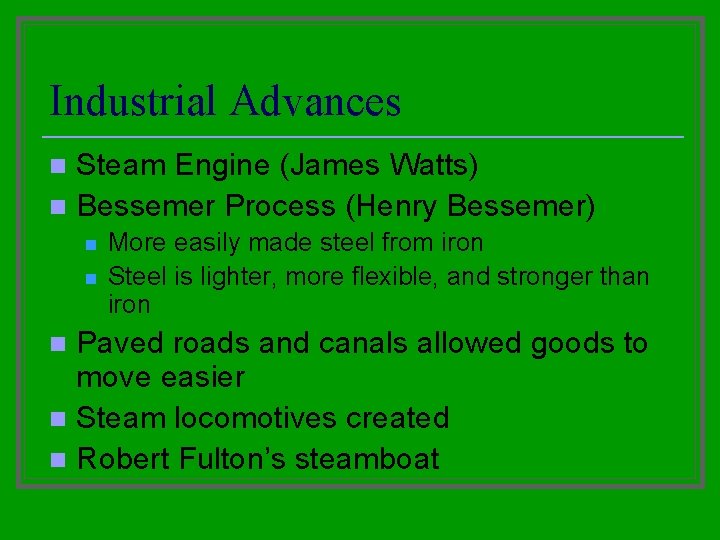
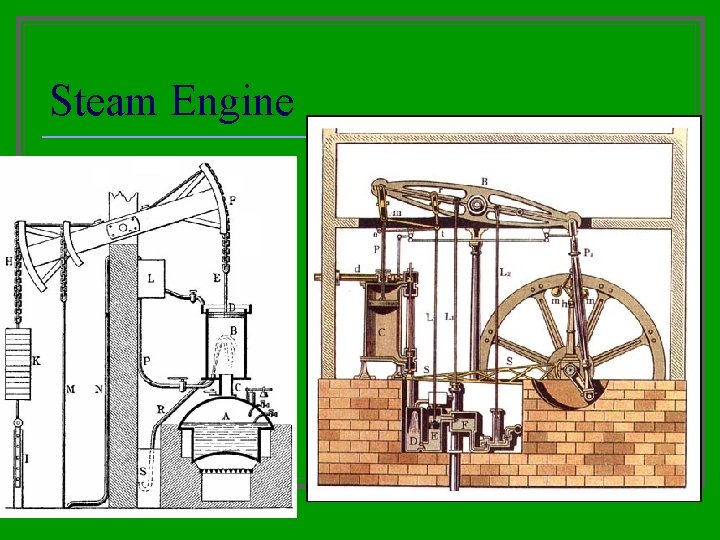
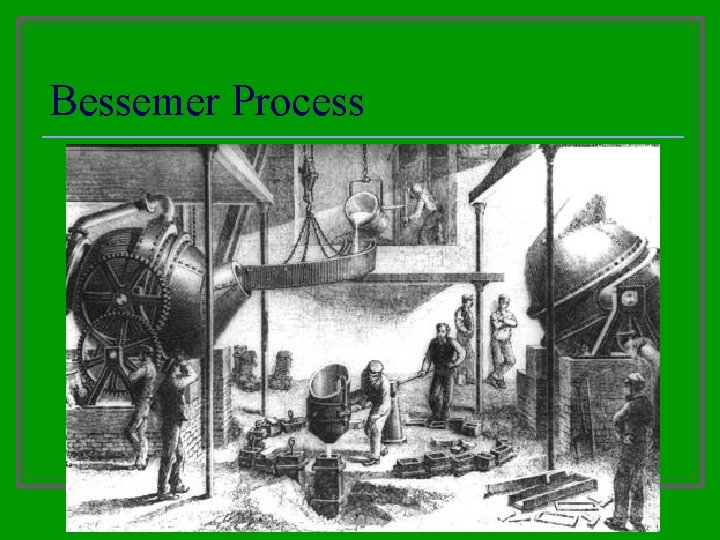
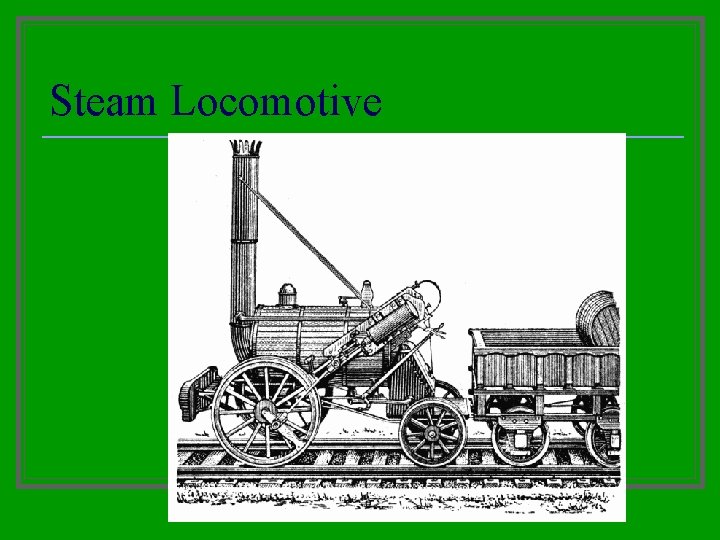
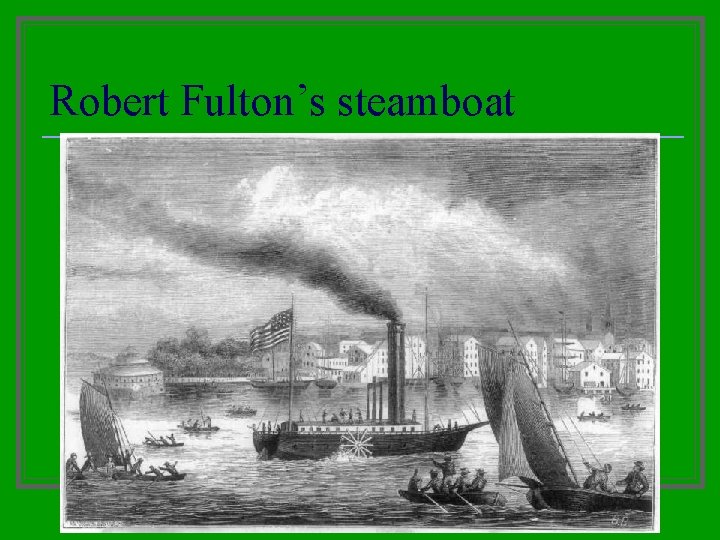
Industrial Advances Steam Engine (James Watts) n Bessemer Process (Henry Bessemer) n n n More easily made steel from iron Steel is lighter, more flexible, and stronger than iron Paved roads and canals allowed goods to move easier n Steam locomotives created n Robert Fulton’s steamboat n
Steam Engine
Bessemer Process
Steam Locomotive
Robert Fulton’s steamboat
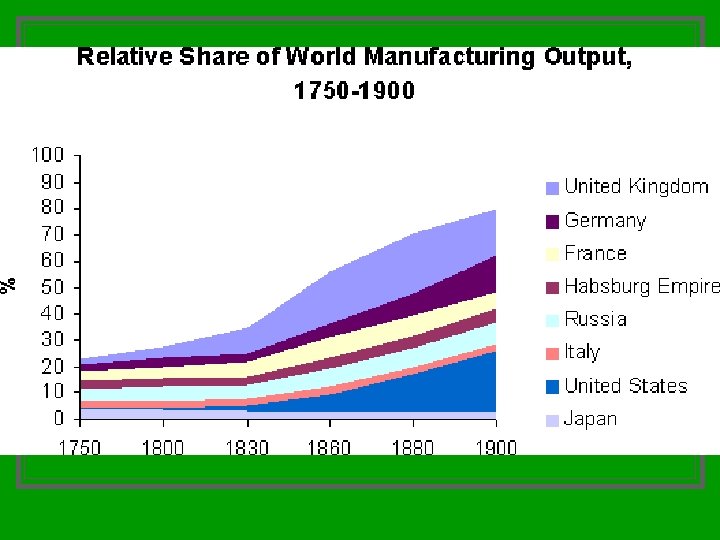
Spread of Industry n Great Britain n n Germany n n Quickly industrializes and helped by the unification in 1871 United States n n n Led the world, made it illegal to transport machinery outside the country Samuel Slater sneaks textile technology to the U. S. By 1870, Northeaster U. S. was as industrial as Great Britain France n Slow to industrialize at first (Napoleon helped and hurt), but developed more during the late 1800’s
Growth of Big Business n Capitalism n n Mass Production n n Interchangeable parts, division of labor, assembly line Organizing business n n Free enterprise system = individuals own production, not the government Entrepreneur – someone who starts a business Partnership – two or more entrepreneurs Corporation – business owned by stockholders who vote on major decisions Business Cycle n Boom and bust periods of the economy
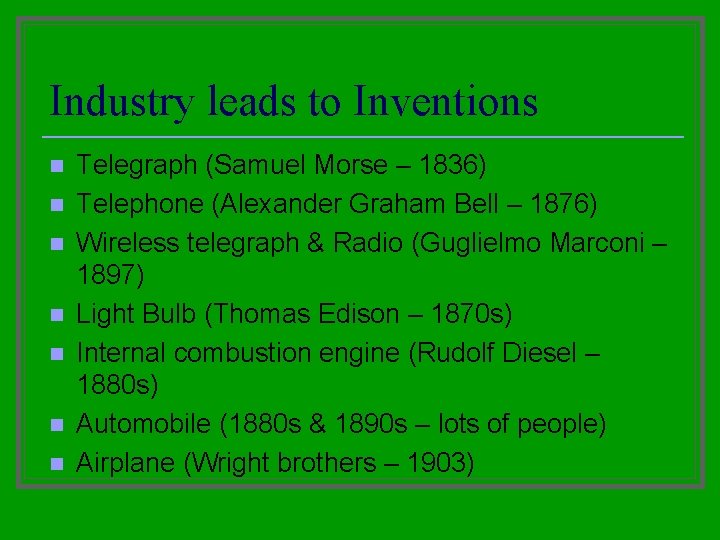
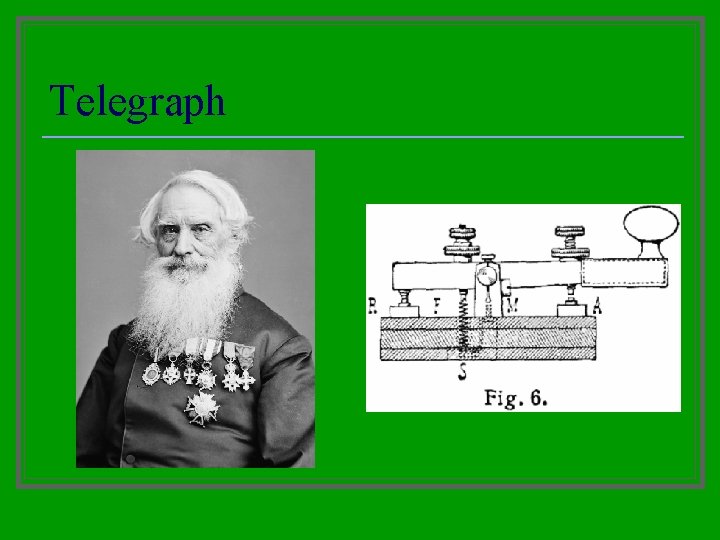
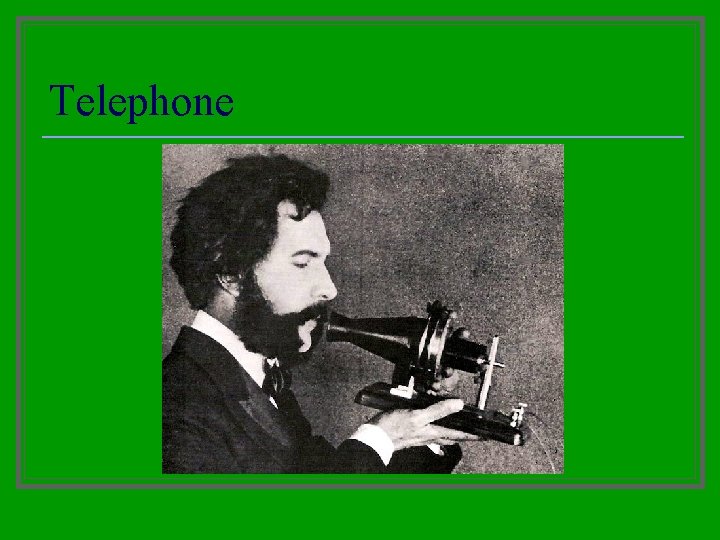
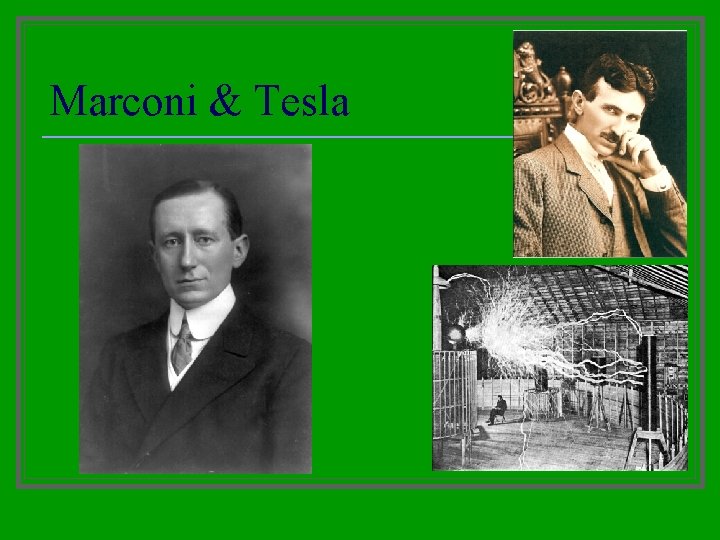
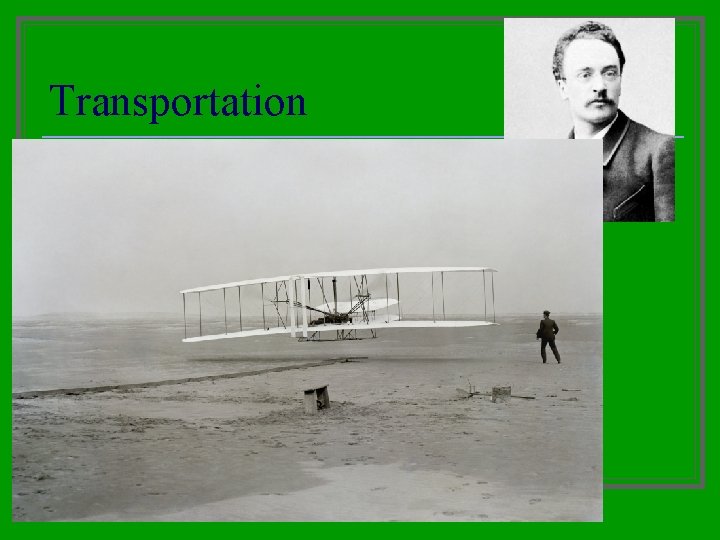
Industry leads to Inventions n n n n Telegraph (Samuel Morse – 1836) Telephone (Alexander Graham Bell – 1876) Wireless telegraph & Radio (Guglielmo Marconi – 1897) Light Bulb (Thomas Edison – 1870 s) Internal combustion engine (Rudolf Diesel – 1880 s) Automobile (1880 s & 1890 s – lots of people) Airplane (Wright brothers – 1903)
Telegraph
Telephone
Marconi & Tesla
Transportation
Effects of the Industrial Revolution Chapter 25
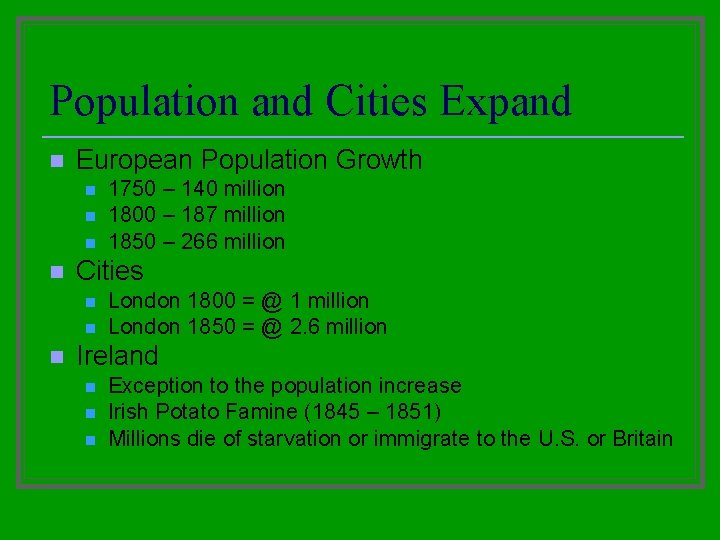
Population and Cities Expand n European Population Growth n n Cities n n n 1750 – 140 million 1800 – 187 million 1850 – 266 million London 1800 = @ 1 million London 1850 = @ 2. 6 million Ireland n n n Exception to the population increase Irish Potato Famine (1845 – 1851) Millions die of starvation or immigrate to the U. S. or Britain
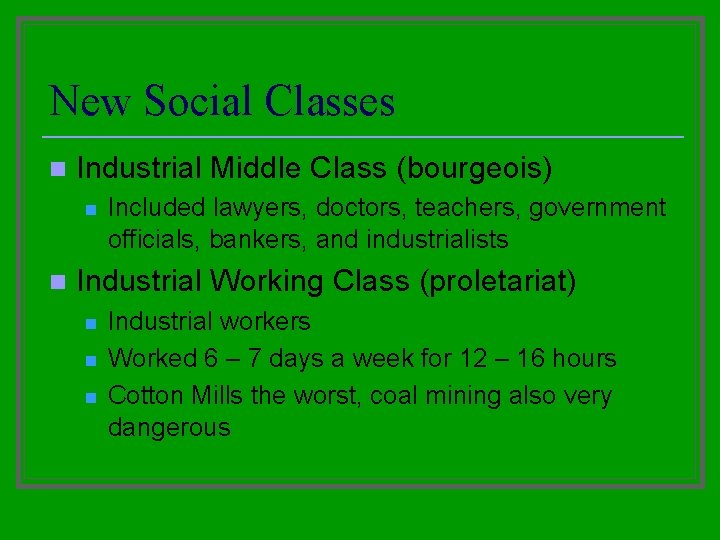
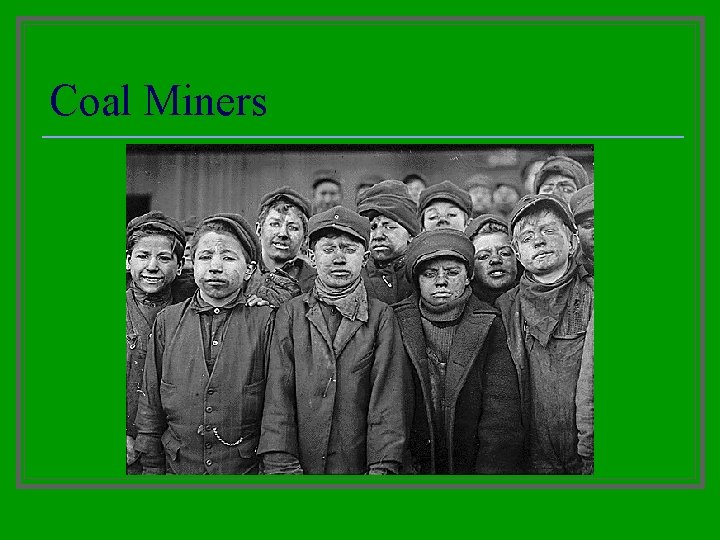
New Social Classes n Industrial Middle Class (bourgeois) n n Included lawyers, doctors, teachers, government officials, bankers, and industrialists Industrial Working Class (proletariat) n n n Industrial workers Worked 6 – 7 days a week for 12 – 16 hours Cotton Mills the worst, coal mining also very dangerous
Women and Children n n Long hours for less pay than men Factory Act of 1833 (not enforced) n n Minimum age at 9 8 hours a day max for 9 to 13 12 hours a day max for 13 to 18 Women n Took place of children (50% of textile mill workers) Laws slowly begin to limit women’s hours Women forced into working the home
Coal Miners
2 nd Industrial Revolution Starting in the 1870 s n Steel, electricity, internal combustion engines n Wages went up, production went up, prices went down n Germany, England, France, Belgium, Northern Italy industrial, while the rest of Europe is largely agricultural n
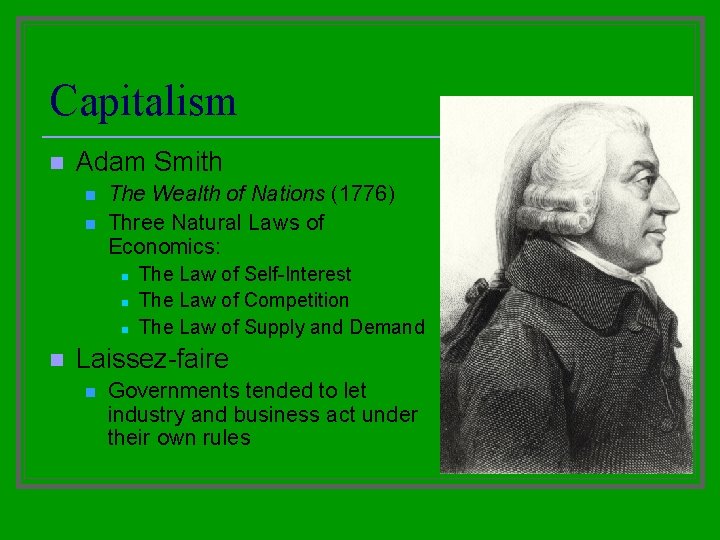
Capitalism n Adam Smith n n The Wealth of Nations (1776) Three Natural Laws of Economics: n n The Law of Self-Interest The Law of Competition The Law of Supply and Demand Laissez-faire n Governments tended to let industry and business act under their own rules
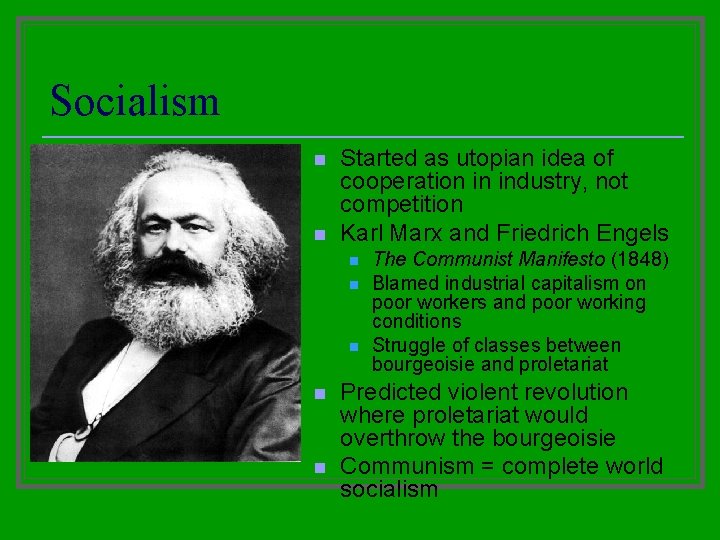
Socialism n n Started as utopian idea of cooperation in industry, not competition Karl Marx and Friedrich Engels n n n The Communist Manifesto (1848) Blamed industrial capitalism on poor workers and poor working conditions Struggle of classes between bourgeoisie and proletariat Predicted violent revolution where proletariat would overthrow the bourgeoisie Communism = complete world socialism
Socialism (cont. ) n n Marx believed in a classless society German Social Democratic Party n n n Political party trying for workers rights Took majority of power in Germany in 1912 Divisions in Socialism n n International socialists (one world country) vs. Nationalism socialists (each country on their own) Revisionists – rejected revolutionary ideas, use democratic means for change
Labor Unions n n 1870 workers gained right to strike in Great Britain Trade unions developed to organize workers n n n Collective bargaining = work together to get benefits for everyone Grew quickly in size and political power in some countries Spread to Germany and other industrial countries (i. e. the United States)