
The Industrial Revolution and the Birth of Modern
The Industrial Revolution and the Birth of Modern Europe “Man no longer treated men as men, but as a commodity which could be bought and sold on the open market. ”
The Industrial Revolution ® Long, slow process of production shifting from hand tools with human and animal labour to steam and electrical machine power ® Political disruptions in France the main reason that Britain lead in the industrial revolution
Agriculture Revolution ® One key to the industrial revolution was the increased production and variety of crops produced
® New crops from Americas – potatoes and corn ® Charles Townsend – discovers crop rotation rather than leaving fields fallow Use of clover and turnips in rotation with wheat and barley ® Clover and turnips used to feed animals for meat = more animals ® Meat $ down = more protein in diets ®

1 2 3 4

® Jethro Tull develops the seed drill rather than random scattering ® Reduced amount of seed used ® Easier to weed ® Iron plow replaced wooden ones ® Mechanical reapers and threshers replace wooden ones
® Land ownership changes Farmers used to work small strips of land in scattered fields and graze their animals on “common land” ® Enclosure movement – wealthy land owners begin claiming sole rights to use of the common lands from 1500 s on ® Land use more efficient but forced many smaller farmers out ® Some become tenant workers ® Most move to towns and cities looking for work ®
Results ® 1. Better diet = increased population = more demand for manufactured goods ® 2. More efficient farming = fewer farm labourers = increased unemployment = urbanization and large available workforce

® Individual gifts should be recognized in the delineation of responsibilities; each person should concentrate on a specific area of work ® Romans 12: 6 -8
Textile Industry ® 1500 s and 1600 s – “domestic industry” developed ® Entrepreneurs supply rural residents with raw wool and cotton ® In their cottages families clean and spin the wool ® Use hand looms to make cloth ® Not able to keep up with increased demand = innovation and invention begins
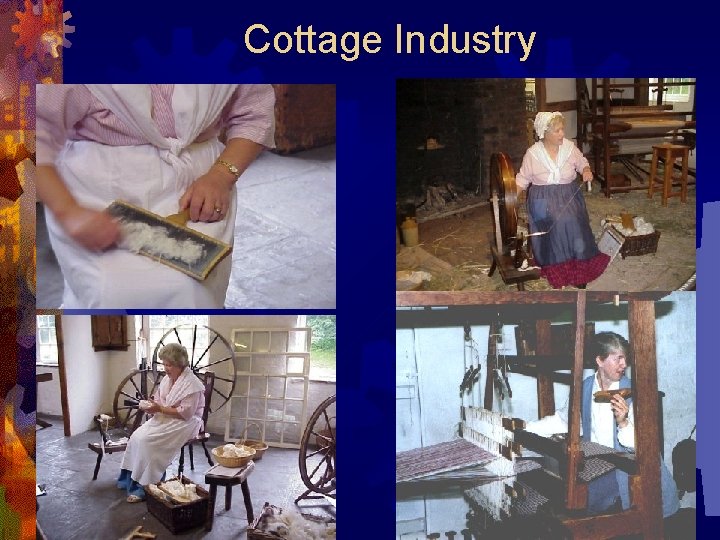
Cottage Industry
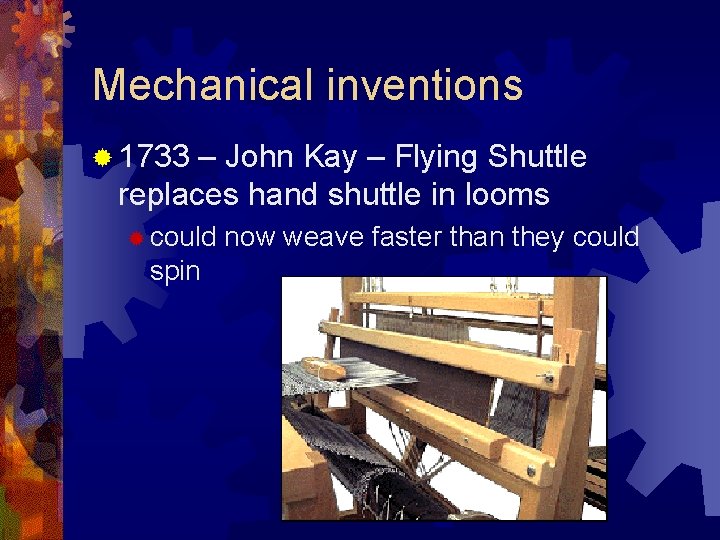
Mechanical inventions ® 1733 – John Kay – Flying Shuttle replaces hand shuttle in looms ® could spin now weave faster than they could
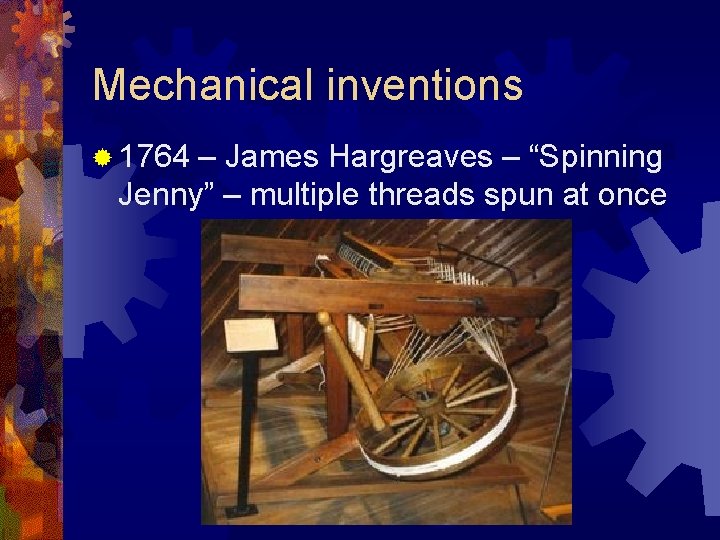
Mechanical inventions ® 1764 – James Hargreaves – “Spinning Jenny” – multiple threads spun at once
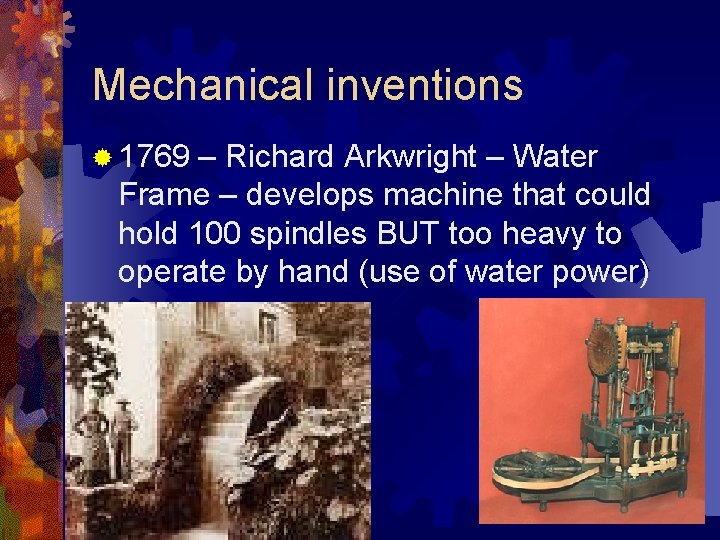
Mechanical inventions ® 1769 – Richard Arkwright – Water Frame – develops machine that could hold 100 spindles BUT too heavy to operate by hand (use of water power)
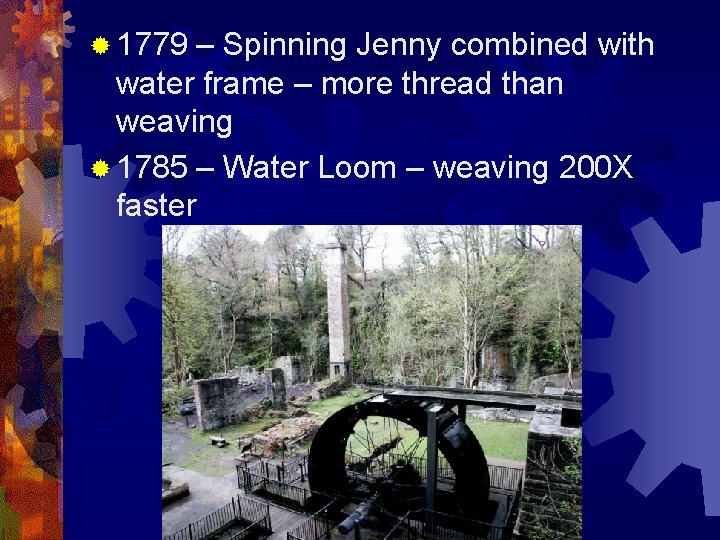
® 1779 – Spinning Jenny combined with water frame – more thread than weaving ® 1785 – Water Loom – weaving 200 X faster
® 1779 – Spinning Jenny combined with water frame – more thread than weaving ® 1785 – Water Loom – weaving 200 X faster ® 1791 – Eli Whitney – Cotton Gin Mechanically tore seeds from cotton plant ® Made cotton cheaper to produce ® ® 1830 s – Britain importing 280 million pounds (127 million Kg) and the largest textile manufacturer in the world
Factory System ® Machines expensive and had to be beside moving water (water wheels) ® Mills often hired hundreds of workers to run new machines ® Factory system gradually replaces domestic system ® Brought workers and machines to one place to manufacture goods (more efficient) ® First time everyone had set number of hours of work and a set daily or weekly wage
Steam Engine ® Idea had been around since 1698 but unreliable and downright dangerous ® 1760 s – James Watt – develops improved version of Newcomen Engine (4 X more power from same amount of coal ® *Portable – no need for rivers* and used in textile industry but demand for coal increases
Iron and Coal Industries ® Steam engines need a lot of coal and iron – Britain had lots ® Shift from charcoal (partially burned hardwoods) to coke (coal with gasses burned off) to make iron ® 1780 s – a puddling process improved iron quality (less cracking under pressure) ® method of rolling molten iron into sheets developed ® 1788 -1806 – Iron production 4 X in Britain because of increased demand for coal and iron for steam engines
Why Britain Led ® Agricultural Revolution = more food = more free workers ® Plentiful coal and iron resources ® Developed excellent transportation system
® Leading commercial power in Europe ® Centre of world trade after defeating the Spanish Armada in 1588 (esp. sugar, tea and slaves) ® Had ® Large the $ to develop new industries colonial empire to supply raw materials (NZ – sheep) and buy finished goods in return
® British government encouraged trade by lifting restrictions, building roads and canals, and having a strong navy to protect merchant ships and colonial interests ® Stable intellectual and social climate promoted industrialization through a class society that was open to social ascendance by financial gain

Rise of Modern Industry (Stage II)
® Industry spread quickly in the second half of the 19 th century to Belgium, France, Japan (after the Meji Restoration) and Germany (after 1870) ® Also spread to USA who would surpass Britain by 1880 ® Southern and Eastern Europe still largely agricultural and did little to encourage industrial development
Advances in science and technology ® Artificial dyes developed - cheaper than natural ones, chemical fertilizers – rapidly increased food production ® Alessandro Volta (1800) created one of the first electric batteries ® Electric generators developed and would eventually replace steam
® 1866 – 1 st Transatlantic Telegraph cable laid ® 1876 – Alexander Graham Bell – invents the telephone ® 1900 – Marconi – develops the radio ® Edison – Light bulb, phonograph, electric generator, etc. . .
Advances in Transportation ® Internal combustion engine ® Could be started and stopped more easily than steam ® 1886 – Daimler (German) develops first small gasoline engine for vehicles ® Rudolf Diesel (German) develops large internal combustion engine for trucks, ships and locomotives ® Resulted in a boom for petroleum, steel, and rubber industries

® Airplanes ®@ Kittyhawk with the Wright Brothers ® Germans believed now to have been first in the air
New Methods of Production ® Eli Whitney – came up with interchangeable parts ® Had a gun factory – all hand made ® Made parts easily interchangeable and repair speed up
® Henry Ford – assembly line (1914) ® Work broken into small tasks ® Cost went down as a result = more people could buy cars = boom in related industries
Financing Industrial Growth ® Corporation – business owned by many investors who have bought shares in the company ® Became the dominant form of ownership due to cost to set up a business ® Investors had limited liability – could only lose what they put in
® Many corporations bought up smaller companies and attempted to create monopolies (CWB) or related industries (Standard Oil) – vertical integration ® Banks esp. prominent in financing corporations ® Nations become interdependent because of trade of manufactured goods and resources, as well as investing in each other’s economies (Canada and USA)

Effects of Industrialization
® Shift from rural and self-employed to urban wage earners ® Population explosion 1750 – 140 million to 1914 – 463 million (over 3 X) ® Ag. Rev. improved diets and health – people live longer, medical discoveries and sanitation reduce deaths from disease ® No major wars fought by Europeans between 1815 and 1914 ® Industry provided goods and jobs for the growing population ®
Problems of Growing Cities ® Cities often sprang up almost overnight and were wherever the factories and resources were located (no longer on rivers or major trade routes)
Case Study: Manchester ® 1750: 16 000 – 1855: 455 000 people ® Became centre of British cotton industry when coal and iron discovered nearby ® Rapid growth mean thousands of factory workers into poorly built houses with 6 -10 people living in a single 8 X 8 room
® Little water or sanitation – sewage thrown in streets with pigs as garbage collectors ® Slums became breeding grounds for disease ® Not even a chartered city so could not raise taxes or pass laws to improve life ® No longer able to rely on neighbors like in rural areas – destroyed sense of community
Working in a Factory ® Conditions often as bad or worse than the conditions outside them ® Wealth of unskilled labour = wages very low ® Often whole families had to work to survive ® Women and children in high demand because they could be paid less than men ® Robertson’s Wagon Works Simulation and Modern Times (SS#5 -4)
® 12 -16 hour workdays, 6 days a week, no vacations, sick leave, or paid holidays ® Conditions promoted illness or injury ® Fumes from machines, poor ventilation, poor lighting, loud machines, and no safety equipment ® If injured on the job there was no compensation, if it prevented you from doing the job they fired you ® Worst of all – work was mindless and monotonous
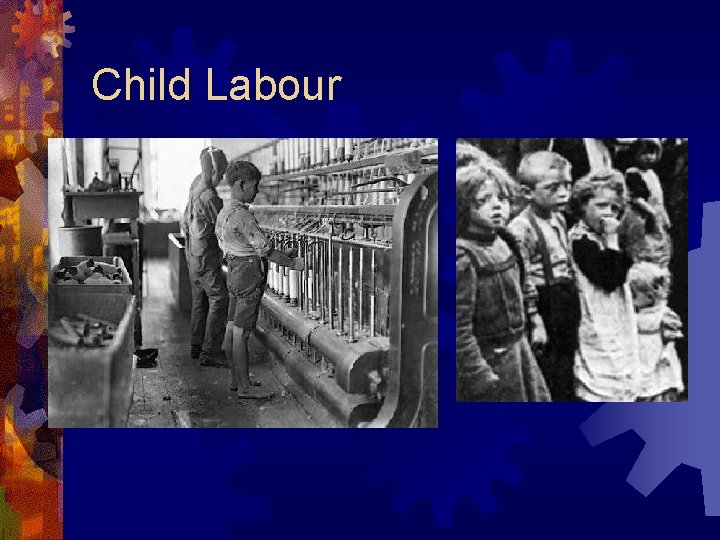
Child Labour
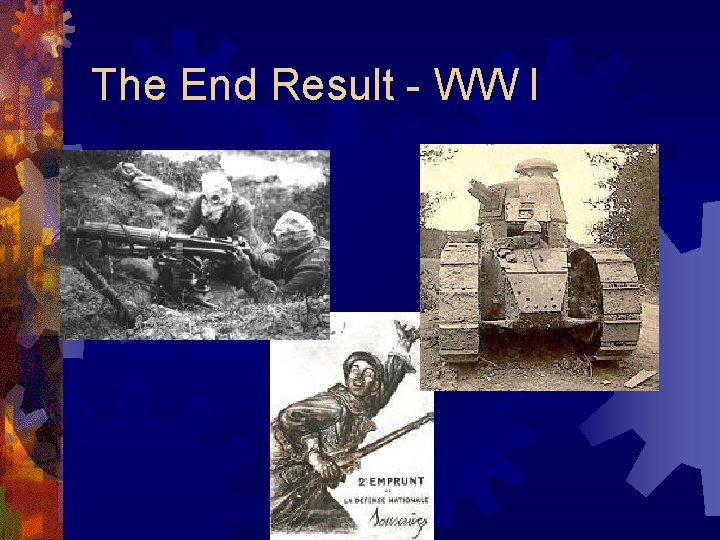
The End Result - WW I
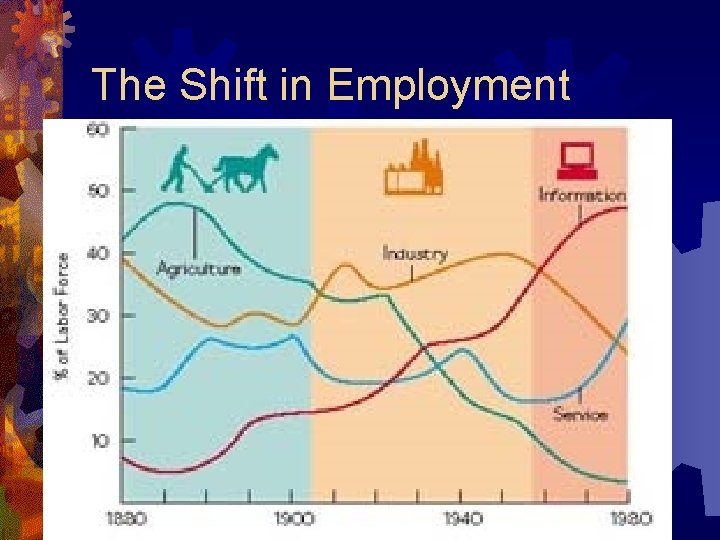
The Shift in Employment
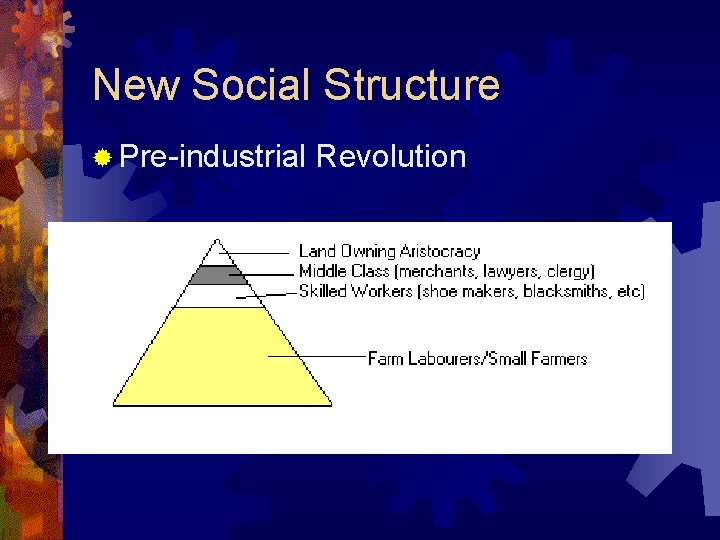
New Social Structure ® Pre-industrial Revolution
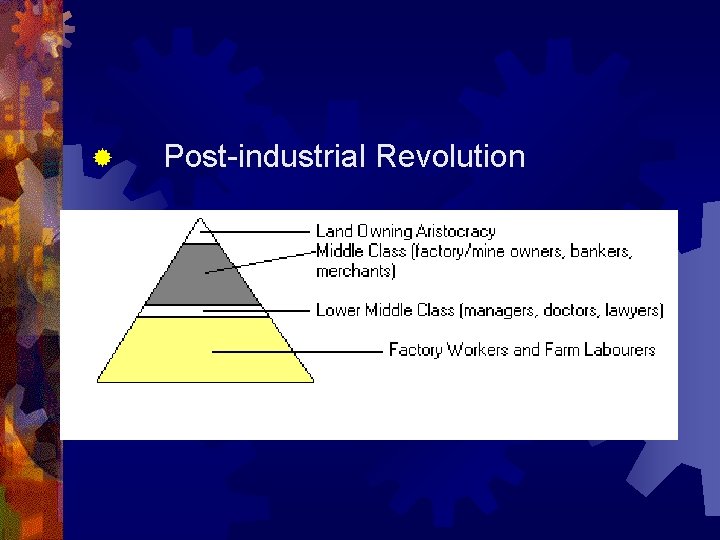
® Post-industrial Revolution
® Upper-middle class attempted to adopt aristocratic customs and attitudes Country estates, horse racing, sailing, etc ® Most Middle Class tried to live quiet respectable lives ® ® Industrial workers largely unskilled and very aware that they were part of the lowest class without political or economic power ® Started to band together
Changing Roles for Women ® Women used to help farm the land as servants or earn money through the domestic system ® Went to work in the industrial revolution to support their family ® Often worked with their children in the mines ® Put in a 12 -16 hour workday and then still had to cook, clean, sew, and raise the children
® Better wages meant women could stay at home and their husband became the sole wage earners late in the Industrial Revolution ® As the Middle Class grew so did demand for domestic servants Often done by single women ® 1/3 of women working outside the home in late 1800 s were domestic servants ® ® Few Middle Class women worked outside the home and were encouraged to raise the children instead

Responses to the Industrial Revolution: Britain and the USA
Britain ® Many in the Middle Class had little sympathy for the workers and were only concerned with their investments and survival of their businesses ® Demands for change in Britain
® Protests against conditions – sometimes even violently ® 1811 -1816 workers sabotaged their machines (wooden shoes called sabo) ® 1819 demonstration in Manchester of 80 000 workers ® 11 killed, 400 wounded by troops
® 1831 Parliament began a series of investigations into factory and mine conditions ® Liberals wanted government to stay out but conservatives sometimes attacked the conditions of workers ® Everyone shocked by the conditions found – writers documented conditions (Oliver Twist, David Copperfield)
Reforms ® 1833 – Factory Act – limited work days for children ® 1842 – Mines Act – barred women and boys under 13 from working in mines ® Ten Hours Act – women and boys under 18 can not work longer than 10 hours ® Extended to all workers in 1874
The Rise of Labour Unions ® Workers began to form associations that would eventually turn into labour unions ® Governments feared labour unions because: ® Shorter hours and increased wages = higher prices for goods and less profit
® Combination Acts (1799/1800) outlawed labour unions ® Repealed in 1820 s but still could not strike or picket ® Trade unions allowed – based on craft (skilled labour) and able to bargain with employers because more valuable skill set ® Struggled for the right to vote, 10 -hour work day, and right to strike
® 1868 – 100 000 in trade unions in Britain alone ® 1870 s – Trade unions won the right to strike and picket peacefully ® Workers emboldened by success of trade unions and began to organize by industry in 1880 s ® 1889 – London Dock Workers Union went on strike and shut down the world’s busiest port ® Unions grew rapidly in W. Europe and USA ® Madagascar 2 – 1: 08: 51
Gains for Workers ® 1870 -1914 wages rose rapidly (2 X in 1880 s) and goods were cheaper than ever before (easier to buy) ® employers gradually come to believe that happy and healthy workers meant better productivity Better light and ventilation, safety devices ® Those who did not change had laws passed to force them to improve (Britain, France, Germany especially) ®
® Insurance funds established for workers who were sick or injured on the job, old age pensions, unemployment insurance for those who lost their jobs because of business failure or economic slowdown ® 1914 – workers better off than 100 years earlier ® Public Schools setup
Improving City Life ® Implementation of building codes, better access to water, sewage systems installed ® Parks est. , police force, gas/electric lighting, electric street cars and subway systems
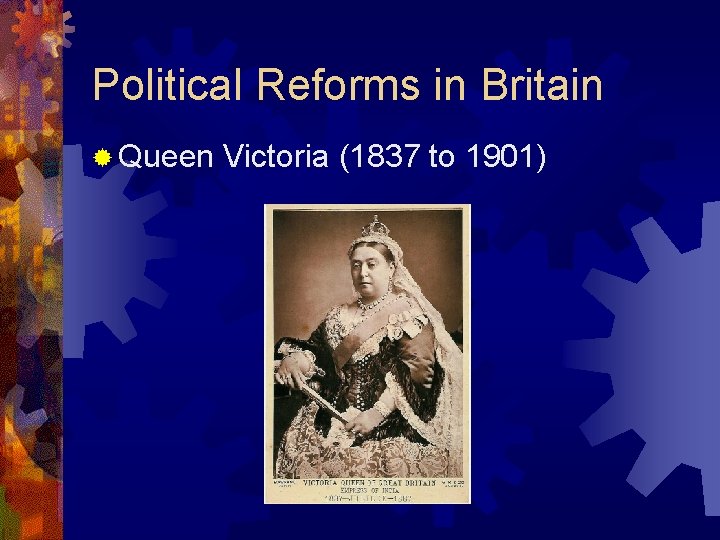
Political Reforms in Britain ® Queen Victoria (1837 to 1901)
® Limited constitutional monarchy with parliament supreme ® most men could not vote (6%) and social & economic conditions drove reform movement ® “rotten boroughs” ® middle class and workers demand reform ® Reform Bill of 1832 ® Chartist Movement ® Corn Laws
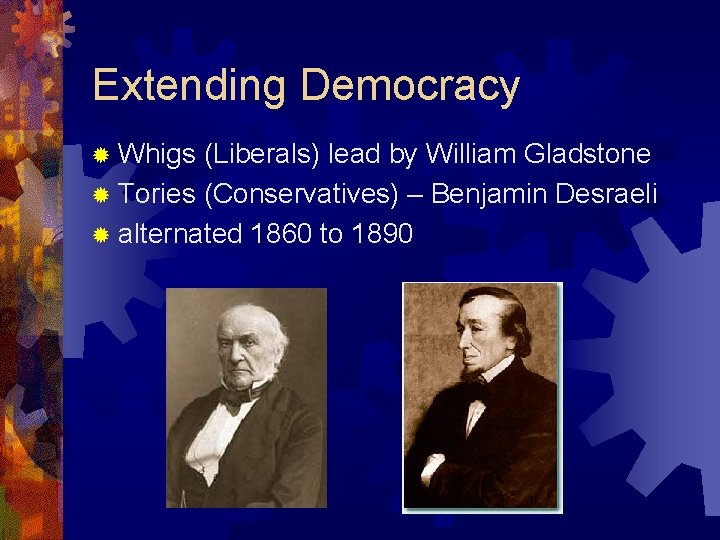
Extending Democracy ® Whigs (Liberals) lead by William Gladstone ® Tories (Conservatives) – Benjamin Desraeli ® alternated 1860 to 1890
® Reform Bill 1867 by Desraeli (same as Gladstone in 1866) ® 1872 – secret ballot ® 1884/5 – rural men allowed to vote ® 1900 – Labour Party formed ® 1911 – House of Lords loses veto
Other Reforms ® lifted restrictions and Catholics and Protestants outside Church of England ® 1807 – slave trade outlawed ® 1833 – slavery outlawed in whole of British Empire ® Factory Acts ® 1870 – Education Act
® 1909 - old age pension ® 1911 - Insurance Act ® 1912 - minimum wages
Reforms in the USA ® 1860 -1910 – 23 million immigrants seeking political and economic freedom ® Cities grew fast and unplanned ® Many of the same problems as Europe ® Opposed unions based on tradition of “rugged individualism” ® American Federation of Labour (a union of unions) formed in 1881 and had 2 million members by 1914
Reforms ® Progressives (1900 s) ® Believed in progress and attacked corruption ® Movement spearheaded by Theodore Roosevelt ® Anti-trust laws ® Regulation of businesses increased ® Encouraged better city conditions and education ® Allowed women to vote (1915 and 1920) and some African-Americans (discontented still)
- Slides: 66