
The Index of Refraction of Solid Hydrogen Lieutenant

- Slides: 16
The Index of Refraction of Solid Hydrogen Lieutenant Colonel Brian Tom*, USAF Siddhartha Bhasker* Yuki Miyamoto‡ Dr. Takamasa Momose‡ Dr. Benjamin Mc. Call*† *Department of Chemistry, University of Illinois at Urbana-Champaign †Department of Astronomy, University of Illinois at Urbana-Champaign ‡Department of Chemistry, The University of British Columbia
Overview • • • Solid hydrogen background Why measure the index of refraction? Experiment Results Conclusions
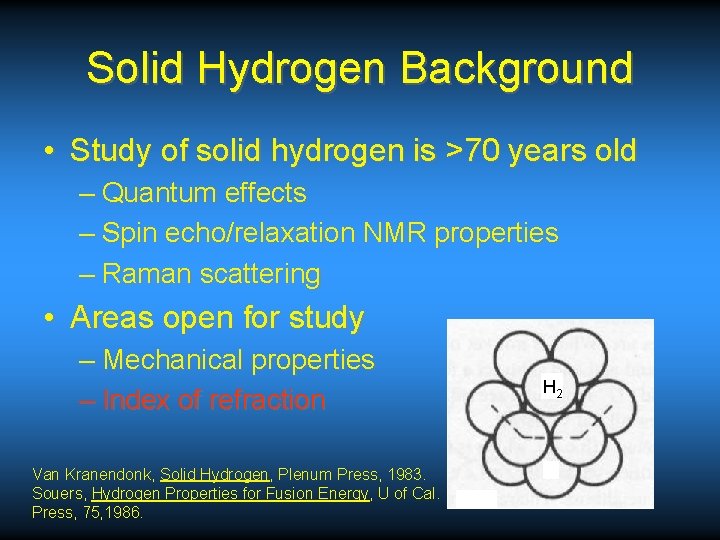
Solid Hydrogen Background • Study of solid hydrogen is >70 years old – Quantum effects – Spin echo/relaxation NMR properties – Raman scattering • Areas open for study – Mechanical properties – Index of refraction Van Kranendonk, Solid Hydrogen, Plenum Press, 1983. Souers, Hydrogen Properties for Fusion Energy, U of Cal. Press, 75, 1986. H 2
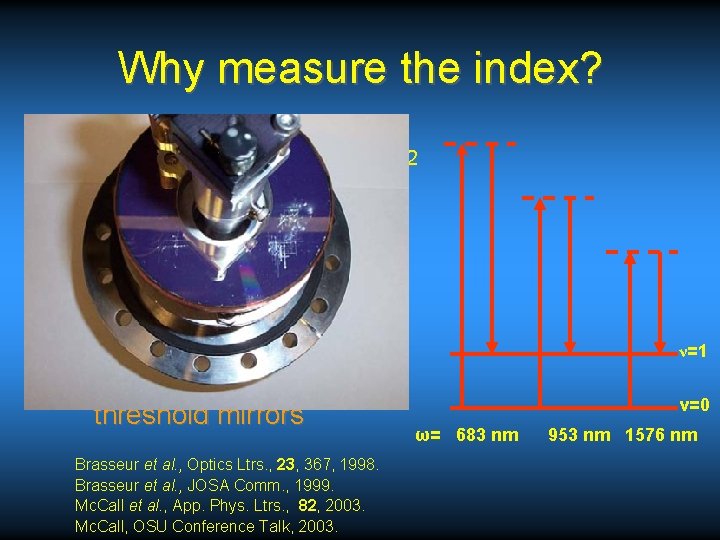
Why measure the index? • Stokes Raman shift in H 2 – Obtain wavelengths for spectroscopy • Can use multipass cell with H 2 gas ωPump=532 nm – Requires high reflectivity/high damage threshold mirrors Brasseur et al. , Optics Ltrs. , 23, 367, 1998. Brasseur et al. , JOSA Comm. , 1999. Mc. Call et al. , App. Phys. Ltrs. , 82, 2003. Mc. Call, OSU Conference Talk, 2003. ν=1 ν=0 ω= 683 nm 953 nm 1576 nm
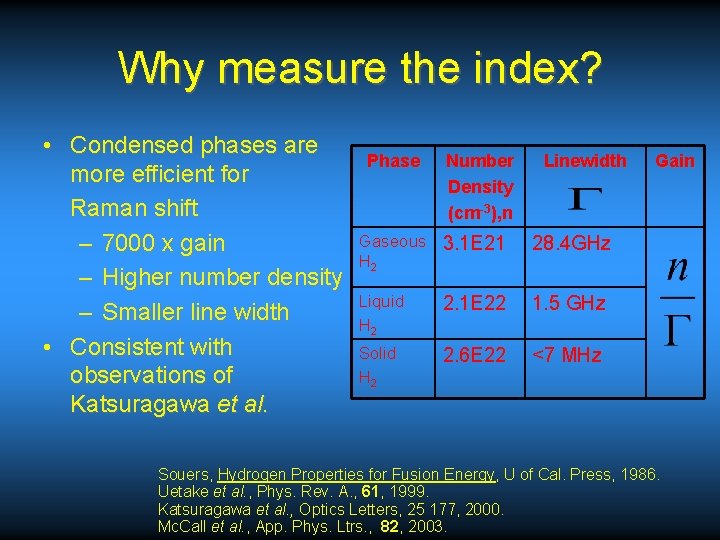
Why measure the index? • Condensed phases are more efficient for Raman shift – 7000 x gain – Higher number density – Smaller line width • Consistent with observations of Katsuragawa et al. Phase Number Density (cm-3), n Linewidth Gaseous 3. 1 E 21 H 2 28. 4 GHz Liquid H 2 2. 1 E 22 1. 5 GHz Solid H 2 2. 6 E 22 <7 MHz Gain Souers, Hydrogen Properties for Fusion Energy, U of Cal. Press, 1986. Uetake et al. , Phys. Rev. A. , 61, 1999. Katsuragawa et al. , Optics Letters, 25 177, 2000. Mc. Call et al. , App. Phys. Ltrs. , 82, 2003.
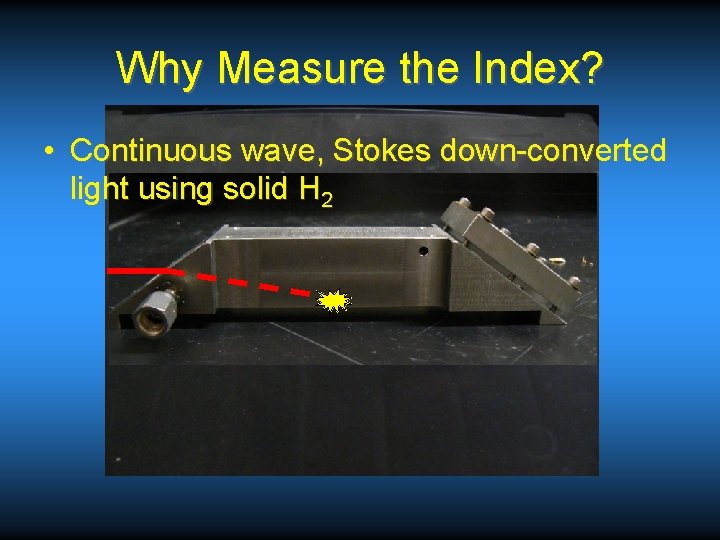
Why Measure the Index? • Continuous wave, Stokes down-converted light using solid H 2
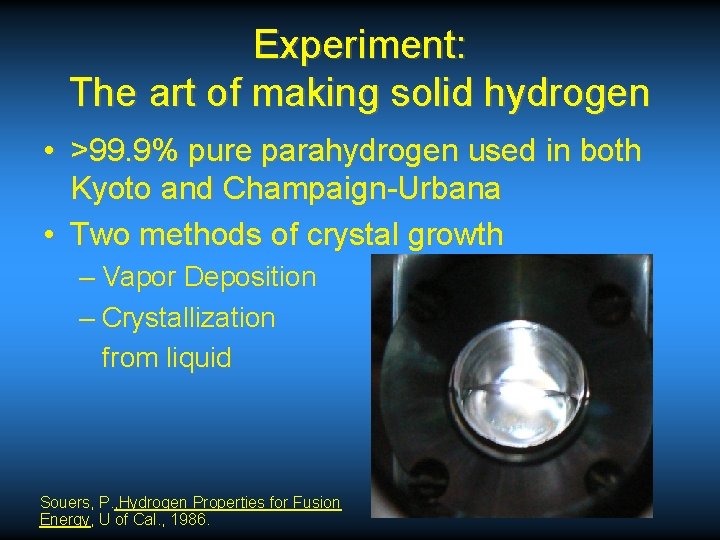
Experiment: The art of making solid hydrogen • >99. 9% pure parahydrogen used in both Kyoto and Champaign-Urbana • Two methods of crystal growth – Vapor Deposition – Crystallization from liquid Souers, P. , Hydrogen Properties for Fusion Energy, U of Cal. , 1986.
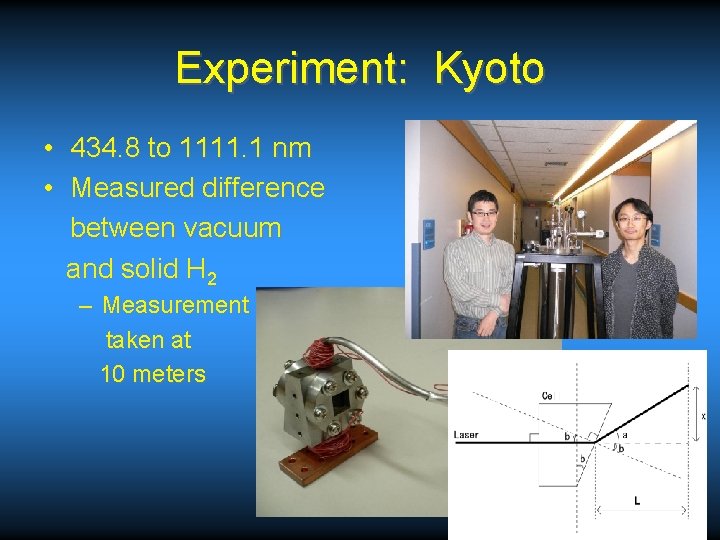
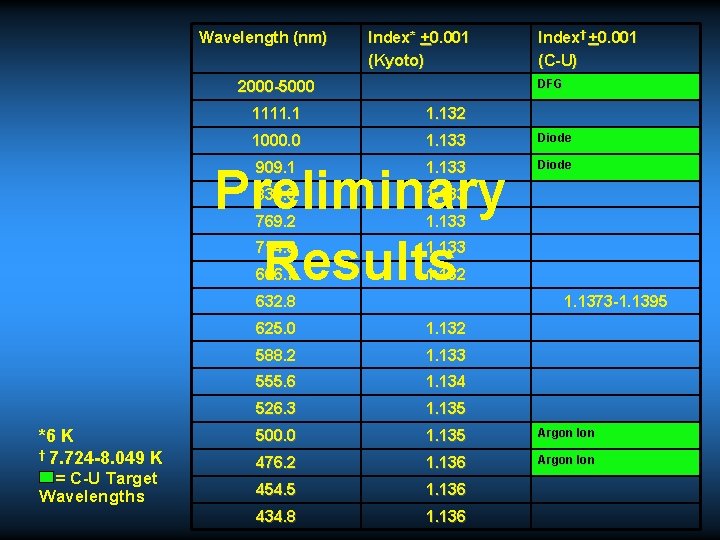
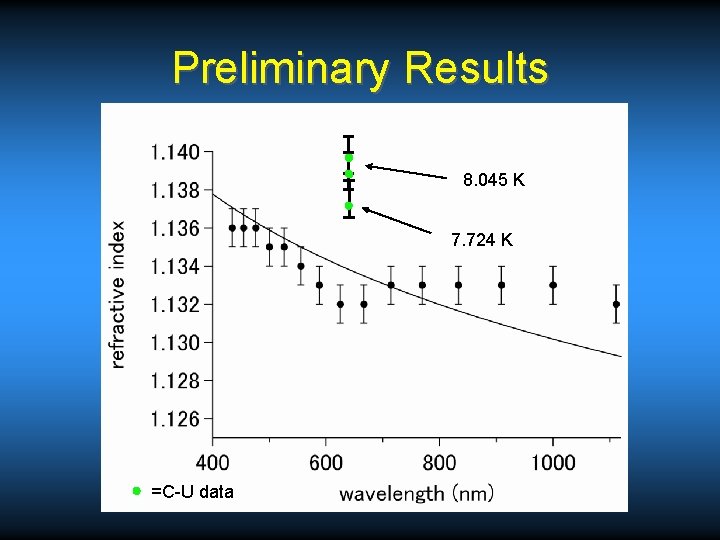
Experiment: Kyoto • 434. 8 to 1111. 1 nm • Measured difference between vacuum and solid H 2 – Measurement taken at 10 meters
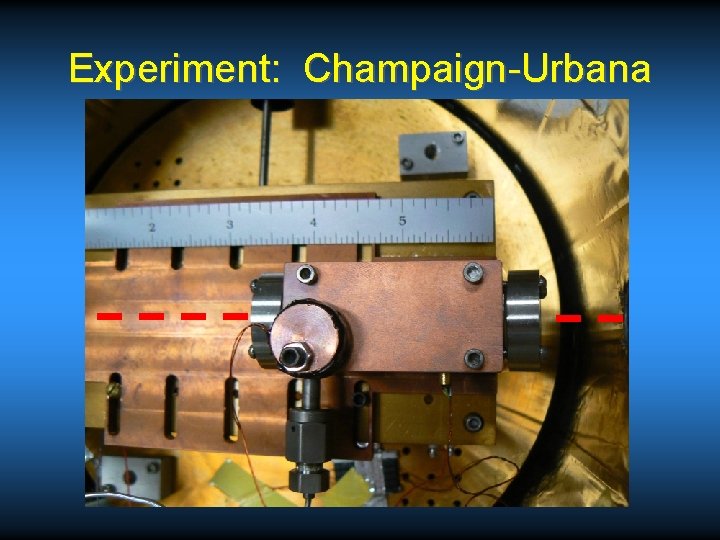
Experiment: Champaign-Urbana
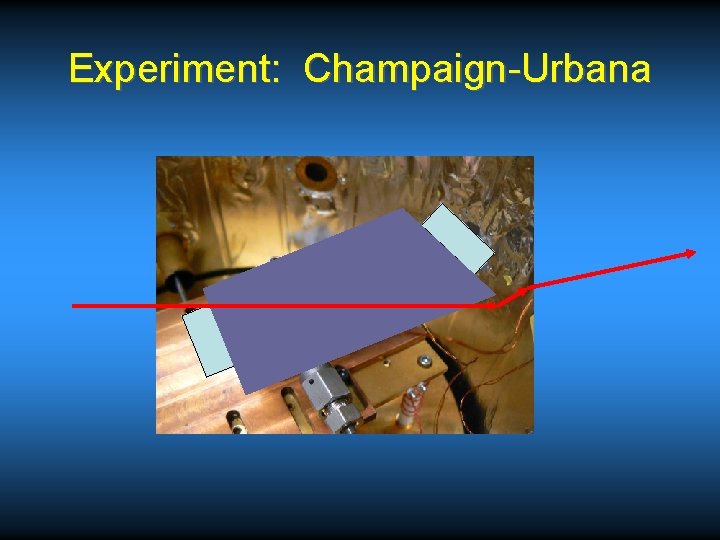
Experiment: Champaign-Urbana
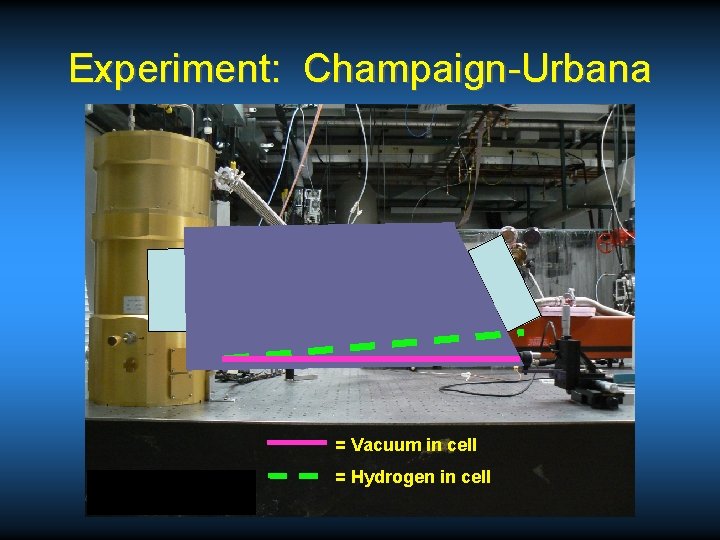
Experiment: Champaign-Urbana = Vacuum in cell = Hydrogen in cell
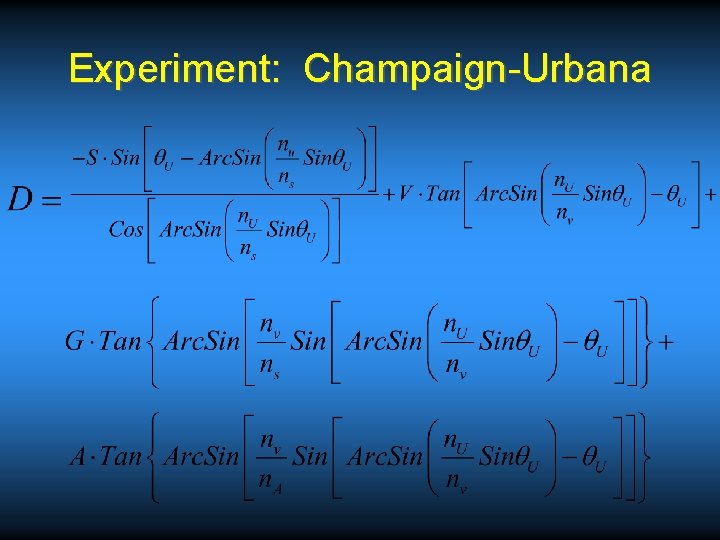
Experiment: Champaign-Urbana
Wavelength (nm) Index* +0. 001 (Kyoto) DFG 2000 -5000 1111. 132 1000. 0 1. 133 Diode 909. 1 1. 133 Diode 833. 3 1. 133 769. 2 1. 133 714. 3 1. 133 666. 7 1. 132 Preliminary Results 632. 8 *6 K † 7. 724 -8. 049 K = C-U Target Wavelengths Index† +0. 001 (C-U) 1. 1373 -1. 1395 625. 0 1. 132 588. 2 1. 133 555. 6 1. 134 526. 3 1. 135 500. 0 1. 135 Argon Ion 476. 2 1. 136 Argon Ion 454. 5 1. 136 434. 8 1. 136
Preliminary Results 8. 045 K 7. 724 K =C-U data
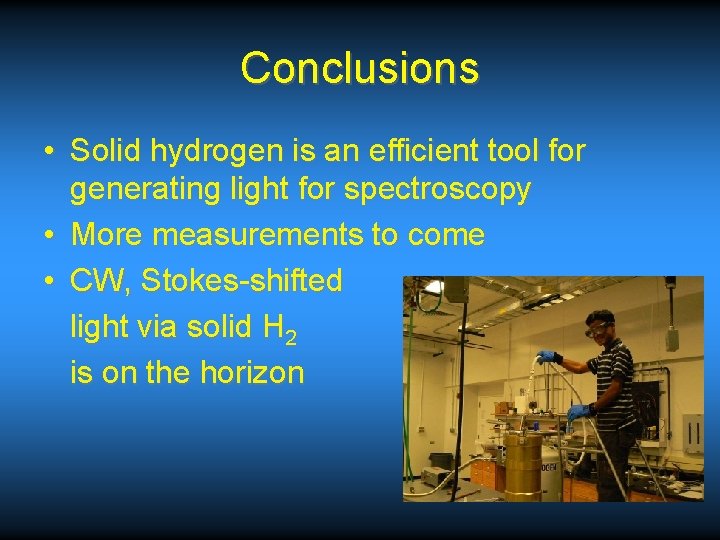
Conclusions • Solid hydrogen is an efficient tool for generating light for spectroscopy • More measurements to come • CW, Stokes-shifted light via solid H 2 is on the horizon
Acknowledgements • United States Air Force • National Science Foundation • The Packard Foundation • Prof. Takeshi Oka, University of Chicago