
The Increasing Responsibility Of The Urologist In Maintaining

The Increasing Responsibility Of The Urologist In Maintaining Bone Health In Prostate Cancer Patients Kurt Miller Charité, Berlin
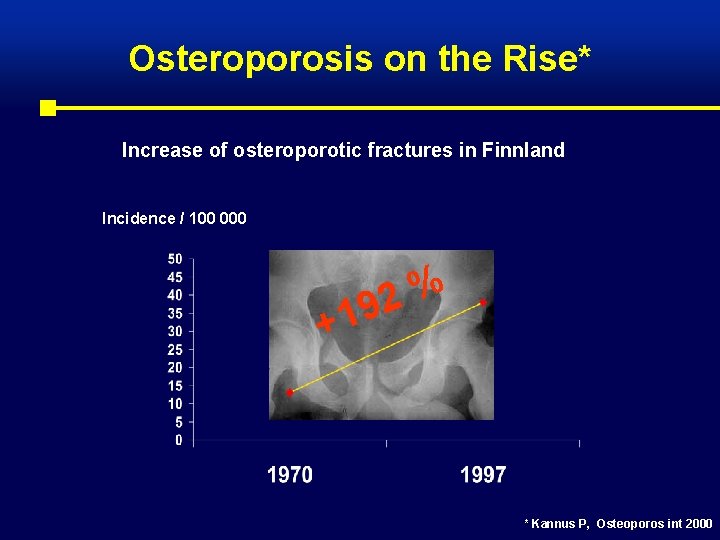
Osteroporosis on the Rise* Increase of osteroporotic fractures in Finnland Incidence / 100 000 % 2 9 1 + * Kannus P, Osteoporos int 2000
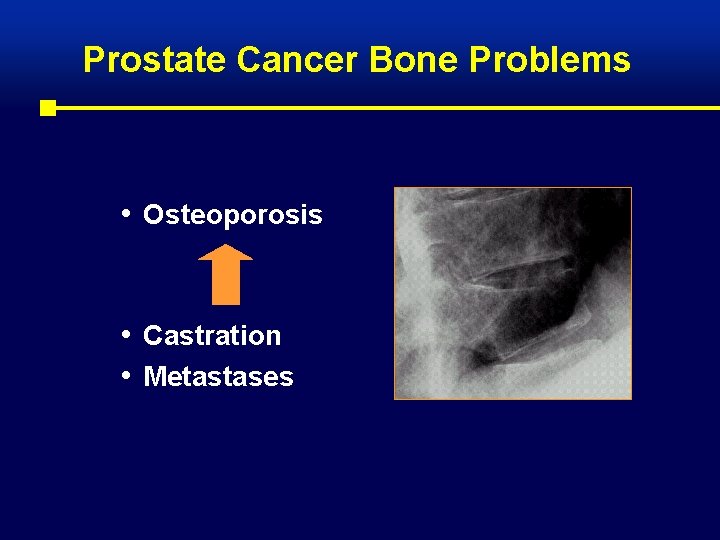
Prostate Cancer Bone Problems • Osteoporosis • Castration • Metastases

Bone Density - Definitions • T-Score = Standard deviation from normal values • T-Score -1 bis – 2, 5 Osteopenia • T-Score < - 2, 5 Osteoporosis
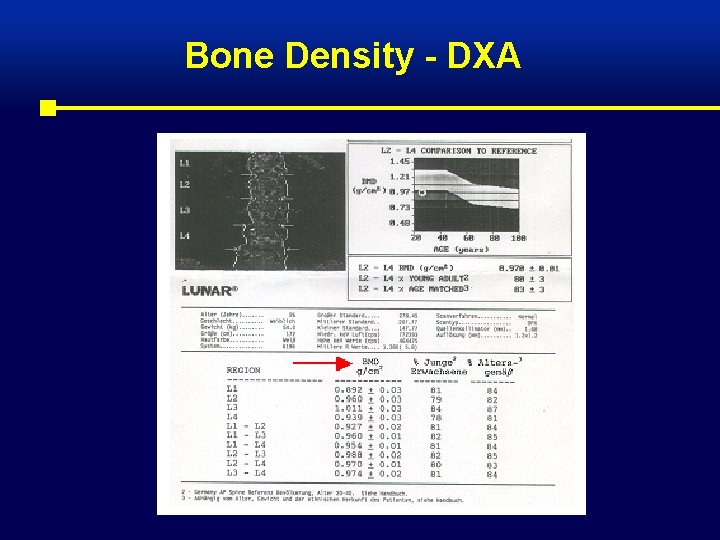
Bone Density - DXA
Risk Factors for Osteoporosis • Study of 174 men with prostate cancer and 106 age-matched controls • Before receiving ADT, 73 (42%) patients were osteoporotic and 65 (37%) were osteopenic – Age correlated significantly with BMD – Smoking, family history of osteoporosis – Diagnosis of prostate cancer • Regardless of PSA, stage, grade Hussain SA, et al. BJU Int. 2003; 92: 690 -694.
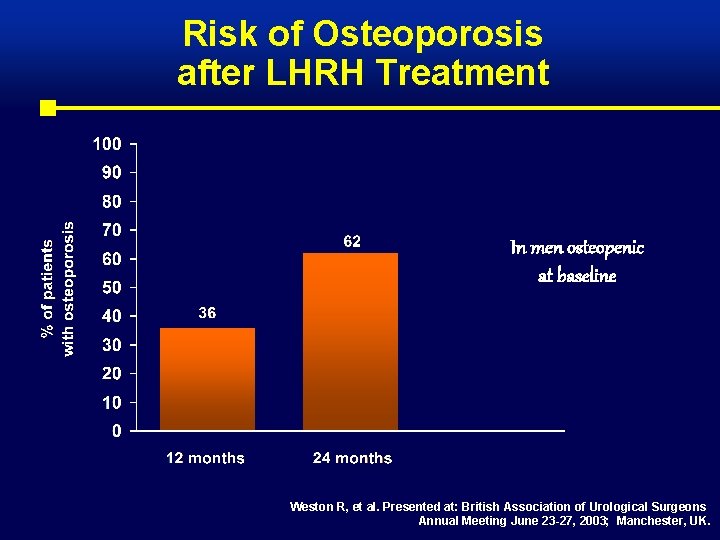
Risk of Osteoporosis after LHRH Treatment In men osteopenic at baseline Weston R, et al. Presented at: British Association of Urological Surgeons Annual Meeting June 23 -27, 2003; Manchester, UK.
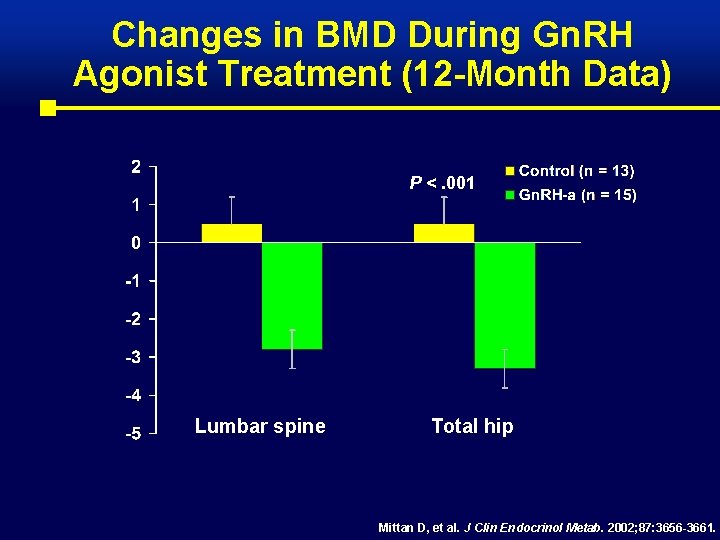
Changes in BMD During Gn. RH Agonist Treatment (12 -Month Data) P <. 001 Lumbar spine Total hip Mittan D, et al. J Clin Endocrinol Metab. 2002; 87: 3656 -3661.
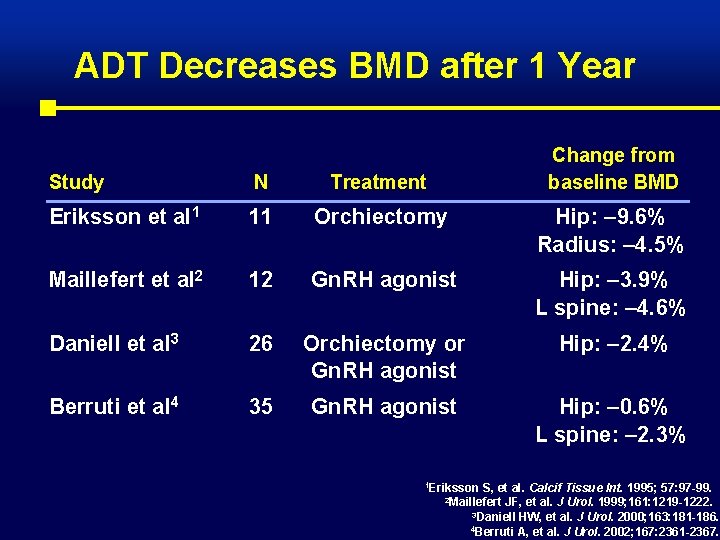
ADT Decreases BMD after 1 Year Change from baseline BMD Study N Treatment Eriksson et al 1 11 Orchiectomy Hip: – 9. 6% Radius: – 4. 5% Maillefert et al 2 12 Gn. RH agonist Hip: – 3. 9% L spine: – 4. 6% Daniell et al 3 26 Orchiectomy or Gn. RH agonist Hip: – 2. 4% Berruti et al 4 35 Gn. RH agonist Hip: – 0. 6% L spine: – 2. 3% 1 Eriksson S, et al. Calcif Tissue Int. 1995; 57: 97 -99. JF, et al. J Urol. 1999; 161: 1219 -1222. 3 Daniell HW, et al. J Urol. 2000; 163: 181 -186. 4 Berruti A, et al. J Urol. 2002; 167: 2361 -2367. 2 Maillefert
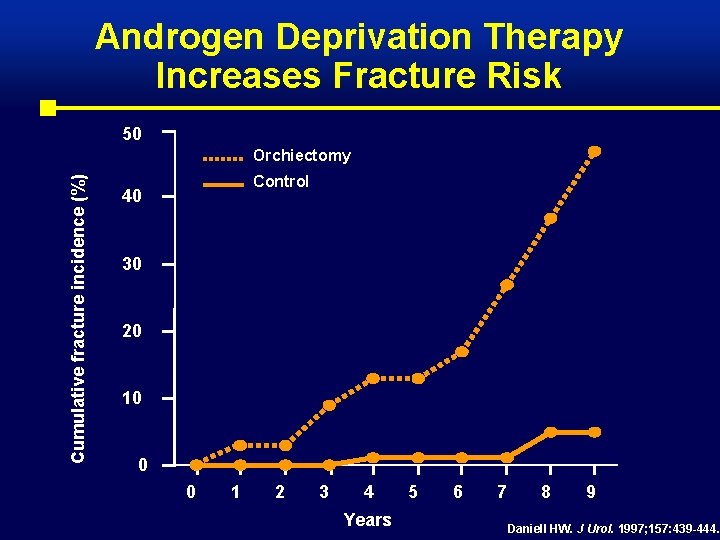
Androgen Deprivation Therapy Increases Fracture Risk 50 Cumulative fracture incidence (%) Orchiectomy Control 40 30 20 10 0 0 1 2 3 4 Years 5 6 7 8 9 Daniell HW. J Urol. 1997; 157: 439 -444.
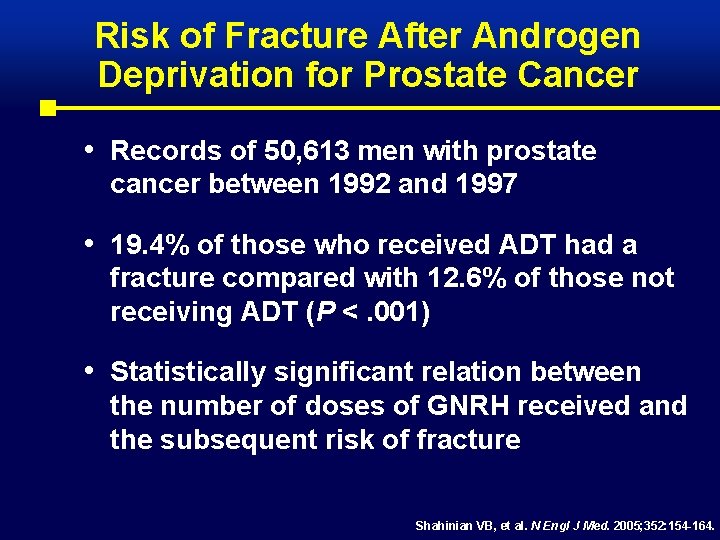
Risk of Fracture After Androgen Deprivation for Prostate Cancer • Records of 50, 613 men with prostate cancer between 1992 and 1997 • 19. 4% of those who received ADT had a fracture compared with 12. 6% of those not receiving ADT (P <. 001) • Statistically significant relation between the number of doses of GNRH received and the subsequent risk of fracture Shahinian VB, et al. N Engl J Med. 2005; 352: 154 -164.
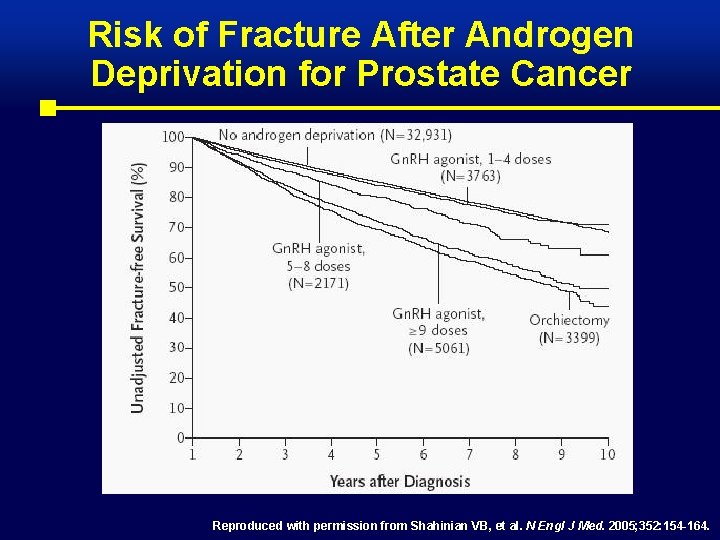
Risk of Fracture After Androgen Deprivation for Prostate Cancer Reproduced with permission from Shahinian VB, et al. N Engl J Med. 2005; 352: 154 -164.
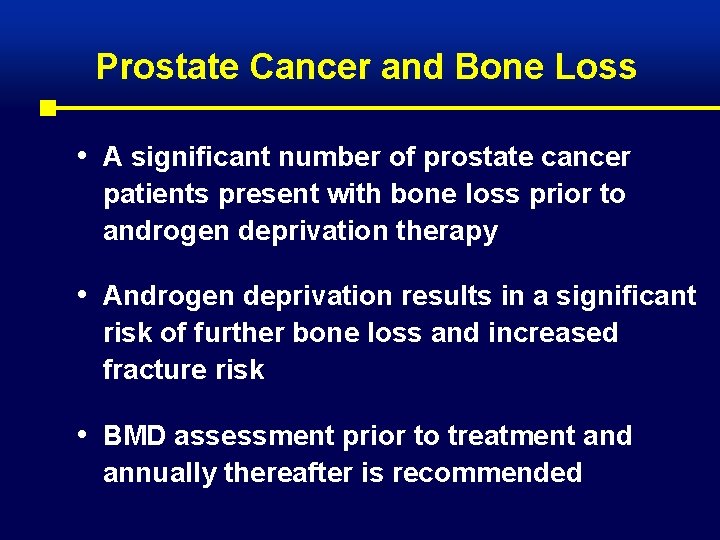
Prostate Cancer and Bone Loss • A significant number of prostate cancer patients present with bone loss prior to androgen deprivation therapy • Androgen deprivation results in a significant risk of further bone loss and increased fracture risk • BMD assessment prior to treatment and annually thereafter is recommended

Can We Prevent Bone Loss Resulting From ADT?
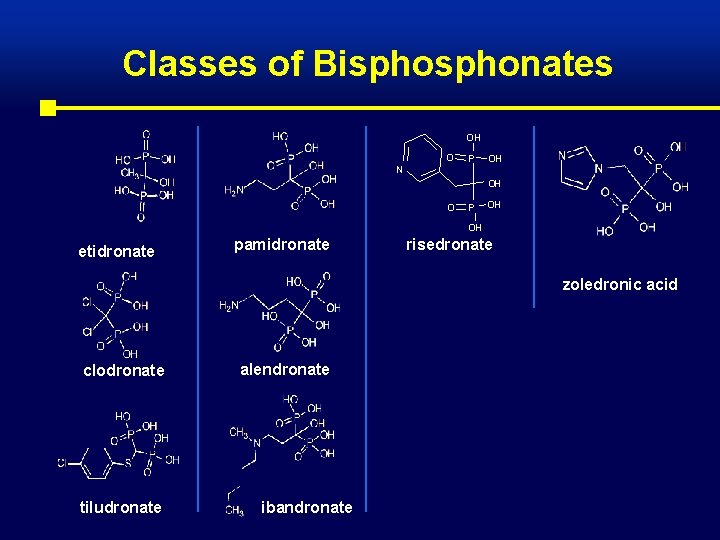
Classes of Bisphonates OH O N P OH OH O P OH OH etidronate pamidronate risedronate zoledronic acid clodronate tiludronate alendronate ibandronate
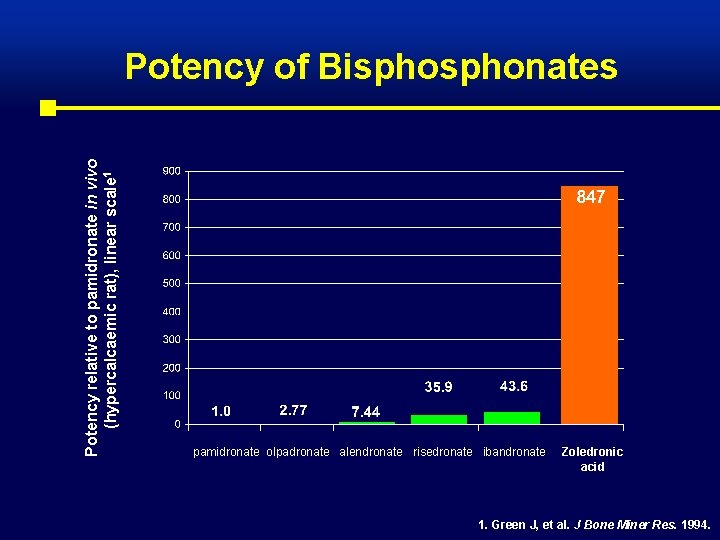
Potency relative to pamidronate in vivo (hypercalcaemic rat), linear scale 1 Potency of Bisphonates pamidronate olpadronate alendronate risedronate ibandronate Zoledronic acid 1. Green J, et al. J Bone Miner Res. 1994.
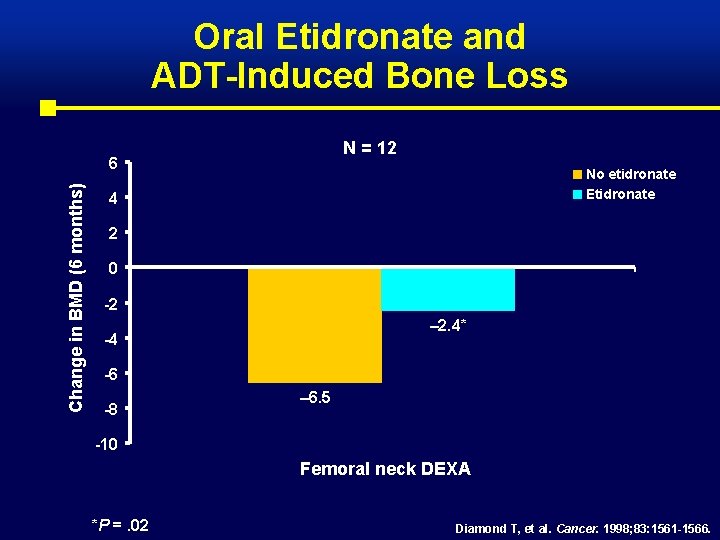
Oral Etidronate and ADT-Induced Bone Loss N = 12 Change in BMD (6 months) 6 No etidronate Etidronate 4 2 0 -2 – 2. 4* -4 -6 -8 – 6. 5 -10 Femoral neck DEXA *P =. 02 Diamond T, et al. Cancer. 1998; 83: 1561 -1566.
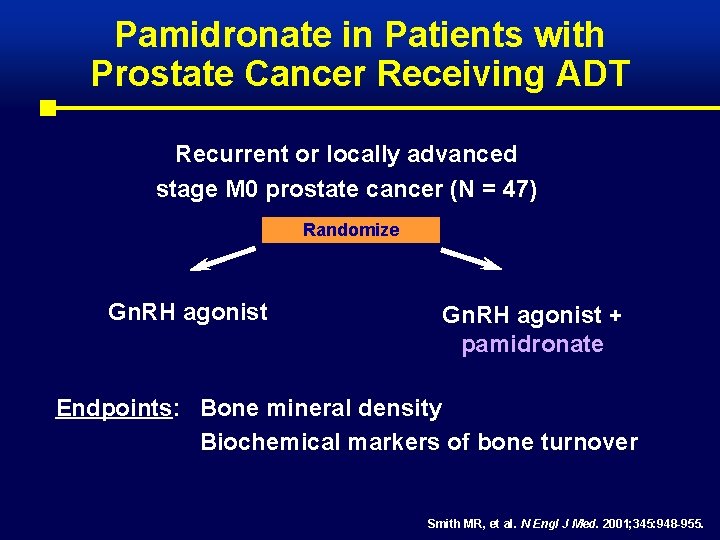
Pamidronate in Patients with Prostate Cancer Receiving ADT Recurrent or locally advanced stage M 0 prostate cancer (N = 47) Randomize Gn. RH agonist + pamidronate Endpoints: Bone mineral density Biochemical markers of bone turnover Smith MR, et al. N Engl J Med. 2001; 345: 948 -955.
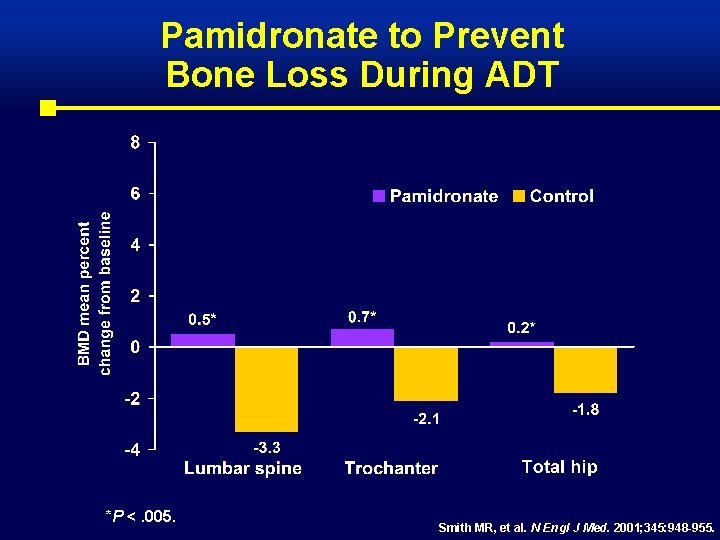
Pamidronate to Prevent Bone Loss During ADT *P <. 005. Smith MR, et al. N Engl J Med. 2001; 345: 948 -955.
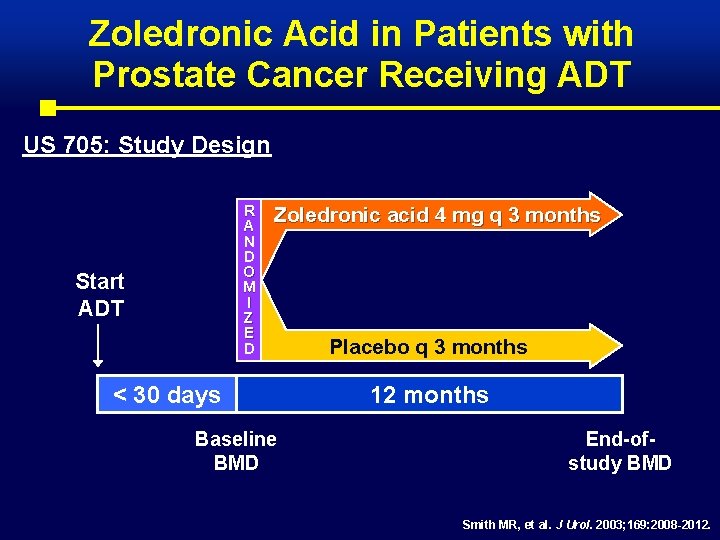
Zoledronic Acid in Patients with Prostate Cancer Receiving ADT US 705: Study Design R A N D O M I Z E D Start ADT Zoledronic acid 4 mg q 3 months < 30 days Baseline BMD Placebo q 3 months 12 months End-ofstudy BMD Smith MR, et al. J Urol. 2003; 169: 2008 -2012.
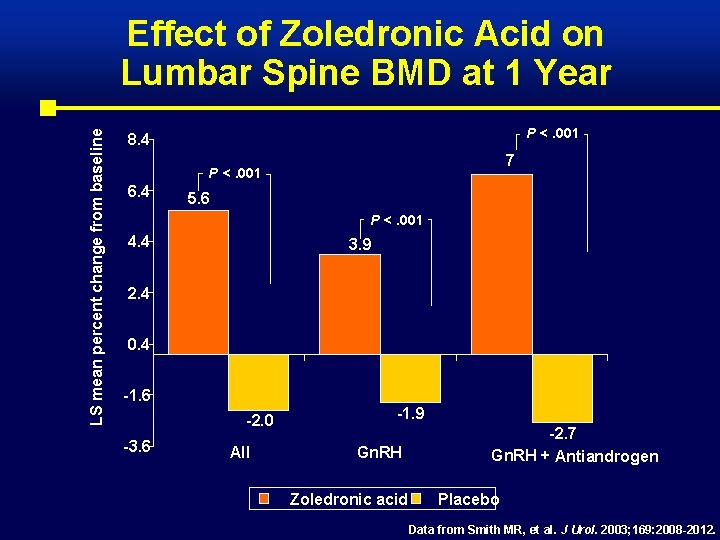
LS mean percent change from baseline Effect of Zoledronic Acid on Lumbar Spine BMD at 1 Year P <. 001 8. 4 7 P <. 001 6. 4 5. 6 P <. 001 4. 4 3. 9 2. 4 0. 4 -1. 6 -2. 0 -3. 6 All -1. 9 Gn. RH Zoledronic acid -2. 7 Gn. RH + Antiandrogen Placebo Data from Smith MR, et al. J Urol. 2003; 169: 2008 -2012.
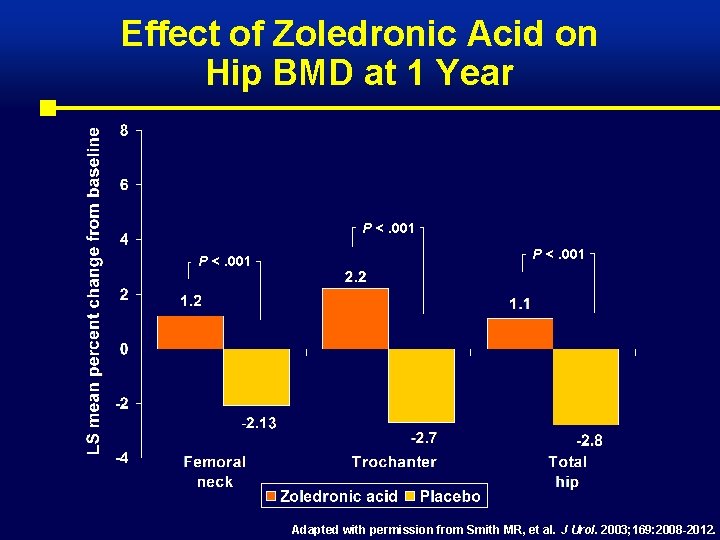
Effect of Zoledronic Acid on Hip BMD at 1 Year P <. 001 Adapted with permission from Smith MR, et al. J Urol. 2003; 169: 2008 -2012.
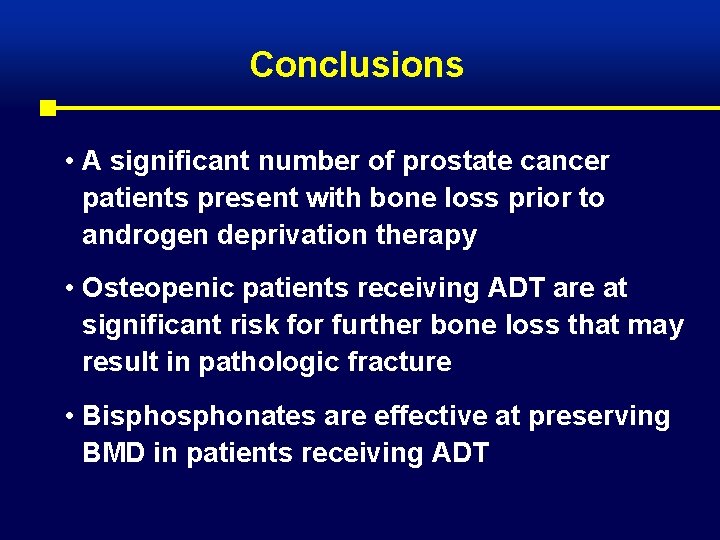
Conclusions • A significant number of prostate cancer patients present with bone loss prior to androgen deprivation therapy • Osteopenic patients receiving ADT are at significant risk for further bone loss that may result in pathologic fracture • Bisphonates are effective at preserving BMD in patients receiving ADT
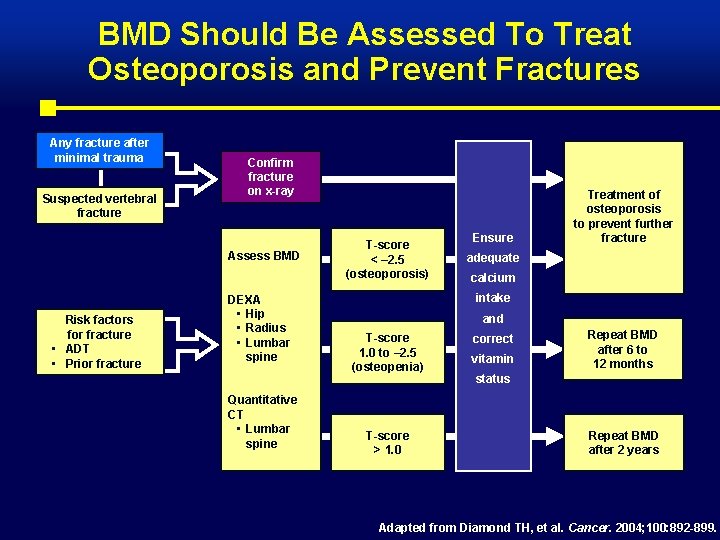
BMD Should Be Assessed To Treat Osteoporosis and Prevent Fractures Any fracture after minimal trauma Suspected vertebral fracture Confirm fracture on x-ray Assess BMD Risk factors for fracture • ADT • Prior fracture DEXA • Hip • Radius • Lumbar spine Quantitative CT • Lumbar spine T-score < – 2. 5 (osteoporosis) Ensure Treatment of osteoporosis to prevent further fracture adequate calcium intake and T-score 1. 0 to – 2. 5 (osteopenia) T-score > 1. 0 correct vitamin Repeat BMD after 6 to 12 months status Repeat BMD after 2 years Adapted from Diamond TH, et al. Cancer. 2004; 100: 892 -899.
- Slides: 24