
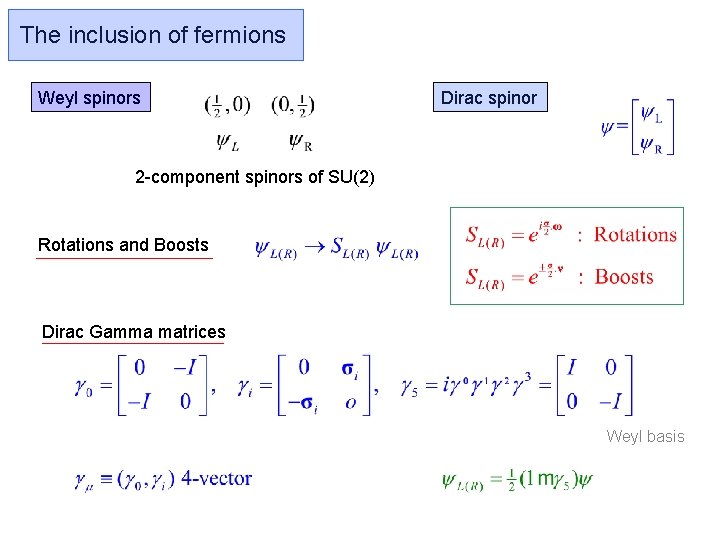
The inclusion of fermions Weyl spinors Dirac spinor

- Slides: 16
The inclusion of fermions Weyl spinors Dirac spinor 2 -component spinors of SU(2) Rotations and Boosts Dirac Gamma matrices Weyl basis
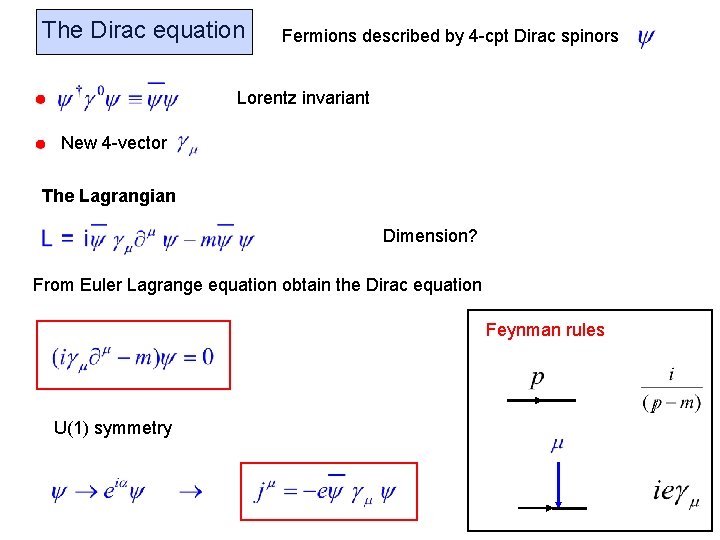
The Dirac equation Fermions described by 4 -cpt Dirac spinors Lorentz invariant New 4 -vector The Lagrangian Dimension? From Euler Lagrange equation obtain the Dirac equation Feynman rules U(1) symmetry
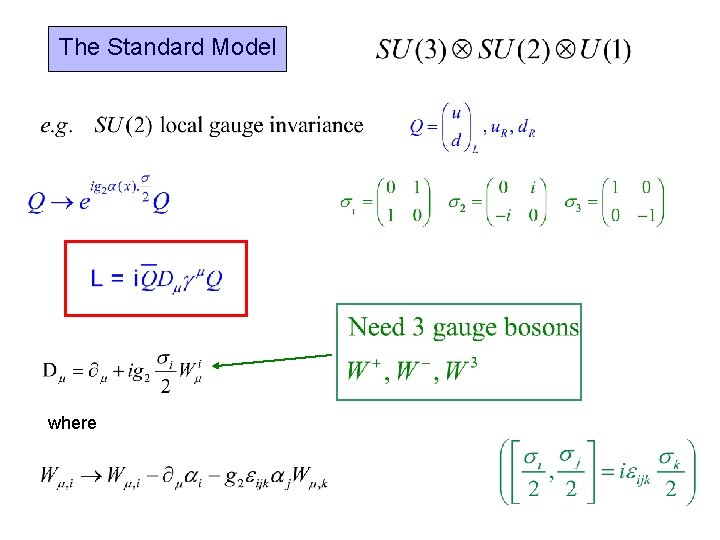
The Standard Model where
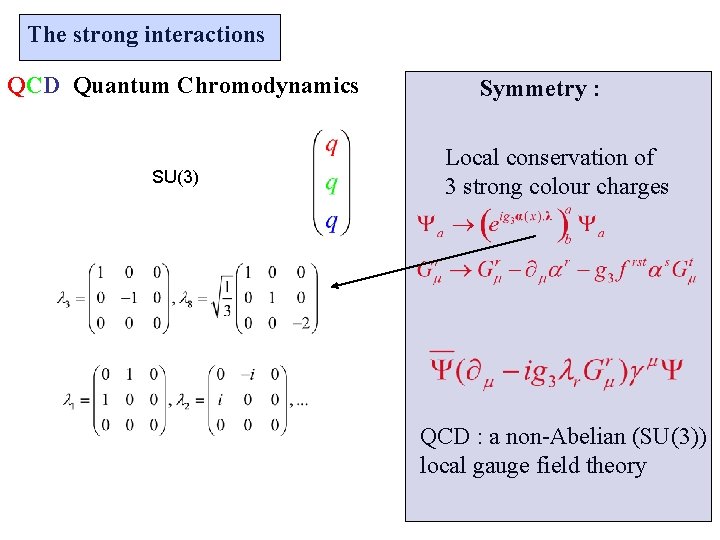
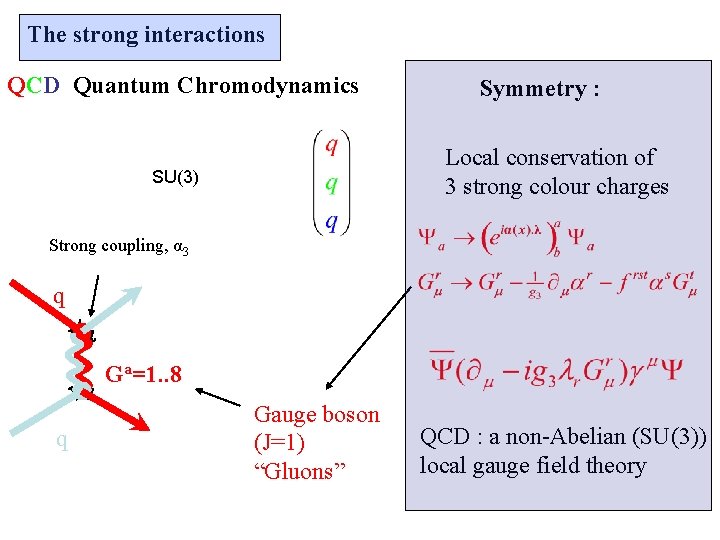
The strong interactions QCD Quantum Chromodynamics SU(3) Symmetry : Local conservation of 3 strong colour charges QCD : a non-Abelian (SU(3)) local gauge field theory
The strong interactions QCD Quantum Chromodynamics Symmetry : Local conservation of 3 strong colour charges SU(3) Strong coupling, α 3 q q Ga=1. . 8 Gauge boson (J=1) “Gluons” QCD : a non-Abelian (SU(3)) local gauge field theory
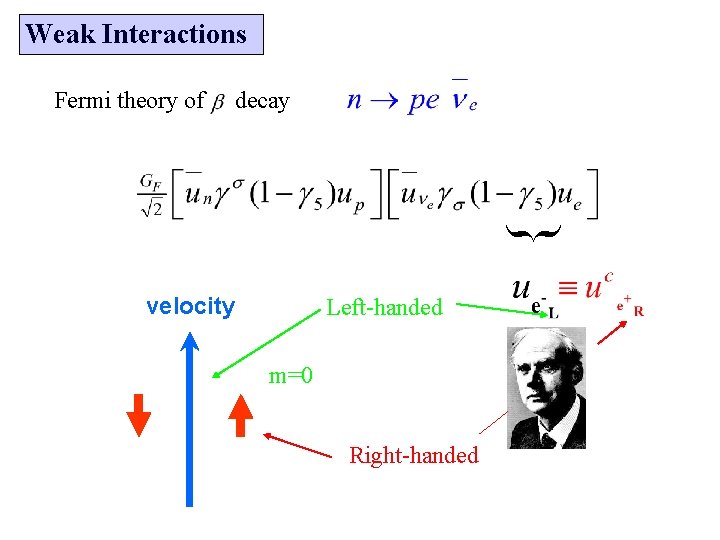
Weak Interactions Fermi theory of decay } velocity Left-handed m=0 Right-handed
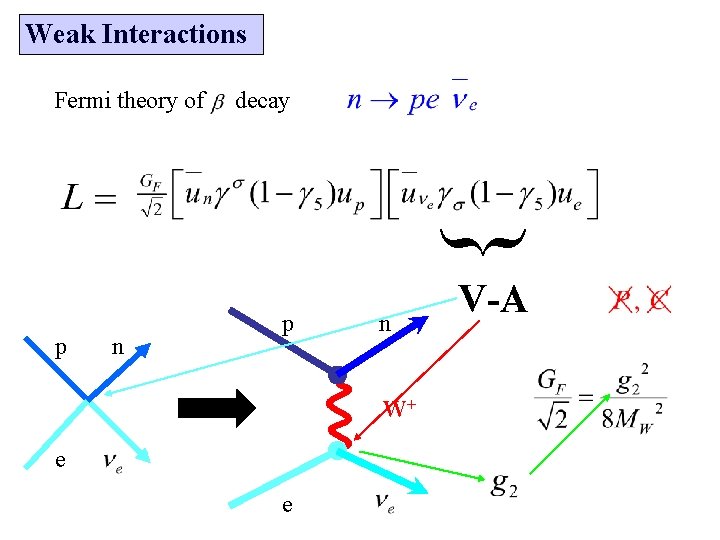
Weak Interactions Fermi theory of decay } p n W+ e e V-A
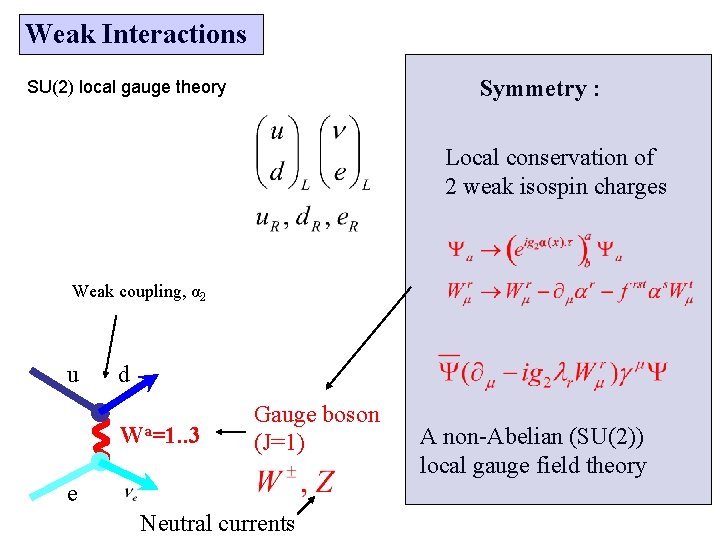
Weak Interactions Symmetry : SU(2) local gauge theory Local conservation of 2 weak isospin charges Weak coupling, α 2 u d Wa=1. . 3 Gauge boson (J=1) e Neutral currents A non-Abelian (SU(2)) local gauge field theory
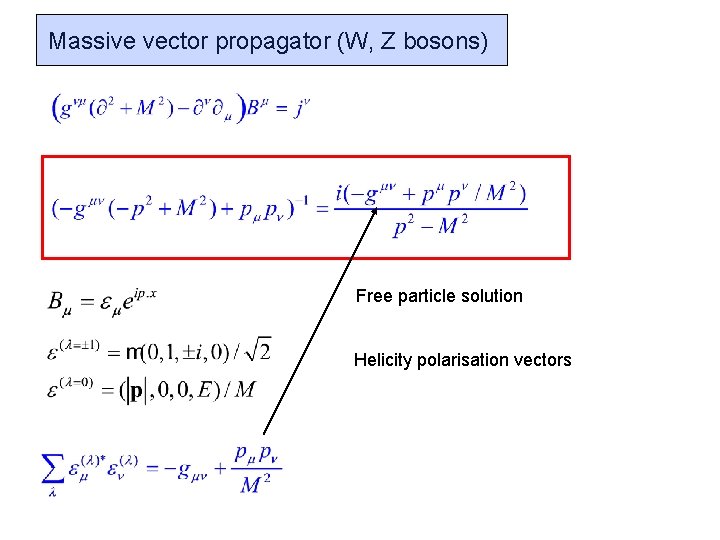
Massive vector propagator (W, Z bosons) Free particle solution Helicity polarisation vectors
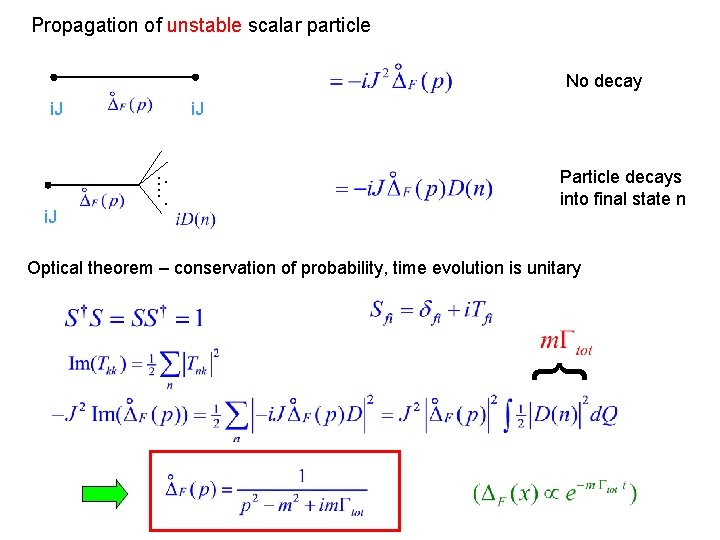
Propagation of unstable scalar particle No decay i. J …. . . i. J Particle decays into final state n } Optical theorem – conservation of probability, time evolution is unitary
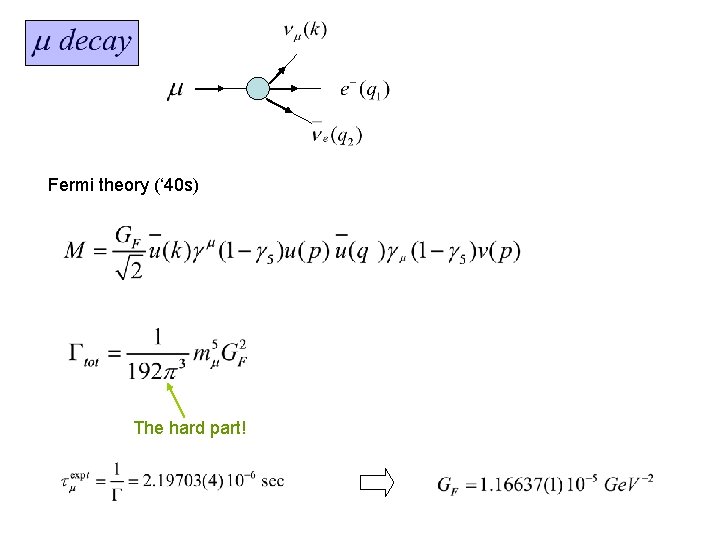
Fermi theory (‘ 40 s) The hard part!
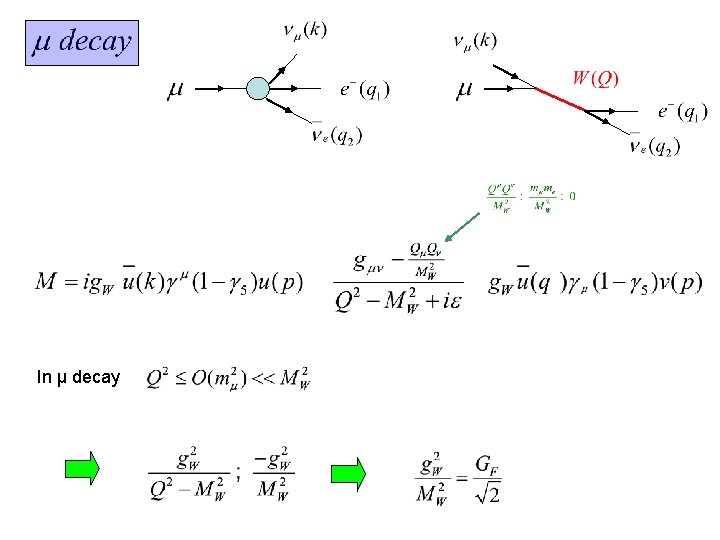
In μ decay
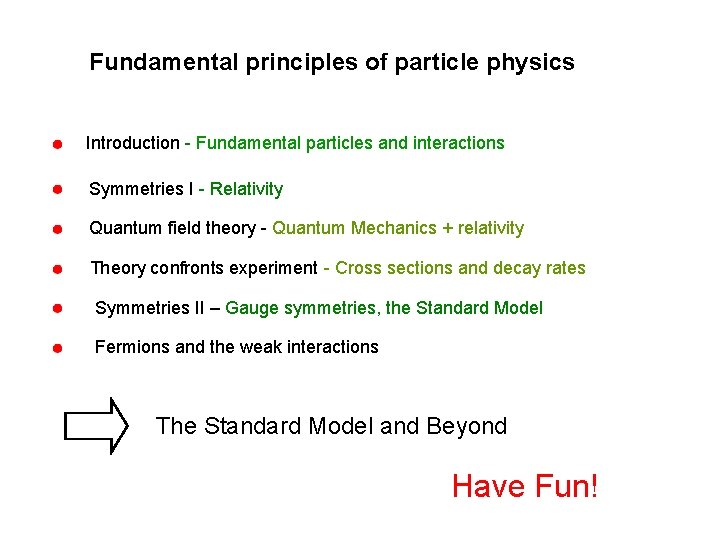
Fundamental principles of particle physics Introduction - Fundamental particles and interactions Symmetries I - Relativity Quantum field theory - Quantum Mechanics + relativity Theory confronts experiment - Cross sections and decay rates Symmetries II – Gauge symmetries, the Standard Model Fermions and the weak interactions The Standard Model and Beyond Have Fun!