
The inclusion of fermions J12 particles Dirac spinor


- Slides: 22
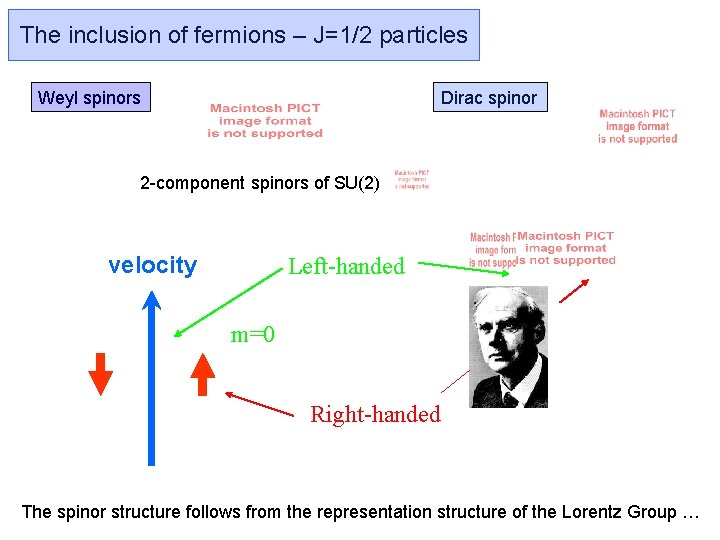
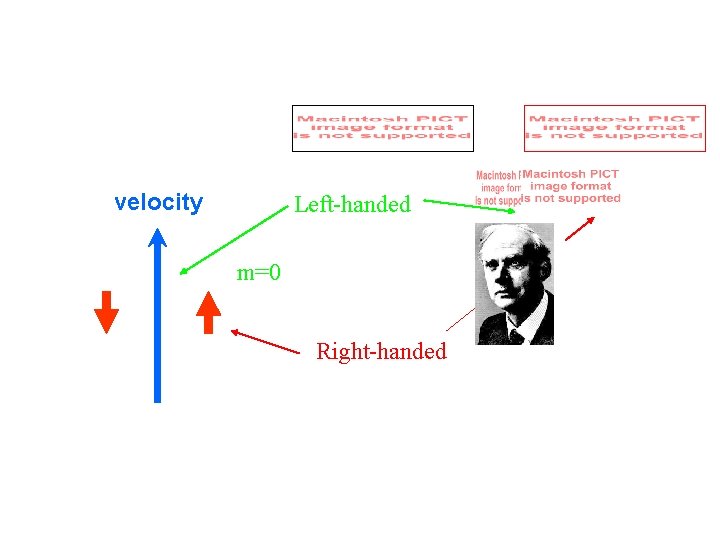
The inclusion of fermions – J=1/2 particles Dirac spinor Weyl spinors 2 -component spinors of SU(2) velocity Left-handed m=0 Right-handed The spinor structure follows from the representation structure of the Lorentz Group …
The Lorentz transformations form a group, G Rotations Angular momentum operator
The Lorentz group } Generate the group SO(3, 1) To construct representations a more convenient (non-Hermitian) basis is }
The Lorentz group } Generate the group SO(3, 1) To construct representations a more convenient (non-Hermitian) basis is Representations
Weyl spinors 2 -component spinors of SU(2) Rotations and Boosts Dirac spinor Can combine to form a 4 -component “Dirac” spinor Lorentz transformations where Weyl basis
Weyl spinors 2 -component spinors of SU(2) Rotations and Boosts Dirac spinor Can combine to form a 4 -component “Dirac” spinor Lorentz transformations where (Dirac gamma matrices, …new 4 -vector ) Note :
The Dirac equation Fermions described by 4 -cpt Dirac spinors Lorentz invariant New 4 -vector The Lagrangian Dimension? From Euler Lagrange equation obtain the Dirac equation Feynman rules U(1) symmetry
Fermion masses Lorentz invariant Dirac mass Lorentz invariant Only term allowed by charge conservation is Majorana mass
Fermions and the weak interactions Fermi theory of decay
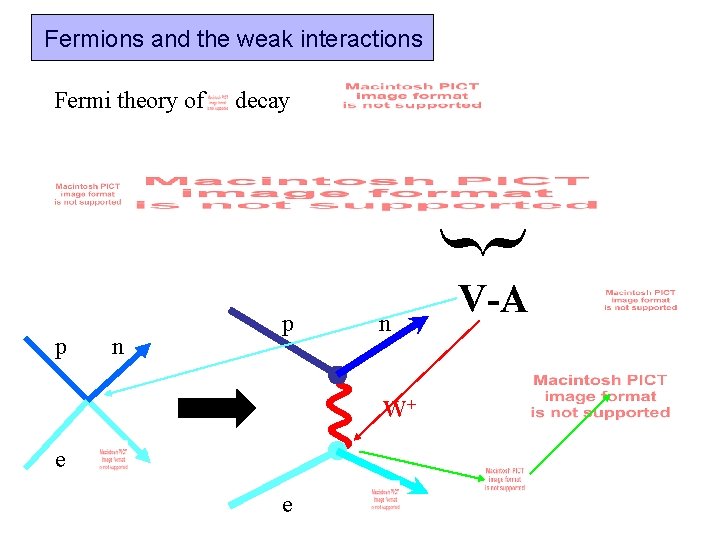
Fermions and the weak interactions Fermi theory of decay } p n W+ e e V-A
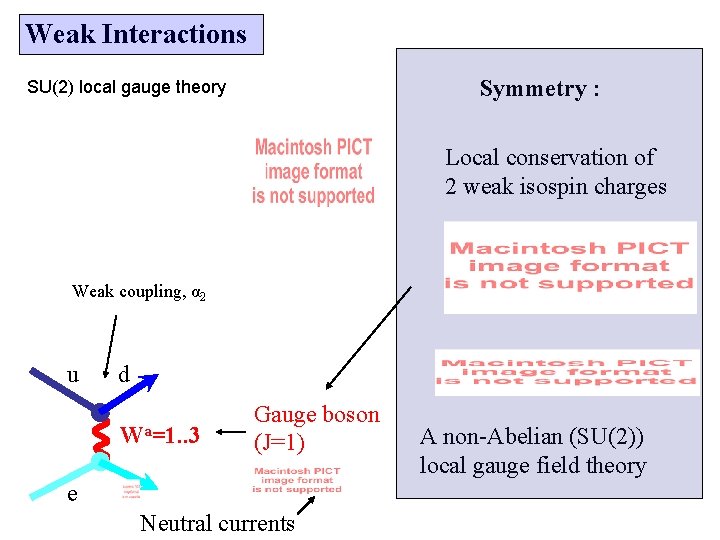
Weak Interactions Symmetry : SU(2) local gauge theory Local conservation of 2 weak isospin charges Weak coupling, α 2 u d Wa=1. . 3 Gauge boson (J=1) e Neutral currents A non-Abelian (SU(2)) local gauge field theory
Massive vector propagator (W, Z bosons) Free particle solution Helicity polarisation vectors
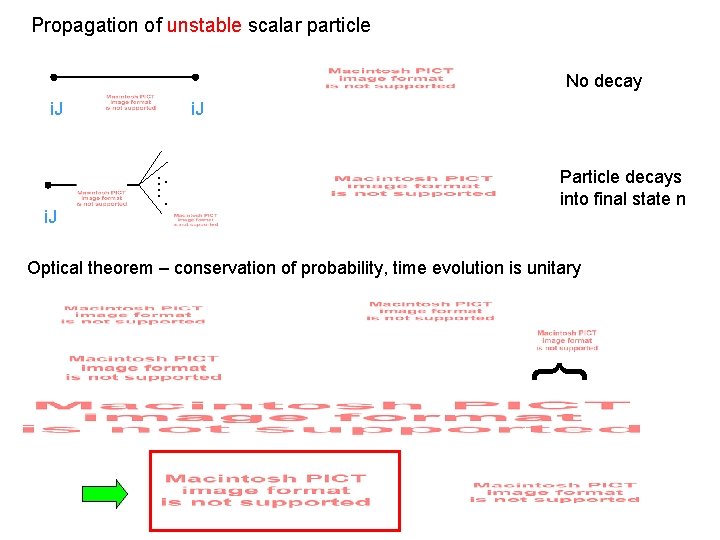
Propagation of unstable scalar particle No decay i. J …. . . i. J Particle decays into final state n } Optical theorem – conservation of probability, time evolution is unitary
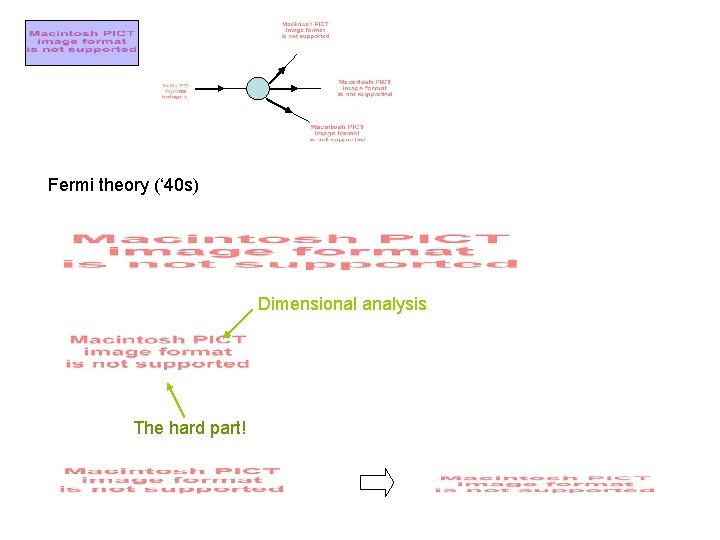
Fermi theory (‘ 40 s) Dimensional analysis The hard part!
In μ decay
Fundamental principles of particle physics Introduction - Fundamental particles and interactions Symmetries I - Relativity Quantum field theory - Quantum Mechanics + relativity Theory confronts experiment - Cross sections and decay rates Symmetries II – Gauge symmetries, the Standard Model Fermions and the weak interactions The Standard Model and Beyond Have Fun!
velocity Left-handed m=0 Right-handed