
The Improvement Process Step 3 The Essential Tools
- Slides: 24
The Improvement Process, Step 3: The Essential Tools and Tasks Michael Gress, Interim Director of Institutional Effectiveness LRC 120, 4275
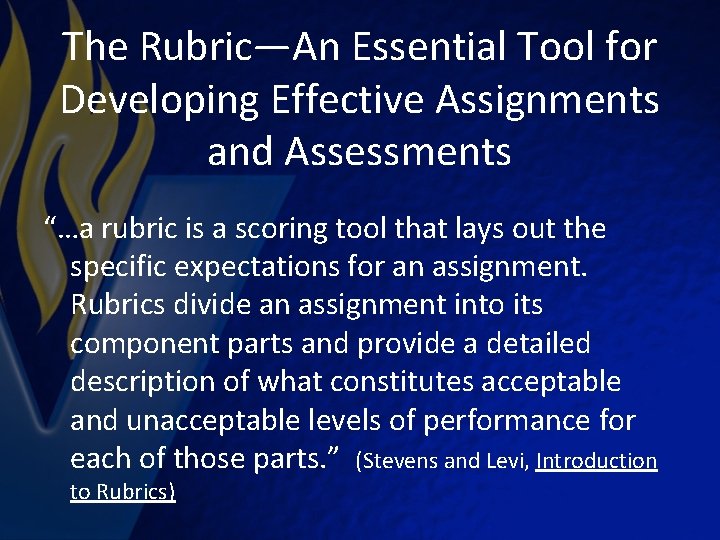
The Rubric—An Essential Tool for Developing Effective Assignments and Assessments “…a rubric is a scoring tool that lays out the specific expectations for an assignment. Rubrics divide an assignment into its component parts and provide a detailed description of what constitutes acceptable and unacceptable levels of performance for each of those parts. ” (Stevens and Levi, Introduction to Rubrics)
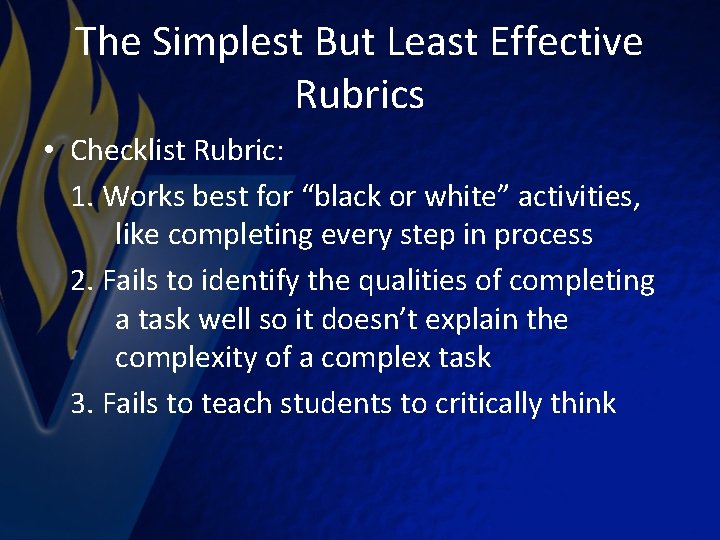
The Simplest But Least Effective Rubrics • Checklist Rubric: 1. Works best for “black or white” activities, like completing every step in process 2. Fails to identify the qualities of completing a task well so it doesn’t explain the complexity of a complex task 3. Fails to teach students to critically think
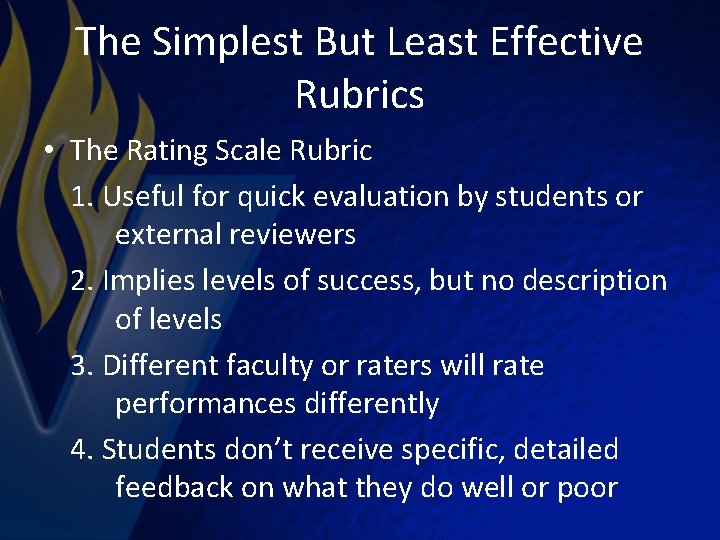
The Simplest But Least Effective Rubrics • The Rating Scale Rubric 1. Useful for quick evaluation by students or external reviewers 2. Implies levels of success, but no description of levels 3. Different faculty or raters will rate performances differently 4. Students don’t receive specific, detailed feedback on what they do well or poor
The Simplest But Least Effective Rubrics • Scoring Guide Rubric 1. Defines the highest level of performance 2. Gives evaluator greater flexibility during a quick, well-done performance 3. Gives students feedback based on how well they did or didn’t meet highest expectations 4. Demands considerable time by instructor to give detailed feedback
What Is the Benefit of an Analytic or Descriptive Rubric? • Gives quick feedback to students that can help reduce repetition of mistakes • Gives concrete expression of task complexity • Teaches critical thinking as students consider what is required for the task to be excellent • Facilitates conversation with students • Helps faculty refine teaching skills (Stevens and Levi, Introduction to Rubrics)
Constructing an Analytic or Descriptive Rubric • First efforts are most difficult—you need to: 1. Reflect on what you want from students if the assignment is done well, why the assignment is important, what happened with past student efforts 2. List the details of the assignment and objectives • Seldom perfect on first attempt • Improves with use and refinement
Constructing an Analytic or Descriptive Rubric • Identify the dimensions of the assignment (the characteristics, criteria, or basic elements) • Identify levels of success without being overly negative Excellent, Good, Average, Below Average Accomplished, Average, Developing, Beginning Distinguished, Proficient, Intermediate, Novice
Constructing an Analytic or Descriptive Rubric • Identify the highest level of success for all the dimensions (characteristics or criteria) of the assignment • Identify the worst level of success • For 3 -level rubrics, make the middle a little of both other columns • For 4 -level rubrics, make the second column just below the first, and third column just above the last
Constructing an Analytic or Descriptive Rubric Two Possible Group Methods for Constructing: • Post-It Note Process—participants identify key elements of a well-completed task. Be sure you have thought about the assignment! • Qualitative Evaluation of Student Artifacts— participants identify what they value, what they don’t value, what they value that they don’t see in the artifacts. Record comments on giant sticky notes
Other Rubrics, Uses • • • Peer Review Rubrics Holistic Rubric for Specific Tasks Combined Holistic and Analytic Holistic Rubric for Performances Portfolio Rubrics
Reflection Two types: • Indirect assessment of students’ perception of what, how, and why they have learned 1. Helps students learn how they learn best and manage their learning (metacognition) 2. Helps students pull together what they have learned and its significance (synthesis) • Direct assessment of students’ ability to “appreciate, ” value diverse points of view, express their levels of spirituality, integrity, openness to ideas, desire to learn, etc.
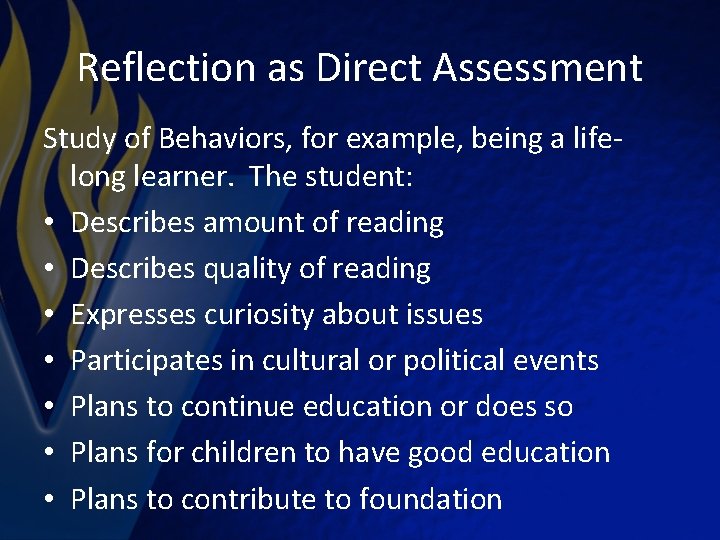
Reflection as Direct Assessment Study of Behaviors, for example, being a lifelong learner. The student: • Describes amount of reading • Describes quality of reading • Expresses curiosity about issues • Participates in cultural or political events • Plans to continue education or does so • Plans for children to have good education • Plans to contribute to foundation
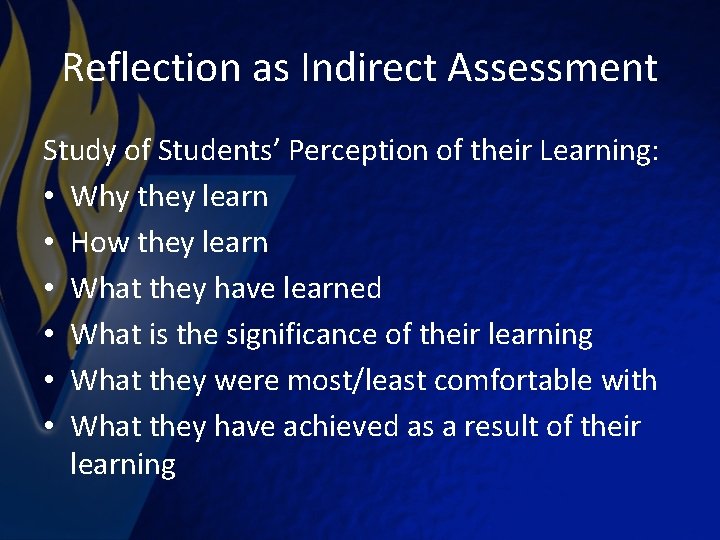
Reflection as Indirect Assessment Study of Students’ Perception of their Learning: • Why they learn • How they learn • What they have learned • What is the significance of their learning • What they were most/least comfortable with • What they have achieved as a result of their learning
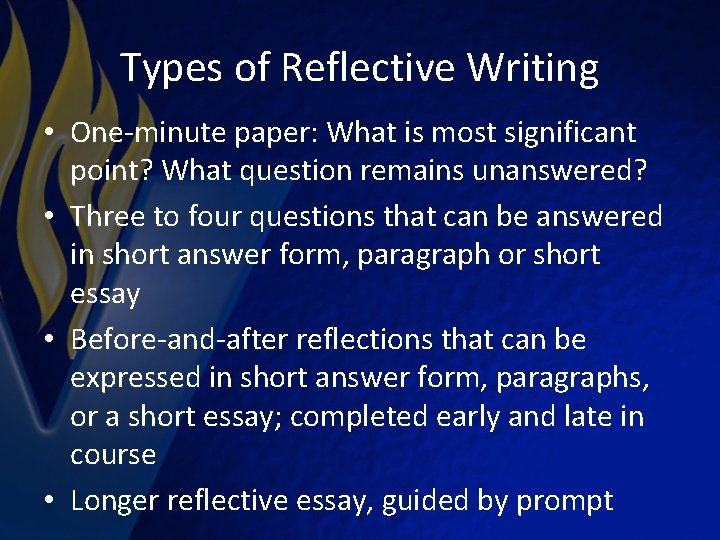
Types of Reflective Writing • One-minute paper: What is most significant point? What question remains unanswered? • Three to four questions that can be answered in short answer form, paragraph or short essay • Before-and-after reflections that can be expressed in short answer form, paragraphs, or a short essay; completed early and late in course • Longer reflective essay, guided by prompt
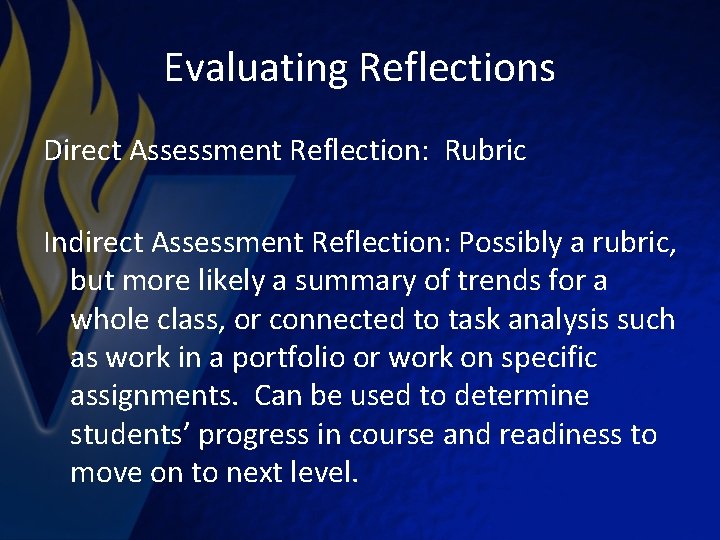
Evaluating Reflections Direct Assessment Reflection: Rubric Indirect Assessment Reflection: Possibly a rubric, but more likely a summary of trends for a whole class, or connected to task analysis such as work in a portfolio or work on specific assignments. Can be used to determine students’ progress in course and readiness to move on to next level.
Test Blueprints—Developing Effective Tests and Assessments “…an outline of the test that lists the learning goals that students are to demonstrate on the test. ” (Suskie, Assessing Student Learning)
Test Blueprints—Developing Effective Tests and Assessments The Value of Test Blueprints: • Help ensure that the test focuses on essential learning goals • Help ensure that test gives appropriate emphasis to different thinking skills • Help make writing test questions easier • Help document that students have achieved major learning goals (Suskie, Assessing Student Learning)
Creating the Blueprint • Review lecture notes, syllabus, textbook to determine the major topics covered in class/readings and to be tested • Allocate appropriate point percentages to areas to be tested and determine the number of questions needed to address each area • Identify the cognitive levels of learning to be assessed (the key outcomes) • Check distribution of point value for outcomes, align with major areas/questions
Think-Alouds A deep probe into the ways students think and solve problems “…a direct method of assessment that prompts the students to say what they are thinking or doing as they solve a problem or perform a process. ” (Maki, Assessing for Learning) Can identify obstacles students encounter in problem solving or performance activities
Think-Alouds • Can be used to see how students handle critical thinking activities such as case studies, planning a paper, reading a complex passage, solving a moral problem • Can be recorded or can be written; either can be evaluated to understand student learning and obstacles to learning • Can be completed by individual students or in groups
Math Think-Aloud Prompt Sheet: 1. The problem says … 2. What am I trying to solve? I am trying to figure out … 3. The important/essential information is … 4. What strategy will I use to solve the problem? The strategy I will use is …
Math Think-Aloud 5. I am going to think aloud each step of this strategy. (Helpful starting words; first; second; the order of operations is; in order to; third; next; I know that if I do _______, I must do ____; after this; then; finally; Does this answer make sense? Let me work backwards and see …; Does this answer make sense if I read the problem over again?
One Minute Paper Please answer the following two questions: 1. What is the most important thing you learned? 2. What is the one question that remains unanswered? Questions? Practice building a rubric? Suggestions for future Workshops?