
The Important Role of Equivalence Scales Household Size
- Slides: 26
The Important Role of Equivalence Scales: Household Size, Composition, and Poverty Dynamics in Russia Kseniya Abanokova, Hai-Anh H. Dang and Michael M. Lokshin ********* Special IARIW-HSE Conference Moscow September 17 -18, 2019
Outline 1. 2. 3. 4. Motivation & Contribution Main Findings Literature Review Empirical Strategy a) Measuring Scale Elasticity b) Measuring Chronic Poverty & Income Mobility 5. Data Description 6. Estimation results a) b) c) d) Scale Parameters & Adjusted Poverty Lines Scale Factors & Poverty Scale Factors & Income Mobility Robustness Checks & Further Extensions 7. Conclusion
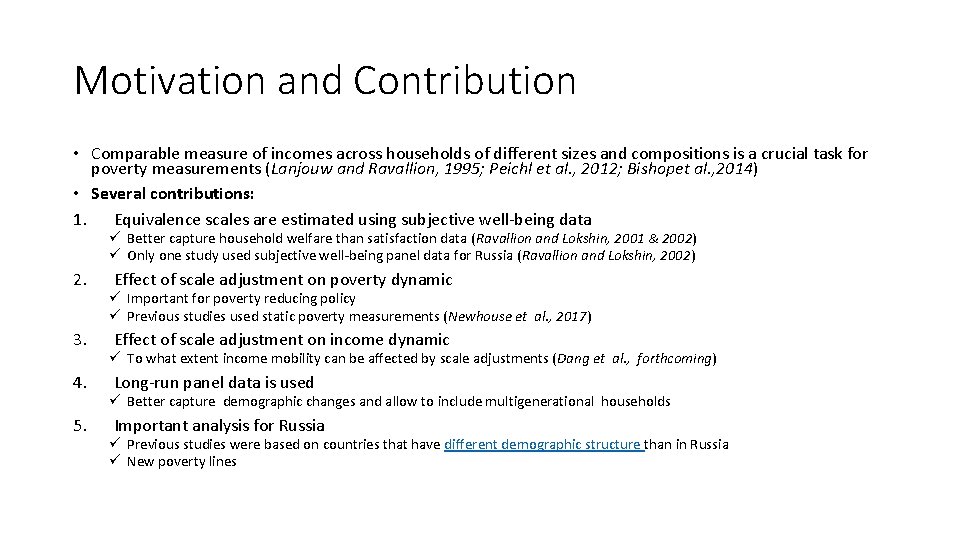
Motivation and Contribution • Comparable measure of incomes across households of different sizes and compositions is a crucial task for poverty measurements (Lanjouw and Ravallion, 1995; Peichl et al. , 2012; Bishopet al. , 2014) • Several contributions: 1. Equivalence scales are estimated using subjective well-being data ü Better capture household welfare than satisfaction data (Ravallion and Lokshin, 2001 & 2002) ü Only one study used subjective well-being panel data for Russia (Ravallion and Lokshin, 2002) 2. 3. 4. 5. Effect of scale adjustment on poverty dynamic ü Important for poverty reducing policy ü Previous studies used static poverty measurements (Newhouse et al. , 2017) Effect of scale adjustment on income dynamic ü To what extent income mobility can be affected by scale adjustments (Dang et al. , forthcoming) Long-run panel data is used ü Better capture demographic changes and allow to include multigenerational households Important analysis for Russia ü Previous studies were based on countries that have different demographic structure than in Russia ü New poverty lines
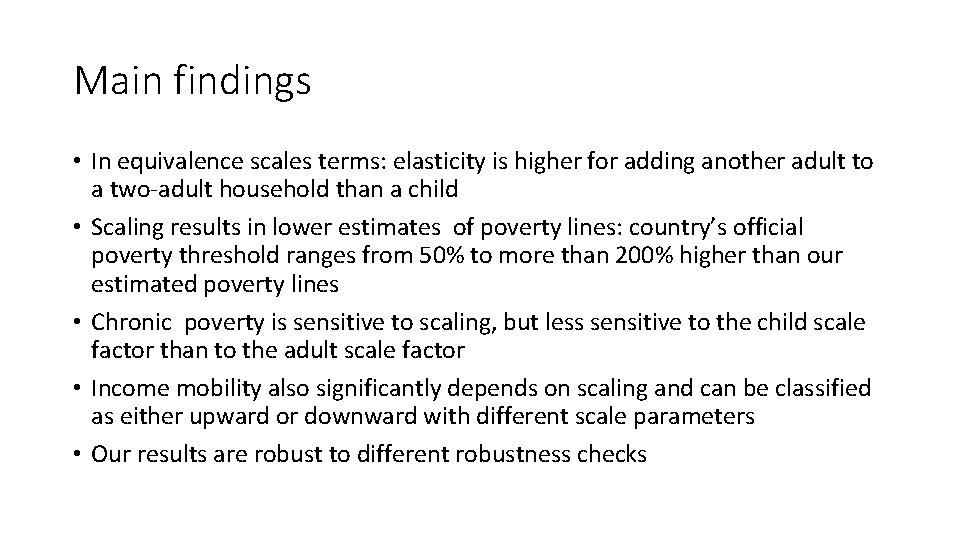
Main findings • In equivalence scales terms: elasticity is higher for adding another adult to a two-adult household than a child • Scaling results in lower estimates of poverty lines: country’s official poverty threshold ranges from 50% to more than 200% higher than our estimated poverty lines • Chronic poverty is sensitive to scaling, but less sensitive to the child scale factor than to the adult scale factor • Income mobility also significantly depends on scaling and can be classified as either upward or downward with different scale parameters • Our results are robust to different robustness checks
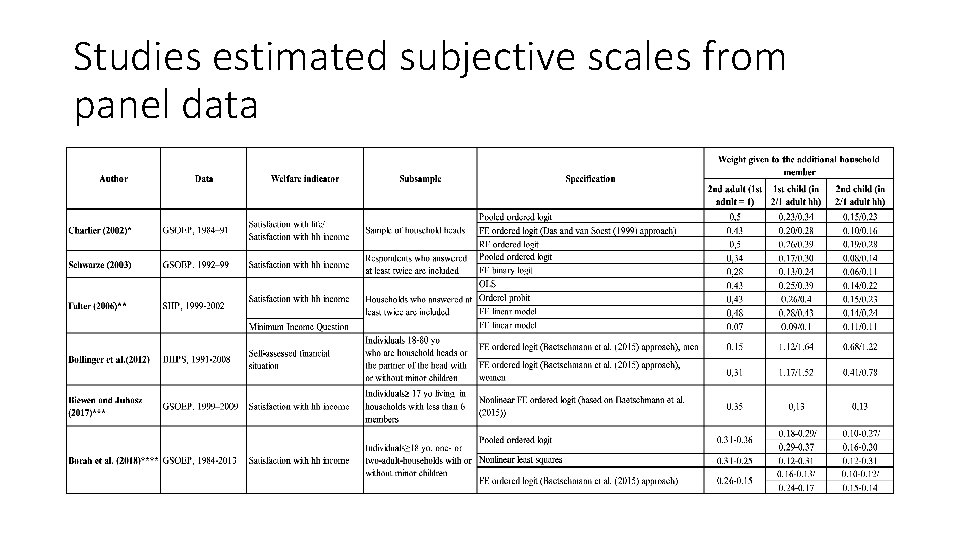
Studies estimated subjective scales from panel data
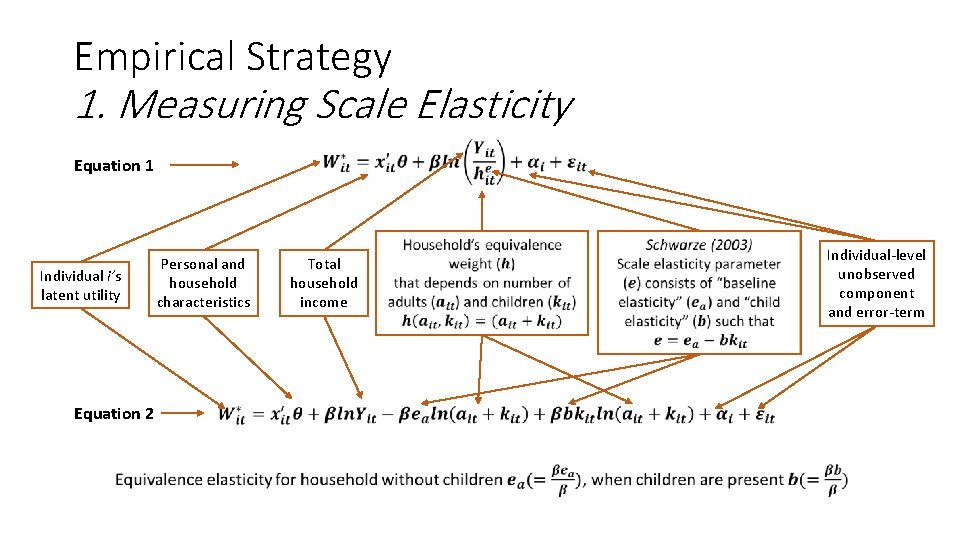
Empirical Strategy 1. Measuring Scale Elasticity Equation 1 Individual i’s latent utility Equation 2 Personal and household characteristics Total household income Individual-level unobserved component and error-term
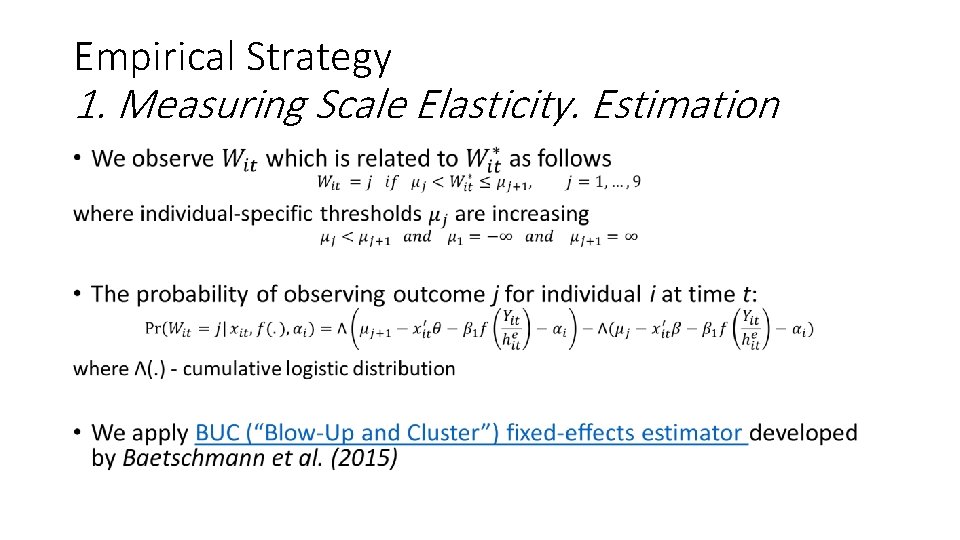
Empirical Strategy 1. Measuring Scale Elasticity. Estimation •
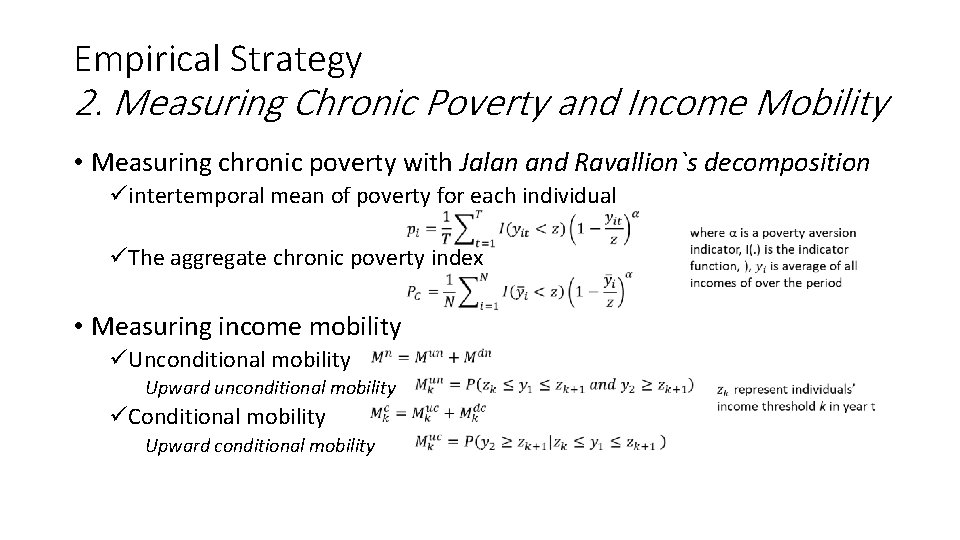
Empirical Strategy 2. Measuring Chronic Poverty and Income Mobility • Measuring chronic poverty with Jalan and Ravallion`s decomposition üintertemporal mean of poverty for each individual üThe aggregate chronic poverty index • Measuring income mobility üUnconditional mobility Upward unconditional mobility üConditional mobility Upward conditional mobility
Data Description • Russian Longitudinal Monitoring Survey (RLMS), unbalanced panel data set over the period 1994 -2017 • Estimation sample: individuals aged 16 years old or older living in hhs with <6 adults and <4 children • Individuals are followed over time, not households (but we cluster by household-wave level) • Income measure: total monetary household income (deflated and adjusted for regional differences) • We remove 0. 25% of income outliers
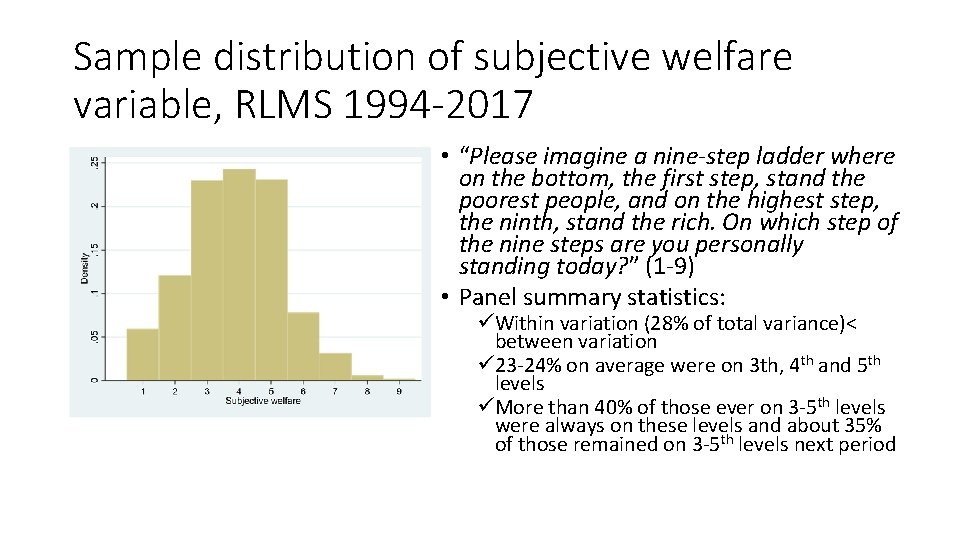
Sample distribution of subjective welfare variable, RLMS 1994 -2017 • “Please imagine a nine-step ladder where on the bottom, the first step, stand the poorest people, and on the highest step, the ninth, stand the rich. On which step of the nine steps are you personally standing today? ” (1 -9) • Panel summary statistics: üWithin variation (28% of total variance)< between variation ü 23 -24% on average were on 3 th, 4 th and 5 th levels üMore than 40% of those ever on 3 -5 th levels were always on these levels and about 35% of those remained on 3 -5 th levels next period
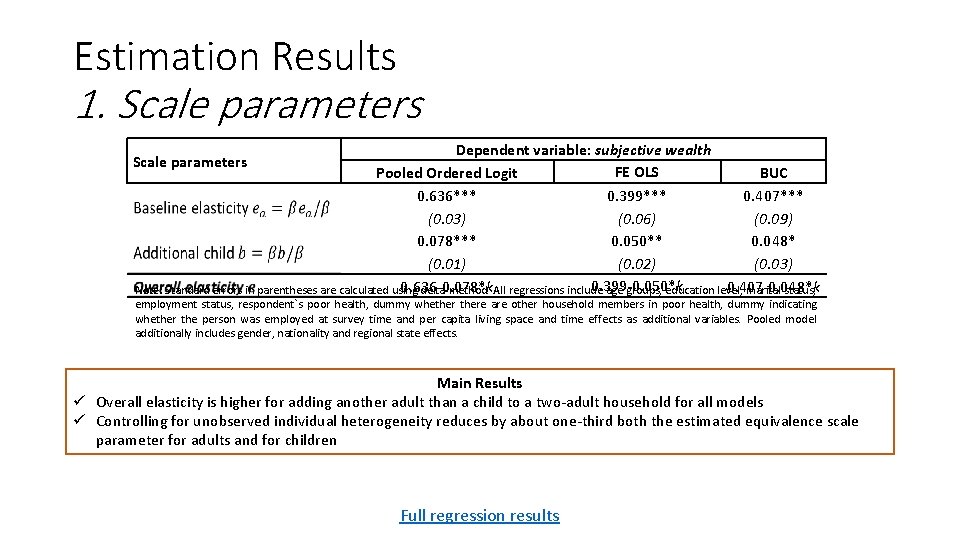
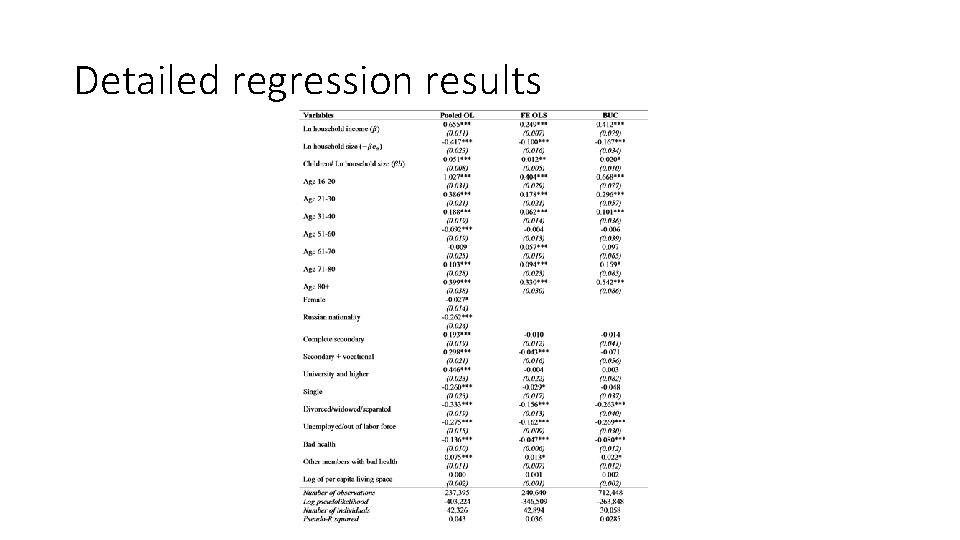
Estimation Results 1. Scale parameters Dependent variable: subjective wealth FE OLS Pooled Ordered Logit BUC 0. 399*** 0. 636*** 0. 407*** (0. 03) (0. 09) (0. 06) 0. 050** 0. 078*** 0. 048* (0. 01) (0. 03) (0. 02) 0. 399 -0. 050*k 0. 636 -0. 078*k 0. 407 -0. 048*k Note: Standard errors in parentheses are calculated using delta-method. All regressions include age groups, education level, marital status, Scale parameters employment status, respondent`s poor health, dummy whethere are other household members in poor health, dummy indicating whether the person was employed at survey time and per capita living space and time effects as additional variables. Pooled model additionally includes gender, nationality and regional state effects. Main Results ü Overall elasticity is higher for adding another adult than a child to a two-adult household for all models ü Controlling for unobserved individual heterogeneity reduces by about one-third both the estimated equivalence scale parameter for adults and for children Full regression results
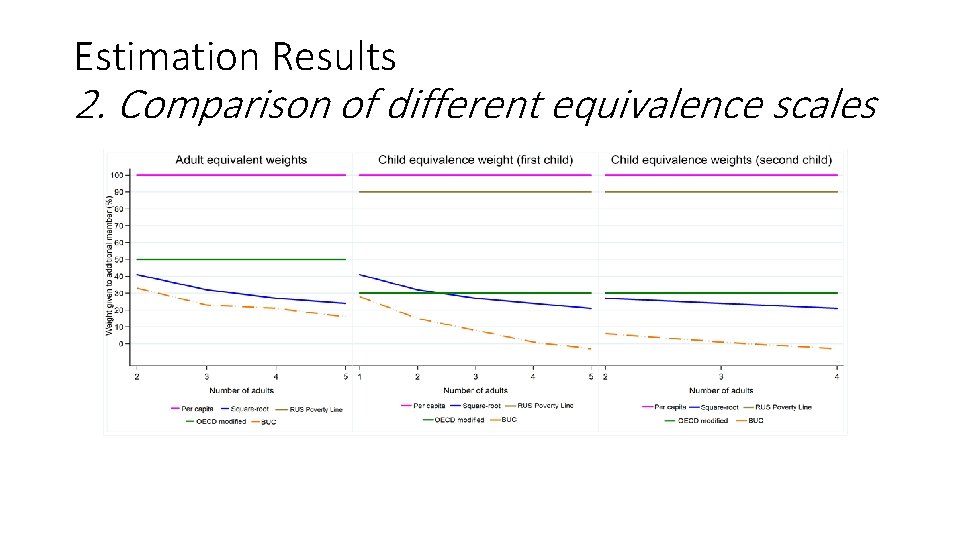
Estimation Results 2. Comparison of different equivalence scales
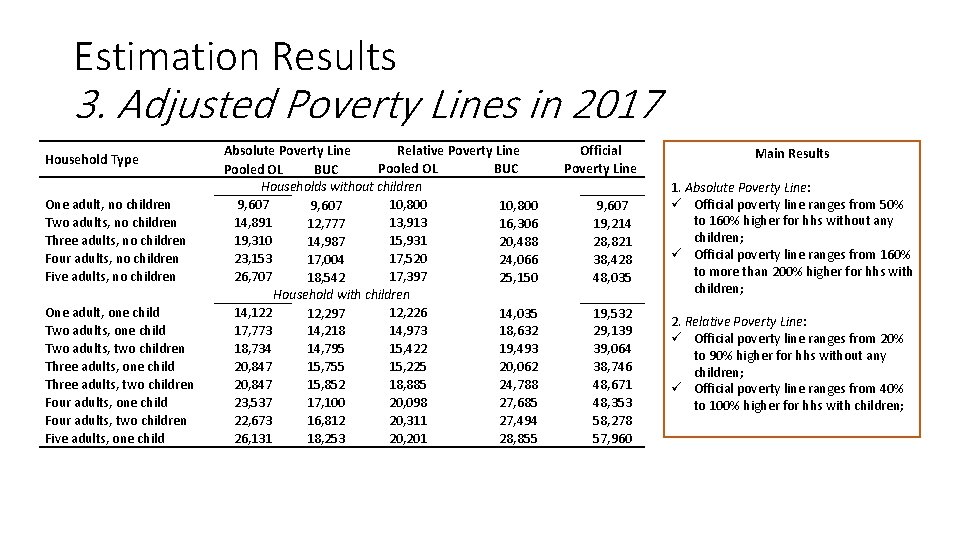
Estimation Results 3. Adjusted Poverty Lines in 2017 Household Type One adult, no children Two adults, no children Three adults, no children Four adults, no children Five adults, no children One adult, one child Two adults, two children Three adults, one child Three adults, two children Four adults, one child Four adults, two children Five adults, one child Absolute Poverty Line Relative Poverty Line Pooled OL BUC Households without children 9, 607 10, 800 14, 891 13, 913 12, 777 16, 306 19, 310 15, 931 14, 987 20, 488 23, 153 17, 520 17, 004 24, 066 26, 707 17, 397 18, 542 25, 150 Household with children 14, 122 12, 226 12, 297 14, 035 17, 773 14, 973 14, 218 18, 632 18, 734 15, 422 14, 795 19, 493 20, 847 15, 225 15, 755 20, 062 20, 847 18, 885 15, 852 24, 788 23, 537 20, 098 17, 100 27, 685 22, 673 20, 311 16, 812 27, 494 26, 131 20, 201 18, 253 28, 855 Official Poverty Line 9, 607 19, 214 28, 821 38, 428 48, 035 19, 532 29, 139 39, 064 38, 746 48, 671 48, 353 58, 278 57, 960 Main Results 1. Absolute Poverty Line: ü Official poverty line ranges from 50% to 160% higher for hhs without any children; ü Official poverty line ranges from 160% to more than 200% higher for hhs with children; 2. Relative Poverty Line: ü Official poverty line ranges from 20% to 90% higher for hhs without any children; ü Official poverty line ranges from 40% to 100% higher for hhs with children;
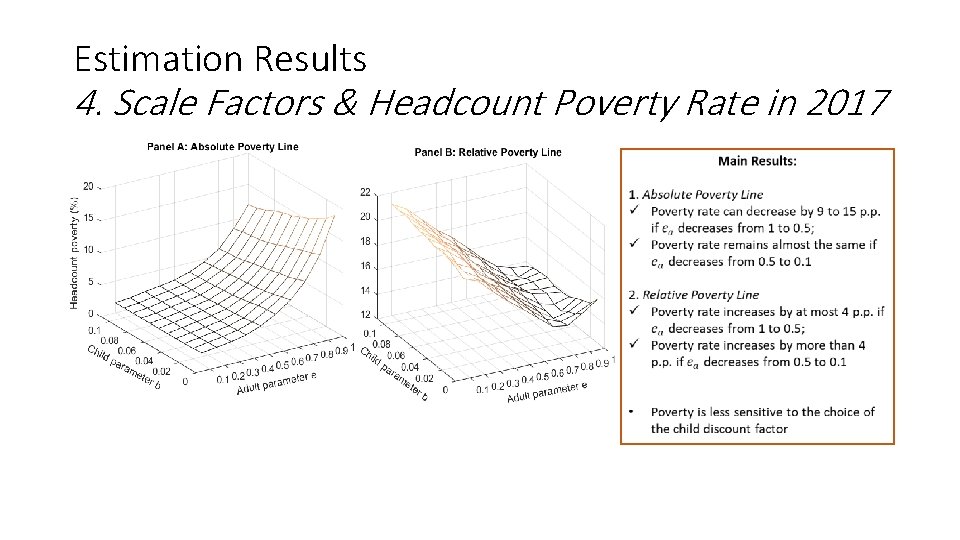
Estimation Results 4. Scale Factors & Headcount Poverty Rate in 2017
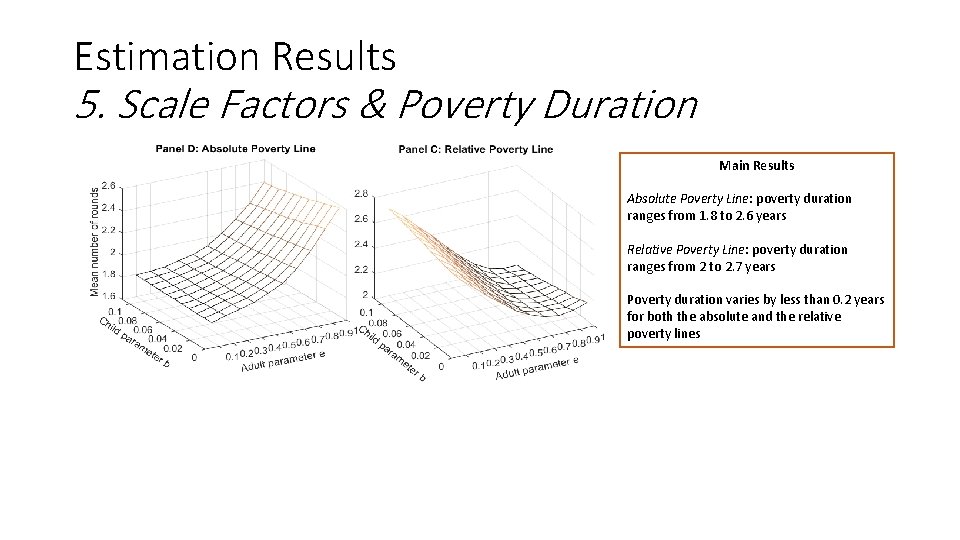
Estimation Results 5. Scale Factors & Poverty Duration Main Results Absolute Poverty Line: poverty duration ranges from 1. 8 to 2. 6 years Relative Poverty Line: poverty duration ranges from 2 to 2. 7 years Poverty duration varies by less than 0. 2 years for both the absolute and the relative poverty lines
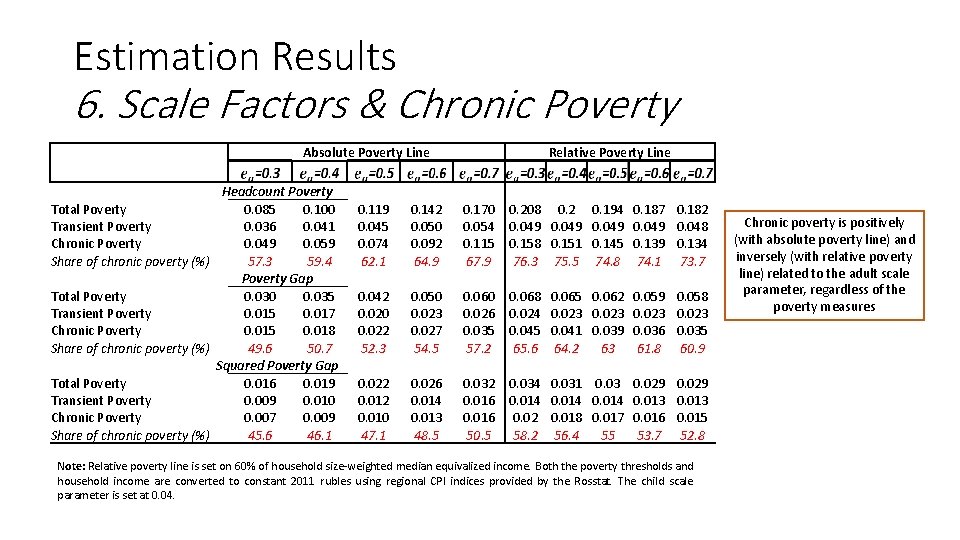
Estimation Results 6. Scale Factors & Chronic Poverty Absolute Poverty Line Headcount Poverty Total Poverty 0. 085 0. 100 Transient Poverty 0. 036 0. 041 Chronic Poverty 0. 049 0. 059 Share of chronic poverty (%) 57. 3 59. 4 Poverty Gap Total Poverty 0. 030 0. 035 Transient Poverty 0. 015 0. 017 Chronic Poverty 0. 015 0. 018 Share of chronic poverty (%) 49. 6 50. 7 Squared Poverty Gap Total Poverty 0. 016 0. 019 Transient Poverty 0. 009 0. 010 Chronic Poverty 0. 007 0. 009 Share of chronic poverty (%) 45. 6 46. 1 Relative Poverty Line 0. 119 0. 045 0. 074 62. 1 0. 142 0. 050 0. 092 64. 9 0. 170 0. 054 0. 115 67. 9 0. 208 0. 2 0. 194 0. 187 0. 182 0. 049 0. 048 0. 151 0. 145 0. 139 0. 134 76. 3 75. 5 74. 8 74. 1 73. 7 0. 042 0. 020 0. 022 52. 3 0. 050 0. 023 0. 027 54. 5 0. 060 0. 026 0. 035 57. 2 0. 068 0. 024 0. 045 65. 6 0. 065 0. 062 0. 059 0. 058 0. 023 0. 041 0. 039 0. 036 0. 035 64. 2 63 61. 8 60. 9 0. 022 0. 010 47. 1 0. 026 0. 014 0. 013 48. 5 0. 032 0. 016 50. 5 0. 034 0. 014 0. 02 58. 2 0. 031 0. 03 0. 029 0. 014 0. 013 0. 018 0. 017 0. 016 0. 015 56. 4 55 53. 7 52. 8 Note: Relative poverty line is set on 60% of household size-weighted median equivalized income. Both the poverty thresholds and household income are converted to constant 2011 rubles using regional CPI indices provided by the Rosstat. The child scale parameter is set at 0. 04. Chronic poverty is positively (with absolute poverty line) and inversely (with relative poverty line) related to the adult scale parameter, regardless of the poverty measures
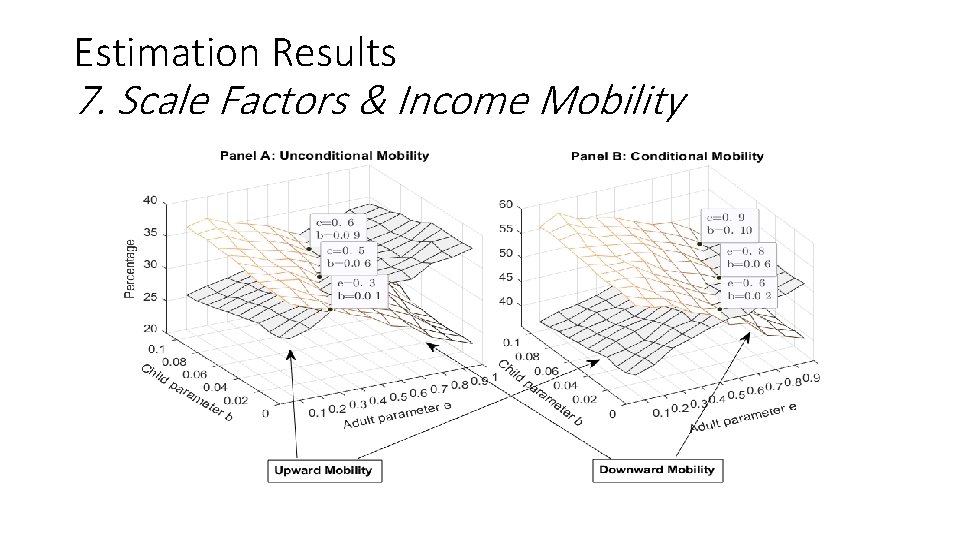
Estimation Results 7. Scale Factors & Income Mobility
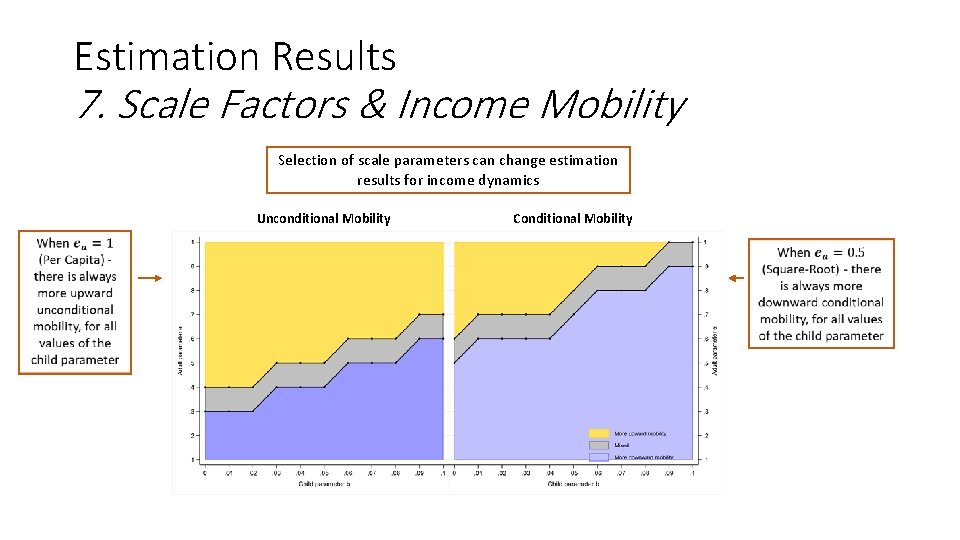
Estimation Results 7. Scale Factors & Income Mobility Selection of scale parameters can change estimation results for income dynamics Unconditional Mobility Conditional Mobility
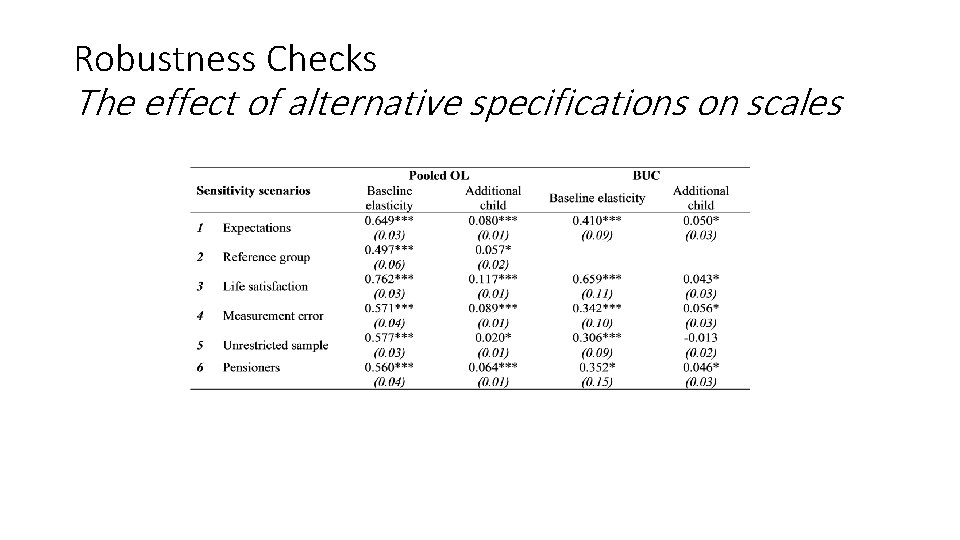
Robustness Checks and Further Extensions • Alternative specifications on scale parameters estimates • Alternative functional form • Alternative measurements of chronic poverty
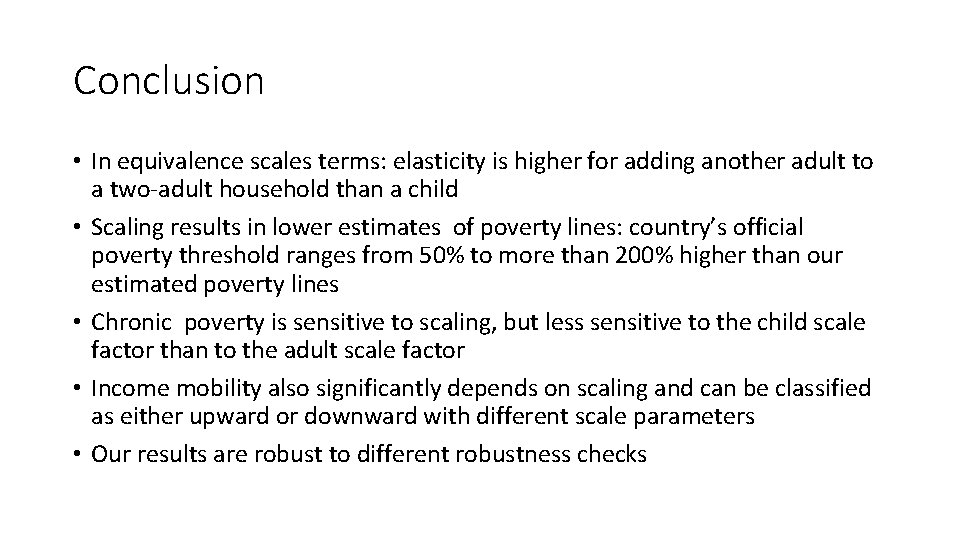
Conclusion • In equivalence scales terms: elasticity is higher for adding another adult to a two-adult household than a child • Scaling results in lower estimates of poverty lines: country’s official poverty threshold ranges from 50% to more than 200% higher than our estimated poverty lines • Chronic poverty is sensitive to scaling, but less sensitive to the child scale factor than to the adult scale factor • Income mobility also significantly depends on scaling and can be classified as either upward or downward with different scale parameters • Our results are robust to different robustness checks
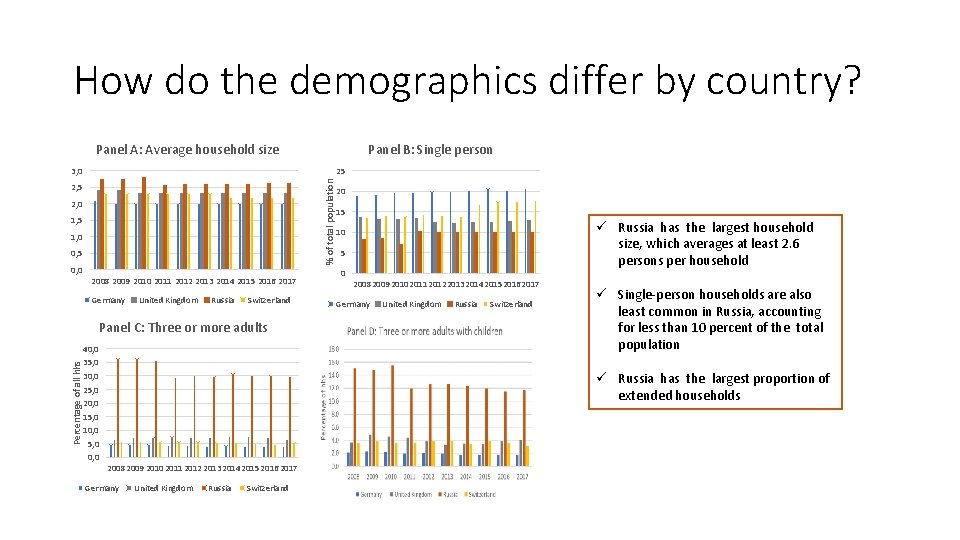
How do the demographics differ by country? Panel A: Average household size 25 % of total population 3, 0 2, 5 20 2, 0 15 1, 5 0, 5 2008 2009 2010 2011 2012 2013 2014 2015 2016 2017 Germany United Kingdom Russia Switzerland Panel C: Three or more adults 40, 0 Percentage of all hhs ü Russia has the largest household size, which averages at least 2. 6 persons per household 10 1, 0 0, 0 Panel B: Single person 5 0 2008200920102011201220132014201520162017 Germany United Kingdom Russia Switzerland ü Single-person households are also least common in Russia, accounting for less than 10 percent of the total population 35, 0 ü Russia has the largest proportion of extended households 30, 0 25, 0 20, 0 15, 0 10, 0 5, 0 0, 0 2008 2009 2010 2011 2012 2013 2014 2015 2016 2017 Germany United Kingdom Russia Switzerland
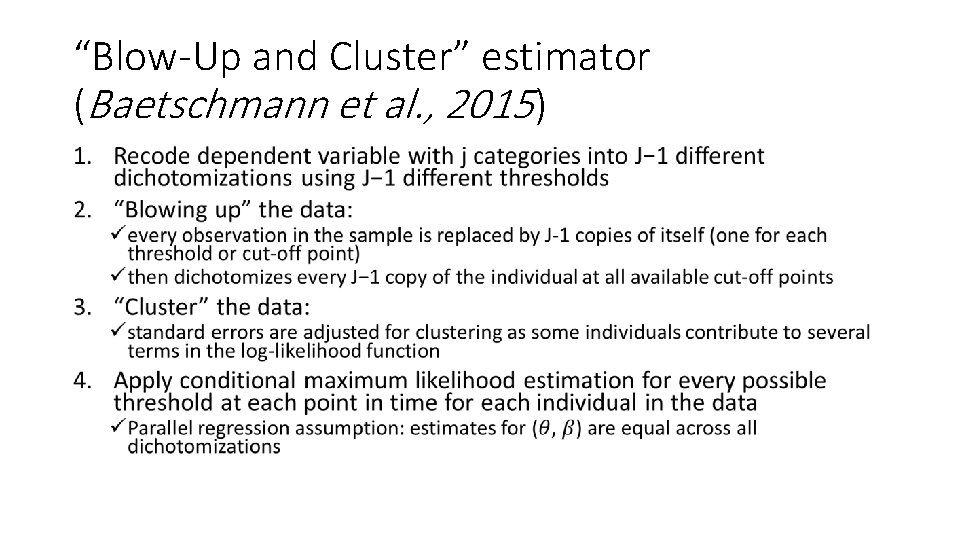
“Blow-Up and Cluster” estimator (Baetschmann et al. , 2015) •
Detailed regression results
Robustness Checks The effect of alternative specifications on scales
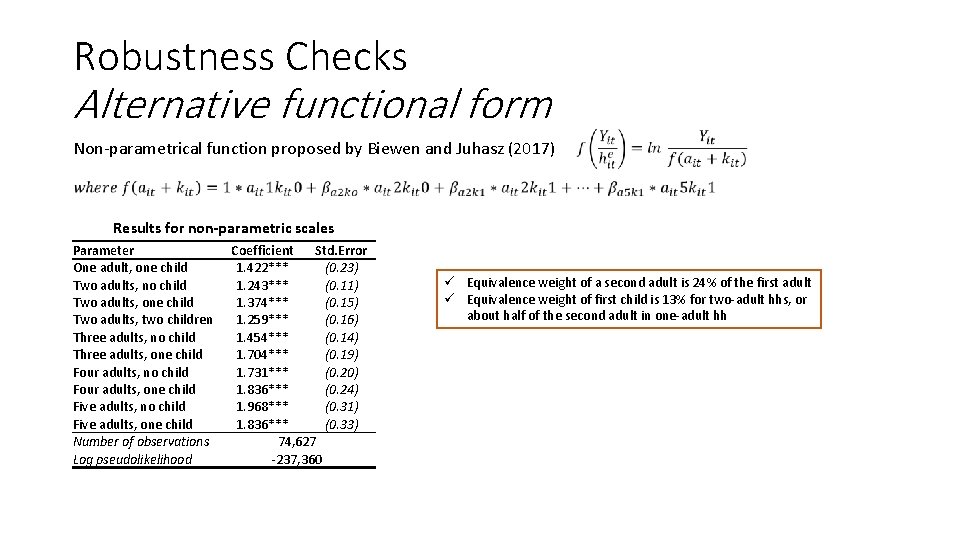
Robustness Checks Alternative functional form Non-parametrical function proposed by Biewen and Juhasz (2017) Results for non-parametric scales Parameter One adult, one child Two adults, no child Two adults, one child Two adults, two children Three adults, no child Three adults, one child Four adults, no child Four adults, one child Five adults, no child Five adults, one child Number of observations Log pseudolikelihood Coefficient Std. Error 1. 422*** (0. 23) 1. 243*** (0. 11) 1. 374*** (0. 15) 1. 259*** (0. 16) 1. 454*** (0. 14) 1. 704*** (0. 19) 1. 731*** (0. 20) 1. 836*** (0. 24) 1. 968*** (0. 31) 1. 836*** (0. 33) 74, 627 -237, 360 ü Equivalence weight of a second adult is 24% of the first adult ü Equivalence weight of first child is 13% for two-adult hhs, or about half of the second adult in one-adult hh
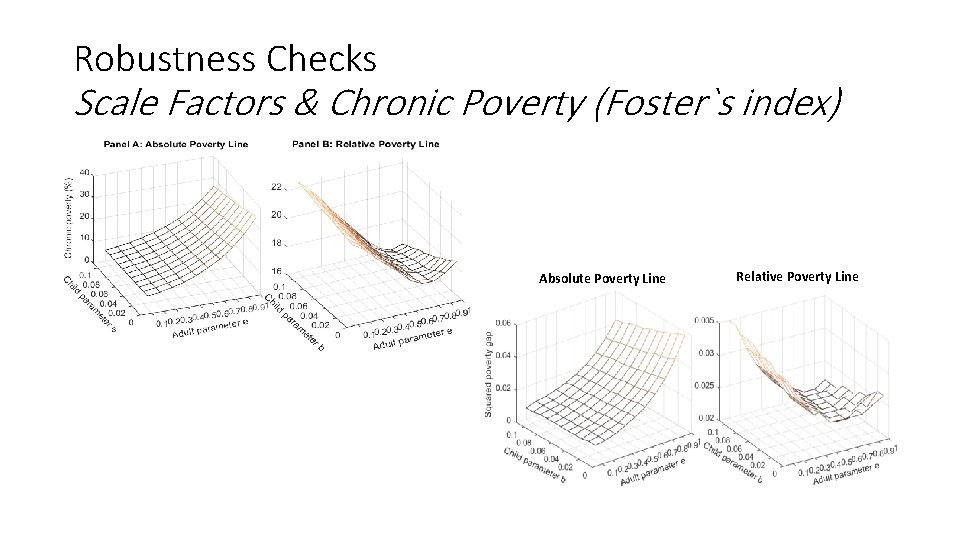
Robustness Checks Scale Factors & Chronic Poverty (Foster`s index) Absolute Poverty Line Relative Poverty Line