
THE IMPORTANCE OF WATER TO LIFE Hydrogen Bonds
THE IMPORTANCE OF WATER TO LIFE
Hydrogen Bonds Give Water Unique Properties • Water molecules are polar molecules • Unequal sharing of electrons & V-like shape – They can thus form hydrogen bonds with each other and with other polar molecules • Each hydrogen bond is very weak – However, the cumulative effect of enormous numbers can make them quite strong • Hydrogen bonding is responsible for many of the physical properties of water
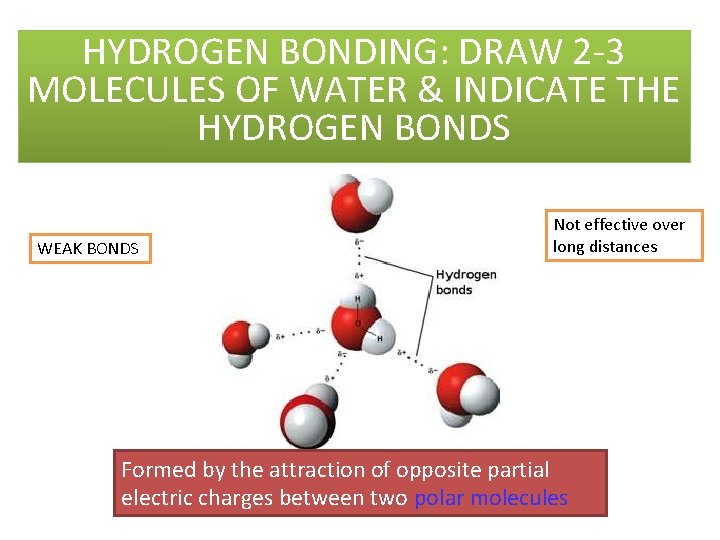
HYDROGEN BONDING: DRAW 2 -3 MOLECULES OF WATER & INDICATE THE HYDROGEN BONDS WEAK BONDS Not effective over long distances Formed by the attraction of opposite partial electric charges between two polar molecules
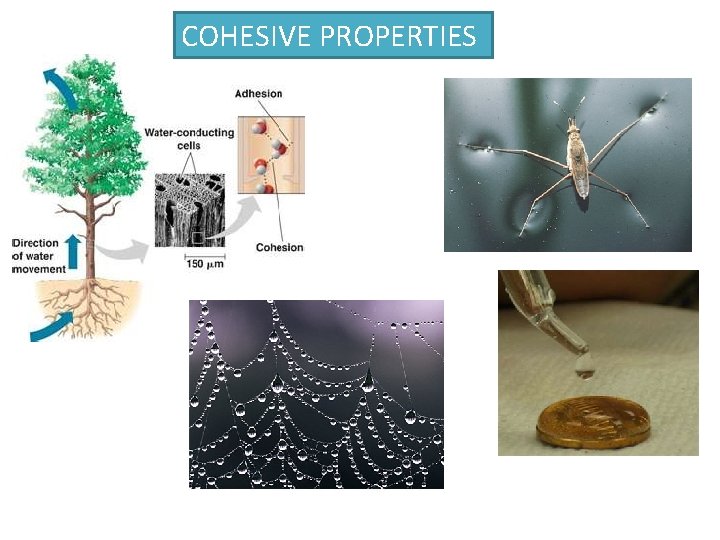
COHESIVE PROPERTIES
Heat vs Temperature • Heat= is a measure of the total amount of kinetic energy due to molecular motion in a body of matter. – Calorie= the amount of heat it takes to raise the temperature of 1 g of water by 10 C • Kilocalorie= 1, 000 calories – Joule (J) one joule = 0. 239 calories and 1 calorie= 4. 184 J • Temperature= the intensity of heat due to the average kinetic energy of the molecules. – We will use Celsius to indicate temperature
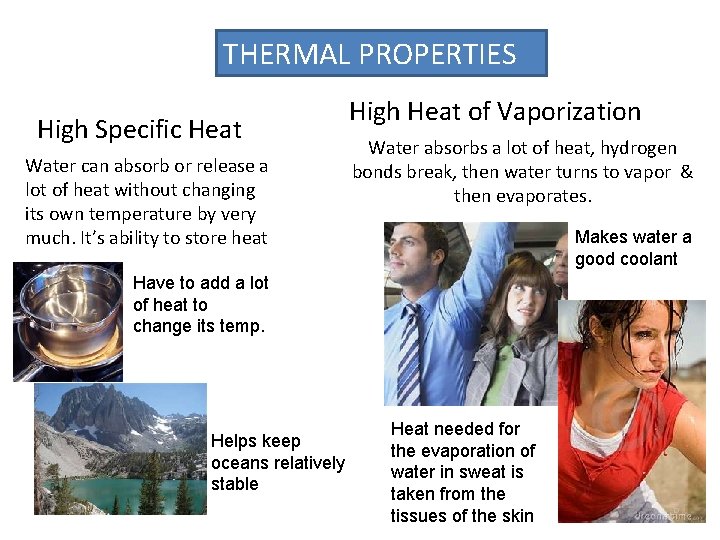
THERMAL PROPERTIES High Specific Heat Water can absorb or release a lot of heat without changing its own temperature by very much. It’s ability to store heat High Heat of Vaporization Water absorbs a lot of heat, hydrogen bonds break, then water turns to vapor & then evaporates. Makes water a good coolant Have to add a lot of heat to change its temp. Helps keep oceans relatively stable Heat needed for the evaporation of water in sweat is taken from the tissues of the skin
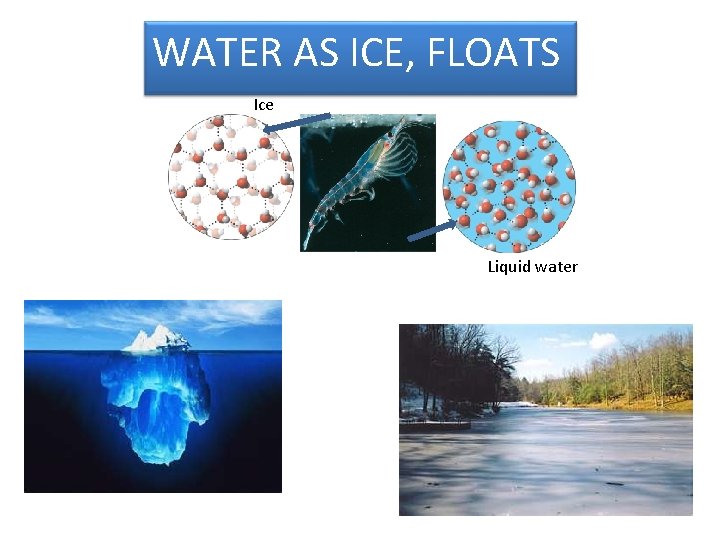
WATER AS ICE, FLOATS Ice Liquid water
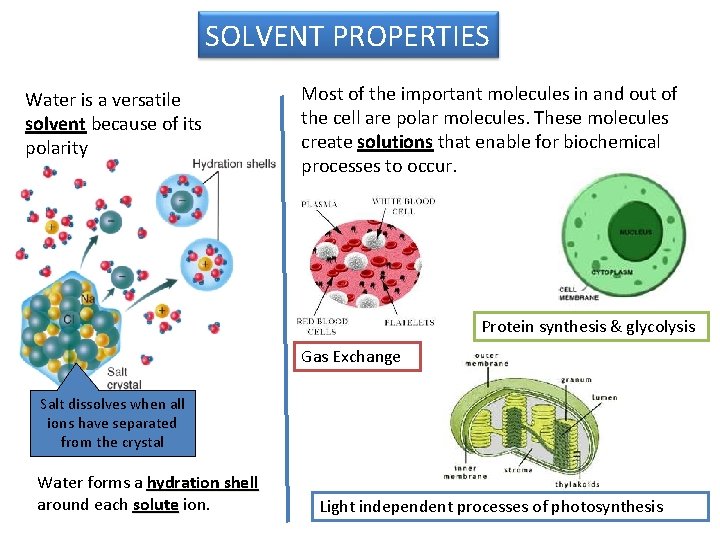
SOLVENT PROPERTIES Water is a versatile solvent because of its polarity Most of the important molecules in and out of the cell are polar molecules. These molecules create solutions that enable for biochemical processes to occur. Protein synthesis & glycolysis Gas Exchange Salt dissolves when all ions have separated from the crystal Water forms a hydration shell around each solute ion. Light independent processes of photosynthesis
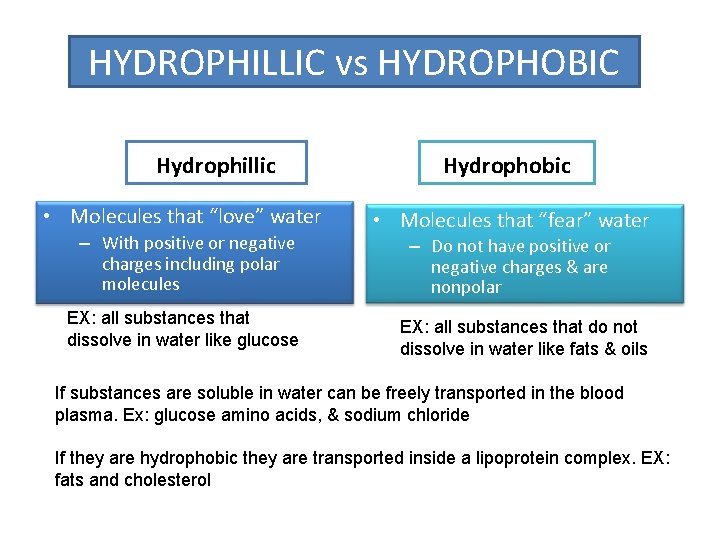
HYDROPHILLIC vs HYDROPHOBIC Hydrophillic • Molecules that “love” water – With positive or negative charges including polar molecules EX: all substances that dissolve in water like glucose Hydrophobic • Molecules that “fear” water – Do not have positive or negative charges & are nonpolar EX: all substances that do not dissolve in water like fats & oils If substances are soluble in water can be freely transported in the blood plasma. Ex: glucose amino acids, & sodium chloride If they are hydrophobic they are transported inside a lipoprotein complex. EX: fats and cholesterol
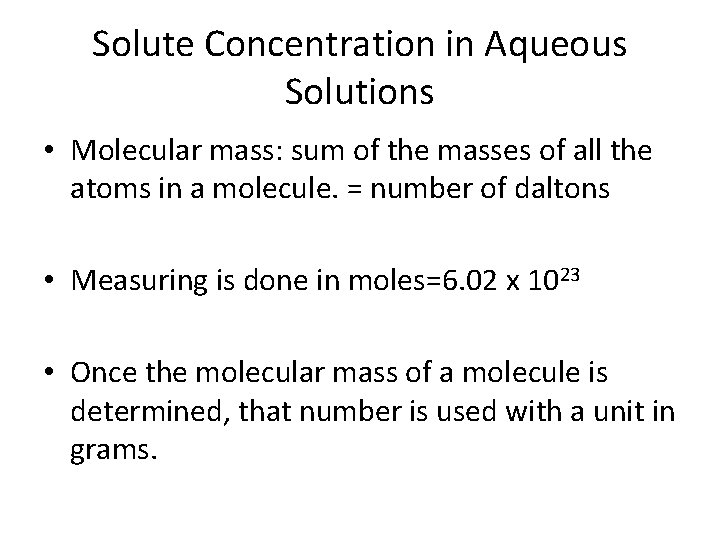
Solute Concentration in Aqueous Solutions • Molecular mass: sum of the masses of all the atoms in a molecule. = number of daltons • Measuring is done in moles=6. 02 x 1023 • Once the molecular mass of a molecule is determined, that number is used with a unit in grams.
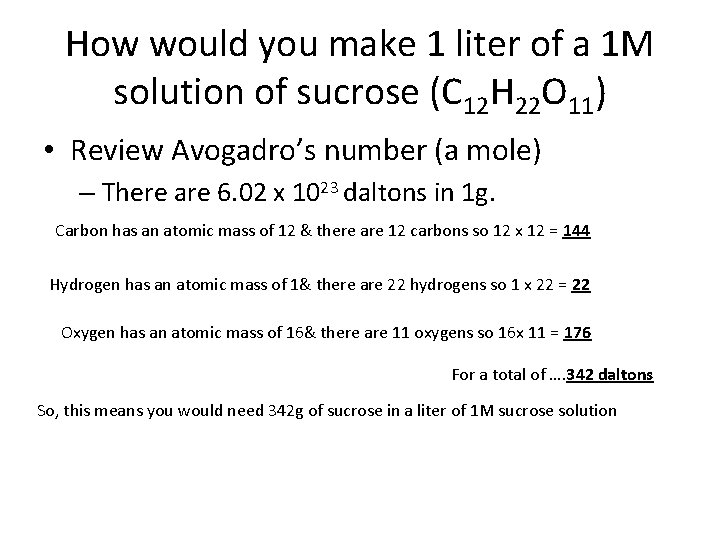
How would you make 1 liter of a 1 M solution of sucrose (C 12 H 22 O 11) • Review Avogadro’s number (a mole) – There are 6. 02 x 1023 daltons in 1 g. Carbon has an atomic mass of 12 & there are 12 carbons so 12 x 12 = 144 Hydrogen has an atomic mass of 1& there are 22 hydrogens so 1 x 22 = 22 Oxygen has an atomic mass of 16& there are 11 oxygens so 16 x 11 = 176 For a total of …. 342 daltons So, this means you would need 342 g of sucrose in a liter of 1 M sucrose solution
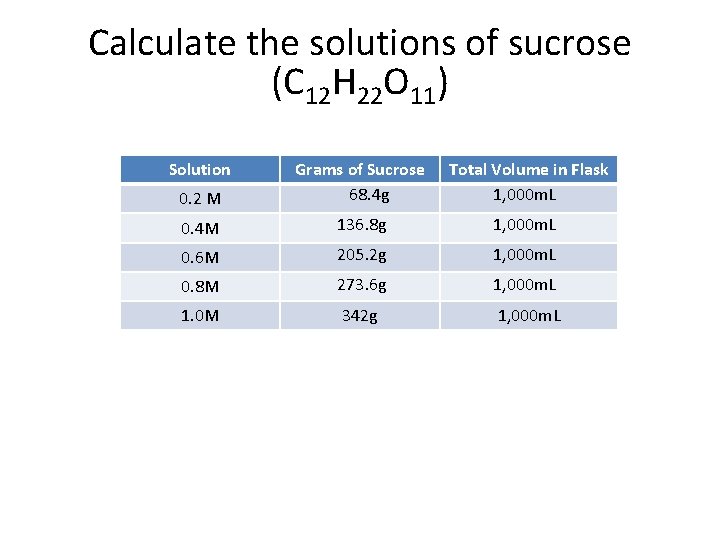
Calculate the solutions of sucrose (C 12 H 22 O 11) Solution 0. 2 M Grams of Sucrose 68. 4 g Total Volume in Flask 1, 000 m. L 0. 4 M 136. 8 g 1, 000 m. L 0. 6 M 205. 2 g 1, 000 m. L 0. 8 M 273. 6 g 1, 000 m. L 1. 0 M 342 g 1, 000 m. L
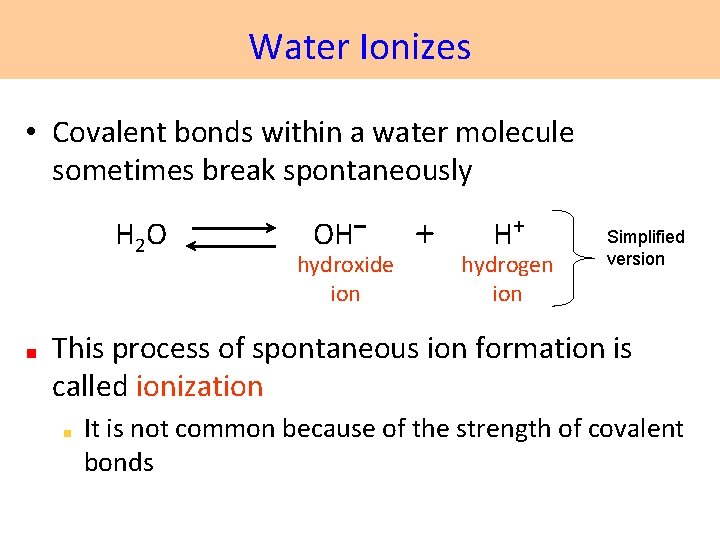
Water Ionizes • Covalent bonds within a water molecule sometimes break spontaneously H 2 O OH– hydroxide ion + H+ hydrogen ion Simplified version This process of spontaneous ion formation is called ionization It is not common because of the strength of covalent bonds
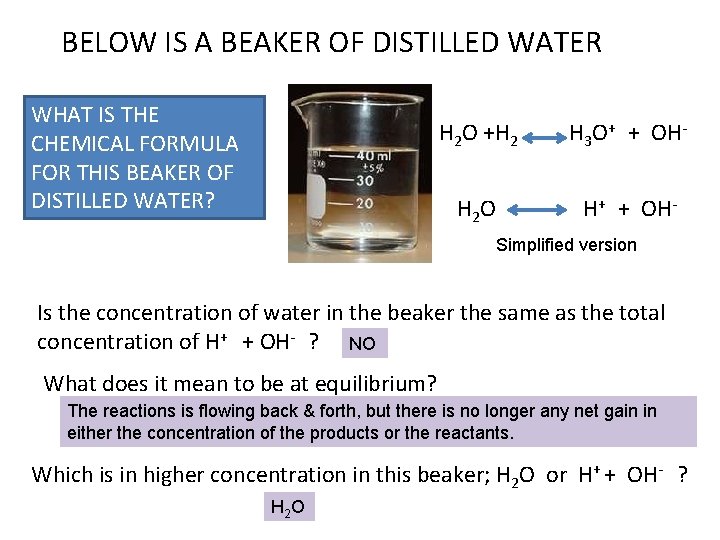
BELOW IS A BEAKER OF DISTILLED WATER WHAT IS THE CHEMICAL FORMULA FOR THIS BEAKER OF DISTILLED WATER? H 2 O +H 2 H 3 O+ + OH- H 2 O H+ + OHSimplified version Is the concentration of water in the beaker the same as the total concentration of H+ + OH- ? NO What does it mean to be at equilibrium? The reactions is flowing back & forth, but there is no longer any net gain in either the concentration of the products or the reactants. Which is in higher concentration in this beaker; H 2 O or H+ + OH- ? H 2 O
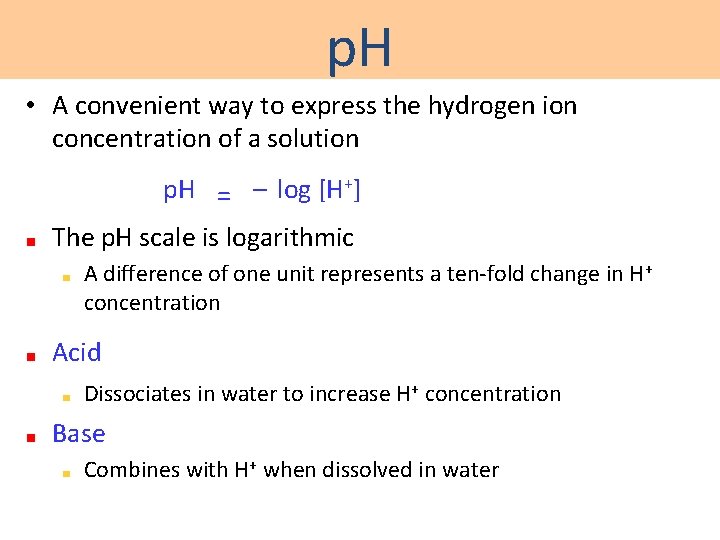
p. H • A convenient way to express the hydrogen ion concentration of a solution p. H = _ log [H+] The p. H scale is logarithmic A difference of one unit represents a ten-fold change in H+ concentration Acid Dissociates in water to increase H+ concentration Base Combines with H+ when dissolved in water
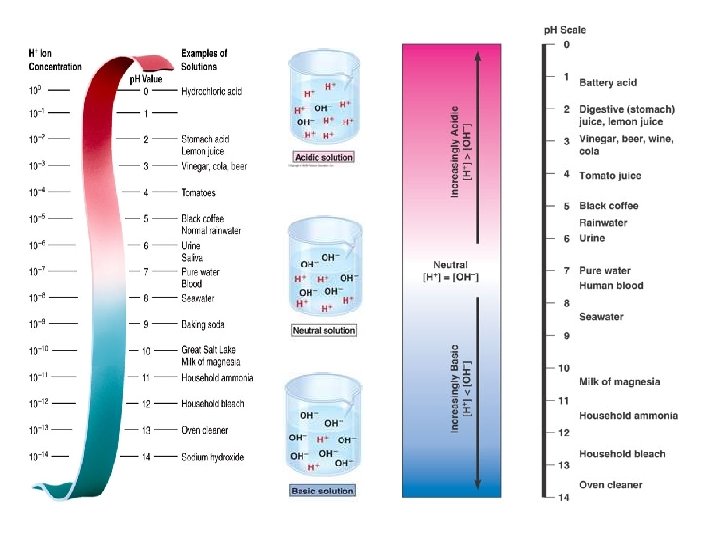
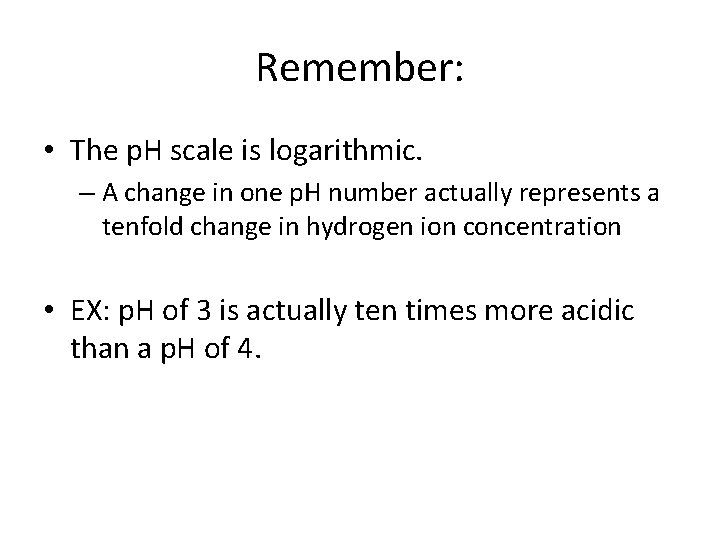
Remember: • The p. H scale is logarithmic. – A change in one p. H number actually represents a tenfold change in hydrogen ion concentration • EX: p. H of 3 is actually ten times more acidic than a p. H of 4.
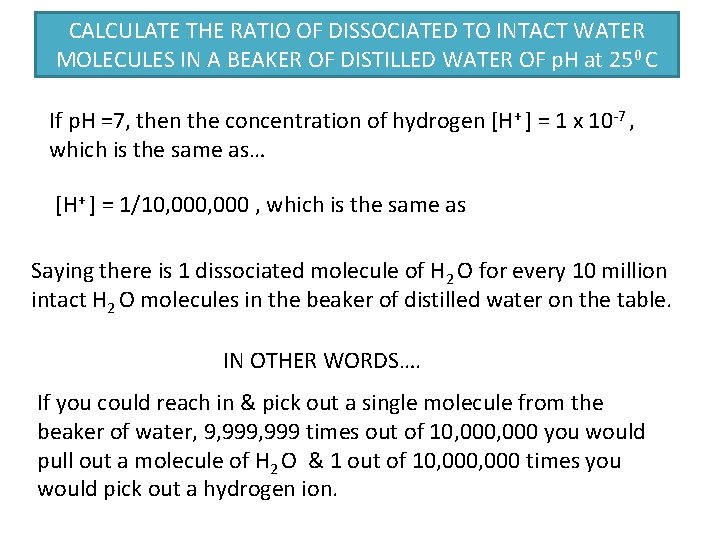
CALCULATE THE RATIO OF DISSOCIATED TO INTACT WATER MOLECULES IN A BEAKER OF DISTILLED WATER OF p. H at 250 C If p. H =7, then the concentration of hydrogen [H+ ] = 1 x 10 -7 , which is the same as… [H+ ] = 1/10, 000 , which is the same as Saying there is 1 dissociated molecule of H 2 O for every 10 million intact H 2 O molecules in the beaker of distilled water on the table. IN OTHER WORDS…. If you could reach in & pick out a single molecule from the beaker of water, 9, 999 times out of 10, 000 you would pull out a molecule of H 2 O & 1 out of 10, 000 times you would pick out a hydrogen ion.
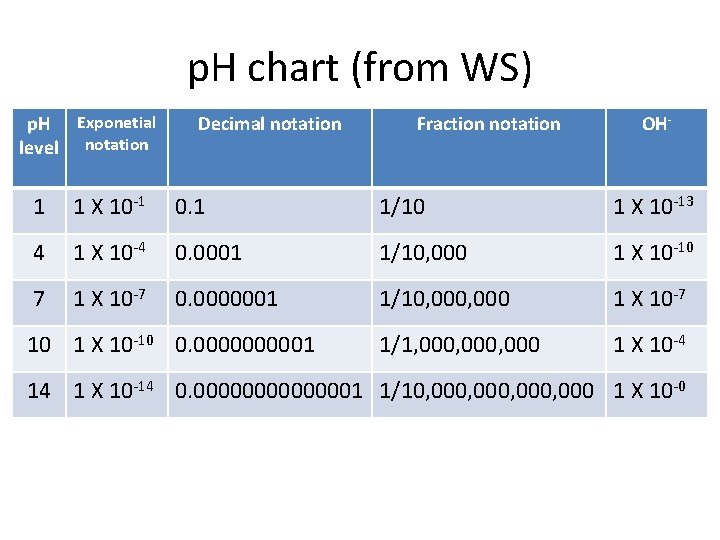
p. H chart (from WS) p. H Exponetial level notation Decimal notation Fraction notation OH- 1 1 X 10 -1 0. 1 1/10 1 X 10 -13 4 1 X 10 -4 0. 0001 1/10, 000 1 X 10 -10 7 1 X 10 -7 0. 0000001 1/10, 000 1 X 10 -7 1/1, 000, 000 1 X 10 -4 10 1 X 10 -10 0. 000001 14 1 X 10 -14 0. 00000001 1/10, 000, 000 1 X 10 -0
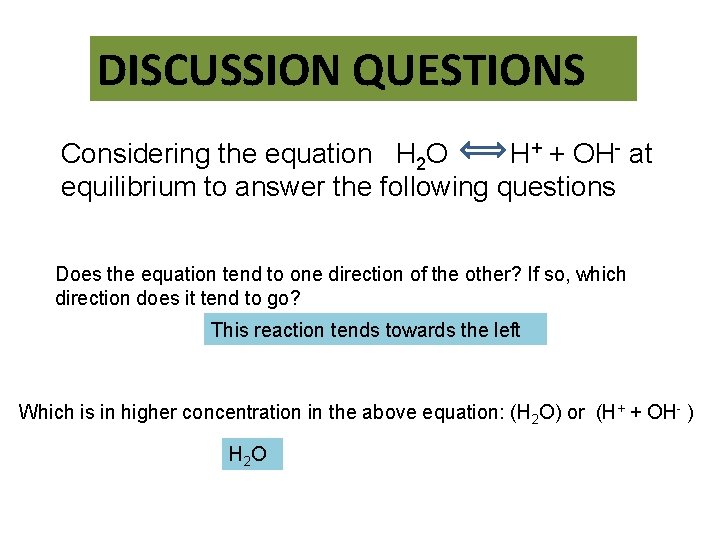
DISCUSSION QUESTIONS Considering the equation H 2 O H+ + OH- at equilibrium to answer the following questions Does the equation tend to one direction of the other? If so, which direction does it tend to go? This reaction tends towards the left Which is in higher concentration in the above equation: (H 2 O) or (H+ + OH- ) H 2 O
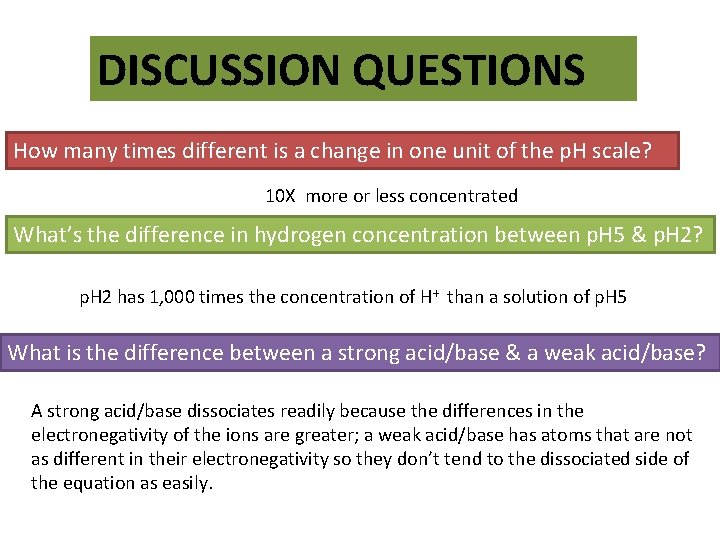
DISCUSSION QUESTIONS How many times different is a change in one unit of the p. H scale? 10 X more or less concentrated What’s the difference in hydrogen concentration between p. H 5 & p. H 2? p. H 2 has 1, 000 times the concentration of H+ than a solution of p. H 5 What is the difference between a strong acid/base & a weak acid/base? A strong acid/base dissociates readily because the differences in the electronegativity of the ions are greater; a weak acid/base has atoms that are not as different in their electronegativity so they don’t tend to the dissociated side of the equation as easily.
DISCUSSION QUESTIONS Which acids/bases are weaker & which are stronger --HCl, NH 3, H 2 CO 3 & Na. OH? Cl & Na both have very high electronegativity – they are both in column VII of ther periodic table with nearly full valence shells - & so they tend to dominate the electrons of H+ or OH- since the electronegativity of these atoms are very low. This huge difference in electronegativity causes a strong tendency for Na. OH and HCl to dissociate. When the H+ or OH- dissociate from the Na & the Cl they are free to react with other molecules making them strong acids & bases. N & CO 3 don’t have as strong of an electronegative difference with H since they are in columns IV-VI. Because of their lower electronegativity they do not dissociate as readily as HCl & Na. OH so they are considered weaker acids & bases.
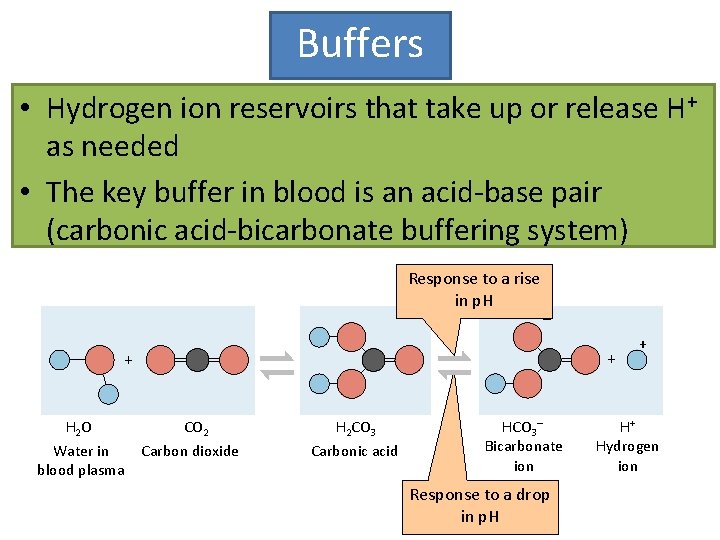
Buffers • Hydrogen ion reservoirs that take up or release H+ as needed • The key buffer in blood is an acid-base pair (carbonic acid-bicarbonate buffering system) Response to a rise in p. H – + + H 2 O Water in blood plasma CO 2 Carbon dioxide H 2 CO 3 Carbonic acid HCO 3– Bicarbonate ion Response to a drop in p. H + H+ Hydrogen ion
- Slides: 25