
The Importance of Verbal Interpretation in Gait Retraining
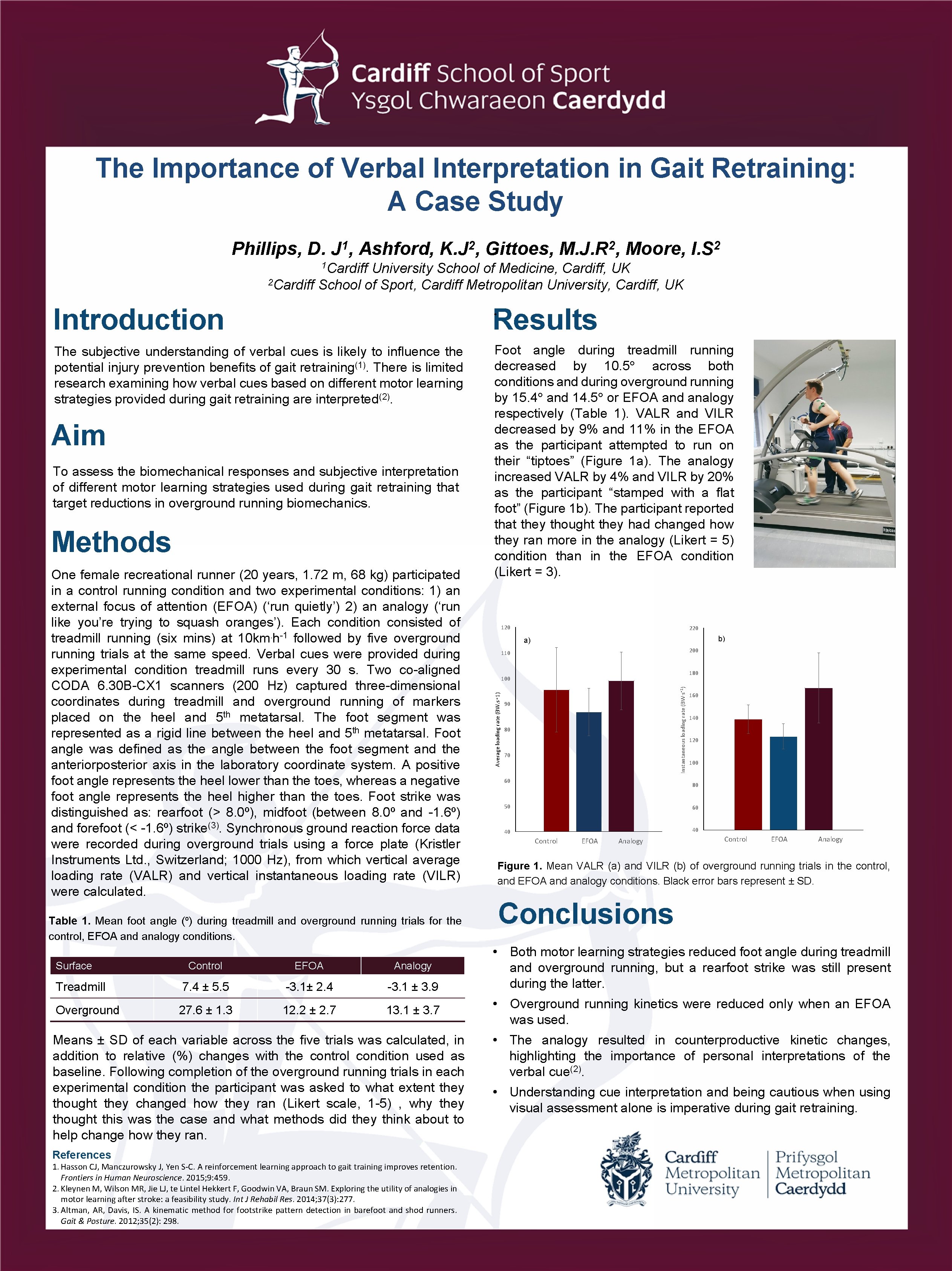
The Importance of Verbal Interpretation in Gait Retraining: A Case Study Phillips, D. 1 J, Ashford, 2 K. J , Gittoes, 2 M. J. R , Moore, 2 I. S 1 Cardiff University School of Medicine, Cardiff, UK 2 Cardiff School of Sport, Cardiff Metropolitan University, Cardiff, UK Introduction Results The subjective understanding of verbal cues is likely to influence the potential injury prevention benefits of gait retraining(1). There is limited research examining how verbal cues based on different motor learning strategies provided during gait retraining are interpreted(2). Foot angle during treadmill running decreased by 10. 5 across both conditions and during overground running by 15. 4 and 14. 5 or EFOA and analogy respectively (Table 1). VALR and VILR decreased by 9% and 11% in the EFOA as the participant attempted to run on their “tiptoes” (Figure 1 a). The analogy increased VALR by 4% and VILR by 20% as the participant “stamped with a flat foot” (Figure 1 b). The participant reported that they thought they had changed how they ran more in the analogy (Likert = 5) condition than in the EFOA condition (Likert = 3). Methods One female recreational runner (20 years, 1. 72 m, 68 kg) participated in a control running condition and two experimental conditions: 1) an external focus of attention (EFOA) (‘run quietly’) 2) an analogy (‘run like you’re trying to squash oranges’). Each condition consisted of treadmill running (six mins) at 10 km. h-1 followed by five overground running trials at the same speed. Verbal cues were provided during experimental condition treadmill runs every 30 s. Two co-aligned CODA 6. 30 B-CX 1 scanners (200 Hz) captured three-dimensional coordinates during treadmill and overground running of markers placed on the heel and 5 th metatarsal. The foot segment was represented as a rigid line between the heel and 5 th metatarsal. Foot angle was defined as the angle between the foot segment and the anteriorposterior axis in the laboratory coordinate system. A positive foot angle represents the heel lower than the toes, whereas a negative foot angle represents the heel higher than the toes. Foot strike was distinguished as: rearfoot (> 8. 0º), midfoot (between 8. 0º and -1. 6º) and forefoot (< -1. 6º) strike(3). Synchronous ground reaction force data were recorded during overground trials using a force plate (Kristler Instruments Ltd. , Switzerland; 1000 Hz), from which vertical average loading rate (VALR) and vertical instantaneous loading rate (VILR) were calculated. Table 1. Mean foot angle (º) during treadmill and overground running trials for the control, EFOA and analogy conditions. Surface Treadmill Overground Control EFOA Analogy 7. 4 ± 5. 5 -3. 1± 2. 4 -3. 1 ± 3. 9 27. 6 ± 1. 3 12. 2 ± 2. 7 13. 1 ± 3. 7 Means ± SD of each variable across the five trials was calculated, in addition to relative (%) changes with the control condition used as baseline. Following completion of the overground running trials in each experimental condition the participant was asked to what extent they thought they changed how they ran (Likert scale, 1 -5) , why they thought this was the case and what methods did they think about to help change how they ran. References 1. Hasson CJ, Manczurowsky J, Yen S-C. A reinforcement learning approach to gait training improves retention. Frontiers in Human Neuroscience. 2015; 9: 459. 2. Kleynen M, Wilson MR, Jie LJ, te Lintel Hekkert F, Goodwin VA, Braun SM. Exploring the utility of analogies in motor learning after stroke: a feasibility study. Int J Rehabil Res. 2014; 37(3): 277. 3. Altman, AR, Davis, IS. A kinematic method for footstrike pattern detection in barefoot and shod runners. Gait & Posture. 2012; 35(2): 298. 120 220 b) a) 200 110 180 100 Instantaneous loading rate (BW. s⁃1) To assess the biomechanical responses and subjective interpretation of different motor learning strategies used during gait retraining that target reductions in overground running biomechanics. Average loading rate (BW. s⁃1) Aim 90 80 70 60 140 120 100 80 50 60 40 40 Control EFOA Analogy Figure 1. Mean VALR (a) and VILR (b) of overground running trials in the control, and EFOA and analogy conditions. Black error bars represent ± SD. Conclusions • Both motor learning strategies reduced foot angle during treadmill and overground running, but a rearfoot strike was still present during the latter. • Overground running kinetics were reduced only when an EFOA was used. • The analogy resulted in counterproductive kinetic changes, highlighting the importance of personal interpretations of the verbal cue(2). • Understanding cue interpretation and being cautious when using visual assessment alone is imperative during gait retraining.
- Slides: 1