
The Importance of the Representation of Deep Convection
- Slides: 1
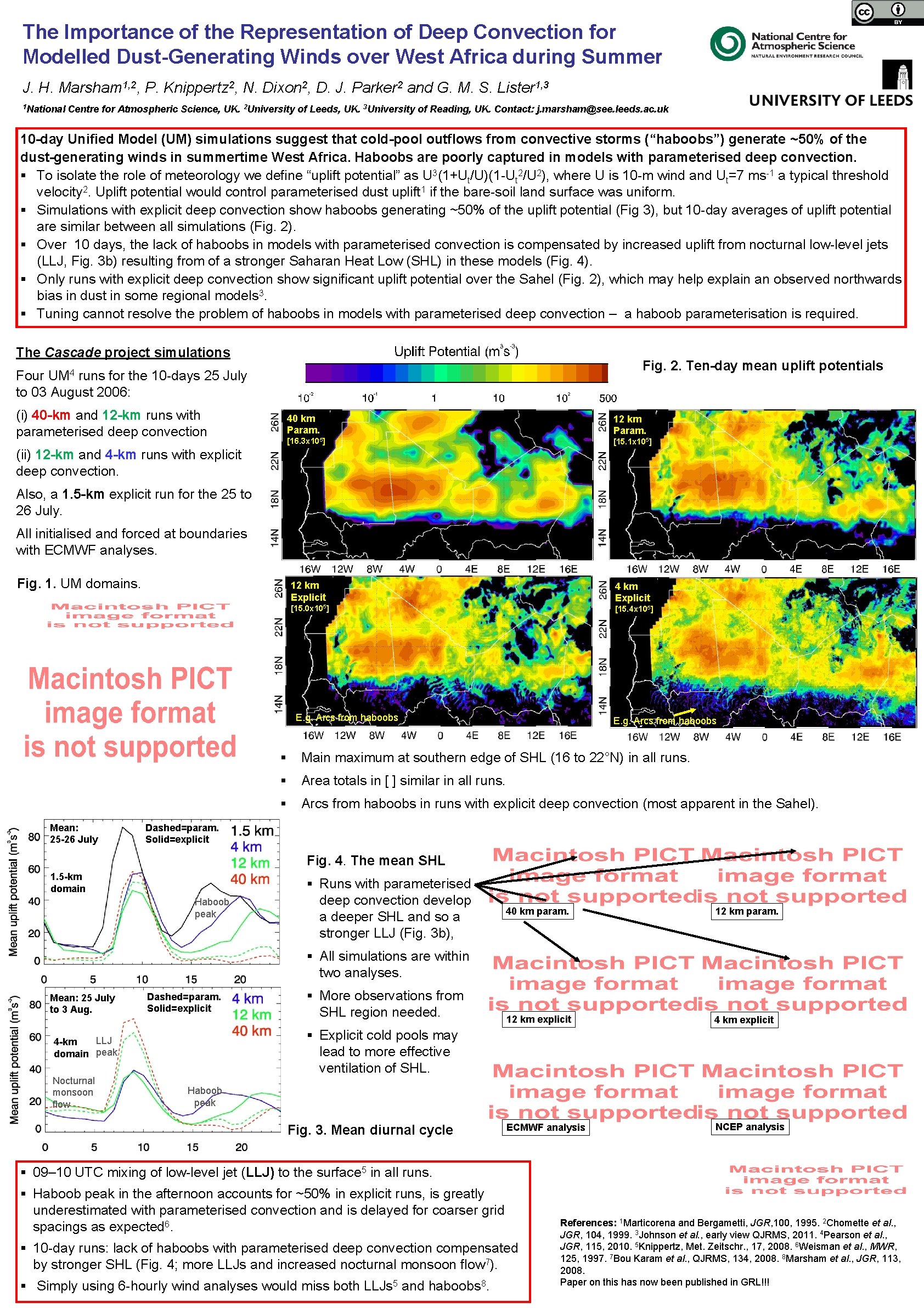
The Importance of the Representation of Deep Convection for Modelled Dust-Generating Winds over West Africa during Summer J. H. Marsham 1, 2, P. Knippertz 2, N. Dixon 2, D. J. Parker 2 and G. M. S. Lister 1, 3 1 National Centre for Atmospheric Science, UK. 2 University of Leeds, UK. 3 University of Reading, UK. Contact: j. marsham@see. leeds. ac. uk 10 -day Unified Model (UM) simulations suggest that cold-pool outflows from convective storms (“haboobs”) generate ~50% of the dust-generating winds in summertime West Africa. Haboobs are poorly captured in models with parameterised deep convection. § To isolate the role of meteorology we define “uplift potential” as U 3(1+Ut/U)(1 -Ut 2/U 2), where U is 10 -m wind and Ut=7 ms-1 a typical threshold velocity 2. Uplift potential would control parameterised dust uplift 1 if the bare-soil land surface was uniform. § Simulations with explicit deep convection show haboobs generating ~50% of the uplift potential (Fig 3), but 10 -day averages of uplift potential are similar between all simulations (Fig. 2). § Over 10 days, the lack of haboobs in models with parameterised convection is compensated by increased uplift from nocturnal low-level jets (LLJ, Fig. 3 b) resulting from of a stronger Saharan Heat Low (SHL) in these models (Fig. 4). § Only runs with explicit deep convection show significant uplift potential over the Sahel (Fig. 2), which may help explain an observed northwards bias in dust in some regional models 3. § Tuning cannot resolve the problem of haboobs in models with parameterised deep convection – a haboob parameterisation is required. The Cascade project simulations Fig. 2. Ten-day mean uplift potentials UM 4 Four runs for the 10 -days 25 July to 03 August 2006: (i) 40 -km and 12 -km runs with parameterised deep convection 40 km Param. 12 km Param. [16. 3 x 10⁵] [15. 1 x 10⁵] 12 km Explicit 4 km Explicit (ii) 12 -km and 4 -km runs with explicit deep convection. Also, a 1. 5 -km explicit run for the 25 to 26 July. All initialised and forced at boundaries with ECMWF analyses. Fig. 1. UM domains. [15. 0 x 105] [15. 4 x 10⁵] E. g. Arcs from haboobs Mean: 25 -26 July E. g. Arcs from haboobs § Main maximum at southern edge of SHL (16 to 22°N) in all runs. § Area totals in [ ] similar in all runs. § Arcs from haboobs in runs with explicit deep convection (most apparent in the Sahel). Dashed=param. Solid=explicit Fig. 4. The mean SHL 1. 5 -km domain Haboob peak § Runs with parameterised deep convection develop a deeper SHL and so a stronger LLJ (Fig. 3 b), 40 km param. 12 km explicit 4 km explicit ECMWF analysis NCEP analysis § All simulations are within two analyses. Mean: 25 July to 3 Aug. Dashed=param. Solid=explicit § Explicit cold pools may lead to more effective ventilation of SHL. LLJ 4 -km domain peak Nocturnal monsoon flow § More observations from SHL region needed. Haboob peak Fig. 3. Mean diurnal cycle § 09– 10 UTC mixing of low-level jet (LLJ) to the surface 5 in all runs. § Haboob peak in the afternoon accounts for ~50% in explicit runs, is greatly underestimated with parameterised convection and is delayed for coarser grid spacings as expected 6. § 10 -day runs: lack of haboobs with parameterised deep convection compensated by stronger SHL (Fig. 4; more LLJs and increased nocturnal monsoon flow 7). § Simply using 6 -hourly wind analyses would miss both LLJs 5 and haboobs 8. References: 1 Marticorena and Bergametti, JGR, 100, 1995. 2 Chomette et al. , JGR, 104, 1999. 3 Johnson et al. , early view QJRMS, 2011. 4 Pearson et al. , JGR, 115, 2010. 5 Knippertz, Met. Zeitschr. , 17, 2008. 6 Weisman et al. , MWR, 125, 1997. 7 Bou Karam et al. , QJRMS, 134, 2008. 8 Marsham et al. , JGR, 113, 2008. Paper on this has now been published in GRL!!!