
The Importance of Snowmelt Runoff Modeling for Sustainable
The Importance of Snowmelt Runoff Modeling for Sustainable Development and Disaster Prevention Muzafar Malikov Space Research Centre Academy of Sciences Republic of Uzbekistan
Water H 2 O Ø Gas - Water Vapor Ø Liquid - Rivers and Oceans Ø Solid – Ice and Snow Very strange substance (38 anomalies) Ø Water shrinks on melting Ø Hot water freezes faster than cold (clustering)
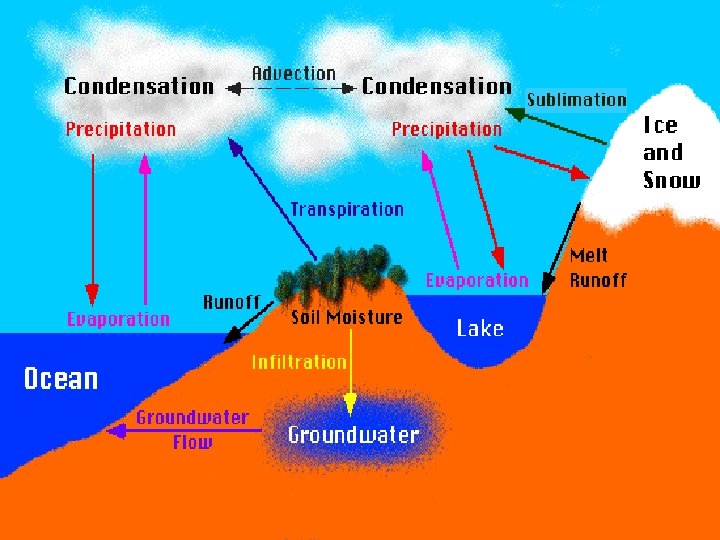
Hydrologic Cycle

Precipitation Ø Rainfall ØLiquid water ØProduces immediate runoff ØPredictable runoff Ø Snowfall ØCrystalline water ØDelayed runoff ØDifficult to predict
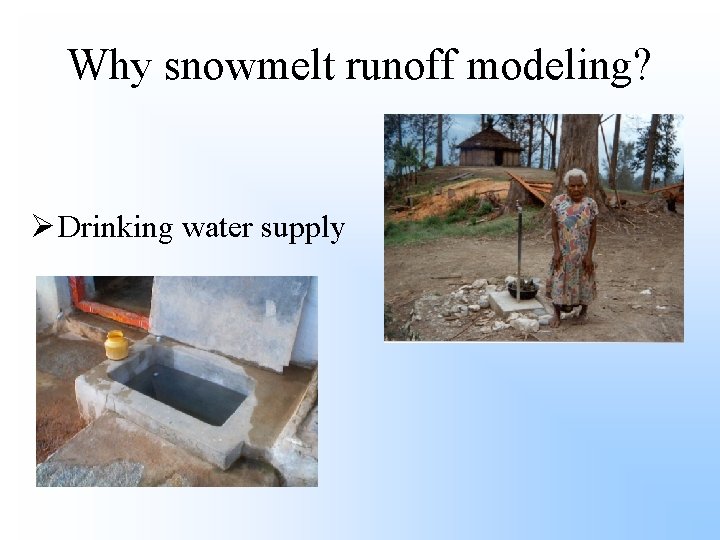
Why snowmelt runoff modeling? Ø Drinking water supply
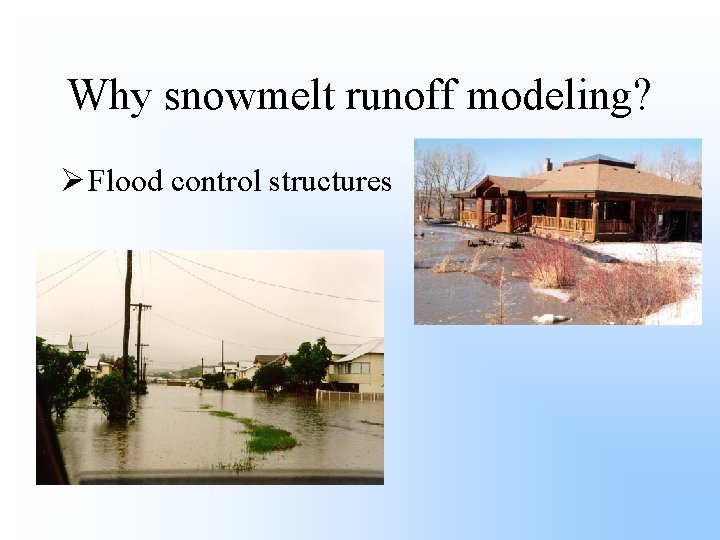
Why snowmelt runoff modeling? Ø Flood control structures
Why snowmelt runoff modeling? Ø Irrigation
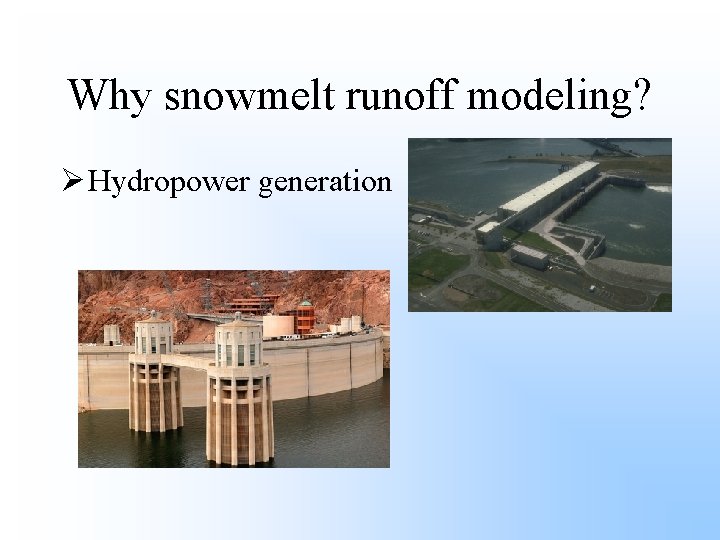
Why snowmelt runoff modeling? Ø Hydropower generation
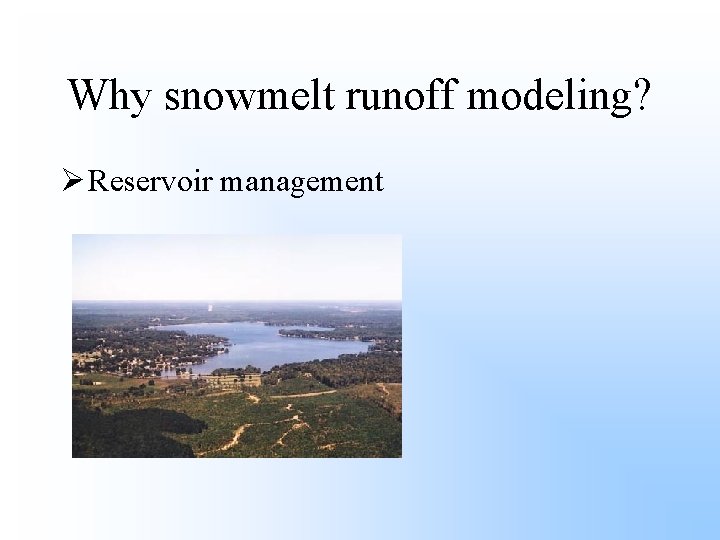
Why snowmelt runoff modeling? Ø Reservoir management
Types of models Ø Physical models ØBased on strict physical laws ØMass and energy balance ØAccuracy is high Ø Conceptual Index models ØEmpirical relationship to approximate mass balance ØRequires less parameters
Physical Models Ø SNTHERM - US army corps CRREL Ø LSM (land surface model) Ø VIC (variable infiltration capacity) - U Washington Ø WATCLASS (Watflood/class) - Env. Can Ø SHE (Systeme Hydrologique Europeen) physically based, distributed, continuous Ø Streamflow and sediment simulation, Abbott et al.
Conceptual Index Models Ø SRM (Snowmelt Runoff Model) - USDA Ø PRMS (precipitation runoff modeling system) - USGS Ø SLURP (simple lumped reservoir) - Env. Can. Ø UBC Watershed Model Ø TOPMODEL (hydrologic simulation model) -Beven
Snowmelt Runoff Model Ø Developed by Martinec Ø Estimation of daily stream flow in Mountain basins Ø Degree-day model (temperature) Ø Applied in 25 countries for more than 80 basins Ø Simple and Efficient
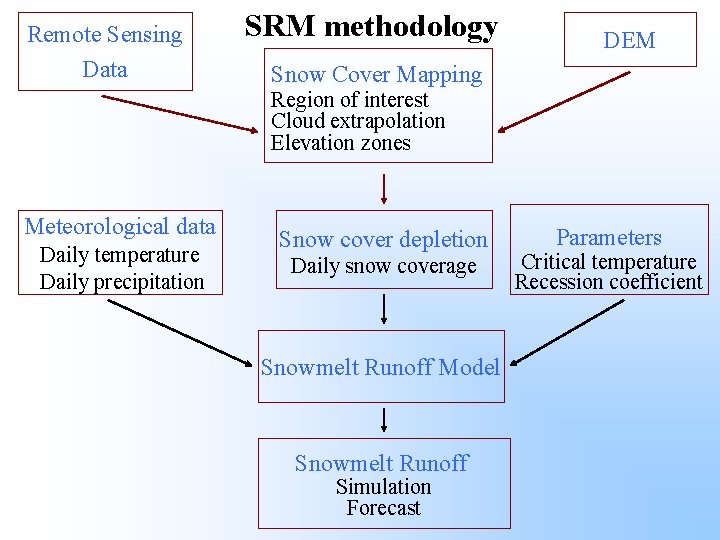
Remote Sensing Data SRM methodology DEM Snow Cover Mapping Region of interest Cloud extrapolation Elevation zones Meteorological data Daily temperature Daily precipitation Snow cover depletion Daily snow coverage Snowmelt Runoff Model Snowmelt Runoff Simulation Forecast Parameters Critical temperature Recession coefficient
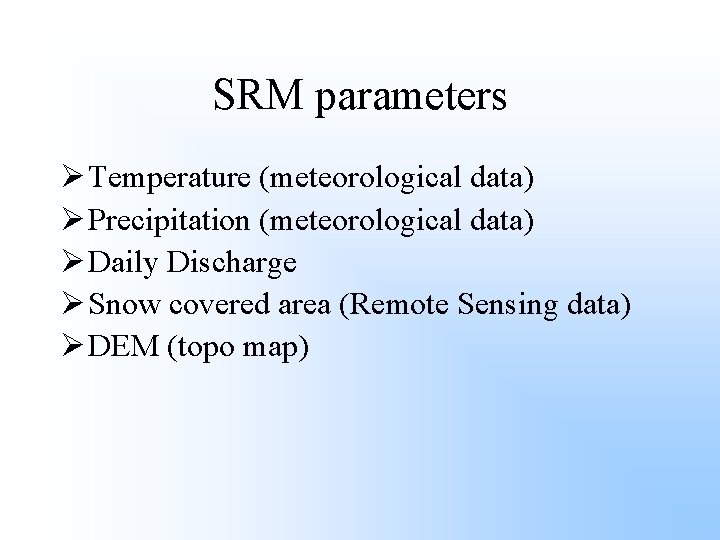
SRM parameters Ø Temperature (meteorological data) Ø Precipitation (meteorological data) Ø Daily Discharge Ø Snow covered area (Remote Sensing data) Ø DEM (topo map)
![Heart of the model Q = average daily discharge [m 3 s-1] c =](http://slidetodoc.com/presentation_image/1f1545db823246be32fdbf2fb7ad3f5f/image-16.jpg "Heart of the model Q = average daily discharge [m 3 s-1] c =")
Heart of the model Q = average daily discharge [m 3 s-1] c = runoff coefficient: losses as a ratio (runoff/precipitation), with c. Sn referring to snowmelt and c. Rn to rain a = degree-day factor [cm·o. C-1·d-1] indicating the snowmelt depth resulting from 1 degree-day T = number of degree-days [o. C·d] T = the adjustment by temperature lapse rate [o. C·d] S = ratio of the snow covered area to the total area P = precipitation contributing to runoff [cm]. Threshold temperature, TCRIT, determines whether this contribution is rainfall or snowfall A = area of the basin or zone [km 2] k = recession coefficient indicating the decline of discharge in a period without snowmelt or rainfall n-number of days
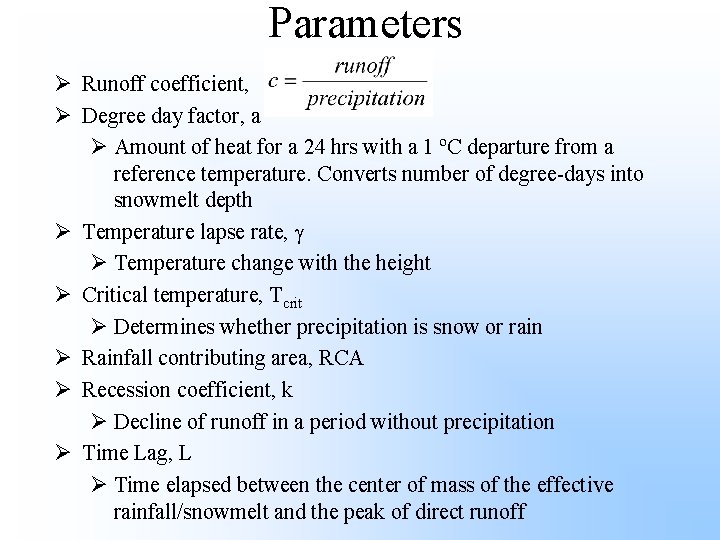
Parameters Ø Runoff coefficient, Ø Degree day factor, a Ø Amount of heat for a 24 hrs with a 1 ºC departure from a reference temperature. Converts number of degree-days into snowmelt depth Ø Temperature lapse rate, Ø Temperature change with the height Ø Critical temperature, Tcrit Ø Determines whether precipitation is snow or rain Ø Rainfall contributing area, RCA Ø Recession coefficient, k Ø Decline of runoff in a period without precipitation Ø Time Lag, L Ø Time elapsed between the center of mass of the effective rainfall/snowmelt and the peak of direct runoff
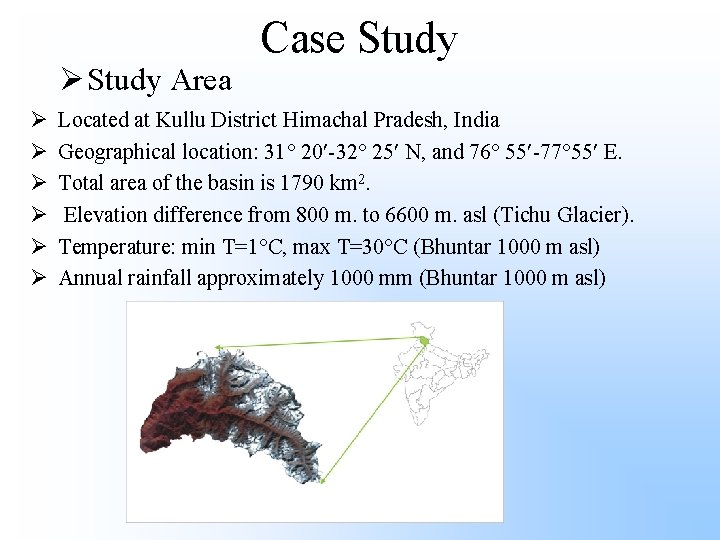
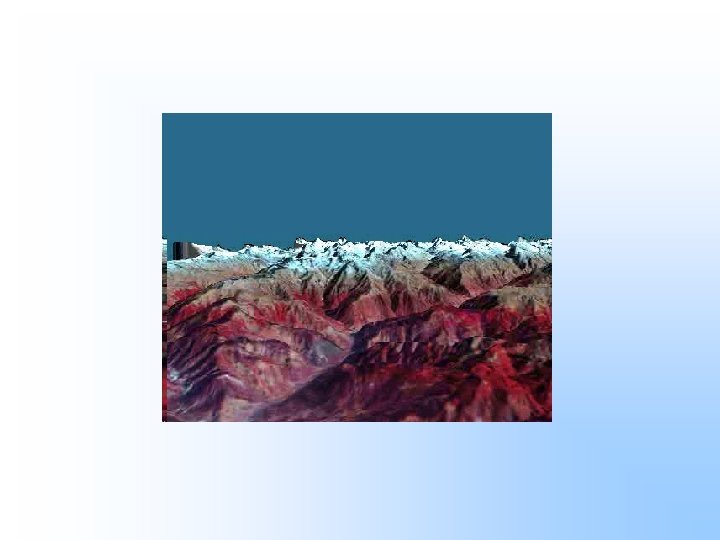
Ø Study Area Ø Ø Ø Case Study Located at Kullu District Himachal Pradesh, India Geographical location: 31 20 -32 25 N, and 76 55 -77 55 E. Total area of the basin is 1790 km 2. Elevation difference from 800 m. to 6600 m. asl (Tichu Glacier). Temperature: min T=1°C, max T=30°C (Bhuntar 1000 m asl) Annual rainfall approximately 1000 mm (Bhuntar 1000 m asl)
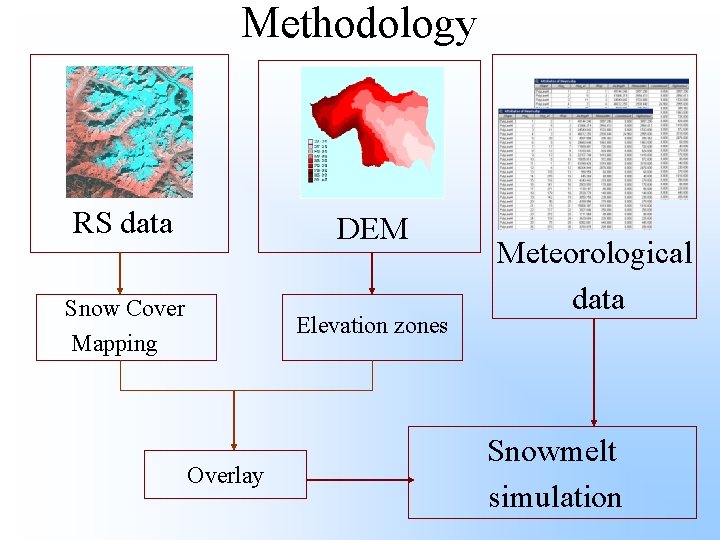
Methodology RS data DEM Snow Cover Mapping Elevation zones Overlay Meteorological data Snowmelt simulation
Thematic Layers ØElevation zones ØSnow cover maps ØTemperature distribution ØRainfall distribution
![Elevation Zones Map [m]](http://slidetodoc.com/presentation_image/1f1545db823246be32fdbf2fb7ad3f5f/image-22.jpg "Elevation Zones Map [m]")
Elevation Zones Map [m]
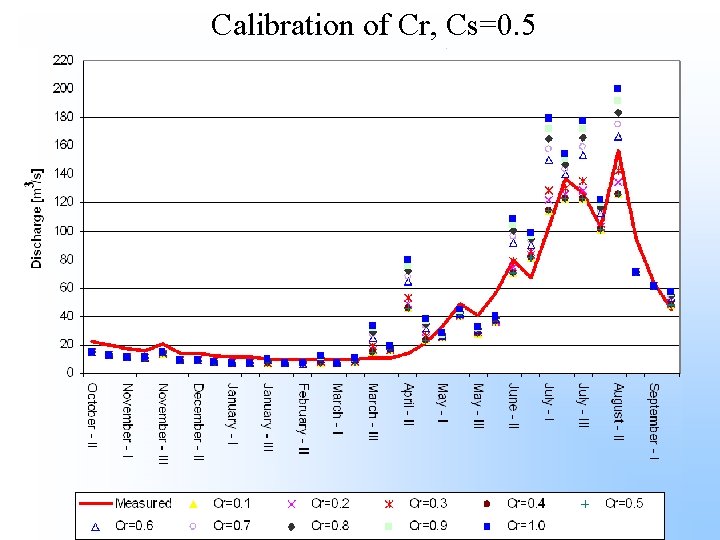
Calibration of Cr, Cs=0. 5
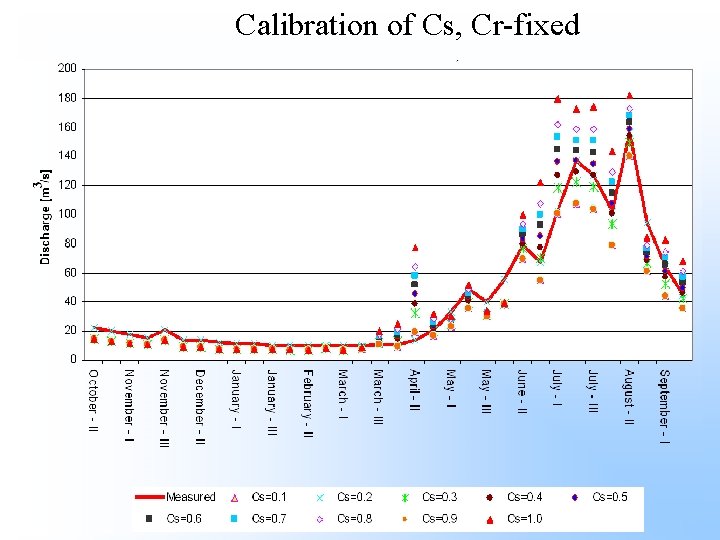
Calibration of Cs, Cr-fixed
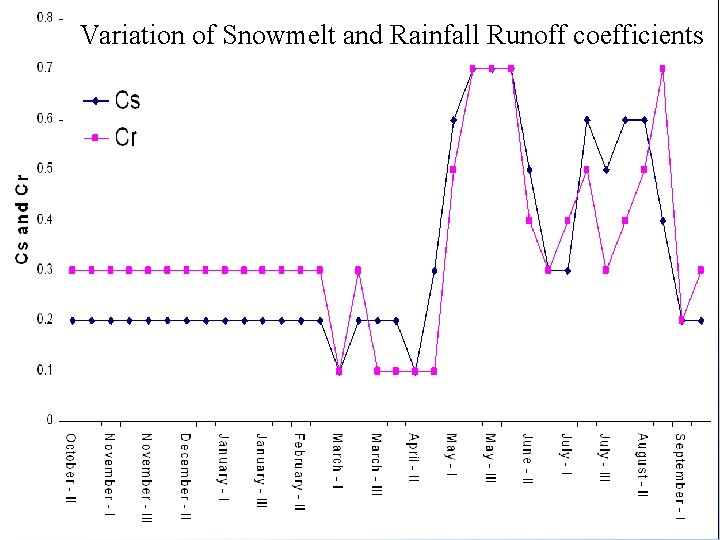
Variation of Snowmelt and Rainfall Runoff coefficients
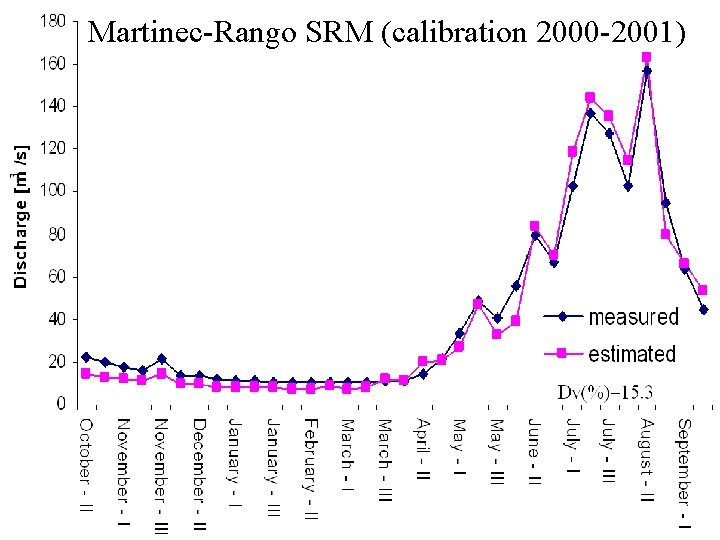
Martinec-Rango SRM (calibration 2000 -2001)
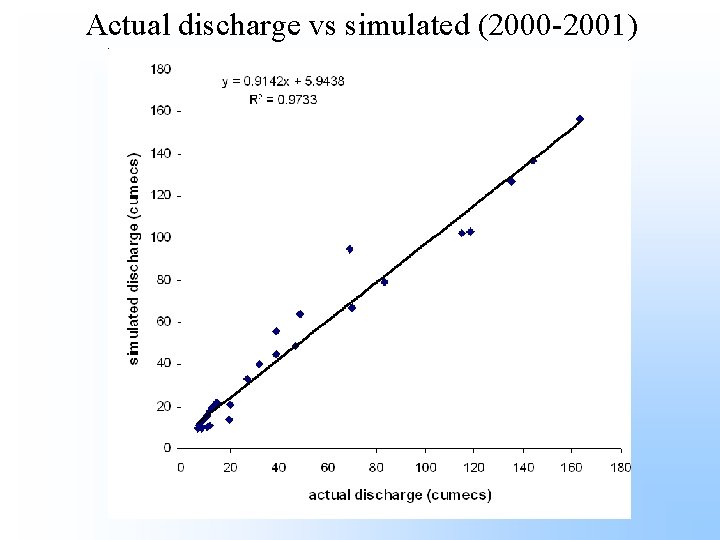
Actual discharge vs simulated (2000 -2001)
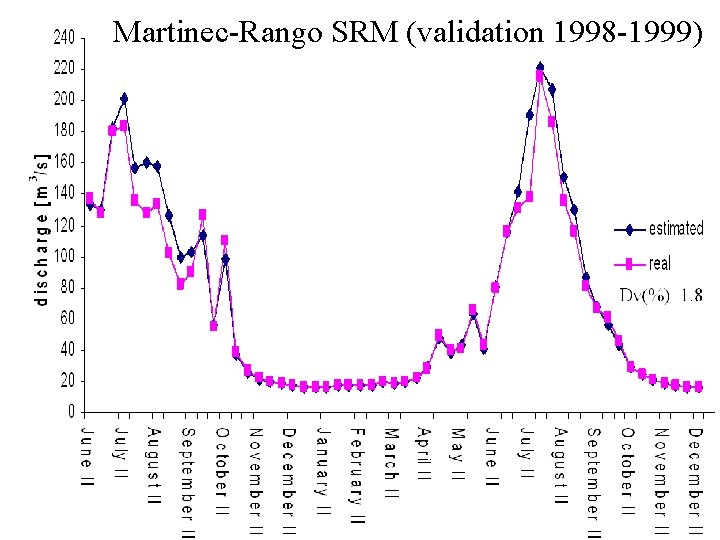
Martinec-Rango SRM (validation 1998 -1999)
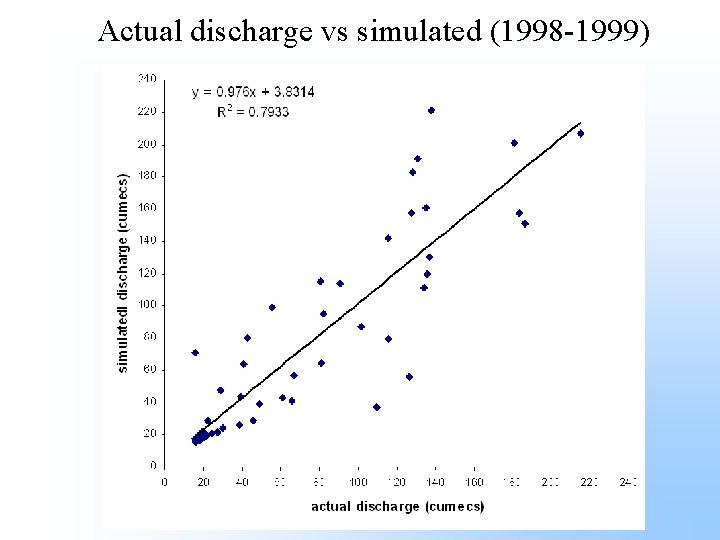
Actual discharge vs simulated (1998 -1999)
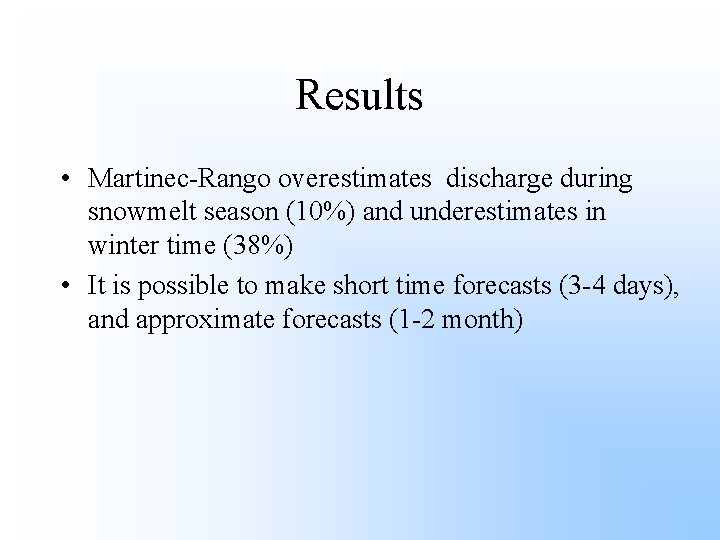
Results • Martinec-Rango overestimates discharge during snowmelt season (10%) and underestimates in winter time (38%) • It is possible to make short time forecasts (3 -4 days), and approximate forecasts (1 -2 month)
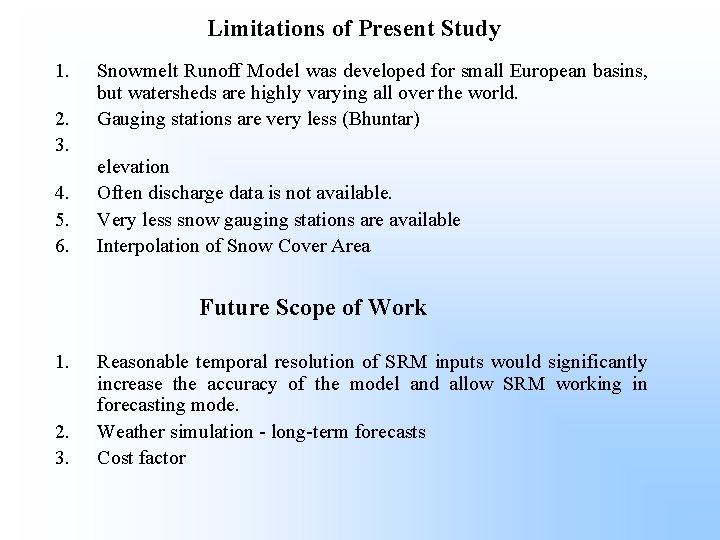
Limitations of Present Study 1. 2. 3. 4. 5. 6. Snowmelt Runoff Model was developed for small European basins, but watersheds are highly varying all over the world. Gauging stations are very less (Bhuntar) elevation Often discharge data is not available. Very less snow gauging stations are available Interpolation of Snow Cover Area Future Scope of Work 1. 2. 3. Reasonable temporal resolution of SRM inputs would significantly increase the accuracy of the model and allow SRM working in forecasting mode. Weather simulation - long-term forecasts Cost factor
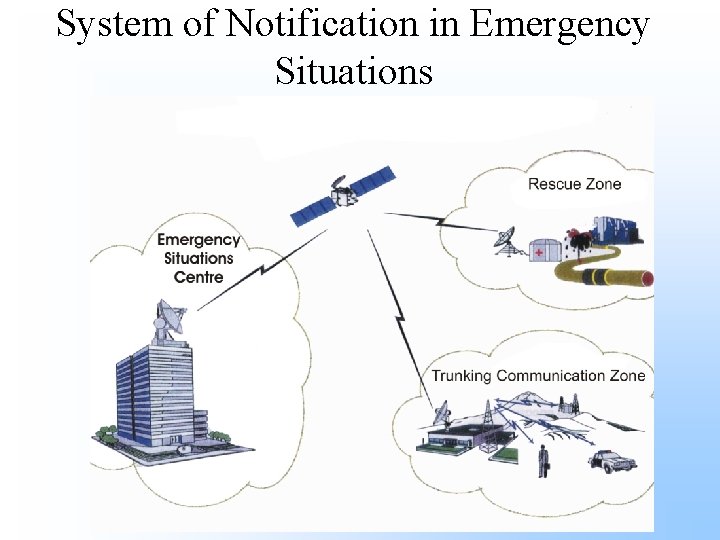
System of Notification in Emergency Situations
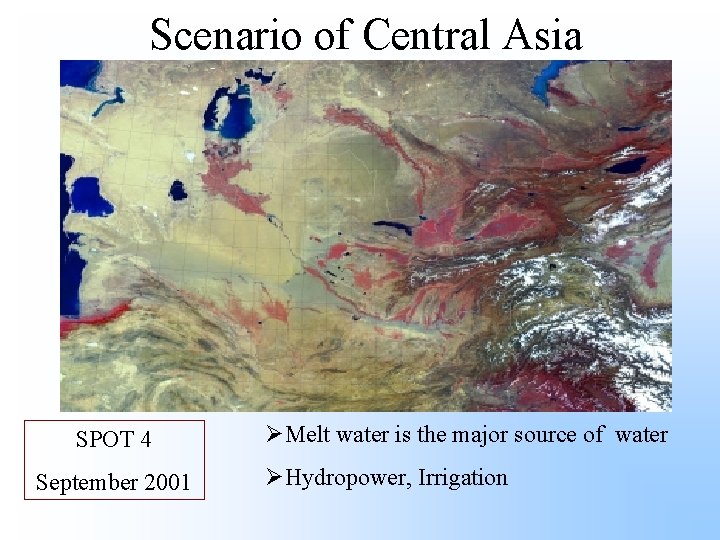
Scenario of Central Asia SPOT 4 September 2001 ØMelt water is the major source of water ØHydropower, Irrigation
What is being done? Ø Data collection for similar project in Uzbekistan ØPractical application ØHigher temporary resolution of satellite imagery ØAvailability of discharge data Ø Close cooperation with interested ministries ØMinistry of Water and Agriculture ØAround 100 000 sq km are under agriculture ØMinistry of Nature Protection ØMinistry of Emergency Situations ØMore than 20 large water bodies ØMeteorological service
- Slides: 35