
The importance of Regional Red Lists for conservation

- Slides: 32
The importance of Regional Red Lists for conservation: from assessments to action Monika Böhm Indicators & Assessments Unit www. nationalredlist. org monika. bohm@ioz. ac. uk
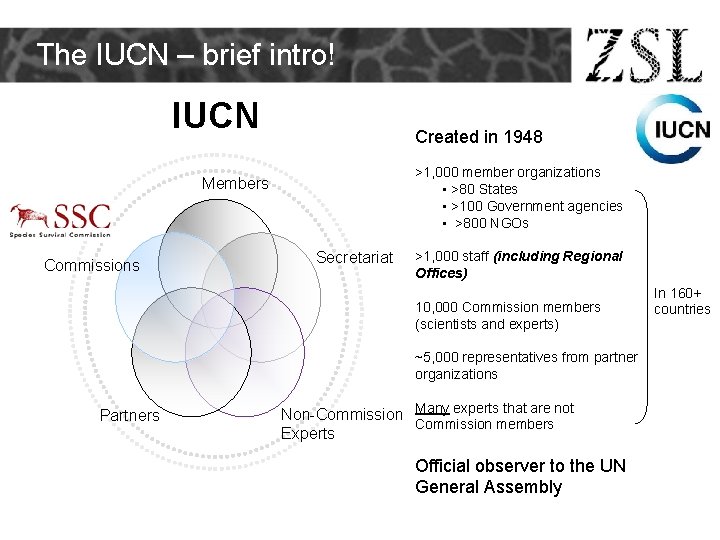
The IUCN – brief intro! IUCN Created in 1948 >1, 000 member organizations • >80 States • >100 Government agencies • >800 NGOs Members Commissions Secretariat >1, 000 staff (including Regional Offices) 10, 000 Commission members (scientists and experts) ~5, 000 representatives from partner organizations Partners Non-Commission Many experts that are not Commission members Experts Official observer to the UN General Assembly In 160+ countries
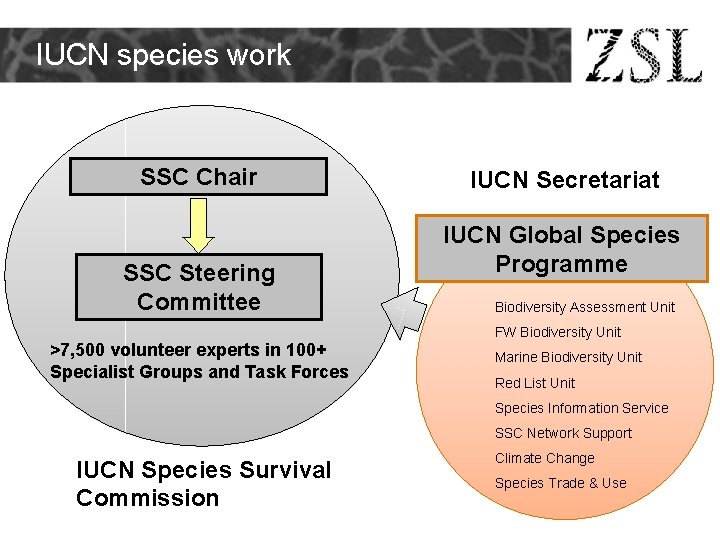
IUCN species work SSC Chair SSC Steering Committee >7, 500 volunteer experts in 100+ Specialist Groups and Task Forces IUCN Secretariat IUCN Global Species Programme Biodiversity Assessment Unit FW Biodiversity Unit Marine Biodiversity Unit Red List Unit Species Information Service SSC Network Support IUCN Species Survival Commission Climate Change Species Trade & Use
Red List Partnership
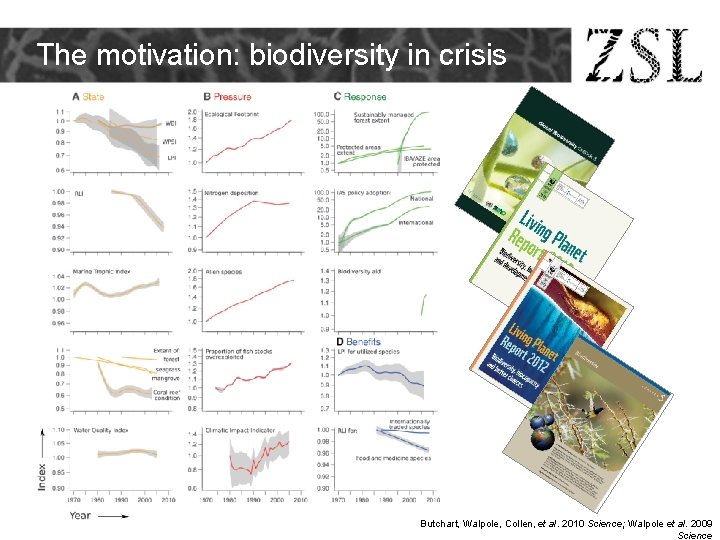
The motivation: biodiversity in crisis Butchart, Walpole, Collen, et al. 2010 Science; Walpole et al. 2009 Science
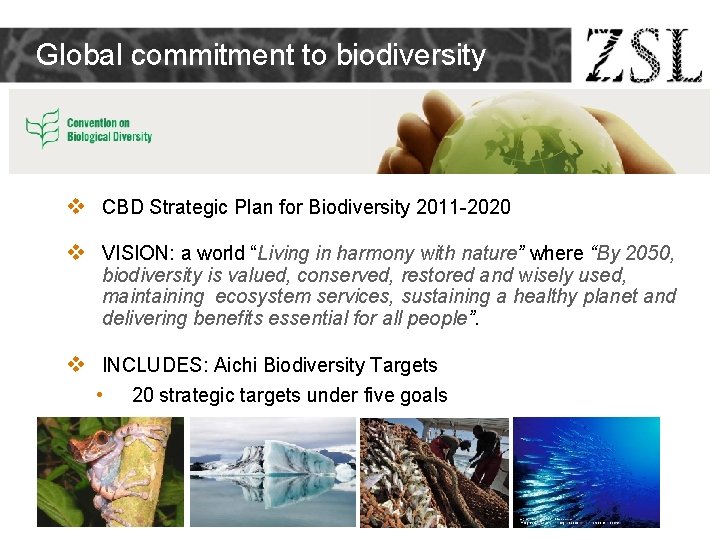
Global commitment to biodiversity v CBD Strategic Plan for Biodiversity 2011 -2020 v VISION: a world “Living in harmony with nature” where “By 2050, biodiversity is valued, conserved, restored and wisely used, maintaining ecosystem services, sustaining a healthy planet and delivering benefits essential for all people”. v INCLUDES: Aichi Biodiversity Targets • 20 strategic targets under five goals
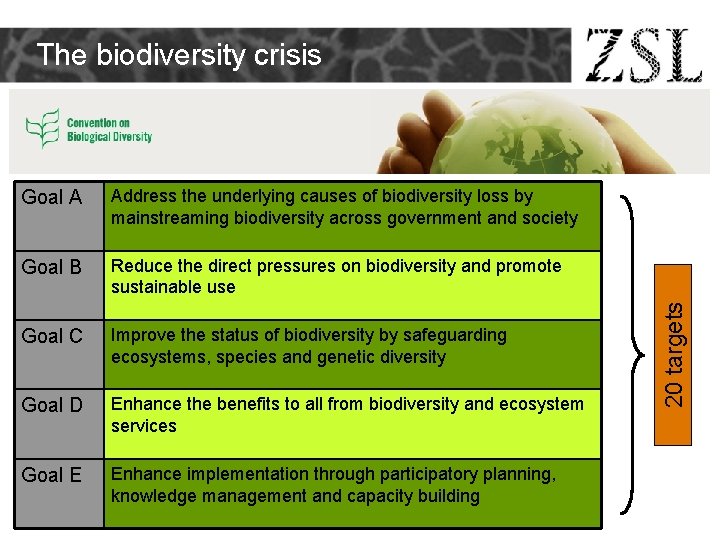
Goal A Address the underlying causes of biodiversity loss by mainstreaming biodiversity across government and society Goal B Reduce the direct pressures on biodiversity and promote sustainable use Goal C Improve the status of biodiversity by safeguarding ecosystems, species and genetic diversity Goal D Enhance the benefits to all from biodiversity and ecosystem services Goal E Enhance implementation through participatory planning, knowledge management and capacity building 20 targets The biodiversity crisis
Keeping track of biodiversity e. g. Extinction risk of species Population trends Butchart, Walpole, Collen, et al. 2010 Science; Walpole et al. 2009 Science
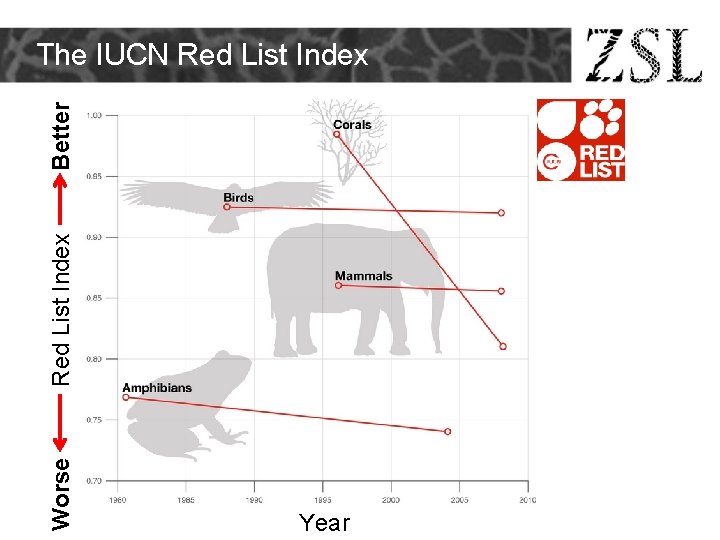
Worse Red List Index Better The IUCN Red List Index Year
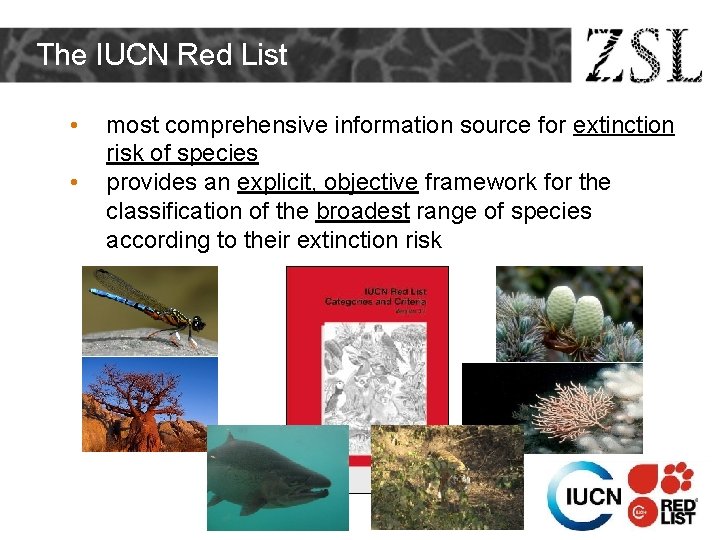
The IUCN Red List • • most comprehensive information source for extinction risk of species provides an explicit, objective framework for the classification of the broadest range of species according to their extinction risk
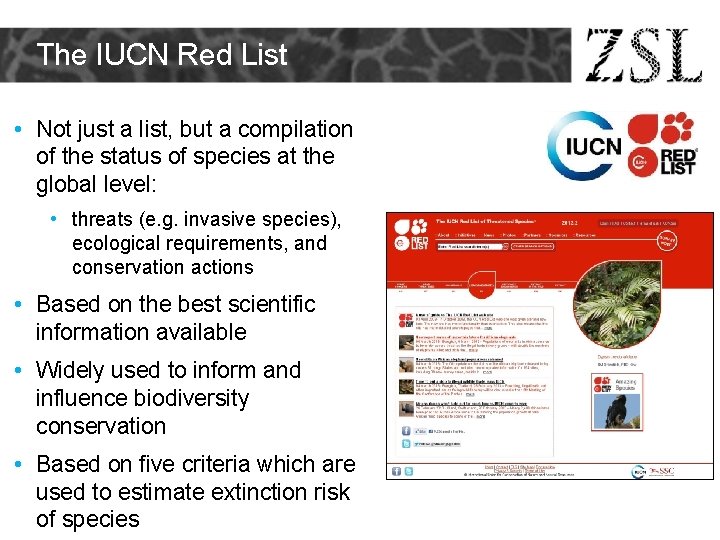
The IUCN Red List • Not just a list, but a compilation of the status of species at the global level: • threats (e. g. invasive species), ecological requirements, and conservation actions • Based on the best scientific information available • Widely used to inform and influence biodiversity conservation • Based on five criteria which are used to estimate extinction risk of species
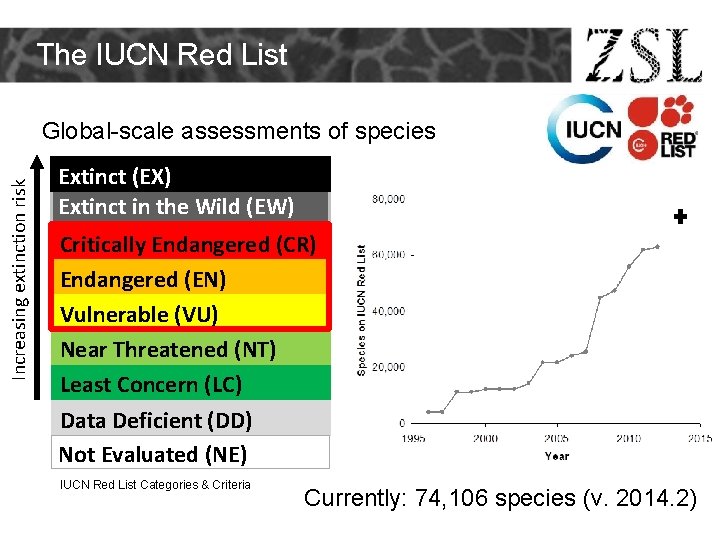
The IUCN Red List Increasing extinction risk Global-scale assessments of species Extinct (EX) Extinct in the Wild (EW) Critically Endangered (CR) Endangered (EN) Vulnerable (VU) Near Threatened (NT) Least Concern (LC) Data Deficient (DD) Not Evaluated (NE) IUCN Red List Categories & Criteria Currently: 74, 106 species (v. 2014. 2)
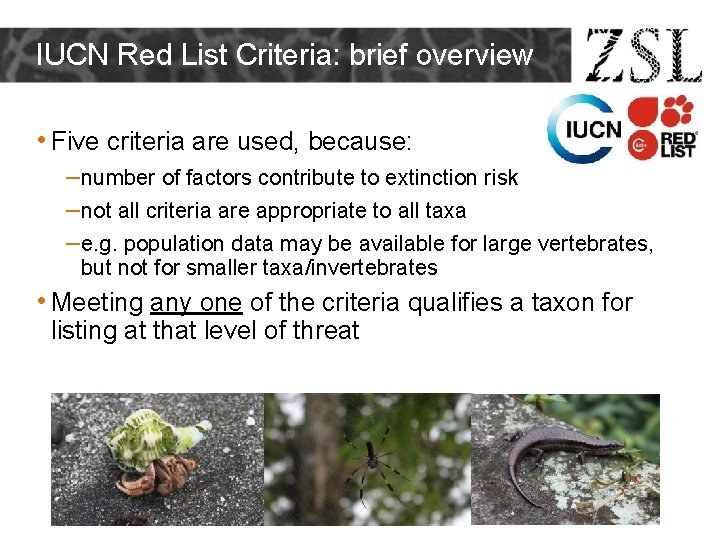
IUCN Red List Criteria: brief overview • Five criteria are used, because: – number of factors contribute to extinction risk – not all criteria are appropriate to all taxa – e. g. population data may be available for large vertebrates, but not for smaller taxa/invertebrates • Meeting any one of the criteria qualifies a taxon for listing at that level of threat
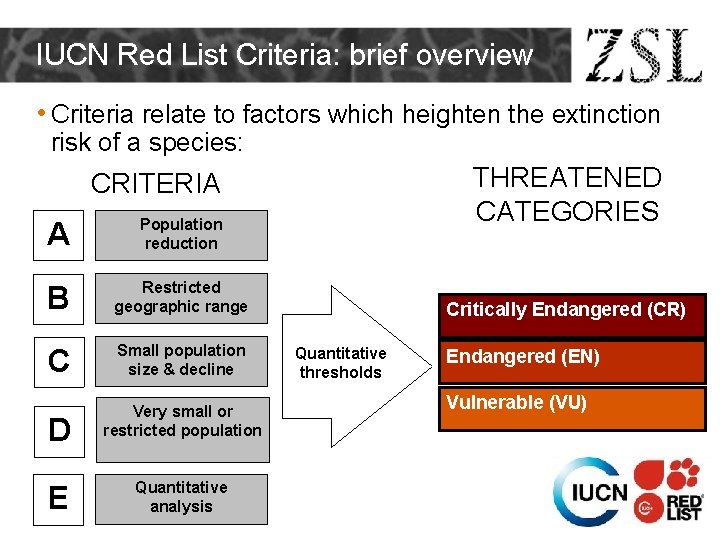
IUCN Red List Criteria: brief overview • Criteria relate to factors which heighten the extinction risk of a species: THREATENED CATEGORIES CRITERIA A Population reduction B Restricted geographic range C Small population size & decline D E Very small or restricted population Quantitative analysis Critically Endangered (CR) Quantitative thresholds Endangered (EN) Vulnerable (VU)
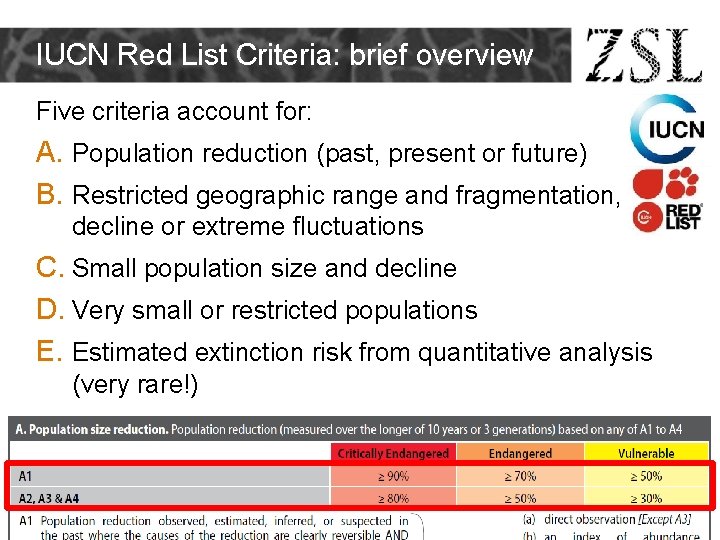
IUCN Red List Criteria: brief overview Five criteria account for: A. Population reduction (past, present or future) B. Restricted geographic range and fragmentation, decline or extreme fluctuations C. Small population size and decline D. Very small or restricted populations E. Estimated extinction risk from quantitative analysis (very rare!)
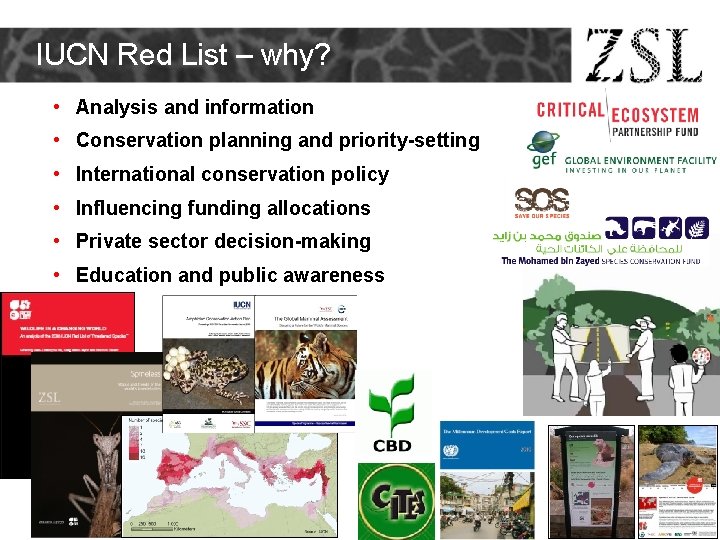
IUCN Red List – why? • Analysis and information • Conservation planning and priority-setting • International conservation policy • Influencing funding allocations • Private sector decision-making • Education and public awareness
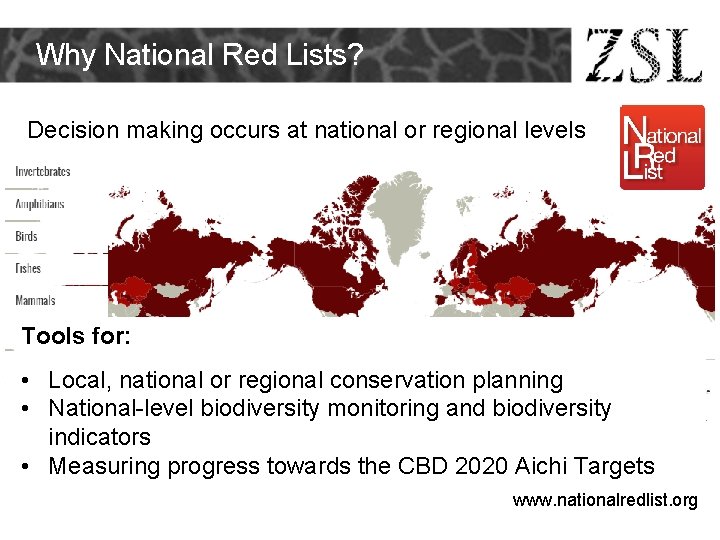
Why National Red Lists? Decision making occurs at national or regional levels Tools for: • Local, national or regional conservation planning • National-level biodiversity monitoring and biodiversity indicators • Measuring progress towards the CBD 2020 Aichi Targets www. nationalredlist. org
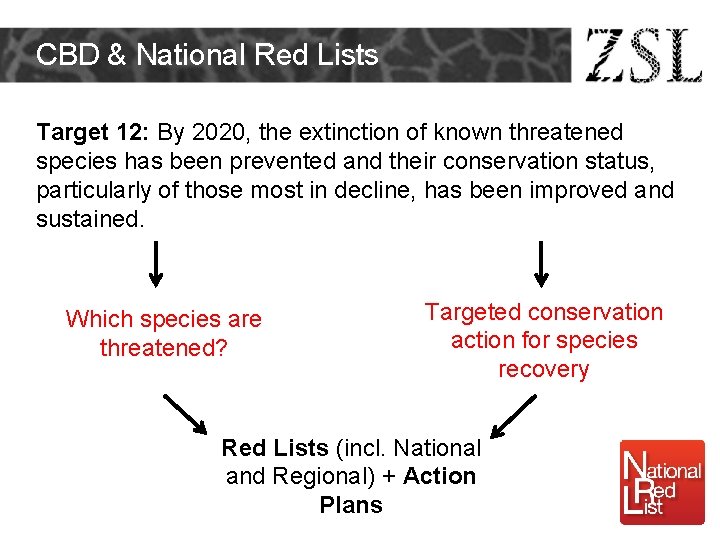
CBD & National Red Lists Target 12: By 2020, the extinction of known threatened species has been prevented and their conservation status, particularly of those most in decline, has been improved and sustained. Which species are threatened? Targeted conservation action for species recovery Red Lists (incl. National and Regional) + Action Plans
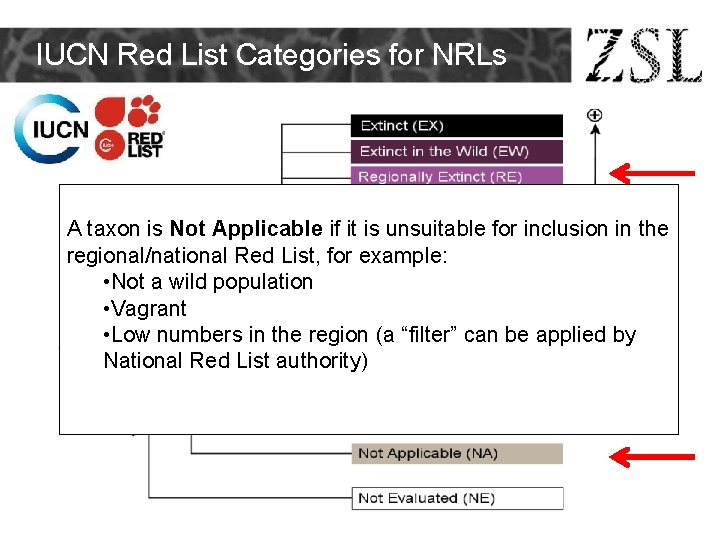
IUCN Red List Categories for NRLs A taxon is Not Applicable if it is unsuitable for inclusion in the regional/national Red List, for example: • Not a wild population • Vagrant • Low numbers in the region (a “filter” can be applied by National Red List authority)
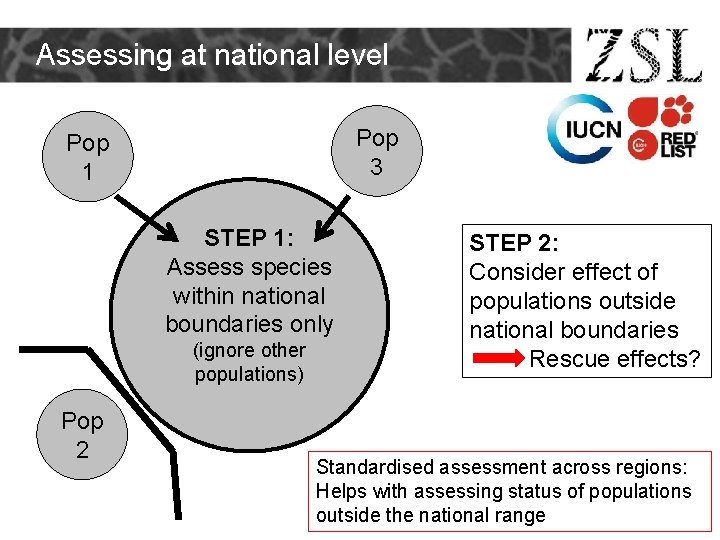
Assessing at national level Pop 3 Pop 1 STEP 1: Assess species within national boundaries only (ignore other populations) Pop 2 STEP 2: Consider effect of populations outside national boundaries Rescue effects? Standardised assessment across regions: Helps with assessing status of populations outside the national range
Advantages of using IUCN standards • Most widely used system for assessments of species status • Assessments are comparable across regions/countries – Reliance on the same data types, e. g. occurrence records – Helps with assessing status of populations outside the national range – Introduces consistency & helps build global picture of species status • Facilitates inclusion of assessments onto IUCN Red List • Achieving harmonization of Red Lists – e. g. Europe
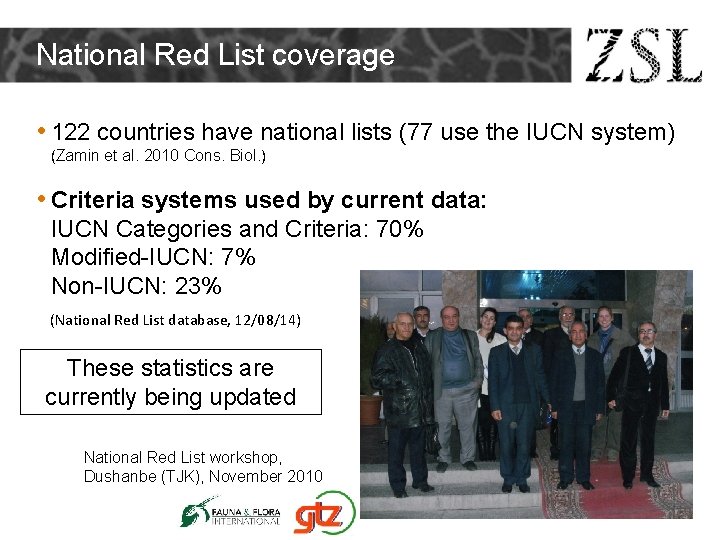
National Red List coverage • 122 countries have national lists (77 use the IUCN system) (Zamin et al. 2010 Cons. Biol. ) • Criteria systems used by current data: IUCN Categories and Criteria: 70% Modified-IUCN: 7% Non-IUCN: 23% (National Red List database, 12/08/14) These statistics are currently being updated National Red List workshop, Dushanbe (TJK), November 2010
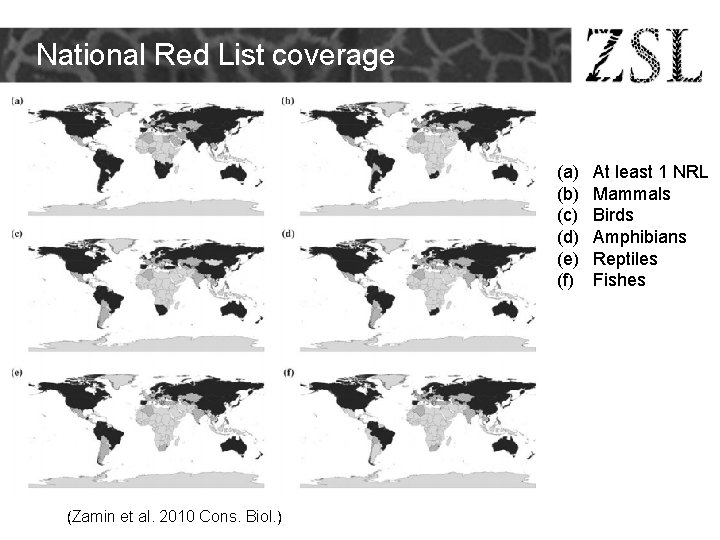
National Red List coverage (a) (b) (c) (d) (e) (f) (Zamin et al. 2010 Cons. Biol. ) At least 1 NRL Mammals Birds Amphibians Reptiles Fishes
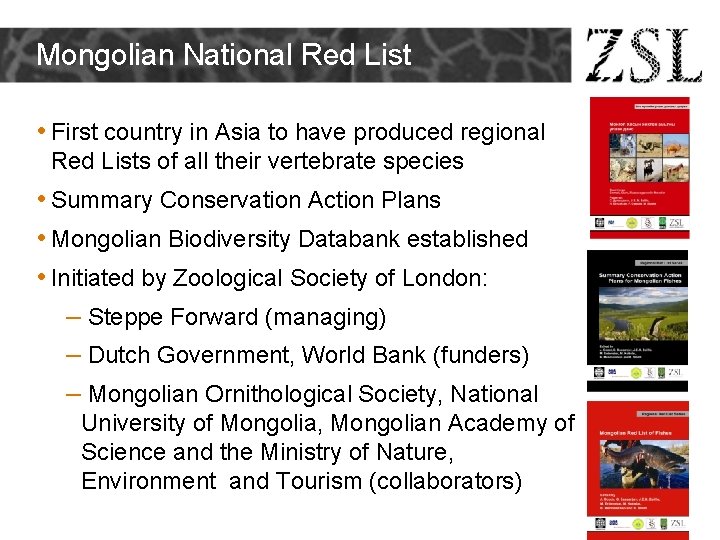
Mongolian National Red List • First country in Asia to have produced regional Red Lists of all their vertebrate species • Summary Conservation Action Plans • Mongolian Biodiversity Databank established • Initiated by Zoological Society of London: – Steppe Forward (managing) – Dutch Government, World Bank (funders) – Mongolian Ornithological Society, National University of Mongolia, Mongolian Academy of Science and the Ministry of Nature, Environment and Tourism (collaborators)
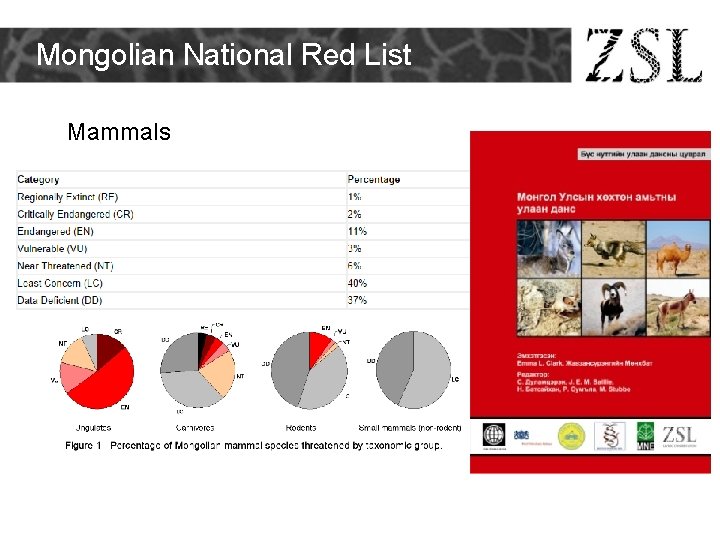
Mongolian National Red List Mammals
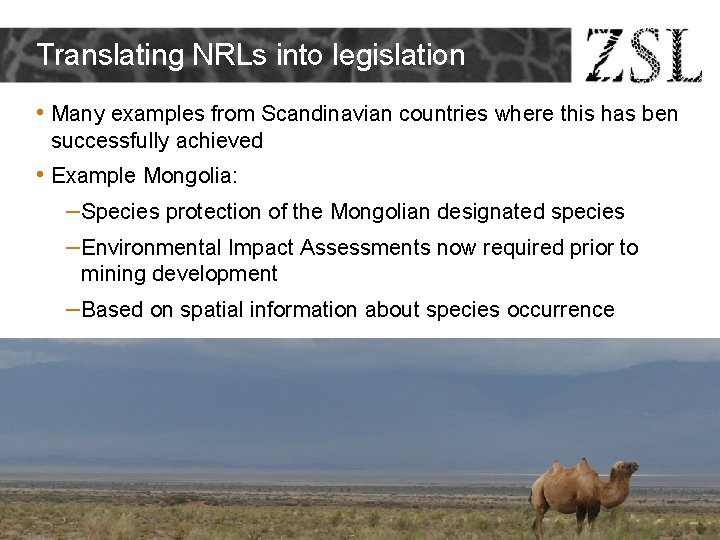
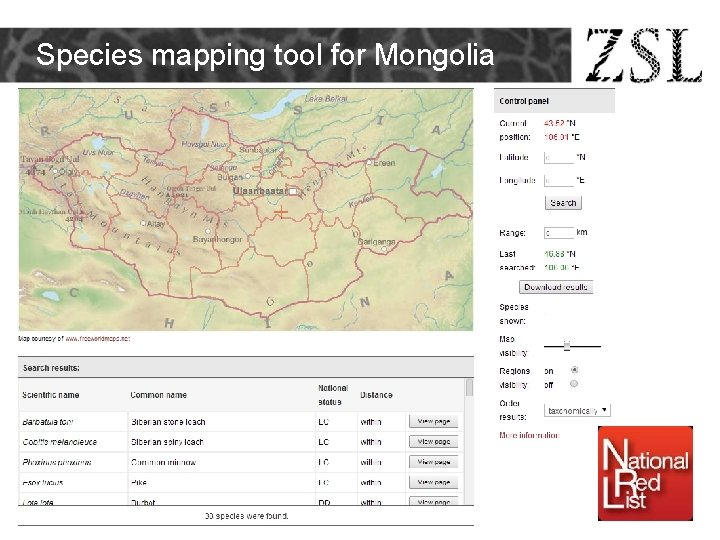
Translating NRLs into legislation • Many examples from Scandinavian countries where this has ben successfully achieved • Example Mongolia: – Species protection of the Mongolian designated species – Environmental Impact Assessments now required prior to mining development – Based on spatial information about species occurrence
Species mapping tool for Mongolia
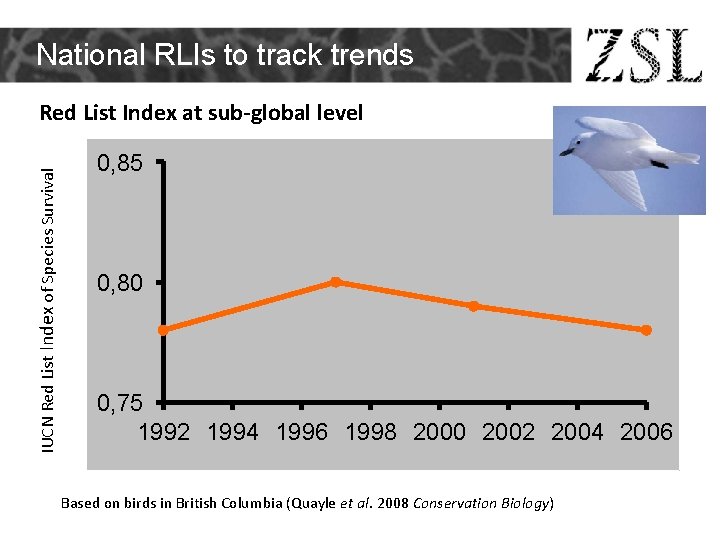
National RLIs to track trends IUCN Red List Index of Species Survival Red List Index at sub-global level 0, 85 0, 80 0, 75 1992 1994 1996 1998 2000 2002 2004 2006 Based on birds in British Columbia (Quayle et al. 2008 Conservation Biology)
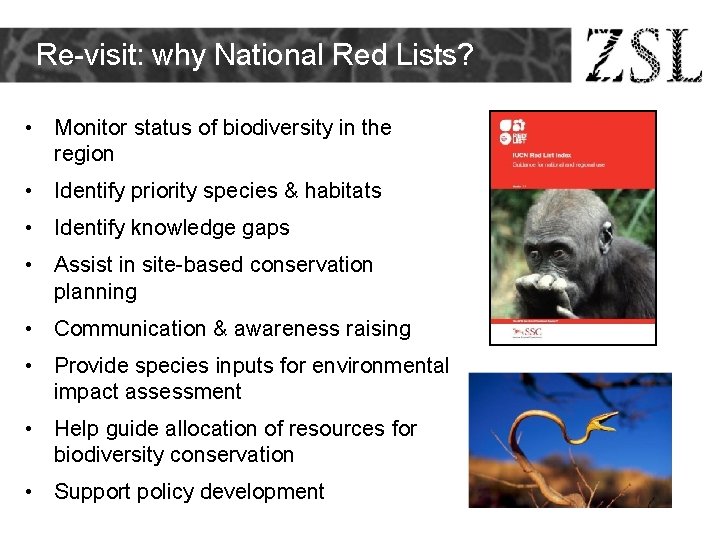
Re-visit: why National Red Lists? • Monitor status of biodiversity in the region • Identify priority species & habitats • Identify knowledge gaps • Assist in site-based conservation planning • Communication & awareness raising • Provide species inputs for environmental impact assessment • Help guide allocation of resources for biodiversity conservation • Support policy development
Re-visit: why IUCN Cats & Crits? • Most widely used system for assessments of species status • Assessments are consistent/comparable across regions/countries • Based on comparable data • Helps with assessing status of populations outside the national range & across regions • Facilitates inclusion of assessments onto IUCN Red List • Guidance and support available • Sharing of experiences and knowledge
National Red List Alliance & website • National Red List Alliance: – established in 2013 to promote National Red listing – help countries monitor their progress towards achieving Millennium Development Goal 7 and the Aichi Biodiversity Targets (particularly target 12) • National Red List website & database: – Assessment resources and help – Case studies – Repository for national and regional assessments – In future, better integration with the IUCN Red List – www. nationalredlist. org
Acknowledgements