
The Importance of Reading A Fourth Grade Presentation





- Slides: 17
The Importance of Reading A Fourth Grade Presentation
n In the upper elementary grades, students move from childhood to adolescence. As they continue to learn about reading and writing, they broaden and deepen their ability to use literacy as a multifaceted tool for learning. They discover their voices as writers and refine their instincts as readers. --Fountas and Pinnell, (2001, p. vi)
n There are three intellectual skills that students develop when they…read: summarization, analysis, and prediction. --Douglas B. Reeves, Ph. D. (2002, p. 21)
Dear Parents, n Did you know? Children are motivated to read when they personally relate to book characters and associate story events to real-life experiences. If you want your child to be intrigued by written words, read aloud stories involving favorite hobbies, true-life mysteries, natural wonders, or any other topic your child finds fascinating.
Avi Something Upstairs Blume, Judy Tales of a Fourth Grade Nothing Brittain, Bill All The Money In The World Bunting, Eve In-Between Days Byars, Betsy Dead Letter Cleary, Beverly Ramona (Series) Clifford, Eth Help! I'm A Prisoner In The Library Coville, Bruce Jeremy Thatcher, Dragon Hatcher Curtis, Christopher Paul Bud, Not Buddy Danziger, Paula Everyone Else's Parents Said Yes Eager, Edward Half Magic Fleischman, Sid The Whipping Boy Fritz, Jean The Cabin Faced West Gilson, Jamie 13 Ways To Sink A Sub Graeber, Charlotte Fudge Gray, Luli Falcon's Egg Greene, Bette Philip Hall Likes Me, I Reckon Maybe Greenfield, Eloise Sister Hahn, Mary Doll In The Garden
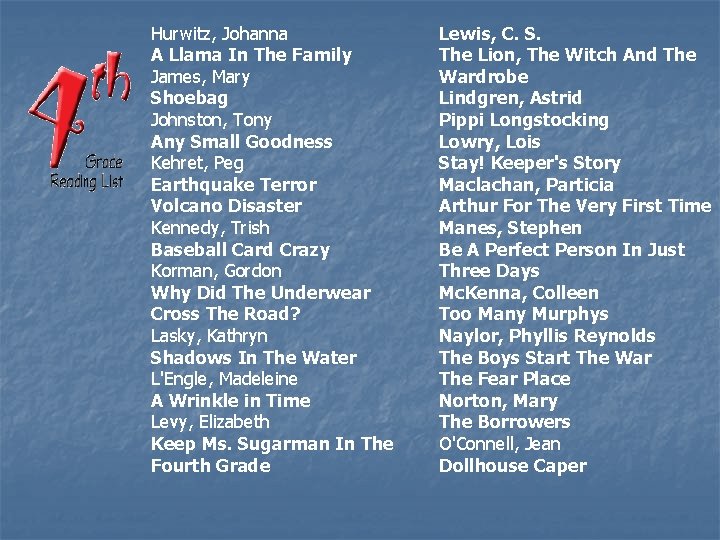
Hurwitz, Johanna A Llama In The Family James, Mary Shoebag Johnston, Tony Any Small Goodness Kehret, Peg Earthquake Terror Volcano Disaster Kennedy, Trish Baseball Card Crazy Korman, Gordon Why Did The Underwear Cross The Road? Lasky, Kathryn Shadows In The Water L'Engle, Madeleine A Wrinkle in Time Levy, Elizabeth Keep Ms. Sugarman In The Fourth Grade Lewis, C. S. The Lion, The Witch And The Wardrobe Lindgren, Astrid Pippi Longstocking Lowry, Lois Stay! Keeper's Story Maclachan, Particia Arthur For The Very First Time Manes, Stephen Be A Perfect Person In Just Three Days Mc. Kenna, Colleen Too Many Murphys Naylor, Phyllis Reynolds The Boys Start The War The Fear Place Norton, Mary The Borrowers O'Connell, Jean Dollhouse Caper
Park, Barbara Almost Starring Skinnybones atneaude, David Someone Was Watching Paulsen, Gary Call Me Francis Tucket Regan, Dian Monsters In Cyberspace Reid Banks, Lynne The Indian In The Cupboard Roberts, Willo Davis The Magic Book Robinson, Barbara The Best Christmas Pageant Ever Ruckman, Ivey Night Of The Twisters Sachar, Louis Sideways Stories From Wayside School Scieszka, Jon Knights Of The Kitchen Table Selden, George The Cricket In Times Square Selznick, Brian Houdini Box Service, Pamela Stinker From Space Smith, Robert Kimmel The War With Grandpa Snyder, Zilpha Keatley The Egypt Game Sterman, Betsy & Samuel Backyard Dragon Stolz, Mary A Dog On Barkham Street Stealing Home Viorst, Judith If I Were in Charge of the World & Other Worries Wardlow, Lee 101 Ways to Bug Your Parents Wright, Betty Ren The Ghost in Room 11
Source: http: //www. seminolecountyfl. gov/lls/library/kids_booklists. html
Dear Parents, Did you know? Shared reading (even in the fifth grade) builds selfesteem. Children feel appreciated and accepted knowing their thoughts and ideas are listened to and respected by others. Help your child grow up to be a confident, self-assured adult by reading together on a regular basis, giving him or her your undivided attention and words of encouragement! n
The Georgia Performance Standards – th 4 Grade
In the fourth grade, students expand deepen their knowledge of reading, writing, and speaking, as well as their understanding of the connections among different types of communication. Fourth grade students read and comprehend texts from a variety of genres (fiction, nonfiction, poetry, and drama), and they can understand learn from texts without having a teacher preview the material for them. Students also read and understand informational texts from other subject areas in addition to language arts. As they read, students in the fourth grade independently use a variety of metacognitive strategies to deepen and expand their understanding of the material. These strategies include using self-questioning techniques when reading materials seem contradictory or hard to understand. Students use writing as a tool for learning, and they write for a variety of purposes and audiences. Fourth graders write daily in order to maximize and formalize their writing skills. Students communicate their personal voices in writing, expressing ideas through journals, notes, and e-mail. Students are aware of the connections between reading and writing, and they begin to use reading and writing strategies interchangeably. These students are ready for opportunities to discuss books and to expand their vocabularies for deeper comprehension of texts. They understand articulate how authors use a variety of techniques and craft in their writing, and they show evidence of the author’s craft in their own writing. In their verbal interactions, students communicate effectively with different audiences. Fourth graders engage in student-to-student and student-to-teacher interactions about a variety of texts and concepts. They use appropriate conversational skills, and they speak in turns rather than all at once during group interaction. Students participate in a cooperative learning environment, and they move independently around the room to gain information from other students. Fourth graders are also ready for more complex assignments that ask them to use sources to inform their oral and written discussions of topics.
The fourthgrade reading student is expected to learn the following: Reading In reading a text closely, the student works carefully to discern the author’s perspective and the particular facts and details that support it. The student reads thoughtfully and purposefully, constantly checking for understanding of the author’s intent and meaning so that the interpretation will be sound. ELA 4 R 1 The student demonstrates comprehension and shows evidence of a warranted and responsible explanation of a variety of literary and informational texts. For literary texts, the student identifies the characteristics of various genres and produces evidence of reading that: a. Relates theme in works of fiction to personal experience. b. Identifies and analyzes the elements of plot, character, and setting in stories read, written, viewed, or performed. c. Identifies the speaker of a poem or story. d. Identifies sensory details and figurative language. e. Identifies and shows the relevance of foreshadowing clues. f. Makes judgments and inferences about setting, characters, and events and supports them with elaborating and convincing evidence from the text. g. Identifies similarities and differences between the characters or events and theme in a literary work and the actual experiences in an author’s life. h. Identifies themes and lessons in folktales, tall tales, and fables. i. Identifies rhyme and rhythm, repetition, similes, and sensory images in poems. For informational texts, the student reads and comprehends in order to develop understanding and expertise and produces evidence of reading that: a. Locates facts that answer the reader’s questions. b. Identifies and uses knowledge of common textual features (e. g. , paragraphs, topic sentences, concluding sentences, glossary). c. Identifies and uses knowledge of common graphic features (e. g. , charts, maps, diagrams, illustrations). d. Identifies and uses knowledge of common organizational structures (e. g. , chronological order, cause and effect). e. Distinguishes cause from effect in context. f. Summarizes main ideas and supporting details. g. Makes perceptive and well-developed connections. h. Distinguishes fact from opinion or fiction.
The fourth -grade reading standards, continued ELA 4 R 2 The student consistently reads at least twenty-five books or book equivalents (approximately 1, 000 words) each year. The materials should include traditional and contemporary literature (both fiction and non-fiction) as well as magazines, newspapers, textbooks, and electronic material. Such reading should represent a diverse collection of material from at least three different literary forms and from at least five different writers. ELA 4 R 3 The student understands and acquires new vocabulary and uses it correctly in reading and writing. The student a. Reads a variety of texts and incorporates new words into oral and written language. b. Determines the meaning of unknown words using their context. c. Identifies the meaning of common root words to determine the meaning of unfamiliar words. d. Determines meanings of words and alternate word choices using a dictionary or thesaurus. e. Identifies the meaning of common prefixes (e. g. , un-, re-, dis-). f. Identifies the meaning of common idioms and figurative phrases. g. Identifies playful uses of language (e. g. , puns, jokes, palindromes). h. Recognizes and uses words with multiple meanings (e. g. , sentence, school, hard) and determines which meaning is intended from the context of the sentence. i. Identifies and applies the meaning of the terms antonym, synonym, and homophone. ELA 4 R 4 The student reads aloud, accurately (in the range of 95%), familiar material in a variety of genres, in a way that makes meaning clear to listeners. The student a. Uses letter-sound knowledge to decode written English and uses a range of cueing systems (e. g. , phonics and context clues) to determine pronunciation and meaning. b. Uses self-correction when subsequent reading indicates an earlier miscue (selfmonitoring and self-correcting strategies). c. Reads with a rhythm, flow, and meter that sounds like everyday speech (prosody).
Resources n n http: //www. emints. org/ethemes/resources/S 000 01316. shtml http: //www. georgiastandards. org/