
The importance of play Why is play important

- Slides: 19
The importance of play Why is play important?
Based on the info in the video, answer the question below (in your notebook) • What do you think the consequences are when children do not have the opportunity to grow up playing?
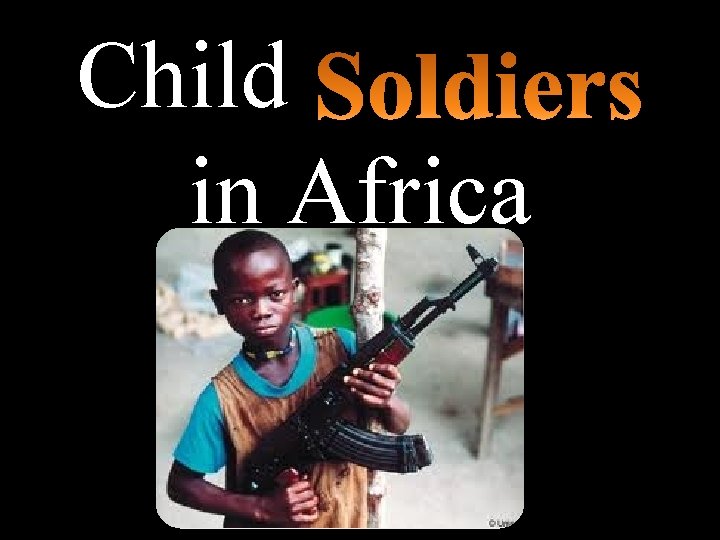
Child in Africa
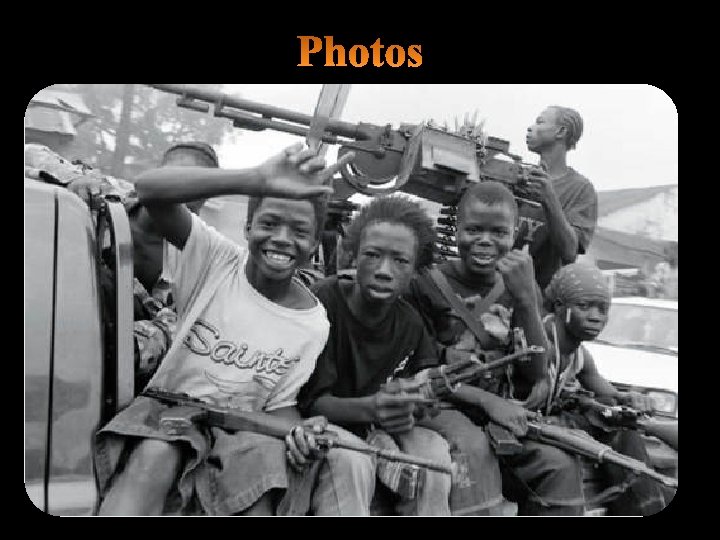
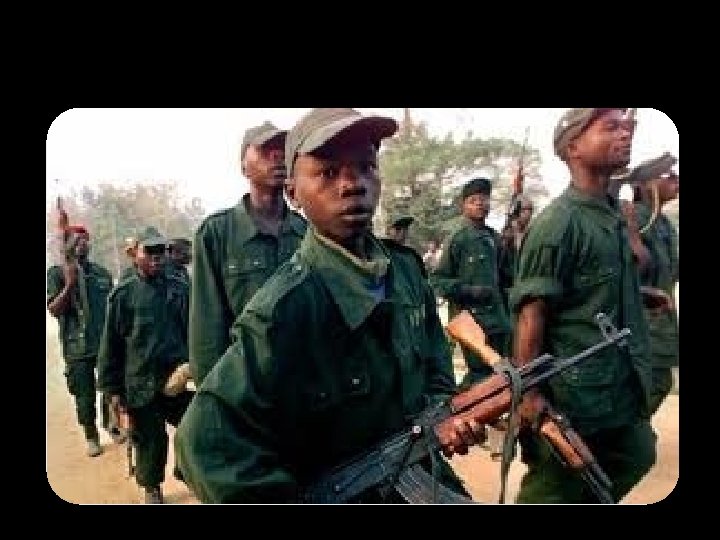
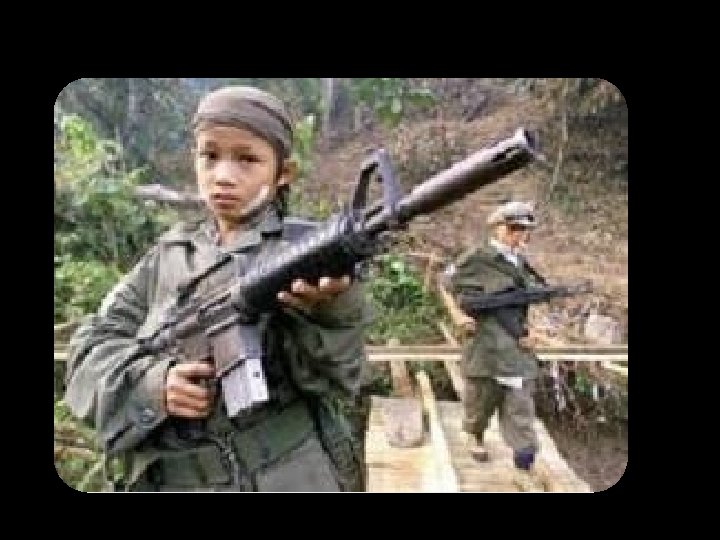
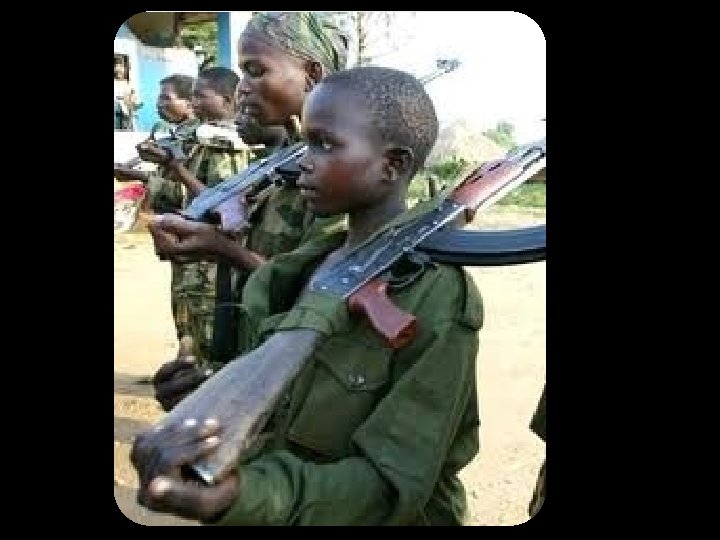
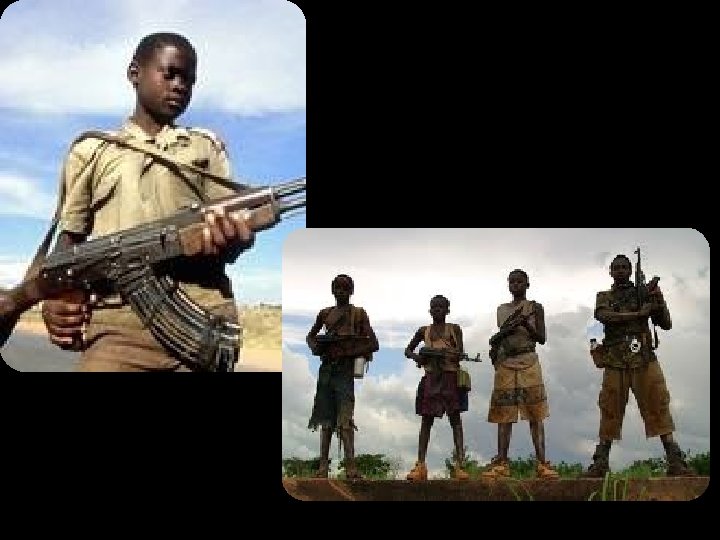
• 300, 000 children under the age of eighteen are currently participating in armed conflicts, 120, 000 of whom are in Africa. • Child soldiers are recruited in more than forty different countries on nearly every continent. • 2 million children dead; 4 -5 million disabled or maimed; 12 million left homeless • While most child soldiers are in their teens, some are as young as seven years old.
• Forced to join after their family is killed • Forced to kill someone from their village so they cannot go back • May join because they admire soldier’s guns or uniforms and want power • May join because they don’t have water, food, shelter and care and they are poor • Some children are abducted and forced into combat Children may not understand the violence • They may be in training as young as 6
They: • are uniquely vulnerable to military recruitment because of their emotional and physical immaturity. • are easily manipulated and can be drawn into violence • are extremely loyal because they substitute their squad commanders and peers for family members • are obedient because of immaturity • don’t take up much room as adults • don’t eat as much as adults • don’t have a fully developed sense of fear or danger • can get into places adults cannot; the enemy may be tricked to thinking they are just kids • can be drugged and brainwashed easily
• Technological advances in weaponry and the proliferation of small arms have contributed to the increased use of child soldiers • Lightweight automatic weapons are simple to operate, often easily accessible, and can be used by children as easily as adults.
• They serve as cooks in the camps • They are used to carry ammunition to the front • They are used to spy on the enemy • They are used as messengers • They are used on suicide missions • Sometimes the girls are used as wives for officers; an estimated 30% of child soldiers are young girls • They are also forced to fight at the front
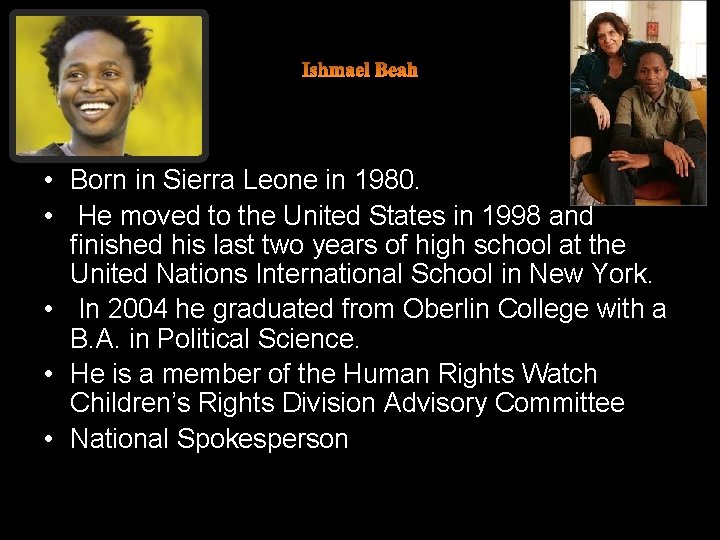
• Born in Sierra Leone in 1980. • He moved to the United States in 1998 and finished his last two years of high school at the United Nations International School in New York. • In 2004 he graduated from Oberlin College with a B. A. in Political Science. • He is a member of the Human Rights Watch Children’s Rights Division Advisory Committee • National Spokesperson
• Title, Author, Nation, Genre • T=A Long Way Gone: Memoirs of a Boy Soldier • A: Ishmael Beah • N: Sierra Leone • G: Memoir- a true account of one significant experience
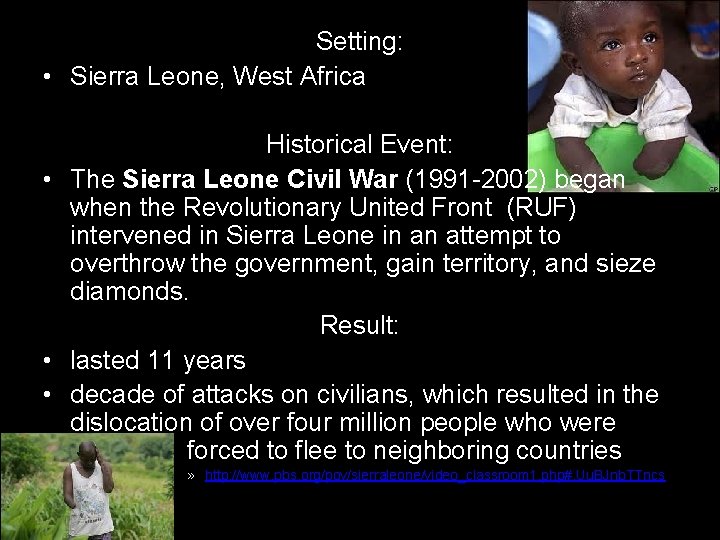
Setting: • Sierra Leone, West Africa Historical Event: • The Sierra Leone Civil War (1991 -2002) began when the Revolutionary United Front (RUF) intervened in Sierra Leone in an attempt to overthrow the government, gain territory, and sieze diamonds. Result: • lasted 11 years • decade of attacks on civilians, which resulted in the dislocation of over four million people who were forced to flee to neighboring countries » http: //www. pbs. org/pov/sierraleone/video_classroom 1. php#. Uu. BJnb. TTncs •
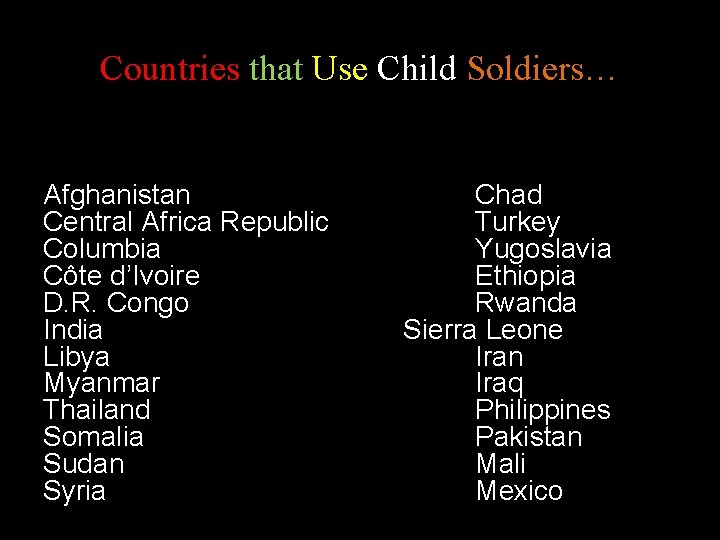
Countries that Use Child Soldiers… Afghanistan Central Africa Republic Columbia Côte d’Ivoire D. R. Congo India Libya Myanmar Thailand Somalia Sudan Syria Chad Turkey Yugoslavia Ethiopia Rwanda Sierra Leone Iran Iraq Philippines Pakistan Mali Mexico
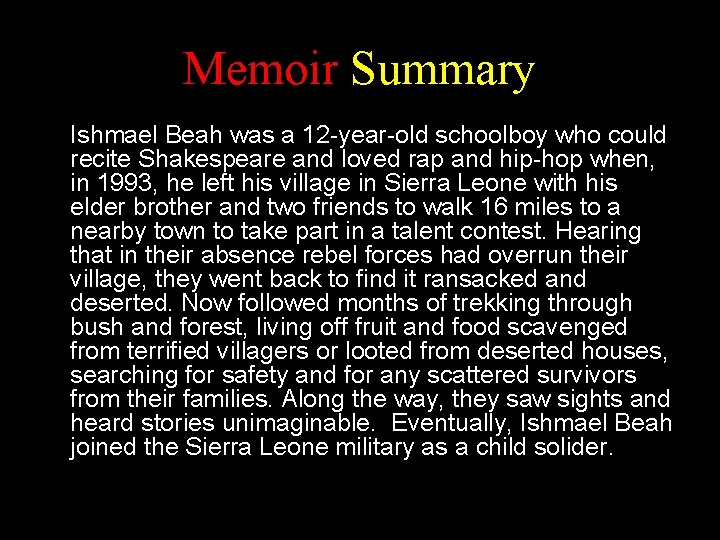
Memoir Summary Ishmael Beah was a 12 -year-old schoolboy who could recite Shakespeare and loved rap and hip-hop when, in 1993, he left his village in Sierra Leone with his elder brother and two friends to walk 16 miles to a nearby town to take part in a talent contest. Hearing that in their absence rebel forces had overrun their village, they went back to find it ransacked and deserted. Now followed months of trekking through bush and forest, living off fruit and food scavenged from terrified villagers or looted from deserted houses, searching for safety and for any scattered survivors from their families. Along the way, they saw sights and heard stories unimaginable. Eventually, Ishmael Beah joined the Sierra Leone military as a child solider.