
The Importance of Intravascular Ultrasound in Proper Balloon
The Importance of Intravascular Ultrasound in Proper Balloon and Stent Sizing for Below the Knee Interventions: a Case presentation Nicolas W Shammas, MD, MS and Qais Radaideh, MD** ** Presenter

Nicolas W Shammas, MD, MS, Qais Radaideh, MD Dr. Shammas receives research and educational grants from Boston Scientific, Intact Vascular, Phillips and C. R. Bard, Inc. Dr. Radaideh has no conflict of interest.
Introduction • Angiography is a suboptimal imaging modality to evaluate vessel size, plaque morphology, intraluminal thrombus and calcium(1, 2). • We present a case of critical limb ischemia with chronic total occlusion of the anterior tibialis artery (AT) treated under Intravascular ultrasound (IVUS) guidance. • A dual access approach was used (pedal retrograde and contralateral common femoral artery antegrade). • We will illustrate the importance of precise imaging for treating infrapopliteal artery disease (3 -4). We speculate that treatment failures in infrapopliteal disease is partly related to suboptimal sizing of these vessels (9 -12).
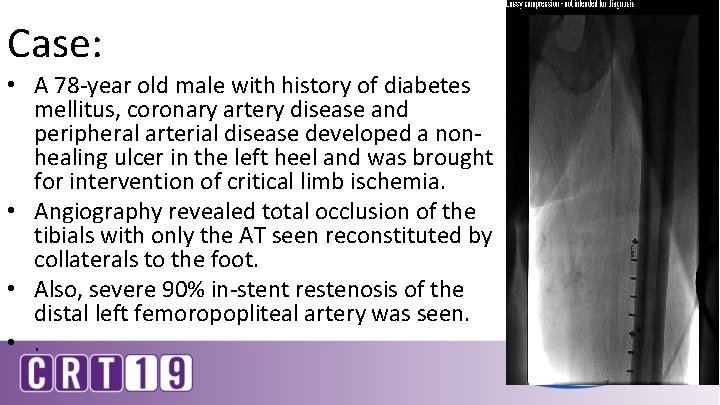
Case: • A 78 -year old male with history of diabetes mellitus, coronary artery disease and peripheral arterial disease developed a nonhealing ulcer in the left heel and was brought for intervention of critical limb ischemia. • Angiography revealed total occlusion of the tibials with only the AT seen reconstituted by collaterals to the foot. • Also, severe 90% in-stent restenosis of the distal left femoropopliteal artery was seen. • .
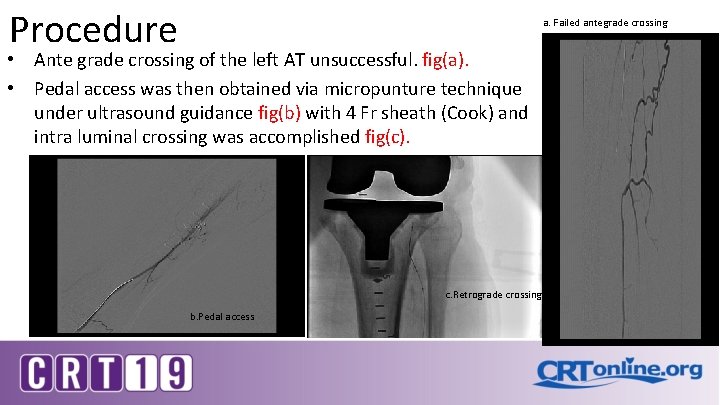
Procedure a. Failed antegrade crossing • Ante grade crossing of the left AT unsuccessful. fig(a). • Pedal access was then obtained via micropunture technique under ultrasound guidance fig(b) with 4 Fr sheath (Cook) and intra luminal crossing was accomplished fig(c). c. Retrograde crossing b. Pedal access
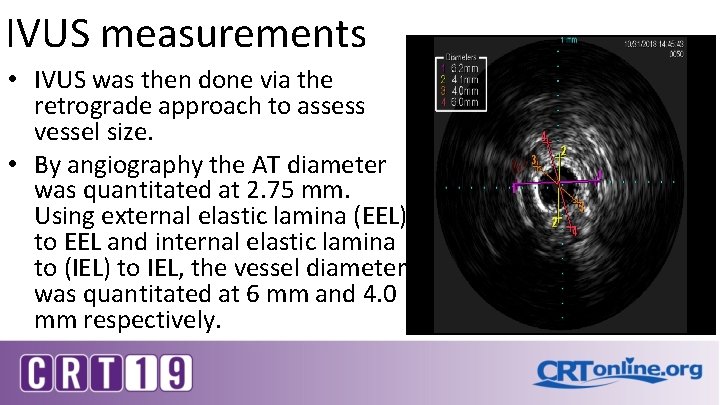
IVUS measurements • IVUS was then done via the retrograde approach to assess vessel size. • By angiography the AT diameter was quantitated at 2. 75 mm. Using external elastic lamina (EEL) to EEL and internal elastic lamina to (IEL) to IEL, the vessel diameter was quantitated at 6 mm and 4. 0 mm respectively.
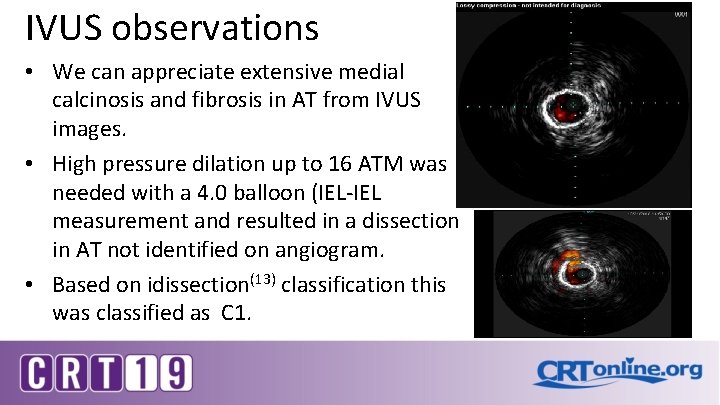
IVUS observations • We can appreciate extensive medial calcinosis and fibrosis in AT from IVUS images. • High pressure dilation up to 16 ATM was needed with a 4. 0 balloon (IEL-IEL measurement and resulted in a dissection in AT not identified on angiogram. • Based on idissection(13) classification this was classified as C 1.
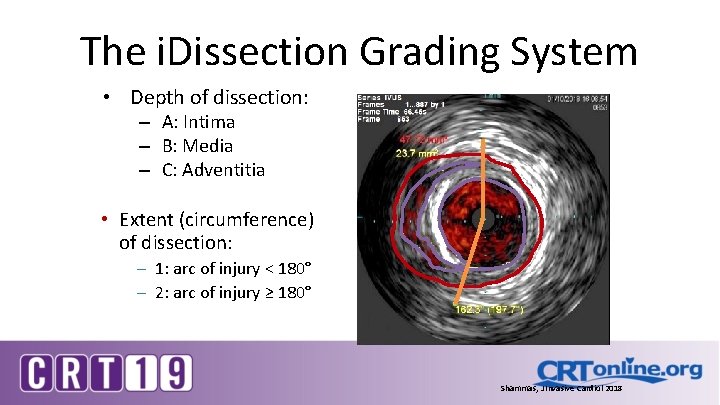
The i. Dissection Grading System • Depth of dissection: – A: Intima – B: Media – C: Adventitia • Extent (circumference) of dissection: – 1: arc of injury < 180° – 2: arc of injury ≥ 180° Shammas, J Invasive Cardiol 2018
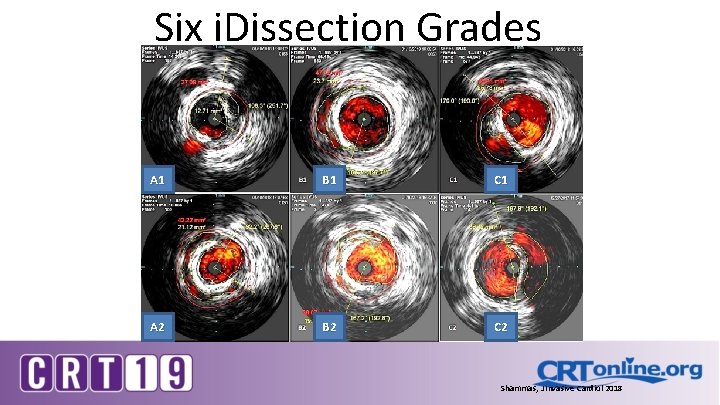
Six i. Dissection Grades A 1 B 1 C 1 A 2 B 2 C 2 Shammas, J Invasive Cardiol 2018
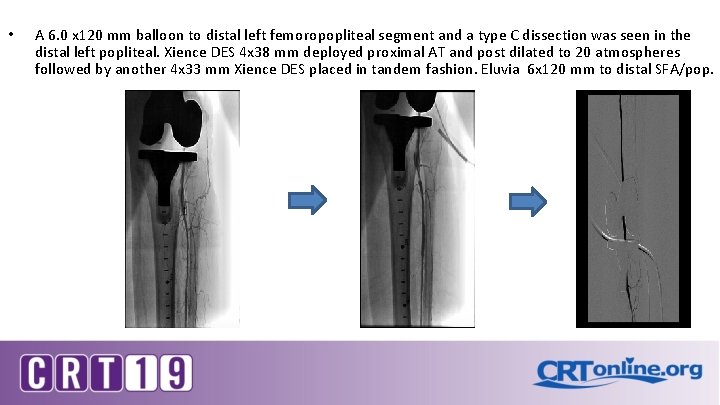
• A 6. 0 x 120 mm balloon to distal left femoropopliteal segment and a type C dissection was seen in the distal left popliteal. Xience DES 4 x 38 mm deployed proximal AT and post dilated to 20 atmospheres followed by another 4 x 33 mm Xience DES placed in tandem fashion. Eluvia 6 x 120 mm to distal SFA/pop.
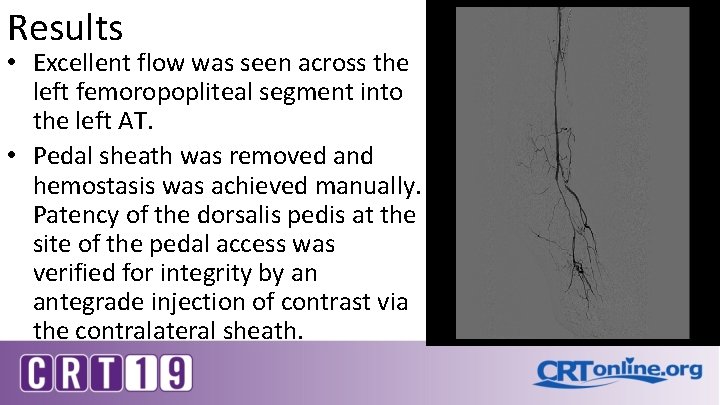
Results • Excellent flow was seen across the left femoropopliteal segment into the left AT. • Pedal sheath was removed and hemostasis was achieved manually. Patency of the dorsalis pedis at the site of the pedal access was verified for integrity by an antegrade injection of contrast via the contralateral sheath.
This cases illustrates several points: • Angiography grossly underestimates the size of infrapopliteal vessels (1 -2) and IVUS guided treatment is critical for optimal stent choice and expansion (4 -6). • Dissections can be missed and can only be seen on IVUS. High pressure inflations are needed in tibial vessels when medial calcinosis or severe fibrosis are present • Pedal access is critical to achieve successful recanalization of total occlusions in patients in whom antegrade crossing fails and is a skill that is essential for endovascular specialists to learn (14).
Discussion • In this case we illustrate the role of IVUS in sizing infrapopliteal vessels and in guiding proper balloon sizing and stent expansion for optimal results. • The reliance on the angiogram would have grossly underestimated the size of the AT and led to under sizing of the stent. Also the fibrotic nature of the vessel and its accurate sizing allowed us an aggressive approach to post stent dilatation leading to excellent stent expansion and optimal minimal luminal area gain. • It could be hypothesized that undersizing of balloons or stents in treating infrapopliteal disease is one possible mechanism that is responsible for treatment failure of infrapopliteal arterial disease (912).
Ongoing studies • We believe precise imaging with IVUS is critical for optimal treatment of the infrapopliteal arteries. • The i. Dissection BTK is a feasibility study, currently ongoing to assess accurate vessel sizing and dissections in infrapopliteal interventions using IEL to IEL diameter as the appropriate target to guide the choice of balloons and stents. • The i. Dissection classification (13) will be used to characterize the nature of dissections below the knee and correlate findings with angiography.
Referrences: 1. 2. 3. 4. 5. 6. 7. 8. 9. 10. 11. 12. 13. 14. Kashyap VS, Pavkov ML, Bishop PD, et al. Angiography underestimates peripheral atherosclerosis: lumenography revisited. J Endovasc Ther. 2008; 15: 117 -125. Arthurs ZM, Bishop PD, Feiten LE, et al. Evaluation of peripheral atherosclerosis: a comparative analysis of angiography and intravascular ultrasound. J Vasc Surg. 2010; 51: 933 -939. Korogi Y, Hirai T, Takahashi M. Intravascular ultrasound imaging of peripheral arteries as an adjunct to balloon angioplasty and atherectomy. Cardiovasc Intervent Radiol. 1996; 19: 1 -9. Katzen BT, Benenati JF, Becker GJ, Zemel G. Role of intravascular ultrasound in peripheral atherectomy and stent deployment (Abstr). Circulation. 1991; 84 (Suppl II): II-542. Shammas NW, Torey JT, Shammas WJ, Jones-Miller S, Shammas GA. Intravascular Ultrasound Assessment and Correlation with Angiographic Findings Demonstrating Femoropopliteal Arterial Dissections Post Atherectomy: Results from the i. Dissection Study. J Invasive Cardiol. 2018; 30: 240 -244. Dong-Ho Shin, Sung-Jin Hong, Gary S. Mintz, et al. Effects of Intravascular Ultrasound–Guided Versus Angiography-Guided New-Generation Drug-Eluting Stent Implantation Meta. Analysis with Individual Patient–Level Data from 2, 345 Randomized Patients JACC cardiovascular intervention. 2016; 9: 2232 -2239 Mustapha JA, Finton SM, Diaz-Sandoval LJ, Saab FA, Miller LE. Percutaneous Transluminal Angioplasty in Patients with Infrapopliteal Arterial Disease: Systematic Review and Meta. Analysis. Circ Cardiovasc Interv. 2016 May; 9: e 003468. doi: 10. 1161/CIRCINTERVENTIONS. 115. 003468. Wu R, Yao C, Wang S, et al. Percutaneous transluminal angioplasty versus primary stenting in infrapopliteal arterial disease: a meta-analysis of randomized trials. J Vasc Surg. 2014; 59: 1711 -20. Zeller T, Baumgartner I, Scheinert D, et al; IN. PACT DEEP Trial Investigators. Drug-eluting balloon versus standard balloon angioplasty for infrapopliteal arterial revascularization in critical limb ischemia: 12 -month results from the IN. PACT DEEP randomized trial. J Am Coll Cardiol. 2014; 64: 1568 -76. Rastan A, Tepe G, Krankenberg H, et al. Sirolimus-eluting stents vs. bare-metal stents for treatment of focal lesions in infrapopliteal arteries: a double-blind, multi-center, randomized clinical trial. Eur Heart J. 2011; 32: 2274 -81. Bosiers M, Scheinert D, Peeters P, et al. Randomized comparison of everolimus-eluting versus bare-metal stents in patients with critical limb ischemia and infrapopliteal arterial occlusive disease. J Vasc Surg. 2012; 55: 390 -8. Scheinert D, Katsanos K, Zeller T, et al. A prospective randomized multicenter comparison of balloon angioplasty and infrapopliteal stenting with the sirolimus-eluting stent in patients with ischemic peripheral arterial disease: 1 -year results from the ACHILLES trial. J Am Coll Cardiol. 2012; 60: 2290 -5. Shammas NW, Torey JT, Shammas WJ. Dissections in Peripheral Vascular Interventions: A Proposed Classification Using Intravascular Ultrasound. J Invasive Cardiol. 2018; 30: 145 -146. Radaideh Q, Shammas NW. When Pedal Access Is the Only Way to Save a Limb! Int J Angiol 2018 DOI: 10. 1055/s-0038 -1673645.
THANK YOU
- Slides: 16