
The Importance of Information Literacy UCLAPacific Bell Initiative
The Importance of Information Literacy UCLA/Pacific Bell Initiative for 21 st Century Literacies Howard Besser UCLA School of Education & Information http: //www. newliteracies. gseis. ucla. edu/ http: //www. gseis. ucla. edu/~howard Besser--La Verne University 1/30/02 1
The Importance of Literacies in the 21 st Century_ _ _ Problem and Background Literacies in the Information Age UCLA/Pacific Bell Initiative for 21 st Century Literacies Besser--La Verne University 1/30/02 2
The Importance of Literacies in the 21 st Century: Background and Issues _ _ Explosion in new sources of information Anyone can be an information “publisher” Access to information is unmediated and unfiltered …all these have both positive and negative implications Besser--La Verne University 1/30/02 3
Increasing Web-based Info _ _ The number of World Wide Web sites doubles every six months. In 1999, there were about 63 million hosts and 8 billion pages on the Web. Someone would have to surf more than 300, 000 pages a day to see it all. Frank Biocca, (2000). New media technology and youth: Trends in the evolution of new media. Journal of Adolescent Health, 27(2, supplement), 22 -29. Besser--La Verne University 1/30/02 4
Increasing use of Mediabased delivery systems- Besser--La Verne University 1/30/02 5
Percent Time American Children 2 -18 Spend at Home In Non-School Uses of Various Media and Technology, Donald F. Roberts, Ulla G. Foehr, Victoria J. Rideout, & Mollyann Brodie. (1999, November). Kids & media @ the new millenium. The Henry J. Kaiser Family Foundation. Besser--La Verne University 1/30/02 6
The Importance of Literacies in the 21 st Century: Literacies in the Information Age _ _ _ Information Literacy Media Literacy Visual Literacy Cultural Literacy. . . Besser--La Verne University 1/30/02 7
Lifetime Learning & Literacy for productive employment _ The heyday when a high school or college education would serve a graduate for a lifetime is gone… Today’s recipients of diplomas expect to have many jobs and to use a wide range of skills over their working lives. Workers must be equipped not simply with technical know-how but also with the ability to create, analyze, and transform information and to interact effectively with others. _ Alan Greenspan, July 11, 2000. Speech before the National Governors’ Association. Besser--La Verne University 1/30/02 8
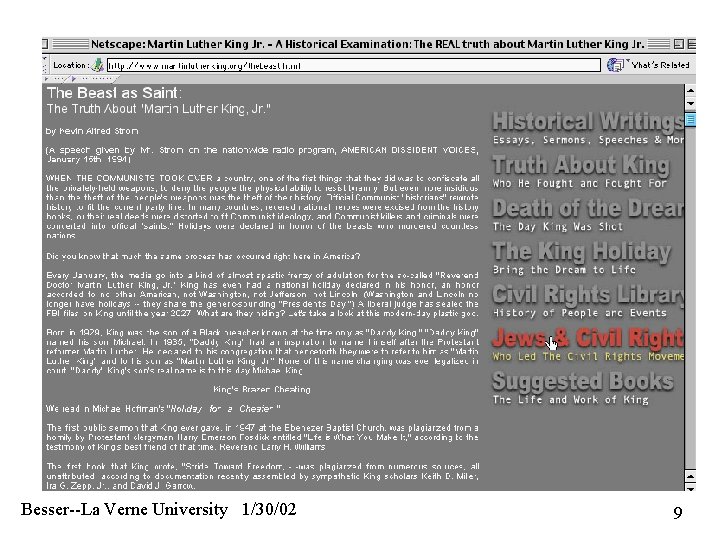
Crisis in Reliability of new information sources (1/2) Besser--La Verne University 1/30/02 9
Crisis in Reliability of new information sources (2/2) _ _ Librarian’s traditional filtering role is diminished “All information is equally valuable” Besser--La Verne University 1/30/02 10
_ _ _ More important than ever to teach traditional Information Literacy sklls Assess recency, relevance, thoroughness, appropriateness of information Evaluate bias of information source Critical Thinking skills Besser--La Verne University 1/30/02 11
E-Literate video Besser--La Verne University 1/30/02 12
ACRL Information Literacy Analysis & Recommendations- Besser--La Verne University 1/30/02 13

ALA Definition _ Information literacy is a set of abilities requiring individuals to "recognize when information is needed and have the ability to locate, evaluate, and use effectively the needed information. " Besser--La Verne University 1/30/02 14
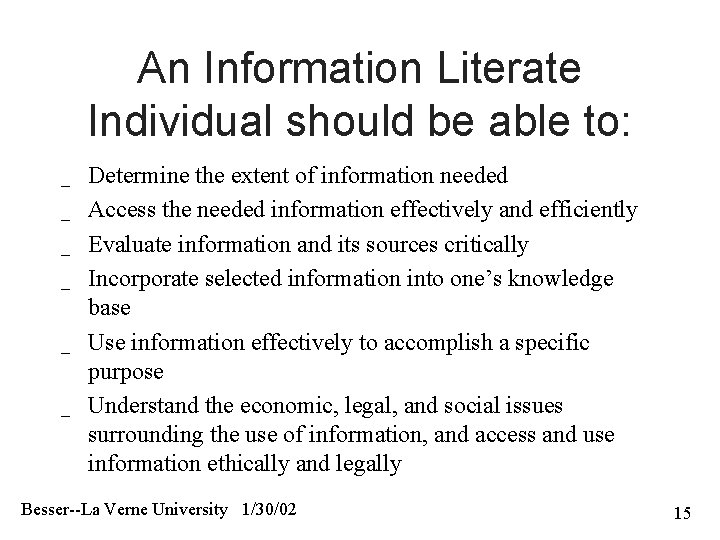
An Information Literate Individual should be able to: _ _ _ Determine the extent of information needed Access the needed information effectively and efficiently Evaluate information and its sources critically Incorporate selected information into one’s knowledge base Use information effectively to accomplish a specific purpose Understand the economic, legal, and social issues surrounding the use of information, and access and use information ethically and legally Besser--La Verne University 1/30/02 15
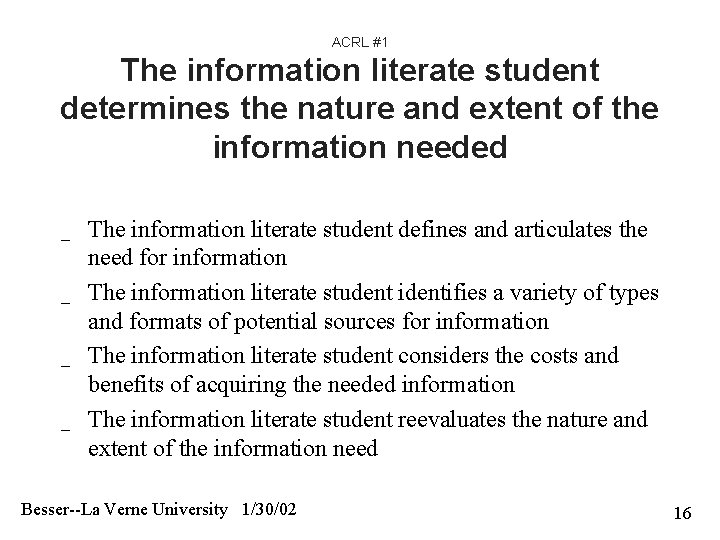
ACRL #1 The information literate student determines the nature and extent of the information needed _ _ The information literate student defines and articulates the need for information The information literate student identifies a variety of types and formats of potential sources for information The information literate student considers the costs and benefits of acquiring the needed information The information literate student reevaluates the nature and extent of the information need Besser--La Verne University 1/30/02 16
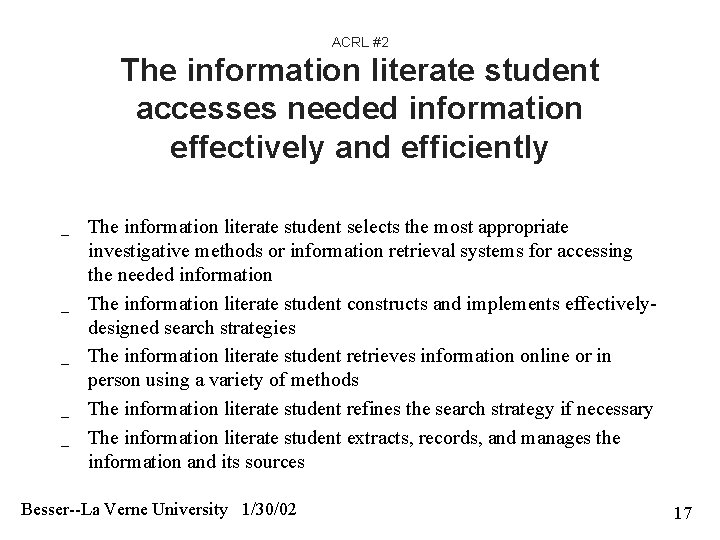
ACRL #2 The information literate student accesses needed information effectively and efficiently _ _ _ The information literate student selects the most appropriate investigative methods or information retrieval systems for accessing the needed information The information literate student constructs and implements effectivelydesigned search strategies The information literate student retrieves information online or in person using a variety of methods The information literate student refines the search strategy if necessary The information literate student extracts, records, and manages the information and its sources Besser--La Verne University 1/30/02 17
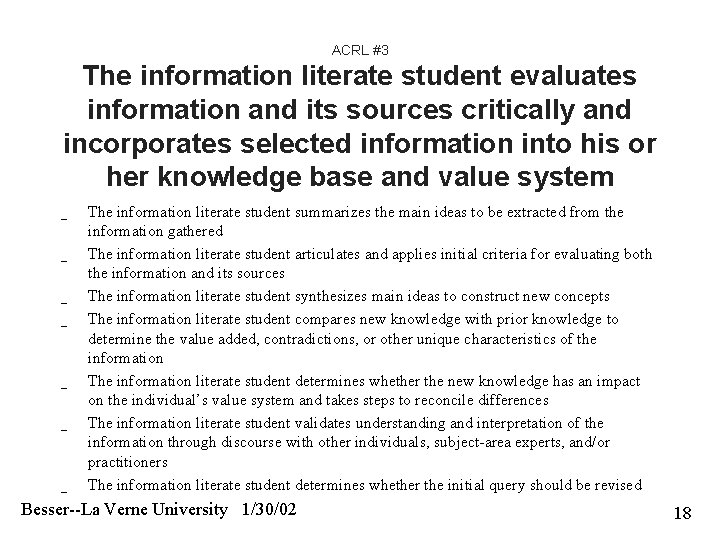
ACRL #3 The information literate student evaluates information and its sources critically and incorporates selected information into his or her knowledge base and value system _ _ _ _ The information literate student summarizes the main ideas to be extracted from the information gathered The information literate student articulates and applies initial criteria for evaluating both the information and its sources The information literate student synthesizes main ideas to construct new concepts The information literate student compares new knowledge with prior knowledge to determine the value added, contradictions, or other unique characteristics of the information The information literate student determines whether the new knowledge has an impact on the individual’s value system and takes steps to reconcile differences The information literate student validates understanding and interpretation of the information through discourse with other individuals, subject-area experts, and/or practitioners The information literate student determines whether the initial query should be revised Besser--La Verne University 1/30/02 18
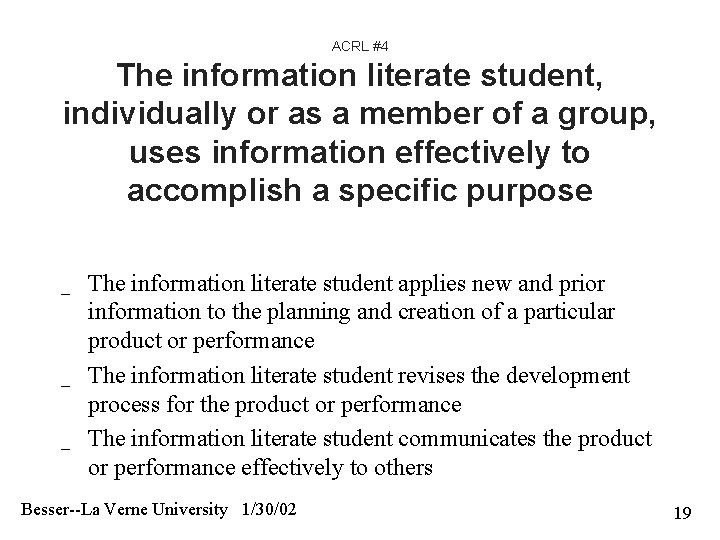
ACRL #4 The information literate student, individually or as a member of a group, uses information effectively to accomplish a specific purpose _ _ _ The information literate student applies new and prior information to the planning and creation of a particular product or performance The information literate student revises the development process for the product or performance The information literate student communicates the product or performance effectively to others Besser--La Verne University 1/30/02 19
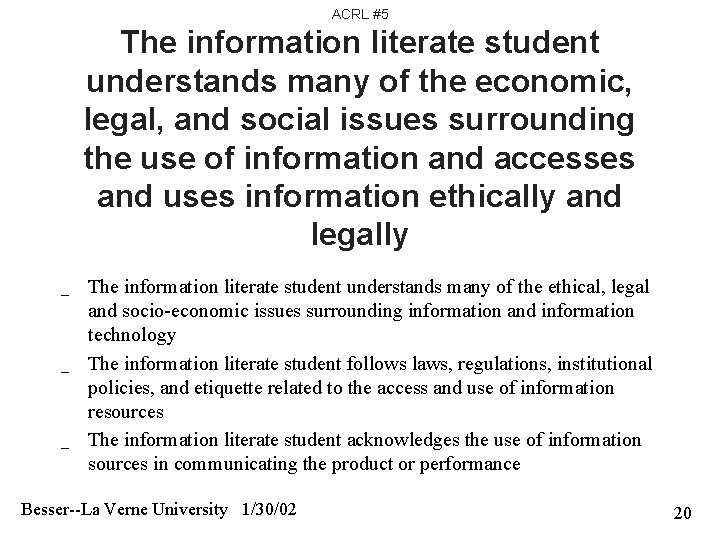
ACRL #5 The information literate student understands many of the economic, legal, and social issues surrounding the use of information and accesses and uses information ethically and legally _ _ _ The information literate student understands many of the ethical, legal and socio-economic issues surrounding information and information technology The information literate student follows laws, regulations, institutional policies, and etiquette related to the access and use of information resources The information literate student acknowledges the use of information sources in communicating the product or performance Besser--La Verne University 1/30/02 20
UCLA/Pacific Bell Initiative for 21 st Century Literacies_ _ _ The Problem and Issues Project Dates & Staff The User Summit Policy Design Issues & Adaptive Systems Besser--La Verne University 1/30/02 21
21 st Century Literacies _ _ _ Information Literacy Visual Literacy Media Literacy Cultural Literacy. . . Besser--La Verne University 1/30/02 22
The Problem and Issues _ _ _ If we solve Access Problem (technology, bandwidth, training), other impediments to an informed citizenry still remain Need critical evaluation of resources (reliability, authoritativeness, thoroughness, recency) Need skills to pare down from information overload Need critical thinking skills Need to deal with different users having different backgrounds and capabilities Besser--La Verne University 1/30/02 23
Project Dates & Staff _ _ _ Summer 2000 -Dec 2001 $1 million Co-Directed by Aimée Dorr and Howard Besser October 21, 2000 Summit (planning involved 20 people from Pacbell & UCLA) Rest of project primarily UCLA Coordinator Sheila Afnan-Manns (afnanmanns@gseis. ucla. edu) Besser--La Verne University 1/30/02 24
Parts to the Initiative_ _ Summit User Policy Design/System Besser--La Verne University 1/30/02 25
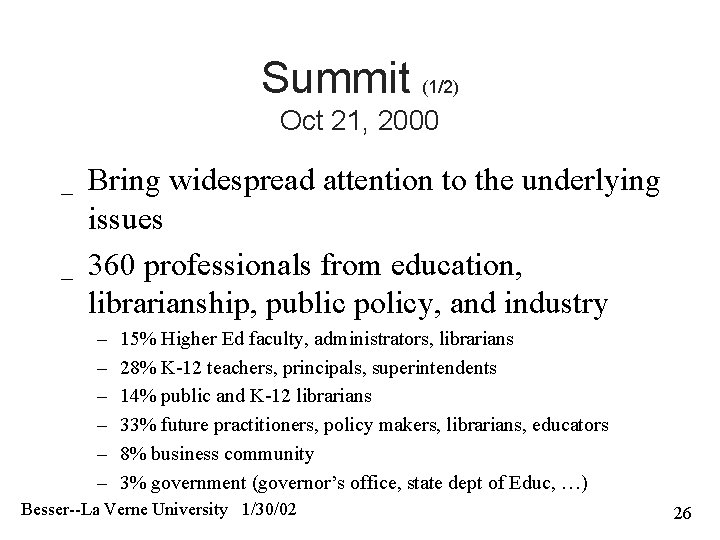
Summit (1/2) Oct 21, 2000 _ _ Bring widespread attention to the underlying issues 360 professionals from education, librarianship, public policy, and industry – – – 15% Higher Ed faculty, administrators, librarians 28% K-12 teachers, principals, superintendents 14% public and K-12 librarians 33% future practitioners, policy makers, librarians, educators 8% business community 3% government (governor’s office, state dept of Educ, …) Besser--La Verne University 1/30/02 26
Summit (2/2) Oct 21, 2000 _ Snappy video to highlight the problems (25 unsolicited requests to show video in 1 st month after Summit) _ _ Over 2 dozen exhibits and poster sessions explaining related projects throughout the country Guest speakers (Alan Kay, Marcia Bates, Pat Breivik, Kathleen Tyner, Anna Deavere Smith, Tal Finney) Besser--La Verne University 1/30/02 27
The User _ _ _ Evaluative bibliography of literature and projects Analysis of what we know thusfar from several different perspectives (curriculum design, library services, critical theory, information retrieval, user -centered design, …) Examining model curriculum (trainer) – Teachers – Librarians Besser--La Verne University 1/30/02 28
Policy _ _ information literacy standards issues related to the "Digital Divide” (measuuring) privacy and ownership concerns. . . Besser--La Verne University 1/30/02 29
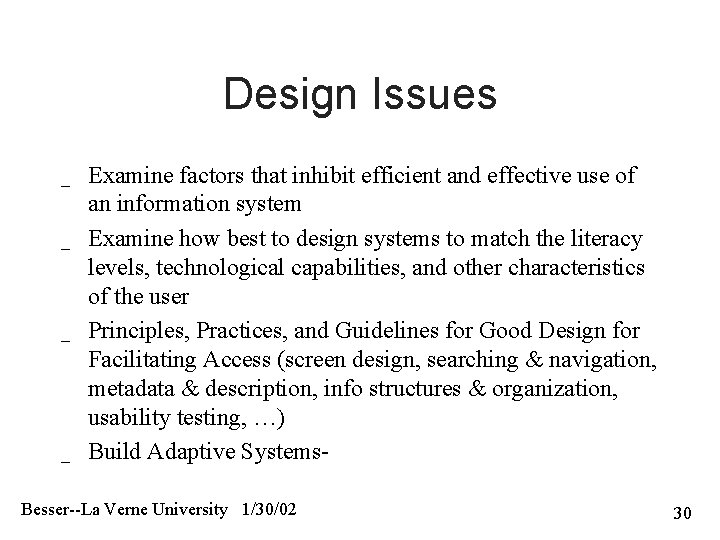
Design Issues _ _ Examine factors that inhibit efficient and effective use of an information system Examine how best to design systems to match the literacy levels, technological capabilities, and other characteristics of the user Principles, Practices, and Guidelines for Good Design for Facilitating Access (screen design, searching & navigation, metadata & description, info structures & organization, usability testing, …) Build Adaptive Systems- Besser--La Verne University 1/30/02 30
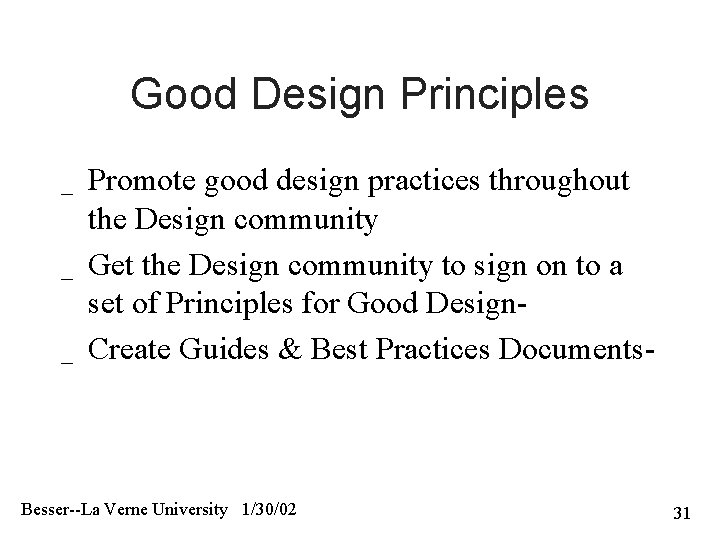
Good Design Principles _ _ _ Promote good design practices throughout the Design community Get the Design community to sign on to a set of Principles for Good Design. Create Guides & Best Practices Documents- Besser--La Verne University 1/30/02 31
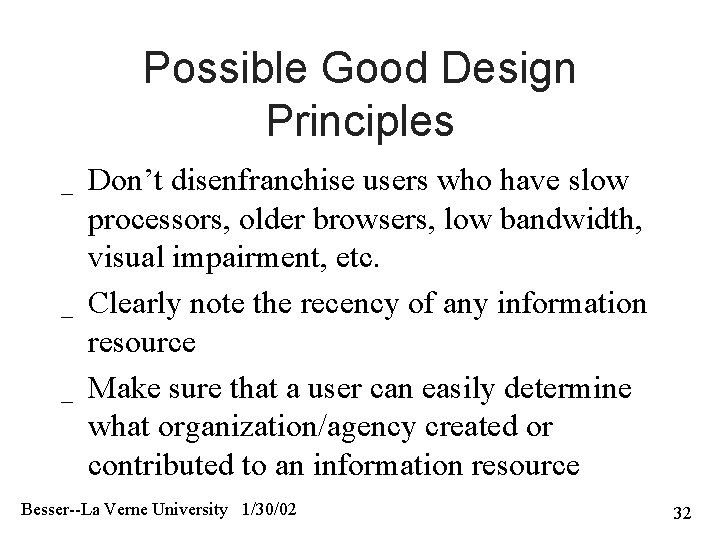
Possible Good Design Principles _ _ _ Don’t disenfranchise users who have slow processors, older browsers, low bandwidth, visual impairment, etc. Clearly note the recency of any information resource Make sure that a user can easily determine what organization/agency created or contributed to an information resource Besser--La Verne University 1/30/02 32
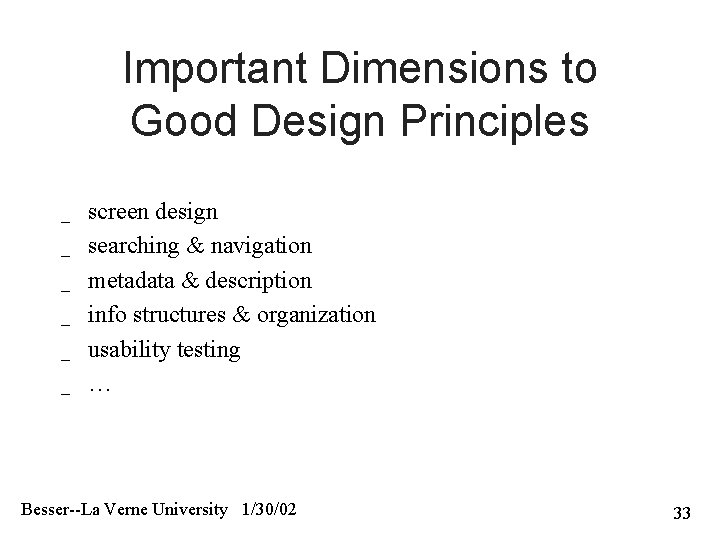
Important Dimensions to Good Design Principles _ _ _ screen design searching & navigation metadata & description info structures & organization usability testing … Besser--La Verne University 1/30/02 33
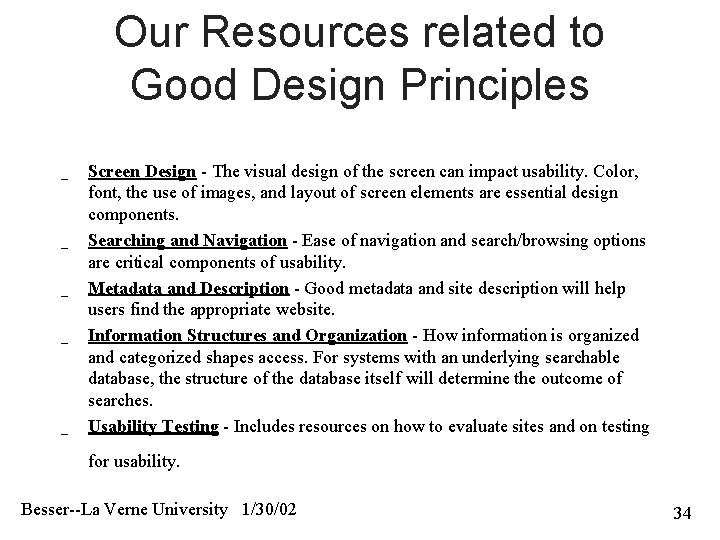
Our Resources related to Good Design Principles _ _ _ Screen Design - The visual design of the screen can impact usability. Color, font, the use of images, and layout of screen elements are essential design components. Searching and Navigation - Ease of navigation and search/browsing options are critical components of usability. Metadata and Description - Good metadata and site description will help users find the appropriate website. Information Structures and Organization - How information is organized and categorized shapes access. For systems with an underlying searchable database, the structure of the database itself will determine the outcome of searches. Usability Testing - Includes resources on how to evaluate sites and on testing for usability. Besser--La Verne University 1/30/02 34
Build Adaptive Systems _ _ _ Build Systems that adapt the same back-end information to different user profiles (different knowledge bases, different technical capabilities, different cognitive structures) User profiles may include advanced researcher in a particular subject area, general undergraduate student, high school student, … Different profiles will need different user interfaces, navigation, searching vocabulary, file formats and sizes, . . . Besser--La Verne University 1/30/02 35
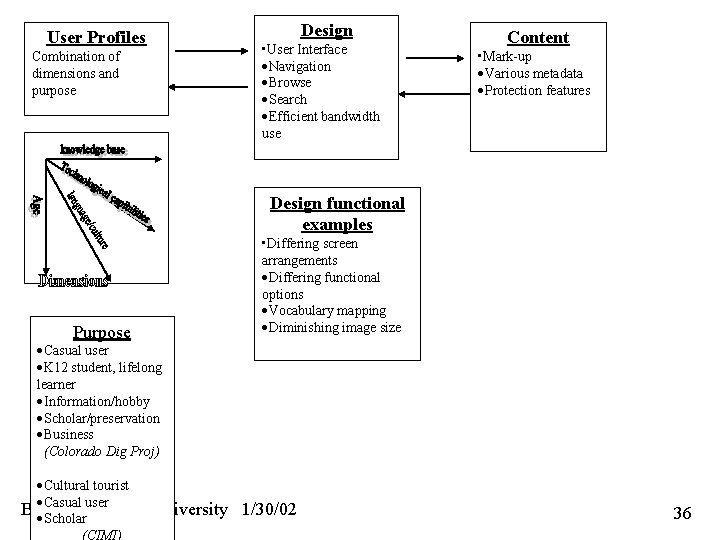
Design User Profiles • User Interface ·Navigation ·Browse ·Search ·Efficient bandwidth use Combination of dimensions and purpose Content • Mark-up ·Various metadata ·Protection features Design functional examples Purpose • Differing screen arrangements ·Differing functional options ·Vocabulary mapping ·Diminishing image size ·Casual user ·K 12 student, lifelong learner ·Information/hobby ·Scholar/preservation ·Business (Colorado Dig Proj) ·Cultural tourist ·Casual user Besser--La Verne ·Scholar University 1/30/02 36
Adaptive Systems what they’ll do _ _ Can serve different audiences (general public, purposeful inquirer [cultural tourist], domain specialist) Each profile audience will – see a level of discourse addressed to them – experience a user interface appropriate to their profile – use vocabulary they are familiar with _ Yet all will be using the same back-end set of information Besser--La Verne University 1/30/02 37
Adaptive Systems how they’ll work _ _ _ Passing search terms through a thesaurus to map specialist vocabulary to/from vernacular Adapting vocabulary from curatorial language into common discourse; development of markup extensions to EAD/CIMI/CIDOC to allow description for different audiences In general, specialized users will experience more textbased interfaces, while general users will experience more graphic/visual interfaces Besser--La Verne University 1/30/02 38
Adaptive Systems development plan _ _ Research and experimentation Profile 5 -10 different user communities Mechanize 2 -3 different information delivery systems Demonstrate the utility of this approach (proof of concept) for further research and design Besser--La Verne University 1/30/02 39
Joint CDL/UCLA project _ _ Use MOAC, California Heritage Collections Profile and construct a series of different front-ends for different audiences – Front-ends– Target Audiences- _ Evaluate Besser--La Verne University 1/30/02 40
Profile and construct a series of different front-ends for different audiences: Front-ends to include _ _ Screen design for searching and for display Browsing, probably with some high-level categorization/grouping Searching Vocabulary mapped through thesauri Besser--La Verne University 1/30/02 41
Profile and construct a series of different front-ends for different audiences Target audiences might include 4 th grade students _ 12 th grade students _ 4 th grade teachers _ 12 th grade teachers _ University faculty _ General. Undergraduates _ Some people outside the history/social studies sector Besser--La Verne University 1/30/02 _ 42
What does this all mean for Info Professionals? _ _ Good set of Design Guidelines Feasibility of Adaptive Systems that deliver the same back-end info tailored to different sets of user needs Besser--La Verne University 1/30/02 43
Adaptive Systems UCLA/Pacific Bell Initiative for 21 st Century Literacies Howard Besser UCLA School of Education & Information http: //www. newliteracies. gseis. ucla. edu/ http: //www. gseis. ucla. edu/~howard/ http: //www. ala. org/acrl/infolit. html Besser--La Verne University 1/30/02 44
- Slides: 44