
The importance of ICT accessibility for persons with
The importance of ICT accessibility for persons with disabilities: perspectives and experience from ITU May 2016 www. itu. int/accessibility
Why ICT accessibility matters www. itu. int/accessibility
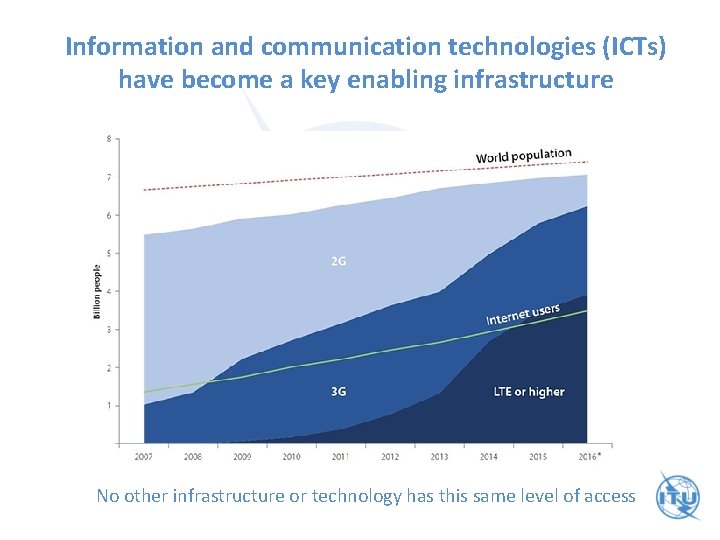
Information and communication technologies (ICTs) have become a key enabling infrastructure No other infrastructure or technology has this same level of access
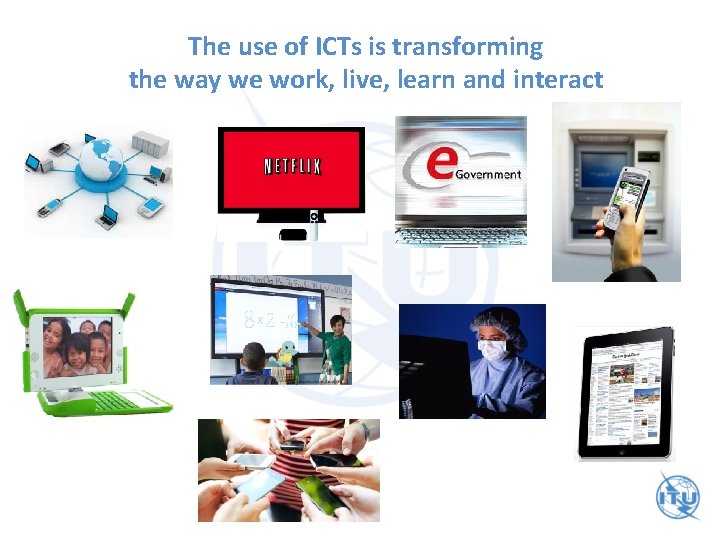
The use of ICTs is transforming the way we work, live, learn and interact
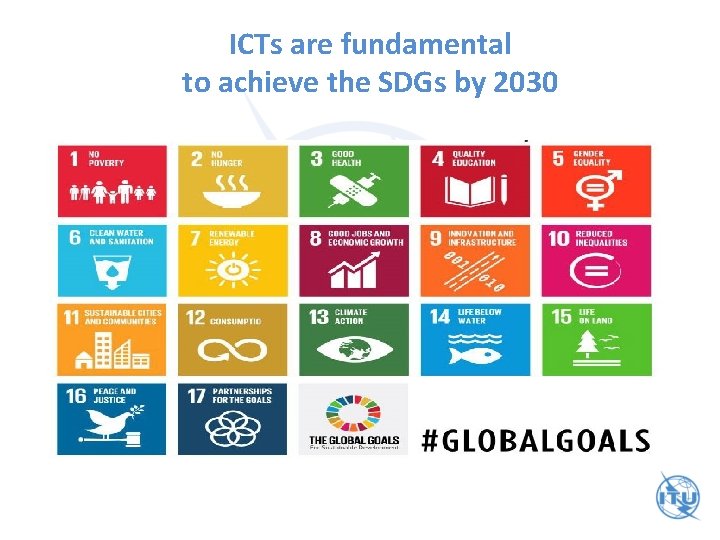
ICTs are fundamental to achieve the SDGs by 2030
ICTs are fundamental to enable the independent living of persons with disabilities • Access to key public services – Health – Education – Government services • Opportunities to increase productivity and Access job market, including becoming entrepreneurs • Communicate
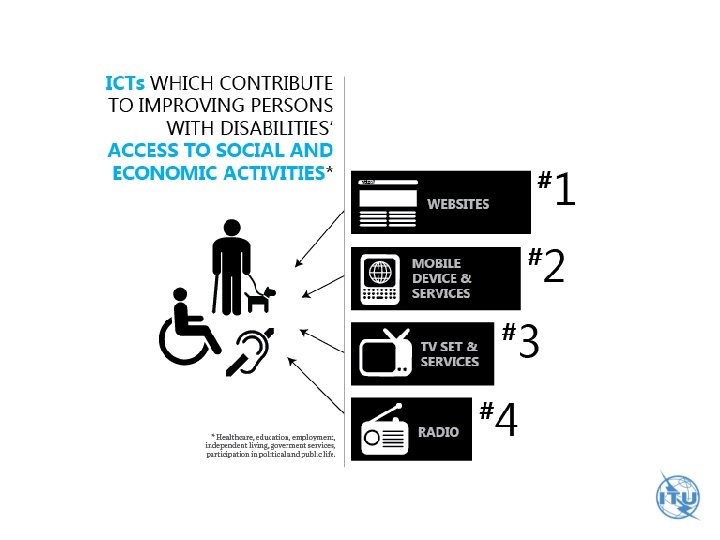
ICTs are a powerful equalizer of abilities, empowering persons with disabilities to fulfill their potential, dreams and ambitions However to achieve this impact ICTs have to be accessible otherwise ICTs will be introducing new barriers for persons with disabilities
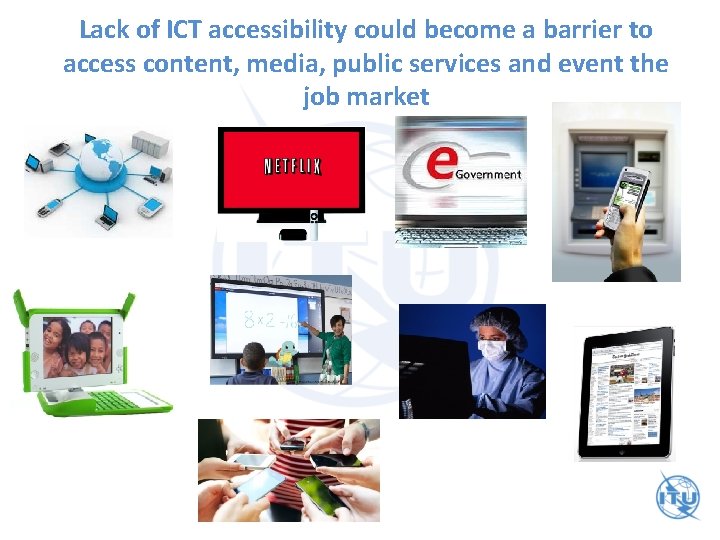
Lack of ICT accessibility could become a barrier to access content, media, public services and event the job market
How to promote an accessible ICT sector? • By promoting Universal Design: role of standards • By creating regulatory/policy frameworks that encourage the private sector to implement access services + accessibility features • By creating accessible content, services and applications • By creating a dynamic market of access services: – Role of public procurement – Role of government as “super user” to create demand • By building capacity of users
ITU’s work in accessibility Overview www. itu. int/accessibility

About ITU is the United Nations specialized agency for information and communication technologies (ICTs) 19 +7 3 00 MEMBE R STATES PRIVATE SECTOR ORGANIZATIONS Enabling a connected world +1 50 ACADEMIA MEMBERS
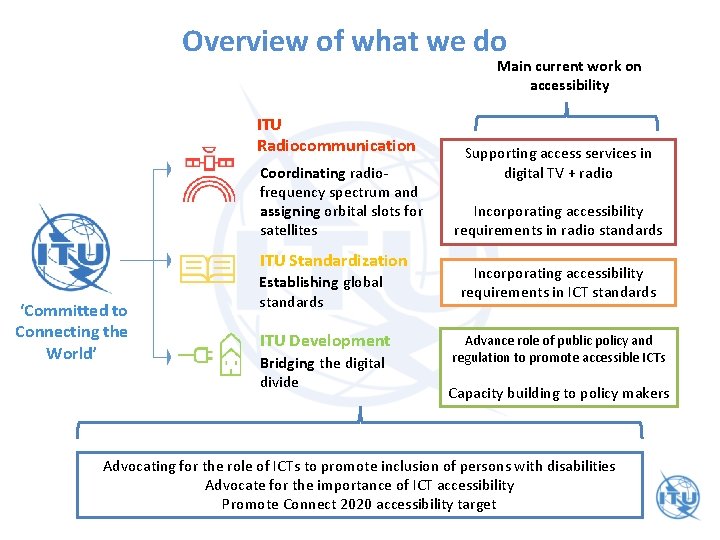
Overview of what we do Main current work on accessibility ITU Radiocommunication Coordinating radiofrequency spectrum and assigning orbital slots for satellites ITU Standardization ‘Committed to Connecting the World’ Establishing global standards ITU Development Bridging the digital divide Supporting access services in digital TV + radio Incorporating accessibility requirements in radio standards Incorporating accessibility requirements in ICT standards Advance role of public policy and regulation to promote accessible ICTs Capacity building to policy makers Advocating for the role of ICTs to promote inclusion of persons with disabilities Advocate for the importance of ICT accessibility Promote Connect 2020 accessibility target
Jose. Batanero@itu. int www. itu. int/accessibility
Annex ITU’s work in accessibility Extended Overview www. itu. int/accessibility

Inter-sectoral activities • Measuring and implementation of Connect 2020 accessibility goal • Participation in meetings of the bodies established by the UN Convention on the Rights of Persons with Disabilities • Implementation of ITU Accessibility Fund • Implementation of ITU Accessibility Policy across the organization to promote the participation of persons with disabilities in the work of the Union • Outreach, advocacy and communication activities • Encouraging all delegations to mobilize experts on accessibility for ITU meetings
ITU’s activities in the area of ICT accessibility for persons with disabilities ACTIVITIES IN ITU Radiocommunication Sector (ITU-R)
ITU-R’s activities on ICT Accessibility • ITU-R Sector contributes to the wireless technological development through the production of Recommendations, Reports, Questions and Handbooks relating to persons with disabilities and persons with specific needs, and by so doing, to improve their accessibility and to reduce the overall Digital Disabilities Divide. • For the ITU-R meetings, in line with Resolution 175 (Guadalajara, 2010), an English live captioning service for specific ITU-R events including WRC, RAG and ITU-R Study Group meetings has been provided since late 2013. • In addition to live captioning, since RA/WRC-15 in 2015, the captioning transcript archives are also available. ITU Members can also access these archives shortly after a session for which captioning is provided.
ITU-R Study Group 1(Spectrum Management) ITU-R Study Group 1 (SG 1) is carrying out studies in response to Resolution ITU-R 54 -2 (revised at RA-15) to achieve harmonization for Short Range Devices (SRDs) (including definitions of categories for instance for audio applications including aids for the hearing impaired) ITU-R Recommendation and Report on SRDs, including in particular SRDs used for hearing aids or medical devices within SG 1: • Recommendation ITU-R SM. 1896 “Frequency ranges for global or regional harmonization of short-range devices (SRDs)” (SM. 1896 -0 (2011)) • Report ITU-R SM. 2153 “Technical and operating parameters and spectrum use for short-range radiocommunication devices” (SM. 2153 -5 (2015)) Other studies on SRDs are available in relevant ITU-R Reports of the SM series (e. g. measurements, impact on radiocommmunication services, specific applications and techniques)
ITU-R Study Group 5 (Terrestrial Services) ITU-R Study Group 5 (SG 5) is carrying out studies to identify the suitable technical and operational characteristics, and conditions that might allow compatible operation of a short-range radiocommunication public access system supporting hearing aid systems at ITU-R SG 5 WP 5 A in response to Resolution ITU-R 67 (2015). ITU-R Recommendation and Question on wireless hearing aid systems within SG 5 • Recommendation ITU-R M. 1076 “Wireless communication systems for persons with impaired hearing” (M. 1076 -1 (2015)) • Question ITU-R 254/5 “Operation of short-range radiocommunication public access system supporting hearing aid systems” (Q. 254/5 (2014))
ITU-R Study Group 6 (Broadcasting Services) ITU-R Study Group 6 (SG 6) continues to actively participate in the ITU Intersector Rapporteur Group on Audiovisual Media Accessibility (IRG-AVA) (ITU-R SG 6, ITU-T SG 9 and SG 16) In line with Resolution 175 (Guadalajara, 2010), the SG 6 Chairman actively contributed to ITU’s approach to the organizers of UEFA and the Paralympic Games 2016 in Brazil in order to promote accessibility services for their audiovisual coverages by 2016. ITU-R Reports, Recommendations and Handbook on broadcasting service accessibility within SG 6 • Report ITU-R BT. 2267 “Integrated broadcast-broadband systems” (T. 2267 -5 (2015)) • Report ITU-R BT. 2207 “Accessibility to broadcasting services for persons with disabilities” (BT. 2207 -2 (2012)) • Recommendation ITU-R BS. 1698 “Evaluating fields from terrestrial broadcasting transmitting systems operating in any frequency band for assessing exposure to non-ionizing radiation” (BS. 1698 -0 (2005)) • Recommendation ITU-R BT. 1702 “Guidance for the reduction of photosensitive epileptic seizures caused by television” (BT. 1702 -0 (2005)) • ”DTTB Handbook - Digital terrestrial television broadcasting in the VHF/UHF bands” (2002)
ITU’s activities in the area of ICT accessibility for persons with disabilities ACTIVITIES IN ITU Standardization Sector (ITU-T)
ITU-T: mainstream accessibility in ICT standardization • mainstream accessibility in ICTs – Develop standards (ITU-T Recommendations) on ICT accessibility – Promote implementation of these standards • 3 rd IPTV Accessibility Application Challenge, partner with International Paralympic Committee for Rio 2016 Paralympics • also making ITU-T accessible to Pw. Ds – Telecommunications Accessibility Checklist - ‘universal design’ principle – Joint ITU/ISO/IEC ‘Policy on Standardization and Accessibility’ and ‘Guide for addressing accessibility in standards’ (ITU-T H Suppl. 17 (11/2014)) – Remote participation (to facilitate Pw. Ds’ participation in ITU-T work) – Reasonable accommodation of specific needs from Pw. Ds – captioning, sign language interpretation, fellowship, etc
ITU-T’s recent publications on accessibility • • • ITU-T H. 702 (11/2015) Accessibility profiles for IPTV systems This recommendation makes it possible for accessibility features like captioning, sign language, and audio description to be added to Internet Protocol TV and that this can be deployed with global interoperability. ITU-T F. 791 (11/2015) Accessibility terms and definitions This is the first consented UN standalone recommendation giving the correct definitions based on the UNCRD with consultation with persons with disabilities to be used by standard writers and others to be used in all respective documents in English. Guidelines for supporting remote participation in meetings for all This is the first approved UN standalone technical paper giving instructions on how to organize and run an accessible remote participation meetings to include persons with disabilities taking into account both the accessible and in accessible aspects of the existing remote participation tools. Guidelines for accessible meetings This is the first approved UN standalone technical paper giving instructions on how to organize and run an accessible meetings to include persons with disabilities. ITU-T F. 790 (01/2007)˝Telecommunications accessibility guidelines for older persons and persons with disabilities˝ - under revision This Recommendation gives guidance on understanding the topic of accessibility and the ways that accessibility may be incorporated in ICT products and services. • • • 2014 - Overview of Disaster Relief Systems, Network Resilience and Recovery 2014 - Requirements for Disaster Relief System ITU-T H. 785. 0 (10/2014) Digital signage: Requirements of disaster information services • 2014 - New Annex A of E. 161: Arrangement of digits, Korean Character set and symbols
ITU-T ongoing work items on accessibility • • • • F. Relay: Multimedia telecommunication relay services FSTP-UMAA: Use cases for assisting people with disabilities using mobile applications H. ACC-MMD: Accessibility Features for Mobile Media Devices H. ACC-MMSIGN: Abstract language for multimedia signing H. ACC-RCAD: Requirements for captioning and audio description for accessibility H. ACC-RDE: Application layer information specification at the terminal to network interface for people with hearing and speaking difficulties to request rescue to emergency rescue agencies H. IPTV-ACC: Accessibility framework for TV-related services HSTP. ACC-AUD: Technical Paper on Methods for improving the intelligibility of audio (or speech) HSTP. ACC-Interop: Interoperability of digital audiovisual media accessibility HSTP. ACC-SL: Production guidelines for sign language service HSTP. ACC-Use. Case: Use cases for inclusive media access services E. FAST: User interface for face-to-face speech translation considering human factors E. OKID: On-screen keyboards for ICT devices
ITU-T Accessibility Entities and meetings • ITU-T SG 2 – Q 4/2 Human Factors • ITU-T SG 16 – Q 26/16 accessibility – Inter-sector Rapporteur Group (ITU-T SG 9, 16 and ITU-R SG 5) • Events: – Q 4/2, Q 26/16, IRG meetings – every 6 -8 months – Workshops, showcasing, challenges, etc with ‘reasonable accommodation’ within available TSB budget: – Captioning (accessibility related events +TSAG) – Sign language interpretation for deaf – Fellowship for delegates with disabilities *DCAD (Dynamic Coalition of Accessibility and Disability) of IGF (Internet Governance Forum) – Convened by Andrea Saks, ITU(-TSB) serves as its secretary. Annual meetings since 2007
JCA-AHF • • • Joint Coordination Activity on Accessibility and Human Factors (JCA-AHF), reports to TSAG Created in Dec. 2007 (reporting to SG 2 until June 2015, now to TSAG) chaired by Andrea Saks Reports to TSAG Terms of Reference – – – • • • increase awareness provide advice concerning the accessibility of ITU facilities and services coordinate among ITU-T SGs on mainstreaming accessibility into ITU-T standardization Communicate with other ITU Sectors and UN orgs Encourage participation of Pw. D in ITU(-T) work open to personal membership: mailing list with 100+ people 18 meetings since 2007 (latest 25 Jan 2016, 21 Oct 2015, 17 Jun 2015, …) next meetings: – 19 th meeting: June 2016, during SG 16 • Achievement: ITU internal & external coordination on issues related to Pw. Ds
ITU’s activities in the area of ICT accessibility for persons with disabilities ACTIVITIES IN ITU Development Sector (ITU-D)
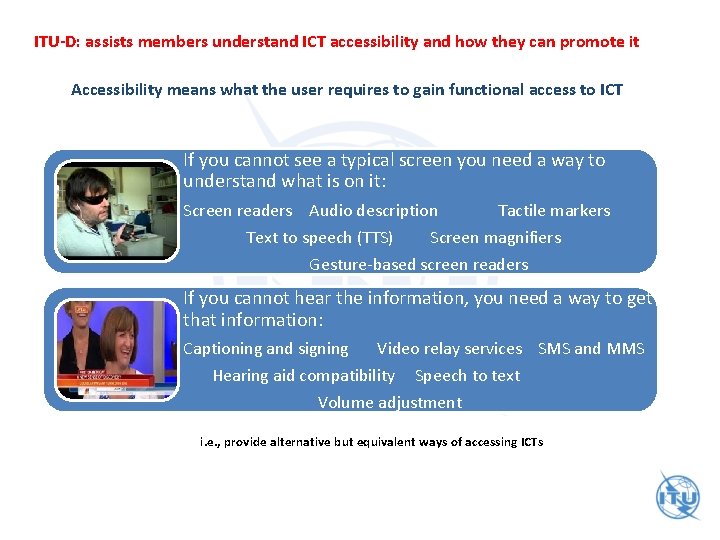
ITU-D: assists members understand ICT accessibility and how they can promote it Accessibility means what the user requires to gain functional access to ICT If you cannot see a typical screen you need a way to understand what is on it: Screen readers Audio description Tactile markers Text to speech (TTS) Screen magnifiers Gesture-based screen readers If you cannot hear the information, you need a way to get that information: Captioning and signing Video relay services SMS and MMS Hearing aid compatibility Speech to text Volume adjustment i. e. , provide alternative but equivalent ways of accessing ICTs
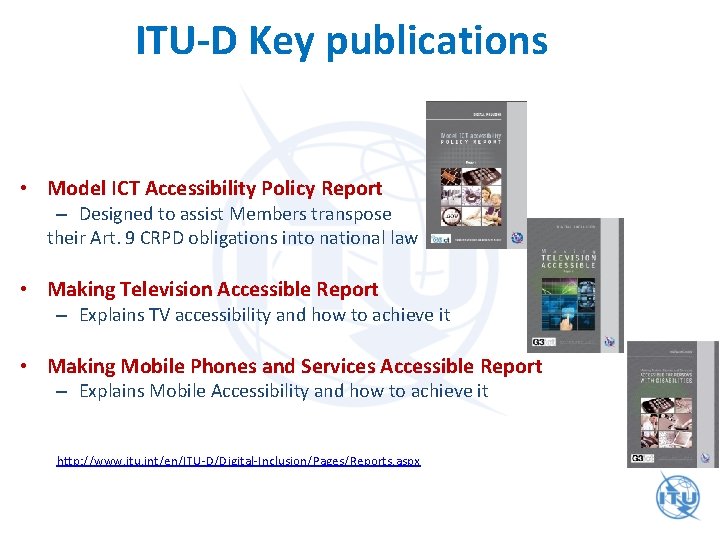
ITU-D Key publications • Model ICT Accessibility Policy Report – Designed to assist Members transpose their Art. 9 CRPD obligations into national law • Making Television Accessible Report – Explains TV accessibility and how to achieve it • Making Mobile Phones and Services Accessible Report – Explains Mobile Accessibility and how to achieve it http: //www. itu. int/en/ITU-D/Digital-Inclusion/Pages/Reports. aspx
Model ICT Accessibility Policy Report: Module 5: WEB ACCESSIBILITY • Identify and create a list of all government websites covered by the policy (to be updated annually) • Conduct a gap analysis to assess the accessibility of existing government websites • Develop a transition plan with milestones and conformance metrics to achieve Level A and Level AA compliance with the WCAG guidelines • includes staff training and updating procurement policies to ensure purchases of website development and services are performed accessibly • guidance on accessibility testing tools and procedures • establishing measurable targets and • monitoring and publishing progress made by government websites • Encourage voluntary compliance by private websites • Explains to policy makers the concrete outcomes the policy is designed to achieve to demystify accessibility: – E. g. website compatibility with screen readers, provision of ALT TXT for images, captions for videos and apps, navigation through use of alternative input devices • Calls for development of the national policy in consultation with persons with disabilities and conducting periodic reviews to address changing technological developments and market conditions • Based on Web Content Accessibility Guidelines (WCAG 2. 0)- (ISO/IEC 40500: 2012 )
BDT Capacity Building & Awareness Raising • ITU Academy course on public procurement of accessible ICTs • ITU Academy course on accessible audio visual media • Arab, CIS and Europe Regional Initiatives on ICT Accessibility – Awareness raising meetings, training and partnerships with key stakeholders • Accessible Americas • ITU-D Study Group Question 7/1 on ICT Accessibility – competition on the best strategies/policies/projects developed by ITU members in area of ICT accessibility – deadline for contributions is due by 19 February • Raise awareness in meetings of Pacific Disability Forum, M-Enabling Summit and UN DESA/UN HABITAT meeting on accessible urban development
- Slides: 32