
The Importance of Gesture in Childrens Spatial Reasoning
- Slides: 1
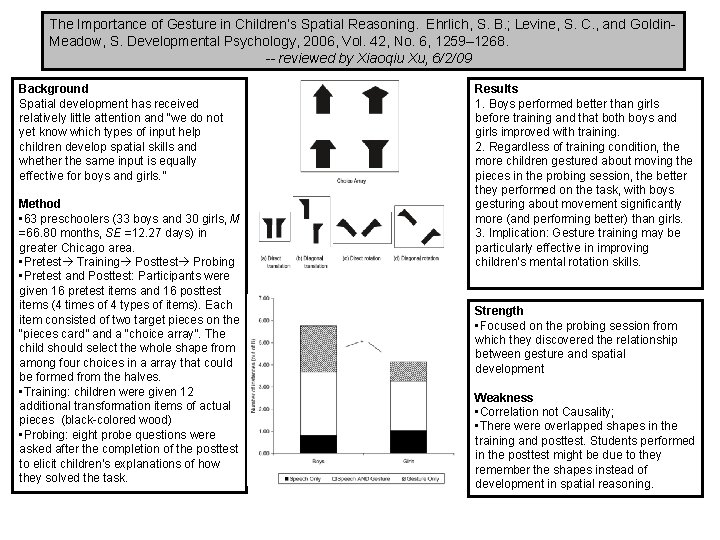
The Importance of Gesture in Children’s Spatial Reasoning. Ehrlich, S. B. ; Levine, S. C. , and Goldin. Meadow, S. Developmental Psychology, 2006, Vol. 42, No. 6, 1259– 1268. -- reviewed by Xiaoqiu Xu, 6/2/09 Background Spatial development has received relatively little attention and “we do not yet know which types of input help children develop spatial skills and whether the same input is equally effective for boys and girls. ” Method • 63 preschoolers (33 boys and 30 girls, M =66. 80 months, SE =12. 27 days) in greater Chicago area. • Pretest Training Posttest Probing • Pretest and Posttest: Participants were given 16 pretest items and 16 posttest items (4 times of 4 types of items). Each item consisted of two target pieces on the “pieces card” and a “choice array”. The child should select the whole shape from among four choices in a array that could be formed from the halves. • Training: children were given 12 additional transformation items of actual pieces (black-colored wood) • Probing: eight probe questions were asked after the completion of the posttest to elicit children’s explanations of how they solved the task. Results 1. Boys performed better than girls before training and that both boys and girls improved with training. 2. Regardless of training condition, the more children gestured about moving the pieces in the probing session, the better they performed on the task, with boys gesturing about movement significantly more (and performing better) than girls. 3. Implication: Gesture training may be particularly effective in improving children’s mental rotation skills. Strength • Focused on the probing session from which they discovered the relationship between gesture and spatial development Weakness • Correlation not Causality; • There were overlapped shapes in the training and posttest. Students performed in the posttest might be due to they remember the shapes instead of development in spatial reasoning.