
The importance of Gerald Croft Starter Recap Act
- Slides: 25
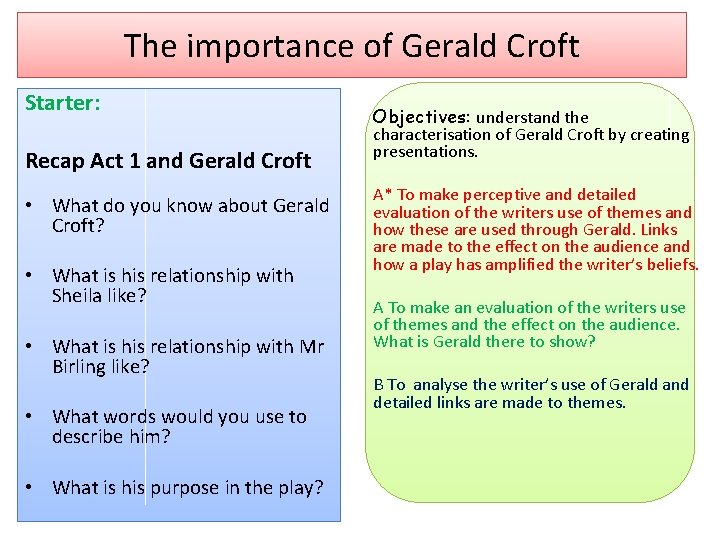
The importance of Gerald Croft Starter: Recap Act 1 and Gerald Croft • What do you know about Gerald Croft? • What is his relationship with Sheila like? • What is his relationship with Mr Birling like? • What words would you use to describe him? • What is his purpose in the play? Objectives: understand the characterisation of Gerald Croft by creating presentations. A* To make perceptive and detailed evaluation of the writers use of themes and how these are used through Gerald. Links are made to the effect on the audience and how a play has amplified the writer’s beliefs. A To make an evaluation of the writers use of themes and the effect on the audience. What is Gerald there to show? B To analyse the writer’s use of Gerald and detailed links are made to themes.
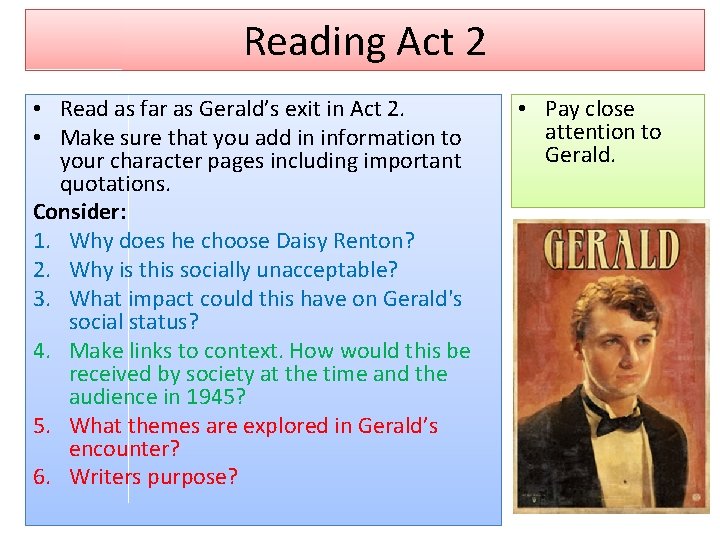
Reading Act 2 • Read as far as Gerald’s exit in Act 2. • Make sure that you add in information to your character pages including important quotations. Consider: 1. Why does he choose Daisy Renton? 2. Why is this socially unacceptable? 3. What impact could this have on Gerald's social status? 4. Make links to context. How would this be received by society at the time and the audience in 1945? 5. What themes are explored in Gerald’s encounter? 6. Writers purpose? • Pay close attention to Gerald.
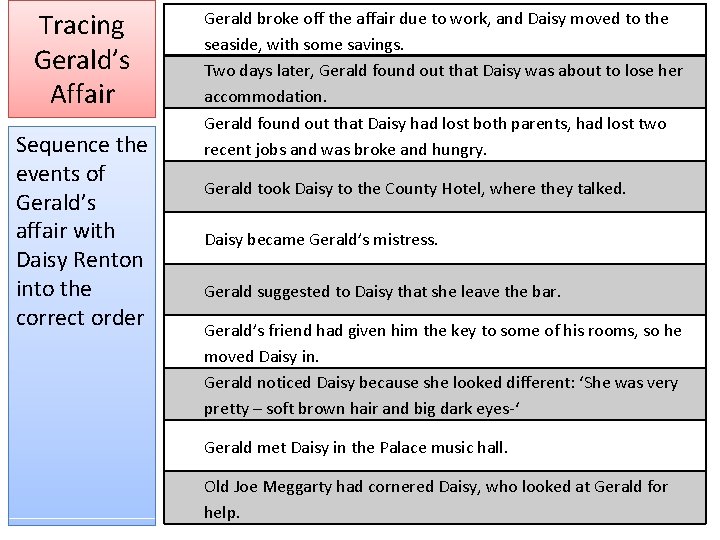
Tracing Gerald’s Affair Sequence the events of Gerald’s affair with Daisy Renton into the correct order Gerald broke off the affair due to work, and Daisy moved to the seaside, with some savings. Two days later, Gerald found out that Daisy was about to lose her accommodation. Gerald found out that Daisy had lost both parents, had lost two recent jobs and was broke and hungry. Gerald took Daisy to the County Hotel, where they talked. Daisy became Gerald’s mistress. Gerald suggested to Daisy that she leave the bar. Gerald’s friend had given him the key to some of his rooms, so he moved Daisy in. Gerald noticed Daisy because she looked different: ‘She was very pretty – soft brown hair and big dark eyes-‘ Gerald met Daisy in the Palace music hall. Old Joe Meggarty had cornered Daisy, who looked at Gerald for help.
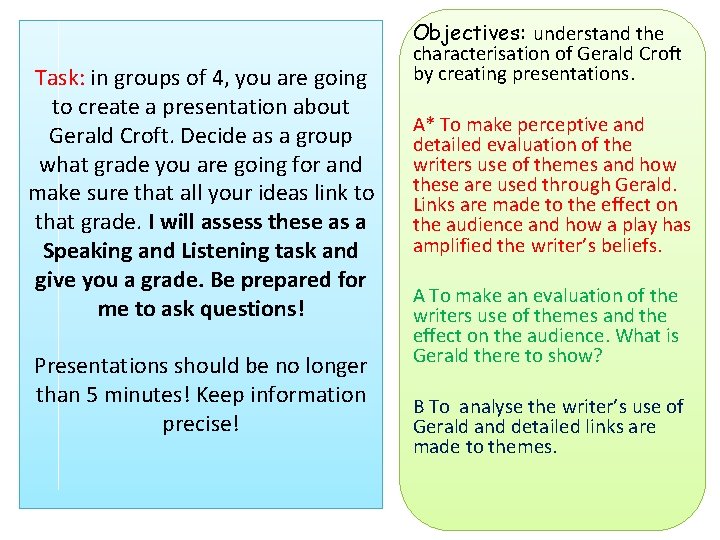
Task: in groups of 4, you are going to create a presentation about Gerald Croft. Decide as a group what grade you are going for and make sure that all your ideas link to that grade. I will assess these as a Speaking and Listening task and give you a grade. Be prepared for me to ask questions! Presentations should be no longer than 5 minutes! Keep information precise! Objectives: understand the characterisation of Gerald Croft by creating presentations. A* To make perceptive and detailed evaluation of the writers use of themes and how these are used through Gerald. Links are made to the effect on the audience and how a play has amplified the writer’s beliefs. A To make an evaluation of the writers use of themes and the effect on the audience. What is Gerald there to show? B To analyse the writer’s use of Gerald and detailed links are made to themes.
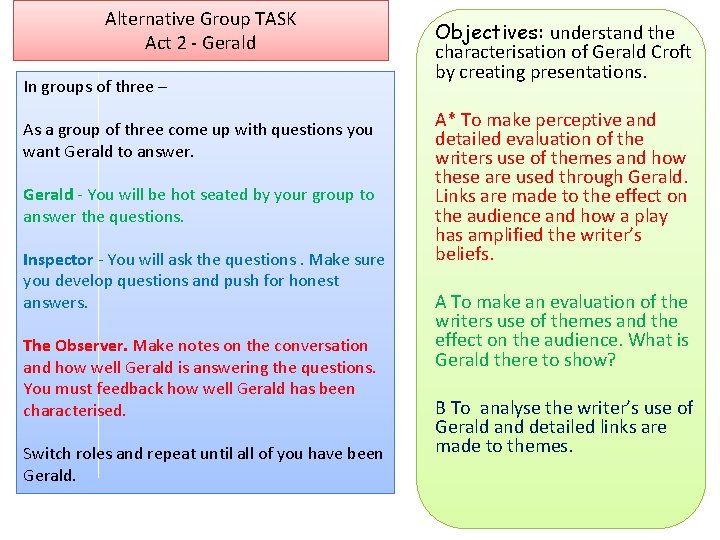
Alternative Group TASK Act 2 - Gerald In groups of three – As a group of three come up with questions you want Gerald to answer. Gerald - You will be hot seated by your group to answer the questions. Inspector - You will ask the questions. Make sure you develop questions and push for honest answers. The Observer. Make notes on the conversation and how well Gerald is answering the questions. You must feedback how well Gerald has been characterised. Switch roles and repeat until all of you have been Gerald. Objectives: understand the characterisation of Gerald Croft by creating presentations. A* To make perceptive and detailed evaluation of the writers use of themes and how these are used through Gerald. Links are made to the effect on the audience and how a play has amplified the writer’s beliefs. A To make an evaluation of the writers use of themes and the effect on the audience. What is Gerald there to show? B To analyse the writer’s use of Gerald and detailed links are made to themes.
Plenary Feedback of presentations. WWW/EBI? GRADE? Objectives: understand the characterisation of Gerald Croft by creating presentations. A* To make perceptive and detailed evaluation of the writers use of themes and how these are used through Gerald. Links are made to the effect on the audience and how a play has amplified the writer’s beliefs. A To make an evaluation of the writers use of themes and the effect on the audience. What is Gerald there to show? B To analyse the writer’s use of Gerald and detailed links are made to themes.
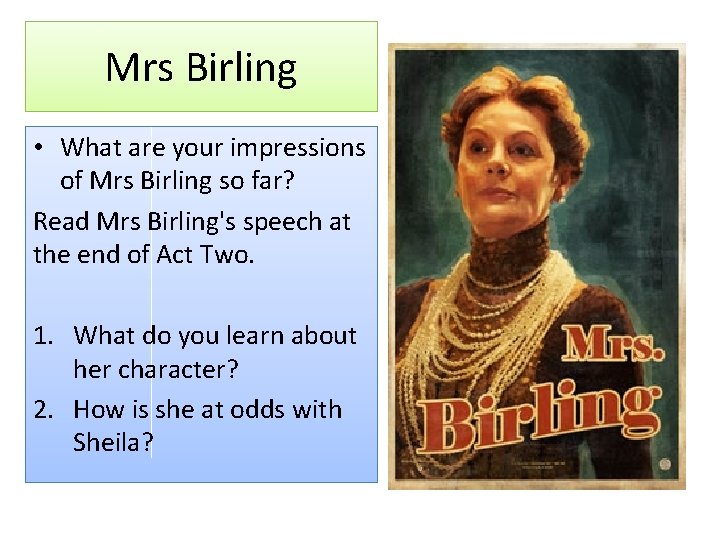
Mrs Birling • What are your impressions of Mrs Birling so far? Read Mrs Birling's speech at the end of Act Two. 1. What do you learn about her character? 2. How is she at odds with Sheila?
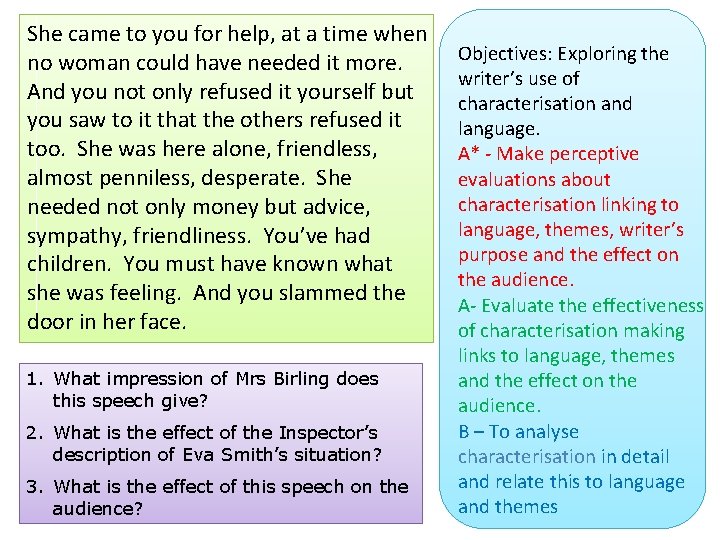
She came to you for help, at a time when no woman could have needed it more. And you not only refused it yourself but you saw to it that the others refused it too. She was here alone, friendless, almost penniless, desperate. She needed not only money but advice, sympathy, friendliness. You’ve had children. You must have known what she was feeling. And you slammed the door in her face. 1. What impression of Mrs Birling does this speech give? 2. What is the effect of the Inspector’s description of Eva Smith’s situation? 3. What is the effect of this speech on the audience? Objectives: Exploring the writer’s use of characterisation and language. A* - Make perceptive evaluations about characterisation linking to language, themes, writer’s purpose and the effect on the audience. A- Evaluate the effectiveness of characterisation making links to language, themes and the effect on the audience. B – To analyse characterisation in detail and relate this to language and themes
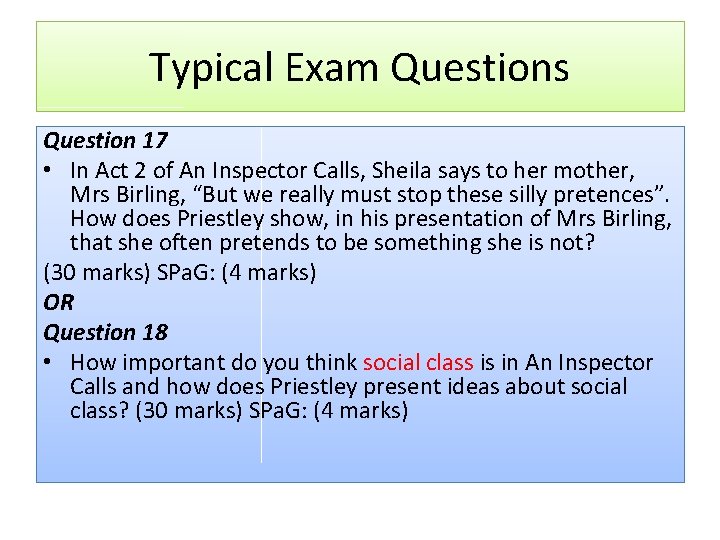
Typical Exam Questions Question 17 • In Act 2 of An Inspector Calls, Sheila says to her mother, Mrs Birling, “But we really must stop these silly pretences”. How does Priestley show, in his presentation of Mrs Birling, that she often pretends to be something she is not? (30 marks) SPa. G: (4 marks) OR Question 18 • How important do you think social class is in An Inspector Calls and how does Priestley present ideas about social class? (30 marks) SPa. G: (4 marks)
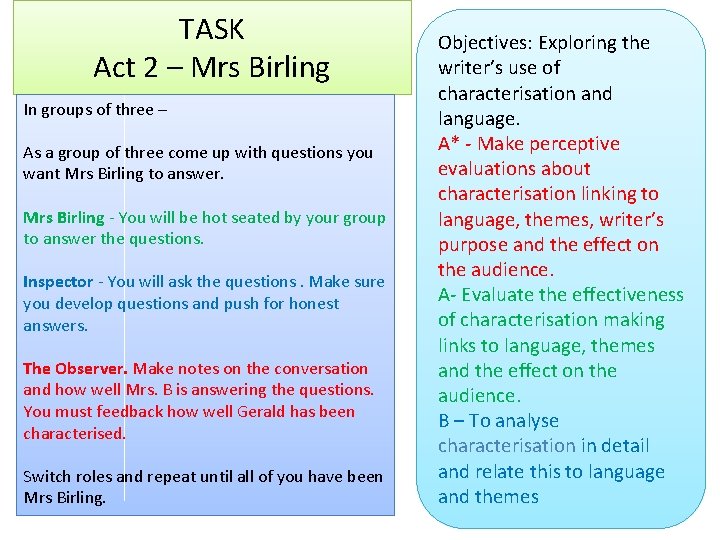
TASK Act 2 – Mrs Birling In groups of three – As a group of three come up with questions you want Mrs Birling to answer. Mrs Birling - You will be hot seated by your group to answer the questions. Inspector - You will ask the questions. Make sure you develop questions and push for honest answers. The Observer. Make notes on the conversation and how well Mrs. B is answering the questions. You must feedback how well Gerald has been characterised. Switch roles and repeat until all of you have been Mrs Birling. Objectives: Exploring the writer’s use of characterisation and language. A* - Make perceptive evaluations about characterisation linking to language, themes, writer’s purpose and the effect on the audience. A- Evaluate the effectiveness of characterisation making links to language, themes and the effect on the audience. B – To analyse characterisation in detail and relate this to language and themes
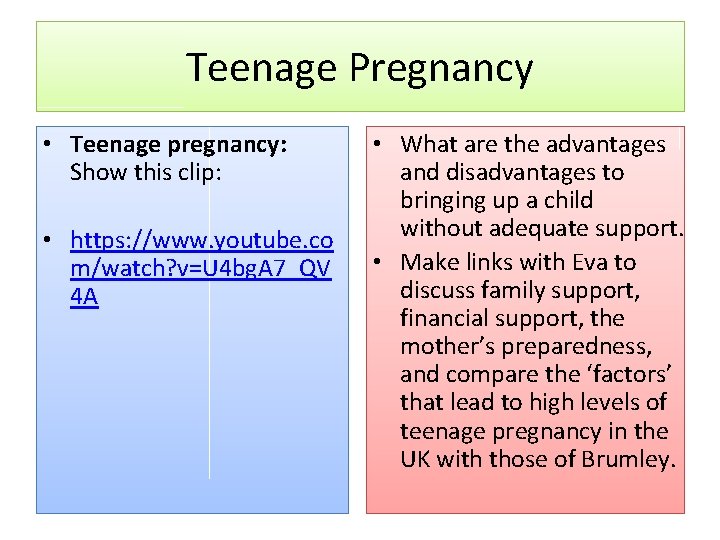
Teenage Pregnancy • Teenage pregnancy: Show this clip: • https: //www. youtube. co m/watch? v=U 4 bg. A 7_QV 4 A • What are the advantages and disadvantages to bringing up a child without adequate support. • Make links with Eva to discuss family support, financial support, the mother’s preparedness, and compare the ‘factors’ that lead to high levels of teenage pregnancy in the UK with those of Brumley.
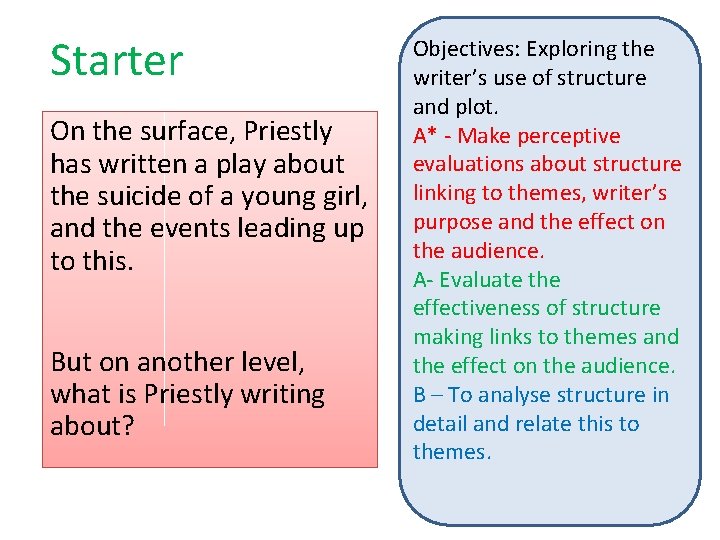
Starter On the surface, Priestly has written a play about the suicide of a young girl, and the events leading up to this. But on another level, what is Priestly writing about? Objectives: Exploring the writer’s use of structure and plot. A* - Make perceptive evaluations about structure linking to themes, writer’s purpose and the effect on the audience. A- Evaluate the effectiveness of structure making links to themes and the effect on the audience. B – To analyse structure in detail and relate this to themes.
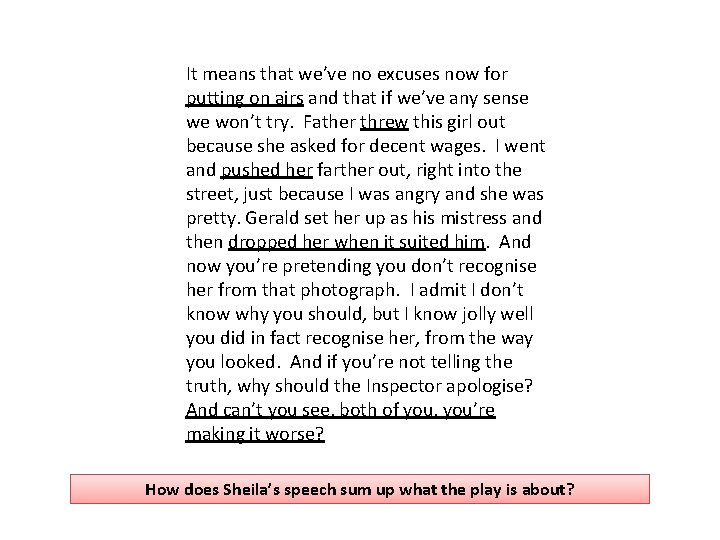
It means that we’ve no excuses now for putting on airs and that if we’ve any sense we won’t try. Father threw this girl out because she asked for decent wages. I went and pushed her farther out, right into the street, just because I was angry and she was pretty. Gerald set her up as his mistress and then dropped her when it suited him. And now you’re pretending you don’t recognise her from that photograph. I admit I don’t know why you should, but I know jolly well you did in fact recognise her, from the way you looked. And if you’re not telling the truth, why should the Inspector apologise? And can’t you see, both of you, you’re making it worse? How does Sheila’s speech sum up what the play is about?
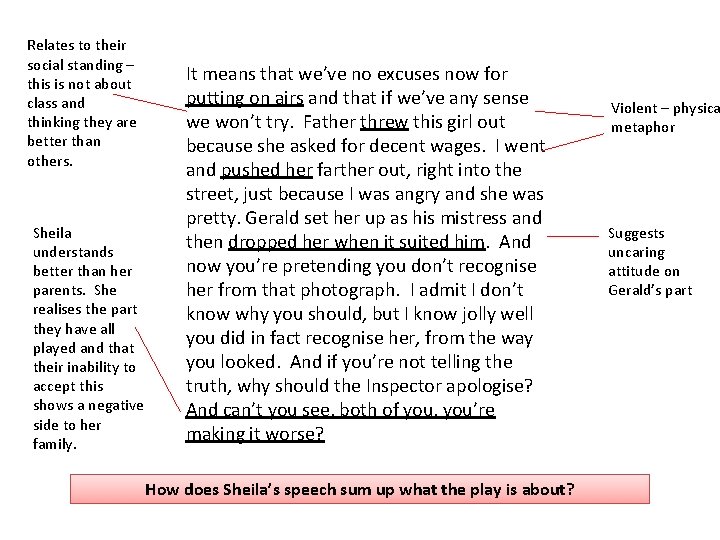
Relates to their social standing – this is not about class and thinking they are better than others. Sheila understands better than her parents. She realises the part they have all played and that their inability to accept this shows a negative side to her family. It means that we’ve no excuses now for putting on airs and that if we’ve any sense we won’t try. Father threw this girl out because she asked for decent wages. I went and pushed her farther out, right into the street, just because I was angry and she was pretty. Gerald set her up as his mistress and then dropped her when it suited him. And now you’re pretending you don’t recognise her from that photograph. I admit I don’t know why you should, but I know jolly well you did in fact recognise her, from the way you looked. And if you’re not telling the truth, why should the Inspector apologise? And can’t you see, both of you, you’re making it worse? How does Sheila’s speech sum up what the play is about? Violent – physica metaphor Suggests uncaring attitude on Gerald’s part
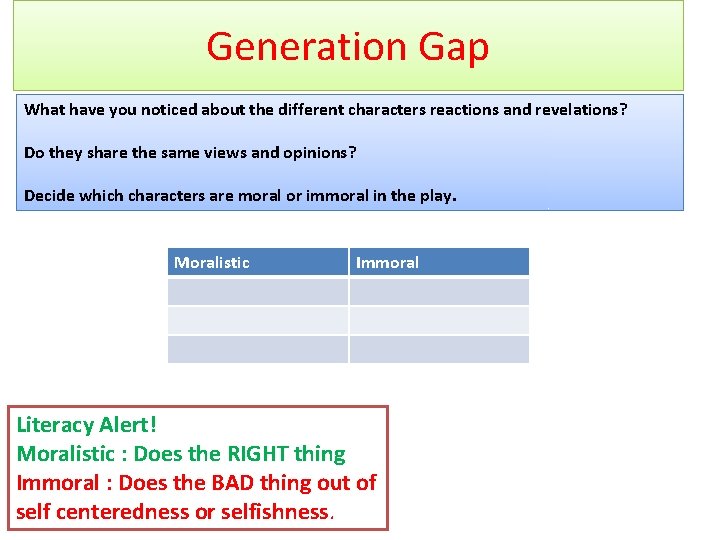
Generation Gap What have you noticed about the different characters reactions and revelations? Do they share the same views and opinions? Decide which characters are moral or immoral in the play. Moralistic Immoral Literacy Alert! Moralistic : Does the RIGHT thing Immoral : Does the BAD thing out of self centeredness or selfishness.
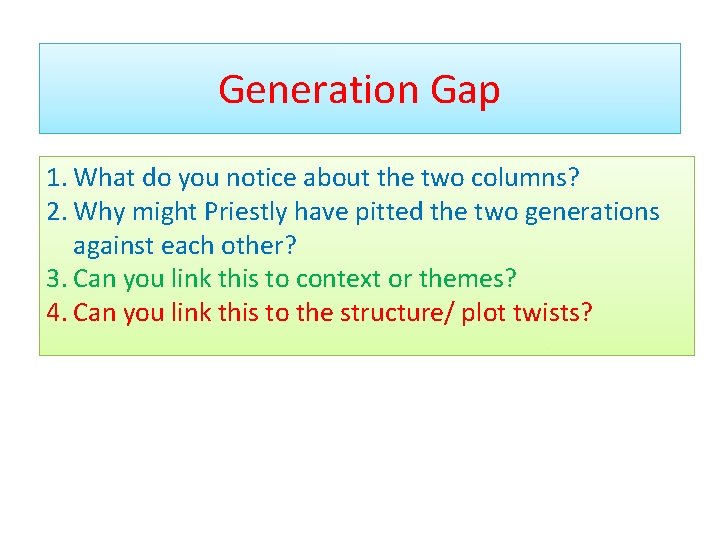
Generation Gap 1. What do you notice about the two columns? 2. Why might Priestly have pitted the two generations against each other? 3. Can you link this to context or themes? 4. Can you link this to the structure/ plot twists?
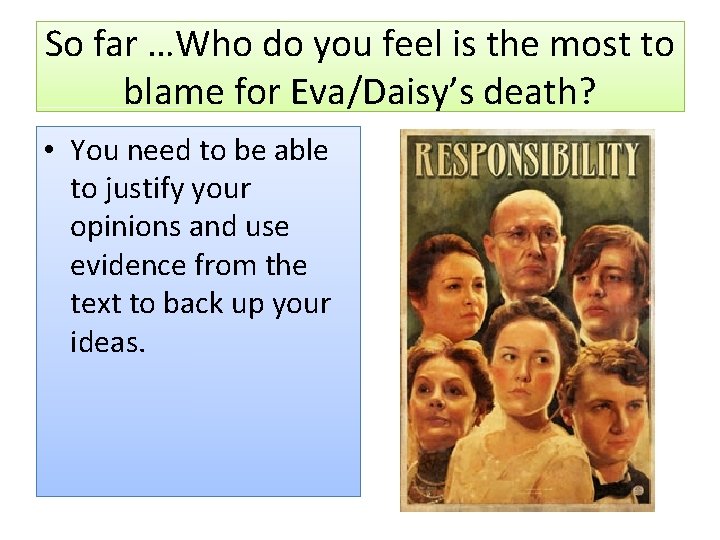
So far …Who do you feel is the most to blame for Eva/Daisy’s death? • You need to be able to justify your opinions and use evidence from the text to back up your ideas.
Plenary • In your opinion, how does the younger generation differ from the older generation in the play? • Give reasons to support your answer. Objectives: Exploring the writer’s use of structure and plot. A* - Make perceptive evaluations about structure linking to themes, writer’s purpose and the effect on the audience. A- Evaluate the effectiveness of structure making links to themes and the effect on the audience. B – To analyse structure in detail and relate this to themes.
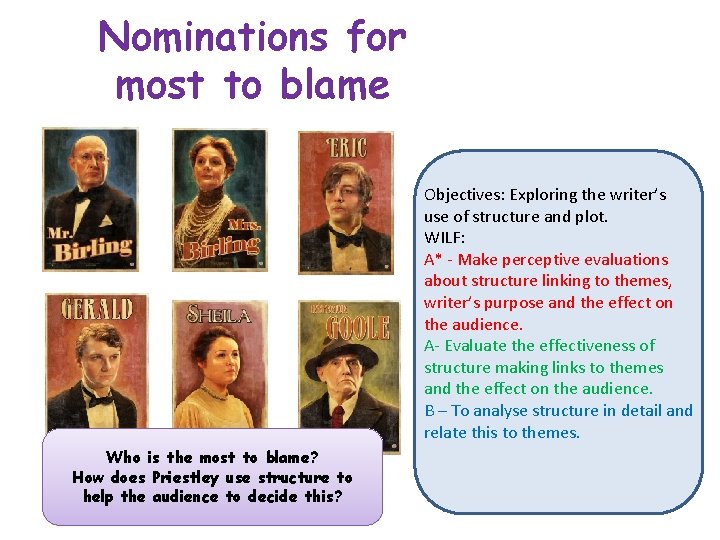
Nominations for most to blame Objectives: Exploring the writer’s use of structure and plot. WILF: A* - Make perceptive evaluations about structure linking to themes, writer’s purpose and the effect on the audience. A- Evaluate the effectiveness of structure making links to themes and the effect on the audience. B – To analyse structure in detail and relate this to themes. Who is the most to blame? How does Priestley use structure to help the audience to decide this?
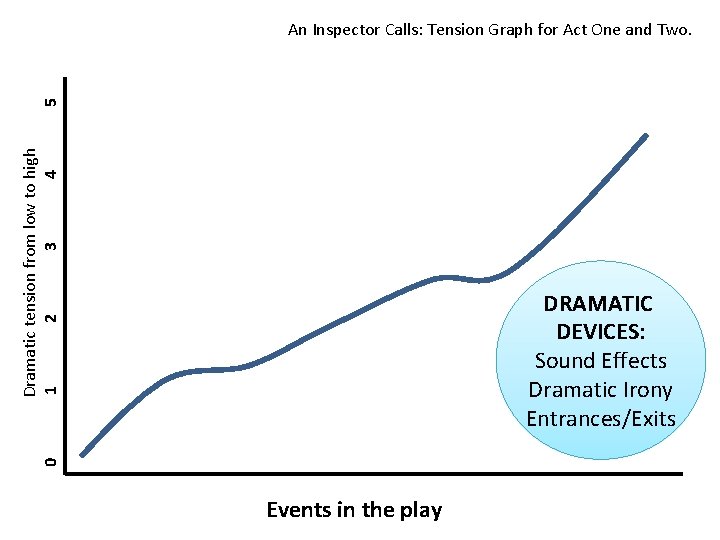
Dramatic tension from low to high 1 2 3 4 5 An Inspector Calls: Tension Graph for Act One and Two. 0 DRAMATIC DEVICES: Sound Effects Dramatic Irony Entrances/Exits Events in the play
0 Dramatic tension from low to high 1 2 3 4 5 An Inspector Calls: Tension Graph for Act One and Two. Events in the play
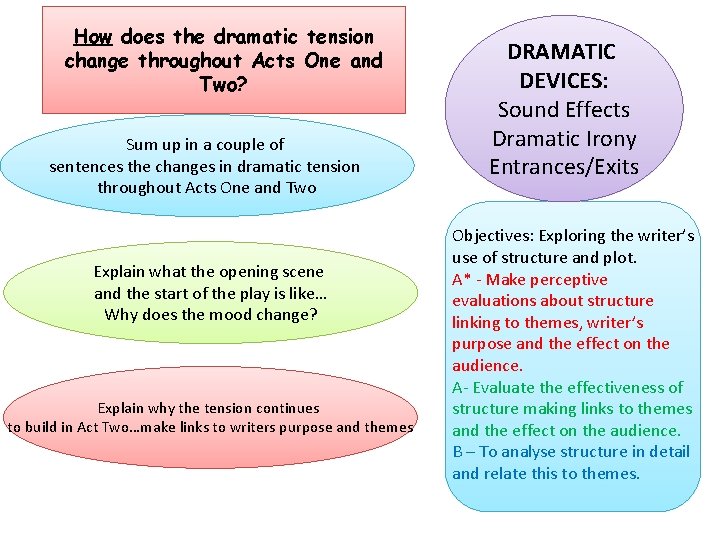
How does the dramatic tension change throughout Acts One and Two? Sum up in a couple of sentences the changes in dramatic tension throughout Acts One and Two Explain what the opening scene and the start of the play is like… Why does the mood change? Explain why the tension continues to build in Act Two…make links to writers purpose and themes DRAMATIC DEVICES: Sound Effects Dramatic Irony Entrances/Exits Objectives: Exploring the writer’s use of structure and plot. A* - Make perceptive evaluations about structure linking to themes, writer’s purpose and the effect on the audience. A- Evaluate the effectiveness of structure making links to themes and the effect on the audience. B – To analyse structure in detail and relate this to themes.
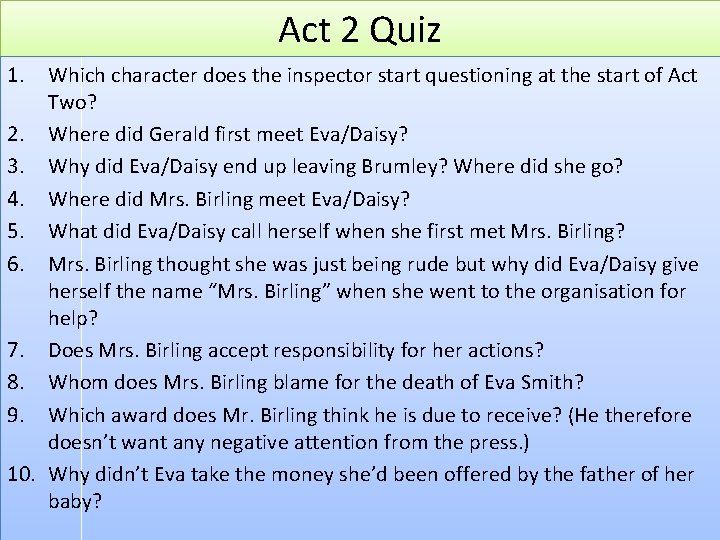
Act 2 Quiz 1. Which character does the inspector start questioning at the start of Act Two? 2. Where did Gerald first meet Eva/Daisy? 3. Why did Eva/Daisy end up leaving Brumley? Where did she go? 4. Where did Mrs. Birling meet Eva/Daisy? 5. What did Eva/Daisy call herself when she first met Mrs. Birling? 6. Mrs. Birling thought she was just being rude but why did Eva/Daisy give herself the name “Mrs. Birling” when she went to the organisation for help? 7. Does Mrs. Birling accept responsibility for her actions? 8. Whom does Mrs. Birling blame for the death of Eva Smith? 9. Which award does Mr. Birling think he is due to receive? (He therefore doesn’t want any negative attention from the press. ) 10. Why didn’t Eva take the money she’d been offered by the father of her baby?
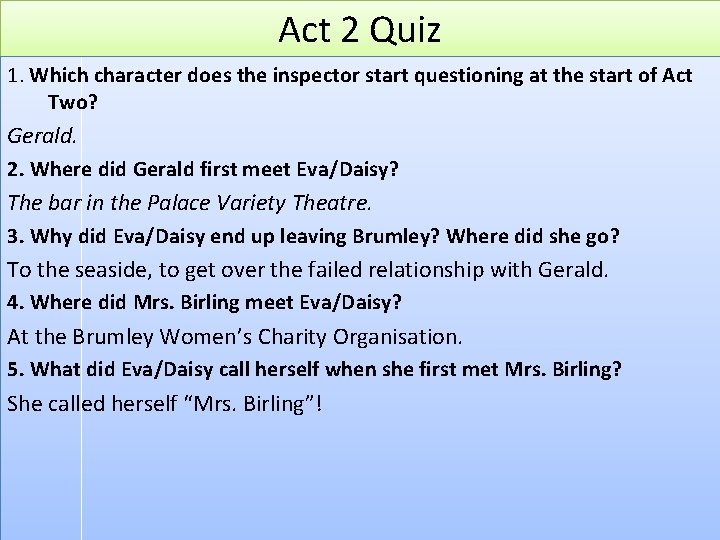
Act 2 Quiz 1. Which character does the inspector start questioning at the start of Act Two? Gerald. 2. Where did Gerald first meet Eva/Daisy? The bar in the Palace Variety Theatre. 3. Why did Eva/Daisy end up leaving Brumley? Where did she go? To the seaside, to get over the failed relationship with Gerald. 4. Where did Mrs. Birling meet Eva/Daisy? At the Brumley Women’s Charity Organisation. 5. What did Eva/Daisy call herself when she first met Mrs. Birling? She called herself “Mrs. Birling”!
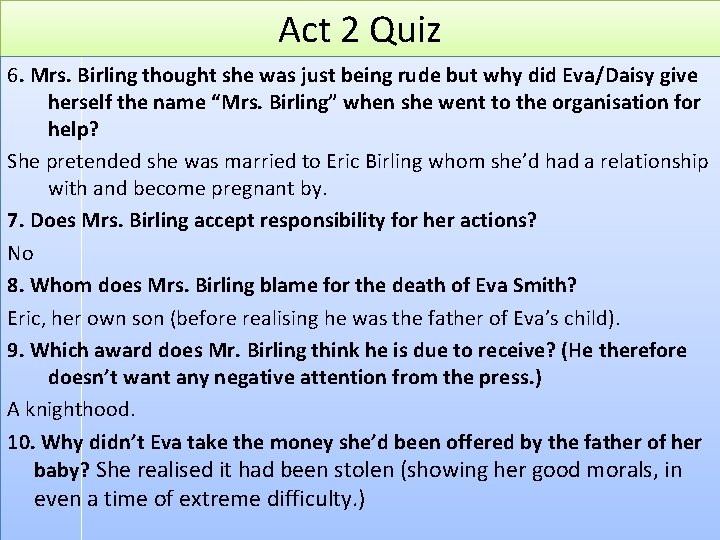
Act 2 Quiz 6. Mrs. Birling thought she was just being rude but why did Eva/Daisy give herself the name “Mrs. Birling” when she went to the organisation for help? She pretended she was married to Eric Birling whom she’d had a relationship with and become pregnant by. 7. Does Mrs. Birling accept responsibility for her actions? No 8. Whom does Mrs. Birling blame for the death of Eva Smith? Eric, her own son (before realising he was the father of Eva’s child). 9. Which award does Mr. Birling think he is due to receive? (He therefore doesn’t want any negative attention from the press. ) A knighthood. 10. Why didn’t Eva take the money she’d been offered by the father of her baby? She realised it had been stolen (showing her good morals, in even a time of extreme difficulty. )